The Cinema of My Dreams – It ended in Sorrento – Episode 51

Questions for Juliet

I called Juliet, then had Cecelia run interference while I left the hotel.  No point in having unwanted guests when I was talking to her.

We met at a café not far from the small hotel where the three women were staying.  I was reminded when I saw her approaching on foot that she was still as attractive as she had been before her troubles, and there could have been something between us if the circumstances were different.

There was no furtiveness about her movements as if she didn’t have a care in the world.  And that, for a woman who had already had one attempt on her life, was odd.  To me, at least.

I waited until she had seen me before I ordered coffee and cake.

When she sat, I waited until she was comfortable, then, with just a small hint of annoyance in my tone, said, “For a person whose life might be in danger, you don’t seem to care.”

“Not if they don’t know where we are.”

“Do you believe that?  The place where the inheritance documents are going to be signed is a fact everyone seems to know.  I was followed here, as far as Pompei, but they will know exactly when I was going.  In fact, I was just speaking with another person who was following me, and I brought her with me.  She was very interested to know you were in Sorrento.”

The look of smugness disappeared.  “Are you mad?”

“Then why should I worry when you said you were here to protect me?”

“That was before I knew what I know now.  Have you got anything to tell me that would be useful to know before the shooting starts?”

There was now fear in place of smugness.  If she didn’t think she was a real target, now she did.  But the question had to be, was she really the daughter of the Count, or someone else?  A photo of her in the gardens of the Count’s residence meant very little.  The fact that the count had told people he had an illegitimate daughter didn’t mean Juliet was that daughter.

People kept telling me she was, but were they trying too hard to push what could be a lie?  It bothered me that I hadn’t spent enough time to find the truth myself.

The coffee and cake arrived.

So had a suspicious man who had so far made three circuits of the block, walking a dog.  If he was surveillance, he was going the extra mile to make himself fit into the landscape.  There were three others walking dogs.

“What could I tell you?”

“Tell me about your mother, Vittoria?”

“I have vague memories of her when I was little, then a few more when I was a teenager, and we went to Italy.  Like any young girl, I was in awe of the surroundings.  Having not seen her for a long time, I was surprised when she turned up on my doorstep.  There was no mention of a fortune in the beginning, and I was happy to see her.”

‘Now you’re not so sure?”

“You’re here, and when you arrive, trouble follows.  Very bad trouble.”

“I didn’t ask Larry to involve you in any business between him and me.  That was on Larry, and not that he’s paid the ultimate price.  I didn’t kill him, by the way, someone else did that.  That’s why I ask.  If Vittoria is another of those strange business partners of yours that had some hold over you, best to tell me now, and I’ll deal with it.”

“Do you think you have a legitimate claim on the Count’s estate?”

“Based on the birth certificate, and what I’m told, yes.”

“Birth certificates can be forged, and people tell lies to further their own ends.  Has your so-called mother asked you to negotiate a deal in which you will forsake any claim on the estate for a princely sum, say a million euros?”

She didn’t have to.  Rule number one in an inheritance scam.  Make it real enough so the real heirs can see competition, and then make a demand that’s not too outrageous that they will settle.  And quickly, before they have time to scrutinise the proof.

A what-if had just come into my head.  Do a deal with the fake Countess, verify her identity, renege on any rights to the estate, and, in turn, when the fake Countess gets the inheritance, get the payout promised.  Win-win-win.  Who better to verify the countess’s identity than her biggest rival?

“If only that were true, Evan.  I’d be rich for the first time in my life.  But we both know that will never happen.  For the record, I’m not interested in the inheritance.  That’s my mother’s issue.  She says she was treated badly, but she got a lot of money from the count for my upkeep.  I don’t want to be in the middle of this, but what choice do I have?”

I shrugged.  She had choices, but kept making bad ones.

“Well, just keep a low profile until I come and get the three of you, and we go to the signing.  You might want to tell the countess that three separate parties are looking for her.”

“Are you not coming to protect us in person.  Or your friend?”

“No.  I don’t want to be killed in the crossfire.  Stay where you are. We are the only five who know exactly where you are.  Don’t tell anyone, and you’ll be safe.”

And if she knew the countess staying with them wasn’t the real countess, she did a very good job of hiding it.

© Charles Heath 2023-2026

The 2am Rant: I should be on holiday but…

You would think that going away for a few days, you would be able to drag yourself away from writing.

You would think, after doing it every day for the last six months, it would be time to take a break. But the trouble with good intentions and being in a different place is that there’s a ton of new and different sights and things to write about.

We are away primarily for a wedding, with part of it being a Chinese Tea Ceremony, and of course, I’ve been reading up on it, and there are several descriptions, making it difficult to get a clear idea of what happens.

I guess I’m going to have to wait until the day, next Friday.

In between, there will be a dinner that will have as the centrepiece, Peking Duck, my absolute favourite duck dish.

I had it last in Hong Kong two years back, before the riots at the restaurant in the Peninsula Hotel, and it was exquisite.

Then it’s my brother’s 70th birthday. As he is working feverishly on the family history, and having jetted off many times overseas tracking down the long lost relatives we knew nothing about, it’ll be time for a progress report.

I must admit that some of those relatives have roused my writer’s curiosity. When I helped clear out my parents’ house after they moved into a retirement home, we found a great deal of ancestral material, the most interesting of which was, would you believe, about my mother.

We have found a whole lot of letters she received from her first boyfriend and then from my father. It shows a side to her I never knew about, and a side to my father that, given what I know of him, is totally out of character.

There will no doubt be more on this subject later.

And finally, but not least, there was a baby announcement, always a subject of much joy and happiness.

This is only day two. There is definitely more to come.

What I learned about writing – Writing comedy

The Mirthful Art of Misunderstanding: Why Comedy Needs More Than Just Punchlines

What makes you laugh? Is it a clever turn of phrase? A perfectly timed pratfall? Or that specific, delicious moment when two realities collide in delightful chaos? For anyone who’s ever tried to craft a joke, a sketch, or an entire sitcom, you know that comedy is far more intricate than simply stringing together funny words. And at its heart, it requires one non-negotiable ingredient: a genuine sense of humour.

The Non-Negotiable: A Sense of Humour

It sounds obvious, doesn’t it? Writing comedy requires a sense of humour. Yet, you’d be surprised how often people try to reverse-engineer “funny” without that innate spark. You can learn comedic timing, structure, and even how to write a killer punchline, but if you don’t possess a fundamental understanding of what makes things absurd, ironic, or just plain ridiculous, your efforts will often fall flat.

A sense of humour isn’t just about telling jokes; it’s a way of seeing the world. It’s the ability to spot the unexpected juxtaposition, the human foibles, the inherent absurdity in everyday life. Without this lens, writing comedy becomes a technical exercise rather than an act of genuine creation. It’s like trying to be a chef without taste buds – you can follow the recipe, but you’ll never truly understand balance or flavour. So, if you’re venturing into comedy writing and find yourself consistently baffled by what causes laughter, that might be your first clue.

The Ingenious Engine: Creating the Misunderstanding

Once you have that internal funny bone, the next step is understanding comedy’s most powerful, enduring engine: the misunderstanding. This is the basic premise upon which so much successful comedy is built. It’s not about malice or cruelty, but about a delightful divergence of perception or information.

Think about it:

  • Mistaken Identity: Character A thinks Character B is someone else entirely.
  • Misinterpreted Intentions: Character C says something innocent, but Character D hears it in the worst possible way.
  • Conflicting Knowledge: The audience knows something the characters don’t, leading to dramatic (and comedic) irony.
  • Literal vs. Figurative: One character takes an idiom or figure of speech literally, while the other means it figuratively.

The brilliance of the misunderstanding lies in the tension it creates. We, the audience, are often in on the secret (or we quickly piece it together), and we squirm with anticipation as the characters dig themselves deeper into their respective holes. We see the train wreck coming, not with dread, but with a giddy excitement, knowing that the inevitable collision will be hilarious. The humour isn’t just in the individual lines; it’s in the gap between what is perceived and what is real.

The Satisfying Release: Clearing It Up

But the tension isn’t meant to last forever. The true comedic genius of the misunderstanding formula comes in the resolution. At the end, everything is cleared up. The mistaken identity is revealed, the intentions are clarified, and the truth comes out.

Why is this so satisfying?

  • Relief: After the build-up of tension and absurdity, the release of understanding is a physical and emotional relief, often expressed through laughter.
  • The “Aha!” Moment: We see how all the threads connect, how the initial false premise led to all the hilarious subsequent events. It’s a puzzle solved, and often, the simple truth is funnier than the elaborate mistaken reality.
  • Catharsis: The characters (often) learn a lesson, or at least come to terms with the absurdity of what just transpired. And crucially, everyone is happy – not necessarily every character in the story (some might be embarrassed!), but the audience is left feeling satisfied, amused, and with a sense of completion. The world, briefly thrown into comical disarray, has been righted.

The Dance of Art and Instinct

So, for aspiring comedy writers, remember this dual approach. Cultivate that innate sense of humour – watch people, observe irony, find the funny in the everyday. But then, layer it with the powerful, proven structure of the misunderstanding. Build that tension, escalate the ridiculousness, and then, with a flourish, clear it all up, letting your audience bask in the delightful “aha!” of laughter.

Because ultimately, comedy isn’t just about telling jokes. It’s about taking us on a journey from confusion to clarity, from tension to release, and leaving us with that wonderful, unifying feeling of joy. And that, my friends, is no laughing matter. (Except, of course, when it is.)

365 Days of writing, 2026 – 136/137

Days 136 and 137 – Writing Exercise

The first thing I could hear when consciousness returned was the swooshing sound.  It was an odd sound that lingered, causing puzzlement momentarily.

Until recognition kicked on.  A roof fan, turning slowly, regurgitates air that holds the aroma of mould.

The odd sensation, if it could be called that, was that silence wasn’t silent.  There were noises everywhere on the edge of my consciousness.

The fan was simply the loudest.

Noises that my mind, as it finally started working again, tried to identify because that will to survive had kicked in.

It needed to know where I was, why I was there, how long I had been there, and what had happened in the period just before.

Except my mind at that moment could only deal with one thing at a time.

The fact that I was alive.

It was dark, but when was darkness really darkness?  It wasn’t.  There was always some ambient light somewhere.  A crack, a hole, even a covered window could never stop even the tiniest of rays from getting through.

There was one, at the top, where the black paint had not been applied properly.  I focused on it, watched it get bigger, and then converted what was inky blackness into a lesser shade of black.

I was in a room.

I closed my eyes then opened them again.

There was something else.

Yes, on the periphery of my vision.  A blinking red dot.  I shifted my head slightly and saw it, perhaps the corner of the room, blink, blink, blink.

Steady.  Slow.  As if sending a message.  Of course, we are watching you.

Question: Who is the ‘we’?

Location established.

Not in imminent danger.

Breathe.

I was lying down on a reasonably soft surface, and carefully testing fingers, one arm then the other, one leg then the other.

No restraints.  No pain when moving any part.

Move head, no pain, so my incapacitation was not a result of being hit or shot.

Only possibility: drugged.

So…

Where was I before this happened?

It took a moment to process the memories, isolate the details.  I received an address, a house I had been to before several times, with a special code.

An urgent request for help.

At the last interview, I had been instructed to give the target a burner phone with one number, mine, and a code that would be routed to me with the location.

I went to the location, gained access to the building, and found the target sitting in a room bound to a chair.

Then nothing.

They, whoever they were, had been waiting for me.

That meant only one possibility:  the target was in on the ambush.

Here’s the thing.

If I were to do a threat assessment, based on one being low and ten being high, it was, at the moment, a three.

I was not bound, not gagged, not hurt.

Why?

Whoever was holding me in this room wanted me for something.

The lack of restraints told me they did not expect me to retaliate, which meant they had leverage, and they would speak to me before initiating anything.

Alternatively, running through possibilities, they could use this room as a means of conditioning, alternating hot and cold, intense lighting, flashing lights, loud and soft sounds, darkness, sleep deprivation, all so I would lose track of time.

Leading to interrogation, sometimes with violence.

Been there and done that.

They could know why I was there, they might not know the whole story, or they might want something else altogether.  I was a harbinger of secrets.  A prize target. 

For someone who wanted revenge for past deeds…

Or maybe I was just being sidelined while certain people got away.  It would set us back, and I would miss the deadline.

The room was suddenly bathed in light.  Not bright but enough to make everything distinctly clear.  After my eyes adjusted.

It was just an ordinary room, pale green walls, carpet with water stains on one side, a window painted black. A bed and nothing else.

The bedspread had seen better days.

The sheets and pillowcase matched.

It was not a hotel room.

“Mr Ryker.”  The voice was female, youngish, not angry, but not gloating.

The sound came from the roof, near the flashing red light.  The speaker was watching me.

“I’m going to open the door.  There is no point trying to escape.  If you do try, you will be shot.  I just want to ask some questions.”

Routine or otherwise?  While attached to electric wires, I could be shocked if I didn’t give a suitable answer.

“Go ahead,” I said, whether they believed I would stay put or not.

I sat on the side of the bed after considering my options for escape.  It was possible, but it was also suicidal.  It was a better option to see who my captor was, then reassess.

After a minute, the lock clicked, and the door opened.  I could see a guard, armed, ten feet back from the other side of the door.  Just outside a woman, nothing special to define her, in dress, in features, in language.

She looked, for all intents and purposes, like a schoolteacher or librarian.  That might have been a defining feature.  A tigress dressed up to look like a kitten.

“Mr Ryker, at last we meet.  You are a very elusive man.”

“Not that elusive, apparently.”  I gave my best impression of a defeated protagonist.

She smiled.  “Don’t despair.  You only made one mistake.  You cared.”

I shrugged.  There was a difference between caring and following orders, but I wasn’t going to explain the difference. 

What I wanted to know was how they knew about the call, or worse still, the location of the target that was used to draw me into their web.

“Come.  Walk with me.”

“Isn’t that risky.  I’m sure you know what I’m capable of?”

“You’re not going to risk Deborah’s life, are you?”

Was there a simple answer to that question?  If we could not keep her safe, there was only one other option. It was one I was not very happy about.

“In normal circumstances, Mr Ryker, I would agree with you.  But you stepped over that invisible line, didn’t you?”

I closed my eyes and took a few seconds to think about how different this might be if I had not taken that one step.  It was just one kiss, but it had a profound effect on me.

Against everything I had been taught.

One moment undid years of training and work ethic, loyalty to the job, and ignoring the distractions.

A shrug, then I stood and faced her.

“My boss always said, in this line of work, everyone has a use-by date.”

“That’s a bit harsh.  You make it sound like he thinks you are all sacrificial lambs.”

“Aren’t we?”

“Doesn’t have to be so.”  She took several steps back, leaving space for me to pass, and the guard would not lose direct line of sight.

I joined her.

There was a hint of lavender in the air.

I’d never seen her before, and of all the players from the briefing, and there were about a dozen, she was not one of them.

So much for thorough research.

“You’re wondering who I am, aren’t you?”

“Not just another pretty face, I imagine.”

“You think I have a pretty face?  I assure you, back when I was a teenager, I was the proverbial ugly duckling.”

High school, peer groups, the in girls making life hell for the ugly ducklings.  Revenge could be a bitch, and I wondered how many of her contemporaries were wishing they’d never met her.

“Not any more.”

It was a long passage with doors with numbers on them.  A dormitory, perhaps.  An old school.

At the end of the passage a large ornate staircase, with two sets of stairs to the level below, one on the left-hand side, and one on the right.

The wall opposite the balcony had windows, some glass, smeared with years of detritus, the centre Staines glass with a depiction of Christ of the cross and angels swirling.

Below looked dusty and littered with furniture that had been, if I were to guess, tossed by disaffected students or inmates.

Odd, no one had tried to hurl a desk or chair through the window.

It was impossible to see outside.

“What is this place?”

“A monument to the rich and powerful who strived hard to keep most of the population in poverty.”

“And when the revolution came, you simply traded one set of greedy bastards for another.  The people basically traded poverty for death.”

There was a flash of anger in her eyes.  “You think you’re better than us?”

“I think if you were to go back to your village and see how the people are, they would be no better off than they were a hundred and fifty years ago.  If I were to go back home to my village, we would be no better off than we were a hundred years ago.  The world revolves around the one per cent who own everything and the five per cent that run everything.  I’m sure you want for nothing, which makes this a hollow argument about ideology.”

What looked like someone counting to ten before exploding, she sucked in a deep breath and exhaled slowly.

“We will beg to differ.”

“Think what you like.  You’re totally wrong, and if your people taught you anything, it’s not to debate with the enemy.”

The smile returned, the first in her eyes remained.

Was I going to be the challenge she might be looking for? 

Several volleys of machine gun fire broke the tension, and her eyes betrayed her thoughts.

“What the…”

A single shot dropped the guard with the gun, and out of the shadows, one of Barrymore’s agents appeared.  Jocelyn or Josephine, I couldn’t remember her name.

Another two heavily armoured agents came up the stairs, guns pointed at my mysterious friend.

I saw Jocelyn put a hand to her ear and listen. The reply, “Clean up, move out.”

The two agents bound the girl and took her away.  She had not recovered from the shock.  I was still a little surprised myself.

“It works,” Jocelyn said.

She was referring to the device that had been implanted in me before the operation.  They needed a crash test dummy.  I volunteered.

If it hadn’t worked, it was quite literally a suicide mission.

“Is she anyone of consequence?”  I was referring to my captor.

“Just one of a dozen brainwashed agents he thinks can contribute to a better world.  It’s like a cult, with a maniacal leader and a bunch of acolytes.  Pity really.”  She slapped me on the shoulder. “Good work.  We got another assignment for you.  Not quite as easy as this one was.”

Crash test dummy or suicidal maniac? 

All in a day’s work.

©  Charles Heath  2026

Searching for locations: Vancouver, Canada – 2

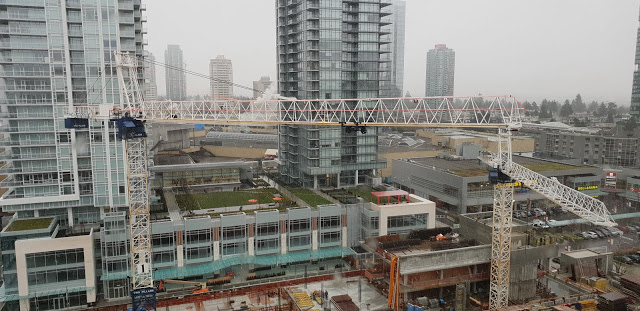
This morning we wake up to rain.  Or so we thought.  Taking a closer look out the window of our room on the 16th floor, we notice the rain is speckled with snowflakes.  As the morning progressed, the snow got harder until there were flurries.

 Later we discover this is called wet snow by the local Vancouverians, and whilst they winge a lot over the endless rain, to them rain is infinitely better than snow.

To us, by the afternoon, it was almost blizzard conditions, with lots of snow.  Then the only thing is that it does not accumulate on most of the ground so there are no drifts to play in.

Because the weather is so dismal, we decided not to go into Vancouver to do some sightseeing because the clouds were down to the ground, and then the snow set in.

Another interesting fact is that construction workers do not go off the job if it’s raining, or worse, when it is snowing.  Our room overlooks a new apartment complex under construction, and the workers battled on through what seemed like appalling conditions.

At four in the afternoon, the Maple Leafs are playing the Ohio Blue Jackets in Ohio.  It is a game we expect them to win.  Sparks is the goalkeeper, not Anderson; they’re playing back-to-back games, and Anderson’s starting tomorrow.

They win, four goals to two.  

Just before darkness falls, about four thirty, the snow stops, and there is a little rain, which melts the snow.

Time to go up to the executive lounge to get some snacks and coffee, then sleep because the next day we’re taking on the Trans Canada highway from Vancouver to Kamloops.

The forecast is for snow, more snow, and just for a change, more snow.

In a word: Park

We mostly understand that a park is an area set aside for recreation, and can have trees, flowers, a lake, and vast lawns.  These parks are also sometimes called ‘gardens’.

A great example of a park is Central Park in New York.

Nearly every city has a park of some sort; some have more than one.

But the word park has several other uses.  For instance,

You can park a car, or bike, or yourself; in other words, it’s a place where you stop for a while.  For cars, it is a carpark.

You could say ‘it’s just a walk in the park’, which means that the job is going to be easy.  I never understood that analogy because quite a lot of parks have difficult walks, and not so much ‘a walk in the park’.

It is also used to describe a place where animals are kept, other than calling it a zoo; it can go by the name of a wildlife park.  Zoos, though, are more for cities.  Wildlife parks can be quite huge, and many are found in Africa.

A park can also be used to describe a sporting arena or field.

You can park a bag in a locker.

You can park an idea in the back of your mind and come back to it later, or if you are like me, it disappears into the ether.

It can be an area of land around a manor house, but there are very few of those left now.  The most notable of these are in England and were designed by a man called Capability Brown.

Another excerpt from ‘Betrayal’; a work in progress

My next destination in the quest was the hotel we believed Anne Merriweather had stayed at.

I was, in a sense, flying blind because we had no concrete evidence she had been there, and the message she had left behind didn’t quite name the hotel or where Vladimir was going to take her.

Mindful of the fact that someone might have been following me, I checked to see if the person I’d assumed had followed me to Elizabeth’s apartment was still in place, but I couldn’t see him. Next, I made a mental note of seven different candidates and committed them to memory.

Then I set off to the hotel, hailing a taxi. There was the possibility that the cab driver was one of them, but perhaps I was slightly more paranoid than I should be. I’d been watching the queue, and there were two others before me.

The journey took about an hour, during which time I kept an eye out the back to see if anyone had been following us. If anyone was, I couldn’t see them.

I had the cab drop me off a block from the hotel and then spent the next hour doing a complete circuit of the block the hotel was on, checking the front and rear entrances, the cameras in place, and the siting of the driveway into the underground carpark. There was a camera over the entrance, and one we hadn’t checked for footage. I sent a text message to Fritz to look into it.

The hotel lobby was large and busy, which was exactly what you’d want if you wanted to come and go without standing out. It would be different later at night, but I could see her arriving about mid-afternoon, and anonymous among the clientele the hotel attracted.

I spent an hour sitting in various positions in the lobby simply observing. I had already ascertained where the elevator lobby for the rooms was, and the elevator down to the car park. Fortunately, it was not ‘guarded’, but there was a steady stream of concierge staff coming and going to the lower levels, and, just from time to time, guests.

Then, when there was a commotion at the front door, what seemed to be a collision of guests and free-wheeling bags, I saw one of the seven potential taggers sitting by the front door. Waiting for me to leave? Or were they wondering why I was spending so much time there?

Taking advantage of that confusion, I picked my moment to head for the elevators that went down to the car park, pressed the down button, and waited.

There was no car on the ground level, so I had to wait, watching, like several others, the guests untangling themselves at the entrance, and keeping an eye on my potential surveillance, still absorbed in the confusion.

The doors to the left car opened, and a concierge stepped out, gave me a quick look, then headed back to his desk. I stepped into the car, pressed the first level down, the level I expected cars to arrive on, and waited what seemed like a long time for the doors to close.

As they did, I was expecting to see a hand poke through the gap, a latecomer. Nothing happened, and I put it down to a television moment.

There were three basement levels, and for a moment, I let my imagination run wild and considered the possibility that there were more levels. Of course, there was no indication on the control panel that there were any other floors, and I’d yet to see anything like it in reality.

With a shake of my head to return to reality, the car arrived, the doors opened, and I stepped out.

A car pulled up, and the driver stepped out, went around to the rear of his car, and pulled out a case. I half expected him to throw me the keys, but the instant glance he gave me told him he was not the concierge, and instead he brushed past me like I wasn’t there.

He bashed the up button several times impatiently and cursed when the doors didn’t open immediately. Not a happy man.

Another car drove past on its way down to a lower level.

I looked up and saw the CCTV camera, pointing towards the entrance, visible in the distance. A gate that lifted up was just about back in position, then clunked when it finally closed. The footage from the camera would not prove much, even if it had been working, because it didn’t cover the lift lobby, only what was in the direction of the car entrance.

The doors to the other elevator car opened, and a man in a suit stepped out.

“Can I help you, sir? You seem lost.”

Security, or something else. “It seems that way. I went to the elevator lobby, got in, and it went down rather than up. I must have been in the wrong place.”

“Lost it is, then, sir.” I could hear the contempt for Americans in his tone. “If you will accompany me, please.”

He put out a hand ready to guide me back into the elevator. I was only too happy to oblige him. There had been a sign near the button panel that said the basement levels were only to be accessed by the guests.

Once inside, he turned a key and pressed the lobby button. The doors closed, and we went up. He stood, facing the door, not speaking. A few seconds later, he was ushering me out to the lobby.

“Now, sir, if you are a guest…”

“Actually, I’m looking for one. She called me and said she would be staying in this hotel and to come down and visit her. I was trying to get to the sixth floor.”

“Good. Let’s go over to the desk and see what we can do for you.”

I followed him over to the reception desk, where he signalled one of the clerks, a young woman who looked and acted very efficiently, and told her of my request, but then remained to oversee the proceeding.

“Name of guest, sir?”

“Merriweather, Anne. I’m her brother, Alexander.” I reached into my coat pocket and pulled out my passport to prove that I was who I said I was. She glanced cursorily at it.

She typed the name into the computer, and then we waited a few seconds while it considered what to output. Then, she said, “That lady is not in the hotel, sir.”

Time to put on my best-confused look. “But she said she would be staying here for the week. I made a special trip to come here to see her.”

Another puzzled look from the clerk, then, “When did she call you?”

An interesting question to ask, and it set off a warning bell in my head. I couldn’t say today, it would have to be the day she was supposedly taken.

“Last Saturday, about four in the afternoon.”

Another look at the screen, then, “It appears she checked out Sunday morning. I’m afraid you have made a trip in vain.”

Indeed, I had. “Was she staying with anyone?”

I just managed to see the warning pass from the suited man to the clerk. I thought he had shown an interest when I mentioned the name, and now I had confirmation. He knew something about her disappearance. The trouble was, he wasn’t going to volunteer any information because he was more than just hotel security.

“No.”

“Odd,” I muttered. “I thought she told me she was staying with a man named Vladimir something or other. I’m not too good at pronouncing those Russian names. Are you sure?”

She didn’t look back at the screen. “Yes.”

“OK, now one thing I do know about staying in hotels is that you are required to ask guests with foreign passports their next destination, just in case they need to be found. Did she say where she was going next?” It was a long shot, but I thought I’d ask.

“Moscow. As I understand it, she lives in Moscow. That was the only address she gave us.”

I smiled. “Thank you. I know where that is. I probably should have gone there first.”

She didn’t answer; she didn’t have to, her expression did that perfectly.

The suited man spoke again, looking at the clerk. “Thank you.” He swivelled back to me. “I’m sorry we can’t help you.”

“No. You have more than you can know.”

“What was your name again, sir, just in case you still cannot find her?”

“Alexander Merriweather. Her brother. And if she is still missing, I will be posting a very large reward. At the moment, you can best contact me via the American Embassy.”

Money is always a great motivator, and that thoughtful expression on his face suggested he gave a moment’s thought to it.

I left him with that offer and left. If anything, the people who were holding her would know she had a brother, that her brother was looking for her, and equally that brother had money.

© Charles Heath – 2018-2025

Searching for locations:  Vancouver, Canada – 1

It’s raining.  There should be no surprise there.  And cold.  It’s late December and well into winter.

Perhaps not as cold as it could be, somewhere between three and four degrees.

We are staying at the Hilton Metrotown in Burnaby.  Metrotown is also the largest shopping mall in British Columbia.  I agree that it is large and found it to be a great way to get some exercise after being in and out of planes for the previous 24 hours.

The first discovery for the day was a trolley bus, something that I thought didn’t exist anymore. 

The second was to discover so many global brands, but how different the products are from what we can get back in Australia.  This is particularly true for cars, where we find that GM-based vehicles and Mazdas are far better than what is available to us.

The third was to discover that it seems we are almost in the heart of Chinatown, where going out an exit on the second floor takes you to a Chinese food court, with all manner of food types, and, it seems, tea bars.  It also explained why, in one supermarket we went to, signs were in both Chinese and English.

Being still tired from the travel, we don’t venture further than the mall, where we have lunch, for me, the Canadian version of KFC, which seems to defeat the purpose of trying local food.  It seems most of the food that I can see in the food shops does not seem that appetising.

Later, we go out and find a Boston Pizza with a sports bar where we indulge in a 21-ounce Molten on tap, and a lime mojito, while watching the ice hockey on the big screen and the surrounding small screens.  Ice hockey is in some world junior championships (but mostly northern hemisphere hockey-playing nations) and seems as ferocious as the NHL.

But it does raise a question: why isn’t there a female NHL?  I guess this wasn’t the time to canvass opinions in the bar.

Something else we discovered is that alcohol is relatively cheap, and get a case of Molten Canadian ale, Bacardi Black label, and maple-flavoured whiskey for about a third of what it would cost at home.  Of course, it must be cheaper than firewood in keeping Canadians warm in the dead of winter.

We didn’t try the pizza, which kind of defeated the purpose of going there.

Meanwhile, back in the room, we find the local ice hockey channel, and then, to make sure we get to see the Maple Leafs, plug in the computer so that we can test it.  Good to go.  

That’s tomorrow, tonight we’re watching the Vancouver Canucks.

“Sunday in New York”, a romantic adventure that’s not a walk in the park!

“Sunday in New York” is ultimately a story about trust, and what happens when a marriage is stretched to its limits.

When Harry Steele attends a lunch with his manager, Barclay, to discuss a promotion that any junior executive would accept in a heartbeat, it is the fact that his wife, Alison, who previously professed her reservations about Barclay, also agreed to attend that casts a small element of doubt in his mind.

From that moment, his life, in the company, in deciding what to do, his marriage, his very life, spirals out of control.

There is no one big factor that can prove Harry’s worst fears, that his marriage is over, just several small, interconnecting events, when piled on top of each other, point to a cataclysmic end to everything he had believed in.

Trust is lost firstly in his best friend and mentor, Andy, who only hints at impending disaster, Sasha, a woman whom he saved, and who appears to have motives of her own, and then in his wife, Alison, as he discovers piece by piece, damning evidence that she is about to leave him for another man.

Can we trust what we see with our eyes or trust what we hear?

Haven’t we all jumped to conclusions at least once in our lives?

Can Alison, a woman whose self-belief and confidence are about to be put to the ultimate test, find a way of proving their relationship is as strong as it has ever been?

As they say in the classics, read on!

Purchase:

http://tinyurl.com/Amazon-SundayInNewYork

365 Days of writing, 2026 – 136/137

Days 136 and 137 – Writing Exercise

The first thing I could hear when consciousness returned was the swooshing sound.  It was an odd sound that lingered, causing puzzlement momentarily.

Until recognition kicked on.  A roof fan, turning slowly, regurgitates air that holds the aroma of mould.

The odd sensation, if it could be called that, was that silence wasn’t silent.  There were noises everywhere on the edge of my consciousness.

The fan was simply the loudest.

Noises that my mind, as it finally started working again, tried to identify because that will to survive had kicked in.

It needed to know where I was, why I was there, how long I had been there, and what had happened in the period just before.

Except my mind at that moment could only deal with one thing at a time.

The fact that I was alive.

It was dark, but when was darkness really darkness?  It wasn’t.  There was always some ambient light somewhere.  A crack, a hole, even a covered window could never stop even the tiniest of rays from getting through.

There was one, at the top, where the black paint had not been applied properly.  I focused on it, watched it get bigger, and then converted what was inky blackness into a lesser shade of black.

I was in a room.

I closed my eyes then opened them again.

There was something else.

Yes, on the periphery of my vision.  A blinking red dot.  I shifted my head slightly and saw it, perhaps the corner of the room, blink, blink, blink.

Steady.  Slow.  As if sending a message.  Of course, we are watching you.

Question: Who is the ‘we’?

Location established.

Not in imminent danger.

Breathe.

I was lying down on a reasonably soft surface, and carefully testing fingers, one arm then the other, one leg then the other.

No restraints.  No pain when moving any part.

Move head, no pain, so my incapacitation was not a result of being hit or shot.

Only possibility: drugged.

So…

Where was I before this happened?

It took a moment to process the memories, isolate the details.  I received an address, a house I had been to before several times, with a special code.

An urgent request for help.

At the last interview, I had been instructed to give the target a burner phone with one number, mine, and a code that would be routed to me with the location.

I went to the location, gained access to the building, and found the target sitting in a room bound to a chair.

Then nothing.

They, whoever they were, had been waiting for me.

That meant only one possibility:  the target was in on the ambush.

Here’s the thing.

If I were to do a threat assessment, based on one being low and ten being high, it was, at the moment, a three.

I was not bound, not gagged, not hurt.

Why?

Whoever was holding me in this room wanted me for something.

The lack of restraints told me they did not expect me to retaliate, which meant they had leverage, and they would speak to me before initiating anything.

Alternatively, running through possibilities, they could use this room as a means of conditioning, alternating hot and cold, intense lighting, flashing lights, loud and soft sounds, darkness, sleep deprivation, all so I would lose track of time.

Leading to interrogation, sometimes with violence.

Been there and done that.

They could know why I was there, they might not know the whole story, or they might want something else altogether.  I was a harbinger of secrets.  A prize target. 

For someone who wanted revenge for past deeds…

Or maybe I was just being sidelined while certain people got away.  It would set us back, and I would miss the deadline.

The room was suddenly bathed in light.  Not bright but enough to make everything distinctly clear.  After my eyes adjusted.

It was just an ordinary room, pale green walls, carpet with water stains on one side, a window painted black. A bed and nothing else.

The bedspread had seen better days.

The sheets and pillowcase matched.

It was not a hotel room.

“Mr Ryker.”  The voice was female, youngish, not angry, but not gloating.

The sound came from the roof, near the flashing red light.  The speaker was watching me.

“I’m going to open the door.  There is no point trying to escape.  If you do try, you will be shot.  I just want to ask some questions.”

Routine or otherwise?  While attached to electric wires, I could be shocked if I didn’t give a suitable answer.

“Go ahead,” I said, whether they believed I would stay put or not.

I sat on the side of the bed after considering my options for escape.  It was possible, but it was also suicidal.  It was a better option to see who my captor was, then reassess.

After a minute, the lock clicked, and the door opened.  I could see a guard, armed, ten feet back from the other side of the door.  Just outside a woman, nothing special to define her, in dress, in features, in language.

She looked, for all intents and purposes, like a schoolteacher or librarian.  That might have been a defining feature.  A tigress dressed up to look like a kitten.

“Mr Ryker, at last we meet.  You are a very elusive man.”

“Not that elusive, apparently.”  I gave my best impression of a defeated protagonist.

She smiled.  “Don’t despair.  You only made one mistake.  You cared.”

I shrugged.  There was a difference between caring and following orders, but I wasn’t going to explain the difference. 

What I wanted to know was how they knew about the call, or worse still, the location of the target that was used to draw me into their web.

“Come.  Walk with me.”

“Isn’t that risky.  I’m sure you know what I’m capable of?”

“You’re not going to risk Deborah’s life, are you?”

Was there a simple answer to that question?  If we could not keep her safe, there was only one other option. It was one I was not very happy about.

“In normal circumstances, Mr Ryker, I would agree with you.  But you stepped over that invisible line, didn’t you?”

I closed my eyes and took a few seconds to think about how different this might be if I had not taken that one step.  It was just one kiss, but it had a profound effect on me.

Against everything I had been taught.

One moment undid years of training and work ethic, loyalty to the job, and ignoring the distractions.

A shrug, then I stood and faced her.

“My boss always said, in this line of work, everyone has a use-by date.”

“That’s a bit harsh.  You make it sound like he thinks you are all sacrificial lambs.”

“Aren’t we?”

“Doesn’t have to be so.”  She took several steps back, leaving space for me to pass, and the guard would not lose direct line of sight.

I joined her.

There was a hint of lavender in the air.

I’d never seen her before, and of all the players from the briefing, and there were about a dozen, she was not one of them.

So much for thorough research.

“You’re wondering who I am, aren’t you?”

“Not just another pretty face, I imagine.”

“You think I have a pretty face?  I assure you, back when I was a teenager, I was the proverbial ugly duckling.”

High school, peer groups, the in girls making life hell for the ugly ducklings.  Revenge could be a bitch, and I wondered how many of her contemporaries were wishing they’d never met her.

“Not any more.”

It was a long passage with doors with numbers on them.  A dormitory, perhaps.  An old school.

At the end of the passage a large ornate staircase, with two sets of stairs to the level below, one on the left-hand side, and one on the right.

The wall opposite the balcony had windows, some glass, smeared with years of detritus, the centre Staines glass with a depiction of Christ of the cross and angels swirling.

Below looked dusty and littered with furniture that had been, if I were to guess, tossed by disaffected students or inmates.

Odd, no one had tried to hurl a desk or chair through the window.

It was impossible to see outside.

“What is this place?”

“A monument to the rich and powerful who strived hard to keep most of the population in poverty.”

“And when the revolution came, you simply traded one set of greedy bastards for another.  The people basically traded poverty for death.”

There was a flash of anger in her eyes.  “You think you’re better than us?”

“I think if you were to go back to your village and see how the people are, they would be no better off than they were a hundred and fifty years ago.  If I were to go back home to my village, we would be no better off than we were a hundred years ago.  The world revolves around the one per cent who own everything and the five per cent that run everything.  I’m sure you want for nothing, which makes this a hollow argument about ideology.”

What looked like someone counting to ten before exploding, she sucked in a deep breath and exhaled slowly.

“We will beg to differ.”

“Think what you like.  You’re totally wrong, and if your people taught you anything, it’s not to debate with the enemy.”

The smile returned, the first in her eyes remained.

Was I going to be the challenge she might be looking for? 

Several volleys of machine gun fire broke the tension, and her eyes betrayed her thoughts.

“What the…”

A single shot dropped the guard with the gun, and out of the shadows, one of Barrymore’s agents appeared.  Jocelyn or Josephine, I couldn’t remember her name.

Another two heavily armoured agents came up the stairs, guns pointed at my mysterious friend.

I saw Jocelyn put a hand to her ear and listen. The reply, “Clean up, move out.”

The two agents bound the girl and took her away.  She had not recovered from the shock.  I was still a little surprised myself.

“It works,” Jocelyn said.

She was referring to the device that had been implanted in me before the operation.  They needed a crash test dummy.  I volunteered.

If it hadn’t worked, it was quite literally a suicide mission.

“Is she anyone of consequence?”  I was referring to my captor.

“Just one of a dozen brainwashed agents he thinks can contribute to a better world.  It’s like a cult, with a maniacal leader and a bunch of acolytes.  Pity really.”  She slapped me on the shoulder. “Good work.  We got another assignment for you.  Not quite as easy as this one was.”

Crash test dummy or suicidal maniac? 

All in a day’s work.

©  Charles Heath  2026