The Writer’s Dilemma: Why the Money-Paying Tale Often Takes Centre Stage (and What It Means for Your Craft)
Every writer knows this internal monologue. It’s late, the house is quiet, and the cursor blinks expectantly. Before you, on one screen, is the outline for that sprawling, genre-bending novel that called you to writing in the first place – your magnum opus, your heart project. On another tab, emails from a client remind you of the looming deadline for that article on “The Top 10 Uses for Biodegradable Sponges” or that ghostwritten piece on “Modern Pet Grooming Techniques.”
And if you’re like many authors, the biodegradable sponges often win.
It’s a source of quiet guilt for some, a pragmatic acceptance for others, but the question remains: Why is it often postulated that it’s better to work on the money-paying tales, rather than the serious writing that sparked your passion, or that beloved pet project? Let’s peel back the layers of this very real writer’s dilemma.
1. The Unsexy Truth: Bills Don’t Pay Themselves
This is, overwhelmingly, the primary driver. Writing, for most, isn’t a guaranteed goldmine, especially when you’re starting out or delving into niche literary fiction. While the dream is to live off your art, the reality is that rent, groceries, internet bills, and – let’s be honest – that ever-growing coffee habit, require immediate, tangible income.
Money-paying tales – be it freelance articles, copywriting gigs, ghostwriting assignments, or even genre fiction with a reliable market – offer a more predictable cash flow. They keep the lights on, the laptop charged, and food on the table. Without this foundational stability, the mental and emotional space required for deeply serious, often financially unrewarding, creative work becomes almost impossible to cultivate.
2. Sharpening the Axe: Professionalism and Practice
Think of money-paying projects not as a distraction, but as a different kind of training. Even if the subject matter isn’t your passion, these gigs offer invaluable professional development:
Meeting Deadlines: A crucial skill for any published author, even in the literary world.
Adhering to Briefs/Guidelines: Learning to work within constraints hones your precision and adaptability.
Understanding Your Audience: Every paying gig requires you to write for a specific reader, which is a transferable skill for any type of writing.
Honing Craft: Whether it’s crafting compelling sentences, structuring arguments, or developing clear prose, every word you write is practice. Even “mundane” writing can teach you about flow, conciseness, and impact.
Building a Reputation: Delivering quality work consistently, even on commercial projects, establishes you as a reliable and professional writer. This professional goodwill can open doors later.
Sometimes, the very act of writing anything takes the pressure off. Your “serious” work can feel monumental, intimidating. A paying gig, while perhaps less creatively fulfilling, can be a welcome change of pace, a chance to simply put words on a page without the intense emotional investment.
3. Building the Foundation (and the Platform)
For many, the “money tales” are a strategic investment in their larger writing career.
Financial Runway: Earning money now means you might save up enough to take dedicated time off later to really immerse yourself in your passion project without immediate financial pressure.
Publishing Credits: Even if it’s not the type of writing you ultimately want to be famous for, any published work builds a portfolio. It shows you’re a working writer, capable of producing content.
Networking: Commercial projects often connect you with editors, publishers, and other industry professionals. These connections can be invaluable when you eventually pitch your more serious work.
Market Intelligence: Working on commercially viable projects gives you a direct line to understanding what sells, what the market demands, and how publishing houses operate. This insight, while not dictating your art, can be useful for strategising the release of your passion project.
4. The Creative Tug-of-War: Balancing Act, Not Betrayal
It’s natural to feel a pang of guilt or a sense of creative betrayal when you prioritise a paying gig over your deep-seated artistic ambitions. However, many authors view this not as an either/or, but as a strategic balancing act.
Allocate Time: Dedicate specific hours or days to your passion project, even if it’s just 30 minutes a day. Consistency is key.
Refuel Your Muse: Sometimes, the “light” work of a commercial gig can be less creatively draining than wrestling with your masterpiece, leaving you with more energy for your passion project when you do turn to it.
Remember Your “Why”: Keep a tangible reminder of your larger goal – a sticky note, a vision board, a printed outline. This helps combat the feeling of drift.
In essence, for many, working on money-paying tales isn’t a surrender of artistic integrity, but a practical, often necessary, step on the path to sustaining a writing life. It’s about building a solid foundation, sharpening the tools of the trade, and sometimes, simply ensuring you have the time and resources to eventually tell the stories that truly matter most to your heart.
It’s a marathon, not a sprint, and sometimes the best way to keep running is to earn a little cash along the way.
What’s your take on this writer’s dilemma? How do you balance the demands of paying work with your passion projects? Share your strategies and insights in the comments below!
The Blank Page Blues: Understanding the Real Effects of Writer’s Block (And How to Beat It)
Every writer, whether they are penning a Pulitzer-winning novel, a corporate newsletter, or a simple blog post, has been there. You sit down, open your laptop, crack your knuckles, and… nothing. The cursor blinks at you, rhythmically mocking your lack of progress.
Writer’s block is the universal enemy of creativity. But what actually happens when we hit that wall, and how can we climb over it? Let’s break down the mechanics of the “block” and, more importantly, how to get your momentum back.
The Hidden Effects: More Than Just “Stuck”
We often think of writer’s block as a simple pause in production. However, the effects are usually deeper and more taxing than just an empty page.
1. The Erosion of Confidence The longer you stare at a blank screen, the more your inner critic takes the wheel. You start to doubt your premise, your vocabulary, and eventually, your aptitude as a writer. This “imposter syndrome” can linger long after the initial block has passed.
2. The “Avoidance Cycle” When writing becomes associated with the frustration of being stuck, you naturally start to avoid it. You find “productive” distractions—doing the dishes, organising your email, or doom-scrolling—which only increases the anxiety you feel when you finally do return to the desk.
3. Creative Atrophy Writing is a muscle. When you stop writing for extended periods, the “creative flow”—that effortless state of articulation—becomes harder to tap into. The longer the blockage persists, the more you have to fight your own brain to regain that rhythm.
How to Break the Cycle
The good news? Writer’s block is not a permanent state; it’s a temporary neurological bottleneck. Here is how to unclog it:
1. Lower the Stakes
Often, we get blocked because we are trying to write something “perfect” on the first pass. Give yourself permission to write “garbage.” Write the worst draft imaginable. Once the words are on the page, you can edit them. You can’t edit a blank page, but you can always fix a bad paragraph.
2. The “Pomodoro” Trick
If the task feels gargantuan, break it down. Set a timer for 15 minutes. Tell yourself you only have to write for that long. Often, the hardest part of writing is the starting—once the gears are turning, continuing becomes much easier.
3. Change Your Environment
If your brain associates your desk with anxiety, move to a coffee shop, a library, or even your kitchen table. Sometimes a change of scenery, ambient noise, or a different chair is enough to signal to your brain that it’s time for a new mode of thinking.
4. Switch Mediums
If the laptop screen feels stifling, go analog. Grab a legal pad and a pen. The physical act of handwriting taps into different creative pathways in the brain and removes the temptation to delete, backspace, and over-edit as you go.
5. Use Prompts to Prime the Pump
If you don’t know where to start, stop trying to write the “masterpiece” and just write five sentences about anything. Describe the room you’re in. Describe your breakfast. Once you break the silence of the page, the transition to your actual project will be much smoother.
The Bottom Line
Writer’s block isn’t a sign that you’ve lost your talent; it’s a sign that your brain needs a different strategy. Don’t try to force your way through it with sheer willpower alone. Sometimes, the best way to move forward is to step back, change the environment, and lower your expectations until the words begin to flow again.
Remember: You are a writer because you write, not because you never get stuck.
So, close this tab, take a breath, and write one sentence. Just one. That’s how the block ends.
This morning started with a visit to the car rental place in Vancouver. It reinforced the notion that you can be given the address and still not find the place. It happened in Washington where it was hiding in the back of the main railway station, and it happened again in Vancouver when it was hidden inside a hotel.
We simply walked straight past it. Pity there wasn’t a sign to let people know.
However…
We went in expecting a Grand Jeep Cherokee and walked out with a Ford Flex, suitable for three people and four large suitcases. It actually seats 7, but forget the baggage, you’d be lucky to get two large suitcases in that configuration.
It is more than adequate for our requirements.
Things to note, it was delivered with just over a quarter of a tank of gas, and it had only done about 11,000 km, so it’s relatively new. It’s reasonably spacious, and when the extra seats are folded down, there is plenty of baggage space.
So far, so good.
We finally leave the hotel at about half-past ten, and it is raining. It is a simple task to get on Highway 1, the TransCanada Highway, initially, and then onto Highway 5, the Coquihalla Highway for the trip to Kamloops.
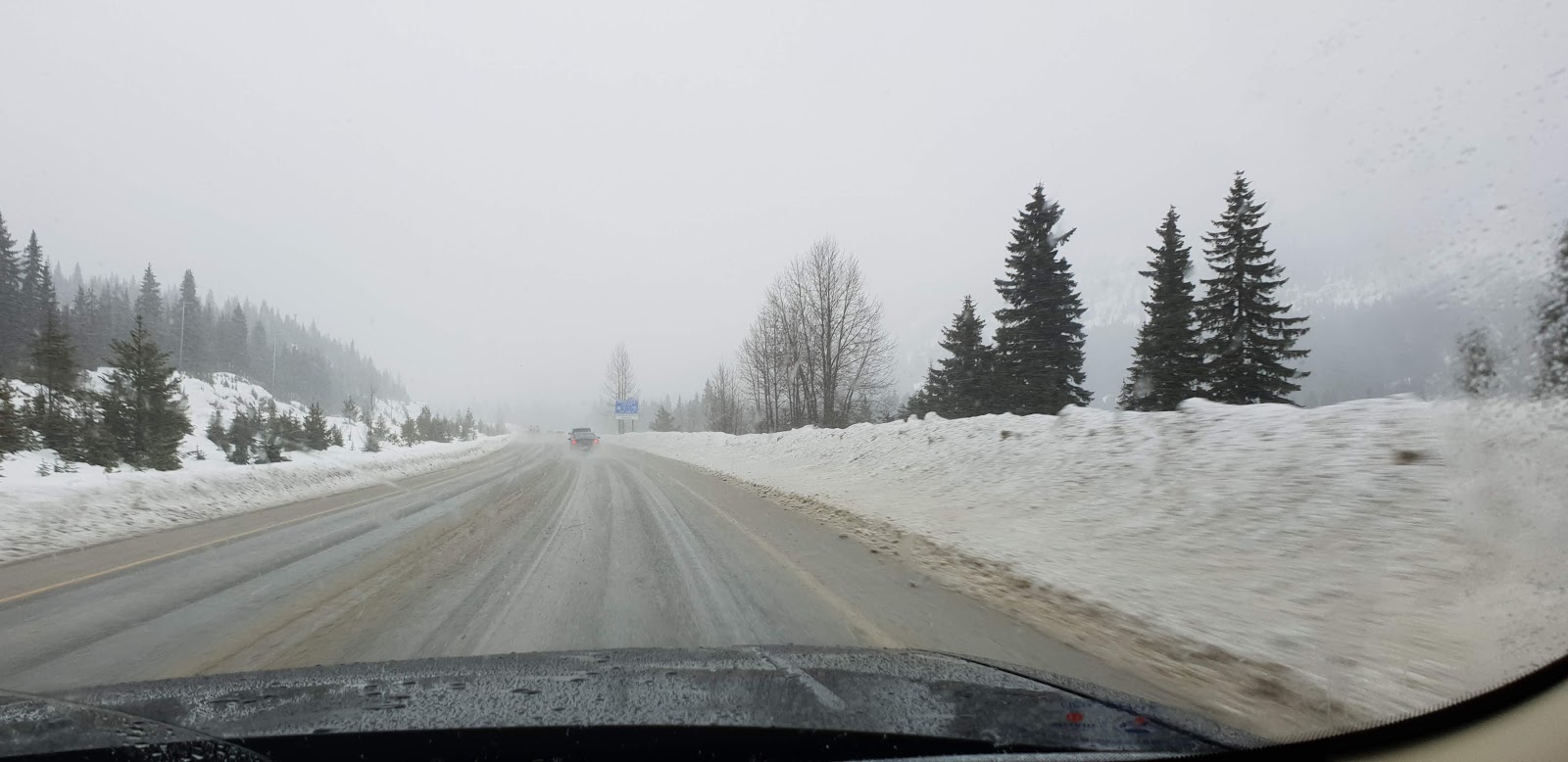
It rains all the way to the top of the mountain, progress hampered from time to time by water sprays from both vehicles and trucks. The rain is relentless. At the top of the mountain, the rain turns into snow and the road surface to slush. It’s 0 degrees, but being the afternoon, I was not expecting it to turn to ice very quickly.
On the other side of the mountain, closer to Kamloops, there was sleet, then rain, then nothing, the last 100kms or so, in reasonably dry conditions.
Outside Kamloops, and in the town itself, there was evidence of snow recently cleared, and slushy roads. Cars in various places were covered in snow, indicating the most recent falls had been the night before.
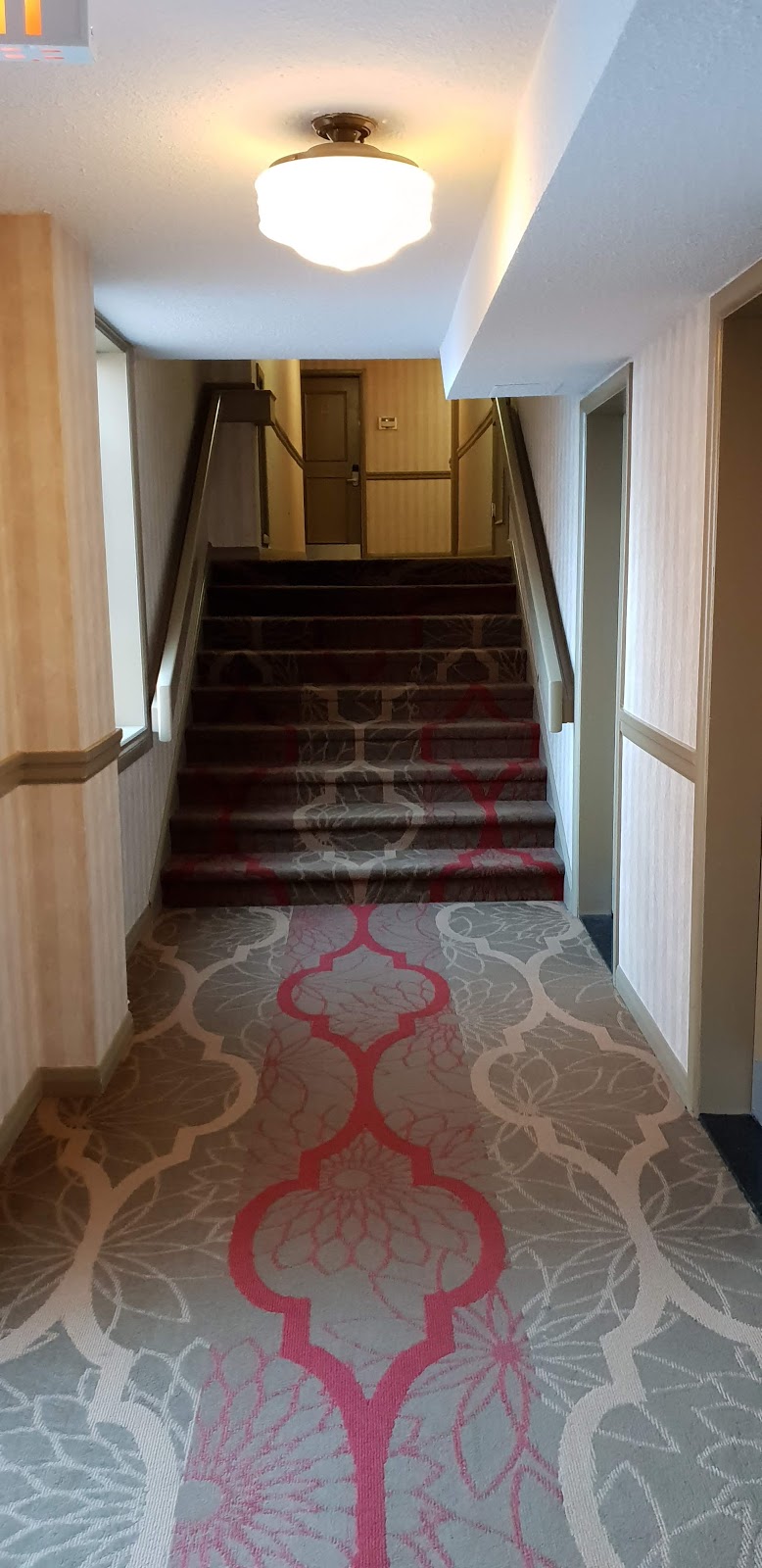
We’re staying at the Park Hotel, a heritage building, apparently built in the later 1920s. In the style of the time, it is a little like a rabbit warren with passages turning off in a number of directions, and showing it is spread across a number of different buildings.
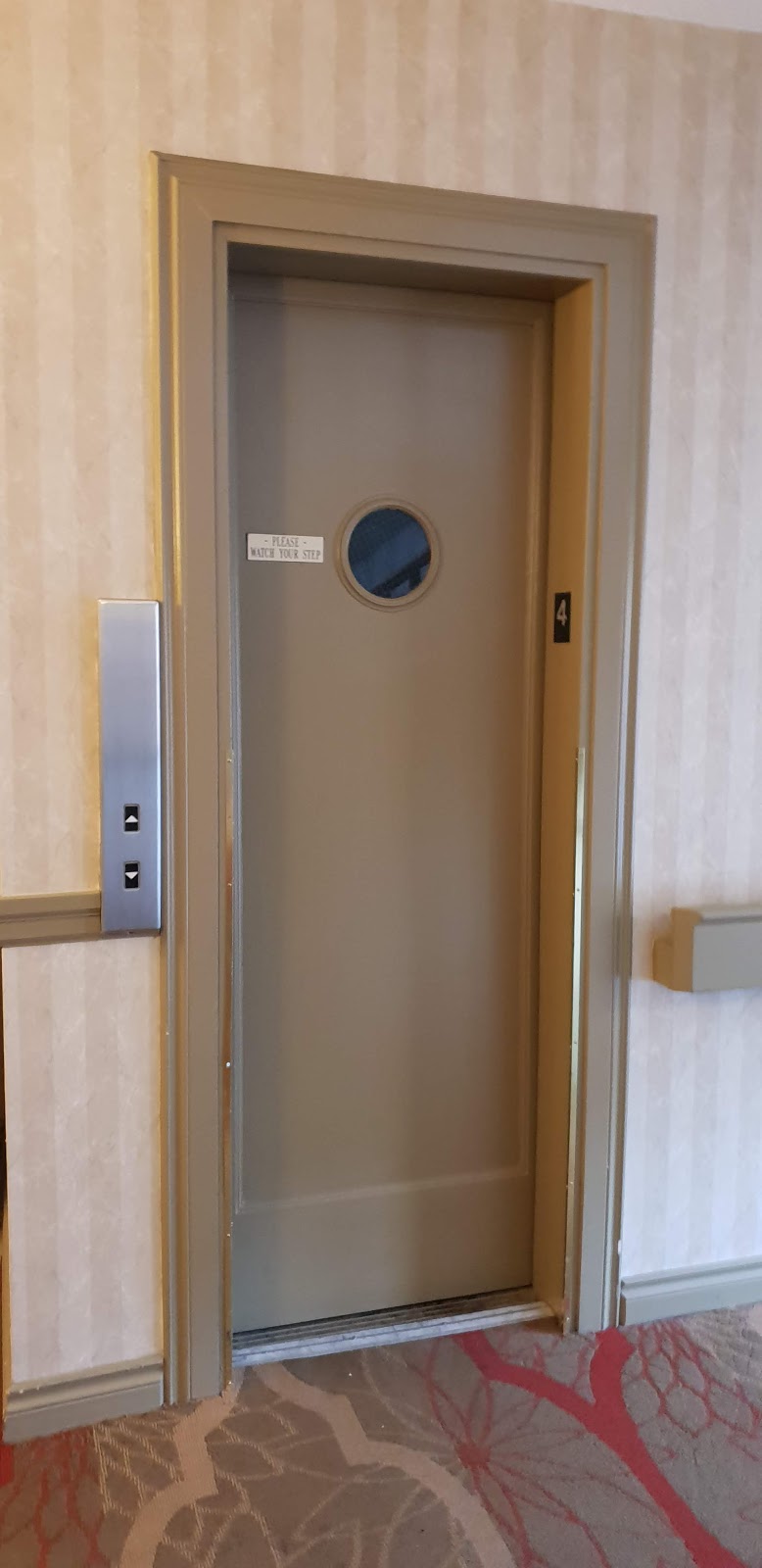
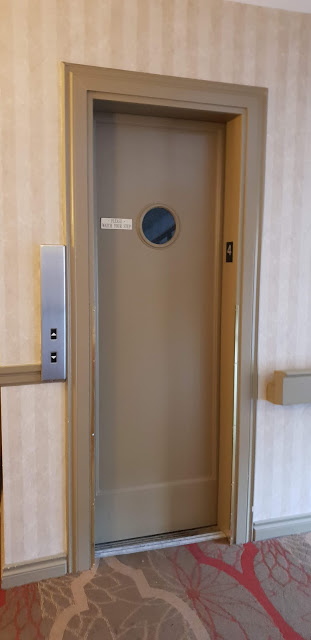
It has the original Otis elevator that can take a maximum of four passengers, and a sign on the wall that says “no horseplay inside the elevator” which is a rather interesting expression that only someone of my vintage would understand. And, for those without a sense of humor, you definitely couldn’t fit a horse in it to play with.
The thing is, how do you find a balance between keeping the old world charm with modern-day expectations. You can’t. Some hotels try valiantly to get that balance. Here, it is simply old world charm, which I guess we should be grateful for because sooner rather than later it’s going to disappear forever.
In my writer’s mind, given the importance of the railways, this was probably a thriving place for travelers, and once upon a time, there were a lot more hotels like this one.
Everyone loves a drink, and that interesting expression, ‘what’s your poison’ often resonates at a bar when among friends.
The thing is, we are supposed to know what our friends drink, me, for instance, I like beer, preferably in a bottle and not local mass-produced brew if I can avoid it.
But, some like white wine, no preference to type, some like cocktails like a Manhattan, or a Long Island Iced Tea, very dangerous if made correctly which quite often it isn’t, or champagne, the real thing not just leftover wine carbonated and given a name like ‘sparkling …’ something.
Every now and then we need to have more than one drink, and that desire is fuelled by our emotions. A celebration, it’s two or three, just enough to allow the euphoria to seep in. A tragedy of any sort means more than a few, usually prefixed with a statement like, ‘I need to get hammered’, but not literally.
Perhaps that’s why it’s called drowning our sorrows.
Of course, there are other meanings for the word ‘drink’ and often poets, and romance novelists will refer to a phrase such as ‘drink in…’ where it may refer to a loving gaze or a look of adulation. You could also, at a stretch, drink in the sight of a magnificent landscape.
Then, at the end of that drinking session, good or bad, where you may have had the opportunity to drink in looks or locations, you might, if you didn’t play your cards right, get thrown in the drink.
Not in the glass, that’s a bit small, but it means a much larger body of water such as a pool, a lake, or the ocean.
And lastly, but probably not the only context for the word ‘drink’, it could be said you were ‘driven to drink’, and I don’t mean by another drinker to the hotel, bar, restaurant or party.
Driven to drink means you blame someone else for your recently acquired desire to drink as much as you can so that it blots out something or someone.
I’m officially blaming my dog for my drinking problem. He drove me to drink.
David is a man troubled by a past he is trying to forget.
Susan is rebelling against a life of privilege and an exasperated mother who holds a secret that will determine her daughter’s destiny.
They are two people brought together by chance. Or was it?
When Susan discovers her mother’s secret, she goes in search of the truth that has been hidden from her since the day she was born.
When David realizes her absence is more than the usual cooling off after another heated argument, he finds himself being slowly drawn back into his former world of deceit and lies.
Then, back with his former employers, David quickly discovers nothing is what it seems as he embarks on a dangerous mission to find Susan before he loses her forever.
This morning started with a visit to the car rental place in Vancouver. It reinforced the notion that you can be given the address and still not find the place. It happened in Washington where it was hiding in the back of the main railway station, and it happened again in Vancouver when it was hidden inside a hotel.
We simply walked straight past it. Pity there wasn’t a sign to let people know.
However…
We went in expecting a Grand Jeep Cherokee and walked out with a Ford Flex, suitable for three people and four large suitcases. It actually seats 7, but forget the baggage, you’d be lucky to get two large suitcases in that configuration.
It is more than adequate for our requirements.
Things to note, it was delivered with just over a quarter of a tank of gas, and it had only done about 11,000 km, so it’s relatively new. It’s reasonably spacious, and when the extra seats are folded down, there is plenty of baggage space.
So far, so good.
We finally leave the hotel about half-past ten, and it is raining. It is a simple task to get on Highway 1, the TransCanada Highway, initially, and then onto Highway 5, the Coquihalla Highway, for the trip to Kamloops.
It rains all the way to the top of the mountain, progress hampered from time to time by water sprays from both vehicles and trucks. The rain is relentless. At the top of the mountain, the rain turns into snow and the road surface becomes slush. It’s 0 degrees, but being the afternoon, I was not expecting it to turn to ice very quickly.
On the other side of the mountain, closer to Kamloops, there was sleet, then rain, then nothing, the last 100kms or so, in reasonably dry conditions.
Outside Kamloops, and in the town itself, there was evidence of snow recently cleared, and slushy roads. Cars in various places were covered in snow, indicating the most recent falls had been the night before.
We’re staying at the Park Hotel, a heritage building, apparently built in the late 1920s. In the style of the time, it is a little like a rabbit warren with passages turning off in several directions, and showing it is spread across a number of different buildings.
It has the original Otis elevator that can take a maximum of four passengers, and a sign on the wall that says “no horseplay inside the elevator” which is a rather interesting expression that only someone of my vintage would understand. And, for those without a sense of humour, you definitely couldn’t fit a horse in it to play with.
The thing is, how do you find a balance between keeping the old world charm with modern day expectations? You can’t. Some hotels try valiantly to get that balance. Here, it is simply old-world charm, which I guess we should be grateful for because sooner rather than later, it’s going to disappear forever.
In my writer’s mind, given the importance of the railways, this was probably a thriving place for travellers, and once upon a time, there were a lot more hotels like this one.
To write a private detective serial has always been one of the items at the top of my to-do list, though trying to write novels and a serial, as well as a blog, and maintain a social media presence, well, you get the idea.
But I made it happen, from a bunch of episodes I wrote a long, long time ago, used these to start it, and then continued on, then as now, never having much of an idea where it was going to end up, or how long it would take to tell the story.
That, I think, is the joy of ad hoc writing, even you, as the author, have as much of an idea of where it’s going as the reader does.
It’s basically been in the mill since 1990, and although I finished it last year, it looks like the beginning to end will have taken exactly 30 years. Had you asked me 30 years ago if I’d ever get it finished, the answer would be maybe?
My private detective, Harry Walthenson
I’d like to say he’s from that great literary mould of Sam Spade, or Mickey Spillane, or Philip Marlowe, but he’s not.
But I’ve watched Humphrey Bogart play Sam Spade with much interest, and modelled Harry and his office on it. Similarly, I’ve watched Robert Micham play Phillip Marlow with great panache, if not detachment, and added a bit of him to the mix.
Other characters come into play, and all of them, no matter what period they’re from, always seem larger than life. I’m not above stealing a little of Mary Astor, Peter Lorre or Sidney Greenstreet, to breathe life into beguiling women and dangerous men alike.
Then there’s the title, like
The Case of the Unintentional Mummy – this has so many meanings in so many contexts, though I imagine that back in Hollywood in the ’30s and ’40s, this would be excellent fodder for Abbott and Costello
The Case of the Three-Legged Dog – Yes, I suspect there may be a few real-life dogs with three legs, but this plot would involve something more sinister. And if made out of plaster, yes, they’re always something else inside.
But for mine, to begin with, it was “The Case of the …”, because I had no idea what the case was going to be about, well, I did, but not specifically.
Then I liked the idea of calling it “The Case of the Brothers’ Revenge” because I began to have a notion there was a brother no one knew about, but that’s stuff for other stories, not mine, so then it went the way of the others.
Now it’s called ‘A Case of Working With the Jones Brothers’, finished the first three drafts, and I am at the editor for the last reading.
I have high hopes of publishing it in mid-2026. It even has a cover.
The Blank Page Blues: Understanding the Real Effects of Writer’s Block (And How to Beat It)
Every writer, whether they are penning a Pulitzer-winning novel, a corporate newsletter, or a simple blog post, has been there. You sit down, open your laptop, crack your knuckles, and… nothing. The cursor blinks at you, rhythmically mocking your lack of progress.
Writer’s block is the universal enemy of creativity. But what actually happens when we hit that wall, and how can we climb over it? Let’s break down the mechanics of the “block” and, more importantly, how to get your momentum back.
The Hidden Effects: More Than Just “Stuck”
We often think of writer’s block as a simple pause in production. However, the effects are usually deeper and more taxing than just an empty page.
1. The Erosion of Confidence The longer you stare at a blank screen, the more your inner critic takes the wheel. You start to doubt your premise, your vocabulary, and eventually, your aptitude as a writer. This “imposter syndrome” can linger long after the initial block has passed.
2. The “Avoidance Cycle” When writing becomes associated with the frustration of being stuck, you naturally start to avoid it. You find “productive” distractions—doing the dishes, organising your email, or doom-scrolling—which only increases the anxiety you feel when you finally do return to the desk.
3. Creative Atrophy Writing is a muscle. When you stop writing for extended periods, the “creative flow”—that effortless state of articulation—becomes harder to tap into. The longer the blockage persists, the more you have to fight your own brain to regain that rhythm.
How to Break the Cycle
The good news? Writer’s block is not a permanent state; it’s a temporary neurological bottleneck. Here is how to unclog it:
1. Lower the Stakes
Often, we get blocked because we are trying to write something “perfect” on the first pass. Give yourself permission to write “garbage.” Write the worst draft imaginable. Once the words are on the page, you can edit them. You can’t edit a blank page, but you can always fix a bad paragraph.
2. The “Pomodoro” Trick
If the task feels gargantuan, break it down. Set a timer for 15 minutes. Tell yourself you only have to write for that long. Often, the hardest part of writing is the starting—once the gears are turning, continuing becomes much easier.
3. Change Your Environment
If your brain associates your desk with anxiety, move to a coffee shop, a library, or even your kitchen table. Sometimes a change of scenery, ambient noise, or a different chair is enough to signal to your brain that it’s time for a new mode of thinking.
4. Switch Mediums
If the laptop screen feels stifling, go analog. Grab a legal pad and a pen. The physical act of handwriting taps into different creative pathways in the brain and removes the temptation to delete, backspace, and over-edit as you go.
5. Use Prompts to Prime the Pump
If you don’t know where to start, stop trying to write the “masterpiece” and just write five sentences about anything. Describe the room you’re in. Describe your breakfast. Once you break the silence of the page, the transition to your actual project will be much smoother.
The Bottom Line
Writer’s block isn’t a sign that you’ve lost your talent; it’s a sign that your brain needs a different strategy. Don’t try to force your way through it with sheer willpower alone. Sometimes, the best way to move forward is to step back, change the environment, and lower your expectations until the words begin to flow again.
Remember: You are a writer because you write, not because you never get stuck.
So, close this tab, take a breath, and write one sentence. Just one. That’s how the block ends.
By the time I returned to the Savoie, the rain had finally stopped, and there was a streak of blue sky to offer some hope that the day would improve.
The ship was not crowded, the possibility of bad weather perhaps holding back potential passengers. Of those I saw, a number of them would be aboard for the lunch by Phillippe Chevrier. I thought about it, but the Concierge had told me about several restaurants in Yvoire and had given me a hand-drawn map of the village. I think he came from the area because he spoke with the pride and knowledge of a resident.
I was looking down from the upper deck observing the last of the boarding passengers when I saw a woman, notable for her red coat and matching shoes, making a last-minute dash to get on board just before the gangway was removed. In fact, her ungainly manner of boarding had also captured a few of the other passengers’ attention. Now they would have something else to talk about, other than the possibility of further rain.
I saw her smile at the deckhand, but he did not smile back. He was not impressed with her bravado, perhaps because of possible injury. He looked at her ticket, then nodded dismissively and went back to his duties in getting the ship underway. I was going to check the departure time, but I, like the other passengers, had my attention diverted to the woman in red.
From what I could see, there was something about her. It struck me when the light caught her as she turned to look down the deck, giving me a perfect profile. I was going to say she looked foreign, but here, as in almost anywhere in Europe, that described just about everyone. Perhaps I was just comparing her to Phillipa, so definitively British, whereas this woman was very definitely not.
She was perhaps in her 30’s, slim or perhaps the word I’d use was lissom, and had the look and manner of a model. I say that because Phillipa had dragged me to most of the showings, whether in Milan, Rome, New York, London, or Paris. The clothes were familiar, and in the back of my mind, I had a feeling I’d seen her before.
Or perhaps, to me, all models looked the same.
She looked up in my direction, and before I could divert my eyes, she locked on. I could feel her gaze boring into me, and then it was gone as if she had been looking straight through me. I remained out on deck as the ship got underway, watching her disappear inside the cabin. My curiosity was piqued, so I decided to keep an eye out for her.
I could feel the coolness of the air as the ship picked up speed, not that it was going to be very fast. With stops, the trip would take nearly two hours to get to my destination. It would turn back almost immediately, but I was going to stay until the evening when it returned at about half eight. It would give me enough time to sample the local fare and take a tour of the medieval village.
Few other passengers ventured out on the deck, most staying inside or going to lunch. After a short time, I came back down to the main deck and headed forward. I wanted to clear my head by concentrating on the movement of the vessel through the water, breathing in the crisp, clean air, and letting the peacefulness of the surroundings envelope me.
It didn’t work.
I knew it wouldn’t be long before I started thinking about why things hadn’t worked and what part I played in it. And the usual question that came to mind when something didn’t work out. What was wrong with me?
I usually blamed it on my upbringing.
I had one of those so-called privileged lives, a nanny till I was old enough to go to boarding school, then sent to the best schools in the land. There I learned everything I needed to be the son of a Duke, or, as my father called it in one of his lighter moments, nobility in waiting.
Had this been five or six hundred years ago, I would have needed to have sword and jousting skills, or if it had been a few hundred years later, a keen military mind. If nothing else, I could ride a horse and go on hunts, or did until they became not the thing to do.
I learned six languages, and everything I needed to become a diplomat in the far-flung British Empire, except the Empire had become the Commonwealth, and then, when no one was looking, Britain’s influence in the world finally disappeared. I was a man without a cause, without a vocation, and no place to go.
Computers were the new vogue, and I had an aptitude for programming. I guess that went hand in hand with mathematics, which, although I hated the subject, I excelled in. Both I and another noble outcast used to toss ideas around in school, but when it came to the end of our education, he chose to enter the public service, and I took a few of those ideas we had mulled over and turned them into a company.
About a year ago, I was made an offer I couldn’t refuse. There were so many zeroes on the end of it I just said yes, put the money into a very grateful bank, and was still trying to come to terms with it.
Sadly, I still had no idea what I was going to do with the rest of my life. My parents had asked me to come back home and help manage the estate, and I did for a few weeks. It was as long as it took for my parents to drive me insane.
Back in the city, I spent a few months looking for a mundane job, but there were very few that suited my qualifications, and the rest I think I intimidated simply because of who I was. In that time, I’d also featured on the cover of the Economist and, through my well-meaning accountant, started involving myself with various charities, earning the title ‘philanthropist’.
And despite all of this exposure, even making one of those ubiquitous ‘eligible bachelor’ lists, I still could not find ‘the one’, the woman I wanted to spend the rest of my life with. Phillipa seemed to fit the bill, but in time, she proved to be a troubled soul with ‘Daddy’ issues. I knew that in building a relationship, compromise was necessary, but with her, in the end, everything was a compromise, and what had happened was always going to be the end result.
It was perhaps a by-product of the whole nobility thing. There was a certain expectation I had to fulfil, to my peers, contemporaries, parents and family, and those who either liked or hated what it represented. The problem was, I didn’t feel like I belonged. Not like my friend from schooldays, and now obscure acquaintance, Sebastian. He had been elevated to his Dukedom early when his father died when he was in his twenties. He had managed to fade from the limelight and was rarely mentioned either in the papers or the gossip columns. He was one of the lucky ones.
I had managed to keep a similarly low profile until I met Phillipa. From that moment, my obscurity disappeared. It was, I could see now, part of a plan put in place by Phillipa’s father, a man who hogged the limelight with his daughter, to raise the profile of the family name and through it their businesses. He was nothing if not the consummate self-advertisement.
Perhaps I was supposed to be the last piece of the puzzle, the attachment to the establishment, that link with a class of people he would not normally get in the front door. There was nothing refined about him or his family, and more than once I’d noticed my contemporaries cringe at the mention of his name, or any reference of my association with him.
Yet could I truthfully say I really wanted to go back to the obscurity I had before Phillipa? For all her faults, there were times when she had been fun to be with, particularly when I first met her, when she had a certain air of unpredictability. That had slowly disappeared as she became part of her father’s plan for the future. She just failed to see how much he was using her.
Or perhaps, over time, I had become cynical.
I thought about calling her. It was one of those moments of weakness when I felt alone, more alone than usual.
I diverted my attention back to my surroundings and the shoreline. Out of the corner of my eye, I could see the woman in the red coat, making a move. The red coat was like a beacon, a sort of fire engine red. It was not the sort of coat most of the women I knew would wear, but on her, it looked terrific. In fact, her sublime beauty was the other attribute that was distinctly noticeable, along with the fact that her hair was short rather than long and jet-black.
I had to wrench my attention away from her.
A few minutes later, several other passengers came out of the cabin for a walk around the deck, perhaps to get some exercise, perhaps checking up on me, or perhaps I was being paranoid. I waited till they passed on their way forward, and I turned and headed aft.
I watched the wake sluicing out from under the stern for a few minutes before retracing my steps to the front of the ship, and there I stood against the railing, watching the bow carve its way through the water. It was almost mesmerising. There, I emptied my mind of thoughts about Phillipa and thoughts about the woman in the red coat.
Until a female voice behind me said, “Having a bad day?”
I started, caught by surprise, and slowly turned. The woman in the red coat had somehow got very close to me without my realising it. How did she do that? I was so surprised I couldn’t answer immediately.
“I do hope you are not contemplating jumping. I hear the water is very cold.”
Closer up, I could see what I’d missed when I saw her on the main deck. There was a slight hint of Chinese, or Oriental, in her, particularly around the eyes, and of her hair, which was jet black. An ancestor twice or more removed had left their mark, not in a dominant way, but more subtly, and easily missed except from a very short distance away, like now.
Other than that, she was quite possibly Eastern European, perhaps Russian, though that covered a lot of territory. The incongruity of it was that she spoke with an American accent and was fluent enough for me to believe English was her first language.
Usually, I could ‘read’ people, but she was a clean slate. Her expression was one of amusement, but with cold eyes. My first thought, then, was to be careful.
“No. Not yet.” I coughed to clear my throat because I could hardly speak. And blushed, because that was what I did when confronted by a woman, beautiful or otherwise.
The amusement gave way to a hint of a smile that brightened her demeanour as a little warmth reached her eyes. “So that’s a maybe. Should I change into my lifesaving gear, just in case?”
It conjured up a rather interesting image in my mind until I reluctantly dismissed it.
“Perhaps I should move away from the edge,” I said, moving sideways until I was back on the main deck, a few feet further away. Her eyes had followed me, and when I stopped, she turned to face me again. She did not move closer.
I realised then she had removed her beret and it was in her left side coat pocket. “Thanks for your concern …?”
“Zoe.”
“Thanks for your concern, Zoe. By the way, my name is John.”
She smiled again, perhaps in an attempt to put me at ease. “I saw you earlier, you looked so sad, I thought …”
“I might throw myself overboard?”
“An idiotic notion, I admit, but it is better to be safe than sorry.”
Then she tilted her head to one side, then the other, looking intently at me. “You seem to be familiar. Do I know you?”
I tried to think of where I may have seen her before, but all I could remember was what I’d thought earlier when I first saw her; she was a model and had been at one of the showings. If she were, it would be more likely she would remember Phillipa, not me. Phillipa always had to sit in the front row.
“Probably not.” I also didn’t mention the fact that she may have seen my picture in the society pages of several tabloid newspapers because she didn’t look the sort of woman who needed a daily dose of the comings and goings, and, more often than not, scandal associated with so-called celebrities.
She gave me a look, one that told me she had just realised who I was. “Yes, I remember now. You made the front cover of the Economist. You sold your company for a small fortune.”
Of course. She was not the first who had recognised me from that cover. It had raised my profile considerably, but not Sternhaven’s. That article had not mentioned Phillipa or her family. I suspect Grandmother had something to do with that, and it was, now I thought about it, another nail in the coffin that was my relationship with Phillipa.
“I wouldn’t say it was a fortune, small or otherwise, just fortunate.” Each time, I found myself playing down the wealth aspect of the business deal.
“Perhaps then, as the journalist wrote, you were lucky. It is not, I think, a good time for internet-based companies.”
The latter statement was an interesting fact, one she read in the Financial Times, which had made that exact comment recently.
“But I am boring you.” She smiled again. “I should be minding my own business and leaving you to your thoughts. I am sorry.”
She turned to leave and took a few steps towards the main cabin.
“You’re not boring me,” I said, thinking I was letting my paranoia get the better of me. It had been Sebastian, on learning of my good fortune, who had warned me against ‘a certain element here and abroad’ whose sole aim would be to separate me from my money. He was not very subtle when he described their methods.
But I knew he was right. I should have let her walk away.
She stopped and turned around. “You seem nothing like the man I read about in the Economist.”
A sudden and awful thought popped into my head. Those words were part of a very familiar opening gambit. “Are you a reporter?”
I was not sure if she looked surprised or amused. “Do I look like one?”
I silently cursed myself for speaking before thinking, and then immediately ignored my own admonishment. “People rarely look like what they are.”
I saw the subtle shake of the head and expected her to take her leave. Instead, she astonished me.
“I fear we have got off on the wrong foot. To be honest, I’m not usually this forward, but you seemed like you needed cheering up when probably the opposite is true. Aside from the fact that this excursion was probably a bad idea. And,” she added with a little shrug, “perhaps I talk too much.”
I was not sure what I thought of her after that extraordinary admission. It was not something I would do, but it was an interesting way to approach someone and have them ignore their natural instinct. I would let Sebastian whisper in my ear for a little longer and see where this was going.
“Oddly enough, I was thinking the same thing. I was supposed to be travelling with my prospective bride. I think you can imagine how that turned out.”
“She’s not here?”
“No.”
“She’s in the cabin?” Her eyes strayed in that direction for a moment, then came back to me. She seemed surprised I might be travelling with someone.
“No. She is back in England, and the wedding is off. So is the relationship. She dumped me by text.”
OK, why was I sharing this humiliating piece of information with her? I still couldn’t be sure she was not a reporter.
She motioned to an empty seat, back from the edge. No walking the plank today. She moved towards it and sat down. She showed no signs of being cold, nor interested in the breeze upsetting her hair. Phillipa would be having a tantrum about now, being kept outside, and freaking out over what the breeze might be doing to her appearance.
I wondered, if only for a few seconds, if she used this approach with anyone else. I guess I was a little different, a seemingly rich businessman alone on a ferry on Lake Geneva, contemplating the way his life had gone so completely off track.
She watched as I sat at the other end of the bench, leaving about a yard between us. After I leaned back and made myself as comfortable as I could, she said, “I have also experienced something similar, though not by text message. It is difficult, the first few days.”
“I saw it coming.”
“I did not.” She frowned, a sort of lifeless expression taking over, perhaps brought on by the memory of what had happened to her. “But it is done, and I moved on. Was she the love of your life?”
OK, that was unexpected.
When I didn’t answer, she said, “I am sorry. Sometimes I ask personal questions without realising what I’m doing. It is none of my business.” She shivered. “Perhaps we should go back inside.”
She stood and held out her hand. Should I take it and be drawn into her web? I thought of Sebastian. What would he do in this situation?
I took her hand in mine and let her pull me gently to my feet. “Wise choice,” she said, looking up at the sky.
The problem is, there are familiar faces and a question of who is a friend and who is a foe made all the more difficult because of the enemy, if it was the enemy, simply because it didn’t look or sound or act like the enemy.
Now, it appears, his problems stem from another operation he participated in, and because of it, he has now been roped into what might be called a suicide mission.
…
We flew out of an unnamed base in an unmarked aircraft, heading for Africa. It would be my second visit. The first didn’t quite go as expected, but there was a chance of redemption this time around.
I was the only one who had been there before, other than our two-faced guide, Jacobi, who by now would be working out how he could double-cross us and save his skin. I had no illusions about a man who would turn in his own mother if he had to.
We were going to need a plan B and a plan C going in with him because I had no doubt plan A had already been sent to the relevant people, who were awaiting our imminent arrival with bated breath. Pity we would not be landing anywhere near that location.
In fact, none of us would know where we would be dropped until minutes before it happened. Security, this time, was going to be formidable. Lallo explained why it was a matter of need to know, and all I had to say was, I didn’t need to know. I suspect Monroe knew, but she was the sort who could keep a secret.
As for the rest of the team, they were a motley crew, but within the group, there was an odd sort of camaraderie between them. Perhaps Lallo had told them that if they stepped out of line, Monroe would shoot them.
Aside from the passengers in the C47 transport, there was a pack for each of us, and enough weapons to start a war. Since we would not be calling at any recognisable airport, I doubted we would have any customs or immigration problems. No one was travelling with any identification papers. It was that sort of mission.
Bamfield met me at the airport before we took off. Monroe had come over and told me there was a visitor in one of the rooms, the one with Operations crookedly glued to the door. She opened the door, ushered me in, then stepped back out, closing the door after her.
Mental note: the door to that room would not withstand a good kick.
There was a table, two chairs, and one of them had Bamfield sitting, looking up expectantly when I entered the room. His eyes beckoned me to the other chair, so, after a look around the room, nothing else other than the table and chairs were in the room, I casually made my way to the chair and sat.
We glared at each other over the tabletop.
”I’m guessing this is the last place you expected to be?”
“You have a funny way of issuing invitations?”
“Would you have come along if I had asked you politely?”
“Probably not.”
Another minute’s silence while he looked for the words that would be anything other than an apology for coercing me into a corner. I’d come to realise that Bamfield was far from the sort of officer I’d first thought him to be.
An excuse could be made that, because he needed to find people to do a particularly dangerous and covert operation, nothing was off the table, including blackmail, in order to get the job done. How he was justifying it using armed services personnel was anyone’s guess, but it would have been kicked higher up the food chain before approval was given.
These operations weren’t just conceived by military commanders, but also by the CIA on a good day, allowing the armed services to tag along. But make no mistake, this would be a CIA operation, and the CIA would take the credit if it worked out, and the army would take a hit if it didn’t. Either way, it would never reach the newspapers.
“You don’t need me to tell you how important this is, and that we’ve only got one shot at it. If you get caught, any of you, we cannot acknowledge you, so you will be on your own. Your team will obey orders. Monroe is there to maintain discipline if it’s needed.”
“So she’ll be shooting first and asking questions later?”
“Something like that. She’s a tough officer and worthy of your respect.”
“And the rest?”
“Good soldiers who just got into trouble. They’re being given an opportunity for redemption, and this mission will count towards lessening their sentences. At any rate, Monroe will have your back.”
Good to know.
“You’ll be going to a new destination, after stopping over in northern Uganda. We’ve arranged for the plane to land at a disused airstrip, where you’ll be met by Colonel Chiswick. He’ll be arranging your and your team’s travel arrangements from there. I can’t tell you any more at this time for security reasons.”
“I have only one question.”
“Only one?”
“There is another 999, but I figure none of those will get answered. It was the same question I asked the last time, who are these people we’re supposed to be rescuing?”
A long and thoughtful look. Could he trust me?
“Two CIA operatives, meddling in DRC affairs without authorisation. They were originally sent to clean up the child soldier problem, but somehow got in the middle of the war between government forces and rebels, if you could call them that. They’re mostly militia groups, and the situation was too fractured for them to do much good. Problem is, they made promises, and now we have to bail them out.”
“Another CIA stuff up then.”
“It had good intentions, but in Africa, good intentions are often mistaken for something else entirely. This is, however, one other possible problem you may have to deal with.”
Of course, there always was. Nothing covert operations were involved in didn’t have a wrinkle or three.
“Good or bad?”
He shrugged. “They might not want to go with you. We now suspect they may have had something to do with the last fiasco, and it wasn’t entirely Jacobi’s fault. But that doesn’t necessarily mean he might not be working with them. You’ll be travelling with a small fortune in diamonds as payment for their release, but it may not necessarily be what it seems. I tell you this, so you don’t get any surprises.”
“Good to know, but I suspect there’s more to the story that you’re not telling me. I’m sure Monroe will keep you in the loop.”
I stood.
Was I expecting a handshake or a good luck, maybe, but I don’t think that was his style? He was probably used to sending men to senseless deaths, so another few would not stir his conscience. I shrugged and walked out of the room, not looking back.