Searching for locations: At large in Paris, France

We have been to Paris a number of times over the years.

The last time we visited Paris we brought the two eldest grandchildren.   We took the Eurostar train from St Pancras station direct to Disneyland, then took the free bus from the station to the hotel.  The train station was directly outside Disneyland.

We stayed at the Dream Castle Hotel, rather than Disneyland itself as it was a cheaper option and we had a family room that was quite large and breakfast was included every morning.  Then it was a matter of getting the free bus to Disneyland.

We spent three days, time which seem to pass far too quickly, and we didn’t get to see everything.  They did, however, find the time to buy two princess dresses, and then spent the rest of the time playing dress-ups whenever they could.

In Paris, we stayed at the Crown Plaza at Republique Square.

We took the children to the Eiffel Tower where the fries, and the carousel at the bottom of the tower, seemed to be more memorable than the tower itself.  The day we visited, the third level was closed.  The day was cold and windy so that probably accounted for the less than memorable visit.  To give you some idea of conditions, it was the shortest queue to get in I’ve ever seen.

We traveled on the Metro where it was pointed out to me that the trains actually ran on rubber tires, something I had not noticed before.  It was a first for both children to travel on a double-decker train.

The same day, we went to the Louvre.

Here, it was cold, wet and windy while we waited,  Once inside we took the girls to the Mona Lisa, and after a walk up and down a considerable numkber of stairs, one said, “and we walked all this way to see this small painting”.
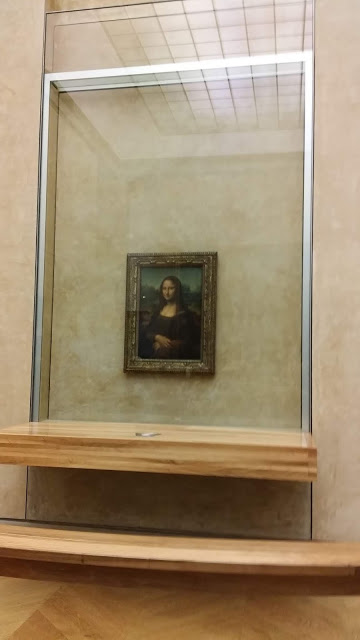
It quickly became obvious their idea of paintings were the much larger ones hanging in other galleries.

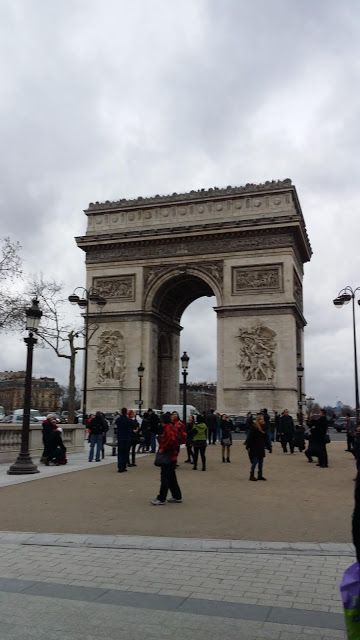
We also took them to the Arc de Triomphe.
We passed, and for some reason had to go into, the Disney shop, which I’m still wondering why after spending a small fortune at Disneyland itself.

Next on the tour list was the Opera House.
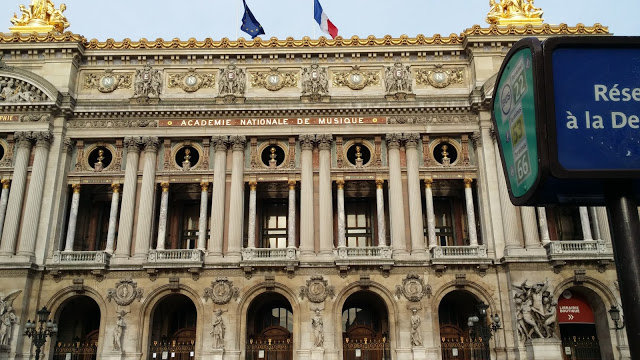
 where one of the children thought she saw the ghost and refused to travel in one of the elevators.  At least it was quite amazing inside with the marble, staircases, and paintings on the roof.

Sadly, I don’t think they were all that interested in architecture, but at the Opera House, they did actually get to see some ballet stars from the Russian Bolshoi ballet company practicing.  As we were leaving the next day we could not go and see a performance.

Last but not least was Notre Dame with its gargoyles and imp[osing architecture.

All in all, traveling with children and experiencing Paris through their eyes made it a more memorable experience.

The first we visited Paris was at the end of a whirlwind bus tour, seven countries in seven days or something like that.  It was a relief to get to Paris and stay two nights if only to catch our breath.

I remember three events from that tour, the visit to the Eiffel Tower, the tour of the night lights, not that we were able to take much in from the inside of the bus, and the farewell dinner in one of the tour guides specially selected restaurants.  The food and atmosphere were incredible.  It was also notable for introducing us to a crepe restaurant in Montmartre, another of the tour guide’s favorite places.

On that trip to Paris, we also spent an afternoon exploring the Palace of Versailles.

The next time we visited Paris we flew in from London.  OK, it was a short flight, but it took all day.  From the hotel to the airport, the wait at the airport, departure, flying through time zones, arrival at Charles De Gaulle airport, now there’s an experience, and waiting for a transfer that never arrived, but that’s another story.

I can’t remember where we stayed the first time, it was somewhere out in the suburbs, but the second time we stayed at the Hilton near both the Eiffel Tower and the Australian Embassy, notable only because the concierge was dating an Australian girl working in the Embassy.  That was our ticket for special treatment, which at times you need to get around in Paris.

It was the year before 2000 and the Eiffel Tower was covered in lights, and every hour or so it looked like a bubbling bottle of champagne.  It was the first time we went to Level 3 of the Tower, and it was well worth it.  The previous tour only included Level 2.  This time we were acquainted with the fries available on the second level, and down below under the tower.

This time we acquainted ourselves with the Metro, the underground railway system, to navigate our way around to the various tourist spots, such as Notre Dame de Paris, The Louvre, Sacre-Coeur Basilica, and Les Invalides, and, of course, the trip to the crepe restaurant.

We also went to the Louvre for the express purpose of seeing the Mona Lisa, and I came away slightly disappointed.  I had thought it to be a much larger painting.  We then went to see the statue of Venus de Milo and spent some time trying to get a photo of it without stray visitors walking in front of us.  Aside from that, we spent the rest of the day looking at the vast number of paintings, and Egyptian artifacts in the Museum.

We also visited the Opera House which was architecturally magnificent.

The third time we visited Paris we took our daughter, who was on her first international holiday.  This time we stayed in a quaint Parisian hotel called Hotel Claude Bernard Saint Germain, (43 Rue Des Ecoles, Paris, 75005, France),  recommended to us by a relation who’d stayed there the year before.  It was small, and the elevator could only fit two people or one person and a suitcase.  Our rooms were on the 4th floor, so climbing the stairs with luggage was out of the question.

It included breakfast and wifi, and it was quite reasonable for the four days we stayed there.

It was close to everything you could want, down the hill to the railway station, and a square where on some days there was a market, and for those days when we were hungry after a day’s exploring, a baguette shop where rolls and salad were very inexpensive and very delicious.

To our daughter we appeared to be experienced travelers, going on the Metro, visiting the Louvre, going, yes once again, to the crepe restaurant and the Basilica at Montmartre, Notre Dame, and this time by boat to the Eiffel Tower.  We were going to do a boat rode on the Seine the last time but ran out of time.

We have some magnificent photos of the Tower from the boat.

Lunch on one of the days was at a restaurant not far from the Arc de Triomphe, where our daughter had a bucket of mussels.  I was not as daring and had a hamburger and fries.  Then we went to the center of the Arch and watched the traffic.

Our first time in Paris the bus driver got into the roundabout just to show us the dangers of driving in an unpredictable situation where drivers seem to take huge risks to get out at their exit.  Needless to say, we survived that experience, though we did make a number of circuits.

In a word: Choice

We are often told that it’s the choices we make that shape our lives.

It’s true.

What distinguishes the basis of those choices is the circumstances of the individual.

What a lot of people don’t realise is the diversity of backgrounds of everyone, and that in a minority of cases, the few that really have no choices at all.

Yes, some have no control over their circumstances, and therefore no choice whatsoever.

Inevitably, the people who are first to criticise those who apparently made the wrong choice are those who have never found themselves in similar circumstances.

And probably never will.

This, perhaps, is the biggest problem with governments that are staffed with advisors who do not understand the plight of the common man.

I never had the same opportunities as those who could afford a university education.  My family were working class and was relatively poor.  Had I not had a scholarship, who knows what sort of education I would have got, if any.

Certainly, my father never got an opportunity to get a good education, but, at the time, during the great depression, his choices were limited, whereas those with any sort of wealth had a different story.

And his lack of choices reflected on us, and that lack of opportunity haunted all of us as time passed.

It was always a case of the haves and the have-nots.

Yes, we all have choices, but sometimes it really is the lesser of two evils, and not whether we will have the fillet or the rib-eye steak.

“Sunday in New York”, a romantic adventure that’s not a walk in the park!

“Sunday in New York” is ultimately a story about trust, and what happens when a marriage is stretched to its limits.

When Harry Steele attends a lunch with his manager, Barclay, to discuss a promotion that any junior executive would accept in a heartbeat, it is the fact that his wife, Alison, who previously professed her reservations about Barclay, also agreed to attend that casts a small element of doubt in his mind.

From that moment, his life, in the company, in deciding what to do, his marriage, his very life, spirals out of control.

There is no one big factor that can prove Harry’s worst fears, that his marriage is over, just several small, interconnecting events, when piled on top of each other, point to a cataclysmic end to everything he had believed in.

Trust is lost firstly in his best friend and mentor, Andy, who only hints at impending disaster, Sasha, a woman whom he saved, and who appears to have motives of her own, and then in his wife, Alison, as he discovers piece by piece, damning evidence that she is about to leave him for another man.

Can we trust what we see with our eyes or trust what we hear?

Haven’t we all jumped to conclusions at least once in our lives?

Can Alison, a woman whose self-belief and confidence are about to be put to the ultimate test, find a way of proving their relationship is as strong as it has ever been?

As they say in the classics, read on!

Purchase:

http://tinyurl.com/Amazon-SundayInNewYork

Searching for locations: Toronto, Canada

The touristy things

On the way to the Hall of Fame, we found an ice-skating rink

The Hockey hall of fame

The hockey hall of fame is a very large exhibition which would take a whole day to see everything.  We sat through a very informative history of the game and the origins of the NHL, which for people who do not have hockey as a sport in their country, is saying something.

We follow the Maple Leafs, coincidentally Toronto’s franchise in the NHL, and we have been here before for a game, which they lost.  It didn’t matter, I was staggered by the energy and enthusiasm both the players and the fans put into making it a memorable experience.

I’m hoping for a repeat experience.

St Lawrence Market

We walked 1.8 km to the market and it was closed which is about right for us as we have a knack for turning up and the place is closed, for instance, the Canadian Club Distillery in Windsor, Canada.

Perhaps tomorrow, before or after the game.

Red Lobster

Ok, we’ve been here before and it was beyond any expectations anyone could have for a restaurant chain.

This was no different from the last.

What more could you want, scallops, shrimp, and a fried lobster tail all drowned in a superb garlic butter sauce.

Add a side of mash potatoes, and a 20oz glass of beer, and there is the definition of heaven on a plate.

St Lawrence Market, again

Snowing, but not heavily

St Lawrence market, everything is very expensive, crab legs $120 per kg, lobster, $50 to $80 per kg.  Oddly everything is quoted per pound, and it’s a good thing that we can convert lbs to kg.

It is, to say the least, a disappointment.

Ice Hockey at the Scotiabank Arena

There was a definite buzz in the air, and heading towards the stadium was both us, and many other Toronto supporters.  Blue Maple Leaf jerseys were in abundance.

We’ve been before, and the last time the Leafs lost.

What else is new?

They have had a very good season so far, and are second on the ladder overall, so it was not without the expectation that they might win this one.


Never have an expectation.

They lost.

But…

It was an incredible game that was none stop action.  It seems to me that you require a lot of skill and skating talent to play this game.  I certainly couldn’t, and freely admit that I’d probably last about five minutes.

The score didn’t reflect the play, but in the end, the Leafs lost 4 – 3, at the end of the three periods.

Souvenir hunting and other stuff

I woke tired and exhausted, not looking forward to walking around Toronto.

Got up early to do the walking.

Oh, did I tell you, this hotel has a laundry and it is the bugbear of staying in major hotels, not being able to wash clothes?

Breakfast is included, but it is the main meal of the day so we feast.  The selection is incredible.

We had to go back to the Maple Leafs franchise shop to exchange a Maple Leafs Jersey, which was no trouble.

So near to the CN tower, we go in to shop for souvenirs, of which there were plenty.  I liked the stuffed mooses and beavers.

We’ve been up the tower so it’s back to the Union Station and a short stay upstairs, a little bar overlooking the Toronto Pearson train line.

Time for tasting some Canadian ales, the first a Mill Street tank house ale, the second a Mill Street hopped and confused.  Seriously, that’s what they were called.

The drinking mood music was old hits like Queen and a little bit of country and western.

We had a good view of the trains, too.

Union Station

Like all main stations very large very tall ceilings and openings that lead to the tracks of which there are about 24, and an underground system

Much the same as all large railway terminals and probably far busier in times gone by.

Dining, but not necessarily dinner

Not far from the station, and opposite to clock tower belonging to the old city hall was a restaurant called Bannock.

There I had a Moosehead Cracked Canoe lager, a light ale, and a house special since 1929, a chicken pot pie, and it was very good.

“Echoes From The Past”, the past doesn’t necessarily stay there


What happens when your past finally catches up with you?

Christmas is just around the corner, a time to be with family. For Will Mason, an orphan since he was fourteen, it is a time for reflection on what his life could have been, and what it could be.

Until a chance encounter brings back to life the reasons for his twenty years of self-imposed exile from a life only normal people could have. From that moment, Will’s life slowly starts to unravel, and it’s obvious to him that it’s time to move on.

This time, however, there is more at stake.

Will has broken his number one rule: don’t get involved.

With his nemesis, Eddie Jamieson, suddenly within reach, and a blossoming relationship with an office colleague, Maria, about to change everything, Will has to make a choice. Quietly leave, or finally, make a stand.

But as Will soon discovers, when other people are involved, there are going to be terrible consequences no matter what choice he makes.

https://amzn.to/2CYKxu4

newechocover5rs

365 Days of writing, 2026 – 145

Day 145 – Writing isn’t work at all…

The Joy of the Page: Why Writing Shouldn’t Feel Like Labour

There is a famous, arguably infamous, sentiment from the poet and novelist Charles Bukowski that often sparks heated debate in writing workshops and literary circles alike:

“Writing isn’t work at all… and when people tell me how painful it is to write, I don’t understand it, because it’s just like rolling down the mountain, you know. It’s freeing. It’s enjoyable. It’s a gift and you get paid for what you want to do.”

If you’ve ever stared at a blinking cursor for three hours, wrestling with a single sentence until your temples throb, Bukowski’s words might sound like a personal insult. How can he call it “rolling down a mountain” when, for the rest of us, it feels more like pushing a boulder up it?

But perhaps it’s time to look past the provocation and see the truth hidden in his perspective.

The Difference Between “Writing” and “Editing”

The friction most writers feel isn’t usually with the act of writing itself—the creative flow, the discovery of a character’s voice, or the thrill of an idea taking shape. The pain comes from the internal critic.

When writers complain about the “pain” of writing, they are often conflating the act of creation with the act of judgment. We stop to edit, we second-guess our word choice, and we worry about the audience before the ink is even dry. Bukowski’s “rolling down the mountain” refers to the act of letting go—the pure, kinetic energy of getting the thought from the brain onto the page without stopping to check if it’s “good enough” yet.

The Gift of Expression

Bukowski’s reminder that writing is a “gift” is a powerful antidote to the burnout that comes with treating writing as a purely transactional industry.

In a world where we spend forty-plus hours a week doing things we have to do—answering emails, attending meetings, navigating logistics—writing is one of the few places where we have total agency. You are the architect, the god, and the witness of your own world. When you view writing as an escape rather than a chore, the “pain” begins to dissipate. You stop trying to force the narrative and start allowing it to move on its own.

How to Find Your Own “Mountain”

If you find yourself stuck in the “painful” phase of writing, it’s worth asking: Are you trying to roll, or are you trying to climb?

To recapture the joy Bukowski describes, try these three shifts:

  1. The “Vomit” Draft: Give yourself permission to write absolute garbage. If you don’t care about the quality of the first draft, you remove the pressure to be perfect. Suddenly, the words start flowing again.
  2. Separate the Hat: Keep the “Writer” and the “Editor” in different rooms. When you write, do not let your inner editor touch the keyboard. Save the critique for a later date.
  3. Find the “Want”: Bukowski mentions being “paid for what you want to do.” Even if you aren’t making a living yet, reconnect with the why. Write about the things that genuinely interest you. If you are writing what you think you should write, it will always feel like work. If you write what you need to write, it becomes a release.

Final Thoughts

Writing will always require discipline, and there are days when the muse is silent. But there is a distinct difference between the healthy exhaustion of a creative sprint and the agonising frustration of a writer at war with themselves.

The next time you sit down to write, don’t try to climb the mountain. Stop trying to control the terrain, stop checking your footing, and just let yourself go. You might be surprised at how much ground you cover when you finally stop fighting the descent.

‘What Sets Us Apart’ – A beta reader’s view

There’s something to be said for a story that starts like a James Bond movie, throwing you straight in the deep end, a perfect way of getting to know the main character, David, or is that Alistair?

A retired spy, well, not so much a spy as a retired errand boy, David’s rather wry description of his talents, and a woman that most men would give their left arm for, not exactly the ideal couple, but there is a spark in a meeting that may or may not have been a setup.

But as the story progressed, the question I kept asking myself was why he’d bother.

And, page after unrelenting page, you find out.

Susan is exactly the sort of woman to pique his interest.  Then, inexplicably, she disappears.  That might have been the end of it, but Prendergast, that shadowy enigma, David’s ex-boss who loves playing games with real people, gives him an ultimatum: find her or come back to work.

Nothing like an offer that’s a double-edged sword!

A dragon for a mother, a sister he didn’t know about, Susan’s BFF who is not what she seems or a friend indeed, and Susan’s father, who, up till David meets her, couldn’t be less interested, his nemesis proves to be the impossible dream, and he’s always just that one step behind.

When the rollercoaster finally came to a halt, and I could start breathing again, it was an ending that was completely unexpected.

I’ve been told there’s a sequel in the works.

Bring it on!

The book can be purchased here:  http://amzn.to/2Eryfth

The cinema of my dreams – I never wanted to go to Africa – Episode 36

Our hero knows he’s in serious trouble.

The problem is, there are familiar faces and a question of who is a friend and who is foe made all the more difficult because of the enemy, if it was the enemy, simply because it didn’t look or sound or act like the enemy.

Now, it appears, his problems stem from another operation he participated in, and because of it, he has now been roped into what might be called a suicide mission.


The next stretch of road was from Aba to Nagero, the gateway to the Garamba National Park.  This was a road where we would have to be more careful because it was possible, now we were off the main road, even though it was designated a highway, or perhaps that was a little too optimistic since it had a number N26, which ran into the R240 at a place nominally named Faradje, but did have a place to stay called the Residence Robert Ball.

I guess I missed that.

Beyond Faradje the road was a little more intense, but something else that worried me, there was more scope for us to be ambushed.  To be honest, I had expected trouble for the last 100 kilometers, but trucks and people were plentiful enough to keep any surprises away.  Now, that element of safety had gone and for quite some distance now we’d been moving slowly, and everyone was on alert.

My fears were not misplaced.

We’d hit a rather rough patch and had to slow down, and coming into a creek crossing the road narrowed, and the trees came down to the side of the road, providing any would-be attacker plenty of cover.  I had been considering how I would arrange an ambush when, suddenly the car in front stopped suddenly, and we, caught unawares, slid almost into the back of them.

My other radio crackled, Monroe was reporting in.  “Houston, we’ve got a problem.”

A flooded creek that was impassable, or a rockfall.  There had been one of each so far, but both had been relatively easy to negotiate.

Then she added, “A gentleman in army gear with a gun.  He’s brought a few friends to the party.”

“Real army, or…”

“The or, I think.  Some of his ‘men’ are, well, not men.”

A local militia.  Ahead I could see several more of the ‘soldiers’ filtering down to cover each of the vehicles until a real soldier stopped near ours, gun aimed and ready to fire.

“Send in our guide and get him to sort the matter out.”

No one was asking us to leave the vehicles yet, so this might but just a ‘request’ for a passing fee.  Jacobi had said this might happen once we left the mainstream roads.  I had hoped, the Garamba National Park is internationally known, all roads in and out would be ‘protected’.  Perhaps that was only for convoys protected by Government troops, a service we had to forego due to the nature of our business.

Five minutes passed, then the next update.

“Jacobi is going now.  We’ve finally got past any possible misunderstandings.  Good thing he knows the language.”

Mindful of where the soldier covering us was standing and his line of sight into the car, I said into the other radio, “Mobley?”

“Sir?”

“Where are you?”

“About a k behind you.”

“Stop.  Park, and approach on foot.  We have a small problem, about 10 militiamen have stopped us at a choke point.”

“Done.  I will be there shortly.  Take them out?”

“Get a position and standby.”

Forward of us little was happening.  I could now see Jacobi and the group commander standing to one side of the lead vehicle, talking.  Jacobi was gesturing, and the soldier was looking defensive.

Seconds dragged by like they were minutes.

Davies came back to life.  “Why have we stopped?”

“Checkpoint.”

“There isn’t meant to be a checkpoint here, is there?”

“No.”

Before we started out Davies had hidden a sidearm under her seat, in a place where I had hoped would not be checked by the border officials.  They had made a cursory scan in the front of the car but hadn’t seen it.  Now she had reached down and had it in her hand, at the same time making sure she had eye contact with the militiaman on her side of our car.

Our personal detail had doubled in the last minute or so.  I had just watched Jacobi return to the lead vehicle, get in, but leave the door open.

The radio crackled again.  “They want five thousand US dollars, and we can proceed.”

“We got five thousand.”

“Jacobi says two should do it.”

“Give it a go.”

I watched and waited as it took a few more minutes before Jacobi, with a bulky envelope, got out of the car and walked towards the soldier.

Showing we had money and were willing to hand it over might lead to further demands, particularly if the soldier though he was being disrespected.  It all depended on Jacobi’s negotiating skills.

Mobley reported in.  He had a position where he could see the men at the head of the convoy.

I spoke into the radio to the others, “Has everyone got a clear shot on their covering guards, just in case this goes sideways.”

“They’re not exactly soldiers,” I heard Barnes say.

“But they’ll shoot to kill you all the same.  Unfortunately, we’re on a mission-critical timeline here, and whilst I don’t like it, it’s going to be one of those at all costs decisions.”

A series of ‘ready’ came over the radio.

Several more minutes passed, and more animated conversation between Jacobi and the commander, then Jacobi returned to the car, minus the envelope.

Was it successful?

Monroe.  “Seems he wants ten thousand now.  Orders?”

“Negotiations are over.”

Several shots rang our, taking down the three men at the front of the convoy in quick succession, the signal for the others to take out their guards almost simultaneously.  It was a miracle none of the guards got a shot off, but, then, they were standing a little too close for their own good.


Five minutes later we were back on the road, the militiamen having their arms removed, and removed from sight, just in case anyone came looking for them.  It might be a forward group from the kidnappers, looking for some extra cash, or, if the negotiations had dragged on, looking to take the ransom and then demand another when we turned up empty-handed.

Whatever had happened, it was over.

Ten minutes later Mobley had re-joined the convoy behind me.


© Charles Heath 2019-2020

PI Walthenson’s second case – A case of finding the ‘Flying Dutchman’.

Known only to a few, there is a legend that a ship named the ‘Flying Dutchman’ left Nazi Germany in the last weeks of the war and set sail for America, escorted by U-boats, under a different name. Aboard was a trove of treasure and gold worth a ‘king’s ransom’.

It was said that it had been sent to a group of American Nazis to create the Fourth Reich at an appropriate time. Over the years, many expeditions off the coast had searched, but found no trace of the vessel or the treasure.

In other words, it was just a legend created to boost tourism.

Fast forward to 2024. Our intrepid private detective, Harry Walthenson, overhears a conversation at Grand Central Station. It was the oddness of the message that caught his attention. An investigation turned up nothing out of the ordinary, and he thinks no more about it.

Then Harry is kidnapped, interrogated, and asked questions over and over about a date and a place, why he went there, and when he could not give satisfactory answers, he was beaten half to death and left for dead on a rubbish heap. He was lucky that it was a living space for homeless men; otherwise, he would have died.

In the aftermath, he once again gives it no more thought.

After resolving his first case successfully, there’s no rest. Harry’s angry mother comes to his office and demands that he find out where his father has gone. She believes he has run off with a mistress, not for the first time.

Perhaps it was not the wisest decision she has made, because Harry promises to investigate, and adds that she might not like what he finds.

He soon discovered he does not like what he finds, that his father’s friends, a cabal formed at University, have two who are his mother’s current lovers, and another, a criminal blackmailing his father.

Felicity, now his partner, working on a different case, and trying to get answers, uncovers a crime family involved in guarding a disused warehouse on the docks, where she believes Harry had been taken for interrogation, and subsequently dumped nearby to die.

Why are they up to? What is so important that the empty warehouse needs guarding? Who is employing them?

Harry, following up on the death of the blackmailer, traces his death back to an enforcer employed by his grandfather. His mother’s grandfather was a pre-war industrialist who made his fortune in war munitions and shipbuilding.

He was also a member of the American Nazi party.

When Harry also discovers a logbook belonging to a so-called wartime Liberty ship the “Paul Revere” in brackets ‘Freiheitskämpfer’, hidden by his father, and written in a code that is not readily identifiable.

It is no longer a matter of a father who has run off with his mistress; it is a very frightened man in fear of his life, running from a group who will stop at nothing to get the logbook back. And when Harry discovers a family connection to the group, it becomes a race against time to decode the log and find his father before his grandfather does.

Coming soon: Harry Walthenson’s new adventure – A case of finding the ‘Flying Dutchman’

The cinema of My Dreams – It ended in Sorrento – Episode 58

It goes exactly as planned

We were monitored from the moment we left the hotel.  Cecelia had taken up her vantage point, and watched as we came out the front door.  Two minutes later she said, quietly, “You’ve got two, man and woman.  The woman is in communication with someone.  Be careful.”

Francesca didn’t seem to have a care in the world.  I suspected she had her phone on so those following us could keep track of when they lost us, but I wouldn’t be dodging and weaving this morning.

“What do you think our chances are of getting snatched off the street in a white van,” I asked her, after about 10 minutes.

“Why?”

“I’ve seen a few.  Of course, they might just be delivery vans, and white is a common colour.  Perhaps I’m just being paranoid.”

“Perhaps you are.”  She gave me a curious look, enough to make me think she might think there might be trouble.

“What happened to Cecelia?”

Juliet was outside the hotel, coming back from a café not far up the road.  I noted she had not bought coffee for the other two women.

“Out on a run.  She’s one of these fitness freaks, or perhaps it has something to do with keeping in shape for the movies.”

Juliet looked Francesca up and down with the eye of a jealous woman, or so I wanted to believe.  It could be that she simply viewed her with suspicion, much the same as I would in her place.

She knew me well enough to know Francesca was not there simply as a visiting friend.  But just how curious would she be.

“Another actress friend of yours?”

Francesca views Juliet with a similar look of contempt.

Francesca looked at me.  “Who is this woman and what is she talking about.  You obviously know each other.”

“Is it that recognisable?  This is Juliet, and ye, far back in a long-forgotten past we did spend some time together.  And lately, for some strange reason, we keep running into each other. Other than that, she’s staying with the countess and her mother.”

“You brought her to see the countess?   Is that wise?”

“No.  But I’ve had a long talk to Francesca, that’s her name by the way, and she’s working with people who have the same goal as I have, protecting the countess and making sure she gets to the signing.”

“Who are her people?”

“Need to know Juliet.”

“Well, this is going to be a cat amongst the pigeon’s moment, Evan.  You’re up to something, I know it.”

Francesca looked at her, then me, and went to say something, then didn’t.  I wished, at that moment, that I could read minds.

In my ear, I could hear Cecelia.  “They’ve stopped at the café just up from the hotel and the woman is talking earnestly into the phone.  She is probably calling for reinforcements.”

“A white van, no doubt,” I said.

Francesca was beside me.  “What about a white van?  Did you see one?”

“No.  Just muttering to myself.”

Juliet went first as we went into the hotel, over to the elevator, and then up to the room floor.  The short distance to the room was slow, running into several other guests who were going down to the lobby.

Juliet was on first-name terms with them.

Cecelia was back.  “As you said.  A white van went down the alley to the back of the hotel.  The two are staying put at the café.  It’s either a delivery or your ride.  What do you want me to do?”

“Nothing.”  Alfie’s voice came on.

“What are you doing here?”

“Joining the party.  Leave the van to me.  If it is involved, we’ll be on it.  If they take any one of the three, and they take their phones, we’ll have a trace.  At any rate, I’ve got a car, and will follow the van, if necessary.”

“Ever been told about a party, and then not get an invite,” I asked no one in general.

Juliet gave me a strange look then unlocked the door, went in, I followed, and Francesca came in last and closed the door behind her.

The countess was sitting at the table and looked up.  She didn’t recognise Francesca or if she did, she was a good actress.

“Who is this?” she asked.

“A woman who claims she has been hired to protect you too.  There seems to be a few of us.”

“Protect or kill?”  She stood and backed away.  “Why did you bring her here?”

“The old adage, keep your friends close, and your enemies closer.  She’s better here than out there,” I waved my hand in the general direction of the street.

Francesca didn’t move, and, better still, didn’t produce a gun from her handbag.

“Who do you work for?” the countess asked.

“Anna von Burkehardt.  She is very keen for you to make it to the signing alive.  She also told us that she would like to have a chat about what you’re going to be doing with the property once the documents are signed.  She would like to make you an offer.  One, I believe, you can’t refuse.”

It sounded reasonable to me.  What wasn’t was that she hadn’t moved from the door.  That was a bad sign.

Cecelia again.  “I’m on the floor, three hostiles heading to your door.  Do you want me to stop them?”

“No.”

Francesca looked at me.  “What do you mean no?”

“No, she can’t refuse it, like you said.”

The countess didn’t look particularly impressed with either of us.  “That hag has no interest in making any offers other than putting a bullet in the back of my head.  Take her away, Evan.  She had no interest in protecting me.  And, because of your incompetence, now Anna knows where I am.

I saw Francesca turn the handle of the door and quickly step to one side as it burst open.  Standing on the side expecting such an entry, I saw the men come in weapons in hand, yelling for us to get on the floor.

Cecelia was in my ear again.  “What do you want me to do?”

“Wait.  But be ready.”

In the confusion, Francesca was too busy acting the part of a hostage, with adequate parts of fear and cringing on the floor.

One of the men pointed his gun at me.  I was not the target.

I just realised that Vittoria was not in the room, so she was outside.

“Watch out for Vittoria,” I said.

Teo men grabbed the countess and gagged her.  The one pointing the gun at me went back to the door and looked out.  He waved his gun to say the coast is clear, and they quickly went out.

“Let them go.  Alf, you better not lose them.”

“I won’t.”

Three minutes and it was over. 

I got up and sat against the wall, and watched Francesca slowly raise her head and look around.

When her eyes reached me, she didn’t see my angry face looking at her, she saw a silenced gun pointed at her head.

“What the hell…”

The door opened again, and Cecelia came in, gun aimed, ready to shoot anything that moved.  It too, ended up on Francesca.

“One chance.  The next thing you tell me better be the truth or I will shoot you dead where you lie.  Am I clear?”

© Charles Heath 2023