“Sunday in New York” is ultimately a story about trust, and what happens when a marriage is stretched to its limits.
When Harry Steele attends a lunch with his manager, Barclay, to discuss a promotion that any junior executive would accept in a heartbeat, it is the fact his wife, Alison, who previously professed her reservations about Barclay, also agreed to attend, that casts a small element of doubt in his mind.
From that moment, his life, in the company, in deciding what to do, his marriage, his very life, spirals out of control.
There is no one big factor that can prove Harry’s worst fears, that his marriage is over, just a number of small, interconnecting events, when piled on top of each other, points to a cataclysmic end to everything he had believed in.
Trust is lost firstly in his best friend and mentor, Andy, who only hints of impending disaster, Sasha, a woman whom he saved, and who appears to have motives of her own, and then in his wife, Alison, as he discovered piece by piece damning evidence she is about to leave him for another man.
Can we trust what we see with our eyes or trust what we hear?
Haven’t we all jumped to conclusions at least once in our lives?
Can Alison, a woman whose self-belief and confidence is about to be put to the ultimate test, find a way of proving their relationship is as strong as it has ever been?
I reviewed the CCTV tapes and worked out who the countess’s bodyguards were in the hotel, and remarkably traced them leaving the hotel by the back entrance, passing only one camera, one I suspect they didn’t know was there. The reason, it did not belong to the hotel but the owner of the building behind the hotel.
They did not leave with the countess, so the question was, why?
I called the office and asked them to do facial recognition on the two, and then trace their movements, and if they left the country by conventional means.
There was no sign of anyone leaving before or after them. Not for two hours on either side of their departure time. It was another lead, which might lead nowhere.
I called Cecilia to ask her how her investigation into Vittoria was going. She didn’t answer, so I sent her a text message arranging to have coffee at a French Pastry café near where I believed I would find Juliet.
I was still working out how I was going to bump into her.
The auditorium was off the Strand near Charing Cross station not far from the Victoria Embankment Gardens, and of course, a French Pastry café in Charing Cross Road I found quite by accident when looking for Foyles Bookshop.
I was still working on that plan when I stopped to have a coffee and a Mille Feuille.
The best idea is just to go and see if she is there and talk to her. I doubt that she would believe that I just happened to be in the same place at the same time, and perhaps if I just told her the truth…
Whatever approach I made; it was going to be a surprise.
I stood outside the building for a few minutes, thinking if I waited, she might just turn up but she didn’t. If anything, she would be inside, setting up for the following day.
Enough prevaricating, I couldn’t wait any longer. I crossed the road and went in. I hoped that it catered for visitors. At the front desk, I asked whether the organiser of the session that was running in one of the lecture rooms was available, I was attending and had some questions, and she directed me to the hall.
When I entered the room I saw her standing on the dais, fiddling with a control that was in the process of displaying slides on the screen behind her. She looked different to when I last saw her, and I couldn’t help but notice she had a presence about her, even if she was flustered.
Then she must have sensed someone had entered the room and looked up. She recognised me immediately.
“Evan? Is that you?”
“It is.”
I walked down the steps and stopped just short of the dais.
“What are you doing here?”
Good question. I was still not prepared for this moment.
“I read in the paper you were leading a discussion on your pet subject of car accident victim’s trauma, where it was, and I didn’t feel we ended things back in Venice very well. I was surprised to learn you were in London, and I was at a loose end.”
She looked me up and down with a curious eye.
“Someone I don’t think that’s, exactly true Evan. I was told, in a roundabout way, that you were responsible for getting my brother out of the fix he was in, and coincidentally solved my problem too. He was a rather creepy little man who was acting strangely. Please, sit down.”
She crossed to the front row of seats, chose one and sat. I sat two seats away.
“Yes, he needs to work on his people skills.”
“Then you are not who you purport to be. Are you still living in Venice?”
“No. There is nothing to keep me there. I have a place here. For the time being.”
“Are you working?”
“In a manner of speaking.”
“Does it involve me?”
“Why would you think that?”
“I have been involved in several shall we say enterprises because of circumstances, all of which I have tried to put in the past. I am not that person anymore, and thankfully some of the ghosts are just that. You and I though, I’m not sure what we are? Would you like to buy me dinner and talk about it?”
Was it an invitation I couldn’t refuse?
“Can you drag yourself away from this?”
“I have a computer guru. I’ll call him and ask him to make it work. You can tell me what you’re up to, and why you need my help. I’m assuming that’s why you’re here?”
You would think, being one of a dozen colours that pip onto your head when asked, name a dozen colours, that it would be easy to find almost anything.
Wrong.
We are on a quest to find bridesmaid dresses in, you guessed it, any shade of purple.
We might as well be looking for gold nuggets. In fact, we’d have a better chance of finding gold than a purple dress.
And, seven stores later, five of which are specialty fashion boutiques, sorry, no one is doing purple. Maybe a dash here or there, but it’s lost in the overall dress that may have flowers or a Picasso abstract.
OK, so the dresses are for a 15-year-old and a 12-year-old, you would think you could go to a Target, or K Mart, or Cotton On, or perhaps the Guess type of store that caters to that 13 to 25 market.
Think again.
Purple, mauve, lilac, or any shade in between just isn’t on the rack.
I suddenly consider the notion of phoning a supermodel and then convincing her to wear every shade of purple every waking hour in public, thus setting a new trend.
I’m betting that within a week, every store on the planet will have purple clothes in stock.
Of course, there is only one flaw in the master plan. I don’t know any supermodels.
So, this search is going to have a bad ending. I’m guessing the bride’s decision for purple and white as the signature color scheme was made before discovering that practically nothing comes in purple.
No the way, it was originally lilac, but that is impossible, not unless there are about 3 years before the wedding and you can get to Hong Kong to have the dresses specially made.
We’ve got about three weeks.
Yes, there’s another thing about this wedding. From announcement to the big day, is six weeks. Logistically, it can’t be done. Practically, there’s going to be a ward in the mental hospital for the wedding party, even if they pull it off.
Meanwhile, it’s back on the trail. There’s one more level to trawl, in what is a very large shopping mall.
And for the first day after the easing of many of the drastic Covid restrictions, it seems everyone for miles around has descended on this very place.
Sigh!
Then, majestically appearing through the mist…
No, not sunshine! A purple dress.
I am all astonishment. And, it’s not just one, there are several.
Hold that thought…
Alas, we find the dress, but not the colour, well, not in that store. Now it’s a matter of phoning other stores to see if they have any purple stock.
Yes, we have to go way back in time to the days when Charles Dickens and other classic English writers wrote their stories in episodes, and yes, they had to have a cliff-hanger ending for each so the readers would be back to read the next instalment.
It was a novel way to get people to buy newspapers.
It was also a chance for the writers to get income by publishing a weekly instalment in either the newspapers or magazines.
Of course, at that time, a lot of people couldn’t read or write, so there was a large percentage of the population missing out.
Imagine my dismay when I decided to write my stories in episodes and publish them in my blog, thinking it was a really great idea, and then discovering the idea had been around for hundreds of years.
Mine were, and are, a little more erratic, sometimes each day, but other times a week apart. Sometimes it’s difficult to write continuously like that, and three or four different stories. If you want to read some, they are the stories I called ‘The Cinema of my Dreams’, and there’s one about an interlude in WW2, one about a rescue in Africa, one about a Treasure Hunt, one about an aspiring spy, one that starts in Venice, and one in outer space
Imagine what Charles Dickens would have thought of having the internet to publish his stories. He’d get more readers than for all of his novels, whether published in book form or episodes, in his lifetime.
And, of course, when the books were published, it wasn’t just one copy for the whole story; it was published in three, four or more volumes.
Of course, the movie moguls couldn’t let a good idea get past them either, and started making serials in episodes, each with a cliff-hanger ending to run before the main feature, thinking they would get the fans hooked into coming every week.
Notable heroes who turned up in Hollywood serials were Flash Gordon, Buck Rogers, Zorro, and the Green Hornet, nearly all of comic book fame.
Day 120 – How can a writer be compared to a magician
…
The Art of the Illusion: Why Every Writer is a Magician
We’ve all had that experience: you open a book, and suddenly, the room around you vanishes. You aren’t looking at ink on paper or pixels on a screen anymore; you are inside a character’s mind, feeling their heartbeat, smelling the rain on a distant street, and racing toward a conclusion you didn’t see coming.
When a story works, it feels like magic. But as any professional magician will tell you, the more effortless a trick looks, the more gruelling the preparation behind the curtain was.
The legendary Toni Morrison once perfectly captured this tension:
“[Handle writing] so the reader is only aware of the rabbit that comes out of the hat, and doesn’t see the false bottom—that’s where the hard work is.”
As writers, we are the magicians of the page. Here is why writing is the ultimate sleight of hand, and why hiding the “false bottom” is the most important part of the craft.
The Rabbit: The Seamless Experience
In Morrison’s metaphor, the “rabbit” is the finished story. It’s the emotional payoff, the sharp dialogue, and the plot twist that leaves the reader breathless.
When a reader picks up a book, they don’t want to see the writer’s struggle. They don’t want to notice the clunky sentence that took four hours to fix or the structural gap that required a total rewrite of Chapter Three. They want the wonder. They want the rabbit to appear out of thin air, vibrant and alive.
If the reader starts thinking about the writer’s technique while they are reading, the spell is broken. The “rabbit” becomes just a prop, and the magic fades.
The False Bottom: The Mechanics of Craft
The “false bottom” is everything that happens before the reader ever turns page one. It is the invisible infrastructure of a story. This includes:
Structural Scaffolding: Building a plot that feels inevitable but not predictable.
The “Ugly” First Draft: Chasing ideas through a mess of bad metaphors and inconsistent pacing.
The Editing Grind: Removing every “very” and “suddenly,” killing your darlings, and refining the rhythm of a sentence until it sings.
Research: Knowing ten times more about a subject than what actually makes it into the book, just to ensure the world feels sturdy.
This is where the “hard work” Morrison mentions resides. It’s the sweat, the frustration, and the endless hours of refinement. It is the mechanical, often tedious labour required to create an object that looks like it was born, not made.
Why We Hide the Work
You might ask: If I worked so hard on this, why shouldn’t I let the reader see it?
In magic, if the audience sees the trapdoor, the wonder is replaced by logic. They stop feeling and start calculating. Writing is the same. To evoke a true emotional response, the mechanics must remain invisible.
We hide the “false bottom” because we want the reader to believe in the reality of the world we’ve built. We want them to believe the characters are making choices of their own free will, not because a writer is pulling their strings from behind a curtain.
Embracing the Invisible Labour
If you are a writer currently struggling with a difficult chapter or a plot hole that won’t close, remember Morrison’s words. The fact that it feels hard doesn’t mean you’re failing; it means you’re building the false bottom.
The goal isn’t to write something that is easy; it’s to write something that feels easy.
Next time you produce a piece of prose that flows so naturally it feels like it wrote itself, take a moment to look back at the “false bottom” you spent weeks constructing. The reader may never see it, but they will feel the magic it allows to happen.
After all, the best magic tricks aren’t about the rabbit—they’re about the secret the magician keeps to make the world feel a little more wondrous.
We walked another umpteen miles from the exhibition to a Chinese restaurant that is going to serve us Chinese food again with a beer and a rather potent pomegranate wine that had a real kick. It was definitely value for money at 60 yuan per person.
But perhaps the biggest thrill, if it could be called that, was discovering downstairs, the man who discovered the original pieces of a terracotta soldier when digging a well. He was signing books bought in the souvenir store, but not those purchased elsewhere.
Some of us even got photographed with him. Fifteen minutes of fame moment? Maybe.
After lunch, it was off to the station for another high-speed train ride, this time for about two and a half hours, from X’ian to Zhangzhou dong.
It’s the standard high-speed train ride and the usual seat switching because of weird allocation issues, so a little confusion reigns until the train departs at 5:59.
Once we were underway it didn’t take long before we hit the maximum speed
Twenty minutes before arrival, and knowing we only have three minutes to get off everyone is heading for the exit clogging up the passageway. It wasn’t panic but with the three-minute limit, perhaps organized panic would be a better description.
As it turned out, with all the cases near the door, the moment to door opened one of our group got off, and the other just started putting cases on the platform, and in doing so we were all off in 42 seconds with time to spare.
And this was despite the fact there were about twenty passengers just about up against the door trying to get in. I don’t think they expected to have cases flying off the train in their direction.
We find our way to the exit and our tour guide Dannie. It was another long walk to the bus, somewhat shabbier from the previous day, with no leg room, no pocket, and no USB charging point like the day before. Disappointing.
On the way from the station to the hotel, the tour guide usually gives us a short spiel on the next day’s activities, but instead, I think we got her life history and a song, delivered in high-pitched and rapid Chinglish that was hard to understand.
Not at this hour of the night to an almost exhausted busload of people who’d had enough from the train. Oh, did I forget the singing, no, it was an interesting rendition of ‘You Are My Sunshine’.
The drive was interesting in that it was mostly in the dark. There was no street lighting and in comparison to X’ian which was very bright and cheerful, this was dark and gloomy.
Then close to the hotel, our guide said that if we had any problems with the room, she would be in the lobby for half an hour.
That spoke volumes about the hotel they put us in.
Yes, if the temperature was 20 degrees below zero and the forecast for the net week was the same, then that would be the big freeze.
In a more understandable way of putting it, to freeze something is to preserve it at a temperature below zero.
Some things don’t freeze, like petrol.
And you want to hope that you put antifreeze in your radiator otherwise you are going to have big problems with your car in winter.
It also means to stand still.
You can also isolate someone by freezing them out.
And freeze in fear, unable to move, like a deer in headlights.
But the worst example of a freeze is when your computer stops, and you forgot to save that 200-page novel, thereby being lost forever.
No. That would never happen, you had autosave on, didn’t you?
Didn’t you??????????
Freeze is not to be confused with a frieze which is a broad horizontal band of sculpted or painted decoration, especially on a wall near the ceiling.
Or frees, which in some countries type of football described multiple free kicks, in one sense, and, in another, what you do when you let them go, e.g. he frees the dog.
What happens when your past finally catches up with you?
…
Christmas is just around the corner, a time to be with family. For Will Mason, an orphan since he was fourteen, it is a time for reflection on what his life could have been, and what it could be.
Until a chance encounter brings back to life the reasons for his twenty years of self-imposed exile from a life only normal people could have. From that moment, Will’s life slowly starts to unravel, and it’s obvious to him that it’s time to move on.
This time, however, there is more at stake.
Will has broken his number one rule: don’t get involved.
With his nemesis, Eddie Jamieson, suddenly within reach, and a blossoming relationship with an office colleague, Maria, about to change everything, Will has to make a choice. Quietly leave, or finally, make a stand.
But as Will soon discovers, when other people are involved there is going to be terrible consequences no matter what choice he makes.
In 1974 a 26-year-old farmer, Yang Jide, was drilling a well and found fragments of the terracotta soldiers and bronze weapons.
What was discovered later was one of the biggest attended burial pits of China’s first feudal Emperor, Qin Shi Huang. In the following years remains had been found in 3 pits, yielding at least 8,000 soldiers and horses, and over 100 chariots. The soldiers were infantry, cavalry, and others.
Emperor Qin was born in 259 BC and died in 210 BC. He began building a mausoleum for himself at the foot of Mount Li when he was 13. Construction took 38 years, from 247 BC to 208 BC. It was divided into 3 stages and involved 720,000 conscripts.
The pits of pottery figures are 1.5 km east of Emperor Qin’s mausoleum. Pit 1 has about 6,000 terracotta armored warriors and horses and 40 wooden chariots. Pit 2 is estimated to have over 900 terracotta warriors and 350 terracotta horses with about 90 wooden chariots. Pit 3 had so far yielded only 66 pottery figures and one chariot drawn by four horses.
Official records say it was discovered later that it was likely Xiang Yu, a rebel, intentionally damaged the Mausoleum and the soldiers in the pits, by setting fire to the wooden roof rafters, and these fell on and broke the warriors into pieces.
However, we were told that after the terracotta warriors were completed, the Emperor ordered the builders to be killed so that they would not tell anyone about the warriors, and then of those that remained alive deliberately smashed all of the artifacts.
The thing is, all of the terracotta figures that have been found are in pieces, and they need computers to piece them back together again.
The visit: The first impression is the size of the car park and the number of buses parked in the lot, and a hell of a lot more outside up the road an off on side streets. Obviously, it costs money to park in the parking lot.
The other first impressions; the numbers waiting to get in were not as many as yesterday outside the forbidden city, in fact, a lot less.
Be warned there’s a long walk from the entrance gate where your bags are scanned and a body scan as well, before admittance. This walk is through a landscaped area which it is expect might sometime in the future reveal more soldiers, or other artifacts.
At the end of the walk that takes about ten minutes, you can get a one-way ride to the second checkpoint, but we opted not to as no one else in our group did.
That walk is the warm-up exercise to an organized viewing of the exhibits after going through a second ticket checkpoint. On the other side, we had to hand our tickets back to the tour guide which was disappointing not to end up with a memento of actually having been there.
So, on the other side in the courtyard, the guide told us the most important parts of the exhibition, that we should spend most of the time looking at pit 1, and then spent a little time in 2 which is only there in the first stages of excavation. Then move onto the museum if only to see the replica chariots.
We do.
The chariots were small but interesting
The horses were better and intricately detailed
These are soldiers, perhaps complete examples of those types found in the end pit.
This is one of the archers. You can tell by the way he wears his hair.
Pit 2
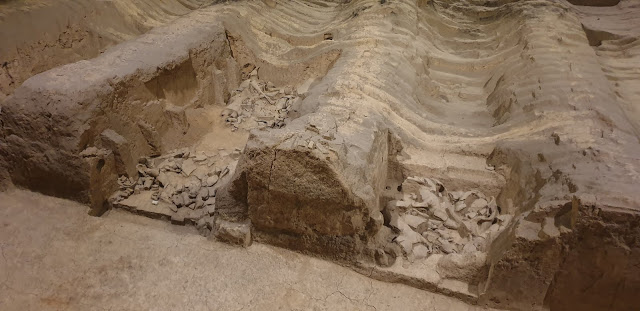
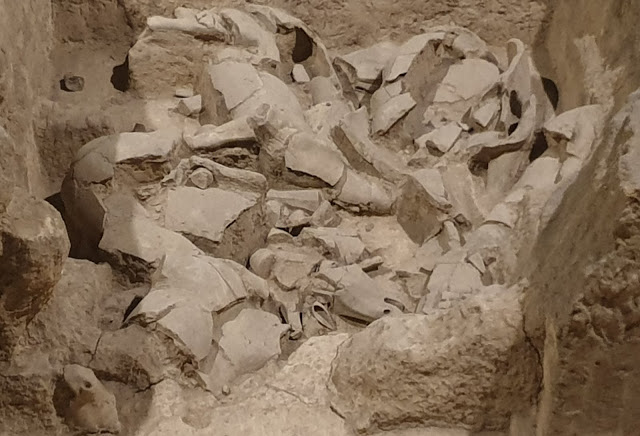
The excavation of this pit has only just begun, so it is possible to see where they have carefully removed the top cover, and you can see the broken parts of the warriors lying in a heap.
Some parts of the warriors are more discernible closer up
These parts are carefully extracted and taken to the ‘hospital’ where they are digitised and the computer will match each part with the warrior it belongs to.
Pit 1
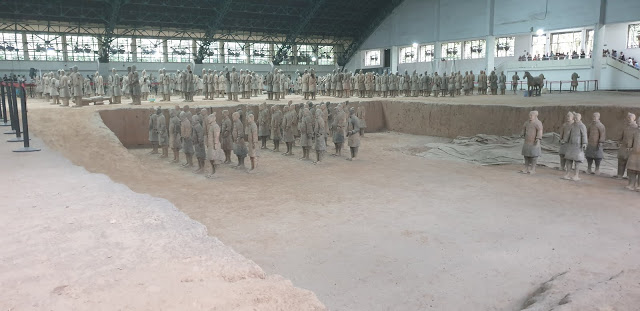
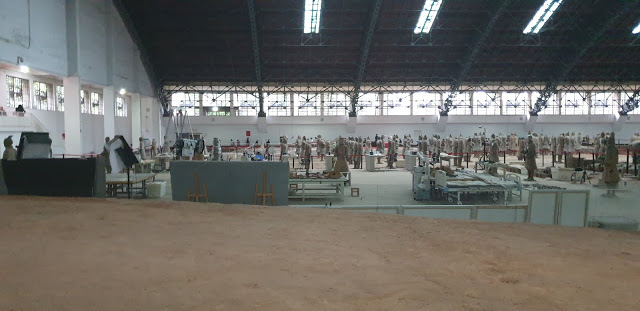
This has quite a number of standing soldiers that have been glued back together, but not necessarily complete and I notice a number if the statues were incomplete. And if they cannot find the missing pieces, then they are not added to or filled in.
The scale of the pit is enormous, and they have hardly scratched the surface in the restoration process.
What is there is a number of horses as well.
That’s at the front of the pit, a long line of statues, and what is clear is the location of the well where the first fragments were found by a farmer.
There are about eight lines of soldiers, and some lining the sides.
Midway down there is a large area currently under excavation
At the back is the hospital where the soldiers are reassembled. There’s nearly a hundred in the various stages of rebuilding. These days the soldiers are rebuilt using computer imaging.
The hospital area is where they are put back together
And these are some of the statues in various stages of reconstruction
Another two views of the size and scale of the reconstruction project
The coffee shop is also a sales centre, but there are too many people waiting for coffee and too few places to sit down.
There’s something to be said for a story that starts like a James Bond movie, throwing you straight in the deep end, a perfect way of getting to know the main character, David, or is that Alistair?
A retired spy, well, not so much a spy as a retired errand boy, David’s rather wry description of his talents, and a woman that most men would give their left arm for, not exactly the ideal couple, but there is a spark in a meeting that may or may not have been a setup.
But as the story progressed, the question I kept asking myself was why he’d bother.
And, page after unrelenting page, you find out.
Susan is exactly the sort of woman to pique his interest. Then, inexplicably, she disappears. That might have been the end of it, but Prendergast, that shadowy enigma, David’s ex-boss who loves playing games with real people, gives him an ultimatum: find her or come back to work.
Nothing like an offer that’s a double-edged sword!
A dragon for a mother, a sister he didn’t know about, Susan’s BFF who is not what she seems or a friend indeed, and Susan’s father, who, up till David meets her, couldn’t be less interested, his nemesis proves to be the impossible dream, and he’s always just that one step behind.
When the rollercoaster finally came to a halt, and I could start breathing again, it was an ending that was completely unexpected.