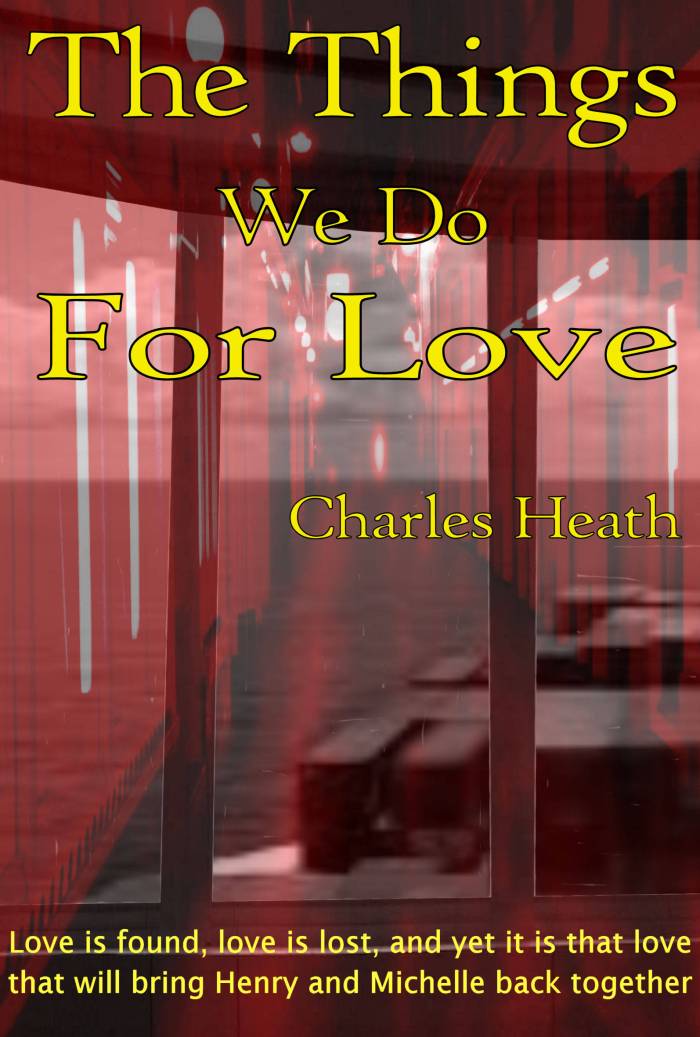
An excerpt from “The Things We Do for Love”; In love, Henry was all at sea!

In the distance, he could hear the dinner bell ringing and roused himself.  Feeling the dampness of the pillow and fearing the ravages of pent-up emotion, he considered not going down but thought it best not to upset Mrs Mac, especially after he said he would be dining.

In the event, he wished he had reneged, especially when he discovered he was not the only guest staying at the hotel.

Whilst he’d been reminiscing, another guest, a young lady, had arrived.  He’d heard her and Mrs Mac coming up the stairs and then shown to a room on the same floor, perhaps at the other end of the passage.

Henry caught his first glimpse of her when she appeared at the door to the dining room, waiting for Mrs Mac to show her to a table.

She was in her mid-twenties, slim, with long brown hair, and the grace and elegance of a woman associated with countless fashion magazines.  She was, he thought, stunningly beautiful with not a hair out of place, and make-up flawlessly applied.  Her clothes were black, simple, elegant, and expensive, the sort an heiress or wife of a millionaire might condescend to wear to a lesser occasion than dinner.

Then there was her expression; cold, forbidding, almost frightening in its intensity.  And her eyes, piercingly blue and yet laced with pain.  Dracula’s daughter was his immediate description of her.

All in all, he considered, the only thing they had in common was, like him, she seemed totally out of place.

Mrs Mac came out of the kitchen, wiping her hands on her apron.  She was, she informed him earlier, chef, waitress, hotelier, barmaid, and cleaner all rolled into one.  Coming up to the new arrival, she said, “Ah, Miss Andrews, I’m glad you decided to have dinner.  Would you like to sit with Mr Henshaw, or would you like to have a table of your own?”

Henry could feel her icy stare as she sized up his appeal as a dining companion, making the hair on the back of his neck stand up.  He purposely didn’t look back.  In his estimation, his appeal rating was minus six.  Out of a thousand!

“If Mr Henshaw doesn’t mind….”  She looked at him, leaving the query in mid-air.

He didn’t mind and said so.  Perhaps he’d underestimated his rating.

“Good.”  Mrs Mac promptly ushered her over.  Henry stood, made sure she was seated properly and sat.

“Thank you.  You are most kind.”  The way she said it suggested snobbish overtones.

“I try to be when I can.”  It was supposed to nullify her sarcastic tone, but it made him sound a little silly, and when she gave him another of her icy glares, he regretted it.

Mrs Mac quickly intervened, asking, “Would you care for the soup?”

They did, and, after writing the order on her pad, she gave them each a look, imperceptibly shook her head, and returned to the kitchen.

Before Michelle spoke to him again, she had another quick look at him, trying to fathom who and what he might be.  There was something about him.

His eyes mirrored the same sadness she felt, and, yes, there was something else, that it looked like he had been crying.  There was a tinge of redness.

Perhaps, she thought, he was here for the same reason she was.

No.  That wasn’t possible.

Then she said, without thinking, “Do you have any particular reason for coming here?”  Seconds later, she realised she’d spoken it out loud, hadn’t meant to actually ask, it just came out.

It took him by surprise, obviously not the first question he was expecting her to ask of him.

“No, other than it is as far from civilisation, and home as I could get.”

At least we agree on that, she thought.

It was obvious he was running away from something as well.

Given the isolation of the village and lack of geographic hospitality, it was, from her point of view, ideal.  All she had to do was avoid him, and that wouldn’t be difficult.

After getting through this evening first.

“Yes,” she agreed.  “It is that.”

A few seconds passed, and she thought she could feel his eyes on her and wasn’t going to look up.

Until he asked, “What’s your reason?”

Slightly abrupt in manner, perhaps, because of her question and how she asked it.

She looked up.  “Rest.  And have some time to myself.”

She hoped he would notice the emphasis she had placed on the word ‘herself’ and take due note.  No doubt, she thought, she had completely different ideas of what constituted a holiday than he, not that she had said she was here for a holiday.

Mrs Mac arrived at a fortuitous moment to save them from further conversation.

Over the entree, she wondered if she had made a mistake coming to the hotel.  Of course, there had been no conceivable way she could know that anyone else might have booked the same hotel, but she realised it was foolish to think she might end up in it by herself.

Was that what she was expecting?

Not a mistake then, but an unfortunate set of circumstances, which could be overcome by being sensible.

Yet, there he was, and it made her curious, not that he was a man, by himself, in the middle of nowhere, hiding like she was, but for quite varied reasons.

On discreet observation, whilst they ate, she gained the impression his air of light-heartedness was forced, and he had no sense of humour.

This feeling was engendered by his looks, unruly dark hair, and permanent frown.  And then there was his abysmal taste in clothes on a tall, lanky frame.  They were quality but totally unsuited to the wearer.

Rebellion was written all over him.

The only other thought crossing her mind, and incongruously, was that he could do with a decent feed.  In that respect, she knew now from the mountain of food in front of her, he had come to the right place.

“Mr Henshaw?”

He looked up.  “Henshaw is too formal.  Henry sounds much better,” he said, with a slight hint of gruffness.

“Then my name is Michelle.”

Mrs Mac came in to take their order for the only main course, gather up the entree dishes, and then return to the kitchen.

“Staying long?” she asked.

“About three weeks.  Yourself?”

“About the same.”

The conversation dried up.

Neither looked at the other, but rather at the walls, out the window, towards the kitchen, anywhere.  It was, she thought, unbearably awkward.

Mrs Mac returned with a large tray with dishes on it, setting it down on the table next to theirs.

“Not as good as the usual cook,” she said, serving up the dinner expertly, “but it comes a good second, even if I do say so myself.  Care for some wine?”

Henry looked at Michelle.  “What do you think?”

“I’m used to my dining companions making the decision.”

You would, he thought.  He couldn’t help but notice the cutting edge of her tone.  Then, to Mrs Mac, he named a particular White Burgundy he liked, and she bustled off.

“I hope you like it,” he said, acknowledging her previous comment with a smile that had nothing to do with humour.

“Yes, so do I.”

Both made a start on the main course, a concoction of chicken and vegetables that were delicious, Henry thought when compared to the bland food he received at home and sometimes aboard my ship.

It was five minutes before Mrs Mac returned with the bottle and two glasses.  After opening it and pouring the drinks, she left them alone again.

Henry resumed the conversation.  “How did you arrive?  I came by train.”

“By car.”

“Did you drive yourself?”

And he thought, a few seconds later, that was a silly question; otherwise, she would not be alone, and certainly not sitting at this table. With him.

“After a fashion.”

He could see that she was formulating a retort in her mind, then changed it, instead, smiling for the first time, and it served to lighten the atmosphere.

And in doing so, it showed him she had another, more pleasant side despite the fact she was trying not to look happy.

“My father reckons I’m just another of ‘those’ women drivers,” she added.

“Whatever for?”

“The first and only time he came with me, I had an accident.  I ran up the back of another car.  Of course, it didn’t matter to him that the other driver was driving like a startled rabbit.”

“It doesn’t help,” he agreed.

“Do you drive?”

“Mostly people up the wall.”  His attempt at humour failed.  “Actually,” he added quickly, “I’ve got a very old Morris that manages to get me where I’m going.”

The apple pie and cream for dessert came and went, and the rapport between them improved as the wine disappeared and the coffee came.  Both had found, after getting to know each other better, that their first impressions were not necessarily correct.

“Enjoy the food?” Mrs Mac asked, suddenly reappearing.

“Beautifully cooked and delicious to eat,” Michelle said, and Henry endorsed her remarks.

“Ah, it does my heart good to hear such genuine compliments,” she said, smiling.  She collected the last of the dishes and disappeared yet again.

“What do you do for a living?” Michelle asked in an offhand manner.

He had a feeling she was not particularly interested, and it was just making conversation.

“I’m a purser.”

“A what?”

“A purser.  I work on a ship doing the paperwork, that sort of thing.”

“I see.”

“And you?”

“I was a model.”

“Was?”

“Until I had an accident, a rather bad one.”

“Oh, I’m sorry.”

So that explained the odd feeling he had about her.

As the evening wore on, he began to think there might be something wrong, seriously wrong with her because she didn’t look too well.  Even the carefully applied makeup, from close, didn’t hide the very pale, tired look, or the sunken, dark-ringed eyes.

“I try not to think about it, but it doesn’t necessarily work.  I’ve come here for peace and quiet, away from doctors and parents.”

“Then you will not have to worry about me annoying you.  I’m one of those fall-asleep-reading-a-book types.”

Perhaps it would be like ships passing in the night, and then he smiled to himself about the analogy.

Dinner over, they separated.

Henry went back to the lounge to read a few pages of his book before going to bed, and Michelle went up to her room to retire for the night.

But try as he might, he was unable to read, his mind dwelling on the unusual, yet compellingly mysterious person he would be sharing the hotel with.

Overlaying that original blurred image of her standing in the doorway was another of her haunting expressions that had, he finally conceded, taken his breath away, and a look that had sent more than one tingle down his spine.

She may not have thought much of him, but she had certainly made an impression on him.

© Charles Heath 2015-2024

lovecoverfinal1

In a word: Hear

Which reminds me, I am told I have selective hearing, that I only hear what I want to hear

But what if you overhear someone?  Would it be by accident or on purpose?  Of course, some people talk so loudly you can’t help but hear them

In reality, to hear is to perceive with the ear something or someone

If you pay attention in class, you might hear what is being said

The judge, far from being dismissive, said he would hear the case

And I’m sure we sometimes wonder if God can hear our prayers

Did you hear the news?  If it’s anything other than COVID I probably did.

Hear hear, now what does that really mean when someone cries it out after someone else makes a statement?

This is not to be confused with the word here

Like when someone asks where you are, you say I’m here, but forget to add that you are invisible

This is going to end here and now!

Here is a book I think you should read

Here, let me take that bag of groceries

How many times did you consider not saying ‘here’ when the teacher called your name at roll-call?  I know I did, a few times

“One Last Look”, nothing is what it seems

A single event can have enormous consequences.

A single event driven by fate, after Ben told his wife Charlotte he would be late home one night, he left early, and by chance discovers his wife having dinner in their favourite restaurant with another man.

A single event where it could be said Ben was in the wrong place at the wrong time.

Who was this man? Why was she having dinner with him?

A simple truth to explain the single event was all Ben required. Instead, Charlotte told him a lie.

A single event that forces Ben to question everything he thought he knew about his wife, and the people who are around her.

After a near-death experience and forced retirement into a world he is unfamiliar with, Ben finds himself once again drawn back into that life of lies, violence, and intrigue.

From London to a small village in Tuscany, little by little Ben discovers who the woman he married is, and the real reason why fate had brought them together.

It is available on Amazon here:  http://amzn.to/2CqUBcz

The cinema of my dreams – I always wanted to write a war story – Episode 47

For a story that was conceived during those long boring hours flying in a steel cocoon, striving to keep away the thoughts that the plane and everyone in it could just simply disappear as planes have in the past, it has come a long way.

Whilst I have always had a fascination with what happened during the second world war, not the battles or fighting, but in the more obscure events that took place, I decided to pen my own little sidebar to what was a long and bitter war.

And, so, it continues…

——

Johannesen went to find Wallace.  He had seen Jackerby leave the castle alone, which couldn’t be a good thing.  He had also noticed most of the Resistance members had gone too and had considered going back to the dungeons,

If he had been picking team members, Jackerby would not have been one of them.  He might act British and speak perfect British English, but he was a Nazi at heart, perhaps more Nazi than the Nazis’

It was not unsurprising.  The file Wallace had on him along with one for all of them, wasn’t exactly describing a life of roses.  His grandparents were German, and the British had killed them during the first world war.  There was no doubting he had based his whole life on one day avenging them, and this war had given him the opportunity.

To be a wolf in sheep’s clothing.

Johannesen guessed that was an apt description of him.  He was a devoted follower of Mosley and the English Fascists, openly supporting Hitler until it came to choosing a side.  That was easy, become part of a fifth column, Worthing from within.

And when the Reich became the all-powerful country when they won the war, there would be a position for him, a war hero.

Losing the war hadn’t figured in the story, but despite the successes, there were more failures, and tactical errors, like trying to invade Russia, and he could see that it was going to be the reason Germany lost.  Superior weapons were not going to staunch the losses, and it was only a matter of time.

The time he would use to figure out how not to get shot as a spy and somehow get back on the other side.

But, not today.

Wallace was trying a new wine, have the same thirst for wine, but not as swill as those Resistance members like Leonardo, a deep-colored red.

“You should try a glass, Johannes.  It’s an exceptional vintage.”  He picked up the bottle and looked at the label, then cleaning the dust off the label, said, “1907 no less.  Bastards never sold any of this to us to try.  We should liberate the cellar, and share it with our compatriots after the war.  At a price, of course.”

Like all the soldiers he’d met along the way, always looking to make a profit.  Goering and Hitler steal all the paintings, they were talking about the wine.  What did the people finish up with?

“Not really a red man, sir.”

“That’s because you’ve never had one like this.”

“Why not.”

Wallace poured him a glass.

Johannesen sipped it.  Wallace was right, it was better than any other he had tasted, not that he could really remember the last time he had the opportunity.

“It is quite good, sir.”

“It is.  You know Jackerby says you are a double agent, which is pretty rich coming from him.  Strictly speaking, if wouldn’t be a double agent, but a triple agent, if that was the case.  You’re not, are you?”

The smile on Wallace’s face didn’t extend to the eyes.  He was not amused, or annoyed.

Just fishing.

“That’s the problem with our situation.  We’ve been lying to everyone for so long, that it’s hard t tell what is the truth and what isn’t.  At the moment, the British don’t know where my allegiances lie, they think I’m the sleeper in this group, and Atherton, well, he’s not sure if that’s the case or not.  No doubt Jackerby told you about my trip to the dungeons to get the woman to talk.  Jackerby offers the big stick and that isn’t going to work on these people.  She’ll die before she gives up any secrets.  They all will.  And by all accounts that breute Leonardo was executing her compatriots in front of her to make her talk, and all they are is dead, and we’re no closer to anything.  What do you think I am?”

“Clever.  But that isn’t going to be my problem in,” he looked at his watch, “two hours.  We have a new commander, and a few more people arriving to weed out this elusive Atherton and the few resistance that’s left.  People higher than me want Meyer returned to Germany.  Whatever you are, Johannesen, you might have to plead your case to someone else far less understanding.”  He stood.  “Enjoy the wine.  It might be your last.”

Reading between the lines, Johannesen got the impression Wallace no longer cared what happened.  For all of them, it had been a long war, and it was dragging on with no success in sight.

And it was becoming abundantly clear he picked the wrong side.  Now, all that was going to happen was that he would end up in the crossfire.  Perhaps he had known all along that the German notion that no one could ever be trusted, that everyone should be treated as a traitor first, was going to be the death of all of them.

He had no doubt the new arrivals would be Waffen SS, battle-hardened, and sent on this mission as a sort of holiday.  They would find Atherton and the remnants very quickly and snuff out a problem Jackerby couldn’t.

Or, if Jackerby knew the Waffen SS was coming, had he left, knowing his loyalties would be called into question.  Pure German soldiers versus double agents, Johannesen knew who’d he believe first.

For the first time, Johannesen knew he was not going to see the end of this war, or that Germany had any hope of winning.

He needed a plan of escape, and that woman in the dungeons was the only one who could help him.

——-

© Charles Heath 2020-2022

A photograph from the inspirational bin – 11

I remember hearing one day, a line from a poem, ‘I wandered lonely as a cloud’.

Little did I know at the time it was the first line of a poem by William Wordsworth, and mentioned something else, daffodils, and I had a moment where a memory came back from when I was about five, gathering daffodils in a field behind the house we lived in.

But, how often is it we look at clouds and try to make them into something else we’ve seen before?

Clouds are the subject of many conversations, like he’s got his head in the clouds, not literally of course in this instance, just that he, or it could be a she, if far removed from reality.

Dark clouds are associated with ill will and infamy, e.g. he was born under a dark cloud. I heard my grandmother use that expression once, and wondered what she meant by it, because, being a child, it was a literal interpretation, that dark clouds brought heavy rain, and he go ‘very wet’.

I’ve been caught out by dark clouds too, misjudging how long before they arrive, and it always seems like next to no time before you, and the washing on the line get a thorough soaking.

These days, the cloud now means something else entirely, though based on an old analogy, that we store our computer files in the cloud, which simply means at a remote location on someone else’s computer. With file sizes the way they are, it’s not practical to store them on our own smallish computers.

And, isn’t it fun when you are flying through the clouds?

Not!

In those cases, going up or going down in a plane, it’s a very bumpy ride, and isn’t it quite strange when you are flying above the clouds, or can just see mountain tops appearing through the blanket of white.

Of course, you can have your head in the clouds and not be off with the fairies, if you are on a mountain when the clouds have come down so low you can touch them. Sometimes it’s called mist or fog, but there are such things as low clouds. I’ve seen them.

And, as for a single cloud as inspiration…

The story starts,

I was sitting down in a quiet corner of the park, the sound of children playing just audible in the background, along with a lawn mower, and the distant sounds of civilization.

I wanted to get as far away as possible, but in the concrete jungle that was not possible.

IT had bene a difficult morning, juggling customer complaints with the the call from the girl I thought was the one, but who had decided we were going in different directions and it was time.

Yes, we were literally going in different directions, she was heading off to Boston to start a new job, one that she only just decided to tell me about.

Was I disappointed? Just a little. Was it inevitable? My best friend thought so, and had said he had noticed a change in her. I had too, but was hoping it was a passing phaze.

I looked up, and there was a single cloud moving slowly across the sky, perhaps chasing after others that had passed before it.

Was it an omen. Would I become like that cloud, alone, always chasing after the impossible dream?

My phone vibrated, and I took it out. A message.

It was from the girl once of my dreams. I had not expected to hear from her again.

It was a short message, just one word.

“Help”

© Charles Heath 2021

The cinema of my dreams – Was it just another surveillance job – Episode 30

I’m back home and this story has been sitting on a back burner for a few months, waiting for some more to be written.

The trouble is, there are also other stories to write, and I’m not very good at prioritizing.

But, here we are, a few minutes opened up and it didn’t take long to get back into the groove.

Chasing leads, maybe


Collecting the car was easy because it was not kept near my flat.  I could not afford to park nearby, and couldn’t get a permit to park on the street.  I had cursed my bad luck at the time, but now it was very useful.

I spend a few hours resting in the car, stopping along the way at a park, and then, well past nightfall, I drove to the block in Oakwood Avenue, easily recognizable from the exterior photo also provided by the realtor.

Twice around the block, I stopped around the corner, past the block, and noted that I could walk back and then take cover from the trees and shrubs growing in front of, and around the building.  To reach the right flat, I would have to pass down the inner side towards the rear where, hopefully, there might be a door.

Otherwise, it would have to be the hard way.

At 00:45, I left the car, and walked back to the block, keeping an eye out form people walking, or looking out their windows on either side of the street.  Then, satisfied I hadn’t been seen, I ducked through the trees and quickly walked the distance from the front to the side where I stopped and waited.  After a few minutes, and nothing had stirred, I started down the side of the building.

Several flats had lights on, but the curtains were drawn.  Being the ground floor, I doubted whether those curtains would be open at night.  It didn’t take long to be alongside the flat in question.

It was in total darkness, and the curtains had been drawn.

First problem.  There was no back door.  The traditional entry point would be the front door, and no doubt there was a communal back door as well.  Next, I checked the windows, and those that I could see were complete glass and non-opening.  Worse still they had a metal grilled across them to deter thieves.

Near the corner, leading to the rear of the building was a window, higher up and ajar.  By its location, I guessed this was the bathroom or the toilet.  I was hoping for the former.

It took a few minutes to unlatch the window and several more to scramble up the wall, and it through the window opening, which wasn’t much wider than me.  I had to be careful not to drop any of the bottles on the inner ledge.

Once down of the other side, inside the room, it was a narrow bathroom, without a bath, and almost impossible to see.  I fixed the window and put everything back on the ledge, just in case someone did a circuit of the building at a security measure.

Once inside, and after one in the morning, little stirred.

I could just faintly hear the flat owners above, hardly enough noise to be concerned about, and bringing a thought; shouldn’t they be asleep like everyone else.

It was certainly a quiet neighborhood.

I brought a small torch from the car with me and sparingly used it to find my way around.  When my eyes got used to the semi-darkness, I found that the flow from small lights of appliances adequately lit the rooms.

It had two bedrooms, one empty and being used as a storeroom, a lounge room, a dining area, and the bathroom, and kitchen area.  It was big enough for a couple, or even a couple with one child.

Inside what I assumed was the front door, I found several letters shoved under the door.  They were addressed to Mr. Adam Quinley.

I hoped that I’d not made a mistake and broken into a flat belonging to another person.  O’Connell didn’t see to me to be a Quinley, because it was an unusual name.

The dates on the letters went back a week and told me whoever the flat belonged to, they hadn’t visited it for a while.  I went back to the lounge room and over to a desk.  There were the familiar cords leading to no computer, but there was a printer.  It meant he had a laptop he carried with him.

A laptop that no one had found.  It suggested to me that he had it somewhere near him, perhaps in a car, which may be still parked in a garage, or parking station somewhere.

I searched through the neat pile of documents on the desk, and in a folder marked ‘Accounts’ and found one for the car registration, in the name of Quigley.  I noted the registration and type of car, and just in case I forgot it, folded the piece of paper and put it in my pocket.  It would be the subject of my next search if nothing showed up.

The next half hour I made a thorough search of the flat and found nothing of use.  I checked for all the spots he might have hidden the USB, but it was not there.  He had kept it somewhere else.

Done, I left the flat by the front door, and for good measure, checked his mailbox, outside, and found a number of letters.  I took them and would look at them back in the car.  Just as I made the tree line to walk back, a car stopped outside the building.

The door opened and I watched the driver get out of the car, stop and look up and down the street, then walk towards the front door,

By chance, the occupant of the flat above the door switched on a light in the room which, uncurtained, spilled out to shed light on the person now at the front entrance.

I recognized her immediately, just before the light was switched off and darkness took over.

It was Jan.


© Charles Heath 2020

365 Days of writing, 2026 – My second story 4

More about my second novel – First Dig Two Graves

So, not all second books are sequels, but in this case, it is.

Not to the first book that was written last year, but for one that I wrote some years ago.

The Devel You Don’t.

This one is called First Dig Two Graves.

At the end of the first book in the series, Alistair, Zoe, the assassin’s handler, was killed.

As far as he was concerned, Zoe had reneged on the contract to kill a target, and for that, she had to be punished, just to let the rest of the team know they could not decide arbitrarily who or whom they would not kill.

For her sins, Zoe had been captured and was about to be executed when John, the man who wanted to become her boyfriend, turned up on a reckless and unplanned rescue mission.

But as ad-hoc operations go, it was one that was very successful.  Zoe, though badly injured, aided John in a do-or-die escape.

Alistair learned to his chagrin that a badly injured Zoe and an untrained, well-meaning friend trumped overconfidence.

Of course, Alistair’s death does not go unnoticed, and his mother, a renowned and very capable ex-KGB agent with connections, wants to avenge his death.  Her influence reaches as far as the upper echelons of the State’s intelligence services, and requests from her would never be ignored.

Such a request for assistance is made; resources are allocated, and so starts the next book in the series.

It’s all about revenge.

Of course, nothing to do with Zoe or John, or their relationship, runs smoothly, and once again in pursuit of the impossible, he makes it his mission in life to win over the assassin-on-sabbatical.

But first, he must find her and sort through the lies and treachery of his best friend, who is also looking for Zoe, but for entirely different reasons.

If I only had one day to stop over in – Moscow – what would I do?

Making the Most of Your One-Day Stopover in Moscow: The Ultimate Guide to Red Square

If you’re whisked away on a one-day stopover in Moscow, you’re in for a whirlwind of history, grandeur, and unforgettable vistas. While the city teems with landmarks, there’s one place that captures Moscow’s soul and serves as the perfect hub for a memorable day: Red Square. This iconic plaza isn’t just a single attraction—it’s the heart of Russia’s capital, where centuries of imperial history, stunning architecture, and vibrant culture converge. Here’s how to make the most of your day.


Morning: Arrival and the Majesty of Red Square

Start your day early to beat the crowds and soak in the serene, pre-dawn atmosphere of Red Square (Красная площадь). As the sun rises, the golden domes of St. Basil’s Cathedral shimmer, and the Kremlin’s fortress walls glow in the light. Begin your stroll here, taking photographs and marvelling at the square’s historical energy.

  • St. Basil’s Cathedral: Pop into this kaleidoscopic masterpiece. Climb its domes for panoramic views of Moscow, or simply admire its colourful onion-shaped roofs.
  • GUM Department Store: Adjacent to the square, this neoclassical shopping arcade has sold luxury goods to Russian elites for centuries. Grab a coffee at its open-air café to people-watch.

Midday: Kremlin Intrigue

A short walk away lies the Kremlin—Moscow’s most powerful symbol. This fortified complex is a labyrinth of palaces, cathedrals, and museums. Allocate 2–3 hours here to explore:

  • Kremlin Walls and Towers: Walk along the 19th-century fortress walls, with stunning views of the city below.
  • Cathedrals of the Assumption and St. George: Tour these UNESCO-listed churches, where Russian emperors and Soviet leaders are buried.
  • The Armory Chamber: Discover opulent treasures like the Diamond Fund and Fabergé eggs.

Pro Tip: Book your Kremlin tickets in advance to skip the lines—especially recommended if you’re short on time.


Afternoon: The State Historical Museum

Head back to Red Square for a deeper dive into Russia’s past at the State Historical Museum (Gosudarstvennyy istoricheskiy muzei). Its gold-domed façade is a masterpiece itself, but inside, you’ll find exhibits spanning Byzantine icons to Soviet memorabilia. This is a must for history buffs, offering context for the landmarks you’ve seen.

Alternatively, take a lunch break at Ermolaevskiy (just steps from the square). This historic restaurant serves traditional Russian dishes like borscht and pelmeni in a lively, old-world setting.


Evening: A Walk to the Kremlin Wall and Beyond

As the sun sets, stroll along the Kremlin Wall Gardens, a hidden gem with a prime view of the Kremlin and St. Basil’s. For a romantic finale, visit Sparrow Hills (Vorobyevy Gory) in Moscow’s southwest. The 200-meter hill offers sweeping views of the city’s skyline and is lit up at night—a magical way to cap your day.

What I learned about writing – It is not what we say, it is how we say it

We’re back to words of wisdom: the true writer has nothing to say; what counts is the way he says it.

Does this mean everything we write must be compelling? Certainly, that remark I once read on the front of a thriller novel I once bought simply because of it, holds true. The remark, “Grabs the reader by the scruff of the neck and drags them through to the last crowded page”.

And oddly enough it was true, I read the book in a single sitting.

It also lit the fire under me to write spy novels, too.

I’m guessing the whole point of the simple few words is to make us writers sit up and think about how we’re going to engage the reader.

I read a lot, and it’s generally the first few pages that will draw me in or turn me off. I had written quite a few stories, and it took me a while to realise that boring introductory stuff can be spread sparingly through the pages, whilst all the edge-of-the-seat stuff is going on around it.

I call it writing the James Bond start, that from the first sentence you’ve been dropped into an erupting volcano, and you’ve got about fifteen seconds to work out how to get out of it. Of course, there is that circling helicopter gunship firing machine guns at you at the same time, shredding the parachute that just caught fire.

It’s why, going way back in cinema land in the previous century, the serials that ran before the main picture always had a cliffhanger ending.

The same should apply, in a sense, to the story, always leaving it in such a way that the reader has to read on.

I try.

Harry Walthenson, Private Detective – the second case – A case of finding the “Flying Dutchman”

What starts as a search for a missing husband soon develops into an unbelievable story of treachery, lies, and incredible riches.

It was meant to remain buried long enough for the dust to settle on what was once an unpalatable truth, when enough time had passed, and those who had been willing to wait could reap the rewards.

The problem was, no one knew where that treasure was hidden or the location of the logbook that held the secret.

At stake, billions of dollars’ worth of stolen Nazi loot brought to the United States in an anonymous tramp steamer and hidden in a specially constructed vault under a specifically owned plot of land on the once docklands of New York.

It may have remained hidden and unknown to only a few, if it had not been for a mere obscure detail being overheard …

… by our intrepid, newly minted private detective, Harry Walthenson …

… and it would have remained buried.

Now, through a series of unrelated events, or are they, that well-kept secret is out there, and Harry will not stop until the whole truth is uncovered.

Even if it almost costs him his life.  Again.