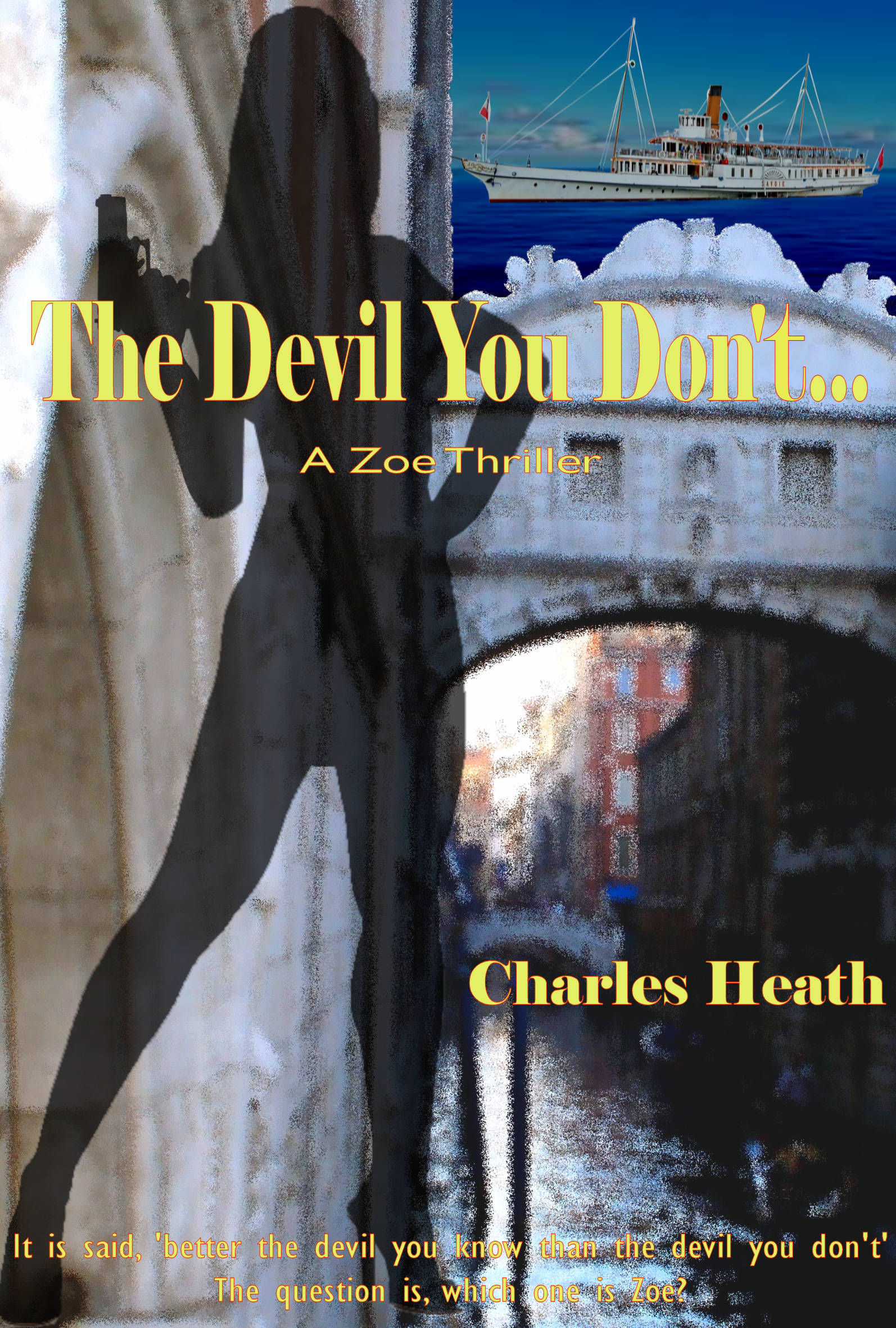
‘The Devil You Don’t’ – A beta reader’s view

It could be said that of all the women one could meet, whether contrived or by sheer luck, what are the odds it would turn out to be the woman who was being paid a very large sum to kill you.

John Pennington is a man who may be lucky in business, but not so lucky in love. He has just broken up with Phillipa Sternhaven, the woman he thought was the one, but relatives and circumstances, and perhaps because she was a ‘princess’, may also have contributed to the end result.

So, what do you do when you are heartbroken?

That is a story that slowly unfolds, from the first meeting with his nemesis on Lake Geneva, all the way to a hotel room in Sorrento, where he learns the shattering truth.

What should have been solace after disappointment, turns out to be something else entirely, and from that point, everything goes to hell in a handbasket.

He suddenly realizes his so-called friend Sebastian has not exactly told him the truth about a small job he asked him to do, the woman he is falling in love with is not quite who she says she is, and he is caught in the middle of a war between two men who consider people becoming collateral damage as part of their business.

The story paints the characters cleverly displaying all their flaws and weaknesses. The locations add to the story at times taking me back down memory lane, especially to Venice where, in those back streets I confess it’s not all that hard to get lost.

All in all a thoroughly entertaining story with, for once, a satisfying end.

Available on Amazon here: https://amzn.to/2Xyh1ow

The cinema of my dreams – I always wanted to write a war story – Episode 51

For a story that was conceived during those long boring hours flying in a steel cocoon, striving to keep away the thoughts that the plane and everyone in it could just simply disappear as planes have in the past, it has come a long way.

Whilst I have always had a fascination in what happened during the second worlds war, not the battles or fighting, but in the more obscure events that took place, I decided to pen my own little sidebar to what was a long and bitter war.

And, so, it continues…

Wallace had not returned upstairs by the normal stairs, but the one by the radio room, far removed from the basement area where the prisoners were kept.

If he had, he might have realised that something was very, very wrong.

There were no more prisoners, except for Martina.  The other defectors that had been captured had, on Johannsen’s orders, taken away by the three remaining resistance fighters, to be executed in the woods not far from the castle.

They had gone an hour before Schmidt’s men had departed, but in a different path, and would avoid running into the others.  Johannesen had given Fernando’s second-in-command a silenced luger and told him to only use that gun for the execution.  And to make as little noise as possible.

When they had left an eerie silence fell over the cellar.

Johannsen passed by Martina’s cell and looked in.  She was lying on the ground, still badly injured from the beating Fernando had given her.  She let him look at her for a minute, then said, “When is this going to be over.  I’m not going to tell you anything.”

“I don’t doubt that for a moment?”

“Where did you send the rest of the prisoners?”

“Back to Germany.  Someone else can deal with them.”

She didn’t believe him for one moment, but let it pass. “Why betray your country?”

“England?  England wasn’t my country, it’s just where I ended up before the war.  Then it seemed a good idea to become a double agent.”

“Germany isn’t winning the war, you know, despite what the fools in Berlin keep telling you.”

“I could have you shot for saying that.”

“Then get on with it.  I’m over waiting for whatever you’re going to do to me.”

“All in good time.  The new people have brought some very good interrogators and they promise they’ll have you singing like a canary in no time.”

She shrugged, and it hurt.

“Fools.”

“Actually, I’m inclined to agree with you.  So much so, I believe, if I can get you out of here, you might put in a good word for me.  Atherton is out there, and he’s coming, isn’t he?”

“Atherton is just a boy pretending to be a soldier.”

He smiled.  “That’s what he wants everyone to think, but Thompson, the man you take orders from, he thinks Atherton is one of his best agents.  And he will have a plan, and being the archaeological major that he was, he’ll know how to breach this place.”

And the fact she didn’t argue or deny what he was suggesting told him she was waiting.

“You expect too much, there are no more resistance fighters except for a few young lads, and that dog of his.”  She laughed.  “Rescued by three children and a dog.  I wonder if Germany will record that piece of history if it comes to pass.  Go away, whoever you are, and leave me to die in peace.”

“When the time comes, I’ll be back.”

She ignored him, and rolled over to face the wall.

The two guards had been watching him, though they had not been following the conversation.  The officer in charge, Wallace, had told them to keep an eye on everyone who came and went, and though Johannesen was on that watch list because he treated them better than Jackerby or the commandant did, they simply ignored him.

At their peril.

Johannesen wandered up to them, bade them a good evening, and then shot them.  He dragged the bodies to a place where no one would look and then headed along to the radio room.  The guards and radio men would not be changed for another eight hours, so no one was going to miss them.  Unless someone came down top check, but Johannesen had done several nights observation, and no one had.

The two radio men disposed of, it was time to block off the entrances to the basement so no one could come down.  These exits or entrances were large iron gates bolted and locked with ancient locks.  There was only one key to each, and Johannsen had the key ring with them on it.  He’d taken that of one of the dead guards.

Once the entrances were locked, he went back to Martina’s cell and unlocked the door.

At the sound of the key, she turned back.

“Time to go,” he said.  “We have a very small wind to escape before they find out upstairs.”

“I cannot save you, if Atherton thinks you are a traitor.”

“Atherton is probably the only level headed person in this area.  He’ll appreciate what I;ve done and give me a second chance.”

She shook her head.

“Once a traitor, always a traitor.”

“Be that as it may, just hold that thought.  I’m giving you a gun, and I’m hoping you won’t use it on me.”

He went into the cell and assisted her to stand.  She was weak, but the thought of escaping death put a little life into her limbs.

“It will not be a quick getaway,” she said.

“Just as long as it is a getaway,” he said, as they headed for the exit.

At the same time, there was a very large explosion from above, the percussive sound almost deafening them.

“What the hell was that?” Johannesen muttered.

“Most likely the diversion we needed, that you forgot to arrange.”

© Charles Heath 2021-2023

A photograph from the inspirational bin – 15

It’s the obvious items in the photograph that you see first, or that your eyes go to first.

The ocean, the beach, the buildings. You can see a shopping mall with MacDonald’s sign above it.

Yes, it’s late afternoon, and you can see long shadows of the buildings.

So, if I asked you what did you see in this photo, what would your reply be?

From a thriller writer or murder mystery writer’s point of view, it’s what you don’t necessarily see.

So, for the purposes of the story, the opening line for the world-weary detective, handing the photo to his partner, “What’s is it you can’t see in this photo?”

A partner that hadn’t been on the job very long, in from the suburbs, and had seen little more than break and enters car theft, and school kids hi-jinks.

“What am I supposed to be looking for?”

“You want to be a detective, or be looking for old ladies cats?”

His partner takes the photo in hand and looks at it again.  There has to be a reason why the old man had given it to him, or perhaps there wasn’t and he was just playing with him again.

No, he thought, there has to be something…

And then he saw it, quite by accident.  A hand, a gun, and following the line of fire, at the end, what looked like someone in the bushes.

In a photo taken from a higher floor of the building over the road, looking down on what was supposed to be a rooftop recreational area.

Only there had been no report of a missing person or a gunshot wound in the last seven days.

“When was it taken?”

“Two days ago?”

“And no reports of a shooting, or a body?”

“No.  And yet the person who took this swears he saw a body, but by the time he came back, there was nothing.”

The detective handed his partner a second photo.  Time-stamped five minutes later.  With no gun and no body.

What will happen next?

The cinema of my dreams – Was it just another surveillance job – Episode 34

I’m back home and this story has been sitting on a back burner for a few months, waiting for some more to be written.

The trouble is, there are also other stories to write, and I’m not very good at prioritizing.

But, here we are, a few minutes opened up and it didn’t take long to get back into the groove.

Chasing leads, maybe

She had brought a file.  It looked the same as the last one she brought with her, the one with my name on it.

This time it was thicker.

Intelligence gathering at its finest.  There’d be stuff in there that even I didn’t know about me.

She didn’t open it, just looked at me.

“What have you been doing?”

“Working?”

“For whom?”

“Nobbin, of course.  I am now assigned to his section.  Did you do that?”

“He did.  He tells me you’re working on the O’Connell investigation.”

“Is that what it’s called.  He never told me that.  And I had to find out where I’d been assigned by logging onto a computer.  An email or a letter would have made my life a little easier.”

“You’re just lucky you’re still working here.  Now, tell me more about this Severin character.”

“I told you everything I knew the last time you spoke to me.  Apparently, you seemed to know who it was.  Perhaps you might tell me, too.”

“It’s…”

“And,” I interrupted, “don’t tell me it’s above my pay grade.  I was potentially working for traitors and could have finished up in jail for treason.”

“You might still get there.”

Then why hadn’t she had me arrested and thrown in a dungeon the last time we met?  There was an easy answer to that question.  She needed me out in the field.  Nobbin needed me in the field.  They presumably needed me to remain available to Severin for whatever reason.

“What do you want?”

She opened the file, turned a few pages, and stopped at a yellow sheet of paper.  I wasn’t able to read it upside down, but it had very small spidery writing on it.

Then she looked at me again.

“Some secret documents appear to have gone missing.  We believe that is to say Director Dobbin thinks these may have been on a USB drive that was in the possession of O’Connell at the time of his death.  You were there at the time of his death.  You can see where this is going…”

No matter which answers I gave it was the wrong one, which led to do not pass go and do not collect two hundred dollars, or pounds as the case may be.

“I haven’t got it, and he didn’t tell me where it was, and I saw him die.”

“If you say so.”  She went back to the file and turned some more pagers.

“What do you mean?”

She looked up.  “So far, there’s no body been recovered, or any evidence there was a shooting where you said it was.”

“Are you trying to tell me he’s alive, because if you are, then I must be a very poor judge of people who have no pulse.  He was not about to get up and walk away.”

“Did you see the body removed?”

Now there’s an interesting point.  I had done as I was told and left when told to.  I assumed Severin would sort the problem out, in fact, hadn’t he called in the cleaners?  I saw a white van.

Actually, when I thought about it, I had no idea what happened after I left.  And, now that I remember, I didn’t see anyone get out of the white van.

Could bodies get up and walk?

I was beginning to think they could.

© Charles Heath 2020-2022

365 Days of writing, 2026 – 28

Day 28 – What is an elevator pitch

The Art of the Elevator Pitch: How to Make a Lasting Impression in 30 Seconds

In today’s fast-paced business world, making a good impression is crucial. Whether you’re an entrepreneur, a job seeker, or a professional looking to network, being able to effectively communicate your value proposition is essential. This is where the elevator pitch comes in – a brief, persuasive speech that can be delivered in the time it takes to ride an elevator, typically between 30 seconds to 2 minutes.

What is an Elevator Pitch?

An elevator pitch is a concise, well-rehearsed summary of your professional brand, product, or service. It’s a way to introduce yourself, highlight your unique selling points, and spark interest in your listener. The goal is to pique their curiosity, establish a connection, and potentially open the door to new opportunities.

Why is an Elevator Pitch Important?

A well-crafted elevator pitch can help you:

  1. Stand out from the crowd: In a crowded room or a competitive job market, a strong elevator pitch can help you differentiate yourself from others.
  2. Build connections: An elevator pitch can be the starting point for meaningful relationships, partnerships, or collaborations.
  3. Generate interest: By highlighting your unique value proposition, you can capture the attention of potential customers, investors, or employers.
  4. Save time: An elevator pitch allows you to quickly and efficiently communicate your message, saving time for both you and your listener.

How to Craft a Compelling Elevator Pitch

To create an effective elevator pitch, follow these steps:

  1. Define your goals: What do you want to achieve with your elevator pitch? Are you looking to promote a product, secure funding, or land a job?
  2. Know your audience: Tailor your pitch to your listener’s interests, needs, and level of understanding.
  3. Focus on benefits: Emphasise the benefits of your product, service, or expertise, rather than just listing features.
  4. Keep it concise: Aim for a pitch that’s 30 seconds to 2 minutes long, depending on the context.
  5. Practice, practice, practice: Rehearse your pitch until it feels natural and confident.

Example of an Elevator Pitch

Here’s an example of a 30-second elevator pitch:

“Hi, I’m [Your Name], a digital marketing specialist with a passion for helping small businesses grow online. I’ve developed a unique approach that combines social media, content marketing, and SEO to drive traffic and increase conversions. I’ve helped numerous clients achieve significant growth, and I’m excited to explore how I can help you take your business to the next level.”

Conclusion

An elevator pitch is a powerful tool that can help you make a lasting impression, build connections, and achieve your professional goals. By crafting a clear, concise, and compelling pitch, you can effectively communicate your value proposition and open doors to new opportunities. Remember to practice your pitch, tailor it to your audience, and focus on the benefits you can offer. With a well-rehearsed elevator pitch, you’ll be ready to make a lasting impression, whenever and wherever the opportunity arises.

If I only had one day to stop over in – Belfast – what would I do?

One Day, One Stop: Why Titanic Belfast Is the Only Place You Need to Visit

You’ve just landed in Belfast for a quick stopover. The clock is ticking, the rain is drizzling, and you’ve got only 24 hours to soak up the soul of Northern Ireland’s capital. Where do you go? The answer is simple: Titanic Belfast—the world‑class visitor experience that turns a fleeting lay‑over into an unforgettable adventure.


1. The Power of a Single Icon

Belfast is a city of layers—industrial heritage, political history, vibrant street art, and a buzzing food scene. Trying to cram them all into a single day inevitably leads to a frantic dash from one museum to the next, leaving you exhausted rather than inspired.

Titanic Belfast, by contrast, packs history, architecture, storytelling, and emotion into one spectacular 10‑storey building that dominates the city’s waterfront. It’s not just a museum; it’s an immersive journey that:

  • Narrates the ship’s birth, tragedy, and rebirth in a way that feels personal, not just factual.
  • Showcases Belfast’s industrial spirit—the very shipyards that built the Titanic were the backbone of the city’s economy.
  • Offers panoramic city views from its rooftop glass lift, giving you a quick, breathtaking orientation of Belfast in under five minutes.

Put simply, stepping into Titanic Belfast means you walk through the heartbeat of the city without having to hop on multiple buses.


2. What Makes the Experience Memorable

FeatureWhy It Stands Out
The BuildingDesigned to look like the hull of a ship, the glass‑clad “ship’s bow” reflects the River Lagan and the surrounding skyline—perfect for a quick photo op.
The Storytelling GalleriesTen interactive galleries guide you from the Edwardian era, through the ship’s construction, to the fateful night in 1912, and finally to the modern-day legacy.
Full‑Scale Titanic ReplicaWalk the exact length of the grand staircase, explore the first‑class lounge, and stand in the engine room—feel the scale that no textbook can convey.
“Iceberg” Immersive TheatreA 3‑D projection room that drops you into the chilling moment the ship struck the iceberg—thrilling, yet respectful.
Rooftop Observation DeckA glass lift ascends 100 m, delivering a sweeping 360° view of Belfast, the shipyard, and the surrounding hills. A perfect “one‑minute” city overview.
Café & Gift ShopFinish with a cup of locally roasted coffee and pick up a handcrafted Titanic souvenir—a reminder of your day for years to come.

3. How to Fit Titanic Belfast Into a One‑Day Itinerary

TimeAction
08:30 – Arrival in BelfastDisembark, collect luggage, and hop on a Metro (bus) 400 from the airport to Titanic Quarter (≈ 15 min).
09:00 – Ticket & Quick BitePurchase tickets online in advance (≈ £19 adults) to skip the queue. Grab a quick pastry at the on‑site café while the line moves.
09:15 – Start the TourDive straight into Gallery 1 – “The Legend Begins.” Use the audio guide for a personal pace.
11:30 – Lunch BreakHead to The Dock Café (right outside) for a 30‑minute sandwich and a local craft beer.
12:00 – The Grand Staircase & Engine RoomFollow the self‑guided route through the ship’s interior—don’t miss the first‑class lounge for that glamorous glimpse.
13:15 – Iceberg Immersive TheatreReserve a 10‑minute slot; the 3‑D experience is short but powerful.
13:45 – Rooftop Observation DeckTake the glass lift up, snap panoramic shots, and soak the city’s layout—use this time to check your next travel connections.
14:30 – Gift Shop & DeparturePick up a souvenir, maybe a Titanic‑themed notebook, and hop back on the Metro 400 to the airport (or train station) for your onward journey.

Total time: ~ 6 hours (including travel, meals, and a comfortable buffer). This leaves you plenty of room for a quick coffee at a local shop or a stroll along the River Lagan before you head out.


4. Insider Tips for a Seamless Visit

  1. Buy Tickets Ahead – The online “Skip‑the‑Line” tickets guarantee you’ll be inside within minutes, even during peak tourist seasons.
  2. Wear Comfortable Shoes – You’ll be walking on metal decks, stairs, and the glass lift.
  3. Pack a Light Rain Jacket – Belfast weather is famously unpredictable; the rooftop deck is glass‑enclosed, but the queue line can be exposed.
  4. Use the Free Wi‑Fi – Download the Titanic Belfast app for audio commentary and interactive maps.
  5. Time Your Photo – Early morning light reflects beautifully off the building’s glass façade, giving you a stunning Instagram shot before the crowds arrive.

5. Why Titanic Belfast Beats All Other Options

Alternative SpotTime RequiredWhat You Miss
Belfast City Hall1‑2 hrs (plus waiting for tours)No deep connection to the city’s industrial roots.
St. George’s Market2‑3 hrs (plus food time)Great for foodies, but weather‑dependent and less “iconic.”
Murals & Political Tours3‑4 hrs (including travel)Powerful, yet emotionally heavy for a brief lay‑over.
Giant’s CausewayFull day (4‑5 hrs just travel)Too far (≈ 1.5 hrs each way) for a single‑day stopover.
Titanic Belfast4‑5 hrs (including lunch)All‑in‑one: history, architecture, views, and a strong sense of place—no extra travel needed.

6. A Quick Story to Seal the Deal

When I first stepped onto the rooftop lift of Titanic Belfast, the city unfolded beneath me like a living map. The old shipyard cranes, the sleek new apartments, the River Lagan glinting in the winter sun—all of Belfast’s past, present, and future converged in that single moment. Within minutes, I felt like a true visitor, not just a passer‑by. That’s the magic of the place: it compresses a city’s story into an unforgettable, tactile experience.


Final Thought: One Stop, One Story, One Memory

If you only have a day in Belfast, make it count. Titanic Belfast isn’t just a museum—it’s a narrative bridge that connects the grit of a shipyard community to the awe of a world‑famous ocean liner, all under one iconic roof. One visit, and you walk away with a clear picture of Belfast’s spirit, a handful of stunning photos, and a story you’ll recount for years to come.

So next time your flight itinerary leaves you with a fleeting stopover, skip the scramble and set your compass for Titanic Belfast—the one place that guarantees your day in Belfast will be nothing short of memorable. 🚢✨

What I learned about writing – Heartbreak can fuel inspired writing

It’s the one feeling we never want to feel, and yet we can experience it in various forms, many times during our lifetime.

Reading the average Mills and Book, there are always large doses of heartbreak, whether it is at the start when the girl expects that a particular dinner date is a proposal, but instead is the breakup, or in the middle, where misinterpretation of events with exes or rivals sends one or the other into a heartbreaking spiral.

it depends on the story you want to tell. You can have a spy story with an incidental affair that might lead to something more interesting, only to have one or the other caught in the crossfire. I remember one particular James Bond film where Mrs Bond was killed in a drive-by.

I must say the actress playing her was my favourite at the time, and I was very, very unhappy.

Undoubtedly, a break-up and the memories of that relationship could lead to writing a compelling narrative, and in fact, some of the more starker memories of my own have been translated into several stories and one book. So far.

Something else I realised, quite a few autobiographies I have read have touched on the subject in many different ways, some benefitting from the experience, others finding it hard to get over, particularly when it is a first love. They are the most potent and the most painful when it comes to an end.

An excerpt from “Betrayal” – a work in progress

It could have been anywhere in the world, she thought, but it wasn’t.  It was in a city where if anything were to go wrong…

She sighed and came away from the window and looked around the room.  It was quite large and expensively furnished.  It was one of several she had been visiting in the last three months.

Quite elegant too, as the hotel had its origins dating back to before the revolution in 1917.  At least, currently, there would not be a team of KGB agents somewhere in the basement monitoring everything that happened in the room.

There was no such thing as the KGB anymore, though there was an FSB, but such organisations were of no interest to her.

She was here to meet with Vladimir.

She smiled to herself when she thought of him, such an interesting man whose command of English was as good as her command of Russian, though she had not told him of that ability.

All he knew of her was that she was American, worked in the Embassy as a clerk, nothing important, whose life both at work and at home was boring.  Not that she had blurted that out the first they met, or even the second.

That first time, at a function in the Embassy, was a chance meeting, a catching of his eye as he looked around the room, looking, as he had told her later, for someone who might not be as boring as the function itself.

It was a celebration, honouring one of the Embassy officials on his service in Moscow, and the fact he was returning home after 10 years.  She had been there once, and still hadn’t met all the staff.

They had talked, Vladimir knew a great deal about England, having been stationed there for a year or two, and had politely asked questions about where she lived, her family, and of course what her role was, all questions she fended off with an air of disinterested interest.

It fascinated him, as she knew it would, a sort of mental sparring as one would do with swords if this was a fencing match.

They had said they might or might not meet again when the party was over, but she suspected there would be another opportunity.  She knew the signs of a man who was interested in her, and Vladimir was interested.

The second time came in the form of an invitation to an art gallery, and a viewing of the works of a prominent Russian artist, an invitation she politely declined.  After all, invitations issued to Embassy staff held all sorts of connotations, or so she was told by the Security officer when she told him.

Then, it went quiet for a month.  There was a party at the American embassy and along with several other staff members, she was invited.  She had not expected to meet Vladimir, but it was a pleasant surprise when she saw him, on the other side of the room, talking to several military men.

A pleasant afternoon ensued.

And it was no surprise that they kept running into each other at the various events on the diplomatic schedule.

By the fifth meeting, they were like old friends.  She had broached the subject of being involved in a plutonic relationship with him with the head of security at the embassy.  Normally for a member of her rank, it would not be allowed, but in this instance it was.

She did not work in any sensitive areas, and, as the security officer had said, she might just happen upon something that might be useful.  In that regard, she was to keep her eyes and ears open and file a report each time she met him.

After that discussion, she got the impression her superiors considered Vladimir more than just a casual visitor on the diplomatic circuit.  She also formed the impression that he might consider her an ‘asset’, a word that had been used at the meeting with security and the ambassador.

It was where the word ‘spy’ popped into her head and sent a tingle down her spine.  She was not a spy, but the thought of it, well, it would be fascinating to see what happened.

A Russian friend.  That’s what she would call him.

And over time, that relationship blossomed, until, after a visit to the ballet, late and snowing, he invited her to his apartment not far from the ballet venue.  It was like treading on thin ice, but after champagne and an introduction to caviar, she felt like a giddy schoolgirl.

Even so, she had made him promise that he remain on his best behaviour.  It could have been very easy to fall under the spell of a perfect evening, but he promised, showed her to a separate bedroom, and after a brief kiss, their first, she did not see him until the next morning.

So, it began.

It was an interesting report she filed after that encounter, one where she had expected to be reprimanded.

She wasn’t.

It wasn’t until six weeks had passed when he asked her if she would like to take a trip to the country.  It would involve staying in a hotel, that they would have separate rooms.  When she reported the invitation, no objection was raised, only a caution; keep her wits about her.

Perhaps, she had thought, they were looking forward to a more extensive report.  After all, her reports on the places, and the people, and the conversations she overheard, were no doubt entertaining reading for some.

But this visit was where the nature of the relationship changed, and it was one that she did not immediately report.  She had realised at some point before the weekend away, that she had feelings for him, and it was not that he was pushing her in that direction or manipulating her in any way.

It was just one of those moments where, after a grand dinner, a lot of champagne, and delightful company, things happen.  Standing at the door to her room, a lingering kiss, not intentional on her part, and it just happened.

And for not one moment did she believe she had been compromised, but for some reason she had not reported that subtle change in the relationship to the powers that be, and so far, no one had any inkling.

She took off her coat and placed it carefully of the back of one of the ornate chairs in the room.  She stopped for a moment to look at a framed photograph on the wall, one representing Red Square.

Then, after a minute or two, she went to the mini bar and took out the bottle of champagne that had been left there for them, a treat arranged by Vladimir for each encounter.

There were two champagne flutes set aside on the bar, next to a bowl of fruit.  She picked up the apple and thought how Eve must have felt in the garden of Eden, and the temptation.

Later perhaps, after…

She smiled at the thought and put the apple back.

A glance at her watch told her it was time for his arrival.  It was if anything, the one trait she didn’t like, and that was his punctuality.  A glance at the clock on the room wall was a minute slow.

The doorbell to the room rang, right on the appointed time.

She put the bottle down and walked over to the door.

A smile on her face, she opened the door.

It was not Vladimir.  It was her worst nightmare.

© Charles Heath 2020

If I only had one day to stop over in – Amsterdam – what would I do?

One Day in Amsterdam? Make It Unforgettable with a Single Stop: The Canal Belt (Grachtengordel)


Why the Canal Belt is the Perfect “One‑Place” Destination

Amsterdam’s 17th‑century canal network is more than a series of waterways—it’s the city’s living arteries, a UNESCO World Heritage site, and the backdrop for every postcard you’ve ever seen. When you have just 24 hours, the Canal Belt gives you:

  • Iconic scenery in minutes: Picture‑perfect bridges, narrow merchant houses with gabled facades, and the gentle sway of historic barges.
  • A compact, walk‑and‑ride playground: All of the city’s most photographed sights sit within a 2‑km radius.
  • Flexible pacing: Whether you have a tight schedule or a couple of spare hours, you can tailor the experience to your rhythm.

In short, the Canal Belt lets you soak up the soul of Amsterdam without hopping from one museum to another or battling long ticket queues.


The Quick‑Start Guide: From Schiphol to the Canals in 20 Minutes

StepHow to Do ItApprox. Time
1. Exit SchipholFollow signs to “Trains & Buses.”
2. Catch a Sprinter train to Amsterdam CentraalTrains depart every 10 min; tickets €5.20 (single).15 min
3. Walk or bike to the Canal BeltThe station opens directly onto the western edge of the Grachtengordel. A 5‑minute stroll or a 2‑minute bike ride gets you to the heart of the action.5 min
4. Start your canal adventureChoose a walking route or hop on a 20‑minute hop‑on/hop‑off boat.

Pro tip: Buy an OV‑chipkaart (public‑transport card) at the airport for smooth tram/bus rides later in the day. It costs €7.50 including a €2.50 credit, and you’ll need it if you decide to explore beyond the canals.


The Experience: A Two‑Hour Itinerary That Feels Like a Whole Day

1️⃣ 10 Minutes – First Glimpse from the Bridge

Begin at Blauwburgwal, the narrowest bridge in the city (just 1.13 m wide). From here, you’ll see the quintessential Dutch row of twee-onder- één houses (two‑storey front, one‑storey back). Snap a quick photo – it’s the perfect “Welcome to Amsterdam” shot.

2️⃣ 30 Minutes – Guided Canal Boat (or DIY Paddle)

  • Option A – Guided 20‑minute hop‑on/hop‑off boat
    Board at the near‑by Pier on Prinsengracht ( tickets €18, includes a narration). The guide will point out the Anne Frank House, Westerkerk, and the Nine Streets (De Negen Straatjes) while you glide beneath the iconic Magere Brug (Skinny Bridge).
  • Option B – Self‑Guided Paddle
    Rent a small electric boat from a dock near Kattenburg (≈ €25 for 45 min). You’ll have the freedom to stop at a quiet spot and dip your toes in the water – a photographer’s dream.

3️⃣ 45 Minutes – Walk the “Golden Triangle”

After disembarking, wander clockwise through the three main canals:

CanalHighlightsPhoto‑Spot
Herengracht (the “Gentlemen’s Canal”)Elegant merchant mansions, the Museum Van Loon interior (if you have time).The twin‑arch Herenstraat Bridge.
Keizersgracht (the “Emperor’s Canal”)Grand city hall, the Royal Palace glimpsed across the water.The Kattenburg Bridge with its pastel houses.
Prinsengracht (the “Prince’s Canal”)Bustling Albert Cuyp Market on the side, lively cafés.The Leidsepoort arch framing the canal.

Take 10–15 seconds at each bridge; the changing light on the water creates a natural Instagram carousel.

4️⃣ 35 Minutes – Café Pause + Local Treat

Find a seat at Café de Dokter (the smallest bar in Amsterdam, tucked in a historic house on Prinsengracht 2). Order a classic stroopwafel with fresh coffee. The tiny interior, with its antique wooden bar, feels like stepping back into a 17th‑century tavern.

5️⃣ 10 Minutes – Souvenir Sprint

If you have a few minutes left before your next train, pop into the Bloemenmarkt (Flower Market) on Singel. Pick up a bundle of fresh tulips for a vibrant reminder of your day.


Practical Tips to Maximise Your Canal Belt Adventure

TipWhy It Matters
Buy boat tickets onlineSaves ~15 minutes waiting in line, especially during peak tourist season.
Carry a lightweight rain jacketAmsterdam weather flips fast; a dry coat means you won’t miss that perfect photo.
Use a bike lockIf you rent a bike at the station, lock it at a designated rack before hopping onto a boat.
Set a “time alarm” on your phoneWith limited hours, a gentle reminder will keep you on schedule for your onward flight.
Download “Amsterdam City Card” (optional)Includes unlimited tram/bus rides and discounts on museums—handy if you decide to squeeze in a quick museum visit after the canals.

The Bottom Line: One Place, Endless Memories

If you have only a single day in Amsterdam, the Canal Belt offers the most condensed, authentic, and photogenic slice of the city. In just a couple of hours, you’ll:

  • Walk beneath historic bridges that have stood for centuries.
  • Glide along water that once powered the Dutch Golden Age.
  • Taste a traditional treat in a centuries‑old café.
  • Capture a visual story you’ll be able to share for years to come.

All you need is a willingness to wander, a camera (or smartphone), and a few euros for a boat ticket. The rest? Amsterdam will hand you its charm on a silver‑lined canal.

Ready to turn a layover into a love‑at‑first‑sight? Slip into the Canal Belt, and let the city’s watery veins carry you straight into the heart of Dutch culture—no extra days required.


Happy travels, and don’t forget to tag your canal photos with #OneDayAmsterdam so we can see your favourite moments!

“The Things we do for Love”, the story behind the story

This story has been ongoing since I was seventeen, and just to let you know, I’m 72 this year.

Yes, it’s taken a long time to get it done.

Why, you might ask.

Well, I never gave it much interest because I started writing it after a small incident when I was 17, and working as a book packer for a book distributor in Melbourne

At the end of my first year, at Christmas, the employer had a Christmas party, and that year, it was at a venue in St Kilda.

I wasn’t going to go because at that age, I was an ordinary boy who was very introverted and basically scared of his own shadow and terrified by girls.

Back then, I would cross the street to avoid them

Also, other members of the staff in the shipping department were rough and ready types who were not backwards in telling me what happened, and being naive, perhaps they knew I’d be either shocked or intrigued.

I was both adamant I wasn’t coming and then got roped in on a dare.

Damn!

So, back then, in the early 70s, people looked the other way when it came to drinking, and of course, Dutch courage always takes away the concerns, especially when normally you wouldn’t do half the stuff you wouldn’t in a million years

I made it to the end, not as drunk and stupid as I thought I might be, and St Kilda being a salacious place if you knew where to look, my new friends decided to give me a surprise.

It didn’t take long to realise these men were ‘men about town’ as they kept saying, and we went on an odyssey.  Yes, those backstreet brothels where one could, I was told, have anything they could imagine.

Let me tell you, large quantities of alcohol and imagination were a very bad mix.

So, the odyssey in ‘The things we do’ was based on that, and then the encounter with Diana. Well, let’s just say I learned a great deal about girls that night.

Firstly, not all girls are nasty and spiteful, which seemed to be the case whenever I met one. There was a way to approach, greet, talk to, and behave.

It was also true that I could have had anything I wanted, but I decided what was in my imagination could stay there.  She was amused that all I wanted was to talk, but it was my money, and I could spend it how I liked.

And like any 17-year-old naive fool, I fell in love with her and had all these foolish notions.  Months later, I went back, but she had moved on, to where no one was saying or knew.

Needless to say, I was heartbroken and had to get over that first loss, which, like any 17-year-old, was like the end of the world.

But it was the best hour I’d ever spent in my life and would remain so until I met the woman I have been married to for the last 48 years.

As Henry, he was in part based on a rebel, the son of rich parents who despised them and their wealth, and he used to regale anyone who would listen about how they had messed up his life

If only I’d come from such a background!

And yes, I was only a run away from climbing up the stairs to get on board a ship, acting as a purser.

I worked for a shipping company and they gave their junior staff members an opportunity to spend a year at sea working as a purser on a cargo ship that sailed between Melbourne, Sydney and Hobart in Australia.

One of the other junior staff members’ turn came, and I would visit him on board when he would tell me stories about life on board, the officers, the crew, and other events. These stories, which sounded incredible to someone so impressionable, were a delight to hear.

Alas, by that time, I had tired of office work and moved on to be a tradesman at the place where my father worked.

It proved to be the right move, as that is where I met my wife.  Diana had been right; love would find me when I least expected it.

lovecoverfinal1