Writing a book in 365 days – My Story 43

More about my story

From Scribbles to a Cohesive Story: How to Tackle the Second Draft Like a Pro

“The time has come. All that scribbling, writing of chapters as they come to you, are roughly assembled, and the endless notes filed in order. You have the detailed synopsis; it’s time to write the second draft, the one that makes sense of quite often what is a disjointed and plothole‑laden manuscript. What’s the plan of action?”

If those words are echoing in your head, congratulations—you’ve crossed the most dreaded threshold for any writer: the moment when the raw material finally sits in front of you, begging for order, logic, and polish. The first draft is often a glorious, chaotic outpouring of imagination. The second draft, however, is where the real craft emerges. Below is a step‑by‑step plan to transform those scattered notes and chapter fragments into a tight, believable narrative that keeps readers turning pages.


1. Pause, Breathe, and Re‑Read (Without Editing)

Before you lift a pen—or tap a key—spend 30–60 minutes simply reading what you’ve already produced.

Why?What to Look For
Big‑picture feelDoes the story’s tone stay consistent?
Narrative momentumAre there sections that drag or rush?
Emotional arcsDo the characters’ journeys feel earned?

Resist the urge to fix anything now. This “cold read” gives you a fresh mental map of where the story stands, and it surfaces the most glaring gaps that you’ll need to address later.


2. Re‑Validate Your Synopsis

Your synopsis is the blueprint; the second draft is the construction crew.

  1. Compare Chapter by Chapter – Align each chapter with the corresponding synopsis point. Tick off what matches, note what deviates.
  2. Identify Missing Beats – Any plot point in the synopsis that has no chapter yet? Flag it.
  3. Spot Redundancies – Sometimes you’ll discover two scenes serving the same purpose; consolidate them.

If your synopsis feels dated after the first draft, revise it now. A solid, up‑to‑date outline is the safety net that prevents you from falling into new plot holes.


3. Map the Structural Skeleton

Visual aids are lifesavers. Choose a method that resonates with you—index cards, a spreadsheet, a mind‑map tool (e.g., Scrivener, Milanote, or even a whiteboard). Populate it with:

  • Scene headings (location, time, POV)
  • Purpose (what does this scene accomplish? Conflict, revelation, transition?)
  • Key beats (the inciting incident, midpoint twist, climax, resolution)

Seeing the entire story laid out reveals:

  • Pacing problems – clusters of low‑stakes scenes or long gaps between major events.
  • Plot holes – missing cause‑and‑effect links.
  • Character arcs – where growth stalls or accelerates too abruptly.

4. Diagnose the “Disjointed” Spots

Now that you have a macro view, zoom in on the trouble areas:

CategoryTypical SymptomsQuick Fixes
Plot GapsUnexplained changes in motivation, events that happen “out of nowhere.”Add a short catalyst scene, insert a character’s internal monologue, or create a flashback for context.
PlotholesContradictory facts (e.g., a character knows something they shouldn’t).Insert a logical bridge—perhaps a conversation, a document, or a memory reveal.
Character InconsistencySudden shifts in personality or skill set.Plant subtle foreshadowing earlier; give a brief “training” moment or a back‑story hint.
Pacing LullsToo many exposition‑heavy paragraphs.Break up with a moment of conflict, a dialogue beat, or a sensory detail that propels the scene forward.

Take each flagged spot and write a mini‑action plan: what needs to be added, moved, or cut, and why. Keep the plan short—one sentence per issue—so you can reference it quickly while you rewrite.


5. Set a Realistic Writing Schedule

Second drafts can feel endless, but a structured timetable keeps momentum alive.

Time BlockGoalExample
Daily 90‑minute sprintFinish a specific scene or page count.“Rewrite Chapter 4, focusing on tightening dialogue.”
Weekly review (30 min)Compare progress to the structural skeleton, adjust if needed.“Check if the midpoint twist lands with enough payoff.”
Bi‑weekly “big‑picture” dayRe‑read the draft up to the current point, ensuring continuity.“Read chapters 1‑6, note any new inconsistencies.”

Treat these blocks as appointments you cannot miss. Use a timer (Pomodoro technique works wonders) to stay disciplined.


6. Rewrite with Intent—One Layer at a Time

Trying to fix everything in one go leads to burnout. Adopt a layered approach:

  1. Structural Pass – Move, add, or delete entire scenes to align with your outline.
  2. Narrative Flow Pass – Smooth transitions, tighten pacing, ensure cause‑and‑effect chains are crystal clear.
  3. Character Consistency Pass – Verify motivations, voice, and growth arcs.
  4. Language Pass – Polish prose, eliminate passive voice, tighten dialogue, enrich descriptions.
  5. Proofreading Pass – Grammar, spelling, formatting.

Each pass focuses on a single type of improvement, making the workload manageable and the end result more cohesive.


7. Leverage Feedback—But Do It Strategically

Before you dive into the final polish, get targeted beta feedback. Instead of handing out the whole manuscript, send:

  • The synopsis + structural skeleton – to confirm the plot makes sense.
  • A few pivotal chapters – especially the opening, the midpoint, and the climax.
  • A character sheet – to verify arcs feel authentic.

Ask specific questions: “Does the protagonist’s decision in Chapter 8 feel justified?” or “Is the reveal at the end of Chapter 12 too abrupt?” Focused feedback saves you from generic, overwhelming commentary.


8. The Final Sweep: Consistency & Polish

When the structural and narrative issues are resolved, it’s time for the polish:

  • Read aloud – catches clunky dialogue and rhythm problems.
  • Run a “character name” search – ensures you haven’t inadvertently swapped names.
  • Check timeline continuity – use a simple spreadsheet to list dates, ages, and events.
  • Run style tools (Grammarly, ProWritingAid) – but trust your own ear first.

Once you’ve run through this checklist, you can consider the second draft complete.


9. Celebrate and Reset

Finishing a second draft is a milestone worth celebrating. Take a short break (a weekend, a hike, a binge‑watch session) before you embark on the third draft or start polishing for submission. A rested mind sees errors you missed while immersed in the manuscript.


TL;DR – The Action Plan in a Nutshell

  1. Read the whole draft (no editing).
  2. Cross‑check every chapter with the synopsis.
  3. Create a visual scene map.
  4. Identify and plan fixes for disjointed spots.
  5. Set a realistic writing schedule.
  6. Rewrite in layers (structure → flow → character → language → proof).
  7. Gather targeted beta feedback.
  8. Do a final consistency & polish sweep.
  9. Celebrate, then move on.

Final Thought

The second draft isn’t just a “clean‑up” phase; it’s where a writer’s critical eye meets the raw spark of imagination. By approaching it methodically—treating each problem as a solvable puzzle—you’ll turn a fragmented manuscript into a compelling, seamless story that readers can’t put down. So roll up your sleeves, follow the plan, and let the magic of revision reveal the masterpiece hidden within your notes. Happy drafting!

An excerpt from “What Sets Us Apart”, a mystery with a twist

See the excerpt from the story below, just a taste of what’s in store…

http://amzn.to/2Eryfth

whatsetscover

McCallister was old school, a man who would most likely fit in perfectly campaigning on the battlefields of Europe during the Second World War. He’d been like a fish out of water in the army, post-Falklands, and while he retired a hero, he still felt he’d more to give.

He’d applied and was accepted as head of a SWAT team, and, watching him now as he and his men disembarked from the truck in almost military precision, a look passed between Annette, the police liaison officer, and I that said she’d seen it all before. I know I had.

There was a one in four chance his team would be selected for this operation, and she had been hoping it would be one of the other three. While waiting for them to arrive she filled me in on the various teams. His was the least co-operative, and the more likely to make ad-hoc decisions rather than adhere to the plan, or any orders that may come from the officer in charge.

This, she said quite bluntly, was going to end badly.

I still had no idea why Prendergast instructed me to attend the scene of what looked to be a normal domestic operation, but as the nominated expert in the field in these types of situations, it was fairly clear he wasn’t taking any chances. It was always a matter of opinion between us, and generally I lost.

In this case, it was an anonymous report identifying what the authorities believed were explosives in one of the dockside sheds where explosives were not supposed to be.

The only reason why the report was given any credence was the man, while not identifying himself by name, said he’d been an explosive expert once and recognized the boxes. That could mean anything, but the Chief Constable was a cautious man.

With his men settled and preparing their weapons, McCallister came over to the command post, not much more than the SUV my liaison and I arrived in, with weapons, bulletproof vests, and rolls of tape to cordon off the area afterward. We both had coffee, steaming in the cold early morning air. Dawn was slowly approaching and although rain had been forecast it had yet to arrive.

A man by the name of Benson was in charge. He too had groaned when he saw McCallister.

“A fine morning for it.” McCallister was the only enthusiastic one here.

He didn’t say what ‘it’ was, but I thought it might eventually be mayhem.

“Let’s hope the rain stays away. It’s going to be difficult enough without it,” Benson said, rubbing his hands together. We had been waiting for the SWAT team to arrive, and another team to take up their position under the wharf, and who was in the final stages of securing their position.

While we were waiting we drew up the plan. I’d go in first to check on what we were dealing with, and what type of explosives. The SWAT team, in the meantime, were to ensure all the exits to the shed were covered. When I gave the signal, they were to enter and secure the building. We were not expecting anyone inside or out, and no movement had been detected in the last hour since our arrival and deployment.

“What’s the current situation?”

“I’ve got eyes on the building, and a team coming in from the waterside, underneath. Its slow progress, but they’re nearly there. Once they’re in place, we’re sending McKenzie in.”

He looked in my direction.

“With due respect sir, shouldn’t it be one of us?” McCallister glared at me with the contempt that only a decorated military officer could.

“No. I have orders from above, much higher than I care to argue with, so, McCallister, no gung-ho heroics for the moment. Just be ready to move on my command, and make sure you have three teams at the exit points, ready to secure the building.”

McCallister opened his mouth, no doubt to question those orders, but instead closed it again. “Yes sir,” he muttered and turned away heading back to his men.

“You’re not going to have much time before he storms the battlements,” Benson quietly said to me, a hint of exasperation in his tone. “I’m dreading the paperwork.”

It was exactly what my liaison officer said when she saw McCallister arriving.

The water team sent their ‘in position’ signal, and we were ready to go.

In the hour or so we’d been on site nothing had stirred, no arrivals, no departures, and no sign anyone was inside, but that didn’t mean we were alone. Nor did it mean I was going to walk in and see immediately what was going on. If it was a cache of explosives then it was possible the building was booby-trapped in any number of ways, there could be sentries or guards, and they had eyes on us, or it might be a false alarm.

I was hoping for the latter.

I put on the bulletproof vest, thinking it was a poor substitute for full battle armor against an exploding bomb, but we were still treating this as a ‘suspected’ case. I noticed my liaison officer was pulling on her bulletproof vest too.

“You don’t have to go. This is my party, not yours,” I said.

“The Chief Constable told me to stick to you like glue, sir.”

I looked at Benson. “Talk some sense into her please, this is not a kindergarten outing.”

He shrugged. Seeing McCallister had taken all the fight out of him. “Orders are orders. If that’s what the Chief Constable requested …”

Madness. I glared at her, and she gave me a wan smile. “Stay behind me then, and don’t do anything stupid.”

“Believe me, I won’t be.” She pulled out and checked her weapon, chambering the first round. It made a reassuring sound.

Suited up, weapons readied, a last sip of the coffee in a stomach that was already churning from nerves and tension, I looked at the target, one hundred yards distant and thought it was going to be the longest hundred yards I’d ever traversed. At least for this week.

A swirling mist rolled in and caused a slight change in plans.

Because the front of the buildings was constantly illuminated by large overhead arc lamps, my intention had been to approach the building from the rear where there was less light and more cover. Despite the lack of movement, if there were explosives in that building, there’d be ‘enemy’ surveillance somewhere, and, after making that assumption, I believed it was going to be easier and less noticeable to use the darkness as a cover.

It was a result of the consultation, and studying the plans of the warehouse, plans that showed three entrances, the main front hangar type doors, a side entrance for truck entry and exit and a small door in the rear, at the end of an internal passage leading to several offices. I also assumed it was the exit used when smokers needed a break. Our entry would be by the rear door or failing that, the side entrance where a door was built into the larger sliding doors. In both cases, the locks would not present a problem.

The change in the weather made the approach shorter, and given the density of the mist now turning into a fog, we were able to approach by the front, hugging the walls, and moving quickly while there was cover. I could feel the dampness of the mist and shivered more than once.

It was nerves more than the cold.

I could also feel rather than see the presence of Annette behind me, and once felt her breath on my neck when we stopped for a quick reconnaissance.

It was the same for McCallister’s men. I could feel them following us, quickly and quietly, and expected, if I turned around, to see him breathing down my neck too.

It added to the tension.

My plan was still to enter by the back door.

We slipped up the alley between the two sheds to the rear corner and stopped. I heard a noise coming from the rear of the building, and the light tap on the shoulder told me Annette had heard it too. I put my hand up to signal her to wait, and as a swirl of mist rolled in, I slipped around the corner heading towards where I’d last seen the glow of a cigarette.

The mist cleared, and we saw each other at the same time. He was a bearded man in battle fatigues, not the average dockside security guard.

He was quick, but my slight element of surprise was his undoing, and he was down and unconscious in less than a few seconds with barely a sound beyond the body hitting the ground. Zip ties secured his hands and legs, and tape his mouth. Annette joined me a minute after securing him.

A glance at the body then me, “I can see why they, whoever they are, sent you.”

She’d asked who I worked for, and I didn’t answer. It was best she didn’t know.

“Stay behind me,” I said, more urgency in my tone. If there was one, there’d be another.

Luck was with us so far. A man outside smoking meant no booby traps on the back door, and quite possibly there’d be none inside. But it indicated there were more men inside, and if so, it appeared they were very well trained. If that were the case, they would be formidable opponents.

The fear factor increased exponentially.

I slowly opened the door and looked in. A pale light shone from within the warehouse itself, one that was not bright enough to be detected from outside. None of the offices had lights on, so it was possible they were vacant. I realized then they had blacked out the windows. Why hadn’t someone checked this?

Once inside, the door closed behind us, progress was slow and careful. She remained directly behind me, gun ready to shoot anything that moved. I had a momentary thought for McCallister and his men, securing the perimeter.

At the end of the corridor, the extent of the warehouse stretched before us. The pale lighting made it seem like a vast empty cavern, except for a long trestle table along one side, and, behind it, stacks of wooden crates, some opened. It looked like a production line.

To get to the table from where we were was a ten-yard walk in the open. There was no cover. If we stuck to the walls, there was equally no cover and a longer walk.

We needed a distraction.

As if on cue, the two main entrances disintegrated into flying shrapnel accompanied by a deafening explosion that momentarily disoriented both Annette and I. Through the smoke and dust kicked up I saw three men appear from behind the wooden crates, each with what looked like machine guns, spraying bullets in the direction of the incoming SWAT members.

They never had a chance, cut down before they made ten steps into the building.

By the time I’d recovered, my head heavy, eyes watering and ears still ringing, I took several steps towards them, managing to take down two of the gunmen but not the third.

I heard a voice, Annette’s I think, yell out, “Oh, God, he’s got a trigger,” just before another explosion, though all I remember in that split second was a bright flash, the intense heat, something very heavy smashing into my chest knocking the wind out of me, and then the sensation of flying, just before I hit the wall.

I spent four weeks in an induced coma, three months being stitched back together and another six learning to do all those basic actions everyone took for granted. It was twelve months almost to the day when I was released from the hospital, physically, except for a few alterations required after being hit by shrapnel, looking the same as I always had.

But mentally? The document I’d signed on release said it all, ‘not fit for active duty; discharged’.

It was in the name of David Cheney. For all intents and purposes, Alistair McKenzie was killed in that warehouse, and for the first time ever, an agent left the Department, the first to retire alive.

I was not sure I liked the idea of making history.

© Charles Heath 2016-2020

In a word: Hide

Hide and seek

As children, we all played hide and seek, where one person counted to a hundred and all the others hid themselves and you had to find them.

I was the spoilsport; I gave up looking very quickly because the kids I played with were very good at hiding.

You have some hide

Well, this means someone you know and probably hate has insulted you, or you’d you something you really did want to know

It’s an old expression often used by my mother on her sister, mostly because her sister was wiser and more sensible and sometimes sailed too close to the wind telling her the painful truth

Sailing too close to the wind?  Yes, quite an interesting analogy – saying what is true without heed to the consequences or taking unnecessary risks.

We spent the morning in the hide

Ah, to be a birdwatcher.  These are in my experience a very strange bunch.  I prefer to be a trainspotter, but then we have been described as a very strange bunch.

However, not to be distracted, birdwatchers hand out in hides and camouflaged buildings where they can observe birds in their natural habitat without disturbing them.

And the camera some of these watchers have a very expensive.

Then, of course, there are the hunters, who lie in wait for say duck season to start, then shoot them.

It’s not my idea of fun, nor does it seem sporting.

We use cowhide to make shoes

After sending it to the tannery.  Animal hides have Bern used over the centuries for many purposes such as clothes, shoes and bags.

Sheep hides make excellent fluffy mats beside the bed.

Mink hides were once used in fur coats, but now it’s frowned upon.

An excerpt from “The Things We Do for Love”; In love, Henry was all at sea!

In the distance, he could hear the dinner bell ringing and roused himself.  Feeling the dampness of the pillow, and fearing the ravages of pent-up emotion, he considered not going down but thought it best not to upset Mrs. Mac, especially after he said he would be dining.

In the event, he wished he had reneged, especially when he discovered he was not the only guest staying at the hotel.

Whilst he’d been reminiscing, another guest, a young lady, had arrived.  He’d heard her and Mrs. Mac coming up the stairs and then shown to a room on the same floor, perhaps at the other end of the passage.

Henry caught his first glimpse of her when she appeared at the door to the dining room, waiting for Mrs. Mac to show her to a table.

She was in her mid-twenties, slim, with long brown hair, and the grace and elegance of a woman associated with countless fashion magazines.  She was, he thought, stunningly beautiful with not a hair out of place, and make-up flawlessly applied.  Her clothes were black, simple, elegant, and expensive, the sort an heiress or wife of a millionaire might condescend to wear to a lesser occasion than dinner.

Then there was her expression; cold, forbidding, almost frightening in its intensity.  And her eyes, piercingly blue and yet laced with pain.  Dracula’s daughter was his immediate description of her.

All in all, he considered, the only thing they had in common was, like him, she seemed totally out of place.

Mrs. Mac came out of the kitchen, wiping her hands on her apron.  She was, she informed him earlier, chef, waitress, hotelier, barmaid, and cleaner all rolled into one.  Coming up to the new arrival she said, “Ah, Miss Andrews, I’m glad you decided to have dinner.  Would you like to sit with Mr. Henshaw, or would you like to have a table of your own?”

Henry could feel her icy stare as she sized up his appeal as a dining companion, making the hair on the back of his neck stand up.  He purposely didn’t look back.  In his estimation, his appeal rating was minus six.  Out of a thousand!

“If Mr. Henshaw doesn’t mind….”  She looked at him, leaving the query in mid-air.

He didn’t mind and said so.  Perhaps he’d underestimated his rating.

“Good.”  Mrs. Mac promptly ushered her over.  Henry stood, made sure she was seated properly and sat.

“Thank you.  You are most kind.”  The way she said it suggested snobbish overtones.

“I try to be when I can.”  It was supposed to nullify her sarcastic tone but made him sound a little silly, and when she gave him another of her icy glares, he regretted it.

Mrs. Mac quickly intervened, asking, “Would you care for the soup?”

They did, and, after writing the order on her pad, she gave them each a look, imperceptibly shook her head, and returned to the kitchen.

Before Michelle spoke to him again, she had another quick look at him, trying to fathom who and what he might be.  There was something about him.

His eyes, they mirrored the same sadness she felt, and, yes, there was something else, that it looked like he had been crying?  There was a tinge of redness.

Perhaps, she thought, he was here for the same reason she was.

No.  That wasn’t possible.

Then she said, without thinking, “Do you have any particular reason for coming here?”  Seconds later she realized she’d spoken it out loud, had hadn’t meant to actually ask, it just came out.

It took him by surprise, obviously not the first question he was expecting her to ask of him.

“No, other than it is as far from civilization, and home, as I could get.”

At least we agree on that, she thought.

It was obvious he was running away from something as well.

Given the isolation of the village and lack of geographic hospitality, it was, from her point of view, ideal.  All she had to do was avoid him, and that wouldn’t be difficult.

After getting through this evening first.

“Yes,” she agreed.  “It is that.”

A few seconds passed, and she thought she could feel his eyes on her and wasn’t going to look up.

Until he asked, “What’s your reason?”

Slightly abrupt in manner, perhaps, because of her question and how she asked it.

She looked up.  “Rest.  And have some time to myself.”

She hoped he would notice the emphasis she had placed on the word ‘herself’ and take due note.  No doubt, she thought, she had completely different ideas of what constituted a holiday than he, not that she had said she was here for a holiday.

Mrs. Mac arrived at a fortuitous moment to save them from further conversation.

Over the entree, she wondered if she had made a mistake coming to the hotel.  Of course, there had been no conceivable way she could know that anyone else might have booked the same hotel, but realized it was foolish to think she might end up in it by herself.

Was that what she was expecting?

Not a mistake then, but an unfortunate set of circumstances, which could be overcome by being sensible.

Yet, there he was, and it made her curious, not that he was a man, by himself, in the middle of nowhere, hiding like she was, but for quite varied reasons.

On discreet observance, whilst they ate, she gained the impression his air of light-heartedness was forced, and he had no sense of humour.

This feeling was engendered by his looks, unruly dark hair, and permanent frown.  And then there was his abysmal taste in clothes on a tall, lanky frame.  They were quality but totally unsuited to the wearer.

Rebellion was written all over him.

The only other thought crossing her mind, and incongruously, was he could do with a decent feed.  In that respect, she knew now from the mountain of food in front of her, he had come to the right place.

“Mr. Henshaw?”

He looked up.  “Henshaw is too formal.  Henry sounds much better,” he said, with a slight hint of gruffness.

“Then my name is Michelle.”

Mrs. Mac came in to take their order for the only main course, gather up the entree dishes, and then return to the kitchen.

“Staying long?” she asked.

“About three weeks.  Yourself?”

“About the same.”

The conversation dried up.

Neither looked at the other, rather at the walls, out the window, towards the kitchen, anywhere.  It was, she thought, unbearably awkward.

Mrs. Mac returned with a large tray with dishes on it, setting it down on the table next to theirs.

“Not as good as the usual cook,” she said, serving up the dinner expertly, “but it comes a good second, even if I do say so myself.  Care for some wine?”

Henry looked at Michelle.  “What do you think?”

“I’m used to my dining companions making the decision.”

You would, he thought.  He couldn’t help but notice the cutting edge of her tone.  Then, to Mrs. Mac, he named a particular White Burgundy he liked, and she bustled off.

“I hope you like it,” he said, acknowledging her previous comment with a smile that had nothing to do with humour.

“Yes, so do I.”

Both made a start on the main course, a concoction of chicken and vegetables that were delicious, Henry thought when compared to the bland food he received at home and sometimes aboard my ship.

It was five minutes before Mrs Mac returned with the bottle and two glasses.  After opening it and pouring the drinks, she left them alone again.

Henry resumed the conversation.  “How did you arrive?  I came by train.”

“By car.”

“Did you drive yourself?”

And he thought, a few seconds later, that was a silly question, otherwise she would not be alone, and certainly not sitting at this table. With him.

“After a fashion.”

He could see that she was formulating a retort in her mind, then changed it, instead, smiling for the first time, and it served to lighten the atmosphere.

And in doing so, it showed him she had another more pleasant side despite the fact she was trying not to look happy.

“My father reckons I’m just another of ‘those’ women drivers,” she added.

“Whatever for?”

“The first and only time he came with me I had an accident.  I ran up the back of another car.  Of course, it didn’t matter to him the other driver was driving like a startled rabbit.”

“It doesn’t help,” he agreed.

“Do you drive?”

“Mostly people up the wall.”  His attempt at humour failed.  “Actually,” he added quickly, “I’ve got a very old Morris that manages to get me where I’m going.”

The apple pie and cream for dessert came and went and the rapport between them improved as the wine disappeared and the coffee came.  Both had found, after getting to know each other better, their first impressions were not necessarily correct.

“Enjoy the food?” Mrs. Mac asked, suddenly reappearing.

“Beautifully cooked and delicious to eat,” Michelle said, and Henry endorsed her remarks.

“Ah, it does my heart good to hear such genuine compliments,” she said, smiling.  She collected the last of the dishes and disappeared yet again.

“What do you do for a living,” Michelle asked in an off-hand manner.

He had a feeling she was not particularly interested, and it was just making conversation.

“I’m a purser.”

“A what?”

“A purser.  I work on a ship doing the paperwork, that sort of thing.”

“I see.”

“And you?”

“I was a model.”

“Was?”

“Until I had an accident, a rather bad one.”

“Oh, I’m sorry.”

So that explained the odd feeling he had about her.

As the evening wore on, he began to think there might be something wrong, seriously wrong with her because she didn’t look too well.  Even the carefully applied makeup, from close, didn’t hide the very pale, and tired look, or the sunken, dark-ringed eyes.

“I try not to think about it, but it doesn’t necessarily work.  I’ve come here for peace and quiet, away from doctors and parents.”

“Then you will not have to worry about me annoying you.  I’m one of those fall-asleep-reading-a-book types.”

Perhaps it would be like ships passing in the night and then smiled to himself about the analogy.

Dinner over, they separated.

Henry went back to the lounge to read a few pages of his book before going to bed, and Michelle went up to her room to retire for the night.

But try as he might, he was unable to read, his mind dwelling on the unusual, yet compellingly mysterious person he would be sharing the hotel with.

Overlaying that original blurred image of her standing in the doorway was another of her haunting expressions that had, he finally conceded, taken his breath away, and a look that had sent more than one tingle down his spine.

She may not have thought much of him, but she had certainly made an impression on him.

© Charles Heath 2015-2024

lovecoverfinal1

The 2 am Rant: Holiday? What holiday?

There’s a reason why I can’t have a holiday.

You might think it’s because of the COVID 19 virus, and, probably that’s a good reason because it hasn’t gone away just yet, but I could just move into the motel down the road for a few days.

You know, a change is as good as a holiday!

But the real reason is right in front of me.

I’m sitting at my desk surrounded by any number of scraps of paper with more storylines, written excerpts, parts of stories, and a number of chapters of a work in progress.

Does this happen to anyone else?

The business of writing requires a talent to keep focused on one project, and silence all the other screaming voices in your head, pouring out their side of the story.

But it’s not working.

I try to be determined in my efforts to edit my current completed novel, after letting it ‘rest’ in my head for a few months.

I planned to have some time off, but all of those prisoners in my head started clamouring for attention.

On top of all of that, a story I started some time ago needs revising, another story I wrote this year of NANOWRIMO has come back to haunt me, and characters, well, they’re out in the waiting room, pacing up and down, ready to tell me their life stories.

And the real reason, that cursed A to Z story thing.  26 stories in 30 days, OMG!  Why did I choose to write stories and not another simple 26 word definitions?

Just as well I don’t have a day job, or nothing would get done.

Writing about writing a book – Day 13 supplemental

I was going to say ‘Captain’s log supplemental’ and add a stardate, but the analogy might get lost because not everyone is a Star Trekker.

Needless to say, there’s always more to say about an event, especially when the mind is casting about for ideas to add or enhance a story.

It comes down to, does art imitate life, or does life imitate art?  It’s an interesting question because, in this instance, art will be imitating, to a certain extent, life.

Perhaps what is lost in the telling is the inability of newly divorced people in working out where the boundaries are, whether or not they are entitled to know about the other person’s private life, and how that will make them feel.

I’m guessing when a marriage breaks down, there’s always a cause, and while the word amicable gets bandied around a lot, it’s said, but quite often not meant.

Does mummy have a boyfriend?

Does daddy have a girlfriend?

What generally happens is the children are the only ones who know what’s really happening to each of the parents, because they get transported between the two, as neither parent would want to be seen stopping the other from seeing them/

Of course, where the children are grown up and leading their own lives, the situation should be a lot easier.

But, where does this fit in with the story I hear you asking.


Marriages fall apart for many reasons.  In the story, Bill acknowledges that it is largely his fault, and one suspects it’s probably an undiagnosed case of PTSD that back in the sixties and seventies was not really understood.

It led to both he and Ellen leading individual but separate lives whilst keeping up appearances for the sake of their children.  There’s no doubting who brought them up, Ellen, and who had the greater influence over them, although, for the sake of this story, both couldn’t wait to leave home and live somewhere else.

They do, and together.  They are not married and do not have children.  They were not the cause of the breakup, and fortunately, neither of the girls blame one or the other parent.

But that doesn’t mean, over the years, that either parent hasn’t tried to use them to glean information about the other.  It is how Bill discovered, some time ago, that Ellen had ‘a special friend’.

Yet, neither of the daughters have seen him, and not surprisingly, he had made sure that Bill has never seen him.  It’s for a particular reason, one that will become obvious later in the story.  It is, I think, a rather clever twist.

Also, Ellen is not a bad person and certainly wasn’t bad to Bill, perhaps more long-suffering.  She did stay with him for a long time, mainly for the children, but also because she genuinely cared for Bill.

And Bill had not had another woman friend, not until he discovers his feelings towards Jennifer and even then, he keeps that to himself, even when he really doesn’t have to.

Sigh.

Time to return to my fictional world.

The cinema of my dreams – I never wanted to go to Africa – Episode 19

Our hero knows he’s in serious trouble.

The problem is, there are familiar faces and a question of who is a friend and who is foe made all the more difficult because of the enemy, if it was the enemy, simply because it didn’t look or sound or act like the enemy.

Now, it appears, his problems stem from another operation he participated in.

It didn’t take much effort to come to the only viable explanation of why a buried operation had been brought back to life.

Colonel Bamfield.

And it didn’t take much more effort to realise that operation had been one of his, not that any of us knew that at the time, but for whatever reason, it had gone badly and now he was looking for answers.

Answers to what though?

It was a simple extraction; two operatives had their cover blown and were in hiding.  A seven-man team in two choppers, get in, collect them, and get out.  Seven men were overkill, but they were important operatives with vital intelligence.

I was a last minute addition to the team, replacing one of the sergeants who had been injured in an accident.  It was a tight-knit team and I was not made to feel welcome.  It was the usual fate of outsiders and it didn’t bother me.

It was their leader that did.  Lieutenant Treen.  But that came later, all it was, at first, was a sense of unease with his informal manner of command, and somewhat edgy disposition.

When I landed at the airfield, I was met by the other Sergeant, Mason, and taken to the briefing, which had been delayed until my arrival.  Treen was there, pacing up and down like a caged tiger.  It was apparent there were still some details still being worked on.  Being so close to wheels up, I was not surprised at the tension among the group.

A Captain, a man named Worsefell, conducted the briefing, and it was patchy.  Not the worst I’d been to, but it appeared the situation on the ground had changed considerably in the last 12 hours, necessitating a change in plans.

 The operative had managed to get cover in an old abandoned building.  That was fine until a group of enemy soldiers arrived and set up camp in the field not 100 yards from their position.  Now, it was not possible to leave without being seen, day or night.

We now had to either distract or remove the enemy soldiers, an enemy we had no numbers or how heavily armed they were because our source on the ground had gone quiet.  To me, it was possible the source had been captured, and if that was the case, it was also possible the enemy knew we were coming.  But according to the Captain, this particular source had gone quiet before, in similar circumstances, so my suggestion was ignored.

Instead, the consensus was to go in and make an assessment on the ground.  It meant we had to land further away, and have a long journey by foot with all the problems that might involve, and then return.  That was the plan.  The Captain had left it in Treen’s hands.

And Treen was not one to back away from a fight, not even when it was clear to everyone in that room, with or without the necessary intelligence, that the odds were stacked against success.

I looked at Lallo who was waiting for an answer.  “I guess the brass didn’t know what to do with me, sir.”

My use of the word sir was noted.

“Be that as it may, I have a few questions about that operation.”

“I’m afraid it’s classified, and I’m under oath not to speak about it.”

Lallo took out a piece of folded paper from the inside pocket of his uniform jacket unfolded it and passed it to me.

From the very General who had ordered my silence.

© Charles Heath 2019-2022

Writing a book in 365 days – 283

Day 283

Should I use a pseudonym

Beyond the Secret Agent: 7 Strategic Reasons to Use a Pseudonym

For centuries, the pseudonym—or nom de plume—has occupied a curious space between secrecy and strategy. We often associate pen names with historical figures hiding from censure, or writers protecting their reputation while exploring controversial themes.

But the role of the adopted name in the modern creative world is far more complex than simple disguise. Whether you are a writer, an artist, a musician, or a content creator, a pseudonym can be one of the most powerful strategic tools in your professional arsenal.

If you’ve ever considered stepping out from behind your birth name, here are seven compelling reasons why embracing a strategic alter ego might be the right move for your career.


1. Safety, Security, and Professional Separation

This is often the most critical and practical reason. If your creative work involves sensitive topics, controversial political commentary, or highly personal memoirs that might expose others, a pseudonym is an essential shield.

Practical Applications:

  • Protecting Your Day Job: If your employer (especially in fields like education, medicine, or government) might disapprove of your side hustle—say, writing steamy romance or true crime—a pseudonym provides necessary separation.
  • Personal Privacy: Limiting the access strangers have to your private life, family history, and home address is crucial in the digital age, especially when dealing with online criticism or harassment.
  • Sensitive Content: When tackling subjects that invite extreme reactions (politics, social justice, whistleblowing), a pen name allows the message to be heard without putting the messenger at personal risk.

2. Establishing a Clear Genre Brand

Imagine an author named Beatrice Bell. Beatrice writes heartwarming children’s books and, under her birth name, publishes historical non-fiction about the French Revolution. This creates a massive problem for readers and marketers.

Readers of historical non-fiction are unlikely to pick up a book advertised next to a picture of a cuddly bunny, and vice versa.

A pseudonym allows you to compartmentalize your audience. Many prolific authors use multiple names to dominate separate niches:

  • Name A: For literary fiction.
  • Name B: For fast-paced thrillers.
  • Name C: For specialized technical guides.

This ensures your marketing efforts are targeted and your readers know exactly what to expect when they pick up your book.

3. Escaping Bias and Preconception

Historically, women often adopted male pseudonyms (like George Eliot or George Sand) to ensure their work was taken seriously in a male-dominated literary establishment. While the landscape has shifted, bias remains.

A strategically chosen pseudonym can help the work stand on its own merits, regardless of the creator’s background:

  • Gender Neutrality: Using initials (J.K. Rowling, P.D. James) or an androgynous name can allow a writer to appeal to the widest possible audience, particularly in genres where gender bias persists (like military sci-fi or hardboiled crime).
  • Combating Ageism: For creators who are very young or very old, a pseudonym can neutralize preconceptions about their experience level.
  • Neutralizing Geographic Bias: If your real name suggests a specific cultural background that might pigeonhole your work in certain markets, a neutral name can broaden your appeal.

4. Addressing a Difficult or Common Name

A good pseudonym is memorable, easy to pronounce, and unique. If your birth name poses a challenge, a pen name can simplify your entire career:

  • Too Hard to Spell/Pronounce: If readers struggle to pronounce your name, they won’t remember or recommend it easily. Creating a simpler, phonetically clean name is smart branding.
  • Too Common: Being “John Smith” in a crowded marketplace can make it impossible for readers or search engines to find your specific work. A unique pseudonym makes you discoverable.
  • Inappropriate Connotations: Sometimes a name simply doesn’t fit the brand. If you write dark, gothic fantasy, a name like “Sunny Meadows” sends the wrong signal.

5. Starting Fresh After a Misstep

The internet doesn’t forget. If you launched a creative endeavor that didn’t go well, received significant critical backlash, or involved content you no longer stand by, moving forward under a new name provides a clean slate.

A fresh identity allows you to:

  • Separate from Past Failures: Shed the baggage of a debut novel that flopped or a previous artistic identity that didn’t resonate.
  • Signal a Major Change: If you are transitioning from one highly specific field to an entirely different one (e.g., from journalism to poetry), a new name signals to the market that this is a distinct, new phase of your career.

6. Managing Prolific Output (The Publishing Powerhouse)

Certain genres, particularly romance, thrillers, and highly niche non-fiction, require writers to publish multiple works per year to maintain engagement.

A single author can only release so many books before they flood the market and confuse retailers. Publishing under multiple pseudonyms allows the author to maintain high productivity without undermining their own sales.

This strategy is often employed by ghostwriters or writers working under specific contractual obligations who need to publish more than their primary contract allows.

7. Creating an Intentional Persona or Mythology

The pseudonym isn’t always about hiding; sometimes, it’s about performing.

Authors like Lemony Snicket (Daniel Handler) or street artists like Banksy don’t just use a name; they use a persona that adds texture and intrigue to their work.

  • Enhanced Mysteriousness: An intentionally obscure or unusual name can generate interest and fuel discussion around the identity of the creator.
  • Building a Character: The pen name acts as a character in itself—a brand ambassador who may have a slightly different voice or temperament than the person behind the keyboard. This allows the creator to take creative risks that they might be too inhibited to take under their own name.

The Power is in the Choice

Choosing a pseudonym is not an exercise in subterfuge; it is a profound act of creative self-determination. It gives you the power to define your brand, manage your privacy, and ensure your creative work is judged precisely how you intend it to be.

Whether you seek protection, separation, or simply a name that sounds better on the bestseller list, the strategic use of a pseudonym can be the key to unlocking the next level of your professional journey.


Do you work under a pseudonym? What was the primary reason you decided to adopt an alter ego? Share your story in the comments below!

Searching for locations: The Henan Museum, Zhengzhou, Henan Province, China

The Henan Museum is one of the oldest museums in China.  In June 1927, General Feng Yuxiang proposed that a museum be built, and it was completed the next year.  In 1961, along with the move of the provincial capital, Henan Museum moved from Kaifeng to Zhengzhou.

It currently holds about 130,000 individual pieces, more of which are mostly cultural relics, bronze vessels of the Shang and Zhou Dynasties, and pottery and porcelain wares of the various dynasties.

Eventually, we arrive at the museum and get off the bus adjacent to a scooter track and despite the efforts of the guide, there’s no stopping them from nearly running us over.

We arrive to find the museum has been moved to a different and somewhat smaller building nearby as the existing, and rather distinctively designed, building is being renovated.

While we are waiting for the tickets to enter, we are given another view of industrial life in that there is nothing that resembles proper health and safety on worksites in this country, and the workers are basically standing on what looks to be a flimsy bamboo ladder with nothing to stop them from falling off.

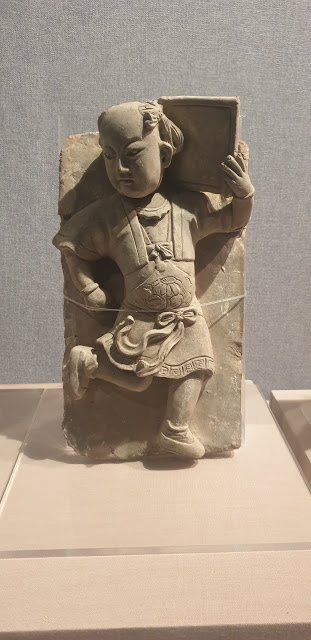
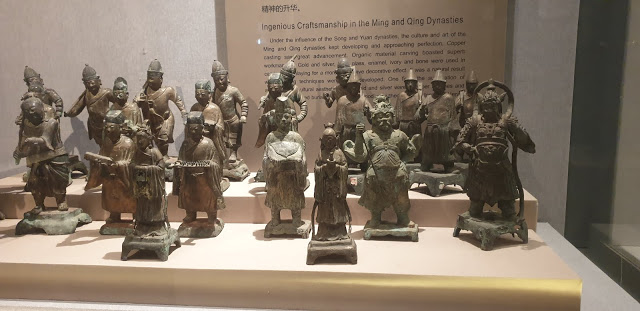
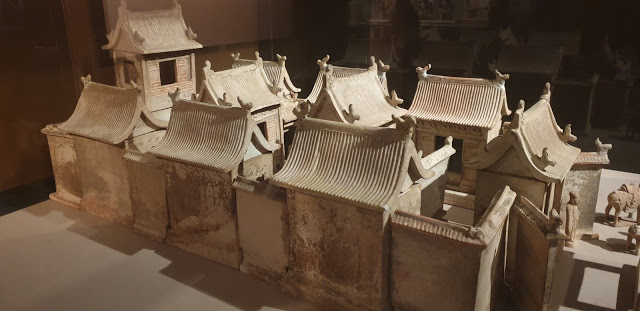
The museum itself has exhibits dating back a few thousand years and consist of bronze and ceramic items.  One of the highlights was a tortoiseshell with reportedly the oldest know writing ever found.

Other than that it was a series of cooking utensils, a table, and ceramic pots, some in very good condition considering their age.


There were also small sculptures

an array of small figures

and a model of a settlement

20 minutes was long enough.

What I learned about writing – There’s going there, and then there’s Google Maps

A lot of locations for stories are based on places that I’ve visited. So, any time I’m on holiday, I’m also discreetly observing and noting the places with an ulterior motive.

At some point in time, they’ll finish up in a story.

Places like Florence, London, Paris, New York and Venice have all been used in recent stories.

Of course, places change, and there are some that I can’t get to, so it’s useful having Google Maps and Street View. These can either make up for a lack of memory or be a refresher.

Especially if you need to visit Africa. Parts of several stories are set in Nigeria, not exactly a place I would go, no matter how much I wanted to get the lay of the land, nor would I go to the Democratic Republic of Congo.

Rwanda, maybe, but in investigating locations, it is interesting to discover that places like Kenya and Rwanda are reasonably safe. Uganda is more or less the same, but whether I’d visit, as inviting as it might be to see the wildlife (animals that is) I’m thinking Google Maps will do for now.

I have always had a fascination for other places, from way back when I was in school and we did a subject called geography. Back then, nearly 60 years ago, we had school atlases that had all of the British colonies, even if they had become independent, coloured red on the maps, and there were a lot of them.

Places like London, of which we also studied in history, always held a fascination for me, and, in particular, the royal family. Oddly enough, I knew all of the kings and queens from 1066 onwards, and yet had no idea who our Prime Ministers in Australia were.

It wasn’t until much later that we learned about Australian history.

But seeing places foreign is only part of the story. I have had time during the pandemic, when we were not allowed to leave home, to delve into the historical side of Australia, and it has created a fascination for writing a story that has a basis in fact.

This was unwittingly pushed along when my granddaughter came home from school with the assignment of writing a story about a character who was affected by a historical event. Thus, Eliza at the Eureka Stockade was created.

I remember back in university days when working on the narrative part of my literature stream, we were set an assignment based on pictures from a certain period, and a series of written documents to put together a story. Mine was about a passenger on a ship from Melbourne to Geelong in the days before rail, around the time of the gold rush.

I’m guessing that’s what is called historical fiction.

Well, it’s time to get back to the mists of time…