“What Sets Us Apart”, a mystery with a twist

David is a man troubled by a past he is trying to forget.

Susan is rebelling against a life of privilege and an exasperated mother who holds a secret that will determine her daughter’s destiny.

They are two people brought together by chance. Or was it?

When Susan discovers her mother’s secret, she goes in search of the truth that has been hidden from her since the day she was born.

When David realizes her absence is more than the usual cooling off after another heated argument, he finds himself being slowly drawn back into his former world of deceit and lies.

Then, back with his former employers, David quickly discovers nothing is what it seems as he embarks on a dangerous mission to find Susan before he loses her forever.

Find the kindle version on Amazon here:  http://amzn.to/2Eryfth

whatsetscover

All I wanted was a cup of coffee

How can something so simple become so complicated and complex?

In New York, it seemed impossible to get exactly what you would like.  The coffee there is driven by what the machine interprets you want, aside from the language constraints due to the fact that English (or American) comes in a zillion different flavours.

So, what do I like (you notice I don’t say ‘want’)

A double shot Latte with two sugars and half a shot of vanilla.  That’s in a large cup.

As we all know coffee can come in a regular, large, or extra-large cup, but, hang on, these cup sizes sometimes have names, and you need to know what these names are.

My efforts of pointing to the cup size in New York often had horrendous consequences, when the cup piles were close together.  Sometimes it was a double shot in a regular, and a single shot in an extra-large cup.

One even had the name benti, or bento, or something like that.

Being old and decrepit, my memory for cup sizes isn’t all that great, so using a name in one shop that doesn’t have that size, well, you get it.

It seems not only coffee makers in New York have a problem producing consistent coffee.

Perhaps, then that’s half the charm of drinking it, the fact that no cup is ever the same.

And, when an outlet gets it right, finally, they go and change the coffee bean supplier, and all of a sudden, it’s bitter, or it’s lighter, as coffee shops try to reduce their costs and maximise profits.

Six dollars is a lot of money for a cup of coffee unless of course, you have to feed that addiction in which case, you’ll have a cup at whatever the cost.

I need coffee right now, so its off te the cupboard to see what’s available.

Maccona instant, which is not bad

A Nespresso long black – ok, don’t get me started with Nespresso because they have numbers from 1 to 12, possibly more, recognising strengths, and I usually have a double shot using a 10 and a 12.

And, yes, they fool around with the type of beans they use because there seem to be inconsistencies in potency from time to time.

Then there’s coffee bags, much the same as tea bags, which produces and interestingly flavoured brew which I’m still trying to figure out.  It tastes like coffee, but there’s something else there, like … paper?

I opt for an instant.

Yes, I needed a coffee after writing this.

Writing about writing a book – Day 13 extra

There’s nothing worse than an interrogation by children, particularly when they are brutally honest.  To make matters worse, I had two inquisitors, and it was clear they had spent some time before getting in the car to organize a coordinated plan of attack.

But, first, a little history.

Back in happier times, in other words before the eventual separation and divorce, we were known as nanna and poppy. I was, most of the time, referred to as grumpy poppy, and the two, girls adored their nanna.

She always had a way with children, and, it was also the case, with our own two sons.  They preferred her to me, for obvious reasons, I had to be bad cop all the time.

When we separated, and this was an eventuality that we both agreed on, and it was, I thought, quite amicable.  There was no underlying reason, like one or other of us cheating, but that we had, over time, simply drifted apart because we had separate ideas about life.

Since I was the nonpreferred grandparent, I decided to see less of the children and allow them more time to be with their nanna.  Sometimes we appeared together, like at birthdays and Christmas, but normally I kept my distance.

No one seemed to complain about my absences, least of all my own children, which spoke volumes, to me, about what they thought of me.

Now, out of the blue, I get this call to pick up my granddaughters from school. It was not as if their nanna was as so overloaded with things to so, so it seemed to me it was some sinister plot, but to what end, I could hardly imagine.

I’d find out soon enough.

The girls were waiting in the drop zone and got in the car.  It didn’t phase them that it was me, and I had thought they may have a problem since I was in a different car. But they seemed to know what to look for.

There was silence until we exited the school grounds, they went to a church primary school and perhaps they didn’t want to risk God’s judgment on me.

The older child fired the first salvo, “Nanna says you have a girlfriend.”

Ok, not the first question I was expecting.

Then the younger girl followed up with the second salvo, “is she going to become our new nanna?”

To them, these were serious questions.  But had they been inspired by their current nanna, and they were to get answers.  She’d know I wouldn’t lie to them.

I stopped at the traffic lights.

“If your nanna saw me with a friend having lunch the other day, then it’s quite possible it may have looked like that, but, no, I don’t have a girlfriend, and for what it’s worth, I’m not ready to embark on that journey again for a while.  As for the other question, there will never be a new or any other sort of nanna other than the one you have already.”

Speech timed to perfection.  The lights changed to green.

I let that sink in and then after a minute asked a question of my own.  “How come your nanna is not picking you up today?”

I notice the two give each other a look and wonder how young does a child have to be to understand what a lie is or be able to keep a secret.

“We were told that you would be collecting us today, that’s all.”

A question then for whoever is at home when I drop them off.

I notice a rather prolonged look from the younger girl, perhaps searching for a truth of her own in my expression, or that she was trying to read my thoughts.  Whatever she saw, she asked, “Do you still go to work?”

“In a manner of speaking.  I work for myself these days.”

“With computers?”

“Not anymore.  I thought I might try writing a novel.  Before, there never seemed to be enough time in a day to do anything, but now things are a little easier.”

Then the older girl chimed in, “Nanna says that it’s a bit late for you to become a writer.”

Yes, I can see it now, the rest of the family sitting around the dinner table saying that I’d finally lost my marbles doing what I always wanted to rather than what I had to.

And my ex had always said I would be wasting my time from the very first time I’d mentioned it to her.  So much for confiding your hopes and dreams in your so-called lifelong partner who is supposed to support you.  I know I had supported her through various career changes, no matter what the consequences.

“What do you think I should do?”

It would be interesting to get their perspective.

“If you don’t have a real job, how do you pay the bills?”

A practical question.  Just the sort my ex would have posed if she was here.

“You’d be surprised what you can do when you put your mind to it.  I manage.”

There was no doubt a dozen other questions to be asked, but the capacity for a child to remember was about three or four.  And then they had to remember my answers so they could relay them.

Hopefully, the interrogation was over.

The cinema of my dreams – I never wanted to go to Africa – Episode 20

Our hero knows he’s in serious trouble.

The problem is, there are familiar faces and a question of who is a friend and who is foe made all the more difficult because of the enemy, if it was the enemy, simply because it didn’t look or sound or act like the enemy.

Now, it appears, his problems stem from another operation he participated in.

Lallo gave me a minute or two to read what amounted to two lines, that my co-operation was expected, and to be given.  It wasn’t exactly addressed to me personally, but a blanket authorization to interview anyone involved in that operation.

I handed the letter back, but not before I noticed it had been unfolded and refolded several times as if it had been used before.  Had Lallo already interrogated Treen, the only other survivor?

Lallo’s first question: “Do you know who was responsible for organising that operation?”

It was rather an odd question, asking a Sergeant who was assigned at the last minute.

“Look, at the time I was assigned to non-combat duties, not as an on-call commando.  I was a late replacement for the member of the team who had to withdraw due to an accident. I was simply ordered to join the team at the airfield.  Given the results, I’m hoping whoever it was that organized and authorized that operation got the bollicking they deserved.”

I had been annoyed at the time, but I’d got over it.  In keeping with a lot of the operations I’d been involved with; very few had a successful outcome, but usually with fewer casualties.

He gave me a sidelong glance, close to an admonishment.  “Just stick to the facts when answering questions.  The other survivor was Lieutenant Treen, correct?”

Not a happy man was the Lieutenant.  Not happy that the operation was changed at the last minute or the fact the odds had been stacked against us, and not happy I’d been flown in as a replacement what he regarded as his personal group.

“Yes.”

“Are you aware he requested an investigation into that operation?”

It came as no surprise.  On the flight over, he had expressed more than one concern about the lack of intelligence and what the real situation was like on the ground.

“No.”

“Were you aware that a week ago Lieutenant Treen was found dead in his quarters, from an apparent suicide?”

Treen if anything was a soldier’s soldier, and the last man to contemplate suicide for any reason.  Surviving, just, that botched operation would not be a catalyst for such an event for such a man.

“No.”

“Odd then, don’t you think, you are nearly sent to your death the day after?”

If that was the case, and on the face of it, it seemed so, that wasn’t the only oddity about this whole affair.  I remembered the date of the General’s letter, the one telling me to be co-operative. It was the day before Treen’s suicide.

I didn’t think it was a coincidence?

It was quite clear someone didn’t want the General or whoever Lallo was working for, to question the last two survivors.

The question now was: what did we know, or what they thought we knew that was so important, that silencing us was necessary.

And would ‘they’ try again?

© Charles Heath 2019-2022

Writing a book in 365 days – My Story 43

More about my story

From Scribbles to a Cohesive Story: How to Tackle the Second Draft Like a Pro

“The time has come. All that scribbling, writing of chapters as they come to you, are roughly assembled, and the endless notes filed in order. You have the detailed synopsis; it’s time to write the second draft, the one that makes sense of quite often what is a disjointed and plothole‑laden manuscript. What’s the plan of action?”

If those words are echoing in your head, congratulations—you’ve crossed the most dreaded threshold for any writer: the moment when the raw material finally sits in front of you, begging for order, logic, and polish. The first draft is often a glorious, chaotic outpouring of imagination. The second draft, however, is where the real craft emerges. Below is a step‑by‑step plan to transform those scattered notes and chapter fragments into a tight, believable narrative that keeps readers turning pages.


1. Pause, Breathe, and Re‑Read (Without Editing)

Before you lift a pen—or tap a key—spend 30–60 minutes simply reading what you’ve already produced.

Why?What to Look For
Big‑picture feelDoes the story’s tone stay consistent?
Narrative momentumAre there sections that drag or rush?
Emotional arcsDo the characters’ journeys feel earned?

Resist the urge to fix anything now. This “cold read” gives you a fresh mental map of where the story stands, and it surfaces the most glaring gaps that you’ll need to address later.


2. Re‑Validate Your Synopsis

Your synopsis is the blueprint; the second draft is the construction crew.

  1. Compare Chapter by Chapter – Align each chapter with the corresponding synopsis point. Tick off what matches, note what deviates.
  2. Identify Missing Beats – Any plot point in the synopsis that has no chapter yet? Flag it.
  3. Spot Redundancies – Sometimes you’ll discover two scenes serving the same purpose; consolidate them.

If your synopsis feels dated after the first draft, revise it now. A solid, up‑to‑date outline is the safety net that prevents you from falling into new plot holes.


3. Map the Structural Skeleton

Visual aids are lifesavers. Choose a method that resonates with you—index cards, a spreadsheet, a mind‑map tool (e.g., Scrivener, Milanote, or even a whiteboard). Populate it with:

  • Scene headings (location, time, POV)
  • Purpose (what does this scene accomplish? Conflict, revelation, transition?)
  • Key beats (the inciting incident, midpoint twist, climax, resolution)

Seeing the entire story laid out reveals:

  • Pacing problems – clusters of low‑stakes scenes or long gaps between major events.
  • Plot holes – missing cause‑and‑effect links.
  • Character arcs – where growth stalls or accelerates too abruptly.

4. Diagnose the “Disjointed” Spots

Now that you have a macro view, zoom in on the trouble areas:

CategoryTypical SymptomsQuick Fixes
Plot GapsUnexplained changes in motivation, events that happen “out of nowhere.”Add a short catalyst scene, insert a character’s internal monologue, or create a flashback for context.
PlotholesContradictory facts (e.g., a character knows something they shouldn’t).Insert a logical bridge—perhaps a conversation, a document, or a memory reveal.
Character InconsistencySudden shifts in personality or skill set.Plant subtle foreshadowing earlier; give a brief “training” moment or a back‑story hint.
Pacing LullsToo many exposition‑heavy paragraphs.Break up with a moment of conflict, a dialogue beat, or a sensory detail that propels the scene forward.

Take each flagged spot and write a mini‑action plan: what needs to be added, moved, or cut, and why. Keep the plan short—one sentence per issue—so you can reference it quickly while you rewrite.


5. Set a Realistic Writing Schedule

Second drafts can feel endless, but a structured timetable keeps momentum alive.

Time BlockGoalExample
Daily 90‑minute sprintFinish a specific scene or page count.“Rewrite Chapter 4, focusing on tightening dialogue.”
Weekly review (30 min)Compare progress to the structural skeleton, adjust if needed.“Check if the midpoint twist lands with enough payoff.”
Bi‑weekly “big‑picture” dayRe‑read the draft up to the current point, ensuring continuity.“Read chapters 1‑6, note any new inconsistencies.”

Treat these blocks as appointments you cannot miss. Use a timer (Pomodoro technique works wonders) to stay disciplined.


6. Rewrite with Intent—One Layer at a Time

Trying to fix everything in one go leads to burnout. Adopt a layered approach:

  1. Structural Pass – Move, add, or delete entire scenes to align with your outline.
  2. Narrative Flow Pass – Smooth transitions, tighten pacing, ensure cause‑and‑effect chains are crystal clear.
  3. Character Consistency Pass – Verify motivations, voice, and growth arcs.
  4. Language Pass – Polish prose, eliminate passive voice, tighten dialogue, enrich descriptions.
  5. Proofreading Pass – Grammar, spelling, formatting.

Each pass focuses on a single type of improvement, making the workload manageable and the end result more cohesive.


7. Leverage Feedback—But Do It Strategically

Before you dive into the final polish, get targeted beta feedback. Instead of handing out the whole manuscript, send:

  • The synopsis + structural skeleton – to confirm the plot makes sense.
  • A few pivotal chapters – especially the opening, the midpoint, and the climax.
  • A character sheet – to verify arcs feel authentic.

Ask specific questions: “Does the protagonist’s decision in Chapter 8 feel justified?” or “Is the reveal at the end of Chapter 12 too abrupt?” Focused feedback saves you from generic, overwhelming commentary.


8. The Final Sweep: Consistency & Polish

When the structural and narrative issues are resolved, it’s time for the polish:

  • Read aloud – catches clunky dialogue and rhythm problems.
  • Run a “character name” search – ensures you haven’t inadvertently swapped names.
  • Check timeline continuity – use a simple spreadsheet to list dates, ages, and events.
  • Run style tools (Grammarly, ProWritingAid) – but trust your own ear first.

Once you’ve run through this checklist, you can consider the second draft complete.


9. Celebrate and Reset

Finishing a second draft is a milestone worth celebrating. Take a short break (a weekend, a hike, a binge‑watch session) before you embark on the third draft or start polishing for submission. A rested mind sees errors you missed while immersed in the manuscript.


TL;DR – The Action Plan in a Nutshell

  1. Read the whole draft (no editing).
  2. Cross‑check every chapter with the synopsis.
  3. Create a visual scene map.
  4. Identify and plan fixes for disjointed spots.
  5. Set a realistic writing schedule.
  6. Rewrite in layers (structure → flow → character → language → proof).
  7. Gather targeted beta feedback.
  8. Do a final consistency & polish sweep.
  9. Celebrate, then move on.

Final Thought

The second draft isn’t just a “clean‑up” phase; it’s where a writer’s critical eye meets the raw spark of imagination. By approaching it methodically—treating each problem as a solvable puzzle—you’ll turn a fragmented manuscript into a compelling, seamless story that readers can’t put down. So roll up your sleeves, follow the plan, and let the magic of revision reveal the masterpiece hidden within your notes. Happy drafting!

Searching for locations: The Erqi Memorial Tower, Zhengzhou, China

A convoluted explanation on the reasons for this memorial came down to it being about the deaths of those involved in the 1923 Erqi strike, though we’re not really sure what the strike was about.

So, after a little research, this is what I found:

The current Erqi Tower was built in 1971 and was, historically, the tallest building in the city. It is a memorial to the Erqi strike and in memory of Lin Xiangqian and other railway workers who went on strike for their rights, which happened on February 7, 1923.

It has 14 floors and is 63 meters high. One of the features of this building is the view from the top, accessed by a spiral staircase, or an elevator, when it’s working (it was not at the time of our visit).

There seems to be an affinity with the number 27 with this building, in that

  • It’s the 27th memorial to be built
  • to commemorate the 27th workers’ strike
  • located in the 27th plaza of Zhengzhou City.

We drive to the middle of the city where we once again find traveling in kamikaze traffic more entertaining than the tourist points

When we get to the drop-off spot, it’s a 10-minute walk to the center square where the tower is located on one side. Getting there we had to pass a choke point of blaring music and people hawking goods, each echoing off the opposite wall to the point where it was deafening. Too much of it would be torture.

But, back to the tower…

It has 14 levels, but no one seemed interested in climbing the 14 or 16 levels to get to the top. The elevator was broken, and after the great wall episode, most of us are heartily sick of stairs.

The center square was quite large but paved in places with white tiles that oddly reflected the heat rather than absorb it. In the sun it was very warm.

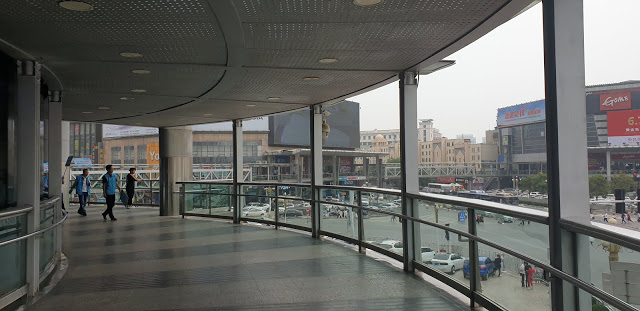
Around the outside of two-thirds of the square, and crossing the roads, was an elevated walkway, which if you go from the first shops and around to the other end, you finish up, on the ground level, at Starbucks.

This is the Chinese version and once you get past the language barrier, the mixology range of cold fruity drinks are to die for, especially after all that walking. Mine was a predominantly peach flavor, with some jelly and apricot at the bottom. I was expecting sliced peaches but I prefer and liked the apricot half.

A drink and fruit together was a surprise.

Then it was the walk back to the meeting point and then into the hotel to use the happy house before rejoining the kamikaze traffic.

We are taken then to the train station for the 2:29 to our next destination, Suzhou, the Venice of the East.

What I learned about writing – You can draw inspiration from anywhere

Watching the doors that lead to the consulting rooms is about as exciting as watching pigeons standing on a window ledge.

But…

When you have little else to do while waiting to see the doctor, it can take on new meaning, especially if you don’t want to be like 95% of the others waiting and be on their mobile phones.

What you basically have is a cross-section of people right in front of you, a virtual cornucopia of characters just waiting to stay in your next novel, of course with some minor adjustments.  It’s the actions and traits I’m looking for, and since it is a hospital, there’s bound to be some good ones.

It’s a steady drip of patients getting called, and it seems like more are arriving than being seen, and those that are being called have arrived and barely got to sit down, whilst a steady core has been waiting, and waiting, and waiting…

Everyone reacts differently to waiting.

A lady arrives, walking tentatively into the waiting area.  It’s reasonably full so the first thing she does is look for a spot where she doesn’t have to sit next to anyone else.  I’m the same, nothing worse if you sit next to a talker, and getting their life history.

Another sits, looking like they’re going to read, they brought a book with them, but it sits on her lap.  The phone comes out, a quick scan, then it remains in hand.  Is she expecting a call or text wishing her luck?  It’s not the oncology clinic so she doesn’t have cancer.  Hopefully.  The fact she brought a book tells me she’s been here before and knows a 9:00 appointment is rarely on time.

As we are discovering.

A couple arrives, maybe a mother and daughter, maybe a patient and her support person.  Both of them don’t look very well do it’s a toss-up who is there to see the doctor.

Next is a man who could easily pass as living on the street.  It’s probably an injustice to say so, but his appearance is compelling, and I’m not the only one.  He sits and the person next to him gets up, apparently looking for something, then moves subtly to another seat.  Someone else nearby wrinkles her nose.  Two others look in his direction and then whisper to each other.  No guesses what the subject is.

More arrive, fewer seats, some are called, but everyone notices, and avoids, the man.

The sign of the door where the stream of patients are going, says no entry staff only, and periodically a staff member comes striding out purposely, or sedately, clutching a piece of all-important paper, the sign of someone who knows where they’re going, on an important mission.  Names are being called from this door and various other sections of the room, requiring you to keep one ear open.

It seems all hospitals are branches of the United Nations, medical staff, and particularly doctors, are recruited from all over the world, and it seems to be able to speak understandable English is not one of the mandatory requirements, and sometimes the person calling out the name, has a little difficulty with the pronunciation.

Perhaps like the UN, we need interpreters.  No, most of the names are recognizable until there is a foreign name that’s unpronounceable, or a person with English as a second language calls an English name.  It makes what could be an interminable wait into something more interesting.

And then there are the people who have names that are completely at odds with their nationality.  They are lucky enough to have the best of a number of cultures, and perhaps a deeper level of understanding where others do not.  I’m reminded never to judge a book by it’s cover.

When there is a lull in arrivals and call-ups, there’s the doctor in consult room 2.  He’s apparently the doctor with no patients and periodically he comes out to look in his pigeonhole, or just look over the patients waiting, and more importantly checking the door handle when not delivering printouts to the consulting room next door.

He’s a doctor with no patients, get my drift.  Well, that joke fell very flat, so, fortunately, he comes out, a piece of paper in hand, and calls a name.  His quiet period is over.  Someone else will have to look at the door handle.

But we’re still waiting, waiting.

It’s been an hour and four minutes, and a little frustrating.  Surely when you check-in they should give you an estimated waiting time, or better still how many patients there are before you.

I guess its time to join the rest and pick up the mobile phone.

The good news, I only got to type one word before my name was called.  By a person who could pronounce it correctly.

The doctor, well that’s another story.

The story behind the story: A Case of Working With the Jones Brothers

To write a private detective serial has always been one of the items at the top of my to-do list, though trying to write novels and a serial, as well as a blog, and maintain a social media presence, well, you get the idea.

But I made it happen, from a bunch of episodes I wrote a long, long time ago, used these to start it, and then continue on, then as now, never having much of an idea where it was going to end up, or how long it would take to tell the story.

That, I think is the joy of ad hoc writing, even you, as the author, have as much idea of where it’s going as the reader does.

It’s basically been in the mill since 1990, and although I finished it last year, it looks like the beginning to end will have taken exactly 30 years.  Had you asked me 30 years ago if I’d ever get it finished, the answer would be maybe?

My private detective, Harry Walthenson

I’d like to say he’s from that great literary mold of Sam Spade, or Mickey Spillane, or Phillip Marlow, but he’s not.

But, I’ve watched Humphrey Bogart play Sam Spade with much interest, and modelled Harry and his office on it.  Similarly, I’ve watched Robert Micham play Phillip Marlow with great panache, if not detachment, and added a bit of him to the mix.

Other characters come into play, and all of them, no matter what period they’re from, always seem larger than life.  I’m not above stealing a little of Mary Astor, Peter Lorre or Sidney Greenstreet, to breathe life into beguiling women and dangerous men alike.

Then there’s the title, like

The Case of the Unintentional Mummy – this has so many meanings in so many contexts, though I imagine that back in Hollywood in the ’30s and ’40s, this would be excellent fodder for Abbott and Costello

The Case of the Three-Legged Dog – Yes, I suspect there may be a few real-life dogs with three legs, but this plot would involve something more sinister.  And if made out of plaster, yes, they’re always something else inside.

But for mine, to begin with, it was “The Case of the …”, because I had no idea what the case was going to be about, well, I did, but not specifically.

Then I liked the idea of calling it “The Case of the Brother’s Revenge” because I began to have a notion there was a brother no one knew about, but that’s stuff for other stories, not mine, so then went the way of the others.

Now it’s called ‘A Case of Working With the Jones Brothers’, finished the first three drafts, and at the editor for the last.

I have high hopes of publishing it in early 2021.  It even has a cover.

PIWalthJones1

Searching for locations: The Henan Museum, Zhengzhou, Henan Province, China

The Henan Museum is one of the oldest museums in China.  In June 1927, General Feng Yuxiang proposed that a museum be built, and it was completed the next year.  In 1961, along with the move of the provincial capital, Henan Museum moved from Kaifeng to Zhengzhou.

It currently holds about 130,000 individual pieces, more of which are mostly cultural relics, bronze vessels of the Shang and Zhou Dynasties, and pottery and porcelain wares of the various dynasties.

Eventually, we arrive at the museum and get off the bus adjacent to a scooter track and despite the efforts of the guide, there’s no stopping them from nearly running us over.

We arrive to find the museum has been moved to a different and somewhat smaller building nearby as the existing, and rather distinctively designed, building is being renovated.

While we are waiting for the tickets to enter, we are given another view of industrial life in that there is nothing that resembles proper health and safety on worksites in this country, and the workers are basically standing on what looks to be a flimsy bamboo ladder with nothing to stop them from falling off.

The museum itself has exhibits dating back a few thousand years and consist of bronze and ceramic items.  One of the highlights was a tortoiseshell with reportedly the oldest know writing ever found.

Other than that it was a series of cooking utensils, a table, and ceramic pots, some in very good condition considering their age.


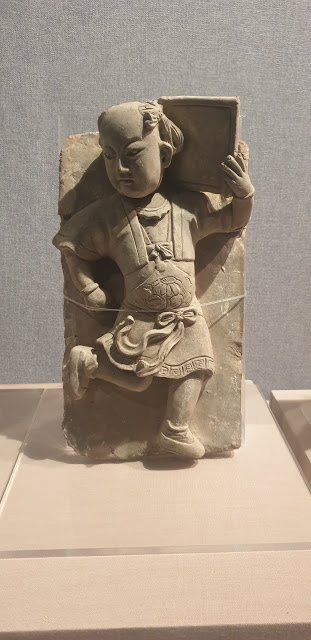
There were also small sculptures

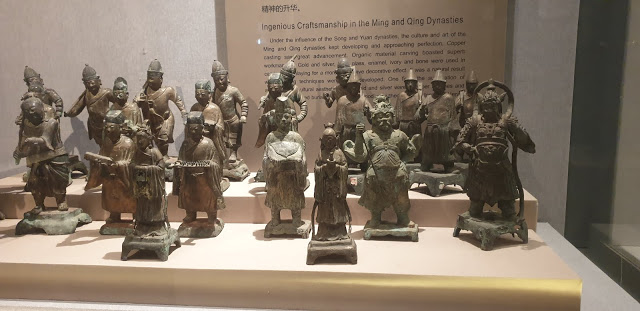
an array of small figures

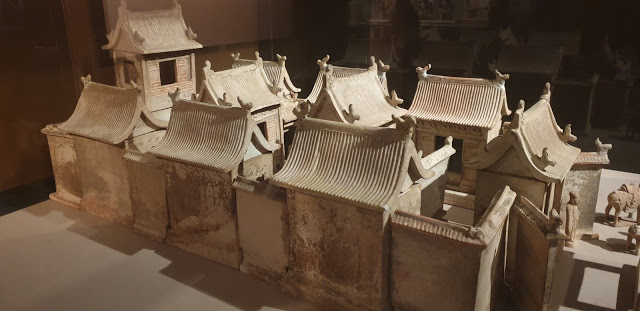
and a model of a settlement

20 minutes was long enough.

An excerpt from “The Devil You Don’t”

Available on Amazon Kindle here:  https://amzn.to/2Xyh1ow

By the time I returned to the Savoie, the rain had finally stopped, and there was a streak of blue sky to offer some hope the day would improve.

The ship was not crowded, the possibility of bad weather perhaps holding back potential passengers.  Of those I saw, a number of them would be aboard for the lunch by Phillippe Chevrier.  I thought about it, but the Concierge had told me about several restaurants in Yvoire and had given me a hand-drawn map of the village.  I think he came from the area because he spoke with the pride and knowledge of a resident.

I was looking down from the upper deck observing the last of the boarding passengers when I saw a woman, notable for her red coat and matching shoes, making a last-minute dash to get on board just before the gangway was removed.  In fact, her ungainly manner of boarding had also captured a few of the other passenger’s attention.  Now they would have something else to talk about, other than the possibility of further rain.

I saw her smile at the deckhand, but he did not smile back.  He was not impressed with her bravado, perhaps because of possible injury.  He looked at her ticket then nodded dismissively, and went back to his duties in getting the ship underway.  I was going to check the departure time, but I, like the other passengers, had my attention diverted to the woman in red.

From what I could see there was something about her.  It struck me when the light caught her as she turned to look down the deck, giving me a perfect profile.  I was going to say she looked foreign, but here, as in almost anywhere in Europe, that described just about everyone.  Perhaps I was just comparing her to Phillipa, so definitively British, whereas this woman was very definitely not.

She was perhaps in her 30’s, slim or perhaps the word I’d use was lissom, and had the look and manner of a model.  I say that because Phillipa had dragged me to most of the showings, whether in Milan, Rome, New York, London, or Paris.  The clothes were familiar, and in the back of my mind, I had a feeling I’d seen her before.

Or perhaps, to me, all models looked the same.

She looked up in my direction, and before I could divert my eyes, she locked on.  I could feel her gaze boring into me, and then it was gone as if she had been looking straight through me.  I remained out on deck as the ship got underway, watching her disappear inside the cabin.  My curiosity was piqued, so I decided to keep an eye out for her.

I could feel the coolness of the air as the ship picked up speed, not that it was going to be very fast.  With stops, the trip would take nearly two hours to get to my destination.  It would turn back almost immediately, but I was going to stay until the evening when it returned at about half eight.  It would give me enough time to sample the local fare, and take a tour of the medieval village.

Few other passengers ventured out on the deck, most staying inside or going to lunch.  After a short time, I came back down to the main deck and headed forward.  I wanted to clear my head by concentrating on the movement of the vessel through the water, breathing in the crisp, clean air, and let the peacefulness of the surroundings envelope me.

It didn’t work.

I knew it wouldn’t be long before I started thinking about why things hadn’t worked, and what part I played in it.  And the usual question that came to mind when something didn’t work out.  What was wrong with me?

I usually blamed it on my upbringing.

I had one of those so-called privileged lives, a nanny till I was old enough to go to boarding school, then sent to the best schools in the land.  There I learned everything I needed to be the son of a Duke, or, as my father called it in one of his lighter moments, nobility in waiting.

Had this been five or six hundred years ago, I would need to have sword and jousting skills, or if it had been a few hundred years later a keen military mind.  If nothing else I could ride a horse, and go on hunts, or did until they became not the thing to do.

I learned six languages, and everything I needed to become a diplomat in the far-flung British Empire, except the Empire had become the Commonwealth, and then, when no-one was looking, Britain’s influence in the world finally disappeared.  I was a man without a cause, without a vocation, and no place to go.

Computers were the new vogue and I had an aptitude for programming.  I guess that went hand in hand with mathematics, which although I hated the subject, I excelled in.  Both I and another noble outcast used to toss ideas around in school, but when it came to the end of our education, he chose to enter the public service, and I took a few of those ideas we had mulled over and turned them into a company.

About a year ago, I was made an offer I couldn’t refuse.  There were so many zeroes on the end of it I just said yes, put the money into a very grateful bank, and was still trying to come to terms with it.

Sadly, I still had no idea what I was going to do with the rest of my life.  My parents had asked me to come back home and help manage the estate, and I did for a few weeks.  It was as long as it took for my parents to drive me insane.

Back in the city, I spent a few months looking for a mundane job, but there were very few that suited the qualifications I had, and the rest, I think I intimidated the interviewer simply because of who I was.  In that time I’d also featured on the cover of the Economist, and through my well-meaning accountant, started involving myself with various charities, earning the title ‘philanthropist’.

And despite all of this exposure, even making one of those ubiquitous ‘eligible bachelor’ lists, I still could not find ‘the one’, the woman I wanted to spend the rest of my life with.  Phillipa seemed to fit the bill, but in time she proved to be a troubled soul with ‘Daddy’ issues.  I knew that in building a relationship compromise was necessary, but with her, in the end, everything was a compromise and what had happened was always going to be the end result.

It was perhaps a by-product of the whole nobility thing.  There was a certain expectation I had to fulfill, to my peers, contemporaries, parents and family, and those who either liked or hated what it represented.  The problem was, I didn’t feel like I belonged.  Not like my friend from schooldays, and now obscure acquaintance, Sebastian.  He had been elevated to his Dukedom early when his father died when he was in his twenties.  He had managed to fade from the limelight and was rarely mentioned either in the papers or the gossip columns.  He was one of the lucky ones.

I had managed to keep a similarly low profile until I met Phillipa.  From that moment, my obscurity disappeared.  It was, I could see now, part of a plan put in place by Phillipa’s father, a man who hogged the limelight with his daughter, to raise the profile of the family name and through it their businesses.  He was nothing if not the consummate self-advertisement.

Perhaps I was supposed to be the last piece of the puzzle, the attachment to the establishment, that link with a class of people he would not normally get in the front door.  There was nothing refined about him or his family, and more than once I’d noticed my contemporaries cringe at the mention of his name, or any reference of my association with him.

Yet could I truthfully say I really wanted to go back to the obscurity I had before Phillipa?  For all her faults, there were times when she had been fun to be with, particularly when I first met her when she had a certain air of unpredictability.  That had slowly disappeared as she became part of her father’s plan for the future.  She just failed to see how much he was using her.

Or perhaps, over time, I had become cynical.

I thought about calling her.  It was one of those moments of weakness when I felt alone, more alone than usual.

I diverted my attention back to my surroundings and the shoreline.  Out of the corner of my eye, I could see the woman in the red coat, making a move.  The red coat was like a beacon, a sort of fire engine red.  It was not the sort of coat most of the women I knew would wear, but on her, it looked terrific.  In fact, her sublime beauty was the one other attribute that was distinctly noticeable, along with the fact her hair was short, rather than long, and jet black.

I had to wrench my attention away from her.

A few minutes later several other passengers came out of the cabin for a walk around the deck, perhaps to get some exercise, perhaps checking up on me, or perhaps I was being paranoid.  I waited till they passed on their way forward, and I turned and headed aft.

I watched the wake sluicing out from under the stern for a few minutes, before retracing my steps to the front of the ship and there I stood against the railing, watching the bow carve its way through the water.  It was almost mesmerizing.  There, I emptied my mind of thoughts about Phillipa, and thoughts about the woman in the red coat.

Until a female voice behind me said, “Having a bad day?”

I started, caught by surprise, and slowly turned.  The woman in the red coat had somehow got very close me without my realizing it.  How did she do that?  I was so surprised I couldn’t answer immediately.

“I do hope you are not contemplating jumping.  I hear the water is very cold.”

Closer up, I could see what I’d missed when I saw her on the main deck.  There was a slight hint of Chinese, or Oriental, in her particularly around the eyes, and of her hair which was jet black.  An ancestor twice or more removed had left their mark, not in a dominant way, but more subtle, and easily missed except from a very short distance away, like now.

Other than that, she was quite possibly Eastern European, perhaps Russian, though that covered a lot of territory.  The incongruity of it was that she spoke with an American accent, and fluent enough for me to believe English was her first language.

Usually, I could ‘read’ people, but she was a clean slate.  Her expression was one of amusement, but with cold eyes.  My first thought, then, was to be careful.

“No.  Not yet.”  I coughed to clear my throat because I could hardly speak.  And blushed, because that was what I did when confronted by a woman, beautiful or otherwise.

The amusement gave way to a hint of a smile that brightened her demeanor as a little warmth reached her eyes.  “So that’s a maybe.  Should I change into my lifesaving gear, just in case?”

It conjured up a rather interesting image in my mind until I reluctantly dismissed it.

“Perhaps I should move away from the edge,” I said, moving sideways until I was back on the main deck, a few feet further away.  Her eyes had followed me, and when I stopped she turned to face me again.  She did not move closer.

I realized then she had removed her beret and it was in her left side coat pocket.  “Thanks for your concern …?”

“Zoe.”

“Thanks for your concern, Zoe.  By the way, my name is John.”

She smiled again, perhaps in an attempt to put me at ease.  “I saw you earlier, you looked so sad, I thought …”

“I might throw myself overboard?”

“An idiotic notion I admit, but it is better to be safe than sorry.”

Then she tilted her head to one side then the other, looking intently at me.  “You seem to be familiar.  Do I know you?”

I tried to think of where I may have seen her before, but all I could remember was what I’d thought earlier when I first saw her; she was a model and had been at one of the showings.  If she was, it would be more likely she would remember Phillipa, not me.  Phillipa always had to sit in the front row.

“Probably not.”  I also didn’t mention the fact she may have seen my picture in the society pages of several tabloid newspapers because she didn’t look the sort of woman who needed a daily dose of the comings and goings, and, more often than not, scandal associated with so-called celebrities.

She gave me a look, one that told me she had just realized who I was.  “Yes, I remember now.  You made the front cover of the Economist.  You sold your company for a small fortune.”

Of course.  She was not the first who had recognized me from that cover.  It had raised my profile considerably, but not the Sternhaven’s.  That article had not mentioned Phillipa or her family.  I suspect Grandmother had something to do with that, and it was, now I thought about it, another nail in the coffin that was my relationship with Phillipa.

“I wouldn’t say it was a fortune, small or otherwise, just fortunate.”  Each time, I found myself playing down the wealth aspect of the business deal.

“Perhaps then, as the journalist wrote, you were lucky.  It is not, I think, a good time for internet-based companies.”

The latter statement was an interesting fact, one she read in the Financial Times which had made that exact comment recently.

“But I am boring you.”  She smiled again.  “I should be minding my own business and leaving you to your thoughts.  I am sorry.”

She turned to leave and took a few steps towards the main cabin.

“You’re not boring me,” I said, thinking I was letting my paranoia get the better of me.  It had been Sebastian on learning of my good fortune, who had warned me against ‘a certain element here and abroad’ whose sole aim would be to separate me from my money.  He was not very subtle when he described their methods.

But I knew he was right.  I should have let her walk away.

She stopped and turned around.  “You seem nothing like the man I read about in the Economist.”

A sudden and awful thought popped into my head.  Those words were part of a very familiar opening gambit.  “Are you a reporter?”

I was not sure if she looked surprised, or amused.  “Do I look like one?”

I silently cursed myself for speaking before thinking, and then immediately ignored my own admonishment.  “People rarely look like what they are.”

I saw the subtle shake of the head and expected her to take her leave.  Instead she astonished me.

“I fear we have got off on the wrong foot.  To be honest, I’m not usually this forward, but you seemed like you needed cheering up when probably the opposite is true.  Aside from the fact this excursion was probably a bad idea.  And,” she added with a little shrug, “perhaps I talk too much.”

I was not sure what I thought of her after that extraordinary admission. It was not something I would do, but it was an interesting way to approach someone and have them ignoring their natural instinct.  I would let Sebastian whisper in my ear for a little longer and see where this was going.

“Oddly enough, I was thinking the same thing.  I was supposed to be traveling with my prospective bride.  I think you can imagine how that turned out.”

“She’s not here?”

“No.”

“She’s in the cabin?”  Her eyes strayed in that direction for a moment then came back to me.  She seemed surprised I might be traveling with someone.

“No.  She is back in England, and the wedding is off.  So is the relationship.  She dumped me by text.”

OK, why was I sharing this humiliating piece of information with her?  I still couldn’t be sure she was not a reporter.

She motioned to an empty seat, back from the edge.  No walking the plank today.  She moved towards it and sat down.  She showed no signs of being cold, nor interested in the breeze upsetting her hair.  Phillipa would be having a tantrum about now, being kept outside, and freaking out over what the breeze might be doing to her appearance.

I wondered, if only for a few seconds if she used this approach with anyone else.  I guess I was a little different, a seemingly rich businessman alone on a ferry on Lake Geneva, contemplating the way his life had gone so completely off track.

She watched as I sat at the other end of the bench, leaving about a yard between us.  After I leaned back and made myself as comfortable as I could, she said, “I have also experienced something similar, though not by text message.  It is difficult, the first few days.”

“I saw it coming.”

“I did not.”  She frowned, a sort of lifeless expression taking over, perhaps brought on by the memory of what had happened to her.  “But it is done, and I moved on.  Was she the love of your life?”

OK, that was unexpected.

When I didn’t answer, she said, “I am sorry.  Sometimes I ask personal questions without realizing what I’m doing.  It is none of my business.”  She shivered.  “Perhaps we should go back inside.”

She stood, and held out her hand.  Should I take it and be drawn into her web?  I thought of Sebastian.  What would he do in this situation?

I took her hand in mine and let her pull me gently to my feet.  “Wise choice,” she said, looking up at the sky.

It just started to rain.

© Charles Heath 2015-2023

newdevilcvr6