The cinema of my dreams – Was it just another surveillance job – Episode 42

I’m back home and this story has been sitting on the back burner for a few months, waiting for some more to be written.

The trouble is, there are also other stories to write, and I’m not very good at prioritizing.

But, here we are, a few minutes opened up and it didn’t take long to get back into the groove.

Chasing leads, maybe

A second later the light came on and I was temporarily blinded.

The woman had to be on the other side of the door, and coming into the room, I must have passed her. Her voice sounded quite old, so it must be the mother.

“Turn around, slowly.

I did. By that time my eyes had readjusted, and I could see a woman, still dressed, with what looked to be an Enfield WW1 rifle. Just as dangerous now as it was then, particularly at this close range.

“Mrs Quigley, I presume,” I asked. Remain polite and conversational and keep her from getting nervous.

“Who are you?”

“Sam Jackson.”

“Is that your real name?”

“Why would you presume to think it wasn’t?”

“You’re breaking into my house which means you’re a criminal, and criminals by nature are also liars. Why would I think you any different to the rest?”

Good question. “I knew your son.”

“Which one?”

“Adam.”

“He’s not here. He hasn’t been around since he gallivanted off overseas a few years back.”

“I saw him only a few days ago, in London. Not gallivanting, by the way, but with feet firmly planted on the ground.”

“He’s not here.”

“Do you know where he is?”

She didn’t know he was dead, and I didn’t think it was my business to tell her. That was Dobbin’s job, and I was surprised he hadn’t. Or, I only had her word for it he hadn’t.

“Are you hard of hearing.” Get into the middle of the room.”

I moved slowly into the middle, watching her edge slowly towards the writing desk while keeping the gun aimed at me. If I tried to run for it, and if she was any sort of shot, I’d be dead before I got three, possibly four paces. If I could get a shred of surprise.

I hadn’t seen the phone on the desk, and watched her pick up the receiver, and, with the same hand, started dialing a number.

“Put it down.” Another voice, another woman, coming from the doorway.

Jennifer.

With a gun in hand, pointed at the woman.

“What if I shoot him, or you?”

“You’ll be dead before either scenario happens. Just put it down. I’m not here to shoot anyone if I can help it.”

Of course, this was just like one of those scenes out of a comedic spy film. Guns pointing in all directions.

And, true to form, a click, and a voice. “You put your weapon down.”

He appeared out of the shadows and had the gun pointed straight at Jennifer’s head at very short range.

Adam Quigley, aka O’Connell, and very much alive.

Jennifer dropped her gun, but Adam didn’t take his gun off her.

“Hello Sam. How did you find me?”

© Charles Heath 2020-2021

Writing a book in 365 days – 239

Day 239

Patronage, good or bad

Three Jobs for One Dream: Is Patronage a Blessing or a Breaking Point?

Ah, the writer’s life. It’s often romanticized, conjuring images of solitary genius, ink-stained fingers, and profound insights emerging from quiet contemplation. But behind many of those published tomes and celebrated screenplays, there’s a less glamorous, often unspoken reality: the support system. Specifically, the partner who shoulders the financial burden, allowing the artist to pursue their muse.

This brings us to a crucial question that buzzes in the ears of many aspiring writers and their long-suffering loved ones: Is patronage for writers, particularly from a spouse, a noble sacrifice or a ticking time bomb?

The Romantic Ideal vs. The Hard Realities

Let’s start with the ideal. The notion that a spouse should work three jobs – the early morning shift, the afternoon grind, and the late-night gig – all to allow their other half to finally tackle that novel, screenplay, or poetry collection they’ve always dreamed of writing. On the surface, it speaks of deep love, unwavering belief, and a shared vision for a future where one partner’s creative potential is fully realized. It’s an echo of historical patronage, albeit a deeply personal and intimate one.

And sometimes, it works. Sometimes, that sacrifice leads to a breakthrough, a published work, and a shared sense of accomplishment that strengthens the bond. The story of the supportive partner becomes part of the legend, a testament to true love and artistic dedication.

But let’s be honest, those success stories are often the exception, not the rule. More frequently, this intense level of spousal patronage breeds a complex cocktail of emotions that can corrode the very foundation of a relationship.

The Weight of Expectation and the Erosion of Self

Imagine the partner working those three jobs. Their days are a blur of labor, their nights are for crashing, not connecting. Their own dreams, hobbies, and personal growth are shelved indefinitely. They’re not just bringing home the bacon; they’re the entire farm.

On the other side, the writer, theoretically freed to create, often carries a crushing weight of expectation. Every blank page feels like a failure. Every hour not spent writing feels like a betrayal of the sacrifice being made for them. The pressure to “make it” becomes immense, turning the creative process, which should be joyful, into a source of debilitating anxiety.

This imbalance isn’t just financial. It’s emotional, physical, and psychological.

  • For the working partner: Resentment begins to brew. Why are their dreams less important? Why is their exhaustion not acknowledged? Loneliness can set in, as the shared life they once had slowly morphs into one person supporting another’s isolated pursuit.
  • For the writer: Guilt gnaws. The fear of failure paralyzes. Self-doubt magnifies. The creative well, instead of being nurtured, can dry up under the immense pressure to justify the cost.

At What Point Does It Become a Breaking Point?

This is the critical question. When does a loving dedication transform into an unsustainable burden? It’s rarely a sudden explosion; it’s more often a slow, insidious erosion, like water carving a canyon.

The breaking point isn’t just about financial strain, though that’s a huge part of it. It’s when:

  1. Communication ceases: Conversations become solely about bills, children, or the writer’s progress, with no room for personal connection, shared joys, or the working partner’s struggles.
  2. Resentment openly festers: Passive-aggressive comments, silent treatments, or outright arguments become commonplace, revealing the deep-seated anger and frustration.
  3. Physical and mental health deteriorates: The working partner is constantly exhausted, stressed, or depressed. The writer is crippled by anxiety, guilt, or isolation.
  4. The “dream” becomes an excuse: When the creative project repeatedly fails to materialize, or shows no significant progress despite years of sacrifice, the partner may start to see it not as a dream, but as an endless deferment of a shared future.
  5. A lack of reciprocity: The working partner realizes their sacrifice is not being met with gratitude, practical help (where possible), or a concrete plan for future balance, but rather an expectation of continued, uncritical support.
  6. Loss of shared identity: The couple stops being a partnership and becomes a patron-artist dynamic, with clear roles but little give-and-take.

Finding a Sustainable Path Forward

So, is spousal patronage inherently bad? Not necessarily. But the extreme scenario of one partner working three jobs for years on end is almost certainly unsustainable and, frankly, unfair.

Instead of an all-or-nothing approach, consider a more balanced, communicative, and realistic path:

  • Open and Honest Communication: Regularly discuss finances, progress, expectations, and most importantly, how both partners are feeling.
  • Set Clear Timelines and Goals: “I’ll focus on writing for X months/years, and if it hasn’t generated income/interest by then, we’ll re-evaluate.” This provides a roadmap and reduces open-ended sacrifice.
  • Shared Responsibility: Can the writer contribute in other ways? Part-time work, freelancing, managing the household, picking up childcare? Even a small income can alleviate significant pressure.
  • Define Success Beyond Publication: Success can also mean completing a draft, getting positive feedback, or simply the joy of the creative process.
  • Prioritize the Relationship: Remember why you’re together. Your shared life, well-being, and happiness should take precedence over any single project.

The journey of a writer is often long and arduous. Support is invaluable. But that support should never come at the cost of the supporter’s well-being, nor should it become an endless burden that ultimately breaks the very relationship it sought to nurture. True partnership means nurturing both the individual dreams and the collective future.

What are your thoughts? Have you experienced or witnessed similar situations? Share your perspective in the comments below.

Searching for locations: At large in Paris, France

We have been to Paris a number of times over the years.

The last time we visited Paris we brought the two eldest grandchildren.   We took the Eurostar train from St Pancras station direct to Disneyland, then took the free bus from the station to the hotel.  The train station was directly outside Disneyland.

We stayed at the Dream Castle Hotel, rather than Disneyland itself as it was a cheaper option and we had a family room that was quite large and breakfast was included every morning.  Then it was a matter of getting the free bus to Disneyland.

We spent three days, time which seem to pass far too quickly, and we didn’t get to see everything.  They did, however, find the time to buy two princess dresses, and then spent the rest of the time playing dress-ups whenever they could.

In Paris, we stayed at the Crown Plaza at Republique Square.

We took the children to the Eiffel Tower where the fries, and the carousel at the bottom of the tower, seemed to be more memorable than the tower itself.  The day we visited, the third level was closed.  The day was cold and windy so that probably accounted for the less than memorable visit.  To give you some idea of conditions, it was the shortest queue to get in I’ve ever seen.

We traveled on the Metro where it was pointed out to me that the trains actually ran on rubber tires, something I had not noticed before.  It was a first for both children to travel on a double-decker train.

The same day, we went to the Louvre.

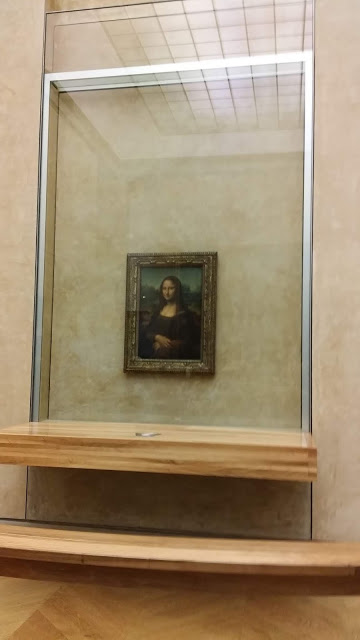
Here, it was cold, wet and windy while we waited,  Once inside we took the girls to the Mona Lisa, and after a walk up and down a considerable numkber of stairs, one said, “and we walked all this way to see this small painting”.

It quickly became obvious their idea of paintings were the much larger ones hanging in other galleries.

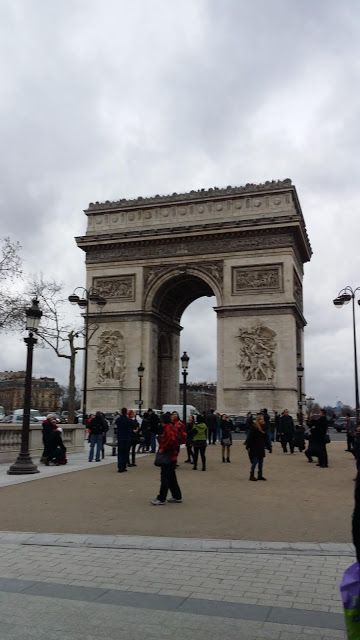
We also took them to the Arc de Triomphe.

We passed, and for some reason had to go into, the Disney shop, which I’m still wondering why after spending a small fortune at Disneyland itself.

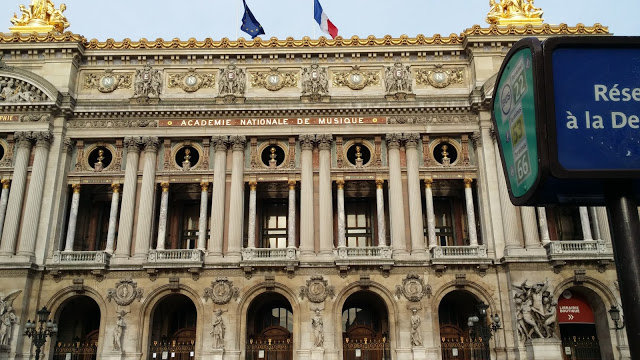
Next on the tour list was the Opera House.

 where one of the children thought she saw the ghost and refused to travel in one of the elevators.  At least it was quite amazing inside with the marble, staircases, and paintings on the roof.

Sadly, I don’t think they were all that interested in architecture, but at the Opera House, they did actually get to see some ballet stars from the Russian Bolshoi ballet company practicing.  As we were leaving the next day we could not go and see a performance.

Last but not least was Notre Dame with its gargoyles and imp[osing architecture.

All in all, traveling with children and experiencing Paris through their eyes made it a more memorable experience.

The first we visited Paris was at the end of a whirlwind bus tour, seven countries in seven days or something like that.  It was a relief to get to Paris and stay two nights if only to catch our breath.

I remember three events from that tour, the visit to the Eiffel Tower, the tour of the night lights, not that we were able to take much in from the inside of the bus, and the farewell dinner in one of the tour guides specially selected restaurants.  The food and atmosphere were incredible.  It was also notable for introducing us to a crepe restaurant in Montmartre, another of the tour guide’s favorite places.

On that trip to Paris, we also spent an afternoon exploring the Palace of Versailles.

The next time we visited Paris we flew in from London.  OK, it was a short flight, but it took all day.  From the hotel to the airport, the wait at the airport, departure, flying through time zones, arrival at Charles De Gaulle airport, now there’s an experience, and waiting for a transfer that never arrived, but that’s another story.

I can’t remember where we stayed the first time, it was somewhere out in the suburbs, but the second time we stayed at the Hilton near both the Eiffel Tower and the Australian Embassy, notable only because the concierge was dating an Australian girl working in the Embassy.  That was our ticket for special treatment, which at times you need to get around in Paris.

It was the year before 2000 and the Eiffel Tower was covered in lights, and every hour or so it looked like a bubbling bottle of champagne.  It was the first time we went to Level 3 of the Tower, and it was well worth it.  The previous tour only included Level 2.  This time we were acquainted with the fries available on the second level, and down below under the tower.

This time we acquainted ourselves with the Metro, the underground railway system, to navigate our way around to the various tourist spots, such as Notre Dame de Paris, The Louvre, Sacre-Coeur Basilica, and Les Invalides, and, of course, the trip to the crepe restaurant.

We also went to the Louvre for the express purpose of seeing the Mona Lisa, and I came away slightly disappointed.  I had thought it to be a much larger painting.  We then went to see the statue of Venus de Milo and spent some time trying to get a photo of it without stray visitors walking in front of us.  Aside from that, we spent the rest of the day looking at the vast number of paintings, and Egyptian artifacts in the Museum.

We also visited the Opera House which was architecturally magnificent.

The third time we visited Paris we took our daughter, who was on her first international holiday.  This time we stayed in a quaint Parisian hotel called Hotel Claude Bernard Saint Germain, (43 Rue Des Ecoles, Paris, 75005, France),  recommended to us by a relation who’d stayed there the year before.  It was small, and the elevator could only fit two people or one person and a suitcase.  Our rooms were on the 4th floor, so climbing the stairs with luggage was out of the question.

It included breakfast and wifi, and it was quite reasonable for the four days we stayed there.

It was close to everything you could want, down the hill to the railway station, and a square where on some days there was a market, and for those days when we were hungry after a day’s exploring, a baguette shop where rolls and salad were very inexpensive and very delicious.

To our daughter we appeared to be experienced travelers, going on the Metro, visiting the Louvre, going, yes once again, to the crepe restaurant and the Basilica at Montmartre, Notre Dame, and this time by boat to the Eiffel Tower.  We were going to do a boat rode on the Seine the last time but ran out of time.

We have some magnificent photos of the Tower from the boat.

Lunch on one of the days was at a restaurant not far from the Arc de Triomphe, where our daughter had a bucket of mussels.  I was not as daring and had a hamburger and fries.  Then we went to the center of the Arch and watched the traffic.

Our first time in Paris the bus driver got into the roundabout just to show us the dangers of driving in an unpredictable situation where drivers seem to take huge risks to get out at their exit.  Needless to say, we survived that experience, though we did make a number of circuits.

It’s a long hard road I’m still on…

Self published authors are fully aware that perhaps the easiest part of the writing journey is the actual writing.  Well, compared to the marketing aspect I believe it is.

I have read a lot of articles, suggestions and tips and tricks to market the book to the reading public.  It is, to say the least, a lot harder to market eBooks than perhaps their hard or paper covered relatives.  This is despite the millions of eReaders out there.

Then there is that other fickle part of the publishing cycle, the need for reviews.  Good reviews of course.  As we are learning, reviews can be bought.  Currently Amazon is out there seeking out these reviews and reviewers and it will be interesting to see the result of their actions.

All the advice I have seen and read tells me that reviews should not be paid for, that reviews will come with sales.  It might be a difficult cycle, more reviews means more sales, etc.  And getting those first sales …

Therein lies the conundrum.  It is a question of paying for advertising, or working it out for ourselves.  I guess if I were to get more sales, I could afford the advertising … yes, back on the merry-go-round!

And yet, the harder the road, the more I enjoy what I do.  It is exhilarating while writing, it is a joy to finish the first draft, it is accomplishment when it is published, but when you sell that first book, well, there is no other feeling like it.

I am inspired.

Now, where are those notes for the next story …

Another excerpt from ‘Betrayal’; a work in progress

My next destination in the quest was the hotel we believed Anne Merriweather had stayed at.

I was, in a sense, flying blind because we had no concrete evidence she had been there, and the message she had left behind didn’t quite name the hotel or where Vladimir was going to take her.

Mindful of the fact that someone might have been following me, I checked to see if the person I’d assumed had followed me to Elizabeth’s apartment was still in place, but I couldn’t see him. Next, I made a mental note of seven different candidates and committed them to memory.

Then I set off to the hotel, hailing a taxi. There was the possibility the cab driver was one of them, but perhaps I was slightly more paranoid than I should be. I’d been watching the queue, and there were two others before me.

The journey took about an hour, during which time I kept an eye out the back to see if anyone had been following us. If anyone was, I couldn’t see them.

I had the cab drop me off a block from the hotel and then spent the next hour doing a complete circuit of the block the hotel was on, checking the front and rear entrances, the cameras in place, and the siting of the driveway into the underground carpark. There was a camera over the entrance, and one we hadn’t checked for footage. I sent a text message to Fritz to look into it.

The hotel lobby was large and busy, which was exactly what you’d want if you wanted to come and go without standing out. It would be different later at night, but I could see her arriving about mid-afternoon, and anonymous among the type of clientele the hotel attracted.

I spent an hour sitting in various positions in the lobby simply observing. I had already ascertained where the elevator lobby for the rooms was, and the elevator down to the car park. Fortunately, it was not ‘guarded’ but there was a steady stream of concierge staff coming and going to the lower levels, and, just from time to time, guests.

Then, when there was a commotion at the front door, what seemed to be a collision of guests and free-wheeling bags, I saw one of the seven potential taggers sitting by the front door. Waiting for me to leave? Or were they wondering why I was spending so much time there?

Taking advantage of that confusion, I picked my moment to head for the elevators that went down to the car park, pressed the down button, and waited.

The was no car on the ground level, so I had to wait, watching, like several others, the guests untangling themselves at the entrance, and an eye on my potential surveillance, still absorbed in the confusion.

The doors to the left car opened, and a concierge stepped out, gave me a quick look, then headed back to his desk. I stepped into the car, pressed the first level down, the level I expected cars to arrive on, and waited what seemed like a long time for the doors to close.

As they did, I was expecting to see a hand poke through the gap, a latecomer. Nothing happened, and I put it down to a television moment.

There were three basement levels, and for a moment, I let my imagination run wild and considered the possibility that there were more levels. Of course, there was no indication on the control panel that there were any other floors, and I’d yet to see anything like it in reality.

With a shake of my head to return to reality, the car arrived, the doors opened, and I stepped out.

A car pulled up, and the driver stepped out, went around to the rear of his car, and pulled out a case. I half expected him to throw me the keys, but the instant glance he gave me told him was not the concierge, and instead brushed past me like I wasn’t there.

He bashed the up button several times impatiently and cursed when the doors didn’t open immediately. Not a happy man.

Another car drove past on its way down to a lower level.

I looked up and saw the CCTV camera, pointing towards the entrance, visible in the distance. A gate that lifted up was just about back in position and then made a clunk when it finally closed. The footage from the camera would not prove much, even if it had been working, because it didn’t cover the life lobby, only in the direction of the car entrance.

The doors to the other elevator car opened, and a man in a suit stepped out.

“Can I help you, sir? You seem lost.”

Security, or something else. “It seems that way. I went to the elevator lobby, got in, and it went down rather than up. I must have been in the wrong place.”

“Lost it is, then, sir.” I could hear the contempt for Americans in his tone. “If you will accompany me, please.”

He put out a hand ready to guide me back into the elevator. I was only too happy to oblige him. There had been a sign near the button panel that said the basement levels were only to be accessed by the guests.

Once inside, he turned a key and pressed the lobby button. The doors closed, and we went up. He stood, facing the door, not speaking. A few seconds later, he was ushering me out to the lobby.

“Now, sir, if you are a guest…”

“Actually, I’m looking for one. She called me and said she would be staying in this hotel and to come down and visit her. I was trying to get to the sixth floor.”

“Good. Let’s go over the the desk and see what we can do for you.”

I followed him over to the reception desk, where he signalled one of the clerks, a young woman who looked and acted very efficiently, and told her of my request, but then remained to oversee the proceeding.

“Name of guest, sir?”

“Merriweather, Anne. I’m her brother, Alexander.” I reached into my coat pocket and pulled out my passport to prove that I was who I said I was. She glanced cursorily at it.

She typed the name into the computer, and then we waited a few seconds while it considered what to output. Then, she said, “That lady is not in the hotel, sir.”

Time to put on my best-confused look. “But she said she would be staying here for the week. I made a special trip to come here to see her.”

Another puzzled look from the clerk, then, “When did she call you?”

An interesting question to ask, and it set off a warning bell in my head. I couldn’t say today, it would have to be the day she was supposedly taken.

“Last Saturday, about four in the afternoon.”

Another look at the screen, then, “It appears she checked out Sunday morning. I’m afraid you have made a trip in vain.”

Indeed, I had. “Was she staying with anyone?”

I just managed to see the warning pass from the suited man to the clerk. I thought he had shown an interest when I mentioned the name, and now I had confirmation. He knew something about her disappearance. The trouble was, he wasn’t going to volunteer any information because he was more than just hotel security.

“No.”

“Odd,” I muttered. “I thought she told me she was staying with a man named Vladimir something or other. I’m not too good at pronouncing those Russian names. Are you sure?”

She didn’t look back at the screen. “Yes.”

“OK, now one thing I do know about staying in hotels is that you are required to ask guests with foreign passports their next destination, just in case they need to be found. Did she say where she was going next?” It was a long shot, but I thought I’d ask.

“Moscow. As I understand it, she lives in Moscow. That was the only address she gave us.”

I smiled. “Thank you. I know where that is. I probably should have gone there first.”

She didn’t answer; she didn’t have to, her expression did that perfectly.

The suited man spoke again, looking at the clerk. “Thank you.” He swivelled back to me. “I’m sorry we can’t help you.”

“No. You have more than you can know.”

“What was your name again, sir, just in case you still cannot find her?”

“Alexander Merriweather. Her brother. And if she is still missing, I will be posting a very large reward. At the moment, you can best contact me via the American Embassy.”

Money is always a great motivator, and that thoughtful expression on his face suggested he gave a moment’s thought to it.

I left him with that offer and left. If anything, the people who were holding her would know she had a brother, that her brother was looking for her, and equally that brother had money.

© Charles Heath – 2018-2025

“Sunday in New York”, a romantic adventure that’s not a walk in the park!

“Sunday in New York” is ultimately a story about trust, and what happens when a marriage is stretched to its limits.

When Harry Steele attends a lunch with his manager, Barclay, to discuss a promotion that any junior executive would accept in a heartbeat, it is the fact his wife, Alison, who previously professed her reservations about Barclay, also agreed to attend, that casts a small element of doubt in his mind.

From that moment, his life, in the company, in deciding what to do, his marriage, his very life, spirals out of control.

There is no one big factor that can prove Harry’s worst fears, that his marriage is over, just a number of small, interconnecting events, when piled on top of each other, points to a cataclysmic end to everything he had believed in.

Trust is lost firstly in his best friend and mentor, Andy, who only hints of impending disaster, Sasha, a woman whom he saved, and who appears to have motives of her own, and then in his wife, Alison, as he discovered piece by piece damning evidence she is about to leave him for another man.

Can we trust what we see with our eyes or trust what we hear?

Haven’t we all jumped to conclusions at least once in our lives?

Can Alison, a woman whose self-belief and confidence is about to be put to the ultimate test, find a way of proving their relationship is as strong as it has ever been?

As they say in the classics, read on!

Purchase:

http://tinyurl.com/Amazon-SundayInNewYork

Writing a book in 365 days – 239

Day 239

Patronage, good or bad

Three Jobs for One Dream: Is Patronage a Blessing or a Breaking Point?

Ah, the writer’s life. It’s often romanticized, conjuring images of solitary genius, ink-stained fingers, and profound insights emerging from quiet contemplation. But behind many of those published tomes and celebrated screenplays, there’s a less glamorous, often unspoken reality: the support system. Specifically, the partner who shoulders the financial burden, allowing the artist to pursue their muse.

This brings us to a crucial question that buzzes in the ears of many aspiring writers and their long-suffering loved ones: Is patronage for writers, particularly from a spouse, a noble sacrifice or a ticking time bomb?

The Romantic Ideal vs. The Hard Realities

Let’s start with the ideal. The notion that a spouse should work three jobs – the early morning shift, the afternoon grind, and the late-night gig – all to allow their other half to finally tackle that novel, screenplay, or poetry collection they’ve always dreamed of writing. On the surface, it speaks of deep love, unwavering belief, and a shared vision for a future where one partner’s creative potential is fully realized. It’s an echo of historical patronage, albeit a deeply personal and intimate one.

And sometimes, it works. Sometimes, that sacrifice leads to a breakthrough, a published work, and a shared sense of accomplishment that strengthens the bond. The story of the supportive partner becomes part of the legend, a testament to true love and artistic dedication.

But let’s be honest, those success stories are often the exception, not the rule. More frequently, this intense level of spousal patronage breeds a complex cocktail of emotions that can corrode the very foundation of a relationship.

The Weight of Expectation and the Erosion of Self

Imagine the partner working those three jobs. Their days are a blur of labor, their nights are for crashing, not connecting. Their own dreams, hobbies, and personal growth are shelved indefinitely. They’re not just bringing home the bacon; they’re the entire farm.

On the other side, the writer, theoretically freed to create, often carries a crushing weight of expectation. Every blank page feels like a failure. Every hour not spent writing feels like a betrayal of the sacrifice being made for them. The pressure to “make it” becomes immense, turning the creative process, which should be joyful, into a source of debilitating anxiety.

This imbalance isn’t just financial. It’s emotional, physical, and psychological.

  • For the working partner: Resentment begins to brew. Why are their dreams less important? Why is their exhaustion not acknowledged? Loneliness can set in, as the shared life they once had slowly morphs into one person supporting another’s isolated pursuit.
  • For the writer: Guilt gnaws. The fear of failure paralyzes. Self-doubt magnifies. The creative well, instead of being nurtured, can dry up under the immense pressure to justify the cost.

At What Point Does It Become a Breaking Point?

This is the critical question. When does a loving dedication transform into an unsustainable burden? It’s rarely a sudden explosion; it’s more often a slow, insidious erosion, like water carving a canyon.

The breaking point isn’t just about financial strain, though that’s a huge part of it. It’s when:

  1. Communication ceases: Conversations become solely about bills, children, or the writer’s progress, with no room for personal connection, shared joys, or the working partner’s struggles.
  2. Resentment openly festers: Passive-aggressive comments, silent treatments, or outright arguments become commonplace, revealing the deep-seated anger and frustration.
  3. Physical and mental health deteriorates: The working partner is constantly exhausted, stressed, or depressed. The writer is crippled by anxiety, guilt, or isolation.
  4. The “dream” becomes an excuse: When the creative project repeatedly fails to materialize, or shows no significant progress despite years of sacrifice, the partner may start to see it not as a dream, but as an endless deferment of a shared future.
  5. A lack of reciprocity: The working partner realizes their sacrifice is not being met with gratitude, practical help (where possible), or a concrete plan for future balance, but rather an expectation of continued, uncritical support.
  6. Loss of shared identity: The couple stops being a partnership and becomes a patron-artist dynamic, with clear roles but little give-and-take.

Finding a Sustainable Path Forward

So, is spousal patronage inherently bad? Not necessarily. But the extreme scenario of one partner working three jobs for years on end is almost certainly unsustainable and, frankly, unfair.

Instead of an all-or-nothing approach, consider a more balanced, communicative, and realistic path:

  • Open and Honest Communication: Regularly discuss finances, progress, expectations, and most importantly, how both partners are feeling.
  • Set Clear Timelines and Goals: “I’ll focus on writing for X months/years, and if it hasn’t generated income/interest by then, we’ll re-evaluate.” This provides a roadmap and reduces open-ended sacrifice.
  • Shared Responsibility: Can the writer contribute in other ways? Part-time work, freelancing, managing the household, picking up childcare? Even a small income can alleviate significant pressure.
  • Define Success Beyond Publication: Success can also mean completing a draft, getting positive feedback, or simply the joy of the creative process.
  • Prioritize the Relationship: Remember why you’re together. Your shared life, well-being, and happiness should take precedence over any single project.

The journey of a writer is often long and arduous. Support is invaluable. But that support should never come at the cost of the supporter’s well-being, nor should it become an endless burden that ultimately breaks the very relationship it sought to nurture. True partnership means nurturing both the individual dreams and the collective future.

What are your thoughts? Have you experienced or witnessed similar situations? Share your perspective in the comments below.

“Echoes From The Past”, the past doesn’t necessarily stay there


What happens when your past finally catches up with you?

Christmas is just around the corner, a time to be with family. For Will Mason, an orphan since he was fourteen, it is a time for reflection on what his life could have been, and what it could be.

Until a chance encounter brings back to life the reasons for his twenty years of self-imposed exile from a life only normal people could have. From that moment Will’s life slowly starts to unravel and it’s obvious to him it’s time to move on.

This time, however, there is more at stake.

Will has broken his number one rule, don’t get involved.

With his nemesis, Eddie Jamieson, suddenly within reach, and a blossoming relationship with an office colleague, Maria, about to change everything, Will has to make a choice. Quietly leave, or finally, make a stand.

But as Will soon discovers, when other people are involved there is going to be terrible consequences no matter what choice he makes.

https://amzn.to/2CYKxu4

newechocover5rs

In a word: Vision

I had one myself once, whether it was a peek into my future, or whether it was just playing out a scene for one of my stories, it was rather intense.

That variation of the word vision is one that uses one’s imagination. I do it quite a lot, and I call it the cinema of my dreams.

But…

Vision, in the simplest sense of the word, is sight, what you see.

People can try to make it better, like movie studios, who have called it rather interesting titles such as VistaVision or Panavision, either of which sounds quite remarkable, and it may have been back in the day, but it’s probably quite ordinary these days.

A vision, in another sense, might be something like a dream as mentioned before, which might happen when we are asleep, but if awake, it might be because we are very bored with our job and we’re imagining what it would be like at Santorini or the Bahamas, or anywhere but where you are now.

It might also describe our particular slant on what else we would like to happen, whether at work or somewhere else, but it’s usually confined to our closest circle of friends. Bosses never invite nor want to hear plebs ideas of improving their lot.

Hence, I have a vision…

But no one will listen. Perhaps if I was Martin Luther King, things might be different.

Then, at the end of it all…

There are visions and then there are visions, like seeing something that no one else can see, whether driven by hallucinogenic drugs or magic mushrooms, or you just happened to be there to see what no one else could.

Dragons, lizard people, or the Virgin Mary.

And no, I have not seen any of the above.

Yet.

An excerpt from “What Sets Us Apart”, a mystery with a twist

See the excerpt from the story below, just a taste of what’s in store…

http://amzn.to/2Eryfth

whatsetscover

McCallister was old school, a man who would most likely fit in perfectly campaigning on the battlefields of Europe during the Second World War. He’d been like a fish out of water in the army, post-Falklands, and while he retired a hero, he still felt he’d more to give.

He’d applied and was accepted as head of a SWAT team, and, watching him now as he and his men disembarked from the truck in almost military precision, a look passed between Annette, the police liaison officer, and I that said she’d seen it all before. I know I had.

There was a one in four chance his team would be selected for this operation, and she had been hoping it would be one of the other three. While waiting for them to arrive she filled me in on the various teams. His was the least co-operative, and the more likely to make ad-hoc decisions rather than adhere to the plan, or any orders that may come from the officer in charge.

This, she said quite bluntly, was going to end badly.

I still had no idea why Prendergast instructed me to attend the scene of what looked to be a normal domestic operation, but as the nominated expert in the field in these types of situations, it was fairly clear he wasn’t taking any chances. It was always a matter of opinion between us, and generally I lost.

In this case, it was an anonymous report identifying what the authorities believed were explosives in one of the dockside sheds where explosives were not supposed to be.

The only reason why the report was given any credence was the man, while not identifying himself by name, said he’d been an explosive expert once and recognized the boxes. That could mean anything, but the Chief Constable was a cautious man.

With his men settled and preparing their weapons, McCallister came over to the command post, not much more than the SUV my liaison and I arrived in, with weapons, bulletproof vests, and rolls of tape to cordon off the area afterward. We both had coffee, steaming in the cold early morning air. Dawn was slowly approaching and although rain had been forecast it had yet to arrive.

A man by the name of Benson was in charge. He too had groaned when he saw McCallister.

“A fine morning for it.” McCallister was the only enthusiastic one here.

He didn’t say what ‘it’ was, but I thought it might eventually be mayhem.

“Let’s hope the rain stays away. It’s going to be difficult enough without it,” Benson said, rubbing his hands together. We had been waiting for the SWAT team to arrive, and another team to take up their position under the wharf, and who was in the final stages of securing their position.

While we were waiting we drew up the plan. I’d go in first to check on what we were dealing with, and what type of explosives. The SWAT team, in the meantime, were to ensure all the exits to the shed were covered. When I gave the signal, they were to enter and secure the building. We were not expecting anyone inside or out, and no movement had been detected in the last hour since our arrival and deployment.

“What’s the current situation?”

“I’ve got eyes on the building, and a team coming in from the waterside, underneath. Its slow progress, but they’re nearly there. Once they’re in place, we’re sending McKenzie in.”

He looked in my direction.

“With due respect sir, shouldn’t it be one of us?” McCallister glared at me with the contempt that only a decorated military officer could.

“No. I have orders from above, much higher than I care to argue with, so, McCallister, no gung-ho heroics for the moment. Just be ready to move on my command, and make sure you have three teams at the exit points, ready to secure the building.”

McCallister opened his mouth, no doubt to question those orders, but instead closed it again. “Yes sir,” he muttered and turned away heading back to his men.

“You’re not going to have much time before he storms the battlements,” Benson quietly said to me, a hint of exasperation in his tone. “I’m dreading the paperwork.”

It was exactly what my liaison officer said when she saw McCallister arriving.

The water team sent their ‘in position’ signal, and we were ready to go.

In the hour or so we’d been on site nothing had stirred, no arrivals, no departures, and no sign anyone was inside, but that didn’t mean we were alone. Nor did it mean I was going to walk in and see immediately what was going on. If it was a cache of explosives then it was possible the building was booby-trapped in any number of ways, there could be sentries or guards, and they had eyes on us, or it might be a false alarm.

I was hoping for the latter.

I put on the bulletproof vest, thinking it was a poor substitute for full battle armor against an exploding bomb, but we were still treating this as a ‘suspected’ case. I noticed my liaison officer was pulling on her bulletproof vest too.

“You don’t have to go. This is my party, not yours,” I said.

“The Chief Constable told me to stick to you like glue, sir.”

I looked at Benson. “Talk some sense into her please, this is not a kindergarten outing.”

He shrugged. Seeing McCallister had taken all the fight out of him. “Orders are orders. If that’s what the Chief Constable requested …”

Madness. I glared at her, and she gave me a wan smile. “Stay behind me then, and don’t do anything stupid.”

“Believe me, I won’t be.” She pulled out and checked her weapon, chambering the first round. It made a reassuring sound.

Suited up, weapons readied, a last sip of the coffee in a stomach that was already churning from nerves and tension, I looked at the target, one hundred yards distant and thought it was going to be the longest hundred yards I’d ever traversed. At least for this week.

A swirling mist rolled in and caused a slight change in plans.

Because the front of the buildings was constantly illuminated by large overhead arc lamps, my intention had been to approach the building from the rear where there was less light and more cover. Despite the lack of movement, if there were explosives in that building, there’d be ‘enemy’ surveillance somewhere, and, after making that assumption, I believed it was going to be easier and less noticeable to use the darkness as a cover.

It was a result of the consultation, and studying the plans of the warehouse, plans that showed three entrances, the main front hangar type doors, a side entrance for truck entry and exit and a small door in the rear, at the end of an internal passage leading to several offices. I also assumed it was the exit used when smokers needed a break. Our entry would be by the rear door or failing that, the side entrance where a door was built into the larger sliding doors. In both cases, the locks would not present a problem.

The change in the weather made the approach shorter, and given the density of the mist now turning into a fog, we were able to approach by the front, hugging the walls, and moving quickly while there was cover. I could feel the dampness of the mist and shivered more than once.

It was nerves more than the cold.

I could also feel rather than see the presence of Annette behind me, and once felt her breath on my neck when we stopped for a quick reconnaissance.

It was the same for McCallister’s men. I could feel them following us, quickly and quietly, and expected, if I turned around, to see him breathing down my neck too.

It added to the tension.

My plan was still to enter by the back door.

We slipped up the alley between the two sheds to the rear corner and stopped. I heard a noise coming from the rear of the building, and the light tap on the shoulder told me Annette had heard it too. I put my hand up to signal her to wait, and as a swirl of mist rolled in, I slipped around the corner heading towards where I’d last seen the glow of a cigarette.

The mist cleared, and we saw each other at the same time. He was a bearded man in battle fatigues, not the average dockside security guard.

He was quick, but my slight element of surprise was his undoing, and he was down and unconscious in less than a few seconds with barely a sound beyond the body hitting the ground. Zip ties secured his hands and legs, and tape his mouth. Annette joined me a minute after securing him.

A glance at the body then me, “I can see why they, whoever they are, sent you.”

She’d asked who I worked for, and I didn’t answer. It was best she didn’t know.

“Stay behind me,” I said, more urgency in my tone. If there was one, there’d be another.

Luck was with us so far. A man outside smoking meant no booby traps on the back door, and quite possibly there’d be none inside. But it indicated there were more men inside, and if so, it appeared they were very well trained. If that were the case, they would be formidable opponents.

The fear factor increased exponentially.

I slowly opened the door and looked in. A pale light shone from within the warehouse itself, one that was not bright enough to be detected from outside. None of the offices had lights on, so it was possible they were vacant. I realized then they had blacked out the windows. Why hadn’t someone checked this?

Once inside, the door closed behind us, progress was slow and careful. She remained directly behind me, gun ready to shoot anything that moved. I had a momentary thought for McCallister and his men, securing the perimeter.

At the end of the corridor, the extent of the warehouse stretched before us. The pale lighting made it seem like a vast empty cavern, except for a long trestle table along one side, and, behind it, stacks of wooden crates, some opened. It looked like a production line.

To get to the table from where we were was a ten-yard walk in the open. There was no cover. If we stuck to the walls, there was equally no cover and a longer walk.

We needed a distraction.

As if on cue, the two main entrances disintegrated into flying shrapnel accompanied by a deafening explosion that momentarily disoriented both Annette and I. Through the smoke and dust kicked up I saw three men appear from behind the wooden crates, each with what looked like machine guns, spraying bullets in the direction of the incoming SWAT members.

They never had a chance, cut down before they made ten steps into the building.

By the time I’d recovered, my head heavy, eyes watering and ears still ringing, I took several steps towards them, managing to take down two of the gunmen but not the third.

I heard a voice, Annette’s I think, yell out, “Oh, God, he’s got a trigger,” just before another explosion, though all I remember in that split second was a bright flash, the intense heat, something very heavy smashing into my chest knocking the wind out of me, and then the sensation of flying, just before I hit the wall.

I spent four weeks in an induced coma, three months being stitched back together and another six learning to do all those basic actions everyone took for granted. It was twelve months almost to the day when I was released from the hospital, physically, except for a few alterations required after being hit by shrapnel, looking the same as I always had.

But mentally? The document I’d signed on release said it all, ‘not fit for active duty; discharged’.

It was in the name of David Cheney. For all intents and purposes, Alistair McKenzie was killed in that warehouse, and for the first time ever, an agent left the Department, the first to retire alive.

I was not sure I liked the idea of making history.

© Charles Heath 2016-2020