The story behind the story – Echoes from the Past

The novel ‘Echoes from the past’ started out as a short story I wrote about 30 years ago, titled ‘The birthday’.

My idea was to take a normal person out of their comfort zone and led on a short but very frightening journey to a place where a surprise birthday party had been arranged.

Thus the very large man with a scar and a red tie was created.

So was the friend with the limousine who worked as a pilot.

So were the two women, Wendy and Angelina, who were Flight Attendants that the pilot friend asked to join the conspiracy.

I was going to rework the short story, then about ten pages long, into something a little more.

And like all re-writes, especially those I have anything to do with, it turned into a novel.

There was motivation.  I had told some colleagues at the place where I worked at the time that I liked writing, and they wanted a sample.  I was going to give them the re-worked short story.  Instead, I gave them ‘Echoes from the past’

Originally it was not set anywhere in particular.

But when considering a location, I had, at the time, recently been to New York in December, and visited Brooklyn and Queens, as well as a lot of New York itself.  We were there for New Years, and it was an experience I’ll never forget.

One evening we were out late, and finished up in Brooklyn Heights, near the waterfront, and there was rain and snow, it was cold and wet, and there were apartment buildings shimmering in the street light, and I thought, this is the place where my main character will live.

It had a very spooky atmosphere, the sort where ghosts would not be unexpected.  I felt more than one shiver go up and down my spine in the few minutes I was there.

I had taken notes, as I always do, of everywhere we went so I had a ready supply of locations I could use, changing the names in some cases.

Fifth Avenue near the Rockefeller center is amazing at first light, and late at night with the Seasonal decorations and lights.

The original main character was a shy and man of few friends, hence not expecting the surprise party.  I enhanced that shyness into purposely lonely because of an issue from his past that leaves him always looking over his shoulder and ready to move on at the slightest hint of trouble.  No friends, no relationships, just a very low profile.

Then I thought, what if he breaks the cardinal rule, and begins a relationship?

But it is also as much an exploration of a damaged soul, as it is the search for a normal life, without having any idea what normal was, and how the understanding of one person can sometimes make all the difference in what we may think or feel.

And, of course, I wanted a happy ending.

Except for the bad guys.

Get it here:  https://amzn.to/2CYKxu4

newechocover5rs

Writing a book in 365 days – 241

Day 241

Why don’t I like poetry, and why can’t I write it

The Poetry Puzzle: Why We Don’t Always ‘Get’ It (And Why That’s Perfectly Normal)

Ever stared at a page of poetry, felt a distinct lack of comprehension, and then wondered if there’s something fundamentally wrong with you? You’re not alone. Many of us grapple with poetry, feeling a disconnect between the words on the page and any meaningful understanding.

If you’ve ever thought, “Why don’t I like poetry, and why can’t I write it?” then this post is for you. Let’s unpack those very common, very valid feelings.

“I Just Don’t Understand It!” – The Heart of the Matter

This is perhaps the biggest barrier. We’re often taught that language should be direct, clear, and efficient. Poetry, however, often delights in the opposite.

  • It speaks in whispers, not shouts: Unlike a news report or a textbook, poetry often communicates through suggestion, metaphor, imagery, and symbolism. It’s less about telling you something directly and more about making you feel something, imagine something, or see something in a new way.
  • The “Strange Rhymes” vs. “Endless Lines”: You mentioned getting a short ditty but feeling lost with longer pieces that resemble short stories. This highlights the vast spectrum of poetry. Some poems are indeed like mini-stories, but they often use poetic devices (like rhythm, line breaks, compressed language) to elevate the narrative beyond simple prose. Other poems eschew traditional narrative altogether, focusing purely on an image, an emotion, or a moment.
  • Haiku and the Rules Conundrum: And then there are the rules! Haiku, sonnets, villanelles, limericks… each comes with its own set of constraints. For many, these rules feel like handcuffs, making the poem impenetrable or, worse, stifling any potential enjoyment. Why restrict yourself when you could just say what you mean?

Why Do People Who Do Like It, Like It?

This is the million-dollar question! When something feels elusive to you, it’s natural to wonder about its appeal to others.

  1. Emotional Resonance: Poetry often taps into universal human emotions – love, loss, joy, grief, wonder, anger – in a way that feels incredibly personal and raw. It can articulate feelings we’ve had but haven’t found the words for.
  2. Beauty of Language: For some, the sheer craft of language is exhilarating. The rhythm of the words, the sound of the rhymes (or the effective lack thereof), the surprising juxtaposition of images, the perfect word choice – it’s an art form akin to music or painting.
  3. Fresh Perspectives: A good poem can make you see an everyday object or concept in an entirely new light. It makes the familiar strange and the strange familiar, jolting us out of our habitual ways of thinking.
  4. Conciseness and Power: Poetry often distills complex ideas or deep emotions into a few potent lines. It’s a powerful punch in a small package, inviting repeated readings to unlock its layers.
  5. A Shared Secret: Unlocking a poem can feel like cracking a code, discovering a hidden meaning that connects you to the poet and the broader human experience.

Think about song lyrics – many of them are poetry set to music. We don’t always fully “understand” every line, but we feel the emotion, appreciate the imagery, and connect to the rhythm.

“Why Can’t I Write It?” – Demystifying Creation

The idea of writing poetry can be incredibly intimidating, especially if you feel you don’t “get” reading it. But here’s a truth: you don’t need to be a literary genius to write poetry.

  • Forget the “Rules” (Initially): If rules feel like a barrier, ignore them! Start with free verse. This form has no set rhyme scheme, meter, or length. It’s about expressing an idea, an image, or an emotion as authentically as possible.
  • Focus on Observation: Poetry often begins with paying close attention to the world around you. What do you see, hear, smell, taste, feel? What small detail catches your eye?
  • Explore an Emotion: What are you feeling right now? Joy, frustration, peace, anxiety? Try to describe that feeling without explicitly naming it. What does it feel like? What images come to mind when you experience it?
  • Play with Language: Think of words as building blocks. Try different combinations. Don’t worry about sounding “poetic” – worry about being honest and curious.
  • It’s for You: The first poems you write don’t have to be shared or even understood by anyone else. They can be a private form of expression, a way to process thoughts and feelings.

It’s Okay Not to “Get” It All

Ultimately, it’s perfectly normal not to connect with every poem, or even most poems. Just like not everyone loves abstract art or classical music, poetry isn’t a one-size-fits-all experience.

Rather than forcing yourself to “understand” it in a purely logical sense, try approaching it differently:

  • Read for sound and rhythm: How do the words feel in your mouth?
  • Read for images: What pictures pop into your mind?
  • Read for emotion: What does the poem make you feel, even if you can’t explain why?
  • Don’t worry about the “meaning”: Sometimes, the experience is the meaning.

So, if you find yourself staring blankly at a stanza, remember you’re in good company. Poetry can be a puzzle, a challenge, a mystery. But sometimes, in simply acknowledging that mystery, we open ourselves up to a different kind of appreciation. And who knows? Maybe one day, a little ditty or even an “endless line” will click into place, and you’ll find a poem that speaks directly to you.

What’s your relationship with poetry? Share your thoughts in the comments below!

The first case of PI Walthenson – “A Case of Working With the Jones Brothers”

This case has everything, red herrings, jealous brothers, femme fatales, and at the heart of it all, greed.

See below for an excerpt from the book…

Coming soon!

PIWalthJones1

An excerpt from the book:

When Harry took the time to consider his position, a rather uncomfortable position at that, he concluded that he was somehow involved in another case that meant very little to him.

Not that it wasn’t important in some way he was yet to determine, it was just that his curiosity had got the better of him, and it had led to this: sitting in a chair, securely bound, waiting for someone one of his captors had called Doug.

It was not the name that worried him so much, it was the evil laugh that had come after the name was spoken.

Doug what? Doug the ‘destroyer’, Doug the ‘dangerous’, Doug the ‘deadly’; there was any number of sinister connotations, and perhaps that was the point of the laugh, to make it more frightening than it was.

But there was no doubt about one thing in his mind right then: he’d made a mistake. A very big. and costly, mistake. Just how big the cost, no doubt he would soon find out.

His mother, and his grandmother, the wisest person he had ever known, had once told him never to eavesdrop.

At the time he couldn’t help himself and instead of minding his own business, listening to a one-sided conversation which ended with a time and a place. The very nature of the person receiving the call was, at the very least, sinister, and, because of the cryptic conversation, there appeared to be, or at least to Harry, criminal activity involved.

For several days he had wrestled with the thought of whether he should go. Stay on the fringe, keep out of sight, observe and report to the police if it was a crime. Instead, he had willingly gone down the rabbit hole.

Now, sitting in an uncomfortable chair, several heat lamps hanging over his head, he was perspiring, and if perspiration could be used as a measure of fear, then Harry’s fear was at the highest level.

Another runnel of sweat rolled into his left eye, and, having his hands tied, literally, it made it impossible to clear it. The burning sensation momentarily took his mind off his predicament. He cursed and then shook his head trying to prevent a re-occurrence. It was to no avail.

Let the stinging sensation be a reminder of what was right and what was wrong.

It was obvious that it was the right place and the right time, but in considering his current perilous situation, it definitely was the wrong place to be, at the worst possible time.

It was meant to be his escape, an escape from the generations of lawyers, what were to Harry, dry, dusty men who had been in business since George Washington said to the first Walthenson to step foot on American soil, ‘Why don’t you become a lawyer?” when asked what he could do for the great man.

Or so it was handed down as lore, though Harry didn’t think Washington meant it literally, the Walthenson’s, then as now, were not shy of taking advice.

Except, of course, when it came to Harry.

He was, Harry’s father was prone to saying, the exception to every rule. Harry guessed his father was referring to the fact his son wanted to be a Private Detective rather than a dry, dusty lawyer. Just the clothes were enough to turn Harry off the profession.

So, with a little of the money Harry inherited from one of his aunts, he leased an office in Gramercy Park and had it renovated to look like the Sam Spade detective agency, you know the one, Spade and Archer, and The Maltese Falcon.

There’s a movie and a book by Dashiell Hammett if you’re interested.

So, there it was, painted on the opaque glass inset of the front door, ‘Harold Walthenson, Private Detective’.

There was enough money to hire an assistant, and it took a week before the right person came along, or, more to the point, didn’t just see his business plan as something sinister. Ellen, a tall cool woman in a long black dress, or so the words of a song in his head told him, fitted in perfectly.

She’d seen the movie, but she said with a grin, Harry was no Humphrey Bogart.

Of course not, he said, he didn’t smoke.

Three months on the job, and it had been a few calls, no ‘real’ cases, nothing but missing animals, and other miscellaneous items. What he really wanted was a missing person. Or perhaps a beguiling, sophisticated woman who was as deadly as she was charming, looking for an errant husband, perhaps one that she had already ‘dispatched’.

Or for a tall, dark and handsome foreigner who spoke in riddles and in heavily accented English, a spy, or perhaps an assassin, in town to take out the mayor. The man was such an imbecile Harry had considered doing it himself.

Now, in a back room of a disused warehouse, that wishful thinking might be just about to come to a very abrupt end, with none of the romanticized trappings of the business befalling him. No beguiling women, no sinister criminals, no stupid policemen.

Just a nasty little man whose only concern was how quickly or how slowly Harry’s end was going to be.

© Charles Heath 2019-2024

In a word: Brevity

Now, brevity is something that I have not been able to fully wrap my head around.

The dictionary explains Brevity as

‘concise and exact use of words in writing and speech’

So…

I remember working with a writer a long time ago who explained certain authors styles, and for James A Michener of Hawaii fame, he said Michener wrote sentences instead of words, paragraphs instead of sentences, pages instead of paragraphs and chapters instead of pages.

It was a little harsh considering I’d just read the book and had liked it, despite its length and the time it took.

But some time later I realized he was not criticizing Michener, but trying to tell me, in his, what I came to discover, interesting way, that I should strive to write more compactly.

I then came across a book by Brian Callison which was exactly that, the concise version, a story that fitted into about 200 pages.

That too was a good book and it took me a day to read it, and by his use of that economy of words, it read quickly.

Of course, I have tried over the years to emulate both styles, and to a certain degree, failing, because I think I have created my own style which is somewhere in between.

Still, when editing, it is always in the back of my mind that I should be

Using words instead of sentences

Using sentences instead of paragraphs

Using paragraphs instead of pages, and

Using pages instead of chapters.

The chapters, he said, with an air of amusement, will always take care of themselves.


‘Sunday in New York’ – A beta reader’s view

I’m not a fan of romance novels but …

There was something about this one that resonated with me.

This is a novel about a world generally ruled by perception, and how people perceive what they see, what they are told, and what they want to believe.

I’ve been guilty of it myself as I’m sure we all have at one time or another.

For the main characters Harry and Alison there are other issues driving their relationship.

For Alison, it is a loss of self-worth through losing her job and from losing her mother and, in a sense, her sister.

For Harry, it is the fact he has a beautiful and desirable wife, and his belief she is the object of other men’s desires, and one in particular, his immediate superior.

Between observation, the less than honest motives of his friends, a lot of jumping to conclusions based on very little fact, and you have the basis of one very interesting story.

When it all comes to a head, Alison finds herself in a desperate situation, she realises only the truth will save their marriage.

But is it all the truth?

What would we do in similar circumstances?

Rarely does a book have me so enthralled that I could not put it down until I knew the result. They might be considered two people who should have known better, but as is often the case, they had to get past what they both thought was the truth.

And the moral of this story, if it could be said there is one, nothing is ever what it seems.

Available on Amazon here: amzn.to/2H7ALs8

Surely there’s a better way… – a short story

Surely there’s a better way…

When you have secrets, sometimes it’s very hard to hide them from others.

It was something Henry had to do since the day he could speak. The fact that his parents had been murdered because of their profession, something his grandfather told him was akin to ‘working for the government’. The fact that he was from a very wealthy and influential family. The fact he was heir to a fortune. The fact he was anything other than just another boy, who grew up to be just another man.

His whole life, to this point, had been ‘managed’ so that no one, other than a selected few chosen by his grandfather, knew who he was, or what he represented. And more to the point, he had been told to just live his life like any other of his age.

Yes, he went to a private school, but it wasn’t an exclusive one, yes he went to university, but he had got into Oxford on his own merit, and, yes, he was smart, smart enough to create his own business, and make a handsome income from it. And no, he never drew upon the stipend he had been granted by his parents will, so it just gathered dust in the bank.

Henry was an only child, and to a certain extent, introverted. It was a shyness that his grandfather knew existed in his son, Henry’s father. It could be an asset or it could be a liability. With Henry’s father, it had been an asset, a means by which many had misunderstood him. It might even serve him well for the next phase of his life.

Today, Henry was meeting his grandfather at Speaker’s Corner at Hyde Park, and an unusual meeting place because in the past it had always been at his grandfather’s club. At his grandfather’s request, he had undertaken a three-year program, one that his father had, and his father before him, and a pre-requisite for a profession that would be explained to him.

And it was all because Henry said he was bored. The business he’d built could run without him, his attempts at relationships with various girls and women hadn’t quite achieved what he was looking for, even though he had no idea what he was looking for, and, quite frankly, he told his grandfather, he needed something more exciting.

It was, he’d been told, the way of the MacCallisters. Ever since the British tried to put down the Scots.

Henry was listening to a rather animated man preaching the word of the Lord, but he was not sure what Lord that was. Anything he quoted from the bible resembled nothing he had read and remembered. Perhaps the man was on drugs.

Two or three people stopped, listened for a minute or two, shook their heads, some even laughed, and moved on.

“It’s the last bastion of freedom of speech, though I can say this man is not about to gather an army of insurrectionists any time soon. Let’s walk.”

His grandfather was getting old, and walking was getting more and more difficult. More scotch was needed, he had told Henry, to ward of the evils of arthritis. And, he added, ‘I should have had a less devil may care attitude when he was younger.’

It was a slow amble to the serpentine, which, being a bright sunny day, if not a little chilly, was alive with people.

He waited until his grandfather spoke. One lesson he had learned, speak when you’re spoken to, and if you’ve got nothing to say, best to remain silent.

“I have found a job you might like to have a go at. Nothing difficult, mind you, but a perhaps, at times, hard work. I think you’d be good at it.”

“Is that meant to be a hint, and I have to guess?”

“I think you’re smart enough to know what it might be yourself, young Henry.”

I think I did too. Everything I’d been doing over the last three years led me to believe I’d been training to walk in my father’s footsteps. It was with the Army, and I had imagined my father had been a soldier, though I’d never seen him in a uniform. But my Grandfather had said he worked for the government, so I wondered if that might be some sort of policeman, or some sort of internal agent, like MI6. It had not been boring, and the exercises had been ‘interesting’, but no one had said what the end result of this training might be; in fact no one had said who they were.

“Something hush, hush as the saying goes.”

We had gone about fifty yards and reached a cross path. As we did, a youngish woman dressed in leather appeared and walked towards us.

“I’d like you to meet a friend of mine, Henry. Her name is Marion, though I suggest you don’t call her that.”

She smiled. “Call me Mary. There’s only one person in the whole world that would dare call me that, and he’s standing here. Your grandfather has spoken a lot about you.”

Henry’s first impression; she had been to the training school he had. He could see it in her manner, and in the way she scanned the area, even though it didn’t look like she was. He’d been doing it himself, and he had seen her earlier. What made her stand out, she didn’t have a bag like all the other women.

“I hope it was good, not bad.”

“You have no bad traits?”

“Everyone had bad traits. You’ll just have to get to know me if you want to know what they are.”

“Well,” my grandfather said, “enough chit chat. Mary has a task, and she needs a little help. I thought you might want to join her.”

“Doing what?”

“She’ll explain it on the way. When it’s done, come and see me.” With that, a hug from Mary, and a handshake from his grandson, he turned and walked back the way they had come earlier.
“So,” Henry asked, “What’s the job?”

“I have to pick up a computer.”

“That doesn’t sound like something you would need help with.” In fact, if he was right in his assessment of her, he was the last person she needed, if at all. She looked to him as if she could handle anything.

“It’s one of those just in case situations.”

They walked a circuitous route back to Park Lane and crossed both roads, up Deanery Street, left where Tilney Street veered off, and then a short distance to Deanery Mews. Henry noted this was an area with a lot of expensive real estate, and scattered Embassies. If he was not mistaken, the Dorchester Hotel wasn’t far away.

Walking down the mews seemed to Henry to be walking into a trap. When he looked back towards Deanery Street he thought he saw two men position themselves, not quick enough to prevent him from getting a glimpse of them.

“You do realize that getting back out of here could be a problem.”

“It’s why I asked for help. Just in case.”

No visible sign of fear, or of what the consequences might be if this went south. Perhaps his grandfather had considered this a test. But what sort of test?

They reached the end, and, just around the corner, a van was parked with what Henry assumed was the driver, standing by the open driver’s door, smoking a cigarette.

Mary stopped about ten feet away from him. “Have you got the package?”

He reached inside the car and lifted up a computer case. There didn’t necessarily have to be a computer in it. I looked up and around. It was a good place for a meeting. No witnesses. But there were CCTV cameras. I wondered if they were working.

The man tossed the bag back in the car. “Have you got the money?”

She held up her phone. “Just need the bank account details.”

“OK. Just step over here and let’s get this done.”

She moved closer, and in a flash, he had grabbed her, holding her by the neck with a gun to her head. The two men Henry thought he’d seen at the top of the mews were now within sight, and both had guns trained on him. A trap, indeed.

“What do you want?” Henry asked.

“Tell your boss the price just doubled. Two million. You’ve got five minutes.”

I shook my head, not to clear the cobwebs, but to calm down and think rationally.

Talk first. “Surely there’s a better way to do this. You don’t need to hold a gun to her head.”

I held my hands out just to show I wasn’t a threat.

“No, probably not.” He released his grip and lowered the gun.

A very, very bad mistake.

—-

© Charles Heath 2020-2021
Memories of the conversations with my cat – 77

As some may be aware, but many not, Chester, my faithful writing assistant, mice catcher, and general pain in the neck, passed away some years go.

Recently I was running a series based on his adventures, under the title of Past Conversations with my cat.

For those who have not had the chance to read about all of his exploits I will run the series again from Episode 1

These are the memories of our time together…

20160905_163149

This is Chester.  He’s not happy we’re cleaning the office.

I guess I’m not either.

But…

It’s school holidays and it’s natural that while parents are working grandparents take up the slack as childminders.  The trick is keeping them amused, and away from computers or being planted in front of the TV.

Of course, knowing the level of fear the grandchildren can bring to the cat, he views their arrival with some apprehension, keeping his distance.

Based on previous experiences, he is assuming they will remain out of the office on the computer for one, and on the smartphone for the other, so he slinks down the passage and quickly runs into the office.

Is this going happen often, he asks.

They’re on holidays, it’s here or daycare, and I’d rather it be here.

Then they appear at the doorway.  “OK.  We’re here to clean the room.  Where do we start?”

Chester’s cornered.  He knows it.  I know it, and worse still, they know it.

He disappears under the desk, safe for the moment, but it’s going to be a long morning.

The cinema of my dreams – Was it just another surveillance job – Episode 43

I’m back home and this story has been sitting on the back burner for a few months, waiting for some more to be written.

The trouble is, there are also other stories to write, and I’m not very good at prioritizing.

But, here we are, a few minutes opened up and it didn’t take long to get back into the groove.

Chasing leads, maybe

—–

“You left a paper trail, a car registration form at the flat in Bromley.”

I saw him shake his head. “I thought I’d removed any evidence.”

“Good thing then, that I found it, and not Severin who was next through the door.”

He nodded towards Jennifer. “What’s she doing here, she was one of your surveillance team.”

“She came with me. The department threw her out, I found her and asked her if she wanted to find out what was going on. Apparently, she did. Everyone can put their guns down now. We are, believe it or not, all friends here.”

Jennifer put her gun back in a pocket I hadn’t seen before.

Adam lowered his, but it was still ready to shoot if either of us made the wrong move. The old woman’s aim hadn’t changed; she was still intent on shooting me if I moved.

“Mother, give it up.”

A few seconds later she lowered the weapon, but it was still ready. To fire if I moved.

“Can we sit,” I asked. Having a gun aimed at you tended to make you feel week in the knees. I was.

There were three chairs in front of the fireplace, this room also having a fire ready but not lit, and one chair by the writing-table. We sat in the three chairs, the old woman over by the table. She put the rifle down on the desktop, within easy reach.

“My first question,” I said, “has to be, how are you still alive?”

“You left when Severin’s crew arrived to clean up. He left at the same time. Luckily. Then two of Dobbin’s agents arrived and cleaned up the cleaners, as it were, and took me to a safe place where it was discovered my injuries were not fatal.”

“You were hit by a sniper, that’s hard to believe he, or she, aimed to miss.”

“They didn’t. I think I moved slightly because of you, so I have you to thank for my life. Something else to remember, Dobbin doesn’t know I’m here, and I think the only link was that registration certificate. No one actually knows me by Adam Quigley, except, of course, my mother.

“And the USB everyone is after?”

A few seconds of silence, then, “It’s missing.”

“Were you the only one who knew where it was?”

“No, but as far as I’m aware, that person is dead, killed by the explosion you witnessed. We were due to meet there, just before the explosion which is why I was heading there.”

“You walked past it, as I recall.”

“Standard procedure. I walk past, check to see if the contact is there, then come back a few minutes later. I was running late, just got past when it went up. We would have both been in there, and dead.”

“And the USB gone with it?”

“Yes. My friend had it with him at the time. I was going there to pick it up.”

“No copies?” It was too much to expect there would be, even if it was worth more than life itself.

“No. That sort of information needs to be in as few places as possible.”

“You knew what it was about?”

“Yes.”

“And…”

“It’s above all our pay grades. But something I can tell you; I know why your Severin and Maury wanted it back.”

“It was theirs?”

“Yes. They originally stole it. I stole it from them and trying to return it to whom it belonged.”

“Nobbin?”

“God, no. I’ve since discovered he’s as crooked as all the rest. But now that it’s gone, it doesn’t matter who the owner of the information is. Just staying one step ahead of the jackals, that’s the job in hand.”

——-

© Charles Heath 2020-2021

Writing a book in 365 days – 240

Day 240

When is it time to hang up the quill?

The Writer’s Crossroads: When Is It Time to Hang Up the Quill?

Imagine for a moment. You’ve been writing for years, pouring your heart onto the page, publishing works on free sites, trying to garner a following. You’ve self-published your books on Amazon, seeing them as the culmination of countless hours, endless revisions, and boundless passion.

People read your stories. Most comments are of praise, echoing the beauty of your prose, the depth of your characters, the compelling nature of your plots. Reviews are overwhelmingly 4 and 5 stars, a testament to the quality you know you possess.

But sales? Only a few every week. A trickle, not the torrent you dreamed of, not the steady stream you need to even consider this a sustainable path.

And your query letters – letters you know are nothing short of brilliant, honed to perfection, showcasing your voice and vision – always come back with the same result: rejection. A polite “not for us,” or worse, silent dismissal.

It’s a scenario many writers know intimately, a soul-crushing paradox where internal validation clashes brutally with external reality. The question starts small, a whisper in the dark, then grows into a gnawing doubt: When is the time to hang up the quill?

The Pain of the Unseen Success

This isn’t about lacking talent. Your readers tell you otherwise. This isn’t about lack of effort. Years of dedication speak for themselves. This is about the heartbreaking disconnect between the quality of your work and its market reception. It’s about the emotional toll of constant rejection despite undeniable praise. It’s about feeling invisible in a crowded, noisy world.

Before You Hang It Up: Revisit Your “Why”

Before you even consider putting down your pen for good, ask yourself one crucial question: Why do you write?

  • Is it for the joy of creation? Does the act of building worlds, crafting characters, and weaving narratives bring you profound satisfaction, regardless of external validation?
  • Is it because you have stories that demand to be told? Do these ideas bubble up inside you, insistent, needing to be set free?
  • Is it for the connection with readers? Do those few 4 and 5-star reviews, those occasional heartfelt comments, fuel your spirit enough to keep going?
  • Is it for fame and fortune? Be honest. If it’s only for the big advance, the bestseller list, or the movie deal, then the current reality is indeed devastating.

The answer to this “why” is your compass.

When NOT to Hang Up the Quill

You might not be ready to quit if:

  • The creative spark still ignites you. If writing still feels like breathing, like an essential part of who you are, then the fire isn’t out.
  • Those few readers truly matter. If those handful of steady sales, those glowing reviews, remind you that your words do touch people, however few, don’t underestimate that impact.
  • You haven’t truly explored all avenues. Have you tried different genres? Different marketing strategies (even self-taught ones)? Different writing communities? Different approaches to querying (pitching a different book, refining your synopsis)?
  • You’re still learning and improving. Every rejection, every low sale, can be a data point. Are you actively seeking to understand why things aren’t working and adjusting your approach?

When It Might Be Time to Re-evaluate (Not Necessarily Quit)

There are legitimate reasons to reconsider your path, or at least, your approach:

  • When the joy is gone, replaced by resentment. If writing has become a bitter chore, a source of constant stress and negativity, it might be time to protect your mental well-being.
  • When your “why” has fundamentally shifted. If you started writing purely for the love of it, but now find yourself only chasing external metrics that aren’t materializing, and that chase is draining you, it’s time to check in.
  • When you’ve genuinely exhausted all strategic and emotional resources. If you’ve tried everything you can think of, sought professional advice, taken breaks, and still feel utterly depleted with no hope in sight, take a step back.
  • When the opportunity cost is too high. Is the time and energy you pour into writing preventing you from pursuing other passions, or even just living a balanced life?

Beyond Quitting: What Else Can You Do?

Hanging up the quill doesn’t have to be a surrender; it can be a pivot.

  1. Take a Break, Not a Surrender: Step away for weeks or months. Let the creative well refill without pressure. Sometimes, absence makes the heart grow fonder, and new perspectives emerge.
  2. Re-evaluate Your Strategy (Ruthlessly):
    • Marketing: Are you doing anything to market your self-published books effectively? This is often the biggest blind spot for writers. Learn about Amazon ads, social media, building an author platform.
    • Genre/Market: Is your brilliant work in a niche that’s too small? Or is it hard to categorize? Sometimes, a slight shift in genre or understanding market trends can make a huge difference.
    • Query Letters: Are they truly brilliant, or simply well-written? A brilliant query letter is strategic. It targets the right agent, highlights marketability, and hints at the “hook.” Consider professional query critiques.
    • Professional Feedback: Move beyond friends and family. Invest in a professional editor or sensitivity reader who can give you objective, market-aware advice on your manuscript’s strengths and weaknesses.
  3. Redefine Success: Does success have to be a bestseller? Can it be the joy of finishing a manuscript? The connection with those few devoted readers? The personal growth you’ve experienced through the craft?
  4. Write for Yourself (Again): If you’ve been constantly chasing trends or trying to impress agents, go back to writing the story only you can tell, purely for your own satisfaction. Publish it anonymously if you wish.
  5. Explore Other Creative Outlets: Maybe your creative energy needs a different channel for a while – painting, music, coding, baking. It can refresh your writing perspective.

The Personal Journey

There’s no universal answer to “When is the time to hang up the quill?” It’s a deeply personal decision, one that only you can make. It’s not about being a “failure” if you choose to step back, nor is it about being “naive” if you choose to persist.

Listen to your writer’s heart. Does it still beat with the rhythm of stories untold? Does the mere thought of not writing feel like losing a part of yourself? If so, then perhaps it’s not time to hang up the quill. Perhaps, it’s simply time to sharpen it, to learn a new stroke, and to write a different kind of story – your own story of resilience, adaptation, and unwavering passion.

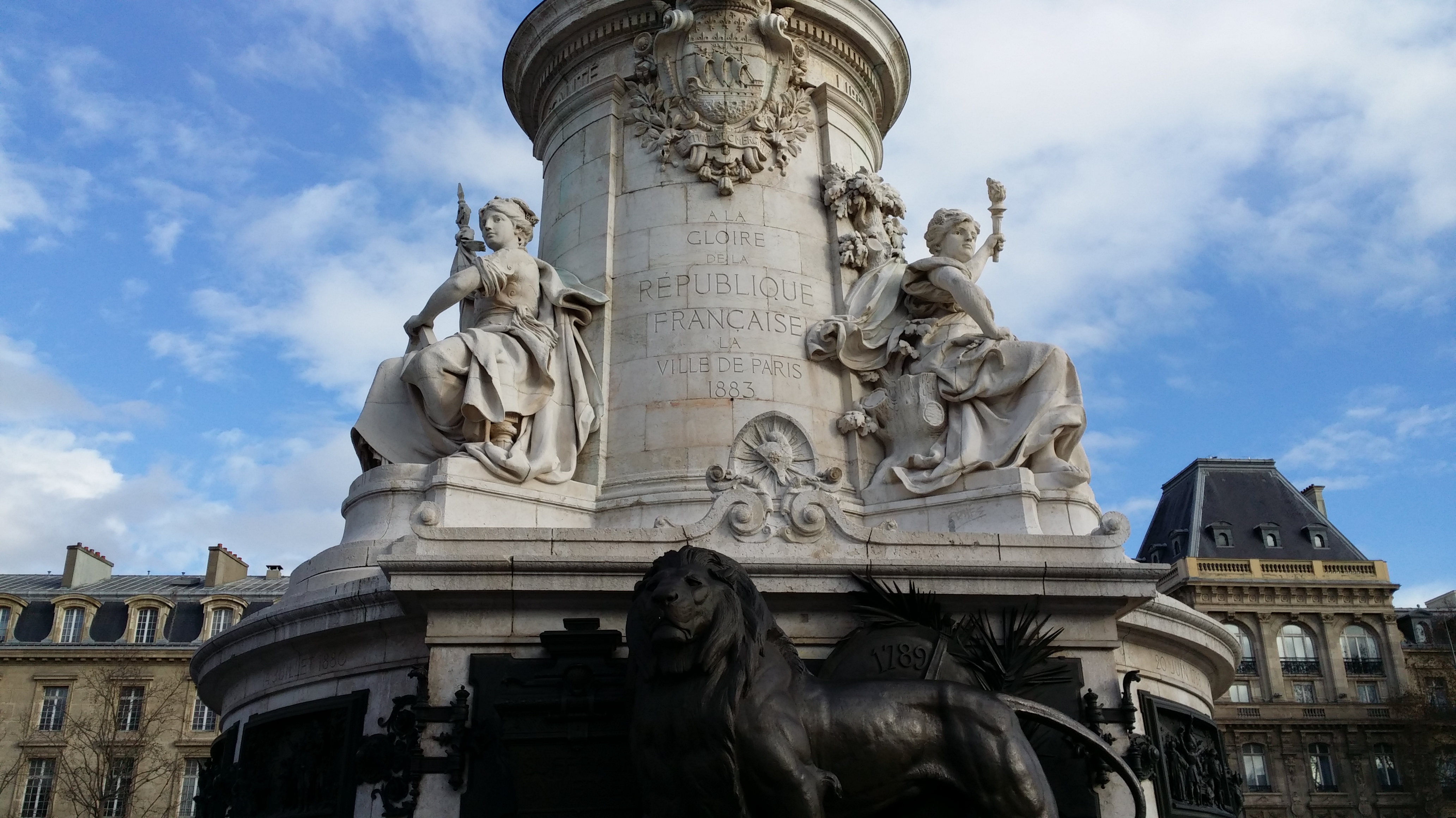
Searching for locations: Paris, France: Place de la Republique

Whilst a rather important place for the French, for us visitors, it has a convenient hotel located just behind the square, and an underground, or Metro station, underneath.

2014-01-07 11.43.05

Added to that was equally convenient cafes, one of which, The Cafe Republique, we had dinner every night.  The service and food were excellent, and we had no problems with the language barriers.

At the top of the monument is a bronze statue of Marianne, said to be the personification of France.

2014-01-07 11.43.41

Surrounding Marianne is three more statues, representing liberty, equality, and fraternity.

2014-01-07 11.43.32

At the base is a lion guarding what is said to be a ballot box.