In a word: Line

The English language has some marvelous words that can be used so as to have any number of meanings

For instance,

Draw a line in the sand

We would all like to do this with our children, our job, our relationships, but for some reason, the idea sounds really good in our heads, but it never quite works out in reality. What does it mean, whatever it is, this I’d where it ends or changes because it can’t keep going the way it is.

Inevitably it leads to,

You’ve crossed the line

Which at some point in our lives, and particularly when children, we all do a few times until, if we’re lucky we learn where that line is. It’s usually considered 8n tandem with pushing boundaries.

Of course, there is

A line you should never cross

And I like to think we all know where that is. Unfortunately, some do not and often find their seemingly idyllic life totally shattered beyond repair. An affair from either side of a marriage or relationship can do that.

You couldn’t walk a straight line if you tried

While we might debate what straight might mean in this context, for this adaptation it means staying on the right side of legality. Some people find a life of crime more appealing than doing honest days work.

This goes hand in hand with,

You’re spinning me a line

Which means you are being somewhat loose with the truth, perhaps in explaining where you’ve been and what you’ve been doing. I think sometimes liars forget they need to have good memories.

Then there are the more practical uses of the word, such as

I have a new line of products

Is that a new fishing line?

Those I think most of us get, but it’s the more ambiguous that we have trouble with. Still, ambiguity is a writer’s best friend and we can make up a lot of stuff from just using one word.

Inspiration, maybe – Volume 1

50 photographs, 50 stories, of which there is one of the 50 below.

They all start with –

A picture paints … well, as many words as you like.  For instance:

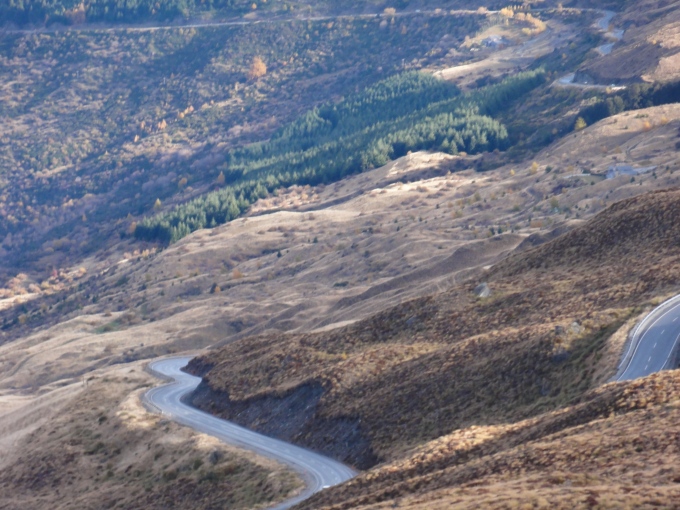
lookingdownfromcoronetpeak

And the story:

It was once said that a desperate man has everything to lose.

The man I was chasing was desperate, but I, on the other hand, was more desperate to catch him.

He’d left a trail of dead people from one end of the island to the other.

The team had put in a lot of effort to locate him, and now his capture was imminent.  We were following the car he was in, from a discrete distance, and, at the appropriate time, we would catch up, pull him over, and make the arrest.

There was nowhere for him to go.

The road led to a dead-end, and the only way off the mountain was back down the road were now on.  Which was why I was somewhat surprised when we discovered where he was.

Where was he going?

“Damn,” I heard Alan mutter.  He was driving, being careful not to get too close, but not far enough away to lose sight of him.

“What?”

“I think he’s made us.”

“How?”

“Dumb bad luck, I’m guessing.  Or he expected we’d follow him up the mountain.  He’s just sped up.”

“How far away?”

“A half-mile.  We should see him higher up when we turn the next corner.”

It took an eternity to get there, and when we did, Alan was right, only he was further on than we thought.”

“Step on it.  Let’s catch him up before he gets to the top.”

Easy to say, not so easy to do.  The road was treacherous, and in places just gravel, and there were no guard rails to stop a three thousand footfall down the mountainside.

Good thing then I had the foresight to have three agents on the hill for just such a scenario.

Ten minutes later, we were in sight of the car, still moving quickly, but we were going slightly faster.  We’d catch up just short of the summit car park.

Or so we thought.

Coming quickly around another corner we almost slammed into the car we’d been chasing.

“What the hell…” Aland muttered.

I was out of the car, and over to see if he was in it, but I knew that it was only a slender possibility.  The car was empty, and no indication where he went.

Certainly not up the road.  It was relatively straightforward for the next mile, at which we would have reached the summit.  Up the mountainside from here, or down.

I looked up.  Nothing.

Alan yelled out, “He’s not going down, not that I can see, but if he did, there’s hardly a foothold and that’s a long fall.”

Then where did he go?

Then a man looking very much like our quarry came out from behind a rock embedded just a short distance up the hill.

“Sorry,” he said quite calmly.  “Had to go if you know what I mean.”

I’d lost him.

It was as simple as that.

I had been led a merry chase up the hill, and all the time he was getting away in a different direction.

I’d fallen for the oldest trick in the book, letting my desperation blind me to the disguise that anyone else would see through in an instant.

It was a lonely sight, looking down that road, knowing that I had to go all that way down again, only this time, without having to throw caution to the wind.

“Maybe next time,” Alan said.

“We’ll get him.  It’s just a matter of time.”

© Charles Heath 2019-2021

Find this and other stories in “Inspiration, maybe”  available soon.

InspirationMaybe1v1

“Trouble in Store” – Short Stories my way: The end of the story

The stage is set for the big finale, though I’m not quite sure how ‘big’ it’s going to be.

Jack is ready to go having been given the green light by the girl with the gun.  It seems collateral damage is not on the agenda for her, though he does admit to himself she is between that proverbial rock and a hard place.

The storekeeper still has a plan, shaky at best, to regain hold of the situation, once the customer is out of the shop.  Nervy or not, he doesn’t think she had the capability to pull the trigger.  He knows what sort of person it takes to do that, and she isn’t one of them.

The policewoman is not sure what to expect but thinks that surprise is on her side, and whatever is going on, she will be able to resolve it.  She has her weapon drawn and ready to use.  She had yet to shoot anyone with it

The girl is at the point of no return, that point where she had nothing left to lose.  Anything she had before was gone, destroyed by the choices she’d made.  No one ever handed out a manual on how you should live your life, or provide a list of people you should avoid, and her father’s prophetic words the last time they men came home with a thud, ‘your life is defined by the choices you make’.

She was not going to jail so it was going to be death or glory.


Now read on:


Jack had heard there were moments where, in a split second, your whole life flashes before your eyes.  He did, and what he saw he didn’t like.

But, then, neither was he very happy about the fact he was nearly out the door before the policewoman on the other side crashed into him and sent him sprawling to the floor.

That was about the same fraction of a second he heard the gun go off, twice, or so he thought and knew he was a dead man, waiting for the bullet.

Another fraction of a second passed as the policewoman tried to unravel the mess they’d become, and at that moment in time felt the tugging at his sleeve and then, as if in slow motion, the sound of the glass door disintegrating behind him.


Annalisa was quite prepared to let the customer go.

She kept one eye on the shopkeeper and one on the customer, sidling towards the door.  The gun was ready to shoot the first person who made a wrong move.

Or so she told herself.  It was getting heavy in her hand, she was shaking almost uncontrollably now, and was getting more and more frightened of the consequences.  She didn’t think, if she aimed, she could hit the side of a barn let alone a person standing ten feet away from her.

The customer reached the door.

At exactly the moment he put his hand 0on the door handle to open the door, another person was pushing the door, trying to make their way in.

With force.

She saw the blue cap, guess it was the police, though she hadn’t heard the siren, but also guessed the shopkeeper might have a silent alarm.

Damn.

A single shot, instantly in the direction of the door, not necessarily aimed at the two people now collapsing to the floor in a tangled mess, but at the door itself.

The impact, yet another guess, might shatter the glass and make it easier to escape.

After one more job.

The hell with Simmo.  He’d dragged her down the rabbit hole far enough.  Simmo knew her first name, that she had rich parents, but nothing else.  Besides, he was in such bad shape she didn’t think he’d recover.

The shopkeeper had no idea who she was, it was the first time she’d been to his shop, and now, after a few weeks with Simmo, not ever her mother would recognize her.

She swiveled the gun and aimed it at the shopkeeper and pulled the trigger.,  One less dealer in the city was good news not bad.

She saw it hit, not exactly where, but it caused him to twist and start falling to the ground, at the same time letting out a very loud scream.  Panic or anger?

She wasn’t waiting to find out.

A last glance at Simmo, now down for the count, she ran for the door, past the two on the floor, what she could now see was a policewoman with her weapon drawn, but unable to use it.

She crashed through the remainder of the glass shards put into the street and ran.

In the distance she could hear a police car coming, siren blaring.  A warning if there was ever one to run harder, up the road, down an alley, out into another street, then down into the subway.

Gone.


It took fifteen seconds to disentangle herself from the customer, pushing him away, and getting to her feet, weapon aimed.

At nothing but air.

The girl had gone, and then she had the vague recollection of a shadow passing her as she was facing the other way getting to her feet.

And running out the door.

Five more valuable seconds as her brain processed this piece of information before it issued the command to go out the door and see which way she went.

Another ten seconds to get out the door, and see the police car coming from the same direction she had earlier, screeching to a halt outside the shop, a car door opening, and an officer getting out.

Margaret was guessing at the driver to drive down the road where she guessed the girl had run, managing to yell breathlessly at the office getting out, “She’s gone that way,” and pointing.

The officer relayed the message and closed the door as the car sped off.

“What happened?”

“Shots fired by a woman, more a girl, in the process of a robbery.”

She ran back inside the officer following.

The customer had moved to a corner and was standing, testing his limbs, with an expression that said he was amazed he was still alive.

“Over behind the counter.  She shopkeeper.  He was standing there.”

The policeman rounded the end of the counter and looked down.  “He’s here.  It’s not looking good.”

Margaret didn’t hear him.  She was calling an ambulance.


Next:  Perhaps some editing


© Charles Heath 2016-2020


Memories of the conversations with my cat – 93

As some may be aware, but many not, Chester, my faithful writing assistant, mice catcher, and general pain in the neck, passed away some months ago.

Recently I was running a series based on his adventures, under the title of Past Conversations with my cat.

For those who have not had the chance to read about all of his exploits I will run the series again from Episode 1

These are the memories of our time together…

20160917_075223

This is Chester.  We’re getting by during the ‘stay at home’ order.

I’m doing just that, though it sometimes feels like I’m in jail, on the inside looking out.

“Now you know how I feel”, Chester tells me, after jumping up on the window ledge to look out the window, trying to see what had caught my interest.

I don’t tell him I’m basically staring into space.

Except, a car passes, not fast, not slow, but much like the rest of the traffic that passes by.  Or used to.  With the order to stay at home, and the fact schools are not open, there have been fewer and fewer cars passing by.

“Didn’t that car…” Chester mutters.

He’s right.  The same car just went back the other way.  Slow, but not too slow.

“Perhaps’s he’s looking for a house, a particular address.”

We watch and wait.

Five minutes later the car has returned and stops outside my window.  A man gets out the passenger side, says something to the driver, then closes the door.  He starts walking back up the street from where the car had just come.

The car drives off, then a minute later is back, and parks on the other side of the road.  We can see the driver.  Not the sort of person you’d want to need on a dark night.  Tattoos on his arm, and smoking a cigarette, negligently stopping ask on the road below his window.

“He’s watching,” Chester says.

“He’s a lookout?”

We’re both thinking the same.  A crime is being committed.  They’ve scoped the street for an unattended house, a rarity for obvious reasons, though these days robbers rob the house while you’re still in it.

We wait.  Three minutes later the other man comes running very quickly to the car, jumps in and they drive off very quickly before the man had closed the door.

Seconds later another man appears with a baseball bat in his hand.

“Close call,” Chester says, interest now waning.  He jumps down.  “Pity they didn’t catch the robber.”

Perhaps.  But one thing is for sure, those robbers will not be back.

Diversion over, back to boredom.  Chester has gone back to one of his hiding spots.  I’m going to do another crossword.

Six months is going to be a long, long, long, long time.

The cinema of my dreams – Was it just another surveillance job – Episode 59

This story is now on the list to be finished so over the new few weeks, expect a new episode every few days.

The reason why new episodes have been sporadic, there are also other stories to write, and I’m not very good at prioritizing.

But, here we are, a few minutes opened up and it didn’t take long to get back into the groove.

Things are about to get complicated…


With Jan safely in custody, probably for about 15 minutes when Dobbin discovered she was in police hands, Jennifer and I were free to chase up O’Connell and maybe we would also find Anna.

It was a long shot at best.

But we had to find out more about Anna Jacovich.  For that, we would have to go back to the office and talk to Joanne.  I told Jennifer what I intended to do and dropped her at the safe house for some much-needed rest before we went after O’Connell.

Then, back in the car, I called the number I had for Joanne.

“Sam.”

“Memorised my number?”

“I like to know who’s calling before I answer.”

“Then this isn’t a restricted line?”

“Restricted enough.”

“I found your little toy?”

Did I hear a sigh? 

“You know the world we live in Sam, trust no one not even your mother.  Hard for me to trust or not trust her, she passed away when I was seven.  Monica said you were good.  What can I do for you?”

“A full workup on Anna Jacovich.  I’m coming into the office now, and will be there in about half an hour.”

“No pressure then?”

“Not at all.”

“Try not to irritate security this time.”

I’m sure I saw a grim expression on the face of the soldier that had been there the last time I tried to run the gauntlet, and then disappointment when my card worked.  I signed in and put the name of the department I was visiting down as Research.

When he asked for a name, I gave him Joanne’s.  No doubt he would call her long before I got to her.

She met me at the second level of defence and then took me to a room where two folders sat at opposite ends of a table, two desk lamps shining light down on them.  The rest of the room was in darkness.

When she shut the door, I said, “Please tell me there in;t a firing squad in black camouflage just waiting to shoot me.”

She smiled.  “If it was more sensitive information, I’d let you read it, then have you shot.  Not today.

That was a relief.  Oddly, I believed that she would if the circumstances warranted it.  Joanne was scary, nor scary than Jan.  It’s the quiet ones you had to worry about.”

We sat.

“Read. Then I’ll answer questions.”

For the ten minutes, it took me to discover that Anna was a biochemist herself, and had worked in a not-so-secret government laboratory that had been unmasked with disastrous results, adding another dimension to the problem.  I was beginning to think she might be the one who created the monster and had set her husband up to take the blame.

If that was the case, she was never going to pass it on to O’Connell or sell it to him, other than to take the money and run.  If that was the case, Severin knew it was her all along, and how dangerous she was.

But and there was a big but in all of this.  She needed an accomplice to get to England, which was O’Connell.  Now he was no longer needed…

Yes, she would also need both Severin and Maury off her tail, and that had been taken care of.

Jan?  Unless I completely misread her, it was not possible she could be the accomplice; she was doing what Dobbin requested.  Or had she?  Dobbin did say she was able to make executive decisions on the fly.

“The threat isn’t O’Connell.  He’s just a pawn.”

“Not just a pretty face then?”

“I never regard my face as pretty.”

She shook her head.  “It’s Anna.  She played Severin and Maury, she played Dobbin, and she played Dobbin’s little toy soldier, O’Connell.  Or Quigley I believe his real name is.  I hesitate to say O’Connell played you.”

“Call a dog a dog, Joanne.  If I had more experience and more information I might have seen that.  You can’t keep people in the dark, and then expect miracles.”

“I’m the messenger, Sam.”

“I’ve been known to shoot messengers, just because I can.”

“Save your bullets for the bad guys.”

“How do I know you and Monica are not the bad guys?”

Another shake of the head.  “OK.  You’ve passed the scepticism test, Sam.  Now put it away.  We have to work together on this.  It’s a condition for continuing to work on the case.”

“And if I don’t?”

“I don’t need to answer that.  But, I get it.  You’re a self-starter and will keep at it, with or without us.  I can see why people like you.  To me, your just another dangerous amateur.”

There were words I could say, but judging by the reek of self-aggrandisement, it would not penetrate the thick hide.

I smiled.  “Not noted for your charm then.”

“No.  Where is Jan?”

“Who?”

“Don’t play games, Sam.  They don’t become you.  You went to see Severin, but he ended up dead, and she shot him.  Why?”

“You read this file?”  I picked it up and dropped it on the table.

She was the sort that read the first page, the preamble, and the last page, the result or desired result.

“I did.”

“Then you know why, as for Jan, if you know I was there when Severin was shot, you’d know where Jan is.”

“She disappeared into the trees.  And no doubt in the wind.  You should know she’s a trained MI5 assassin on loan to Dobbin.”

Who was now in jail somewhere pending the Detective Inspectors leisure, unless she filed a report.  If she did, she would be out now, and looking for O’Connell and Anna.

“Then how should I know?”

She shrugged.  “I thought I’d ask.  I’m not sure I like having to peel away the layers of this story one by one.”

“Be more forthcoming.”  I stood.  I had what I needed.  “If that’s all, I’ll go on with the job.”

“O’Connell?”

“He’s probably dead by now, but I have to find him, one way or another.”

“Keep me in the loop.  Monica wants to know.”

“Of course.”

© Charles Heath 2020-2023

Writing a book in 365 days – My story 38

More about my story

At the heart of the story is the fictional Coup d’état, sometimes used by nefarious elements, but in this case, it is orchestrated by a group of people who wish to rid themselves of a corrupt and brutal regime. It is useful to look at some of the elements and weave these into the story.

This is not a blueprint for executing such a process; it is merely a guide to understanding what it is and why the people in the story felt they had to resort to it.

The Tumultuous Path of a Coup d’état: Understanding Its Mechanics, Motivations, and Risks

The phrase “coup d’état” – a sudden, often violent, seizure of power from a government – conjures images of military might and political upheaval. While usually associated with historical events, understanding its core mechanics, the reasons behind such desperate gambits, and the factors that contribute to their success or failure is crucial for comprehending political instability and the fragility of power.

What Exactly is a Coup d’état?

At its heart, a coup d’état (French for “stroke of state”) is an illegal and unconstitutional overthrow of a government, typically by a small group, most often from within the existing state apparatus. Unlike a revolution, which involves widespread popular participation and aims for fundamental societal change, a coup is generally swift, decisive, and carried out by an elite faction – often military officers, but sometimes political figures or intelligence agencies.

Key characteristics include:

  • Speed and Surprise: Coups rely on catching the existing leadership off guard.
  • Limited Scope: They usually target the top echelons of power, aiming to replace leaders rather than dismantle the entire system immediately.
  • Use of Force or Threat of Force: While not always bloody, the potential for violence is inherent.
  • Internal Actors: The plotters are typically insiders who have access to state resources and institutions.

Why Might a Coup Be Pursued?

The motivations behind attempting a coup d’état can be varied and often deeply rooted in perceived grievances and aspirations. Some common drivers include:

  • Discontent with the Current Leadership: This can stem from perceived corruption, incompetence, authoritarianism, or failure to address national crises (economic, social, or security).
  • Desire for Political Power: Ambitious individuals or factions may see a coup as the fastest and most direct route to seizing control.
  • Ideological Differences: A group may believe the current government’s policies or ideology are detrimental to the nation and seek to impose their own vision.
  • Ethnic or Regional Grievances: In diverse nations, a particular group might feel marginalized or oppressed and attempt to seize power to assert their dominance or secure their interests.
  • External Influence: Foreign powers may sometimes support or instigate coups to install friendly regimes or destabilize adversaries.

What is Needed to Make a Coup d’état Work?

A successful coup d’état is a meticulously planned and executed operation that requires a confluence of specific elements:

  • A Committed and Organized Core Group: This is the engine of the coup. They need a clear plan, leadership, and a unity of purpose.
  • Control of Key State Institutions: This is paramount. Access to and control over the military, police, intelligence agencies, and vital communication networks are essential for neutralizing opposition and projecting authority.
  • Disruption of Communications: Cutting off or controlling communication channels prevents the existing government from rallying support or issuing counter-orders.
  • Neutralization of Key Leaders: The swift arrest, detention, or elimination of the head of state, key ministers, and loyal military commanders is crucial to preventing organized resistance.
  • Public Apathy or Support (or at least acquiescence): While coups are not revolutions, the general populace’s reaction can be a significant factor. If the public is indifferent, divided, or even sympathetic to the coup plotters’ initial message, it can significantly ease their path.
  • Rapid Consolidation of Power: Once the initial seizure is complete, the plotters must quickly establish their authority, issue decrees, and begin to govern to prevent a vacuum or counter-coup.
  • Legitimizing Narrative: Even in an illegal act, plotters often try to frame their actions as necessary for the greater good, using propaganda to justify their takeover.

What Lets a Coup d’état Work or Fail?

The success or failure of a coup d’état is a delicate balance, with numerous factors tipping the scales:

Factors Contributing to Success:

  • Overwhelming Military Support: If the majority of the armed forces, especially elite units, back the coup, it’s very difficult for the existing government to resist.
  • Weakness of the Current Regime: A government that is already unpopular, fractured, and lacking in popular legitimacy is more vulnerable.
  • Effective Intelligence and Secrecy: The element of surprise is a powerful weapon. If the plot is kept secret until the last moment, the government has little time to react.
  • Swift and Decisive Action: Hesitation or botched initial moves can give the government time to regroup and retaliate.
  • Lack of Coordinated Opposition: If loyalist forces are disorganized or divided, they are less likely to mount an effective counter-attack.
  • International Non-Intervention: If major global powers remain neutral or even tacitly support the coup, it can increase its chances of survival.

Factors Leading to Failure:

  • Loyalist Resistance: If a significant portion of the military or security forces remains loyal to the government and can effectively organize resistance, the coup can be crushed.
  • Popular Uprising: While not a direct cause, widespread popular mobilization against the coup can create significant challenges and force the plotters to overextend their resources.
  • Internal Divisions Among Plotters: Disagreements within the coup leadership can lead to indecision, infighting, and ultimately, collapse.
  • Infiltration and Betrayal: If the plot is discovered prematurely or key members betray the plan, it can lead to the arrest of the plotters.
  • Ineffective Planning and Execution: Poorly organized coups, marked by confusion and disarray, are easily thwarted.
  • International Condemnation and Intervention: Strong international opposition, sanctions, or even direct intervention can undermine a coup’s legitimacy and effectiveness.
  • Failure to Consolidate Power: If the plotters fail to quickly establish control over essential services and institutions, they can find themselves in a precarious position.

In conclusion, a coup d’état is a high-stakes gamble that, while seemingly decisive in its initial moments, is fraught with uncertainty. Its success hinges on a complex interplay of internal political dynamics, military loyalty, strategic execution, and the ever-unpredictable reaction of the population and the international community. Understanding these elements provides a critical lens through which to analyze political instability and the enduring struggle for power in various nations.

Searching for locations: New York, USA

After arriving latish from Toronto, and perhaps marginally disappointed that while in Toronto, the ice hockey didn’t go our way, we slept in.

Of course, the arrival was not without its own problems. The room we were allocated was on the 22nd floor and was quite smallish. Not a surprise, but we needed space for three, and with the fold-out bed, it was tight but livable.

Except…

We needed the internet to watch the Maple Leafs ice hockey game. We’d arrive just in time to stream it to the tv.

But…

There was no internet. It was everywhere else in the hotel except our floor.

First, I went to the front desk and they directed me to call tech support.

Second, we called tech support and they told us that the 22nd-floor router had failed and would get someone to look at it.

When?

It turns out it didn’t seem to be a priority. Maybe no one else on the floor had complained

Third, I went downstairs and discussed the lack of progress with the night duty manager, expressing disappointment with the lack of progress.

I also asked if they could not provide the full service that I would like a room rate reduction or a privilege in its place as compensation.

He said he would check it himself.

Fourth, after no further progress, we called the front desk to advise there was still no internet. This time we were asked if we wanted a room on another floor, where the internet is working. We accepted the offer.

The end result, a slightly larger, less cramped room, and the ability to watch the last third of the Maple Leaf’s game. I can’t remember if we won.

We all went to bed reasonably happy.

After all, we didn’t have to get up early to go up or down to breakfast because it was not included in the room rate, a bone of contention considering the cost.

I’ll be booking with them directly next time, at a somewhat cheaper rate, a thing I find after using a travel wholesaler to book it for me.

As always every morning while Rosemary gets ready, I go out for a walk and check out where we are.

It seems we are practically in the heart of theaterland New York. Walk one way or the other you arrive at 7th Avenue or Broadway.

Walk uptown and you reach 42nd Street and Times Square, little more than a 10-minute leisurely stroll. On the way down Broadway, you pass a number of theatres, some recognizable, some not.

Times Square is still a huge collection of giant television screens advertising everything from confectionary to TV shows on the cable networks.

A short walk along 42nd street takes you to the Avenue of the Americas and tucked away, The Rockefeller center and its winter ice rink.

A few more steps take you to 5th Avenue and the shops like Saks of Fifth Avenue, shops you could one day hope to afford to buy something.

In the opposite direction, over Broadway and crossing 8th Avenue is an entrance to Central Park. The approach is not far from what is called the Upper West Side, home to the rich and powerful.

Walk one way in the park, which we did in the afternoon, takes you towards the gift shop and back along a labyrinth of laneways to 5th Avenue. It was a cold, but pleasant, stroll looking for the rich and famous, but, discovering, they were not foolish enough to venture out into the cold.

Before going back to the room, we looked for somewhere to have dinner and ended up in Cassidy’s Irish pub. There was a dining room down the back and we were one of the first to arrive for dinner service.

The first surprise, our waitress was from New Zealand.

The second, the quality of the food.

I had a dish called Steak Lyonnaise which was, in plain words, a form of mince steak in an elongated patty. It was cooked rare as I like my steak and was perfect. It came with a baked potato.

As an entree, we had shrimp, which in our part of the world are prawns, and hot chicken wings, the sauce is hot and served on the side.

The beer wasn’t bad either. Overall given atmosphere, service, and food, it’s a nine out of ten.

It was an excellent way to end the day.

Plots ripped from newspaper headlines – 3

Truth is stranger than fiction

Beyond the Headlines: When the News Reads Like a Thriller Plot

Ever scroll through the news, jump from one headline to another, and feel a growing sense of unease that isn’t quite about any single story, but lingers in the space between them? You’re not alone. As someone who occasionally dips into the world of thriller writing, I’ve found myself looking at the daily churn of global events through a rather specific lens lately. And let me tell you, the plot points are getting interesting.

Consider just a few snippets from recent reports:

  • Whispers of a looming currency war.
  • Oil prices are set to rise, ostensibly due to production cuts.
  • Certain tankers are avoiding the Hormuz Strait.
  • massive power outage plunged parts of the UK into darkness.
  • Gold prices are steadily climbing.
  • North Korea is launching missiles into the sea.
  • The USA needs more missiles for its arsenal.
  • Chinese survey vessels are operating in the South China Sea.
  • An explosion on a secret base in Russia reportedly had “nuclear implications.”
  • And, the ever-present shadow of a potential global recession.

Taken individually, these might seem like isolated events – economic fluctuations, regional tensions, unfortunate accidents. But what if they’re not? What if, as a thriller writer’s mind might suggest, these are individual brushstrokes on a much larger, more ominous canvas?

The Plot Thickens: Connecting the Unconnected

Let’s play “what if” for a moment.

Take that unsettling report from Russia – an explosion on a secret base with ‘nuclear implications.’ Now, juxtapose that with the massive power outage in the UK. The thriller writer in me immediately wonders: What if that Russian site wasn’t just any base, but a clandestine laboratory pushing the boundaries of miniaturized, high-yield devices? Devices designed to be easily deployed, perhaps around vital infrastructure? And what if the UK outage wasn’t just a technical glitch, but… a test run? A demonstration of capability, proving that critical systems are vulnerable? If so, should we be looking for more such “accidents” down the line?

This thought then casts a chilling shadow over the Hormuz Strait, where tankers are already facing problems, with some opting to steer clear. If small, powerful devices exist, imagine the potential for an apocalyptic event if one were to disable or detonate a tanker carrying volatile cargo in such a critical global choke point. The domino effect on global trade, energy, and stability would be catastrophic.

Meanwhile, the geopolitical chess board is equally active. North Korea is firing test missiles into the sea, a perennial provocateur. Simultaneously, the USA issues a call for more missiles to replenish its own arsenal. Is this a direct response, or is North Korea merely a convenient smokescreen? My thriller instincts twitch when I see Chinese “survey vessels” in the South China Sea. What if they’re not merely surveying? What if they’re establishing critical sub-sea infrastructure, mapping strategic pathways, or deploying advanced surveillance, all under the guise of scientific research? Are we witnessing a distraction, a proxy game, or the careful positioning of pieces before a major move?

Economic Storm Clouds and the Golden Truth

And then there’s the economy, often the underlying current of global tension. We hear that oil prices are set to rise due to OPEC cutting output. A straightforward economic decision, right? Or could it be another facet of a brewing currency war, where nations jockey for economic advantage, and the price of essential commodities becomes a weapon? Such a scenario would certainly accelerate the march towards that predicted global recession.

A crucial indicator, often flashing red before the storm, is gold. Its price is soaring. Gold traditionally goes into overdrive when currencies begin to lose value, when recessions loom or deepen, or when the drums of war beat louder. And indeed, the drums are beating: US-China tensions remain high, the Middle East is a perpetual tinderbox, the Korean peninsula is volatile, and in a recent development, India and Pakistan are once again facing off over Kashmir. Are we truly surprised that people are turning to the ancient safe haven of gold?

It’s enough to make one consider trading the daily news feed for a quiet crossword puzzle, isn’t it? To ignore the swirling confluence of events and pretend the world is a simpler, less interconnected place. Perhaps these are all indeed unconnected events, coincidences in the vast, chaotic tapestry of global affairs. Or perhaps, just perhaps, the world is penning a story far more complex and thrilling than any fiction we could devise.

What narrative do you see unfolding?

#GlobalNews #ThrillerWriter #CurrentEvents #WhatIf #Geopolitics #Economy #ConspiracyTheories #ConnectingTheDots #WorldAffairs

First Dig Two Graves

A sequel to “The Devil You Don’t”

Revenge is a dish best served cold – or preferably so when everything goes right

Of course, it rarely does, as Alistair, Zoe’s handler, discovers to his peril. Enter a wildcard, John, and whatever Alistair’s plan for dealing with Zoe was dies with him.

It leaves Zoe in completely unfamiliar territory.

John’s idyllic romance with a woman who is utterly out of his comfort zone is on borrowed time. She is still trying to reconcile her ambivalence, after being so indifferent for so long.

They agree to take a break, during which she disappears. John, thinking she has left without saying goodbye, refuses to accept the inevitable, calls on an old friend for help in finding her.

After the mayhem and being briefly reunited, she recognises an inevitable truth: there is a price to pay for taking out Alistair; she must leave and find them first, and he would be wise to keep a low profile.

But keeping a low profile just isn’t possible, and enlisting another friend, a private detective and his sister, a deft computer hacker, they track her to the border between Austria and Hungary.

What John doesn’t realise is that another enemy is tracking him to find her too. It could have been a grand tour of Europe. Instead, it becomes a race against time before enemies old and new converge for what will be an inevitable showdown.

Searching for locations – Dorrigo to Glenreagh, New South Wales, Australia

Once a bustling railway

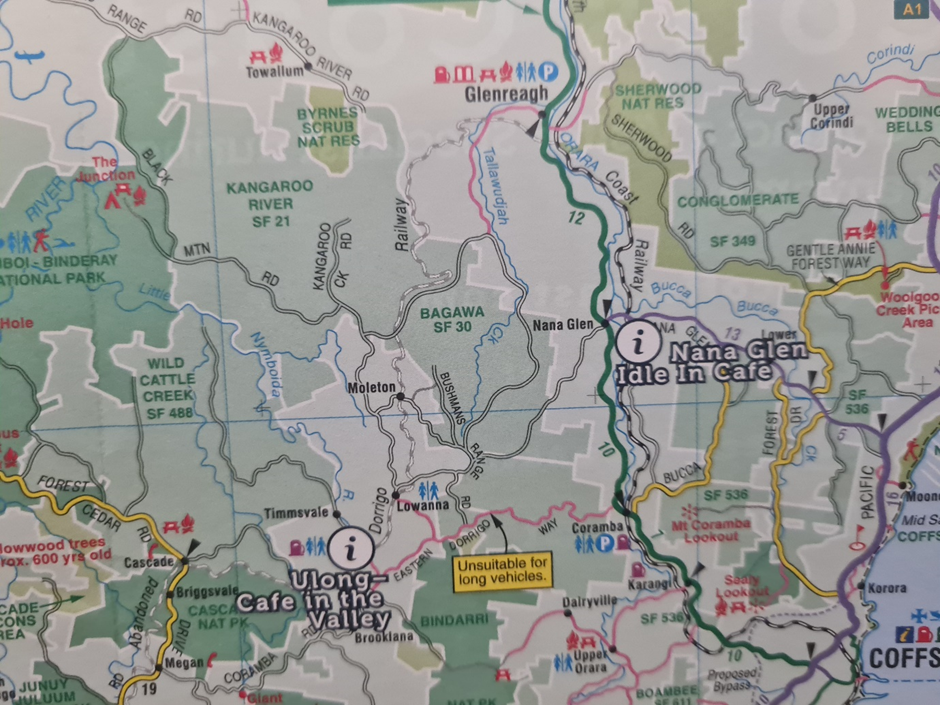
When you pick up a document that describes tourist attractions in Coffs Harbour, there’s one about the Orara Valley, and what caught my eye was firstly the Lowanna Railway Station.

To get there, you pass through Coramba, where the current railway line runs through it, but any attempt to find the railway station will be met with disappointment.

But …

That’s not the railway story we’re trying to visualise, that is the Glenreagh to Dorrigo line, first mooted in 1906, but not getting started until 1910, then halted because of the First World War and not completed until December 1924, and ran until October 1972.

However, back to Coramba momentarily…

The North Coast railway (the primary rail route in the Mid North Coast and Northern Rivers regions of New South Wales) passes through Coramba, which had a now-closed railway station from 1922.  An attempt to find the station took us to a private residence, which obviously was once the station. It was not what we were looking for.

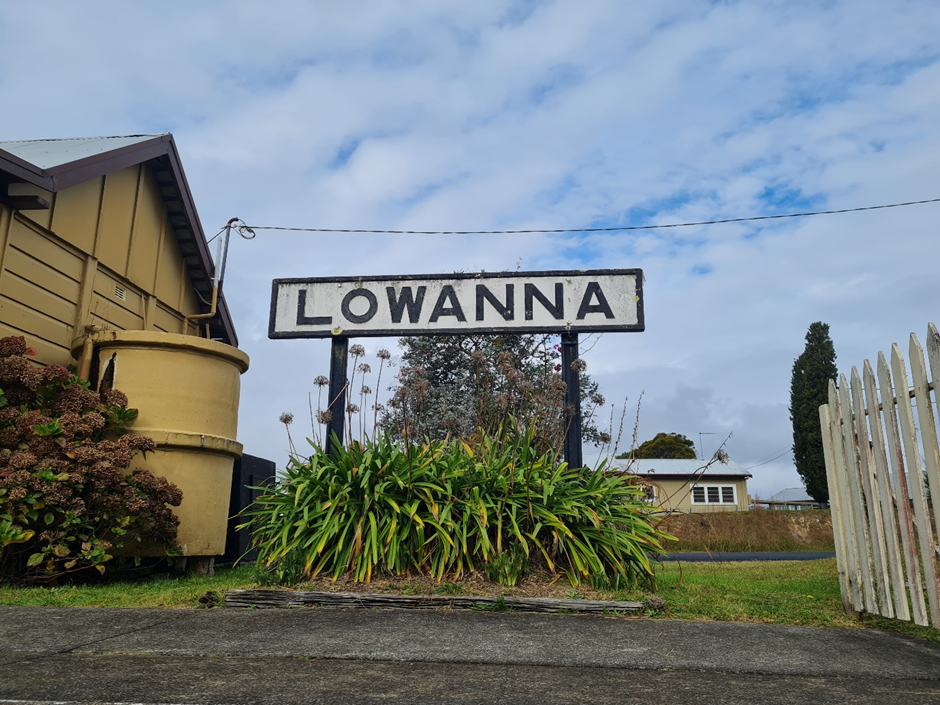
And then to the right historic station, in Lowanna, not far from Coramba…

Lowanna was the largest of the intermediate stations. It was an attended station, with a crossing loop and siding. Most of the timber was loaded at this location. 

Opened  23-Dec-1924 and Closed 20-Sep-1975

What we were really looking for was the Lowanna Railway Station, which, when we put it in the GPS, almost got us lost.  We eventually found the refurbished station, a rather run-down platform, and rail tracks.

Lowanna was on the Dorrigo branch and lies on the north coast of NSW.  It branches off the North Coast Line at Glenreagh and climbs up to the Dorrigo Plateau.

The Dorrigo area was settled in the early 1900s by pastoralists and tree fellers. Due to the steep terrain, it was decided to build a railway to allow products to be brought to nearby port towns. Several routes were surveyed, with the route from Glenreagh eventually chosen. The line climbs 664m over a length of 69km.

Apart from the endpoints of Dorrigo and Glenreagh, the stations on this line were very small, often consisting of a short platform with a small shelter. The major traffic on this line was timber.

More on the other stations, not that much still exists, on the line from Dorrigo to Glenreagh. At Dorrigo, there is a very big surprise…