Writing a book in 365 days – 248

Day 248

Some pointers for reviewing your work

Sharpen Your Words: Simple Tips for Better Writing

Ever finish writing something and feel like it’s just… not quite right? We’ve all been there. Polishing your writing is key to making sure your message shines through. Here are a few handy tips to help you review your work and make it stronger.

Keep it Concise

Don’t write long sentences. Shorter sentences are easier to follow. They pack a punch.

Each sentence should make a clear statement. Get straight to the point. Avoid rambling. Every sentence needs a purpose.

Watch Your Vocabulary

Don’t use big words. Choose words that everyone understands. Simple language is powerful language.

Never use words whose meanings you are not sure of. If you’re second-guessing a word, swap it out. Clarity is king.

Be Concrete

Avoid the abstract. Stick to what you can see, hear, touch, taste, and smell. Give examples. Paint a picture with your words.

What Else?

These are great starting points, but what else can help you make your writing shine?

  • Read it aloud: This is a game-changer. You’ll catch awkward phrasing and sentences that are too long. Your ears will tell you what your eyes miss.
  • Get a second opinion: Ask a friend or colleague to read your work. They’ll see things you’re too close to notice.
  • Take a break: Step away from your writing. Come back with fresh eyes.
  • Focus on flow: Do your ideas connect smoothly? Are your paragraphs logically ordered?
  • Check for repetition: Are you saying the same thing over and over? Find different ways to express your ideas.

Reviewing your writing doesn’t have to be a chore. By keeping these simple tips in mind, you can transform your drafts into clear, engaging pieces that truly connect with your readers. Happy writing!

An excerpt from “Strangers We’ve Become” – Coming Soon

I wandered back to my villa.

It was in darkness.  I was sure I had left several lights on, especially over the door so I could see to unlock it.

I looked up and saw the globe was broken.

Instant alert.

I went to the first hiding spot for the gun, and it wasn’t there.  I went to the backup and it wasn’t there either.  Someone had found my carefully hidden stash of weapons and removed them.

Who?

There were four hiding spots and all were empty.  Someone had removed the weapons.  That could only mean one possibility.

I had a visitor, not necessarily here for a social call.

But, of course, being the well-trained agent I’d once been and not one to be caught unawares, I crossed over to my neighbor and relieved him of a weapon that, if found, would require a lot of explaining.

Suitably armed, it was time to return the surprise.

There were three entrances to the villa, the front door, the back door, and a rather strange escape hatch.  One of the more interesting attractions of the villa I’d rented was its heritage.  It was built in the late 1700s, by a man who was, by all accounts, a thief.  It had a hidden underground room which had been in the past a vault but was now a wine cellar, and it had an escape hatch by which the man could come and go undetected, particularly if there was a mob outside the door baying for his blood.

It now gave me the means to enter the villa without my visitors being alerted, unless, of course, they were near the vicinity of the doorway inside the villa, but that possibility was unlikely.  It was not where anyone could anticipate or expect a doorway to be.

The secret entrance was at the rear of the villa behind a large copse, two camouflaged wooden doors built into the ground.  I move aside some of the branches that covered them and lifted one side.  After I’d discovered the doors and rusty hinges, I’d oiled and cleaned them, and cleared the passageway of cobwebs and fallen rocks.  It had a mildew smell, but nothing would get rid of that.  I’d left torches at either end so I could see.

I closed the door after me, and went quietly down the steps, enveloped in darkness till I switched on the torch.  I traversed the short passage which turned ninety degrees about halfway to the door at the other end.  I carried the key to this door on the keyring, found it and opened the door.  It too had been oiled and swung open soundlessly.

I stepped in the darkness and closed the door.

I was on the lower level under the kitchen, now the wine cellar, the ‘door’ doubling as a set of shelves which had very little on them, less to fall and alert anyone in the villa.

Silence, an eerie silence.

I took the steps up to the kitchen, stopping when my head was level with the floor, checking to see if anyone was waiting.  There wasn’t.  It seemed to me to be an unlikely spot for an ambush.

I’d already considered the possibility of someone coming after me, especially because it had been Bespalov I’d killed, and I was sure he had friends, all equally as mad as he was.  Equally, I’d also considered it nigh on impossible for anyone to find out it was me who killed him because the only people who knew that were Prendergast, Alisha, a few others in the Department, and Susan.

That raised the question of who told them where I was.

If I was the man I used to be, my first suspect would be Susan.  The departure this morning, and now this was too coincidental.  But I was not that man.

Or was I?

I reached the start of the passageway that led from the kitchen to the front door and peered into the semi-darkness.  My eyes had got used to the dark, and it was no longer an inky void.  Fragments of light leaked in around the door from outside and through the edge of the window curtains where they didn’t fit properly.  A bone of contention upstairs in the morning, when first light shone and invariably woke me up hours before I wanted to.

Still nothing.

I took a moment to consider how I would approach the visitor’s job.  I would get a plan of the villa in my head, all entrances, where a target could be led to or attacked where there would be no escape.

Coming in the front door.  If I was not expecting anything, I’d just open the door and walk-in.  One shot would be all that was required.

Contract complete.

I sidled quietly up the passage staying close to the wall, edging closer to the front door.  There was an alcove where the shooter could be waiting.  It was an ideal spot to wait.

Crunch.

I stepped on some nutshells.

Not my nutshells.

I felt it before I heard it.  The bullet with my name on it.

And how the shooter missed, from point-blank range, and hit me in the arm, I had no idea.  I fired off two shots before a second shot from the shooter went wide and hit the door with a loud thwack.

I saw a red dot wavering as it honed in on me and I fell to the floor, stretching out, looking up where the origin of the light was coming and pulled the trigger three times, evenly spaced, and a second later I heard the sound of a body falling down the stairs and stopping at the bottom, not very far from me.

Two assassins.

I’d not expected that.

The assassin by the door was dead, a lucky shot on my part.  The second was still breathing.

I checked the body for any weapons and found a second gun and two knives.  Armed to the teeth!

I pulled off the balaclava; a man, early thirties, definitely Italian.  I was expecting a Russian.

I slapped his face, waking him up.  Blood was leaking from several slashes on his face when his head had hit the stairs on the way down.  The awkward angle of his arms and legs told me there were broken bones, probably a lot worse internally.  He was not long for this earth.

“Who employed you?”

He looked at me with dead eyes, a pursed mouth, perhaps a smile.  “Not today my friend.  You have made a very bad enemy.”  He coughed and blood poured out of his mouth.  “There will be more …”

Friends of Bespalov, no doubt.

I would have to leave.  Two unexplainable bodies, I’d have a hard time explaining my way out of this mess.  I dragged the two bodies into the lounge, clearing the passageway just in case someone had heard anything.

Just in case anyone was outside at the time, I sat in the dark, at the foot of the stairs, and tried to breathe normally.  I was trying not to connect dots that led back to Susan, but the coincidence was worrying me.

A half-hour passed and I hadn’t moved.  Deep in thought, I’d forgotten about being shot, unaware that blood was running down my arm and dripping onto the floor.

Until I heard a knock on my front door.

Two thoughts, it was either the police, alerted by the neighbors, or it was the second wave, though why would they be knocking on the door?

I stood, and immediately felt a stabbing pain in my arm.  I took out a handkerchief and turned it into a makeshift tourniquet, then wrapped a kitchen towel around the wound.

If it was the police, this was going to be a difficult situation.  Holding the gun behind my back, I opened the door a fraction and looked out.

No police, just Maria.  I hoped she was not part of the next ‘wave’.

“You left your phone behind on the table.  I thought you might be looking for it.”  She held it out in front of her.

When I didn’t open the door any further, she looked at me quizzically, and then asked, “Is anything wrong?”

I was going to thank her for returning the phone, but I heard her breathe in sharply, and add, breathlessly, “You’re bleeding.”

I looked at my arm and realized it was visible through the door, and not only that, the towel was soaked in blood.

“You need to go away now.”

Should I tell her the truth?  It was probably too late, and if she was any sort of law-abiding citizen she would go straight to the police.

She showed no signs of leaving, just an unnerving curiosity.  “What happened?”

I ran through several explanations, but none seemed plausible.  I went with the truth.  “My past caught up with me.”

“You need someone to fix that before you pass out from blood loss.  It doesn’t look good.”

“I can fix it.  You need to leave.  It is not safe to be here with me.”

The pain in my arm was not getting any better, and the blood was starting to run down my arm again as the tourniquet loosened.  She was right, I needed it fixed sooner rather than later.

I opened the door and let her in.  It was a mistake, a huge mistake, and I would have to deal with the consequences.  Once inside, she turned on the light and saw the pool of blood just inside the door and the trail leading to the lounge.  She followed the trail and turned into the lounge, turned on the light, and no doubt saw the two dead men.

I expected her to scream.  She didn’t.

She gave me a good hard look, perhaps trying to see if I was dangerous.  Killing people wasn’t something you looked the other way about.  She would have to go to the police.

“What happened here?”

“I came home from the cafe and two men were waiting for me.  I used to work for the Government, but no longer.  I suspect these men were here to repay a debt.  I was lucky.”

“Not so much, looking at your arm.”

She came closer and inspected it.

“Sit down.”

She found another towel and wrapped it around the wound, retightening the tourniquet to stem the bleeding.

“Do you have medical supplies?”

I nodded.  “Upstairs.”  I had a medical kit, and on the road, I usually made my own running repairs.  Another old habit I hadn’t quite shaken off yet.

She went upstairs, rummaged, and then came back.  I wondered briefly what she would think of the unmade bed though I was not sure why it might interest her.

She helped me remove my shirt, and then cleaned the wound.  Fortunately, she didn’t have to remove a bullet.  It was a clean wound but it would require stitches.

When she’d finished she said, “Your friend said one day this might happen.”

No prizes for guessing who that friend was, and it didn’t please me that she had involved Maria.

“Alisha?”

“She didn’t tell me her name, but I think she cares a lot about you.  She said trouble has a way of finding you, gave me a phone and said to call her if something like this happened.”

“That was wrong of her to do that.”

“Perhaps, perhaps not.  Will you call her?”

“Yes.  I can’t stay here now.  You should go now.  Hopefully, by the time I leave in the morning, no one will ever know what happened here, especially you.”

She smiled.  “As you say, I was never here.”

© Charles Heath 2018-2022

strangerscover9

In a word: Park

We mostly understand that a park is an area set aside for recreation, and can have trees, flowers, a lake, and vast lawns.  These parks are also sometimes called ‘gardens’.

A great example of a park is Central Park in New York.

Nearly every city has a park of some sort, some have more than one.

But the word park has a number of other uses.  For instance,

You can park a car, or bike, or yourself; in other words, it’s a place where you stop for a while.  For cars, it is a carpark.

You could say ‘it’s just a walk in the park’, which means that the job is going to be easy.  I never understood that analogy because quite a lot of parks have walks that are difficult, and not so much ‘a walk in the park’.

It is also used to describe a place where animals are kept, other than calling it a zoo, it can go by the name of a wildlife park.  Zoos though are more for cities.  Wildlife parks can be quite huge and many are found in Africa.

A park can also be used to describe a sporting arena or field.

You can park a bag in a locker.

You can park an idea in the back of your mind and come back to it later, or if you are like me, it disappears into the ether.

It can be an area of land around a manor house, but there are very few of those left now.  The most notable of these are in England, and were designed by a man called Capability Brown.

Another excerpt from ‘Betrayal’; a work in progress

My next destination in the quest was the hotel we believed Anne Merriweather had stayed at.

I was, in a sense, flying blind because we had no concrete evidence she had been there, and the message she had left behind didn’t quite name the hotel or where Vladimir was going to take her.

Mindful of the fact that someone might have been following me, I checked to see if the person I’d assumed had followed me to Elizabeth’s apartment was still in place, but I couldn’t see him. Next, I made a mental note of seven different candidates and committed them to memory.

Then I set off to the hotel, hailing a taxi. There was the possibility the cab driver was one of them, but perhaps I was slightly more paranoid than I should be. I’d been watching the queue, and there were two others before me.

The journey took about an hour, during which time I kept an eye out the back to see if anyone had been following us. If anyone was, I couldn’t see them.

I had the cab drop me off a block from the hotel and then spent the next hour doing a complete circuit of the block the hotel was on, checking the front and rear entrances, the cameras in place, and the siting of the driveway into the underground carpark. There was a camera over the entrance, and one we hadn’t checked for footage. I sent a text message to Fritz to look into it.

The hotel lobby was large and busy, which was exactly what you’d want if you wanted to come and go without standing out. It would be different later at night, but I could see her arriving about mid-afternoon, and anonymous among the type of clientele the hotel attracted.

I spent an hour sitting in various positions in the lobby simply observing. I had already ascertained where the elevator lobby for the rooms was, and the elevator down to the car park. Fortunately, it was not ‘guarded’ but there was a steady stream of concierge staff coming and going to the lower levels, and, just from time to time, guests.

Then, when there was a commotion at the front door, what seemed to be a collision of guests and free-wheeling bags, I saw one of the seven potential taggers sitting by the front door. Waiting for me to leave? Or were they wondering why I was spending so much time there?

Taking advantage of that confusion, I picked my moment to head for the elevators that went down to the car park, pressed the down button, and waited.

The was no car on the ground level, so I had to wait, watching, like several others, the guests untangling themselves at the entrance, and an eye on my potential surveillance, still absorbed in the confusion.

The doors to the left car opened, and a concierge stepped out, gave me a quick look, then headed back to his desk. I stepped into the car, pressed the first level down, the level I expected cars to arrive on, and waited what seemed like a long time for the doors to close.

As they did, I was expecting to see a hand poke through the gap, a latecomer. Nothing happened, and I put it down to a television moment.

There were three basement levels, and for a moment, I let my imagination run wild and considered the possibility that there were more levels. Of course, there was no indication on the control panel that there were any other floors, and I’d yet to see anything like it in reality.

With a shake of my head to return to reality, the car arrived, the doors opened, and I stepped out.

A car pulled up, and the driver stepped out, went around to the rear of his car, and pulled out a case. I half expected him to throw me the keys, but the instant glance he gave me told him was not the concierge, and instead brushed past me like I wasn’t there.

He bashed the up button several times impatiently and cursed when the doors didn’t open immediately. Not a happy man.

Another car drove past on its way down to a lower level.

I looked up and saw the CCTV camera, pointing towards the entrance, visible in the distance. A gate that lifted up was just about back in position and then made a clunk when it finally closed. The footage from the camera would not prove much, even if it had been working, because it didn’t cover the life lobby, only in the direction of the car entrance.

The doors to the other elevator car opened, and a man in a suit stepped out.

“Can I help you, sir? You seem lost.”

Security, or something else. “It seems that way. I went to the elevator lobby, got in, and it went down rather than up. I must have been in the wrong place.”

“Lost it is, then, sir.” I could hear the contempt for Americans in his tone. “If you will accompany me, please.”

He put out a hand ready to guide me back into the elevator. I was only too happy to oblige him. There had been a sign near the button panel that said the basement levels were only to be accessed by the guests.

Once inside, he turned a key and pressed the lobby button. The doors closed, and we went up. He stood, facing the door, not speaking. A few seconds later, he was ushering me out to the lobby.

“Now, sir, if you are a guest…”

“Actually, I’m looking for one. She called me and said she would be staying in this hotel and to come down and visit her. I was trying to get to the sixth floor.”

“Good. Let’s go over the the desk and see what we can do for you.”

I followed him over to the reception desk, where he signalled one of the clerks, a young woman who looked and acted very efficiently, and told her of my request, but then remained to oversee the proceeding.

“Name of guest, sir?”

“Merriweather, Anne. I’m her brother, Alexander.” I reached into my coat pocket and pulled out my passport to prove that I was who I said I was. She glanced cursorily at it.

She typed the name into the computer, and then we waited a few seconds while it considered what to output. Then, she said, “That lady is not in the hotel, sir.”

Time to put on my best-confused look. “But she said she would be staying here for the week. I made a special trip to come here to see her.”

Another puzzled look from the clerk, then, “When did she call you?”

An interesting question to ask, and it set off a warning bell in my head. I couldn’t say today, it would have to be the day she was supposedly taken.

“Last Saturday, about four in the afternoon.”

Another look at the screen, then, “It appears she checked out Sunday morning. I’m afraid you have made a trip in vain.”

Indeed, I had. “Was she staying with anyone?”

I just managed to see the warning pass from the suited man to the clerk. I thought he had shown an interest when I mentioned the name, and now I had confirmation. He knew something about her disappearance. The trouble was, he wasn’t going to volunteer any information because he was more than just hotel security.

“No.”

“Odd,” I muttered. “I thought she told me she was staying with a man named Vladimir something or other. I’m not too good at pronouncing those Russian names. Are you sure?”

She didn’t look back at the screen. “Yes.”

“OK, now one thing I do know about staying in hotels is that you are required to ask guests with foreign passports their next destination, just in case they need to be found. Did she say where she was going next?” It was a long shot, but I thought I’d ask.

“Moscow. As I understand it, she lives in Moscow. That was the only address she gave us.”

I smiled. “Thank you. I know where that is. I probably should have gone there first.”

She didn’t answer; she didn’t have to, her expression did that perfectly.

The suited man spoke again, looking at the clerk. “Thank you.” He swivelled back to me. “I’m sorry we can’t help you.”

“No. You have more than you can know.”

“What was your name again, sir, just in case you still cannot find her?”

“Alexander Merriweather. Her brother. And if she is still missing, I will be posting a very large reward. At the moment, you can best contact me via the American Embassy.”

Money is always a great motivator, and that thoughtful expression on his face suggested he gave a moment’s thought to it.

I left him with that offer and left. If anything, the people who were holding her would know she had a brother, that her brother was looking for her, and equally that brother had money.

© Charles Heath – 2018-2025

“Quickly, quickly…” – a short story


It was odd having a voice in your head, well, not really in your head as such, but in your ear, and sounding like it was in your head.

You could truthfully say you were hearing voices.

It was the next step after going through some very intensive training, having someone else as your eyes and ears when breaching a secure compound, and avoiding the enemy.

I’d signed on for this extra training thinking one day it would land me in the thick of the action. Some of the others thought I was mad, but someone had to do it, and the fact it was quite dangerous added just that extra bit to it.

But as they say, what you learn in training, and practise in a non-hostile environment, is nothing like being in that same situation in reality.

Now on was on my first assignment, part of an elite team, packed and taken to what was to everyone else, an unspecified location, but to us, it was the point of incursion.

The mission?

To rescue a government official (that was how he was described to us) who had been illegally detained in a foreign prison.

Our job?

To break him out and get out without the knowledge of the prison staff, or anyone representing that government. Yes, what we were doing was highly illegal, and yes, if we were caught it was more likely than not we would be executed as spies.

We were under cover in an abandoned farmhouse about three miles from the prison. We had been brought in under cover of darkness, and had only a few hours to set up, and then wait it out until the following night.

It was now or never, the weather people predicting that there would be sufficient cloud cover to make us invisible. Two of us were going in, and two remaining strategically placed outside to monitor the inside of the prison through a system of infrared scanners. We also had a floor plan of the building in which the prisoner was being held, and intelligence supplied, supposedly, by one of the prison guards who had been paid a lot of money for information on guard movements.

To me, it was a gigantic leap of faith to trust him, but I kept those thoughts to myself.

We had been over the plan a dozen times, and I’d gone through the passageways, rooms, and doors so many times I’d memorised where they were and would be able to traverse the building as if I had worked there for a lifetime. Having people outside, talking me through it was just an added benefit, along with alerts on how near the guards were to our position.

I was sure the other person going with me, a more seasoned professional who had a number of successful missions under his belt, was going through the same motions I was. After all, it was he who had devised and conducted the training.

There was a free period of several hours before departure, time to listen to some music, empty the head of unwanted thoughts, and get into the right mindset. It was no place to get tangled up in what-ifs, if anything went wrong, it was a simple matter of adapting.

Our training had reinforced the necessity to instantly gauge a situation and make changes on the fly. There would literally be no time to think.

I listened to the nuances of Chopin’s piano concertos, pretending to play the piano myself, having translated every note onto a piano key, and observing it in my mind’s eye.

My opposite number played games of chess in his head. We all had a different method of relaxing.

Until it was 22:00 hours, and time to go.

“Go left, no, hang on, go right.” The voice on my ear sounded confused and it was possible to get lefts and rights mixed up, if you were not careful.

It didn’t faze me, I knew from my study of the plans that once inside the perimeter fence, I had to go right, and head towards a concrete building the roof of which was barely above the ground.

It was once used as a helipad, and underneath, before the site became a prison, the space was used to make munitions. And it was an exceptionally large space that practically ran under the whole of the prison, built above ground.

All that had happened was the lower levels were sealed, covered over and the new structures built on top. Our access was going to be from under the ground.

Quite literally, they would not see, or hear, us coming.

The meteorological people had got it right, there was cloud cover, the moon hidden from view, and the whole perimeter was in inky darkness. Dressed in black from head to foot, the hope was we would be invisible.

There were two of us heading to the same spot, stairs that led down to a door that was once one of the entrances to the underground bunker. We were going separate ways in case one of the other was intercepted in an unforeseen event.

But, that part of the plan worked seamlessly, and we both arrived at the same place nearly at the same time.

Without the planning, we might easily have missed it because I didn’t think it would be discernable even in daylight.

I followed the Sergeant downstairs, keeping a watchful eye behind us. I stopped at the point where I could see down, and across the area we had just traversed.

Nothing else was stirring.

As expected, the door was seamless and without an apparent handle. It may have had one once, but not anymore, so anyone who stumbled across it, couldn’t get in.

Except us. We had special explosives designed to break the lock, and once set, they did not make a lot of noise. Sixty seconds later, we were inside, and the door closed so no one would know we’d broken in.

I was carrying a beacon so that the voice in my head could follow my progress. The sergeant had one too, and he led.

“Straight ahead, 200 yards, then another door. It shouldn’t be locked, but it might be closed.”

In other words, we had no way of knowing. Our informant had said no one had been down in the dungeons, as he called them, since the munition factory closed, and had been sealed up soon after the prison building had been handed over for use.

We were using night goggles, and there was a lot of rubbish strewn over the floor area so we had to carefully pick our way through which took time we really didn’t have. It looked as though our informant was right, no one had been down there for a long time. We were leaving bootprints in the dust.

We reached the door ten minutes later than estimated. Losing time would have a flow-on effect, and this operation was on a very tight time constraint.

“Once you are through the door, there’s a passage. Turn left and go about 50 paces. There should be another passage to your right.”

“Anyone down here?”

“No, but there is a half dozen prison officers above you. Standard patrol, from guardhouse to guardhouse. Unless they can hear you through five feet of solid concrete, you’re safe.”

My instincts told me five feet of concrete were not enough, but I’ll let it ride for the moment.

The door was slightly ajar and it took the two of us to pull it open so that we could get past. Behind it was the passage, going left and right. Trusting my invisible guide was not getting mixed up again, I motioned right, and we headed down the passage.

Despite the fact we should be alone, both of us were careful not to make any noise and trod carefully.

At 50 or so paces, the passage came into sight. The sergeant went ahead. I stayed back and kept an eye in both directions. The passage before us was the one that would take us under the cell of the captive we were sent to retrieve.

There would be no blasting our way in. The floor to the cell had a grate, and when removed, a person could drop down into the ‘dungeon’. Currently, the grate was immovable, but we had the tools to fix that.

The sergeant would verify the grate was where it was supposed to be, then come back to get me.

Five minutes passed, then ten. It was not that far away.

I was about to go search when the voice in my head returned but with panic. “We’ve been compromised. Get the hell out of there, now. Quickly…”

Then I heard what sounded like gunshots, then nothing.

A minute later there was a new voice. “I don’t know who you are, but I’d strongly advise you to give yourself up to the guards. Failure to do so within one hour, I’ll execute the two men I now have in custody.”

Ahead of me, there was a sudden explosion, followed by a cloud of dust and fine debris.

A hand grenade, or mine, it didn’t matter. The sergeant wouldn’t be coming back.

I sighed.

Plan B it was.

© Charles Heath 2021

Memories of the conversations with my cat – 84

As some may be aware, but many not, Chester, my faithful writing assistant, mice catcher, and general pain in the neck, passed away some years ago.

Recently I was running a series based on his adventures, under the title of Past Conversations with my cat.

For those who have not had the chance to read about all of his exploits I will run the series again from Episode 1

These are the memories of our time together…


cat-1

This is Chester.  He is looking out the door at the rain.

After a long spell of heat and humidity that was practically unbearable, we now have rain and cold.

I’m standing at the back door watching the near torrential downpour, and both of us are watching the river of water flowing from the back yard down the side of the house.

Chester looks at me.  Is that the look that’s asking me to let him outside.,

I’m toying with the idea.

He turns his head and looks up at me.  Is that an imploring look to stay in or go out.

The hell with it, I open the door.  If he wants to go out in the rain, that’s his business.

He stands up and turns his head to look at me.

OK, I get it.  When you know I can’t go out, you let me out.  That’s just not right.

What’s stopping you?

You know exactly what the problem is.  Water.  You know I hate water.

That’s every other cat.  A while back you convinced you were not like the other cats.  Fearless, you said, able to take on any challenge.

Open door, it’s an invitation to paradise.

He takes two tentative steps towards freedom.  The rain comes down harder as if someone up there is playing a mean joke on him.

Another step, just about through the door.

The wind blows and we both catch a spray of water.

He jumps and scuttles back inside so fast, and I’m left alone at the door.  I close it again.

We will be discussing invincibility sometime soon, I yell out.  But, he’s gone.

I shrug and go back inside.  I will savor this victory for the next few minutes.

Or for along as he’ll let me.

The cinema of my dreams – Was it just another surveillance job – Episode 50

I’m back home and this story has been sitting on the back burner for a few months, waiting for some more to be written.

The trouble is, there are also other stories to write, and I’m not very good at prioritizing.

But, here we are, a few minutes opened up and it didn’t take long to get back into the groove.

Chasing leads, maybe


Just because you have a security card with your name on it doesn’t mean you are cleared.  Yesterday, maybe, but today?  Anything can happen in 24 hours, much like the political landscape.

When I walked in the front entrance and up to the scanning gate, I was just another employee coming into work.  I ran my card through the scanning device, and the light turned red.

It failed.

In the time it took for me to scan it a second time, a security guard had arrived from the front desk, and a soldier, armed and ready was standing behind me.

I didn’t doubt for one minute he would shoot me if I tried to run.

“What seems to be the problem?”  The security guard was polite but firm.

“My card that scanned the last time and worked, doesn’t seem to work now.”

I could read his expression, ‘you just got fired, and are trying to get back in.”

“Let me try.”

I gave him the card, he looked at it, no doubt to see if there was any damage, then tried it.”

“Have you any other means of identification?”

Now, here’s the thing.  This was the office full of spies and support staff all of whom could be using assumed names, different guises, or just plain secretive with their private information.  Luckily I had a driver’s license with the name on the card, but not much else.

I thought about telling him about the place he was guarding, but I doubted he would listen.

He looked at both, then handed back the license. 

“Come with me over to the counter and we’ll see if we can sort this out.”

It was not a request, nor was I unaccompanied.  I now had a soldier permanently attached to me.

When we all arrived at the desk, he joined another guard behind.

“Who is your immediate superior?”

It was a toss-up between Dobbin and Monica.  Since Dobbin spent a lot of time in his car or appeared to, I said it was Monica.

I watched him search slowly through the phone list until he found her number, then called her.

He had his back to me when they spoke, but it wasn’t for long; after a minute, perhaps two, he replaced the receiver and turned back.

“Ms. Shrive will be down in about five minutes.”  He pointed to a row of chairs against the wall, remnants from the last world war.  “If you would like to wait over there, sir.”

He didn’t hand back my card.

The wait was more like a half-hour, but I had become engrossed in an old copy of Country Life, and an article that made me consider retiring to the country in an old thatch cottage beside a babbling brook somewhere in the Cotswolds.

Until I read the price. 

The arrival of Monica came at a fortuitous moment.  Coming to the desk.

“Nnn, I was hoping you would drop by sooner rather than later.”

“My card doesn’t work.”

“Oh, that’s because we revoked it.”  She held out another in her hand.  “We’ve replaced it with one with better access, or as we say jokingly, you’ve moved up in the pay grade scale.”

I took the card and went to put it in my pocket.

“You need to register your presence, so I’m afraid you’ll have to go out and come back in again.”

I did as she asked, this time greeted by the friendly green light.  The soldier seemed disappointed that I was not free of his attention.  The security guard on the desk had alt=ready forgotten I existed.

“Come.”

I followed Monica to the antiquated elevator, we stepped in, closed the door and she pressed a button for the third and fourth floors.  It seemed creakier than usual this time.

“I’m assuming you have come in to use the computer resources?”

“Yes.”

“Good thing then we upgraded your access level.”

“And is there someone who manages access to CCTV footage?”

“Yes.  Same floor, four.  Her name is Amelia Enders.  Tell her what you need, and she’ll find it.  I assume it will have something to do with the surveillance exercise of yours.”

How could she guess, or had she been already investigating?”

“Come and see me when you’re finished.  I live on the third floor.  Literally.”

The elevator stopped on the third floor with a creak and a thump.

A smile and she headed off down the passage.

If I wasn’t mistaken, she had that cat who ate the canary look, and it worried me.

© Charles Heath 2020-2022

Writing a book in 365 days – 247

Day 247

Making sense out of formless rubble

Taming the Chaos: How Art Builds Sanctuaries in a World of Rubble

We’ve all felt it, haven’t we? That creeping sense of overwhelm. The news cycle churns relentlessly, a tidal wave of disconnected events. Our personal lives can feel like a jumble of unfinished tasks and fuzzy anxieties. The world, in its raw, unedited state, can seem like a vast, formless expanse, a “mass of senseless rubble” threatening to swallow us whole.

It’s this very formlessness, this inherent chaos, that I believe lies at the heart of a profound motive for creating art. Whether it’s a sprawling epic novel, a defiant abstract painting, a haunting melody, or even a meticulously arranged bouquet of flowers, art, in its myriad manifestations, is our deeply human act of defiance against the shapeless void.

Think about it. The world, left to its own devices, is a wild, untamed thing. It doesn’t adhere to our neat narratives or our tidy classifications. It’s a messy, unpredictable storm of emotions, events, and experiences – some beautiful, some brutal, and many simply baffling. Trying to grasp it all, to make sense of its sheer scale and complexity, can be an exhausting, and frankly, demoralizing endeavor.

And here’s where the artist steps in, armed not with a bulldozer, but with a brush, a pen, a chisel, or a musical score. The deep motive, as I see it, is to defeat the formlessness of the world. It’s a declaration that we can impose order, that we can find patterns, and that we can create meaning where none immediately presents itself.

Consider the act of storytelling. A novelist takes a stream of consciousness, a tangle of potential plotlines, a cast of characters with complicated motivations, and weaves them into a coherent narrative. A beginning emerges, a middle unfolds, and an end, however bittersweet, is reached. The chaos of human experience is channeled, shaped, and channeled into a form that we can understand, digest, and even learn from. We read a book and, for a time, the bewildering mess of life is held at bay, replaced by the carefully constructed architecture of a fictional universe.

The visual artist does something similar. They stare at a blank canvas, a lump of clay, or a digital void, and begin to impose their vision. They choose colors, shapes, textures, and compositions. They translate the abstract feelings and observations that swirl within them into tangible forms. A Rothko painting, with its vast fields of color, doesn’t necessarily depict a specific object, but it evokes an emotional landscape. It gives form to the ineffable, allowing us to engage with feelings that might otherwise remain formless and elusive.

And this act of creation isn’t just about imposing order on the external world; it’s profoundly about cheering oneself up by constructing forms out of what might otherwise be a mass of senseless rubble. When we feel lost, overwhelmed, or insignificant, the act of creation is an act of empowerment. It’s taking a piece of the formless, the chaotic, the seemingly senseless, and wrestling it into something beautiful, something resonant, something that serves as a small, but potent, sanctuary.

Think of the artist who, after experiencing profound loss, picks up their instrument and composes a lament. They aren’t erasing the pain, but they are giving it a shape, a melody, a rhythm. This act of formalizing grief can be incredibly cathartic, transforming raw emotion into something that can be shared, understood, and perhaps, in time, healed. It’s building a small, sturdy structure of sound against the howling wind of sorrow.

In our own lives, we don’t all need to be professional artists to tap into this motive. Organizing a messy desk, planning a meal, or even meticulously tending a garden are all small acts of form-making. They are ways of bringing order to our immediate surroundings, of saying, “This chaos will not defeat me.”

So, the next time you find yourself staring at the bewildering vastness of the world, feeling a bit lost in the rubble, remember the power of form. Remember that art, in all its glorious diversity, is our innate human response to that formlessness. It’s our way of building beautiful, meaningful sanctuaries, one carefully crafted line, one resonant chord, one poignant word at a time. It’s our quiet, persistent, and ultimately triumphant declaration that even in the face of overwhelming chaos, we can create. And in that creation, we find not only order, but also a much-needed dose of cheer.

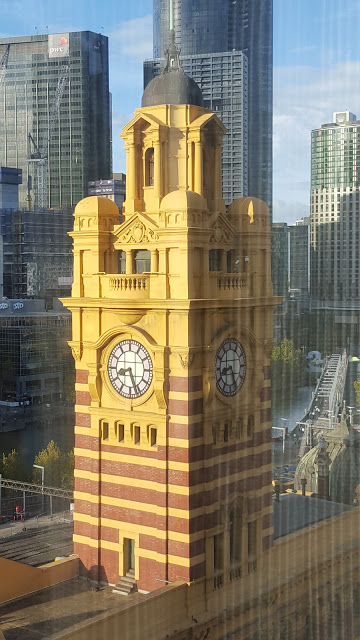
Searching for locations: Flinders Street Station, Melbourne, Australia

This is the famous clock tower of the Flinders Street Station (the main train station for suburban trains) in Melbourne.

We were staying in a hotel (The Doubletree) directly opposite the station and our room overlooked the station and the clock tower.  I took photos of it during the day:

and this one, at night.  It came out better than I thought it would.

20160302_215639

A door that is always open

My opinions are my own


It’s always a good thing to get that across, especially if you work for an organisation that could misinterpret what that opinion is, or generally have an opposing opinion.  Of course, by saying your opinions are your own, you’re covering yourself from becoming unemployed, but is this a futile act?

Perhaps it’s better to not say anything because everything you say and do eventually finds its way to those you want most not to hear about it, perhaps one of the big negatives of the internet and social media.

And…

It seems odd to me that more often than not, you can’t have an opinion of your own, even if it is contrary to that of the organisation you work for, and especially if their opinion has changed over time.  An opposing opinion, delivered in a non-derogatory manner, would be expected to spark a healthy debate, but it doesn’t always end up that way.

I’m sure there are others out there that will disagree and use the overused word, ‘loyalty’.   Perhaps their mantra will be ‘keep your opinions to yourself’.

This, too, often arises in personal relationships, adding weight to the statement, ‘you can pick your friends but not your relatives.’

I’m told I have an opinion on everything, a statement delivered in a manner that suggests sarcasm.  Whether it’s true or not, isn’t the essence of free speech, working within the parameters of not inciting hate, bigotry, racism or sexism, a fundamental right of anyone in a democracy?

Seems not.

There’s always someone out there, higher up the food chain, with an opinion of their own, obviously the right one, and who will not hesitate to silence yours.  But, isn’t it strange that to silence you, they have to use leverage, like your job, to get theirs across?

Well, my opinions are in my writing, and whether or not you agree with them or not, I’m sure you will let me know.  In a robust but respectful manner.

Unlike some, my door is always open.