Another excerpt from “Strangers We’ve Become” – A sequel to ‘What Sets Us Apart’

It was the first time in almost a week that I made the short walk to the cafe alone.  It was early, and the chill of the morning was still in the air.  In summer, it was the best time of the day.  When Susan came with me, it was usually much later, when the day was much warmer and less tolerable.

On the morning of the third day of her visit, Susan said she was missing the hustle and bustle of London, and by the end of the fourth she said, in not so many words, she was over being away from ‘civilisation’.  This was a side of her I had not seen before, and it surprised me.

She hadn’t complained, but it was making her irritable.  The Susan that morning was vastly different to the Susan on the first day.  So much, I thought, for her wanting to ‘reconnect’, the word she had used as the reason for coming to Greve unannounced.

It was also the first morning I had time to reflect on her visit and what my feelings were towards her.  It was the reason I’d come to Greve: to soak up the peace and quiet and think about what I was going to do with the rest of my life.

I sat in my usual corner.  Maria, one of two waitresses, came out, stopped, and there was no mistaking the relief in her manner.  There was an air of tension between Susan and Maria I didn’t understand, and it seemed to emanate from Susan rather than the other way around.  I could understand her attitude if it was towards Alisha, but not Maria.  All she did was serve coffee and cake.

When Maria recovered from the momentary surprise, she said, smiling, “You are by yourself?”  She gave a quick glance in the direction of my villa, just to be sure.

“I am this morning.  I’m afraid the heat, for one who is not used to it, can be quite debilitating.  I’m also afraid it has had a bad effect on her manners, for which I apologise.  I cannot explain why she has been so rude to you.”

“You do not have to apologise for her, David, but it is of no consequence to me.  I have had a lot worse.  I think she is simply jealous.”

It had crossed my mind, but there was no reason for her to be.  “Why?”

“She is a woman, I am a woman, she thinks because you and I are friends, there is something between us.”

It made sense, even if it was not true.  “Perhaps if I explained…”

Maria shook her head.  “If there is a hole in the boat, you should not keep bailing but try to plug the hole.  My grandfather had many expressions, David.  If I may give you one piece of advice, as much as it is none of my business, you need to make your feelings known, and if they are not as they once were, and I think they are not, you need to tell her.  Before she goes home.”

Interesting advice.  Not only a purveyor of excellent coffee, but Maria was also a psychiatrist who had astutely worked out my dilemma.  What was that expression, ‘not just a pretty face’?

“Is she leaving soon?” I asked, thinking Maria knew more about Susan’s movements than I did.

“You would disappoint me if you had not suspected as much.  Susan was having coffee and talking to someone in her office on a cell phone.  It was an intense conversation.  I should not eavesdrop, but she said being here was like being stuck in hell.  It is a pity she does not share your love for our little piece of paradise, is it not?”

“It is indeed.  And you’re right.  She said she didn’t have a phone, but I know she has one.  She just doesn’t value the idea of getting away from the office.  Perhaps her role doesn’t afford her that luxury.”

And perhaps Alisha was right about Maria, that I should be more careful.  She had liked Maria the moment she saw her.  We had sat at this very table, the first day I arrived.  I would have travelled alone, but Prendergast, my old boss, liked to know where ex-employees of the Department were, and what they were doing.

She sighed.  “I am glad I am just a waitress.  Your usual coffee and cake?”

“Yes, please.”

Several months had passed since we had rescued Susan from her despotic father; she had recovered faster than we had thought, and settled into her role as the new Lady Featherington, though she preferred not to use that title, but go by the name of Lady Susan Cheney.

I didn’t get to be a Lord, or have any title, not that I was expecting one.  What I had expected was that Susan, once she found her footing as head of what seemed to be a commercial empire, would not have time for details like husbands, particularly when our agreement made before the wedding gave either of us the right to end it.

There was a moment when I visited her recovering in the hospital, where I was going to give her the out, but I didn’t, and she had not invoked it.  We were still married, just not living together.

This visit was one where she wanted to ‘reconnect’ as she called it, and invite me to come home with her.  She saw no reason why we could not resume our relationship, conveniently forgetting she indirectly had me arrested for her murder, charges both her mother and Lucy vigorously pursued, and had the clone not returned to save me, I might still be in jail.

It was not something I would forgive or forget any time soon.

There were other reasons why I was reluctant to stay with her, like forgetting small details, an irregularity in her character I found odd.  She looked the same, she sounded the same, she basically acted the same, but my mind was telling me something was not right.  It was not the Susan I first met, even allowing for the ordeal she had been subjected to.

But, despite those misgivings, there was no question in my mind that I still loved her, and her clandestine arrival had brought back all those feelings.  But as the days passed, I began to get the impression my feelings were one-sided and she was just going through the motions.

Which brought me to the last argument, earlier, where I said if I went with her, it would be business meetings, social obligations, and quite simply her ‘celebrity’ status that would keep us apart.  I reminded her that I had said from the outset I didn’t like the idea of being in the spotlight, and when I reiterated it, she simply brushed it off as just part of the job, adding rather strangely that I always looked good in a suit.  The flippancy of that comment was the last straw, and I left before I said something I would regret.

I knew I was not a priority.  Maybe somewhere inside me, I had wanted to be a priority, and I was disappointed when I was not.

And finally, there was Alisha.  Susan, at the height of the argument, had intimated she believed I had an affair with her, but that elephant was always in the room whenever Alisha was around.  It was no surprise when I learned Susan had asked Prendergast to reassign her to other duties. 

At least I knew what my feelings for Alisha were, and there were times when I had to remember she was persona non grata.  Perhaps that was why Susan had her banished, but, again, a small detail; jealousy was not one of Susan’s traits when I first knew her.

Perhaps it was time to set Susan free.

When I swung around to look in the direction of the lane where my villa was, I saw Susan.  She was formally dressed, not in her ‘tourist’ clothes, which she had bought from one of the local clothing stores.  We had fun that day, shopping for clothes, a chore I’d always hated.  It had been followed by a leisurely lunch, lots of wine and soul searching.

It was the reason why I sat in this corner; old habits die hard.  I could see trouble coming from all directions, not that Susan was trouble or at least I hoped not, but it allowed me the time to watch her walking towards the cafe in what appeared to be short, angry steps; perhaps the culmination of the heat wave and our last argument.

She glared at me as she sat, dropping her bag beside her on the ground, where I could see the cell phone sitting on top.  She followed my glance down, and then she looked unrepentant back at me.

Maria came back at the exact moment she was going to speak.  I noticed Maria hesitate for a second when she saw Susan, then put her smile in place to deliver my coffee.

Neither spoke nor looked at each other.  I said, “Susan will have what I’m having, thanks.”

Maria nodded and left.

“Now,” I said, leaning back in my seat, “I’m sure there’s a perfectly good explanation as to why you didn’t tell me about the phone, but that first time you disappeared, I’d guessed you needed to keep in touch with your business interests.  I thought it somewhat unwisethat you should come out when the board of one of your companies was trying to remove you, because of what was it, an unexplained absence?  All you had to do was tell me there were problems and you needed to remain at home to resolve them.”

My comment elicited a sideways look, with a touch of surprise.

“It was unfortunate timing on their behalf, and I didn’t want you to think everything else was more important than us.  There were issues before I came, and I thought the people at home would be able to manage without me for at least a week, but I was wrong.”

“Why come at all.  A phone call would have sufficed.”

“I had to see you, talk to you.  At least we have had a chance to do that.  I’m sorry about yesterday.  I once told you I would not become my mother, but I’m afraid I sounded just like her.  I misjudged just how much this role would affect me, and truly, I’m sorry.”

An apology was the last thing I expected.

“You have a lot of work to do catching up after being away, and of course, in replacing your mother and gaining the requisite respect as the new Lady Featherington.  I think it would be for the best if I were not another distraction.  We have plenty of time to reacquaint ourselves when you get past all these teething issues.”

“You’re not coming with me?”  She sounded disappointed.

“I think it would be for the best if I didn’t.”

“Why?”

“It should come as no surprise to you that I’ve been keeping an eye on your progress.  You are so much better doing your job without me.  I told your mother once that when the time came I would not like the responsibilities of being your husband.  Now that I have seen what it could possibly entail, I like it even less.  You might also want to reconsider our arrangement, after all, we only had a marriage of convenience, and now that those obligations have been fulfilled, we both have the option of terminating it.  I won’t make things difficult for you if that’s what you want.”

It was yet another anomaly, I thought; she should look distressed, and I would raise the matter of that arrangement.  Perhaps she had forgotten the finer points.  I, on the other hand, had always known we would not last forever.  The perplexed expression, to me, was a sign she might have forgotten.

Then, her expression changed.  “Is that what you want?”

“I wasn’t madly in love with you when we made that arrangement, so it was easy to agree to your terms, but inexplicably, since then, my feelings for you changed, and I would be sad if we parted ways.  But the truth is, I can’t see how this is going to work.”

“In saying that, do you think I don’t care for you?”

That was exactly what I was thinking, but I wasn’t going to voice that opinion out loud.  “You spent a lot of time finding new ways to make my life miserable, Susan.  You and that wretched friend of yours, Lucy.  While your attitude improved after we were married, that was because you were going to use me when you went to see your father, and then almost let me go to prison for your murder.”

“I had nothing to do with that, other than to leave, and I didn’t agree with Lucy that you should be made responsible for my disappearance.  I cannot be held responsible for the actions of my mother.  She hated you; Lucy didn’t understand you, and Millie told me I was stupid for not loving you in return, and she was right.  Why do you think I gave you such a hard time?  You made it impossible not to fall in love with you, and it nearly changed my mind about everything I’d been planning so meticulously.  But perhaps there was a more subliminal reason why I did because after I left, I wanted to believe, if anything went wrong, you would come and find me.”

“How could you possibly know that I’d even consider doing something like that, given what you knew about me?”

“Prendergast made a passing comment when my mother asked him about you; he told us you were very good at finding people and even better at fixing problems.”

“And yet here we are, one argument away from ending it.”

I could see Maria hovering, waiting for the right moment to deliver her coffee, then go back and find Gianna, the café owner, instead.  Gianna was more abrupt and, for that reason, was rarely seen serving the customers.  Today, she was particularly cantankerous, banging the cake dish on the table and frowning at Susan before returning to her kitchen.  Gianna didn’t like Susan either.

Behind me, I heard a car stop, and when she looked up, I knew it was for her.  She had arrived with nothing, and she was leaving with nothing.

She stood.  “Last chance.”

“Forever?”

She hesitated and then shook away the look of annoyance on her face.  “Of course not.  I wanted you to come back with me so we could continue working on our relationship.  I agree there are problems, but it’s nothing we can’t resolve if we try.”

I had been trying.  “It’s too soon for both of us, Susan.  I need to be able to trust you, and given the circumstances, and all that water under the bridge, I’m not sure if I can yet.”

She frowned at me.  “As you wish.”  She took an envelope out of her bag and put it on the table.  “When you are ready, it’s an open ticket home.  Please make it sooner rather than later.  Despite what you think of me, I have missed you, and I have no intention of ending it between us.”

That said, she glared at me for a minute, shook her head, then walked to the car.  I watched her get in and the car drive slowly away.

No kiss, no touch, no looking back. 

© Charles Heath 2018-2025

strangerscover9

In a word: Dry

We all know what this means, without moisture, in other words not wet.

It could also mean dull factually, as in reading some non-fiction books, and quite often those prescribed as mandatory reading at school.

You could also have a dry sense of humour, where you have to be on your game to understand, or get, the humour.

It could also describe boredom by saying that it’s like watching paint dry.

For those who like a bit of a tipple, the last place you want to go is a dry bar, where no alcohol is served.

Perhaps this should be mandatory for weddings and funerals, places where feelings often run very high and do not need the stimulus of half a dozen double Scotches.

And speaking of alcohol and cider in particular, you can have it sweet, dry, or draft. Many people prefer dry, sometimes the drier the better, especially wine, and oddly martinis.

Aside from whether they are shaken or stirred.

But the most fascinating version of dry is dry cleaning. Just how can you ‘dry’ clean clothes?

Would that be what they call an oxymoron?

An excerpt from “The Things We Do For Love”; In love, Henry was all at sea!

In the distance, he could hear the dinner bell ringing and roused himself.  Feeling the dampness of the pillow, and fearing the ravages of pent-up emotion, he considered not going down but thought it best not to upset Mrs. Mac, especially after he said he would be dining.

In the event, he wished he had reneged, especially when he discovered he was not the only guest staying at the hotel.

Whilst he’d been reminiscing, another guest, a young lady, had arrived.  He’d heard her and Mrs. Mac coming up the stairs and then shown to a room on the same floor, perhaps at the other end of the passage.

Henry caught his first glimpse of her when she appeared at the door to the dining room, waiting for Mrs. Mac to show her to a table.

She was in her mid-twenties, slim, with long brown hair, and the grace and elegance of a woman associated with countless fashion magazines.  She was, he thought, stunningly beautiful with not a hair out of place, and make-up flawlessly applied.  Her clothes were black, simple, elegant, and expensive, the sort an heiress or wife of a millionaire might condescend to wear to a lesser occasion than dinner.

Then there was her expression; cold, forbidding, almost frightening in its intensity.  And her eyes, piercingly blue and yet laced with pain.  Dracula’s daughter was his immediate description of her.

All in all, he considered, the only thing they had in common was, like him, she seemed totally out of place.

Mrs. Mac came out of the kitchen, wiping her hands on her apron.  She was, she informed him earlier, chef, waitress, hotelier, barmaid, and cleaner all rolled into one.  Coming up to the new arrival she said, “Ah, Miss Andrews, I’m glad you decided to have dinner.  Would you like to sit with Mr. Henshaw, or would you like to have a table of your own?”

Henry could feel her icy stare as she sized up his appeal as a dining companion, making the hair on the back of his neck stand up.  He purposely didn’t look back.  In his estimation, his appeal rating was minus six.  Out of a thousand!

“If Mr. Henshaw doesn’t mind….”  She looked at him, leaving the query in mid-air.

He didn’t mind and said so.  Perhaps he’d underestimated his rating.

“Good.”  Mrs. Mac promptly ushered her over.  Henry stood, made sure she was seated properly and sat.

“Thank you.  You are most kind.”  The way she said it suggested snobbish overtones.

“I try to be when I can.”  It was supposed to nullify her sarcastic tone but made him sound a little silly, and when she gave him another of her icy glares, he regretted it.

Mrs. Mac quickly intervened, asking, “Would you care for the soup?”

They did, and, after writing the order on her pad, she gave them each a look, imperceptibly shook her head, and returned to the kitchen.

Before Michelle spoke to him again, she had another quick look at him, trying to fathom who and what he might be.  There was something about him.

His eyes, they mirrored the same sadness she felt, and, yes, there was something else, that it looked like he had been crying?  There was a tinge of redness.

Perhaps, she thought, he was here for the same reason she was.

No.  That wasn’t possible.

Then she said, without thinking, “Do you have any particular reason for coming here?”  Seconds later she realized she’d spoken it out loud, had hadn’t meant to actually ask, it just came out.

It took him by surprise, obviously not the first question he was expecting her to ask of him.

“No, other than it is as far from civilization, and home, as I could get.”

At least we agree on that, she thought.

It was obvious he was running away from something as well.

Given the isolation of the village and lack of geographic hospitality, it was, from her point of view, ideal.  All she had to do was avoid him, and that wouldn’t be difficult.

After getting through this evening first.

“Yes,” she agreed.  “It is that.”

A few seconds passed, and she thought she could feel his eyes on her and wasn’t going to look up.

Until he asked, “What’s your reason?”

Slightly abrupt in manner, perhaps, because of her question and how she asked it.

She looked up.  “Rest.  And have some time to myself.”

She hoped he would notice the emphasis she had placed on the word ‘herself’ and take due note.  No doubt, she thought, she had completely different ideas of what constituted a holiday than he, not that she had said she was here for a holiday.

Mrs. Mac arrived at a fortuitous moment to save them from further conversation.

Over the entree, she wondered if she had made a mistake coming to the hotel.  Of course, there had been no conceivable way she could know that anyone else might have booked the same hotel, but realized it was foolish to think she might end up in it by herself.

Was that what she was expecting?

Not a mistake then, but an unfortunate set of circumstances, which could be overcome by being sensible.

Yet, there he was, and it made her curious, not that he was a man, by himself, in the middle of nowhere, hiding like she was, but for quite varied reasons.

On discreet observance, whilst they ate, she gained the impression his air of light-heartedness was forced, and he had no sense of humour.

This feeling was engendered by his looks, unruly dark hair, and permanent frown.  And then there was his abysmal taste in clothes on a tall, lanky frame.  They were quality but totally unsuited to the wearer.

Rebellion was written all over him.

The only other thought crossing her mind, and incongruously, was he could do with a decent feed.  In that respect, she knew now from the mountain of food in front of her, he had come to the right place.

“Mr. Henshaw?”

He looked up.  “Henshaw is too formal.  Henry sounds much better,” he said, with a slight hint of gruffness.

“Then my name is Michelle.”

Mrs. Mac came in to take their order for the only main course, gather up the entree dishes, and then return to the kitchen.

“Staying long?” she asked.

“About three weeks.  Yourself?”

“About the same.”

The conversation dried up.

Neither looked at the other, rather at the walls, out the window, towards the kitchen, anywhere.  It was, she thought, unbearably awkward.

Mrs. Mac returned with a large tray with dishes on it, setting it down on the table next to theirs.

“Not as good as the usual cook,” she said, serving up the dinner expertly, “but it comes a good second, even if I do say so myself.  Care for some wine?”

Henry looked at Michelle.  “What do you think?”

“I’m used to my dining companions making the decision.”

You would, he thought.  He couldn’t help but notice the cutting edge of her tone.  Then, to Mrs. Mac, he named a particular White Burgundy he liked, and she bustled off.

“I hope you like it,” he said, acknowledging her previous comment with a smile that had nothing to do with humour.

“Yes, so do I.”

Both made a start on the main course, a concoction of chicken and vegetables that were delicious, Henry thought when compared to the bland food he received at home and sometimes aboard my ship.

It was five minutes before Mrs Mac returned with the bottle and two glasses.  After opening it and pouring the drinks, she left them alone again.

Henry resumed the conversation.  “How did you arrive?  I came by train.”

“By car.”

“Did you drive yourself?”

And he thought, a few seconds later, that was a silly question, otherwise she would not be alone, and certainly not sitting at this table. With him.

“After a fashion.”

He could see that she was formulating a retort in her mind, then changed it, instead, smiling for the first time, and it served to lighten the atmosphere.

And in doing so, it showed him she had another more pleasant side despite the fact she was trying not to look happy.

“My father reckons I’m just another of ‘those’ women drivers,” she added.

“Whatever for?”

“The first and only time he came with me I had an accident.  I ran up the back of another car.  Of course, it didn’t matter to him the other driver was driving like a startled rabbit.”

“It doesn’t help,” he agreed.

“Do you drive?”

“Mostly people up the wall.”  His attempt at humour failed.  “Actually,” he added quickly, “I’ve got a very old Morris that manages to get me where I’m going.”

The apple pie and cream for dessert came and went and the rapport between them improved as the wine disappeared and the coffee came.  Both had found, after getting to know each other better, their first impressions were not necessarily correct.

“Enjoy the food?” Mrs. Mac asked, suddenly reappearing.

“Beautifully cooked and delicious to eat,” Michelle said, and Henry endorsed her remarks.

“Ah, it does my heart good to hear such genuine compliments,” she said, smiling.  She collected the last of the dishes and disappeared yet again.

“What do you do for a living,” Michelle asked in an off-hand manner.

He had a feeling she was not particularly interested, and it was just making conversation.

“I’m a purser.”

“A what?”

“A purser.  I work on a ship doing the paperwork, that sort of thing.”

“I see.”

“And you?”

“I was a model.”

“Was?”

“Until I had an accident, a rather bad one.”

“Oh, I’m sorry.”

So that explained the odd feeling he had about her.

As the evening wore on, he began to think there might be something wrong, seriously wrong with her because she didn’t look too well.  Even the carefully applied makeup, from close, didn’t hide the very pale, and tired look, or the sunken, dark-ringed eyes.

“I try not to think about it, but it doesn’t necessarily work.  I’ve come here for peace and quiet, away from doctors and parents.”

“Then you will not have to worry about me annoying you.  I’m one of those fall-asleep-reading-a-book types.”

Perhaps it would be like ships passing in the night and then smiled to himself about the analogy.

Dinner over, they separated.

Henry went back to the lounge to read a few pages of his book before going to bed, and Michelle went up to her room to retire for the night.

But try as he might, he was unable to read, his mind dwelling on the unusual, yet compellingly mysterious person he would be sharing the hotel with.

Overlaying that original blurred image of her standing in the doorway was another of her haunting expressions that had, he finally conceded, taken his breath away, and a look that had sent more than one tingle down his spine.

She may not have thought much of him, but she had certainly made an impression on him.

© Charles Heath 2015-2024

lovecoverfinal1

While it seems like nothing is getting done…

This month is just starting to disappear, and once again, I don’t feel like I’m going to make any more progress than I did the last.

Winter has all but disappeared, and Spring is around the corner. Not as cold as Lake Louise in December, but it feels like it.

What were my expectations last month? 

I had set a list of projects for the month, more episodes for the three continuing stories, and a start to the next episodic story, ‘Motive, Means, and Opportunity’, though for this story I have brought together all the writing I’ve been doing in past weeks. But like most of these fringe stories, it has reached a point where more research is needed, and I have too much else to do.

Then there is the completion of ‘The things we do for love’. It’s finally finished and needs a read-through before going to the editor, but making time to just sit and read…?

The same applies to ‘Strangers We’ve Become’ and it is in the same time-consuming basket. It needs a final read-through, so it’s on the to-do list.

It would be easy to blame COVID-19, but that’s not the problem.  I’ve been home and had the time, but there have been a number of distractions and ideas for new stories that seem to divert my attention from what I should be doing.

It’s not writer’s block.  It’s not laziness.  It seems that I just don’t want to work on them, and that might be because there are problems with the narrative, and I’m just not ready to address them.

What has got my attention then?

I’m not sure how or why, but something triggered the idea of passing through a portal into another time, in the past.  I think I might have been looking for photographs to write another photo/story, and I came across a covered bridge, which led to looking for photographs of ghost towns.  What topped it off, there was an old western in black and white, High Noon, which provoked a whole lot of memories of many westerns I’d seen in the past.

What other reason do you need to write your own story?

Then, when visiting my grandchildren, we just happened to do some star gazing, using Google Sky Map, and picking out the planets.  Somehow I managed to take a photo and looking at it, took me back to the days of Star Trek, and the many series, which sort of gave me an idea for another story, which has been running off and on over the last month. It now has 53 episodes, and I need to write more, yep, on the to-do list.

Equally, I’m always on the lookout for photo opportunities that I can use to write short stories, and these continue apace, the latest being published this week, number 146.  These are being formed into anthologies, stories 1 to 50, and stories 51 to 100.  The first has been assembled into book form and is awaiting the editor’s first reading and report.  I’m still working on the second.

Meanwhile, another 50 have been written and awaiting publishing in volume 3.

Perhaps some of the time has been spent keeping up with Twitter, where over the last six months, and more recently, sales of my books on Amazon have been increasing.  Not to best-seller numbers, but people are reading my stories, and the reviews have been very good.

It has, of course, pushed me to work harder on marketing, and that had consumed some of my time, which unfortunately takes me away from writing.  It sometimes feels like a self-defeating exercise, but it is the same for all of us.

Oh, and something else that cropped up this month, my brother has been digging into our family history, and around the middle of the month, he found some interesting revelations about some family members, including a pseudo-Luddite, and then later on, when chasing down the places that we, as a family, lived, and this brought out some very interesting information about our father.

It also seems we may have had a distant relative on the ship that left after the Mayflower to Plymouth Rock, USA, at the very beginning. That will be remarkable if it is true.

I’m discovering for what I’d always assumed was an ordinary man, had done a lot of very interesting things in his life, and not only that, I’ve been fictionalizing the story.  I have potted pieces written over various stages, and, one day, they might come together as a sort of biography.  It is astonishing just how much you don’t know about your family, until much later on, at least for some of us.  Our relatives have always been a mystery to me, and it’s fascinating as each one is brought to life with new detail here and there.

Looking back on what I’ve just written, perhaps the passing of the month had been more productive than I first thought.  It just seems like nothing major has happened.

The cinema of my dreams – I always wanted to go on a treasure hunt – Epilog

Here’s the thing…

Every time I close my eyes, I see something different.

I’d like to think the cinema of my dreams is playing a double feature but it’s a bit like a comedy cartoon night on Fox.

But these dreams are nothing to laugh about.

Once again there’s a new instalment of an old feature, and we’re back on the treasure hunt.

A little treasure!

After a hot day, it was now the middle of the night, still quite warm, but a thunderstorm had just passed and the sound of the residual rain on the tile roof and plants outside the windows was soothing.

Nadia stirred momentarily beside me, and although it was quite dark, I could see the outline of her body and had to resist the temptation of running my finger along the contours.

She was the most beautiful girl in the world to me and had made the transition from a nervous, even frightened, young man, into something I never thought I could be, and I loved her more than anything else in the world

It was nearly a year now since the events back home, and still, whenever I closed my eyes, all I could see was Boggs, wide-eyed and eager to find that missing treasure, not knowing it was a fruitless and eventually deadly quest, not only for him but everyone in his family.

And I still blamed myself for what happened.

Shortly after Mrs Boggs last stand, she died.  There had been a third bullet, one that the paramedics hadn’t detected, that eventually killed her, but from the last words I heard her speak, just before the paramedics took her to the hospital, it was clear she wanted to die.

I could understand that, and perhaps in the same place, I would too.

My mother was beside herself when she found out what happened, not only because Benderby was dead, and her chances of getting out of the poverty cycle swiftly taken away, but of what might have happened to me.

An alternative suitor, the sheriff, was off the table because of his actions, so it was a sorry sight to see her back where she had started, alone, and the mother of an inquisitive, impetuous young man who should be making something of himself.

Sadly, all I wanted to was crawl into a hole and stay there, not only because of my role in the whole mess, but the fact Nadia had inexplicably disappeared, was nowhere to be found and not answering her phone.

To be honest, I was not surprised.  Anyone in their right mind would not see me as anything but trouble.

The funeral of Boggs, and his mother, was a sad affair attended by seven people, the sheriff, Charlene, Rico, three women who had known her, and myself.  It rained that day, with thunder and lightning of such ferocity, it was like God was making a statement.

So wrapped up in my grief I failed to notice a hand slipping into mine and a head leaning on my shoulder, until a whisper, “Sorry I’m late,” told me it was the missing girl of my dreams, Nadia.

I guess that was the first day of my new life.

Within a week, I left behind the last vestiges of my life in that dismal town and got on a very large aeroplane, for the first time in my life, heading for a new world, and new possibilities.

Nadia had made it all happen, not only for me, but also for my mother, who was reluctant at first, but warmed to the idea because I told her I was never coming back.

We moved to Italy, to a large vineyard in Tuscany, near a town with a funny name, though it wasn’t funny to those who lived there.

We lived with the other family members in a large villa in our own large room, in what used to be an old factory.  Community and family were everything to these people, and when they realized Nadia loved me as much as I loved her, I and my mother became family, it was like we always had been.

We had work, we had leisure, and we had each other.  The work was hard but satisfying.  We got married and had a traditional wedding where the family all came to eat, drink, and be merry.

Life was, indeed, beautiful.

“Still having bad dreams?” A voice whispered in my ear.

Nadia was used to my restlessness.

“It’ll probably take a little more time, but I guess eventually I’ll get past it.”

Time, as they say, was supposed to heal all wounds.  It was a belief I fervently wanted to believe.

“Perhaps what you need is something to take your mind off everything.”

I knew that voice, and Nadia at her most mischievous was something to behold.

“Oh, and what’s that?”

“Some news.  I was waiting until our anniversary tomorrow, but I think now is the time.”

Nadia was one of those girls who had anniversaries for everything, first meeting, the first kiss, first, well you get the idea.  I was just trying to think of what this one was.  Unfortunately, I was one of those boys who could never remember anything like that.

And over the last day or so, she had been particularly happy, for the first time since we arrived where she now called home.  The problems with her parents, what happened to Vince although he was only a stepbrother, and the fallout from the treasure hunt, it had taken a toll she had tried very hard to hide.

Being home, among her real family, the wedding, the purpose, and the satisfaction of work helped, but we both had our demons to deal with, and each of us strived to help the other as much as we could.

But it was like something was missing, like that single sky piece in a jigsaw puzzle.

And then I knew.

© Charles Heath 2020-2022

Memories of the conversations with my cat – 31

As some may be aware, but many are not, Chester, my faithful writing assistant, mouse catcher, and general pain in the neck, passed away some years ago.

Recently, I was running a series based on his adventures, under the title of Past Conversations with my cat.

For those who have not had the chance to read about all of his exploits, I will run the series again from Episode 1

These are the memories of our time together…

20161008_135125_001

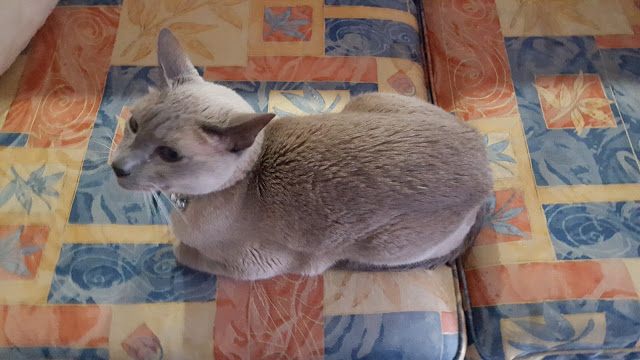
This is Chester. He doesn’t like being on the receiving end of a berating.

In a moment of extreme pique, as can happen when dealing with an obstinate and sometimes utterly obdurate cat, you can sometimes forget who is the master and who is living on borrowed time.

It’s like dealing with a spoiled child, but unlike a child, you cannot get down to their level, and instead of speaking down to them, you can reach them on their level.

With a cat, it’s different.

You are enraged, you see red, you are prone to becoming something other than who you really are, going from calm and urbane to this red-faced, infuriated gibbering idiot.

Over something so simple that you can only describe the circumstances as inexplicable.

And yet above it all, this wretched animal remains quite calm and looks at you with those innocent eyes and a face that tells you that whatever the problem is, he didn’t do it.

Those claw marks on the curtains didn’t get there by themselves, did they?

And it’s not as if the humans are likely to climb up the curtains, is it?

What’s the point?

It’s off to the vet to have the claws cut. Then we’ll see what happens.

I’m also wondering if we really need curtains. I hear shutters are in vogue.

Damn cat!

Short Story Writing: Don’t try this at home – Part 4

This is not meant to be a treatise on short story writing.  Far be it for me to advise anyone on the subject.  I prefer to say how it is that I do it so you can learn all of the pitfalls in one go.

I find inspiration in the most unlikely places.

Shopping malls are great, there is so many things going on, so many different types of people, there’s often enough to fill a journal.

Driving on the roads, you get to see some of the most amazing stunt driving, and it’s not even being filmed, it’s just playing out before your very eyes.

Waiting in hospitals, waiting for doctors, accountants, dentists, friends, hanging around coffee shops, cafes, bistros, restaurants, the list is endless.

But the best source, newspapers, and the more obscure the headline the better, and then just let your imagination run free, like:

Four deaths, four mysteries, all homeless.

This poses a few interesting scenarios, such as, were they homeless or were they made to look like they’re homeless.  Are they connected in any way?

The point is, far from the original story that simply covers four seemingly random murders, a writer can turn this into a thriller very easily.

It could follow a similar headline in another country where three headlines could be found, say, in London, where a man is found dead in an abandoned building, a week after he died, with no obvious signs of how he died.

A woman is killed in what seems from the outset an accident involving two cars, where, after three days, the driver of the second vehicle just simply disappears.

A man is reported missing after not reporting for work when he was supposed to return from a vacation in Germany.

Where an obscure piece says that a man was found at the bottom of a mountain, presumed to have fallen in a climbing accident.

It’s all in the joining of the dots.


Writing a book in 365 days – 193/194

Days 192 and 194

Early childhood memories

From Mordialloc, we moved to Dandenong, a new house, 1 Bess Court.  It must have been around the time I started school, because the early memories of living there were going to Dandenong State School No. 1403.  Amazingly, the school number sticks in my mind all this time.

I remember thinking at the time that it was like a castle.  That might have been in 1958 or 1959 when I was 5 or 6 years old, and in pre-school. 

Where we lived was quite new, just up from the Dandenong Creek, and those fields from the bottom of our street were our playground.  We made friends and we all played together.

My father, at the time, worked at General Motors in the Dandenong factory, where they built cars.  For our holidays, he used to get a truck to deliver big wooden box sides, which we, in turn, with the other kids, built a large cubby house.  One caught the eye of the council building inspector, and we had to pull it down.  Why?  It was nearly three stories high!

That was some holiday project.

It also became what might be called a house of horrors.  We were always poor, my mother did not work, and we survived on what my father earned.  There were not enough bedrooms, and to make ends meet, we took in boarders. I know, for a while, I had to live outside in a tent until a bungalow was built onto the back of the house, when the outside toilet was moved inside.  I remember coming home from school one day and one of the male boarders was drunk after losing his job, and when my father came home, he sent him packing.  Another boarder we had, a lady named May, was with us for a while and once went on holiday with us.  For some reason, I always remember her being in a dressing gown.

My father, at one point, suffered a mental breakdown, but I had always believed it was a resurgence of malaria he caught when he was serving in New Guinea during the war.  There were also the memories of being sexually assaulted by my uncle for a period while living here.  It is a memory I have tried hard to forget.

There was also a period of domestic violence where my father would direct his anger at my older brother, and my mother tried to get between them and received some harsh treatment at his hands. And I remember hiding under my bed to get away from it.  We had no idea why he was like this, not then, but after his breakdown, things got better.

Oh, and every year, at Easter, we would paint the whole outside of the house.  As a six- or seven-year-old, I don’t think I was much of a help.

Other times we would go on holidays, packing the tent and ourselves into the car and taking off at short notice to places like Queenscliff, Adelaide, Lakes Entrance, and Wilson’s Promontory.

At some point, things must have got better.  I got to live in the bungalow, school proceeded to grade six, where I remember the teacher distinctly, Mr McPhee, a hard taskmaster, but he taught us well.

We got a bottle of milk every morning, I got lunches made by my mother that were inedible, and several classes and fellow students stuck in my mind, but curiously were forgotten for many years until now.  One, a boy named Andrew Stroud, who was English, I remember because he talked funny, and a girl, Elizabeth Llewellen, because she was nice to me.  I also remember skipping a grade, but I don’t know why.

But that didn’t last long. We moved, and it was a whole new, but not necessarily better world.

Those memories will always be hazy. I was told once that what I remembered would not be the same as anyone else in the same house, and it is true. My brother’s memories of the same period are completely different. Somehow that didn’t surprise me.

Searching for locations: The Maglev (Magnetic Levitation) Train, Shanghai, China

So, the first treat for the day is the high-speed magnetic train, something we only learned about after arriving in China and was not on any of the pre-tour documentation.

The train line connects Shanghai Pudong International Airport and Longyang Road Station (in the outskirts of central Pudong).  It is the oldest commercial maglev still in operation, and the first commercial high-speed maglev with cruising speed of 431 km/h (268 mph).  At full speed, the journey takes 7 minutes and 20 seconds to complete the distance of about 30 km.

Construction of the line began on March 1, 2001 and public services commenced on 1 January 2004.  It was built by a joint venture of Siemens and ThyssenKrupp from Kassel, Germany.

But, like visiting anything from a hotel, first we have to drive to the station and because we are leaving at 8, its peak hour traffic, and it takes 1 hour 10 minutes to get there.

The train also has a practical use and that is to take passengers from Shanghai to Pudong international airport as well as for those train enthusiasts, which is what we are.

On the train, it has the same sleek look as the bullet trains, but it is completely different, and you are able to see from the front of the train to the back.

Reputed to travel at 431 kph we take a seat and it is not long before the doors shut, and a loud humming noise is soon replaced by what sounds like an engine, then we start moving.  It sounds just like a normal train, and is a lot noisier than a normal bullet train.

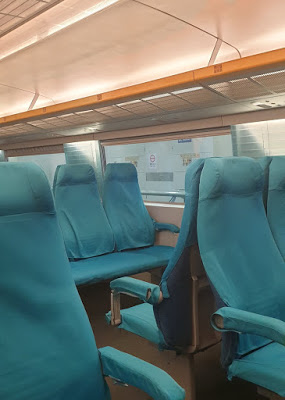
Seating on the train was nothing special, as one might expect

It didn’t take long before it hits the advertised speed of 431 kph.  This is not sustained for very long, because the distance is on 40 odd kilometers, and the whole trip takes about 7 minutes.

We go to the airport, and then we come back.  Is it worth the price, yes.  If you are a train enthusiast.

An excerpt from “If Only” – a work in progress

Investigation of crimes doesn’t always go according to plan, nor does the perpetrator get either found or punished.

That was particularly true in my case.  The murderer was incredibly careful in not leaving any evidence behind, to the extent that the police could not rule out whether it was a male or a female.

At one stage the police thought I had murdered my own wife though how I could be on a train at the time of the murder was beyond me.  I had witnesses and a cast-iron alibi.

The officer in charge was Detective First Grade Gabrielle Walters.  She came to me on the day after the murder seeking answers to the usual questions like, when was the last time you saw your wife, did you argue, the neighbors reckon there were heated discussions the day before.

Routine was the word she used.

Her fellow detective was a surly piece of work whose intention was to get answers or, more likely, a confession by any or all means possible.  I could sense the raging violence within him.  Fortunately, common sense prevailed.

Over the course of the next few weeks, once I’d been cleared of committing the crime, Gabrielle made a point of keeping me informed of the progress.

After three months the updates were more sporadic, and when, for lack of progress, it became a cold case, communication ceased.

But it was not the last I saw of Gabrielle.

The shock of finding Vanessa was more devastating than the fact she was now gone, and those images lived on in the same nightmare that came to visit me every night when I closed my eyes.

For months I was barely functioning, to the extent I had all but lost my job, and quite a few friends, particularly those who were more attached to Vanessa rather than me.

They didn’t understand how it could affect me so much, and since it had not happened to them, my tart replies of ‘you wouldn’t understand’ were met with equally short retorts.  Some questioned my sanity, even, for a time, so did I.

No one, it seemed, could understand what it was like, no one except Gabrielle.

She was by her own admission, damaged goods, having been the victim of a similar incident, a boyfriend who turned out to be an awfully bad boy.  Her story varied only in she had been made to witness his execution.  Her nightmare, in reliving that moment in time, was how she was still alive and, to this day, had no idea why she’d been spared.

It was a story she told me one night, some months after the investigation had been scaled down.  I was still looking for the bottom of a bottle and an emotional mess.  Perhaps it struck a resonance with her; she’d been there and managed to come out the other side.

What happened become our secret, a once-only night together that meant a great deal to me, and by mutual agreement, it was not spoken of again.  It was as if she knew exactly what was required to set me on the path to recovery.

And it had.

Since then, we saw each about once a month in a cafe.   I had been surprised to hear from her again shortly after that eventful night when she called to set it up, ostensibly for her to provide me with any updates on the case, but perhaps we had, after that unspoken night, formed a closer bond than either of us wanted to admit.

We generally talked for hours over wine, then dinner and coffee.  It took a while for me to realize that all she had was her work, personal relationships were nigh on impossible in a job that left little or no spare time for anything else.

She’d always said that if I had any questions or problems about the case, or if there was anything that might come to me that might be relevant, even after all this time, all I had to do was call her.

I wondered if this text message was in that category.  I was certain it would interest the police and I had no doubt they could trace the message’s origin, but there was that tiny degree of doubt, about whether or not I could trust her to tell me what the message meant.

I reached for the phone then put it back down again.  I’d think about it and decide tomorrow.

© Charles Heath 2018-2020