“Trouble in Store” – Short stories my way: Character refinement

I have reworked the first part of the story with a few new elements about the characters and changed a few of the details of how the characters finish up in the shop before the policewoman makes her entrance.

This is part of the new first section is the one that involves Annalisa, and her boyfriend, Simmo:


Annalisa looked at the two men facing her.

Simmo, the boy on the floor, had told her that the shopkeeper would be a pushover, he was an old man who’d just hand over the drugs, rather than cause trouble for himself.

Where Simmo had discovered what the shopkeeper’s true vocation, dispensing drugs to the neighborhood addicts, she didn’t know, but it was not the first place like this they had visited.

She had always known Simmo had a problem, but he had assured her he had it under control.  Until a month ago, when he had tried something new.

It had changed him.

The breaking point came earlier that day when, seeing how sick he was, she threatened to leave.  It brought out the monster within him, and he threatened to kill her.  Not long after he had changed into a whimpering child pleading with her to stay, that he hadn’t meant anything he’d said before.

All he needed was one more ‘score’ to get his ‘shit’ together, and he would do as she asked, and find help.

She believed him.

He said he knew a place not far from the apartment, a small shop where what he needed was available, and said he had the money.

That should have been the first sign he was not telling the truth because she had been funding his habit until her parents cut off the money supply.  She suspected her father had put a private detective on to find her, had, and reported back, and rather than make a scene, just cut her off so she would have to come home or starve.  Her father was no better than Simmo.

And, as soon as they stepped into the shop, Simmo pulled out the gun,

Instead of the shopkeeper cowered like Simmo said he would, he had laughed at them and told them to get out.  Simmo started ranting and waving the gun around, then all of a sudden collapsed. 

There was a race for the gun which spilled out of Simmo’s hand, and she won. 

That was just before the customer burst into the shop.

It had been shortly before closing time.  Simmo had said there would be no one else around.

Wrong again.

Now she had another problem to deal with, a man who was clearly as scared shitless as she was.

This was worse than any bad hair day, or getting out of the wrong side of bed day, this was, she was convinced, the last day of her life.

She heard a strange sound come from beside her and looked down.  There was a trickle of blood coming out of his mouth and Simmo was making strange sounds like he was choking.

Any other time she might have been concerned, but the hard reality of it was, Simmo was never going to change.  She was only surprised at the fact it took so long for her to realize it.

As for the man standing in front of her, she was safe from the shopkeeper with him around, so he would have to stay.

“No.  Stay.”

Another glance at the shopkeeper told her she had made the right decision, his expression said it all.  Gun or no gun, the moment she was alone with him, he would kill her.


© Charles Heath 2016-2020

Writing a book in 365 days – 176

Day 176

Could you apply real-life work information to a story?

One of the how-to books I was reading once made several statements about what you could write about.

The first was to write about what you know. To me, that means if you were in the military, you would have the inside knowledge on how the army, navy or air force worked and you could apply that to the scenarios, the situations and the people.

Then there’s the idea that your work environment could provide you with enough inspiration and authentic information to make the story sound realistic.

I’m going with the latter because the place where I worked, in one instance, provided the detail to incorporate into a story. That workplace is a phosphate mining company, and the place where that mining took place, on a small Pacific Island.

I was also lucky enough to work on a history of the company for several years as the principal research officer. It wasn’t long before I began writing a parallel story, which I had tentatively called The phosphateers, and as each piece of research yielded yet another gem of information, so began the story.

It started in the aftermath of World War 1, and the first volume was to end when the island was evacuated, after several of the company’s ships were sunk by a German raider in World War 2.

But that was not the only story…

My acquiring of knowledge about computer systems, and in particular in those early days, the primitive sort of networking available with cables, connectors and network cards, was the basis for another story.

So, yes, a real-life job can be a gold mine of information.

Searching for locations: The Longjing Pearl Factory, Beijing, China

The Longjing Pearl Factory is located at:
No.2 Zuoan Gate Inner Street, ChongWen District, Beijing 100061 China.

This Pearl Center specializes in both freshwater and seawater pearls, with a reputation backed by the government of China, with a big selection and of the highest quality.  There were all kinds of jewelry made of pearls in different colors, shapes, and sizes.

They also had, as an interesting sideline, famous Chinese traditional cosmetics such as pearl cream and pearl powder, reputed to make your skin smoother, tendered and most importantly, younger.

We were advised of all of this well before we arrived at the factory, and of course, one suspected the glowing review, with emphasis on the fact it was a government operation and therefore trustworthy, suggested we should buy, meant the tour guide would receive a commission on each sale.

This is nothing new, it’s the same the world over, so it’s up to the visitor to buy or not to buy.

As soon as you get in the door you are taken to the group’s guide for the tour (and afterward, available for help on making purchases). who gives you a rundown on the different types and colors of pearls.  This briefly is,

Pearls come in two main categories: freshwater cultured pearls and saltwater cultured pearls. Various types of pearls are the result of the environment in which they live, and different cultivation techniques used by the pearl farmers. 

Freshwater cultured pearls are grown in lakes and rivers, whereas saltwater cultured pearls are grown in bodies of saltwater such as bays.  The most commonly used pearls are Freshwater pearls. 

Freshwater Pearls come in various pastel shades of white, pink, peach, lavender, plum, purple, and tangerine.  
South Sea cultured pearls come in shades of lustrous white, often with silver or rose overtones. 

Black pearls are known as Tahitian pearls and come most often in shades of black and gray. While a Tahitian pearl has a black body color, it will vary in its overtones, which most often will be green or pink.

Then there’s a demonstration, where one of the tour group is selected to pick an oyster out of the tank, and then there’s the guessing game as to how many pearls are in the shell, with the winner getting a pearl.

Guesses ranged from 1 to 23 and the answer was 26.  Nearest wins, and one for the person who picked the oyster out of the tank.  After this demonstration, we move on to the ways we can tell the difference between real and fake pearls.

It seems strange that they would, but we were guaranteed by both the tour guide and the lady delivering the lecture that the pearls we were about to buy were real, so how could we suspect there was anything dodgy about them?  Besides, now we could tell real from fake!

We then move onto the showroom floor where there are casements of pearl products, in the form of necklaces, earrings, and any number of variations and uses.  And, just to let you know, the prices are very, very expensive, even if they say they have a special.

Perhaps the best products, and those that found favor with many of the women on the tour, was the pearl cremes and powders.  These were not expensive, and, as we discovered later, actually worked as described.

The cinema of my dreams – I always wanted to go on a treasure hunt – Episode 72

Here’s the thing…

Every time I close my eyes, I see something different.

I’d like to think the cinema of my dreams is playing a double feature but it’s a bit like a comedy cartoon night on Fox.

But these dreams are nothing to laugh about.

Once again there’s a new installment of an old feature, and we’re back on the treasure hunt.

Charlene, and speaking to Boggs

She had been one of the few nice girls at school and we had got along better than most.  Boggs had once told me she liked me but was disappointed I hadn’t noticed her.  I suppose, back then, I didn’t recognize the signs, and even now, I was still all at sea with girls.

Was she Boggs’s girlfriend?  If she was, it was the best-kept secret.

“Hello Charlene,” I said when she also looked up to see who had entered the room.

“Sam.”

“Are you…”

Before I could finish she interrupted, “I’m working in the sheriff’s office, and dad asked me to keep a watch over Boggs.”

“You don’t have to be in the room,” Boggs growled.  “It’s not as if I’m going anywhere.”

It was hardly a conciliatory tone.  And a mental note, Boggs was uncharacteristically angry. With her, or with me?

“My father asked me to do a job, so here I stay.  It’s for your protection as much as anything else.”  Then, to me, “how are you, Sam?”

“Good.”

“I understand you found him on the beach belonging to the Cossatino’s.  Odd place to be, Sam, for you at least?”

“Nadia and I were searching the coastline for coins with metal detectors when we stumbled over a body.  Thought at first it was a beached shark.”

Boggs turned his head back.  “Whose idea was it?”

Curious response and I thought about telling him it was mine, but something told me to tell the truth. “Nadia.  And before you ask, no, I don’t think she had any other idea in mind because as you and I both know, there’s no access from the ocean to the shore through the reef.  That much I ascertained for myself, and that goes for the whole coastline of The Grove.”

If he had looked down from the top of the cliff face, at any point along the coastline he would have seen that for himself.  But, that might not always have been the case because there were almost two centuries and a lot of seismic activity in between.  I’d seen the big A, but no other evidence it might be the spot, but Boggs had been there, and it was likely he knew it a likely spot too.

He nodded, which meant he had checked himself, which gave him a reason for being at The Grove, but not finishing up where he’d landed.  There was something else in his expression and had I not had the knowledge I had, I would have ignored it.

“Why look for coins then?”

“Something to do, I guess, since you’ve stopped asking me to help you.  That and doing a little investigation on the side.  I’m amazed at just how much information there is out there, and it’s a battle to sort fact from fiction.  And I didn’t have the head start you have.”

“You do realize Nadia is a Cossatino.  You can’t be consorting with the enemy.”

“I thought she was just someone to hang out with since we hadn’t hit it off at school.  In case you didn’t notice, she hasn’t been around these parts for several years, going to Italy to get away from the family.  But, I get it, she’s still a Cossatino, or so everyone keeps telling me, and not someone I should be associating with.  You’re not the only one issuing dire warnings.”

“That’s your problem, Sam, you see the good in everyone, even if they’re bad.”

“Should I apply that theory to you.  You don’t finish up unconscious on a beach where you’re not supposed to be.  What happened?”

I could practically see the wheels turning while he formulated an excuse he thought I would buy, then said, “I slipped and fell, something that shouldn’t have happened?”

“Not unless you’d been seen and the Cossatino’s were either coming to get you or were chasing you?”

He didn’t answer perhaps knowing Charlene was there to get answers, but his expression told me it was close to the truth.

“No.  Slipped, a fundamental error setting up.  I was simply sloppy.”

“You were trespassing.”

“I was practicing my skills, and it’s the best rockface along the coast for exactly that.  It’s not the first time I’ve tried.”

OK, we weren’t going to get past the ‘I was practicing mantra’, so I moved on to the next question, “Where have you been lately?”

“The caves in the hills, and trying a bit of climbing there, too.”

“You shouldn’t be doing it alone.”

“I wouldn’t have to if my so-called friend wasn’t cavorting with a snake.”

© Charles Heath 2020-2022

“The Things We Do For Love”

Would you give up everything to be with the one you love?

Is love the metaphorical equivalent to ‘walking the plank’; a dive into uncharted waters?

For Henry, the only romance he was interested in was a life at sea, and when away from it, he strived to find sanctuary from his family and perhaps life itself.  It takes him to a small village by the sea, a place he never expected to find another just like him, Michelle, whom he soon discovers is as mysterious as she is beautiful.

Henry had long since given up the notion of finding romance, and Michelle couldn’t get involved for reasons she could never explain, but in the end, both acknowledge that something happened the moment they first met.  

Plans were made, plans were revised, and hopes were shattered.

A chance encounter causes Michelle’s past to catch up with her, and whatever hope she had of having a normal life with Henry, or anyone else, is gone.  To keep him alive she has to destroy her blossoming relationship, an act that breaks her heart and shatters his.

But can love conquer all?

It takes a few words of encouragement from an unlikely source to send Henry and his friend Radly on an odyssey into the darkest corners of the red-light district in a race against time to find and rescue the woman he finally realizes is the love of his life.

The cover, at the moment, looks like this:

lovecoverfinal1

Is love the metaphorical equivalent to ‘walking the plank’; a dive into uncharted waters?

For Henry, the only romance he was interested in was a life at sea, and when away from it, he strived to find sanctuary from his family and perhaps life itself.  It takes him to a small village by the sea, s place he never expected to find another just like him, Michelle, whom he soon discovers is as mysterious as she is beautiful.

Henry had long since given up the notion of finding romance, and Michelle couldn’t get involved for reasons she could never explain, but in the end, both acknowledge that something happened the moment they first met.  

Plans were made, plans were revised, and hopes were shattered.

A chance encounter causes Michelle’s past to catch up with her, and whatever hope she had of having a normal life with Henry, or anyone else, is gone.  To keep him alive she has to destroy her blossoming relationship, an act that breaks her heart and shatters his.

But can love conquer all?

It takes a few words of encouragement from an unlikely source to send Henry and his friend Radly on an odyssey into the darkest corners of the red-light district in a race against time to find and rescue the woman he finally realizes is the love of his life.

The cover, at the moment, looks like this:

lovecoverfinal1

Searching for locations: Tiananmen Square, Beijing, China

Some interesting facts before we get out of the bus…

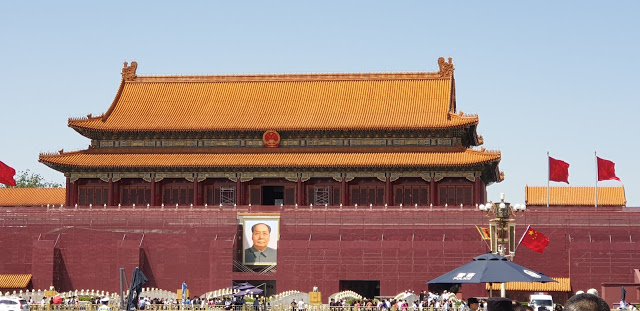
Tiananmen Square or Tian’anmen Square is in the centre of Beijing name after the Gate of Heavenly Peace, a gate that one separated the square from the Forbidden City.

The Square contains,

   the Monument to the People’s Heroes
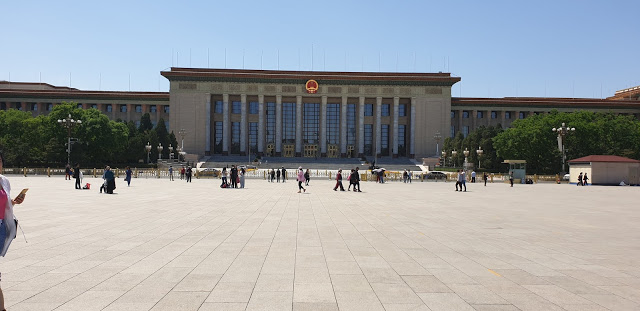
   the Great Hall of the People
   the National Museum of China
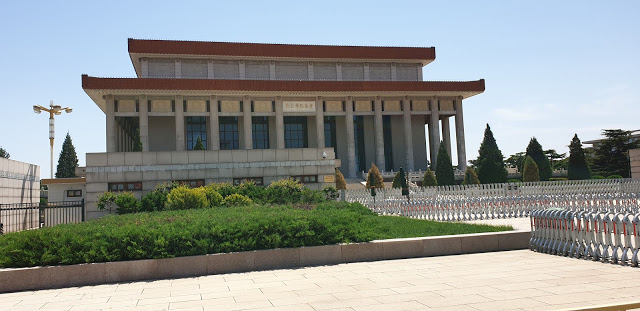
   the Mausoleum of Mao Zedong.

The square is about 109 acres and was designed and built in 1651, and since then been enlarged four times since, the most recent upgrade in the 1950s.

The Monument to the People’s Heroes

This is a ten-story obelisk built to commemorate the matters of the revolutions.  It was built between August 1952 and May 1958.  On the pedestal are reliefs depicting the eight major revolutionary episodes.

The Great Hall of the People

This was opened in September 1959, and covers 171809 square meters.  The Great Hall is the largest auditorium in China and can seat up to 10,000 people.  The State Banquet Hall can seat up to 5,000 diners.

The National Museum of China

This is one of the largest museums in the world and the second most visited museum in the world after the Louvre in Paris.   It was completed in 1959, and sits on 65 hectares, and rises four floors.  It has a permanent collection of over 1,000,000 items.

The Mauseloum of Mao Zedong

This was built shortly after his death, and completed on May 24th, 1977.  The embalmed body of the Chairman is preserved and on display in the center hall.

My own observations
This is huge; one of the largest public squares in the world, and if you’re going to walk it, like we did, make sure you’ve been exercising before you go.  It covers 44 hectares, borders on the Forbidden City, and has a memorial to Chairman Mao in the center of it.  But you cannot go near it, it’s fenced off, and it is guarded.

That’s both the statue and the square as there are random guards marching in random directions all the while watching us to see that we don’t misbehave.No one wants to find out what would happen if you jumped the fence around the statue, but I’m guessing you’ll have a few years to contemplate the stupidity of your actions with some very unhappy government officials.

Around the edges of the square are huge buildings, on one side is the museum 

and on the other is the Chinese equivalent of parliament.

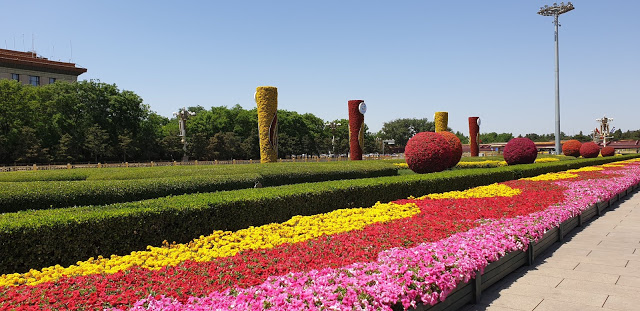
Around the sides are also large gardens

At one end, where the Forbidden City borders on the square, there’s a huge flag pole flying the Chinese flag, and this too like the monument is fenced off, and guarded by members of all of their armed services.  No tanks rolled out during our visit much to our disappointment.  There is no entrance to the Forbidden City from the square

At the other end is the Mausoleum of Mao Zedong, which was closed the day we were there, as was the museum. 

There are four sculptural groups installed outside the mausoleum.

Other than that, it’s just another square, albeit probably one of the largest in the world.  It can, we were told, hold about a million people.

“One Last Look”, nothing is what it seems

A single event can have enormous consequences.

A single event driven by fate, after Ben told his wife Charlotte he would be late home one night, he left early, and by chance discovers his wife having dinner in their favourite restaurant with another man.

A single event where it could be said Ben was in the wrong place at the wrong time.

Who was this man? Why was she having dinner with him?

A simple truth to explain the single event was all Ben required. Instead, Charlotte told him a lie.

A single event that forces Ben to question everything he thought he knew about his wife, and the people who are around her.

After a near-death experience and forced retirement into a world he is unfamiliar with, Ben finds himself once again drawn back into that life of lies, violence, and intrigue.

From London to a small village in Tuscany, little by little Ben discovers who the woman he married is, and the real reason why fate had brought them together.

It is available on Amazon here:  http://amzn.to/2CqUBcz

Writing a book in 365 days – 176

Day 176

Could you apply real-life work information to a story?

One of the how-to books I was reading once made several statements about what you could write about.

The first was to write about what you know. To me, that means if you were in the military, you would have the inside knowledge on how the army, navy or air force worked and you could apply that to the scenarios, the situations and the people.

Then there’s the idea that your work environment could provide you with enough inspiration and authentic information to make the story sound realistic.

I’m going with the latter because the place where I worked, in one instance, provided the detail to incorporate into a story. That workplace is a phosphate mining company, and the place where that mining took place, on a small Pacific Island.

I was also lucky enough to work on a history of the company for several years as the principal research officer. It wasn’t long before I began writing a parallel story, which I had tentatively called The phosphateers, and as each piece of research yielded yet another gem of information, so began the story.

It started in the aftermath of World War 1, and the first volume was to end when the island was evacuated, after several of the company’s ships were sunk by a German raider in World War 2.

But that was not the only story…

My acquiring of knowledge about computer systems, and in particular in those early days, the primitive sort of networking available with cables, connectors and network cards, was the basis for another story.

So, yes, a real-life job can be a gold mine of information.

PI Walthenson’s second case – A case of finding the ‘Flying Dutchman’.

Known only to a few, there is a legend that a ship named the ‘Flying Dutchman’ left Nazi Germany in the last weeks of the war and set sail for America, escorted by U-boats, under a different name. Aboard was a trove of treasure and gold worth a ‘king’s ransom’.

It was said that it had been sent to a group of American Nazis to create the Fourth Reich at an appropriate time. Over the years since many expeditions off the coast had searched, but found no trace of the vessel or the treasure.

In other words, it was just a legend created to boost tourism.

Fast forward to 2024. Our intrepid private detective, Harry Walthenson, overhears a conversation at Grand Central Station. It was the oddness of the message that caught his attention. An investigation turned up nothing out of the ordinary, and he thinks no more about it.

Then Harry is kidnapped, interrogated, and asked questions over and over about a date and a place, why he went there, and when he could not give satisfactory answers, he was beaten half to death and left for dead on a rubbish heap. He was lucky that it was a living space for homeless men; otherwise, he would have died.

In the aftermath, he once again gives it no more thought.

After resolving his first case successfully, there’s no rest. Harry’s angry mother comes to his office and demands that he find out where his father has gone. She believes he has run off with a mistress, not for the first time.

Perhaps it was not the wisest decision she has made, because Harry promises to investigate, and adds that she might not like what he finds.

He soon discovered he does not like what he finds, that his father’s friends, a cabal formed at University, have two who are his mother’s current lovers, and another, a criminal blackmailing his father.

Felicity, now his partner, working on a different case, and trying to get answers, uncovers a crime family involved in guarding a disused warehouse on the docks, where she believes Harry had been taken for interrogation, and subsequently dumped nearby to die.

Why are they up to? What is so important that the empty warehouse needs guarding? Who is employing them?

Harry, following up on the death of the blackmailer, traces his death back to an enforcer employed by his grandfather. His mother’s grandfather was a pre-war industrialist who made his fortune in war munitions and shipbuilding.

He was also a member of the American Nazi party.

When Harry also discovers a logbook belonging to a so-called wartime Liberty ship the “Paul Revere” in brackets ‘Freiheitskämpfer’, hidden by his father, and written in a code that is not readily identifiable.

It is no longer a matter of a father who has run off with his mistress; it is a very frightened man in fear of his life, running from a group who will stop at nothing to get the logbook back. And when Harry discovers a family connection to the group, it becomes a race against time to decode the log and find his father before his grandfather does.

Coming soon: Harry Walthenson’s new adventure – A case of finding the ‘Flying Dutchman’

In a word: Bar

There’s more than one way … er, perhaps it’s better to say, there are many ways to use the word bar, which is not bad for a three-letter word.

Bar, the one you associate with drinks, in hotels, restaurants and we’ll, just bars.

Probably the best type of bar you might find me in is a Sports Bar, where you can snack on buffalo wings a tall glass of beer and watch with ice hockey in winter or baseball in summer.

It’s one I use from time to time when asked, what will we do, and the reply is often let’s go to a bar.  The best bars are underground, dark and dingy, full of eclectic people, with a band playing almost passable music or better still jazz

Bar, as in the legal variety

There are so many legal references to using bar, that the one that I am most familiar with is being admitted to the bar which means that you can now practice law.

Raising the bar, if that’s possible, where the bar is that imaginary level which offers sinks very low.  When someone says they’re going to try and raise the bar, you may be assured there will be a long battle ahead, simply because people generally find it hard to change.

Bar, as in we are not going to let you in here.  Yes, this is the irksome one where you find yourself, often for reasons unknown, barred from somewhere or something.  This may also be referred to by saying everyone may enter bar you.  

Bar, as in an iron bar, the sort that is sometimes used as a blunt force object by villains to remind the victim they owe any one of a loan shark, bookie or the mafia.  God help you if it is all three.

There are also iron bars of a different sort, those that are set in concrete outside a window most likely in a prison where the objective is to prevent escape.

It gives rise to an old expression, that person should be behind bars.

Then there is just a bar, such as a bar of gold, which I’m sure we’d all like to have stashed away, but not necessarily in the mattress, or the more common variety, a chocolate bar, which I have one now.  What’s your favorite?

And just to add to the list of meanings you can always refer to sashes or stripes as bars.

Confused?  Well, there’s still music, and the bane of yachtsmen, sand bars but I think we’ll leave it there.

Welcome to the English language