The cinema of my dreams – I always wanted to go on a treasure hunt – Episode 84

Here’s the thing…

Every time I close my eyes, I see something different.

I’d like to think the cinema of my dreams is playing a double feature but it’s a bit like a comedy cartoon night on Fox.

But these dreams are nothing to laugh about.

Once again there’s a new installment of an old feature, and we’re back on the treasure hunt.

Nadia reappears

There was no fanfare when I walked out of the hospital lobby and out into the cool afternoon.  After the heat, we were due some rain, and looking up to the sky, it was imminent.

I hadn’t organized a ride and was hoping to get a taxi.  It was probably the wrong time of the day.  Standing in the curb, I noticed a black SUV pulling into the drive-through, distinguishable by the reflective windows.  FBI or the state’s equivalent?

It stopped in front of me, and I stepped back, expecting a couple of Feds to get out.  Instead, the passenger door window opened and I could see a woman at the wheels.

When she turned to look at me, I recognized the face instantly.  Nadia.

“Get in.”

No hello, how are you, beg your pardon.

I climbed in, and we were moving almost before I shut the door.  The forward momentum did that.

“Is there a reason for this cloak and dagger approach?  It’s good to see you, and all that, by the way.”

“I’m trying to keep under the radar.  The sheriff seems to think I know more than I told them, which was nothing.  I hope you did the same.”

“What would be the point?  Alex and your brother took control of the narrative, days before we were found.”

“They did.  Deceitful lying little…”

It was clear that just talking about them made her extremely angry, so I figured I should change the subject.

“When are you going back to Italy?”

It didn’t take long to realize she was heading towards The Grove, and we were not far from the Mall.  I wondered if there was still a hold on the demolition.

“Soon.  I have a few jobs to attend to before then.”

I was going to ask what jobs, but then decided I was better off not knowing.

“How did you know I was leaving the hospital?”

“I called, pretending to be your mother.  She seems to spend a lot of time with Benderby.”

A sidelong glance at the girl I hardly knew, to say it was odd that she was interested in what my mother was doing was an understatement.  I thought I had some understanding of the girl I’d come to like a lit more than I should, but now I wasn’t so sure.

“Does it matter?”

“You can see what Benderby is doing, can’t you?”

“Take me out of the equation, of course.  Shiny new promotion and all, at work.  She’s going to be disappointed all round I guess when I leave town.”

“You thought about going to Italy with me?”

“Anywhere but here.  I don’t think Boggs’s death has sunk in yet.  Mad as he might have been he didn’t deserve what he got.”

“You don’t believe he slipped and fell?”

“Nor does Charlene.”

“Charlene is naive.”

Charlene still believed the world wasn’t a corrupt place, and that the law was the same for everyone.  The job was going to destroy her in the end.

“Or she might just find a way to bring Alex and Vince down, that is if you still think Vince needs to be taught the error of his ways.  I didn’t think he would have the temerity to attach his own sister.”

“Neither did I, but my suspicion there was something wrong with him mentally was right.  He crossed a line, Sam, and in my book, you cried that line, you don’t come back.”

Instead of heading straight on, where I thought she was heading for her beachside shack, we took the side road to the mall and the rear carpark.

The whole site was abandoned now, with the demolition halted.  Even the security guards had abandoned the place, their demountable office closed, and in darkness.

She parked the car some distance from the side door we used on our last visit, behind the overgrown tree line that separated the staff carpark from the customer’s.  The question was, what were we doing there.

As they say, the silence was deafening.

I didn’t know what to think.  After everything that happened in such a short space of time, my head was still reeling. 

I guess I should have been pleased that I worked put where the treasure once was and that we had solved the mysterious disappearances of Boggs senior and Ormiston.  I wanted to tell the respective families, but given the threat of both Alex and Vince, and no doubt Benderby himself, made it difficult.

There was also the possibility no one would believe me since the evidence had been removed.

And there was no doubt the near-death experience had crystallized my desire to change my life, and definitely get away from this place which now seemed more like a prison than a home.

Then, there was Nadia. 

I could never have imagined in my wildest dreams actually being in the same room as Nadia, let alone stealing a kiss.  Just a touch of hands had the effect of sending an electric charge through me, and the thought of doing anything else almost made me weak at the knees.

I wondered if she had any idea of the effect she had on me. 

A stolen glance showed her sitting relaxed, eyes closed, the hint of a smile on her face.  What was she thinking?

A few seconds later I felt her hand touch mine, and it was like getting an electric shock.  Almost instinctively our fingers intertwined.  She opened her eyes and turned her head to look at me.

“I had a lot of time, back in the cave, to think about stuff I never really thought about before.  You think you have all the time in the world, but the truth is, you don’t.  Everything can be taken away from you in an instant, and all those things you said you’d do one day, never happen.”

“All part of the near-death experience.  It got me thinking too.  Everything I was going to do, one day.  And for a little while there, I honestly believed I’d wasted my whole life.”

“It’s funny, or rather not funny, what you think was important, and really isn’t.  We shared something nearly everyone else won’t or could, Sam.”

She held up her hand in mine.  “Like this.  A month ago, this would not have happened, you and I, not a possibility.  I was too wrapped up in who and what I was, that overdose of self-importance and ego, when the reality was I am nothing more than just another speck on the landscape.”

“You’re more than that, Nadia.”

“To you, yes.  To everyone else, no.  I was brought up to believe the family was everything, but, in the end, it counted for nothing.”  She sighed.  “To them, I’ll be nothing but a girl.  I can’t tell how disappointed I was, or repeat what I said to my father, or that which I now refuse to call my mother.”

I wondered what I could say that would make her feel better, but there was nothing in my word armory.

“If it’s any consolation, I want to go to Italy with you, and explore the possibilities.”

She smiled.  “Summers are magic, you wake up, the early morning sun caressing warmth on your body, the tactile feel of the person lying next to you.  It’s hard not to imagine those feelings coursing through you.”

Did that mean she had a boyfriend back in Italy?  My have must have expressed my thoughts.

“You are the one in my thoughts, Sam.  It’s you there beside me and has been since getting out of the cave.  I know you feel the same about me.”

My heart missed a beat, or three.  I could see us there, together, bodies entwined.

“Now hold that thought.  We have one last job to do, and I think you’ll appreciate it.”

I hadn’t realized I’d stopped breathing and let out a long breath.  If it were up to me, I’d be on the next plane to Rome.

Instead, it looked like we were going to make a final visit to the mall.

© Charles Heath 2020-2022

An excerpt from “Amnesia”, a work in progress

I remembered a bang.

I remembered the car slewing sideways.

I remember another bang, and then it was lights out.

When I opened my eyes again, I saw the sky.

Or I could be underwater.

Everything was blurred.

I tried to focus but I couldn’t. My eyes were full of water.

What happened?

Why was I lying down?

Where was I?

I cast my mind back, trying to remember.

It was a blank.

What, when, who, why and where, are questions I should easily be able to answer. These are questions any normal person could answer.

I tried to move. Bad, bad mistake.

I did not realise the scream I heard was my own. Just before my body shut down.

“My God! What happened?”

I could hear, not see. I was moving, lying down, looking up.

I was blind. Everything was black.

“Car accident; hit a tree, sent the passenger flying through the windscreen. Pity to poor bastard didn’t get the message that seat belts save lives.”

Was I that poor bastard?

“Report?” A new voice, male, authoritative.

“Multiple lacerations, broken collar bone, broken arm in three places, both legs broken below the knees, one badly. We are not sure of internal injuries, but ruptured spleen, cracked ribs and pierced right lung are fairly evident, x-rays will confirm that and anything else.”

“What isn’t broken?”

“His neck.”

“Then I would have to say we are looking at the luckiest man on the planet.”

I heard the shuffling of pages.

“OR1 ready?”

“Yes. On standby since we were first advised.”

“Good. Let’s see if we can weave some magic.”

Magic.

It was the first word that popped into my head when I surfaced from the bottom of the lake. That first breath, after holding it for so long, was sublime, and, in reality, agonising.

Magic, because it seemed like I’d spent a long time underwater.

Or somewhere.

I tried to speak but couldn’t. The words were just in my head.

Was it night or was it day?

Was it hot, or was it cold?

Where was I?

Around me, it felt cool.

It was incredibly quiet. No noise except for the hissing of air through an air-conditioning vent. Or that was the sound of pure silence.  And with it the revelation that silence was not silent. It was noisy.

I didn’t try to move.

Instinctively, somehow, I knew not to.

A previous unpleasant experience?

I heard what sounded like a door opening, and noticeably quiet footsteps slowly came into the room. They stopped. I could hear breathing, slightly laboured, a sound I’d heard before.

My grandfather.

He had smoked all his life until he was diagnosed with lung cancer. But for years before that he had emphysema. The person in the room was on their way, down the same path. I could smell the smoke.

I wanted to tell whoever it was the hazards of smoking.

I couldn’t.

I heard a metallic clanging sound from the end of the bed. A moment later the clicking of a pen, then writing.

“You are in a hospital.” A female voice suddenly said. “You’ve been in a bad accident. You cannot talk, or move, all you can do, for the moment, is listen to me. I am a nurse. You have been here for 45 days and just came out of a medically induced coma. There is nothing to be afraid of.”

She had a very soothing voice.

Her fingers stroked the back of my hand.

“Everything is fine.”

Define fine, I thought. I wanted to ask her what ‘fine’ meant.

“Just count backwards from 10.”

Why?

I didn’t reach seven.

Over the next ten days, that voice became my lifeline to sanity. Every morning, I longed to hear it, if only for the few moments she was in the room, those few waking moments when I believed she, and someone else who never spoke, were doing tests. I knew it had to be someone else because I could smell the essence of lavender. My grandmother had worn a similar scent.

It rose above the disinfectant.

She was another doctor, not the one who had been there the day I arrived. Not the one who had used some ‘magic’ and kept me alive.

It was then, in those moments before she put me under again, that I thought, what if I was paralysed? It would explain a lot. A chill went through me.

The next morning, she was back.

“My name is Winifred. We don’t know what your name is, not yet. In a few days, you will be better, and you will be able to ask us questions. You were in an accident, and you were very severely injured, but I can assure you there will be no lasting damage.”

More tests, and then when I expected the lights to go out, they didn’t. Not for a few minutes more. This was how I would be integrated back into the world. A little bit at a time.

The next morning, she came later than usual, and I’d been awake for a few minutes. “You have bandages over your eyes and face. You had bad lacerations to your face, and glass in your eyes. We will know more when the bandages come off in a few days. Your face will take longer to heal. It was necessary to do some plastic surgery.”

Lacerations, glass in my eyes, car accidents, plastic surgery. By logical deduction, I knew I was the poor bastard thrown through the windscreen. It was a fleeting memory from the day I was admitted.

How could that happen?

That was the first of many startling revelations. The second was the fact I could not remember the crash. Equally shocking, in that same moment was the fact I could not remember before the crash either, or only vague memories after.

But the most shattering of all these revelations was the one where I realised, I could not remember my name.

I tried to calm down, sensing a rising panic.

I was just disoriented, I told myself. After 45 days in an induced coma, it had messed with my mind, and it was only a temporary lapse. Yes, that’s what it was, a temporary lapse. I will remember tomorrow. Or the next day.

Sleep was a blessed relief.

The next day I didn’t wake up feeling nauseous. I think they’d lowered the pain medication. I’d heard that morphine could have that effect. Then, how could I know that but not who I am?

Now I knew Winifred the nurse was preparing me for something unbelievably bad. She was upbeat, and soothing, giving me a new piece of information each morning. This morning, “You do not need to be afraid. Everything is going to be fine. The doctor tells me you are going to recover with little scarring. You will need some physiotherapy to recover from your physical injuries, but that’s in the future. We need to let you mend a little bit more before then.”

So, I was not going to be able to leap out of bed and walk out of the hospital any time soon. I don’t suppose I’d ever leapt out of bed, except as a young boy. I suspect I’d sustained a few broken bones. I guess learning to walk again was the least of my problems.

But there was something else. I picked it up in the timbre of her voice, a hesitation, or reluctance. It sent another chill through me.

This time I was left awake for an hour before she returned.

This time sleep was restless.

Scenes were playing in my mind, nothing I recognised, and nothing lasting longer than a glimpse. Me. Others, people I didn’t know. Or I knew them and couldn’t remember them.

Until they disappeared, slowly like the glowing dot in the centre of the computer screen, before finally fading to black.

The morning the bandages were to come off she came in early and woke me. I had another restless night, the images becoming clearer, but nothing recognisable.

“This morning the doctor will be removing the bandages over your eyes. Don’t expect an immediate effect. Your sight may come back quickly, or it may come back slowly, but we believe it will come back.”

I wanted to believe I was not expecting anything, but I was. It was human nature. I did not want to be blind as well as paralysed. I had to have at least one reason to live.

I dozed again until I felt a gentle hand on my shoulder. I could smell the lavender; the other doctor was back. And I knew the hand on my shoulder was Winifred’s. She told me not to be frightened.

I was amazed to realise at that moment, I wasn’t.

I heard the scissors cutting the bandages.

I felt the bandage being removed, and the pressure coming off my eyes. I could feel the pads covering both eyes.

Then a moment when nothing happened.

Then the pads are gently lifted and removed.

Nothing.

I blinked my eyes, once, twice. Nothing.

“Just hold on a moment,” Winifred said. A few seconds later I could feel a cool towel wiping my face, and then gently wiping my eyes. There was ointment or something else in them.

Then a flash. Well, not a flash, but like when a light is turned on and off. A moment later, it was brighter, not the inky blackness of before, but a shade of grey.

She wiped my eyes again.

I blinked a few more times, and then the light returned, and it was like looking through water, at distorted and blurry objects in the distance.

I blinked again, and she wiped my eyes again.

Blurry objects took shape. A face looking down on me, an elderly lady with a kindly face, surely Winifred, who was smiling. And on the opposite side of the bed, the doctor, a Chinese woman of indescribable beauty.

I nodded.

“You can see?”

I nodded again.

“Clearly?”

I nodded.

“Very good. We will just draw the curtains now. We don’t want to overdo it. Tomorrow we will be taking off the bandages on your face. Then, it will be the next milestone. Talking.”

I couldn’t wait.

When morning came, I found myself afraid. Winifred had mentioned scarring, there were bandages on my face. I knew, but wasn’t quite sure how I knew, I wasn’t the most handsome of men before the accident, so this might be an improvement.

I was not sure why I didn’t think it would be the case.

They came at mid-morning, the nurse, Winifred, and the doctor, the exquisite Chinese. She was the distraction, taking my mind off the reality of what I was about to see.

Another doctor came into the room before the bandages were removed, and he was introduced as the plastic surgeon who had ‘repaired’ the ravages of the accident. It had been no easy job, but, with a degree of egotism, he did say he was one of the best in the world.

I found it hard to believe, if he were, that he would be at a small country hospital.

“Now just remember, what you might see now is not how you will look in a few months.”

Warning enough.

The Chinese doctor started removing the bandages. She did it slowly and made sure it did not hurt. My skin was very tender, and I suspect still bruised, either from the accident or the surgery, I didn’t know.

Then it was done.

The plastic surgeon gave his work a thorough examination and seemed pleased with his work. “Coming along nicely,” he said to the other doctor. He issued some instructions on how to manage the skin, nodded to me, and I thanked him before he left.

I noticed Winifred had a mirror in her hand and was reticent in using it. “As I said,” she said noticing me looking at the mirror, “what you see now will not be the result. The doctor said it was going to heal with little scarring. You have been extremely fortunate he was available. Are you ready?”

I nodded.

She showed me.

I tried not to be reviled at the red and purple mess that used to be my face. At a guess, I would have to say he had to put it all back together again, but not knowing what I looked like before, I had no benchmark. All I had was a snippet of memory that told me I was not the tall, dark, and handsome type.

And I still could not talk. There was a reason, he had worked in that area too. Just breathing hurt. I think I would save up anything I had to say for another day. I could not even smile. Or frown. Or grimace.

“We’ll leave you for a while. Everyone needs a little time to get used to the change. I suspect you are not sure if there has been an improvement in last year’s model. Well, time will tell.”

A new face?

I could not remember the old one.

My memory still hadn’t returned.

©  Charles Heath  2024

Searching for locations: From Zhengzhou to Suzhou by train, and the Snowy Sea Hotel, Suzhou, China

For the first time on this trip, we encounter problems with Chinese officialdom at the railway station, though we were warned that this might occur.

We had a major problem with the security staff when they pulled everyone over with aerosols and confiscated them. We lost styling mousse, others lost hair spray, and the men, their shaving cream.  But, to her credit, the tour guide did warn us they were stricter here, but her suggestion to be angry they were taking our stuff was probably not the right thing to do.

As with previous train bookings, the Chinese method of placing people in seats didn’t quite manage to keep couples traveling together, together on the train.  It was an odd peculiarity which few of the passengers understood, nor did they conform, swapping seat allocations.

This train ride did not seem the same as the last two and I don’t think we had the same type of high-speed train type that we had for the last two.  The carriages were different, there was only one toilet per carriage, and I don’t think we were going as fast.

But aside from that, we had 753 kilometers to travel with six stops before ours, two of which were very large cities, and then our stop, about four and a half hours later.  With two minutes this time, to get the baggage off the team managed it in 40 seconds, a new record.

After slight disorientation getting off the train, we locate our guide, easily found by looking for the Trip-A-Deal flag.  From there it’s a matter of getting into our respective groups and finding the bus.

As usual, the trip to the hotel was a long one, but we were traveling through a much brighter, and well lit, city.

As for our guide, we have him from now until the end of the tour.  There are no more train rides, we will be taking the bus from city to city until we reach Shanghai.  Good thing then that the bus is brand new, with that new car smell.  Only issue, no USB charging point.

The Snowy Sea hotel.  

It is finally a joy to get a room that is nothing short of great.  It has a bathroom and thus privacy.

Everyone had to go find a supermarket to purchase replacements for the confiscated items.  Luckily there was a huge supermarket just up from the hotel that had everything but the kitchen sink.

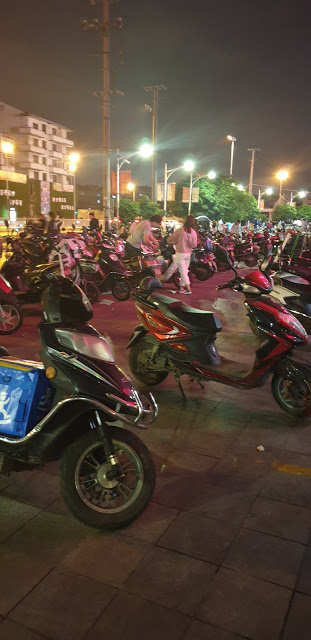
But, unlike where we live, the carpark is more of a scooter park!

It is also a small microcosm of Chinese life for the new more capitalistic oriented Chinese.

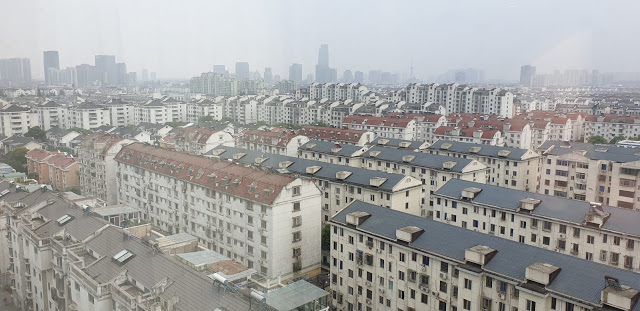
The next morning we get some idea of the scope of high-density living, though here, the buildings are not 30 stories tall, but still just as impressive.

These look like the medium density houses, but to the right of these are much larger buildings

The remarkable thing about this is those buildings stretch as far as the eye can see.

“The Devil You Don’t”, she was the girl you would not take home to your mother!

Now only $0.99 at https://amzn.to/2Xyh1ow

John Pennington’s life is in the doldrums. Looking for new opportunities, and prevaricating about getting married, the only joy on the horizon was an upcoming visit to his grandmother in Sorrento, Italy.

Suddenly he is left at the check-in counter with a message on his phone telling him the marriage is off, and the relationship is over.

If only he hadn’t promised a friend he would do a favour for him in Rome.

At the first stop, Geneva, he has a chance encounter with Zoe, an intriguing woman who captures his imagination from the moment she boards the Savoire, and his life ventures into uncharted territory in more ways than one.

That ‘favour’ for his friend suddenly becomes a life-changing event, and when Zoe, the woman who he knows is too good to be true, reappears, danger and death follow.

Shot at, lied to, seduced, and drawn into a world where nothing is what it seems, John is dragged into an adrenaline-charged undertaking, where he may have been wiser to stay with the ‘devil you know’ rather than opt for the ‘devil you don’t’.

newdevilcvr6

Writing a book in 365 days – 186/187

Days 186 and 187

Writing exercise – about something other than the book I’m writing –

I had worked very hard to improve my position from fact checker to my ultimate role, editor. It took years of dedication and application, doing everything that was asked of me, and more.

And now, after seven years, I believed my time had come, an email from the chief editor to discuss my role moving forward.

It had been the same every year but those were reviews of my work, and I knew it took time before the review became an interview for promotion.  It was my turn.

10 AM:  Montgomery Montague’s office, 45th floor, the executive level, one above editorial, the department I aspired to work for.

Chester, my recalcitrant cat, raised his head as I came into the kitchen, and gave me his usual look of disdain.  This morning, he was not going to get off as easily.

“This is my day,” I said.  “You can rejoice in my success, or you can mope.”

A meow told me he did not give one jot what was happening in my world, just get the food in the bowl now.  Yes, that look was almost one of malice.

“Not today mister.”  I selected a tin of some sort of fish, removed the lid and scooped it into the bowl. 

Before I could move the bowl to the floor he had jumped up onto the counter, sniffed it, and looked at me.  Yes, that was the ‘you gave me that yesterday’ look, and that momentary thrill of tricking him, passed.

Of course, I hadn’t.  He looked at me and meowed twice.  The rebuke.

“No,” I said.  “You eat it, or you starve.  I’m going to work now.”

I stared him down.  “You cannot rain on my parade.” Another few seconds, he turned back to the bowl and took a tentative bite.  “I’ll be back with the good news.”

Good things happened in threes, my mother used to say.  That was number one.

The train was late, a holdup over a signal failure, or that’s what I thought I heard, but to Montgomery Montague, that was not an excuse.

Despite the minor setback, I forgoed my usual early morning coffee and went straight to the office, and weas only five minutes late.

When I reached his outer office where his personal assistant sat I saw her coming out of his office, and she gave me the ‘look’.  Everyone knew it, it was not a good day.

Had an event I had no control over ruined my chance.  She sat and I took a seat.

She was going to make me wait.

And panic.

Then she looked up and smiled.  “You are very lucky I was detained in his office.  I’ll tell him you’re here.”

She called, then nodded, assent to enter the inner sanctum.  It would be the third time I had bene in his office, the first my interview for the job, the second a discussion over some facts that were in dispute. And this time. Hopefully, my promotion.

I knocked on the door, waited for the terse ‘enter’ then went in, softly closing the door behind me.

Then it was past the meeting table. The coffee table the lounge chairs, the open space, the stop at the desk.

There was always the right number of chairs for those invited.  The uncomfortable chairs so you didn’t linger longer than necessary.

“Have a seat.”

The question was, which one?  Someone said once there was a right choice and a wrong choice, and I just realised there were two seats.  Was there another person about to join the interview?

I sat in the left seat.

There was just a hint of a smile on his face.  “The pilot’s seat.  Good choice, Ben.”

He gave me the serious look, the one that rattled everyone who sat opposite his desk, from new employees to the seasoned editors, those who had been here for years.

“Do you write?”

It was an unexpected question, and perhaps a little superfluous.  Why work at a publisher if you didn’t write?  I was going to say that, but was it a trick question?

“Yes, I do.”

“And read?”

“Avidly.  Writers must read.”  It was almost a mantra in this place.

“Of course, they do.  What type of stories do you write?”

“Thrillers, espionage, but at the moment historical fiction.”

“Busy then?”

“I keep myself amused in my spare time, and Chester more so.”

“Chester?”

“My cat, and harshest critic.  I read him parts of the story, and if he complains, it’s a rewrite.”

He made a face; one I didn’t decipher.  Someone once said, don’t embellish.  “What makes you think you can edit?”

“I’ve read a great many books to learn style and composition.  Ui can see errors in manuscripts that I’ve been given to fact check and often check later what I found with the end product, and I’ve had successes.”

“Editing is more than just grammar and spelling.  It’s continuity, missing links, slight changes in titles, descriptions, and other errors that authors routinely make.  We do not want to be checking your work.  You are the final word.  But…”

And here it comes, all my hopes and dreams were about to be shattered.

“I need you to do a test case for me before I make the final decision.”

He leaned forward and opened a drawer in front of him and pulled out a folder, looked at it then put it on the desk.  It was quite thick, but old, and quite discoloured.  The front had several coffee cup stains.

“This novel has been here for at least thirty years, and so far, no one has been able to turn it into something worth reading.  We call it Pandora’s Box.  You never know what’s inside.  A word to the wise, the last 25 recipients of this manuscript failed and didn’t get to become an editor here.  I have high hopes that you will not join them.  You have three weeks.”

He pushed the file across the desk towards me.  The interview, such as it was, was over.

Good things come in threes. Let’s call the outcome of this meeting a possible second.

Clutching the folder close, I took the elevator back down to my floor.  I assumed I was not yet a fully-fledged editor, so I could not move to the editorial floor five above, where I currently worked with nine other fact-checkers.

We worked in pairs, and my pair was Josie, a graduate with more degrees than I had, and I often wondered why she was not a rocket scientist.  She certainly knew enough about them, and space.

I had been considering asking her on a date, but after hearing about her last one, I decided she was not going to be interested in someone like me.

She saw me come out of the elevator and then went back to her work until I sat down.  In the fact-checking department, a year longer than me, and having no desire to become an editor, she had this dream of the cottage, the country garden, the picket fence, the husband who came home the same time every day, and the 2.4 children.  I was not sure the last part was possible; it had to be either 2 or 3.

“How did the interview go?”

I had told her I was going to see Montague and High Hopes.  She didn’t try to dash them, having seen her fair share of hopefuls’ crash and burn, but I could see the lack of confidence in her eyes when I told her of my ambition.  All she told me was to not fly too close to the sun.

“I have a task, a test.”

“Pandora’s Box?”

“You know?”

“Everyone knows.  No one speaks of it.”

“It’s not the first time he’s brought it out?”

“No.”

“And no one has made it work?”

“They couldn’t.  It’s gibberish.  He’s reputed to have written it himself as a means to squash budding hopefuls.”

“No one?”

“None that I’ve heard of over the last 10 years.  They come, they get the call to his office, he gives them Pandora’s Box, they fail, and then they leave.”

“Why?”

“Because they know he will never promote them to editor.”

I shrugged.  “There’s always a first time.”

“Have you read any of it?”

“No.”

“Then take it home and read it to Chester.  If he turns up his nose, then you have a problem.  If not, well, there may be hope.”

That said, she returned to the pile of manuscripts, each about some aspect of space.

I put the file in my backpack along with my laptop computer and, at precisely 6:05 pm, left the office.

I thought of asking Josie if she wanted to drop into a bar that was on both our ways home.  Sometimes when she wanted a sounding board, we would drop into a quaint bar and have a drink or two and sometimes a snack.  They were not dates, even though in my imagination they were.

She had come from a small town in the Midwest, and I came from upstate, New York.  Her family were ranchers, mine bankers, so we had little in common.

This time we parted at the door, with a promise I’d tell her what my reaction was to the story.  She had only heard about it, and nothing good.

Chester was waiting, curled up on the lounge where he was not supposed to be, but then, he never listened to me.

I glared at him as I closed the door, crossed to the kitchen bench where I put dinner from the Deli up the road, and the backpack.  I thought about taking the file out, but left it.  Dinner for Chester, then dinner for me, first.

An hour later and after cleaning up. I dragged the folder out and extracted the manuscript.  It was about three hundred pages of double-spaced type, done on an old-world manual typewriter with a cloth ribbon that had seen a lot of use.  The unevenness of the typeface told me some keys were stiffer to push than others, typed by a hunter and pecker, not an accomplished typist.

Errors we xxed out, and there were handwritten notes in red ink, whether put there by the author or a hapless would-be editor.

The title:  A Continental Mystery.

No author, the sheets were yellowing and darkening around the paper edges.  All of the pages had the look and feel of being thumbed through many times.  There were dog-eared pages scattered throughout the manuscript.  I looked, but there was no reason behind any of them, and one had a coffee cup stain.

It was hardly the sort of manuscript the company would accept.  I knew their requested requirements for submissions, and they were very high.  This would never have made the cut.

So…

I had to ask myself what Montague’s game was here?

Perhaps if I read the first page…

I made myself comfortable on the lounge chair, put my feet up on the ottoman and after a few minutes, Chester came and sat next to me.

“Would you like me to read you this story?” I said, looking at him.

His expression said ‘No’.

Good.  I was not in the mood to spare him.

It was a dark early morning; the moon had disappeared behind clouds that suggested an imminent downpour.  James quickened his pace to get to King’s Cross station before the skies above him opened.

It was not the only reason he was in a hurry; he had promised Matilda, the girl he was intending to ask to marry him, that he would be at the station a half hour before the train was to depart, and she did not like tardiness.

They were taking the train to Edinburgh, where they would be collected and taken to Matilda’s family home, Barkworth Manor.  For him, it was an opportunity to travel on the latest night Scotsman service, just upgraded to rival any luxury train in the world.

“Well,” I said to Chester, who seemed to have an expression of interest.  “A girl who belongs to a wealthy family, living in such a salubrious residence to be named Barkworth Manor, in Scotland no less.”

Chester turned away and yawned.  Rich girls living in posh manor houses obviously didn’t impress him.  I shrugged.  It had my attention.  Was she an heiress?  And who was this James?

Read on…

James considered himself the luckiest man in London and had to believe he had been in the right place at the right time.  A chance meeting outside the Savoy Hotel, an awkward conversation that led to coffee and cake, which in turn led to dinner.

It seemed serendipitous; they were both down from Oxford, both studying Archaeology, and could have equally accidentally met in Oxford as in London.  It led to a semester of chance meetings, which led to study time in the Bodleian Library, which led to dinner, and then an invitation for him to spend the weekend in Scotland with her parents.

In normal circumstances, he visited his mother in Cornwall, or sometimes a weekend with his academic acquaintances.  That had all changed as his friendship with Matilda slowly became something more.

I dragged the notebook computer over and started a new document, and typed a note, ‘the start needs work’.  A better definition of the protagonists was needed.

But in my imagination, I could visualise London at night, dark clouds swirling, rain imminent, as it had rained every time I had visited England myself and then I tried to remember what Kings Cross looked like.

The year, if I was assuming correctly, was about 1928, and I remembered seeing a steam train documentary not long ago.  I would have been as excited as James, just seeing the train, let alone travelling on it.

The fact-checking part of me then went looking for information on the night trains to Edinburgh.  There was the Flying Scotsman, the overnight train from London to Edinburgh, selecting the date 1928.  There was, however, another train, the Night Scotsman, that had started in May of that year, left London at 10:35 pm and arrived in Edinburgh about eight and a half hours later.  Photos showed the locomotive, the carriages, and plans of the sleepers, first and third class.  It was between the wars, and a bustling time, but there might be a lead into the great depression, so there was going to be historical context.

Then I realised I was getting ahead of myself and needed to read more.  It wasn’t badly written, it just needed a few changes, making the characters more relatable, and whether they were on equal footing.

Or perhaps I wasn’t.

The reader always needs to know the basics.  Firstly, who was going to be the main protagonist? That was James.  Male, early twenties, perhaps the accepted age for a prospective graduate, and given the cost of his studies, perhaps reasonably wealthy parents were funding him.

Certainly, the girl, of similar age, was being funded by her parents, though at that time it might have been less acceptable for her to be studying rather than getting married.  Social mores were very different then, but times were changing, albeit slowly.  It wasn’t long after the suffragettes.

I scanned through the pages for more information on the boy.

James McArthur, the third son of Sir William McArthur, banker, the son being 24 years old.  His mother, Lady Allison McArthur, nee Benton, was a writer, not overly successful but enough to be in a circle of similar ladies, who cross all sections of the Arts.  James had been 14 at the end of the Great War, and had lost two of his brothers to it, leaving him, a younger brother and two older sisters.

Then, the girl. 

Matilda Carterville was one of four daughters and two sons of Lord and Lady Carterville, landowner and shipping magnate, whose personal Empire was as vast as the British Empire of the day.  Matilda’s mother had not been from the aristocracy, and had caught the eye of the Lord, before he became a Lord, when she was a Shakespearean actress.  For him, it had been love at first sight; for her, it had been an amusing interlude until she discovered who he was, and it ended up all over the society pages.

Several hours passed as I constructed a family tree from the first 100 pages.  I wondered if this was what other Editors did, trying to get a handle on the characters, their associations, and be ready for whatever the author threw at them. I felt, by the end of it, that I knew James and Matilda.

It was interesting to discover that James’s mother lived in a house that was described as a cottage, it also had a name, and to me sounded like it had a hundred rooms, a dozen servants who all lived in, and grounds the size of a municipal park.

That paled to insignificance when it came to the castle Matilda came from.  Yes, an actual castle, once described as sprawling, a place where one could get lost, that was described as cold and draughty, with towers, and everything made of stone.  It had a banquet hall, a dining hall, and countless other rooms and staff, a place that would cost a fortune to keep in good repair and run.

Oh, yes, it had grounds to go hunting and shooting, fox hunting, and a lake to go fishing.  Surrounding it was farmland with cattle, sheep, and various crops, and produce used in the castle kitchen.  It was hard to imagine such places still existed, especially the class divisions that I had read about, which were virtually swept away after the Second World War.  Still, I did see mention of butlers, maids, ground staff, chauffeurs and countless others.

It was a world I could only imagine existed, once upon a time.

©  Charles Heath  2025

“The Things we do for Love”, the story behind the story

This story has been ongoing since I was seventeen, and just to let you know, I’m 71 this year.

Yes, it’s taken a long time to get it done.

Why, you might ask.

Well, I never gave it much interest because I started writing it after a small incident when I was 17, and working as a book packer for a book distributor in Melbourne

At the end of my first year, at Christmas, the employer had a Christmas party, and that year, it was at a venue in St Kilda.

I wasn’t going to go because at that age, I was an ordinary boy who was very introverted and basically scared of his own shadow and terrified by girls.

Back then, I would cross the street to avoid them

Also, other members of the staff in the shipping department were rough and ready types who were not backwards in telling me what happened, and being naive, perhaps they knew I’d be either shocked or intrigued.

I was both adamant I wasn’t coming and then got roped in on a dare.

Damn!

So, back then, in the early 70s, people looked the other way when it came to drinking, and of course, Dutch courage always takes away the concerns, especially when normally you wouldn’t do half the stuff you wouldn’t in a million years

I made it to the end, not as drunk and stupid as I thought I might be, and St Kilda being a salacious place if you knew where to look, my new friends decided to give me a surprise.

It didn’t take long to realise these men were ‘men about town’ as they kept saying, and we went on an odyssey.  Yes, those backstreet brothels where one could, I was told, have anything they could imagine.

Let me tell you, large quantities of alcohol and imagination were a very bad mix.

So, the odyssey in ‘The things we do’ was based on that, and then the encounter with Diana. Well, let’s just say I learned a great deal about girls that night.

Firstly, not all girls are nasty and spiteful, which seemed to be the case whenever I met one. There was a way to approach, greet, talk to, and behave.

It was also true that I could have had anything I wanted, but I decided what was in my imagination could stay there.  She was amused that all I wanted was to talk, but it was my money, and I could spend it how I liked.

And like any 17-year-old naive fool, I fell in love with her and had all these foolish notions.  Months later, I went back, but she had moved on, to where no one was saying or knew.

Needless to say, I was heartbroken and had to get over that first loss, which, like any 17-year-old, was like the end of the world.

But it was the best hour I’d ever spent in my life and would remain so until I met the woman I have been married to for the last 48 years.

As Henry, he was in part based on a rebel, the son of rich parents who despised them and their wealth, and he used to regale anyone who would listen about how they had messed up his life

If only I’d come from such a background!

And yes, I was only a run away from climbing up the stairs to get on board a ship, acting as a purser.

I worked for a shipping company and they gave their junior staff members an opportunity to spend a year at sea working as a purser on a cargo ship that sailed between Melbourne, Sydney and Hobart in Australia.

One of the other junior staff members’ turn came, and I would visit him on board when he would tell me stories about life on board, the officers, the crew, and other events. These stories, which sounded incredible to someone so impressionable, were a delight to hear.

Alas, by that time, I had tired of office work and moved on to be a tradesman at the place where my father worked.

It proved to be the right move, as that is where I met my wife.  Diana had been right; love would find me when I least expected it.

In a word: Arm

Like leg, arm is a word that is mostly associated with a body part.

Like being legless, another description for being drunk, being rendered ‘armless’ means you are no threat, in a rather awful but funny way by saying it.

I guess we all have a dash of ‘sick’ humour in all of us.

However, arm can also be used to describe a part of a structure too.

It could also describe the arm of an ‘armchair’.

But…

Arm also means to give people weapons like guns, usually from an armoury.

I’m guessing that a whole lot of people with arms is an army!

You can also say that taking those weapons away would be to disarm them.

It might take the long arm of the law to do it, too.

And to disarm someone doesn’t necessarily mean to take away their arms, but to ‘charm’ them with your wit and humour.

An arm can also be a river or streams tributary, so I could say instead of staying on the main river, I’ll take the ‘named’ arm, but just remember, sometimes this can be dangerous, getting off the main route.

On a boat, there is a yardarm, and this was once used to hang seamen who committed serious crimes such as mutiny.

A call to arms was to declare war,

And lastly, an arm of the defence services could be any one of Army, Navy, Marines or Airforce.

Just steer clear of the Navy for the aforementioned reasons.


Another excerpt from “Strangers We’ve Become” – A sequel to ‘What Sets Us Apart’

It was the first time in almost a week that I made the short walk to the cafe alone.  It was early, and the chill of the morning was still in the air.  In summer, it was the best time of the day.  When Susan came with me, it was usually much later, when the day was much warmer and less tolerable.

On the morning of the third day of her visit, Susan said she was missing the hustle and bustle of London, and by the end of the fourth she said, in not so many words, she was over being away from ‘civilisation’.  This was a side of her I had not seen before, and it surprised me.

She hadn’t complained, but it was making her irritable.  The Susan that morning was vastly different to the Susan on the first day.  So much, I thought, for her wanting to ‘reconnect’, the word she had used as the reason for coming to Greve unannounced.

It was also the first morning I had time to reflect on her visit and what my feelings were towards her.  It was the reason I’d come to Greve: to soak up the peace and quiet and think about what I was going to do with the rest of my life.

I sat in my usual corner.  Maria, one of two waitresses, came out, stopped, and there was no mistaking the relief in her manner.  There was an air of tension between Susan and Maria I didn’t understand, and it seemed to emanate from Susan rather than the other way around.  I could understand her attitude if it was towards Alisha, but not Maria.  All she did was serve coffee and cake.

When Maria recovered from the momentary surprise, she said, smiling, “You are by yourself?”  She gave a quick glance in the direction of my villa, just to be sure.

“I am this morning.  I’m afraid the heat, for one who is not used to it, can be quite debilitating.  I’m also afraid it has had a bad effect on her manners, for which I apologise.  I cannot explain why she has been so rude to you.”

“You do not have to apologise for her, David, but it is of no consequence to me.  I have had a lot worse.  I think she is simply jealous.”

It had crossed my mind, but there was no reason for her to be.  “Why?”

“She is a woman, I am a woman, she thinks because you and I are friends, there is something between us.”

It made sense, even if it was not true.  “Perhaps if I explained…”

Maria shook her head.  “If there is a hole in the boat, you should not keep bailing but try to plug the hole.  My grandfather had many expressions, David.  If I may give you one piece of advice, as much as it is none of my business, you need to make your feelings known, and if they are not as they once were, and I think they are not, you need to tell her.  Before she goes home.”

Interesting advice.  Not only a purveyor of excellent coffee, but Maria was also a psychiatrist who had astutely worked out my dilemma.  What was that expression, ‘not just a pretty face’?

“Is she leaving soon?” I asked, thinking Maria knew more about Susan’s movements than I did.

“You would disappoint me if you had not suspected as much.  Susan was having coffee and talking to someone in her office on a cell phone.  It was an intense conversation.  I should not eavesdrop, but she said being here was like being stuck in hell.  It is a pity she does not share your love for our little piece of paradise, is it not?”

“It is indeed.  And you’re right.  She said she didn’t have a phone, but I know she has one.  She just doesn’t value the idea of getting away from the office.  Perhaps her role doesn’t afford her that luxury.”

And perhaps Alisha was right about Maria, that I should be more careful.  She had liked Maria the moment she saw her.  We had sat at this very table, the first day I arrived.  I would have travelled alone, but Prendergast, my old boss, liked to know where ex-employees of the Department were, and what they were doing.

She sighed.  “I am glad I am just a waitress.  Your usual coffee and cake?”

“Yes, please.”

Several months had passed since we had rescued Susan from her despotic father; she had recovered faster than we had thought, and settled into her role as the new Lady Featherington, though she preferred not to use that title, but go by the name of Lady Susan Cheney.

I didn’t get to be a Lord, or have any title, not that I was expecting one.  What I had expected was that Susan, once she found her footing as head of what seemed to be a commercial empire, would not have time for details like husbands, particularly when our agreement made before the wedding gave either of us the right to end it.

There was a moment when I visited her recovering in the hospital, where I was going to give her the out, but I didn’t, and she had not invoked it.  We were still married, just not living together.

This visit was one where she wanted to ‘reconnect’ as she called it, and invite me to come home with her.  She saw no reason why we could not resume our relationship, conveniently forgetting she indirectly had me arrested for her murder, charges both her mother and Lucy vigorously pursued, and had the clone not returned to save me, I might still be in jail.

It was not something I would forgive or forget any time soon.

There were other reasons why I was reluctant to stay with her, like forgetting small details, an irregularity in her character I found odd.  She looked the same, she sounded the same, she basically acted the same, but my mind was telling me something was not right.  It was not the Susan I first met, even allowing for the ordeal she had been subjected to.

But, despite those misgivings, there was no question in my mind that I still loved her, and her clandestine arrival had brought back all those feelings.  But as the days passed, I began to get the impression my feelings were one-sided and she was just going through the motions.

Which brought me to the last argument, earlier, where I said if I went with her, it would be business meetings, social obligations, and quite simply her ‘celebrity’ status that would keep us apart.  I reminded her that I had said from the outset I didn’t like the idea of being in the spotlight, and when I reiterated it, she simply brushed it off as just part of the job, adding rather strangely that I always looked good in a suit.  The flippancy of that comment was the last straw, and I left before I said something I would regret.

I knew I was not a priority.  Maybe somewhere inside me, I had wanted to be a priority, and I was disappointed when I was not.

And finally, there was Alisha.  Susan, at the height of the argument, had intimated she believed I had an affair with her, but that elephant was always in the room whenever Alisha was around.  It was no surprise when I learned Susan had asked Prendergast to reassign her to other duties. 

At least I knew what my feelings for Alisha were, and there were times when I had to remember she was persona non grata.  Perhaps that was why Susan had her banished, but, again, a small detail; jealousy was not one of Susan’s traits when I first knew her.

Perhaps it was time to set Susan free.

When I swung around to look in the direction of the lane where my villa was, I saw Susan.  She was formally dressed, not in her ‘tourist’ clothes, which she had bought from one of the local clothing stores.  We had fun that day, shopping for clothes, a chore I’d always hated.  It had been followed by a leisurely lunch, lots of wine and soul searching.

It was the reason why I sat in this corner; old habits die hard.  I could see trouble coming from all directions, not that Susan was trouble or at least I hoped not, but it allowed me the time to watch her walking towards the cafe in what appeared to be short, angry steps; perhaps the culmination of the heat wave and our last argument.

She glared at me as she sat, dropping her bag beside her on the ground, where I could see the cell phone sitting on top.  She followed my glance down, and then she looked unrepentant back at me.

Maria came back at the exact moment she was going to speak.  I noticed Maria hesitate for a second when she saw Susan, then put her smile in place to deliver my coffee.

Neither spoke nor looked at each other.  I said, “Susan will have what I’m having, thanks.”

Maria nodded and left.

“Now,” I said, leaning back in my seat, “I’m sure there’s a perfectly good explanation as to why you didn’t tell me about the phone, but that first time you disappeared, I’d guessed you needed to keep in touch with your business interests.  I thought it somewhat unwisethat you should come out when the board of one of your companies was trying to remove you, because of what was it, an unexplained absence?  All you had to do was tell me there were problems and you needed to remain at home to resolve them.”

My comment elicited a sideways look, with a touch of surprise.

“It was unfortunate timing on their behalf, and I didn’t want you to think everything else was more important than us.  There were issues before I came, and I thought the people at home would be able to manage without me for at least a week, but I was wrong.”

“Why come at all.  A phone call would have sufficed.”

“I had to see you, talk to you.  At least we have had a chance to do that.  I’m sorry about yesterday.  I once told you I would not become my mother, but I’m afraid I sounded just like her.  I misjudged just how much this role would affect me, and truly, I’m sorry.”

An apology was the last thing I expected.

“You have a lot of work to do catching up after being away, and of course, in replacing your mother and gaining the requisite respect as the new Lady Featherington.  I think it would be for the best if I were not another distraction.  We have plenty of time to reacquaint ourselves when you get past all these teething issues.”

“You’re not coming with me?”  She sounded disappointed.

“I think it would be for the best if I didn’t.”

“Why?”

“It should come as no surprise to you that I’ve been keeping an eye on your progress.  You are so much better doing your job without me.  I told your mother once that when the time came I would not like the responsibilities of being your husband.  Now that I have seen what it could possibly entail, I like it even less.  You might also want to reconsider our arrangement, after all, we only had a marriage of convenience, and now that those obligations have been fulfilled, we both have the option of terminating it.  I won’t make things difficult for you if that’s what you want.”

It was yet another anomaly, I thought; she should look distressed, and I would raise the matter of that arrangement.  Perhaps she had forgotten the finer points.  I, on the other hand, had always known we would not last forever.  The perplexed expression, to me, was a sign she might have forgotten.

Then, her expression changed.  “Is that what you want?”

“I wasn’t madly in love with you when we made that arrangement, so it was easy to agree to your terms, but inexplicably, since then, my feelings for you changed, and I would be sad if we parted ways.  But the truth is, I can’t see how this is going to work.”

“In saying that, do you think I don’t care for you?”

That was exactly what I was thinking, but I wasn’t going to voice that opinion out loud.  “You spent a lot of time finding new ways to make my life miserable, Susan.  You and that wretched friend of yours, Lucy.  While your attitude improved after we were married, that was because you were going to use me when you went to see your father, and then almost let me go to prison for your murder.”

“I had nothing to do with that, other than to leave, and I didn’t agree with Lucy that you should be made responsible for my disappearance.  I cannot be held responsible for the actions of my mother.  She hated you; Lucy didn’t understand you, and Millie told me I was stupid for not loving you in return, and she was right.  Why do you think I gave you such a hard time?  You made it impossible not to fall in love with you, and it nearly changed my mind about everything I’d been planning so meticulously.  But perhaps there was a more subliminal reason why I did because after I left, I wanted to believe, if anything went wrong, you would come and find me.”

“How could you possibly know that I’d even consider doing something like that, given what you knew about me?”

“Prendergast made a passing comment when my mother asked him about you; he told us you were very good at finding people and even better at fixing problems.”

“And yet here we are, one argument away from ending it.”

I could see Maria hovering, waiting for the right moment to deliver her coffee, then go back and find Gianna, the café owner, instead.  Gianna was more abrupt and, for that reason, was rarely seen serving the customers.  Today, she was particularly cantankerous, banging the cake dish on the table and frowning at Susan before returning to her kitchen.  Gianna didn’t like Susan either.

Behind me, I heard a car stop, and when she looked up, I knew it was for her.  She had arrived with nothing, and she was leaving with nothing.

She stood.  “Last chance.”

“Forever?”

She hesitated and then shook away the look of annoyance on her face.  “Of course not.  I wanted you to come back with me so we could continue working on our relationship.  I agree there are problems, but it’s nothing we can’t resolve if we try.”

I had been trying.  “It’s too soon for both of us, Susan.  I need to be able to trust you, and given the circumstances, and all that water under the bridge, I’m not sure if I can yet.”

She frowned at me.  “As you wish.”  She took an envelope out of her bag and put it on the table.  “When you are ready, it’s an open ticket home.  Please make it sooner rather than later.  Despite what you think of me, I have missed you, and I have no intention of ending it between us.”

That said, she glared at me for a minute, shook her head, then walked to the car.  I watched her get in and the car drive slowly away.

No kiss, no touch, no looking back. 

© Charles Heath 2018-2025

strangerscover9

Writing stories can be fun

There is more going on in the story front, and just to keep my mind active, or tortured, as the case may be, there are several other stories I’m working on.

In particular, there is the story with the description, of what happens after an action-packed start.

Quite a lot. In the third section of the story, after being shot out of the sky, interrogated, flown into northern Nigeria, and then crossed into the Democratic Republic of the Congo, to search for two men being held to ransom, our players finally made it home.

Previous attempts to rescue them had failed, this one had to succeed. It’s a matter of dealing with local militias who are tricky to deal with and then getting out of the country after effecting the rescue.

At times, while writing it, looking at a map and using Google Earth to see what it is like, I felt like I was there looking down the barrel of a gun, and then, in the helter-skelter of getting to the evacuation point, I’m sure my heart rate had lifted considerably, particularly when the battered DC3 was about to be shot at with air to air missiles.

Just imagine this …

A DC3 versus a very maneuverable helicopter. I was on the edge of my seat.

Next is the surveillance story where nothing is as it seems, which in the espionage business is nothing unusual. Nor is the fact you cannot trust anyone.

It starts out as a routine surveillance operation until a shop front explodes a moment or two after the target passes it. In the ensuing mayhem, the target reappears, now in fear of his life, and our main character tracks him to an alley where he is murdered before his eyes.

Soon after the two men whom our main character is working for, appear and start asking questions that make our main character think that they had perpetrated a hit on him, and he decides that something is not right.

From there, the deeper he probes, the more interesting the characters and developments. Who was the target? What was he doing that got him killed? What does he have that everyone wants?

I’m about to start on the next phase of this story…

Then there is what I call comic light relief, the writing of stories inspired by photographs I’ve taken. Some, however, have exceeded the 1,000-word limit that I’ve set, only because I want to explore the story more, and some are spread over several stories.

The first book of stories, 1 to 50 is to be published soon. Currently, I’m working on number 148 of the third volume of stories, but number 88 is my favourite so far, simply because it involves a starship.


“Trouble in Store” – Short Stories My Way:  The re-write – Part 6

Now that I’ve gone through the story and made quite a few changes, it’s time to look at the story

It had been another long day at the office for Officer Margaret O’Donnell, or, out in the streets, coping with people who either didn’t know or didn’t care about the law.

People who couldn’t cross the road where there were crossings and lights to protect them, silly girls shoplifting on a dare, and boys who thought they were men and could walk on water.

The one they scraped off the road would never get to grow up, and his mother, well, she was not doing another call on a family to give them bad news for a while.  Someone else could deal with the problem next time.

That was her day.

So far.

At the end of the day, she was glad to be getting home, putting her feet up, and forgetting about everything until the next morning when it would start all over again.

Coming around that last corner, the home stretch she called it, she was directly opposite the corner shop, usually closed at this hour of the night.

It was not.  The lights were still on.

She looked at her watch and saw it was ten minutes to midnight and long past closing time.  She looked through the window, but from the other side of the street, she could only see three heads and little else.

Damn, she thought, I’m going to have to check it out.

She was aware of the rumours, from her co-residents and also her colleagues down at the station, rumours she hoped were not true.

© Charles Heath 2016-2024