A photograph from the inspirational bin – 55

What story does it inspire?

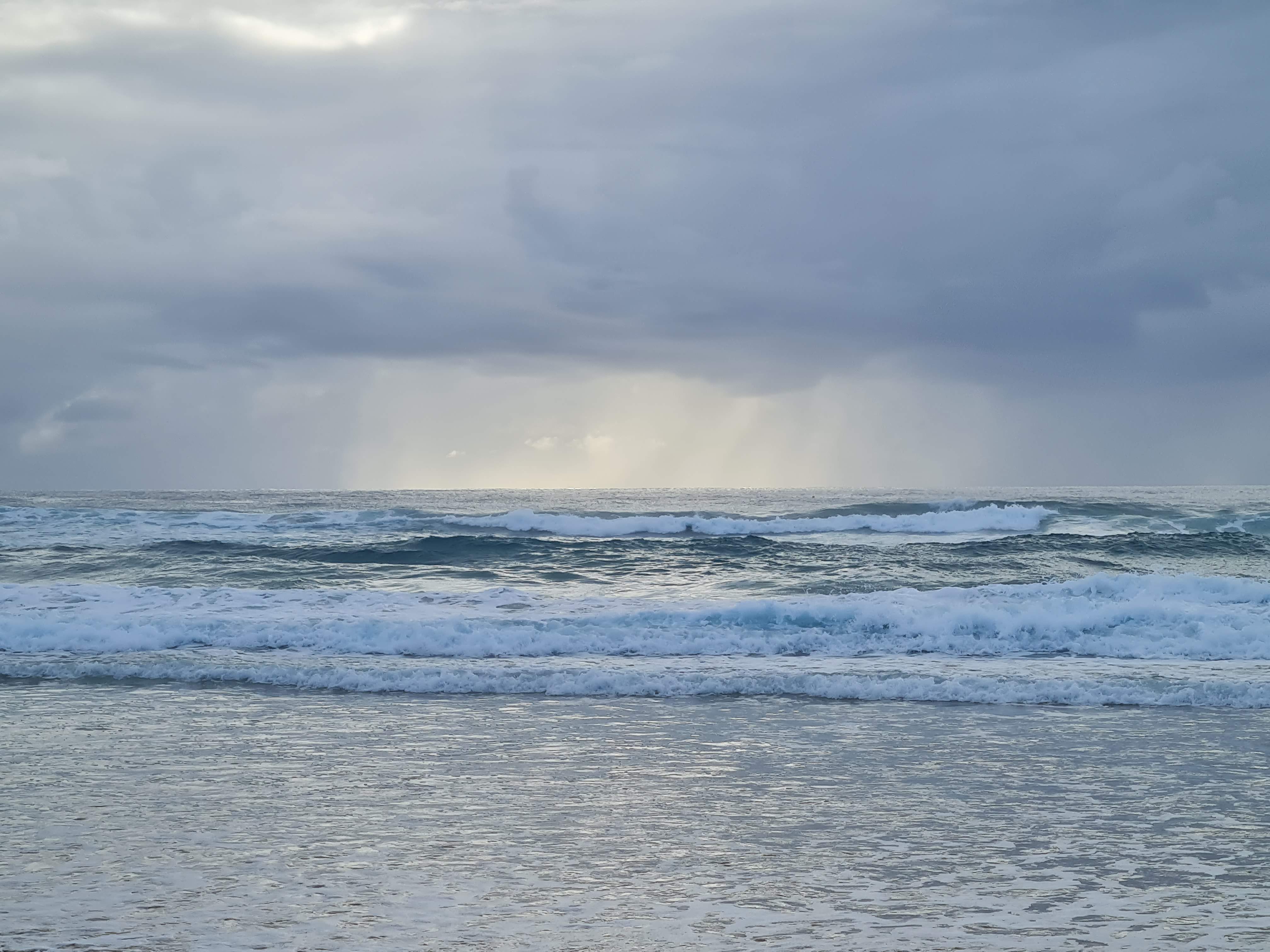
I have this thing about taking photos of the ocean. This one was taken early in the morning, after sunrise, which was pretty spectacular, and of a passing rain belt. It’s not quite as discernable as it was with the naked eye, but it was out to sea, and I wondered what it might be like aboard a large ship.

What if the rain storm followed the ship? It would be intriguing to know if that’s ever happened, but my thought would be, a ship in the middle of the ocean, with limited engine power because of a mysterious breakdown, pouring rain continuously pounding the ship keeping everyone inside, and then people start dying.

Of course, there’s no visible reason why they should be, no wounds, no strangulation, no gunshot or knife attacks, people just dropping dead.

Is it the shroud that has enveloped the ship?

Is it unworldly?

Is it nature’s retribution?

It might be the latter, because on board is a large group of industrialists responsible for more of the carbon dioxide output that is destroying the ozone layer and worsening climate change.

Now, there’s a story!

Writing a book in 365 days – 162

Day 162

Journalism is a great learning ground for writers

It comes as no surprise that many writers, when they are asked about how they got into writing, say they were once journalists.

This is because journalism is a great background. You learn to get to the crux of any story in one paragraph, asking five basic questions: who, what, where, when, and why.

In the commission of any story, sooner or later, you ask the question: at what point does a writer become a journalist?

Quite often, journalists become writers because of their vast experience in observing and writing about the news, sometimes in the category of ‘truth is stranger than fiction’.

I did journalism at university and thought I would never get to use it.  I had to interview people, write articles, and act as an editor.  The hardest part was the headlines. Thank God that’s usually a problem for the editor. It’s about as much fun as coming up with a title for the book.

But, for example…

Several opportunities arose over the last few months to dig out the journalist hat, put it on, and go to work.

Where?

Hospital.  I’ve had to go there a few times more in the last few months than I have in recent years.

And I’d forgotten just how hospitals are interesting places, especially the waiting room in the Emergency department.

After the second or third visit, I began observing the people who were waiting and ran through various scenarios as to the reason for their visit.  None may have been true, but it certainly was an exercise in creative writing, or would make an excellent article.

Similarly, once we got inside the inner sanctum where the real work is done, there were any number of crises and operations going on, and plenty of material for when I might need to include a hospital scene in one of my stories.

Or I could write a volume in praise of the people who work there and what they have to endure.  Tending the sick, injured and badly injured is not a job for the faint-hearted.

Research, which is one of the most important tools a journalist uses, if it could be called a ‘tool’, turns up in the unlikeliest of places.  Doctors who answer questions, not necessarily about the malady, nurses who tell you about what it’s like in Emergency on nights you really don’t want to be there, and other patients and their families, all having a perspective, amd a story to tell, while waiting patiently for a diagnosis and then treatment so they can go home.

We get to go this time at about four in the morning.  Everyone is tired.  More people are waiting.  Outside, it is cool, and the first rays of light are coming over the horizon as dawn is about to break.

I ponder the question without an answer, a question one of the nurses asked a youngish doctor, tossed out in conversation, but was there more intent to it, what he was doing on Saturday night?

He didn’t answer.  Another crisis, another patient.

I suspect he was about to say, where else would he be, but on duty in the Emergency.

Searching for locations: Ice hockey in Newark, New Jersey. USA

That meant we had to make the journey from New York to New Jersey, by train. It involved the underground, or as New Yorkers call it, the subway, from Columbus Circle which by any other name was really, 80th street, to 34th street which apparently was the New Jersey jump-off point for us to get overground, well a lot of it was overground.
So, were we going uptown or downtown?

Apparently, it was downtown, and to 34th Street on the A train.

You would not think this to be a difficult task, but for people not used to the subway, and where they were going other than some internet derived instructions, but without the help of a man at the station, just getting tickets may have stopped us dead in our tracks. With his help, we determined the return fare for three of us and then get through the turnstile onto the platform.

We get on the A train, but soon discover it was not stopping at all stations. There was for a few minutes, a little apprehension we might just simply bypass our station. Luckily we did not.

Now, finding your way to the New Jersey transit part of Penn station might appear to be easy, on paper, but once there, on the ground, and mingling with the other passengers which all seemed to be purpose going somewhere, it took a few moments to realize we had to follow the New Jersey transit signs.

This led to a booking hall where luckily we realized we needed to buy more tickets, then find the appropriate platform, and then get on the right train, all of which, in the end, was not difficult at all.

Maybe on the return trip, it might be.

At Newark Penn station it was momentarily confusing because the exit was not readily in sight, so it was a case of following the majority of other passengers who’d got off the train.

This led us to exit onto the street under the train tracks. Luckily, having been before to Prudential Stadium to buy the tickets, we knew what the stadium looked like and roughly where it was, so it was a simple task to walk towards it.

We were early, so it was a case of finding a restaurant to get dinner before the game.
So was a great many others, and we passed about 6 different restaurants that looked full to overflowing before we stopped at one called Novelty Burger and Bar.

It looked inviting, and it was not crowded.

It was yet another excuse to have a hamburger and beer, both of which seemed to be a specialty in American. I could not fault either.

And soon after we arrived, this restaurant too was full to overflowing. Thankfully there were other Maple Leaf fans there because being in a room full of opposition teams supports can be quite harrowing.

That was yet to come when we finally got to the stadium. I was not expecting a lot of Maple Leaf fans.

We went to this game with high hopes. New Jersey Devils were not exactly at the top of the leader board, and coming off the loss in Toronto, this was make or break for whether we would ever go to another game.

It’s remarkable in that all the Ice Hockey stadiums are the same. Everyone has an excellent view of the game, the sound systems are loud, and the fans passionate.
Here it seems to be a thing to ride on the Zambonis.

At the front door they were handing out figurines of a Devil’s past player, and it seems a thing that you get a handout of some sort at each game. At Toronto we got towels.
And, finally, we were in luck

The Maple Leafs won.

And it was an odd feeling to know that even though their team lost, there did not seem to be any rancor amount the fans and that any expectation of being assaulted by losing fans was totally unfounded, unlike some sporting events I’ve been to.

Perhaps soccer should take a leaf out of the ice hockey playbook.

That also went for taking public transport late at night. I did not have any fears about doing so, which is more than I can say about traveling at night on our own transport system back home.

Oh, and by the way, there are train conductors who still come to every passenger to collect or stamp their tickets. No trusting the passenger has paid for his trip here. And, if you don’t have a ticket, I have it on good authority they throw you off the train and into the swamp. Good thing then, we had tickets.

It was, all in all, a really great day.

The cinema of my dreams – I always wanted to go on a treasure hunt – Episode 58

Here’s the thing…

Every time I close my eyes, I see something different.

I’d like to think the cinema of my dreams is playing a double feature but it’s a bit like a comedy cartoon night on Fox.

But these dreams are nothing to laugh about.

Once again there’s a new installment of an old feature, and we’re back on the treasure hunt.

It was only an hours’ worth of skimming newspapers, for the dates I’d discovered at the cemetery, and the month around the time that Boggs’s father had disappeared, because the date of death for Friedrich Ormiston had a familiar ring to it.

They’d both apparently died in the same year, within months of each other.

Of course, there was a twist.

Neither of the two men’s bodies had been found, and both missing person’s cases had remained open for the specified period before being declared legally dead.  I knew that to be the case for Boggs’s father, but I had not really known the details of the circumstances.

The paper had played up the disappearance of both men, pushing the Treasure hunt aspect knowing it would bring in readers, and perhaps get picked up by the big city papers.  It had got a television crew down briefly, I remembered that much, and the fact Boggs had wanted nothing to do with it.  

The story, though, was interesting, that everyone remembered that fateful night in the bar when he had been telling anyone who would listen that he had found ‘the’ clue to the treasure’s whereabouts, and the drunker he got, the more outlandish the story.

A number of people who were visiting the town because suspects simply because they were out of towners, and subsequently cleared in the ensuing investigation.  What had turned up was the fact he owed a great deal of one to loan sharks, and one in particular, who was in town to collect on a prior loan for a fruitless search, and who was a prime suspect.

In the end, the price of his freedom was to forgo the collection of the debt.

Yet another was unmasked as a fellow treasure hunter with a dubious past, having been jailed for earlier transgressions of stealing other’s finds, but he claimed he was not a legitimate treasure hunter, and that he was in town at the request of Benderby, to oversee the dredging of a part of the bay for more coins.  It had been a fruitless endeavor.

But despite his assertions, no one really believed Boggs’s father’s claims and had dismissed it as the usual ravings that had become his mantra for many years.  Only his son believed him.

Boggs himself had made the newspaper, a photo of him by the grave where his father’s spirit rather than body had been buried, vowing to prove his father right.

What added to the legend was the disappearance and apparent death of Ormiston not long after.  The story of his search for the treasure was long and fruitless, one of dissipating the family fortune in search of another.

His disappearance was attributed to the fact he had become erratic and forgetful, the town doctor at the time telling the coroner’s inquest that he had early onset dementia and was prone to wandering off.  This time it had been his downfall.

A search had been mounted and all the cave systems were checked, known to be the places he frequented the most, and when a new rockslide was discovered in one of the caves, it was assumed he had ventured too far and been trapped.  Several attempts were made to clear the way, but the fall had been far too extensive and had to be abandoned.

Every few years the paper revisited Boggs’s disappearance, but there was no new information, and after ten years nothing more was written.  It seemed that Lenny had a continued interest in the Treasure hunt because he had filed a number of newspaper reports, making it easy for me to get the gist of the story.

Then, several months ago, he had written a new story, a small piece that I had missed, reporting on Boggs’s discovery of a new map of the coastline, one that suggested that the site of the ill-fated mall was, in fact, an entrance to the cave system where the treasure may have been placed.  It referenced a survey that had been made before the second world war, one that hinted that the cave system was much larger than originally thought, and quite likely went all the way to the mountains, the origin of an ancient underground river.

The fact the mall site had been the victim of flooding made that seemed to make that assumption plausible, but apparently, no one else had seen that particular map, and Boggs had not been forthcoming in sharing it with the reporter.

But aside from those few paragraphs nothing more was said.

It explained what Boggs was doing when we went to the mall site.

All of that was condensed into a page of notes in my notepad, where it would have to stay for a day or so because I had to go home, change and go to work.

Perhaps tomorrow I would get to talk to Boggs about it.

As luck would have it, I ran into Boggs just up the street where he was coming out of the hardware store with a skein of rope slung over his shoulder.

“Just the person I’m looking for,” I said.

His look told me that I was the last person he wanted to see.

“I’m busy, Sam.  Can we do this another time?”

“Planning a lynching?”  My eyes went from him to the rope, and back.

“Climbing.  I’m going away for a few days, get away from everything, and do something other than think about treasure.”

“Probably a good idea.  I’m sorry I haven’t been much of help lately, with work and stuff.”

“How’s Nadia?”

It was a pointed question, and I knew he had seen me with her.  I had thought it might be Alex.

“Being Nadia, leopards don’t change their spots, and I’m trying to keep the enemies close so I can track what they’re up to.”

“There’s close and then there’s too close, Sam.”

“True, but it’s not what you think.”

“I don’t know what to think anymore.  Let’s just leave it at that, and I’ll call you when I get back.”

I knew the tone, and I could smell a burnt bridge.  Maybe it was time to give him some space, and I could get on with a bit of research and bring it to him when he was in a more receptive frame of mind. 

“As you wish.  Be careful out there.”

© Charles Heath 2020-2022

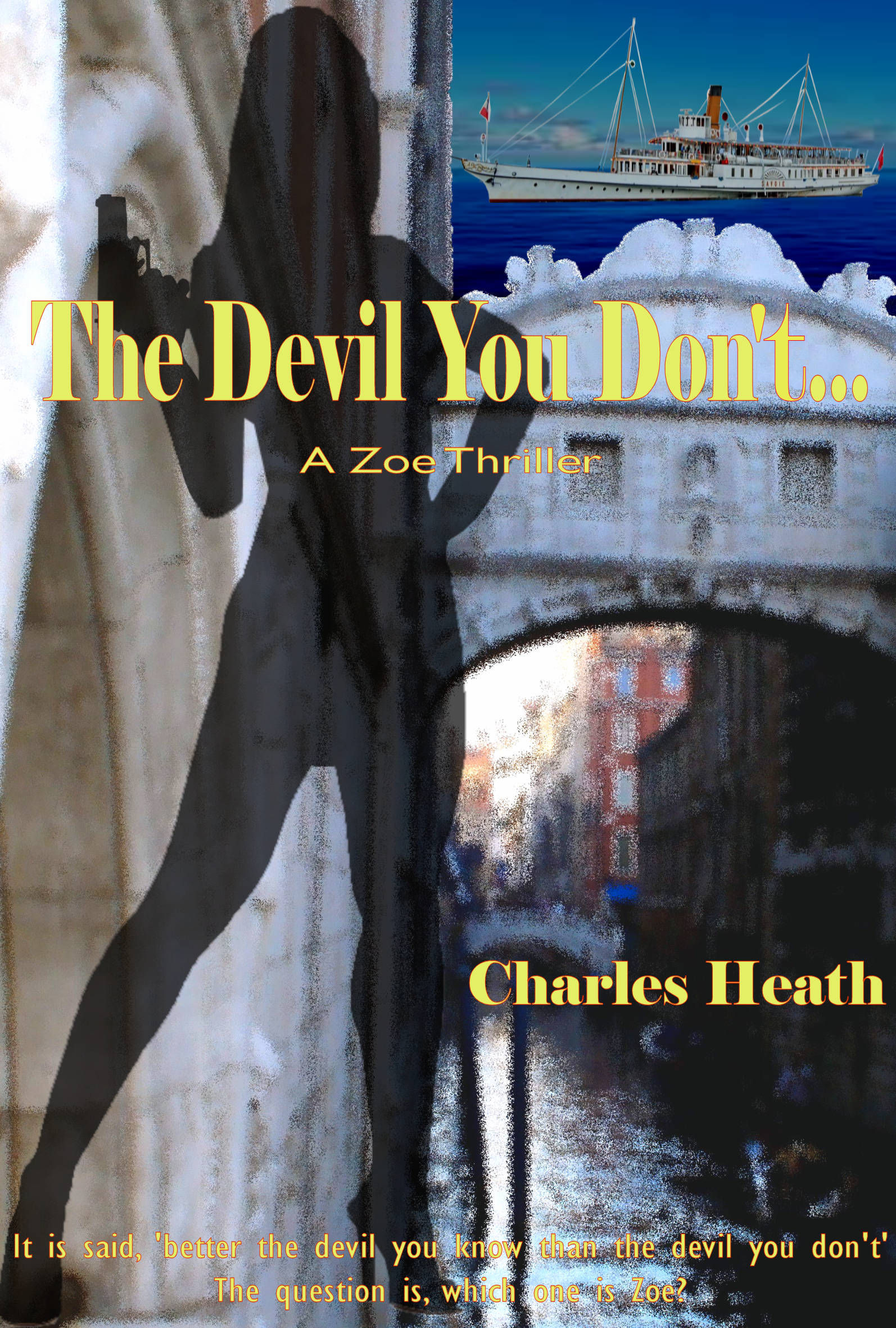
An excerpt from “The Devil You Don’t”

Available on Amazon Kindle here:  https://amzn.to/2Xyh1ow

By the time I returned to the Savoie, the rain had finally stopped, and there was a streak of blue sky to offer some hope the day would improve.

The ship was not crowded, the possibility of bad weather perhaps holding back potential passengers.  Of those I saw, a number of them would be aboard for the lunch by Phillippe Chevrier.  I thought about it, but the Concierge had told me about several restaurants in Yvoire and had given me a hand-drawn map of the village.  I think he came from the area because he spoke with the pride and knowledge of a resident.

I was looking down from the upper deck observing the last of the boarding passengers when I saw a woman, notable for her red coat and matching shoes, making a last-minute dash to get on board just before the gangway was removed.  In fact, her ungainly manner of boarding had also captured a few of the other passenger’s attention.  Now they would have something else to talk about, other than the possibility of further rain.

I saw her smile at the deckhand, but he did not smile back.  He was not impressed with her bravado, perhaps because of possible injury.  He looked at her ticket then nodded dismissively, and went back to his duties in getting the ship underway.  I was going to check the departure time, but I, like the other passengers, had my attention diverted to the woman in red.

From what I could see there was something about her.  It struck me when the light caught her as she turned to look down the deck, giving me a perfect profile.  I was going to say she looked foreign, but here, as in almost anywhere in Europe, that described just about everyone.  Perhaps I was just comparing her to Phillipa, so definitively British, whereas this woman was very definitely not.

She was perhaps in her 30’s, slim or perhaps the word I’d use was lissom, and had the look and manner of a model.  I say that because Phillipa had dragged me to most of the showings, whether in Milan, Rome, New York, London, or Paris.  The clothes were familiar, and in the back of my mind, I had a feeling I’d seen her before.

Or perhaps, to me, all models looked the same.

She looked up in my direction, and before I could divert my eyes, she locked on.  I could feel her gaze boring into me, and then it was gone as if she had been looking straight through me.  I remained out on deck as the ship got underway, watching her disappear inside the cabin.  My curiosity was piqued, so I decided to keep an eye out for her.

I could feel the coolness of the air as the ship picked up speed, not that it was going to be very fast.  With stops, the trip would take nearly two hours to get to my destination.  It would turn back almost immediately, but I was going to stay until the evening when it returned at about half eight.  It would give me enough time to sample the local fare, and take a tour of the medieval village.

Few other passengers ventured out on the deck, most staying inside or going to lunch.  After a short time, I came back down to the main deck and headed forward.  I wanted to clear my head by concentrating on the movement of the vessel through the water, breathing in the crisp, clean air, and let the peacefulness of the surroundings envelope me.

It didn’t work.

I knew it wouldn’t be long before I started thinking about why things hadn’t worked, and what part I played in it.  And the usual question that came to mind when something didn’t work out.  What was wrong with me?

I usually blamed it on my upbringing.

I had one of those so-called privileged lives, a nanny till I was old enough to go to boarding school, then sent to the best schools in the land.  There I learned everything I needed to be the son of a Duke, or, as my father called it in one of his lighter moments, nobility in waiting.

Had this been five or six hundred years ago, I would need to have sword and jousting skills, or if it had been a few hundred years later a keen military mind.  If nothing else I could ride a horse, and go on hunts, or did until they became not the thing to do.

I learned six languages, and everything I needed to become a diplomat in the far-flung British Empire, except the Empire had become the Commonwealth, and then, when no-one was looking, Britain’s influence in the world finally disappeared.  I was a man without a cause, without a vocation, and no place to go.

Computers were the new vogue and I had an aptitude for programming.  I guess that went hand in hand with mathematics, which although I hated the subject, I excelled in.  Both I and another noble outcast used to toss ideas around in school, but when it came to the end of our education, he chose to enter the public service, and I took a few of those ideas we had mulled over and turned them into a company.

About a year ago, I was made an offer I couldn’t refuse.  There were so many zeroes on the end of it I just said yes, put the money into a very grateful bank, and was still trying to come to terms with it.

Sadly, I still had no idea what I was going to do with the rest of my life.  My parents had asked me to come back home and help manage the estate, and I did for a few weeks.  It was as long as it took for my parents to drive me insane.

Back in the city, I spent a few months looking for a mundane job, but there were very few that suited the qualifications I had, and the rest, I think I intimidated the interviewer simply because of who I was.  In that time I’d also featured on the cover of the Economist, and through my well-meaning accountant, started involving myself with various charities, earning the title ‘philanthropist’.

And despite all of this exposure, even making one of those ubiquitous ‘eligible bachelor’ lists, I still could not find ‘the one’, the woman I wanted to spend the rest of my life with.  Phillipa seemed to fit the bill, but in time she proved to be a troubled soul with ‘Daddy’ issues.  I knew that in building a relationship compromise was necessary, but with her, in the end, everything was a compromise and what had happened was always going to be the end result.

It was perhaps a by-product of the whole nobility thing.  There was a certain expectation I had to fulfill, to my peers, contemporaries, parents and family, and those who either liked or hated what it represented.  The problem was, I didn’t feel like I belonged.  Not like my friend from schooldays, and now obscure acquaintance, Sebastian.  He had been elevated to his Dukedom early when his father died when he was in his twenties.  He had managed to fade from the limelight and was rarely mentioned either in the papers or the gossip columns.  He was one of the lucky ones.

I had managed to keep a similarly low profile until I met Phillipa.  From that moment, my obscurity disappeared.  It was, I could see now, part of a plan put in place by Phillipa’s father, a man who hogged the limelight with his daughter, to raise the profile of the family name and through it their businesses.  He was nothing if not the consummate self-advertisement.

Perhaps I was supposed to be the last piece of the puzzle, the attachment to the establishment, that link with a class of people he would not normally get in the front door.  There was nothing refined about him or his family, and more than once I’d noticed my contemporaries cringe at the mention of his name, or any reference of my association with him.

Yet could I truthfully say I really wanted to go back to the obscurity I had before Phillipa?  For all her faults, there were times when she had been fun to be with, particularly when I first met her when she had a certain air of unpredictability.  That had slowly disappeared as she became part of her father’s plan for the future.  She just failed to see how much he was using her.

Or perhaps, over time, I had become cynical.

I thought about calling her.  It was one of those moments of weakness when I felt alone, more alone than usual.

I diverted my attention back to my surroundings and the shoreline.  Out of the corner of my eye, I could see the woman in the red coat, making a move.  The red coat was like a beacon, a sort of fire engine red.  It was not the sort of coat most of the women I knew would wear, but on her, it looked terrific.  In fact, her sublime beauty was the one other attribute that was distinctly noticeable, along with the fact her hair was short, rather than long, and jet black.

I had to wrench my attention away from her.

A few minutes later several other passengers came out of the cabin for a walk around the deck, perhaps to get some exercise, perhaps checking up on me, or perhaps I was being paranoid.  I waited till they passed on their way forward, and I turned and headed aft.

I watched the wake sluicing out from under the stern for a few minutes, before retracing my steps to the front of the ship and there I stood against the railing, watching the bow carve its way through the water.  It was almost mesmerizing.  There, I emptied my mind of thoughts about Phillipa, and thoughts about the woman in the red coat.

Until a female voice behind me said, “Having a bad day?”

I started, caught by surprise, and slowly turned.  The woman in the red coat had somehow got very close me without my realizing it.  How did she do that?  I was so surprised I couldn’t answer immediately.

“I do hope you are not contemplating jumping.  I hear the water is very cold.”

Closer up, I could see what I’d missed when I saw her on the main deck.  There was a slight hint of Chinese, or Oriental, in her particularly around the eyes, and of her hair which was jet black.  An ancestor twice or more removed had left their mark, not in a dominant way, but more subtle, and easily missed except from a very short distance away, like now.

Other than that, she was quite possibly Eastern European, perhaps Russian, though that covered a lot of territory.  The incongruity of it was that she spoke with an American accent, and fluent enough for me to believe English was her first language.

Usually, I could ‘read’ people, but she was a clean slate.  Her expression was one of amusement, but with cold eyes.  My first thought, then, was to be careful.

“No.  Not yet.”  I coughed to clear my throat because I could hardly speak.  And blushed, because that was what I did when confronted by a woman, beautiful or otherwise.

The amusement gave way to a hint of a smile that brightened her demeanor as a little warmth reached her eyes.  “So that’s a maybe.  Should I change into my lifesaving gear, just in case?”

It conjured up a rather interesting image in my mind until I reluctantly dismissed it.

“Perhaps I should move away from the edge,” I said, moving sideways until I was back on the main deck, a few feet further away.  Her eyes had followed me, and when I stopped she turned to face me again.  She did not move closer.

I realized then she had removed her beret and it was in her left side coat pocket.  “Thanks for your concern …?”

“Zoe.”

“Thanks for your concern, Zoe.  By the way, my name is John.”

She smiled again, perhaps in an attempt to put me at ease.  “I saw you earlier, you looked so sad, I thought …”

“I might throw myself overboard?”

“An idiotic notion I admit, but it is better to be safe than sorry.”

Then she tilted her head to one side then the other, looking intently at me.  “You seem to be familiar.  Do I know you?”

I tried to think of where I may have seen her before, but all I could remember was what I’d thought earlier when I first saw her; she was a model and had been at one of the showings.  If she was, it would be more likely she would remember Phillipa, not me.  Phillipa always had to sit in the front row.

“Probably not.”  I also didn’t mention the fact she may have seen my picture in the society pages of several tabloid newspapers because she didn’t look the sort of woman who needed a daily dose of the comings and goings, and, more often than not, scandal associated with so-called celebrities.

She gave me a look, one that told me she had just realized who I was.  “Yes, I remember now.  You made the front cover of the Economist.  You sold your company for a small fortune.”

Of course.  She was not the first who had recognized me from that cover.  It had raised my profile considerably, but not the Sternhaven’s.  That article had not mentioned Phillipa or her family.  I suspect Grandmother had something to do with that, and it was, now I thought about it, another nail in the coffin that was my relationship with Phillipa.

“I wouldn’t say it was a fortune, small or otherwise, just fortunate.”  Each time, I found myself playing down the wealth aspect of the business deal.

“Perhaps then, as the journalist wrote, you were lucky.  It is not, I think, a good time for internet-based companies.”

The latter statement was an interesting fact, one she read in the Financial Times which had made that exact comment recently.

“But I am boring you.”  She smiled again.  “I should be minding my own business and leaving you to your thoughts.  I am sorry.”

She turned to leave and took a few steps towards the main cabin.

“You’re not boring me,” I said, thinking I was letting my paranoia get the better of me.  It had been Sebastian on learning of my good fortune, who had warned me against ‘a certain element here and abroad’ whose sole aim would be to separate me from my money.  He was not very subtle when he described their methods.

But I knew he was right.  I should have let her walk away.

She stopped and turned around.  “You seem nothing like the man I read about in the Economist.”

A sudden and awful thought popped into my head.  Those words were part of a very familiar opening gambit.  “Are you a reporter?”

I was not sure if she looked surprised, or amused.  “Do I look like one?”

I silently cursed myself for speaking before thinking, and then immediately ignored my own admonishment.  “People rarely look like what they are.”

I saw the subtle shake of the head and expected her to take her leave.  Instead she astonished me.

“I fear we have got off on the wrong foot.  To be honest, I’m not usually this forward, but you seemed like you needed cheering up when probably the opposite is true.  Aside from the fact this excursion was probably a bad idea.  And,” she added with a little shrug, “perhaps I talk too much.”

I was not sure what I thought of her after that extraordinary admission. It was not something I would do, but it was an interesting way to approach someone and have them ignoring their natural instinct.  I would let Sebastian whisper in my ear for a little longer and see where this was going.

“Oddly enough, I was thinking the same thing.  I was supposed to be traveling with my prospective bride.  I think you can imagine how that turned out.”

“She’s not here?”

“No.”

“She’s in the cabin?”  Her eyes strayed in that direction for a moment then came back to me.  She seemed surprised I might be traveling with someone.

“No.  She is back in England, and the wedding is off.  So is the relationship.  She dumped me by text.”

OK, why was I sharing this humiliating piece of information with her?  I still couldn’t be sure she was not a reporter.

She motioned to an empty seat, back from the edge.  No walking the plank today.  She moved towards it and sat down.  She showed no signs of being cold, nor interested in the breeze upsetting her hair.  Phillipa would be having a tantrum about now, being kept outside, and freaking out over what the breeze might be doing to her appearance.

I wondered, if only for a few seconds if she used this approach with anyone else.  I guess I was a little different, a seemingly rich businessman alone on a ferry on Lake Geneva, contemplating the way his life had gone so completely off track.

She watched as I sat at the other end of the bench, leaving about a yard between us.  After I leaned back and made myself as comfortable as I could, she said, “I have also experienced something similar, though not by text message.  It is difficult, the first few days.”

“I saw it coming.”

“I did not.”  She frowned, a sort of lifeless expression taking over, perhaps brought on by the memory of what had happened to her.  “But it is done, and I moved on.  Was she the love of your life?”

OK, that was unexpected.

When I didn’t answer, she said, “I am sorry.  Sometimes I ask personal questions without realizing what I’m doing.  It is none of my business.”  She shivered.  “Perhaps we should go back inside.”

She stood, and held out her hand.  Should I take it and be drawn into her web?  I thought of Sebastian.  What would he do in this situation?

I took her hand in mine and let her pull me gently to my feet.  “Wise choice,” she said, looking up at the sky.

It just started to rain.

© Charles Heath 2015-2023

newdevilcvr6

Searching for locations: A trip to Newark, New Jersey. USA

That meant we had to make the journey from New York to New Jersey, by train.  It involved the underground, or as New Yorkers call it, the subway, from Columbus Circle which by any other name was really, 80th street, to 34th street which apparently was the New Jersey jump-off point for us to get overground, well a lot of it was overground. So, were we going uptown or downtown?

Apparently, it was downtown, and to 34th Street on the A train.

You would not think this to be a difficult task, but for people not used to the subway, and where they were going other than some internet derived instructions, but without the help of a man at the station, just getting tickets may have stopped us dead in our tracks.  With his help, we determined the return fare for three of us and then get through the turnstile onto the platform.

We get on the A train, but soon discover it was not stopping at all stations.  There was for a few minutes, a little apprehension we might just simply bypass our station.  Luckily we did not.

Now, finding your way to the New Jersey transit part of Penn station might appear to be easy, on paper, but once there, on the ground, and mingling with the other passengers which all seemed to be purpose going somewhere, it took a few moments to realize we had to follow the New Jersey transit signs.

This led to a booking hall where luckily we realized we needed to buy more tickets, then find the appropriate platform, and then get on the right train, all of which, in the end, was not difficult at all.

Maybe on the return trip, it might be.

At Newark Penn station it was momentarily confusing because the exit was not readily in sight, so it was a case of following the majority of other passengers who’d got off the train.

This led us to exit onto the street under the train tracks.  Luckily, having been before to Prudential Stadium to buy the tickets, we knew what the stadium looked like and roughly where it was, so it was a simple task to walk towards it.

We were early, so it was a case of finding a restaurant to get dinner before the game. So was a great many others, and we passed about 6 different restaurants that looked full to overflowing before we stopped at one called Novelty Burger and Bar.

It looked inviting, and it was not crowded.

It was yet another excuse to have a hamburger and beer, both of which seemed to be a specialty in American.  I could not fault either.

And soon after we arrived, this restaurant too was full to overflowing.  Thankfully there were other Maple Leaf fans there because being in a room full of opposition teams supports can be quite harrowing.

That was yet to come when we finally got to the stadium.  I was not expecting a lot of Maple Leaf fans.
We went to this game with high hopes.  New Jersey Devils were not exactly at the top of the leader board, and coming off the loss in Toronto, this was make or break for whether we would ever go to another game.

It’s remarkable in that all the Ice Hockey stadiums are the same.  Everyone has an excellent view of the game, the sound systems are loud, and the fans passionate. Here it seems to be a thing to ride on the Zambonis.
At the front door they were handing out figurines of a Devil’s past player, and it seems a thing that you get a handout of some sort at each game.  At Toronto we got towels. And, finally, we were in luck.

The Maple Leafs won.

And it was an odd feeling to know that even though their team lost, there did not seem to be any rancor amount the fans and that any expectation of being assaulted by losing fans was totally unfounded, unlike some sporting events I’ve been to.

Perhaps soccer should take a leaf out of the ice hockey playbook.

That also went for taking public transport late at night.  I did not have any fears about doing so, which is more than I can say about traveling at night on our own transport system back home.

Oh, and by the way, there are train conductors who still come to every passenger to collect or stamp their tickets.  No trusting the passenger has paid for his trip here.  And, if you don’t have a ticket, I have it on good authority they throw you off the train and into the swamp.  Good thing then, we had tickets.

It was, all in all, a really great day.

“What Sets Us Apart”, a mystery with a twist

David is a man troubled by a past he is trying to forget.

Susan is rebelling against a life of privilege and an exasperated mother who holds a secret that will determine her daughter’s destiny.

They are two people brought together by chance. Or was it?

When Susan discovers her mother’s secret, she goes in search of the truth that has been hidden from her since the day she was born.

When David realizes her absence is more than the usual cooling off after another heated argument, he finds himself being slowly drawn back into his former world of deceit and lies.

Then, back with his former employers, David quickly discovers nothing is what it seems as he embarks on a dangerous mission to find Susan before he loses her forever.

Find the kindle version on Amazon here:  http://amzn.to/2Eryfth

whatsetscover

Writing a book in 365 days – 162

Day 162

Journalism is a great learning ground for writers

It comes as no surprise that many writers, when they are asked about how they got into writing, say they were once journalists.

This is because journalism is a great background. You learn to get to the crux of any story in one paragraph, asking five basic questions: who, what, where, when, and why.

In the commission of any story, sooner or later, you ask the question: at what point does a writer become a journalist?

Quite often, journalists become writers because of their vast experience in observing and writing about the news, sometimes in the category of ‘truth is stranger than fiction’.

I did journalism at university and thought I would never get to use it.  I had to interview people, write articles, and act as an editor.  The hardest part was the headlines. Thank God that’s usually a problem for the editor. It’s about as much fun as coming up with a title for the book.

But, for example…

Several opportunities arose over the last few months to dig out the journalist hat, put it on, and go to work.

Where?

Hospital.  I’ve had to go there a few times more in the last few months than I have in recent years.

And I’d forgotten just how hospitals are interesting places, especially the waiting room in the Emergency department.

After the second or third visit, I began observing the people who were waiting and ran through various scenarios as to the reason for their visit.  None may have been true, but it certainly was an exercise in creative writing, or would make an excellent article.

Similarly, once we got inside the inner sanctum where the real work is done, there were any number of crises and operations going on, and plenty of material for when I might need to include a hospital scene in one of my stories.

Or I could write a volume in praise of the people who work there and what they have to endure.  Tending the sick, injured and badly injured is not a job for the faint-hearted.

Research, which is one of the most important tools a journalist uses, if it could be called a ‘tool’, turns up in the unlikeliest of places.  Doctors who answer questions, not necessarily about the malady, nurses who tell you about what it’s like in Emergency on nights you really don’t want to be there, and other patients and their families, all having a perspective, amd a story to tell, while waiting patiently for a diagnosis and then treatment so they can go home.

We get to go this time at about four in the morning.  Everyone is tired.  More people are waiting.  Outside, it is cool, and the first rays of light are coming over the horizon as dawn is about to break.

I ponder the question without an answer, a question one of the nurses asked a youngish doctor, tossed out in conversation, but was there more intent to it, what he was doing on Saturday night?

He didn’t answer.  Another crisis, another patient.

I suspect he was about to say, where else would he be, but on duty in the Emergency.

“The Things We Do For Love”

Would you give up everything to be with the one you love?

Is love the metaphorical equivalent to ‘walking the plank’; a dive into uncharted waters?

For Henry, the only romance he was interested in was a life at sea, and when away from it, he strived to find sanctuary from his family and perhaps life itself.  It takes him to a small village by the sea, a place he never expected to find another just like him, Michelle, whom he soon discovers is as mysterious as she is beautiful.

Henry had long since given up the notion of finding romance, and Michelle couldn’t get involved for reasons she could never explain, but in the end, both acknowledge that something happened the moment they first met.  

Plans were made, plans were revised, and hopes were shattered.

A chance encounter causes Michelle’s past to catch up with her, and whatever hope she had of having a normal life with Henry, or anyone else, is gone.  To keep him alive she has to destroy her blossoming relationship, an act that breaks her heart and shatters his.

But can love conquer all?

It takes a few words of encouragement from an unlikely source to send Henry and his friend Radly on an odyssey into the darkest corners of the red-light district in a race against time to find and rescue the woman he finally realizes is the love of his life.

The cover, at the moment, looks like this:

lovecoverfinal1

Is love the metaphorical equivalent to ‘walking the plank’; a dive into uncharted waters?

For Henry, the only romance he was interested in was a life at sea, and when away from it, he strived to find sanctuary from his family and perhaps life itself.  It takes him to a small village by the sea, s place he never expected to find another just like him, Michelle, whom he soon discovers is as mysterious as she is beautiful.

Henry had long since given up the notion of finding romance, and Michelle couldn’t get involved for reasons she could never explain, but in the end, both acknowledge that something happened the moment they first met.  

Plans were made, plans were revised, and hopes were shattered.

A chance encounter causes Michelle’s past to catch up with her, and whatever hope she had of having a normal life with Henry, or anyone else, is gone.  To keep him alive she has to destroy her blossoming relationship, an act that breaks her heart and shatters his.

But can love conquer all?

It takes a few words of encouragement from an unlikely source to send Henry and his friend Radly on an odyssey into the darkest corners of the red-light district in a race against time to find and rescue the woman he finally realizes is the love of his life.

The cover, at the moment, looks like this:

lovecoverfinal1

In a word: Meat

We all know what meat is, the flesh of an animal like cattle, pigs, sheep, even goats.

It can be used to describe a pie, such as a meat pie, but the odd thing is that it doesn’t have to have 100% meat in it.

It can be used in the context of humans, depending on when you eat certain types of food that will put meat on your bones.

Meat can also be used to describe the fleshy part of nuts, fruit, or eggs.

Then there’s the meat of the matter, which is the crux or basis of the argument or message you want to get across.

And a rather interesting if not obscure meaning is to describe a favorite occupation or activity.

Another form of the word is meet; what we do at a coffee shop, on a date, at a pub, or any number of different places.

We can gather together for a meeting, such as a board of directors or a committee.

It can be used to describe an athletic or swimming carnival.

How about you meet me halfway, in a negotiation, not on a long road trip

To dole out or allot something like punishment, is to mete it out.

Good thing then, we don’t live in the dark ages, all manner of bad punishments were meted put to the serfs.