Writing a book in 365 days – My Story 20

More about my story

Could it be more of an epic romance than a sizzling spy story?

There is the woman in white

The mysterious, enigmatic woman who wanders into his life, fascinated by a man who does not act upon the signals she is sending.

What man could resist her allure?

He had to be up to one good.

Of course, in time, we learn that she is more than just a free spirit, that she has connections to several of the main players in ways that are surprising yet not.

She is one of the reasons why our main protagonist realises it’s time to take a step back and decide what is more important, working a job that is becoming more of a chore than a joy, or having a life.

And whether he really wants to exact the retribution that might or might not give him closure.

There is Amanda, the woman who derailed his career when he got too close.

It was like Icarus flying too close to the sun, and when it ended, it ended very badly, leaving visible scars and an impairment to his soul.

He discovered love and loss and had never recovered.

Now she was back, and on top of nursing a near-death experience, crossing her path was just one omen too many.

Can he exercise this demon or will it, quite literally, be the death of him?

There is a spy sent to spy on a spy.

Teresa, just as broken as our protagonists, with a whole different set of demons to contend with.

A woman who had been described by many as the devil incarnate.

A woman who could tempt the devil into doing her bidding, sent to the one person who saw her only as an impediment to doing his job and as a punishment from his boss.

She was ostensibly there to act in any capacity he requires, and after a difficult beginning, it works.

Sort of.

Unfortunately, their demons have other ideas…

Skeletons in the closet, and doppelgangers

A story called “Mistaken Identity”

How many of us have skeletons in the closet that we know nothing about? The skeletons we know about generally stay there, but those we do not, well, they have a habit of coming out of left field when we least expect it.

In this case, when you see your photo on a TV screen with the accompanying text that says you are wanted by every law enforcement agency in Europe, you’re in a state of shock, only to be compounded by those same police, armed and menacing, kicking the door down.

I’d been thinking about this premise for a while after I discovered my mother had a boyfriend before she married my father, a boyfriend who was, by all accounts, the man who was the love of her life.

Then, in terms of coming up with an idea for a story, what if she had a child by him that we didn’t know about, which might mean I had a half brother or sister I knew nothing about. It’s not an uncommon occurrence from what I’ve been researching.

There are many ways of putting a spin on this story.

Then, in the back of my mind, I remembered a story an acquaintance at work was once telling us over morning tea, that a friend of a friend had a mother who had a twin sister and that each of the sisters had a son by the same father, without each knowing of the father’s actions, both growing up without the other having any knowledge of their half brother, only to meet by accident on the other side of the world.

It was an encounter that in the scheme of things might never have happened, and each would have remained oblivious of the other.

For one sister, the relationship was over before she discovered she was pregnant, and therefore had not told the man he was a father. It was no surprise the relationship foundered when she discovered he was also having a relationship with her sister, a discovery that caused her to cut all ties with both of them and never speak to either from that day.

It’s a story with more twists and turns than a country lane!

And a great idea for a story.

That story is called ‘Mistaken Identity’.

In a word: Key

So, as we all know, a key is used to lock or unlock a door, gate, or something else.  It’s either made of shiny metal, brass, or rusty iron, it can be small, or very, very big, as is the key to a dungeon.

We can have one key or we can have many or even a master key that unlocks everything, very handy if you have a house full of locked rooms.

People always seem to want to steal them, especially in crime shows.

There is also an item called a key card.  Not the metal thing, but a plastic thing, that opens doors.  Odd that it’s called keyless entry!

Then there’s what is known as the key to something, i.e. you might have the key to his or her heart, metaphorically speaking.

And in that metaphorical sense, it opens up pandora’s box with a plethora of different meanings.

He had the key to the puzzle.

I wish sometimes I had the key to be able to write better, that that one particular key eludes me.

There are keys on a keyboard, the ones you use on computers and calculators.  They were originally on typewriters.  You can also find keys on a piano, or an accordion, and some other musical instruments.

A key can also be a master index field, or unique identifier, in a database, particularly those kept on computers.

And,

there’s a host of other uses for the word key, such as

roughening a surface

describing the shooting area on a basketball court

a group, or one, of small coral islets

matching words to pictures

or, you’re just too keyed up to sleep.


An excerpt from “Amnesia”, a work in progress

I remembered a bang.

I remembered the car slewing sideways.

I remember another bang, and then it was lights out.

When I opened my eyes again, I saw the sky.

Or I could be underwater.

Everything was blurred.

I tried to focus but I couldn’t. My eyes were full of water.

What happened?

Why was I lying down?

Where was I?

I cast my mind back, trying to remember.

It was a blank.

What, when, who, why and where, are questions I should easily be able to answer. These are questions any normal person could answer.

I tried to move. Bad, bad mistake.

I did not realise the scream I heard was my own. Just before my body shut down.

“My God! What happened?”

I could hear, not see. I was moving, lying down, looking up.

I was blind. Everything was black.

“Car accident; hit a tree, sent the passenger flying through the windscreen. Pity to poor bastard didn’t get the message that seat belts save lives.”

Was I that poor bastard?

“Report?” A new voice, male, authoritative.

“Multiple lacerations, broken collar bone, broken arm in three places, both legs broken below the knees, one badly. We are not sure of internal injuries, but ruptured spleen, cracked ribs and pierced right lung are fairly evident, x-rays will confirm that and anything else.”

“What isn’t broken?”

“His neck.”

“Then I would have to say we are looking at the luckiest man on the planet.”

I heard the shuffling of pages.

“OR1 ready?”

“Yes. On standby since we were first advised.”

“Good. Let’s see if we can weave some magic.”

Magic.

It was the first word that popped into my head when I surfaced from the bottom of the lake. That first breath, after holding it for so long, was sublime, and, in reality, agonising.

Magic, because it seemed like I’d spent a long time underwater.

Or somewhere.

I tried to speak but couldn’t. The words were just in my head.

Was it night or was it day?

Was it hot, or was it cold?

Where was I?

Around me, it felt cool.

It was incredibly quiet. No noise except for the hissing of air through an air-conditioning vent. Or that was the sound of pure silence.  And with it the revelation that silence was not silent. It was noisy.

I didn’t try to move.

Instinctively, somehow, I knew not to.

A previous unpleasant experience?

I heard what sounded like a door opening, and noticeably quiet footsteps slowly came into the room. They stopped. I could hear breathing, slightly laboured, a sound I’d heard before.

My grandfather.

He had smoked all his life until he was diagnosed with lung cancer. But for years before that he had emphysema. The person in the room was on their way, down the same path. I could smell the smoke.

I wanted to tell whoever it was the hazards of smoking.

I couldn’t.

I heard a metallic clanging sound from the end of the bed. A moment later the clicking of a pen, then writing.

“You are in a hospital.” A female voice suddenly said. “You’ve been in a bad accident. You cannot talk, or move, all you can do, for the moment, is listen to me. I am a nurse. You have been here for 45 days and just came out of a medically induced coma. There is nothing to be afraid of.”

She had a very soothing voice.

Her fingers stroked the back of my hand.

“Everything is fine.”

Define fine, I thought. I wanted to ask her what ‘fine’ meant.

“Just count backwards from 10.”

Why?

I didn’t reach seven.

Over the next ten days, that voice became my lifeline to sanity. Every morning, I longed to hear it, if only for the few moments she was in the room, those few waking moments when I believed she, and someone else who never spoke, were doing tests. I knew it had to be someone else because I could smell the essence of lavender. My grandmother had worn a similar scent.

It rose above the disinfectant.

She was another doctor, not the one who had been there the day I arrived. Not the one who had used some ‘magic’ and kept me alive.

It was then, in those moments before she put me under again, that I thought, what if I was paralysed? It would explain a lot. A chill went through me.

The next morning, she was back.

“My name is Winifred. We don’t know what your name is, not yet. In a few days, you will be better, and you will be able to ask us questions. You were in an accident, and you were very severely injured, but I can assure you there will be no lasting damage.”

More tests, and then when I expected the lights to go out, they didn’t. Not for a few minutes more. This was how I would be integrated back into the world. A little bit at a time.

The next morning, she came later than usual, and I’d been awake for a few minutes. “You have bandages over your eyes and face. You had bad lacerations to your face, and glass in your eyes. We will know more when the bandages come off in a few days. Your face will take longer to heal. It was necessary to do some plastic surgery.”

Lacerations, glass in my eyes, car accidents, plastic surgery. By logical deduction, I knew I was the poor bastard thrown through the windscreen. It was a fleeting memory from the day I was admitted.

How could that happen?

That was the first of many startling revelations. The second was the fact I could not remember the crash. Equally shocking, in that same moment was the fact I could not remember before the crash either, or only vague memories after.

But the most shattering of all these revelations was the one where I realised, I could not remember my name.

I tried to calm down, sensing a rising panic.

I was just disoriented, I told myself. After 45 days in an induced coma, it had messed with my mind, and it was only a temporary lapse. Yes, that’s what it was, a temporary lapse. I will remember tomorrow. Or the next day.

Sleep was a blessed relief.

The next day I didn’t wake up feeling nauseous. I think they’d lowered the pain medication. I’d heard that morphine could have that effect. Then, how could I know that but not who I am?

Now I knew Winifred the nurse was preparing me for something unbelievably bad. She was upbeat, and soothing, giving me a new piece of information each morning. This morning, “You do not need to be afraid. Everything is going to be fine. The doctor tells me you are going to recover with little scarring. You will need some physiotherapy to recover from your physical injuries, but that’s in the future. We need to let you mend a little bit more before then.”

So, I was not going to be able to leap out of bed and walk out of the hospital any time soon. I don’t suppose I’d ever leapt out of bed, except as a young boy. I suspect I’d sustained a few broken bones. I guess learning to walk again was the least of my problems.

But there was something else. I picked it up in the timbre of her voice, a hesitation, or reluctance. It sent another chill through me.

This time I was left awake for an hour before she returned.

This time sleep was restless.

Scenes were playing in my mind, nothing I recognised, and nothing lasting longer than a glimpse. Me. Others, people I didn’t know. Or I knew them and couldn’t remember them.

Until they disappeared, slowly like the glowing dot in the centre of the computer screen, before finally fading to black.

The morning the bandages were to come off she came in early and woke me. I had another restless night, the images becoming clearer, but nothing recognisable.

“This morning the doctor will be removing the bandages over your eyes. Don’t expect an immediate effect. Your sight may come back quickly, or it may come back slowly, but we believe it will come back.”

I wanted to believe I was not expecting anything, but I was. It was human nature. I did not want to be blind as well as paralysed. I had to have at least one reason to live.

I dozed again until I felt a gentle hand on my shoulder. I could smell the lavender; the other doctor was back. And I knew the hand on my shoulder was Winifred’s. She told me not to be frightened.

I was amazed to realise at that moment, I wasn’t.

I heard the scissors cutting the bandages.

I felt the bandage being removed, and the pressure coming off my eyes. I could feel the pads covering both eyes.

Then a moment when nothing happened.

Then the pads are gently lifted and removed.

Nothing.

I blinked my eyes, once, twice. Nothing.

“Just hold on a moment,” Winifred said. A few seconds later I could feel a cool towel wiping my face, and then gently wiping my eyes. There was ointment or something else in them.

Then a flash. Well, not a flash, but like when a light is turned on and off. A moment later, it was brighter, not the inky blackness of before, but a shade of grey.

She wiped my eyes again.

I blinked a few more times, and then the light returned, and it was like looking through water, at distorted and blurry objects in the distance.

I blinked again, and she wiped my eyes again.

Blurry objects took shape. A face looking down on me, an elderly lady with a kindly face, surely Winifred, who was smiling. And on the opposite side of the bed, the doctor, a Chinese woman of indescribable beauty.

I nodded.

“You can see?”

I nodded again.

“Clearly?”

I nodded.

“Very good. We will just draw the curtains now. We don’t want to overdo it. Tomorrow we will be taking off the bandages on your face. Then, it will be the next milestone. Talking.”

I couldn’t wait.

When morning came, I found myself afraid. Winifred had mentioned scarring, there were bandages on my face. I knew, but wasn’t quite sure how I knew, I wasn’t the most handsome of men before the accident, so this might be an improvement.

I was not sure why I didn’t think it would be the case.

They came at mid-morning, the nurse, Winifred, and the doctor, the exquisite Chinese. She was the distraction, taking my mind off the reality of what I was about to see.

Another doctor came into the room before the bandages were removed, and he was introduced as the plastic surgeon who had ‘repaired’ the ravages of the accident. It had been no easy job, but, with a degree of egotism, he did say he was one of the best in the world.

I found it hard to believe, if he were, that he would be at a small country hospital.

“Now just remember, what you might see now is not how you will look in a few months.”

Warning enough.

The Chinese doctor started removing the bandages. She did it slowly and made sure it did not hurt. My skin was very tender, and I suspect still bruised, either from the accident or the surgery, I didn’t know.

Then it was done.

The plastic surgeon gave his work a thorough examination and seemed pleased with his work. “Coming along nicely,” he said to the other doctor. He issued some instructions on how to manage the skin, nodded to me, and I thanked him before he left.

I noticed Winifred had a mirror in her hand and was reticent in using it. “As I said,” she said noticing me looking at the mirror, “what you see now will not be the result. The doctor said it was going to heal with little scarring. You have been extremely fortunate he was available. Are you ready?”

I nodded.

She showed me.

I tried not to be reviled at the red and purple mess that used to be my face. At a guess, I would have to say he had to put it all back together again, but not knowing what I looked like before, I had no benchmark. All I had was a snippet of memory that told me I was not the tall, dark, and handsome type.

And I still could not talk. There was a reason, he had worked in that area too. Just breathing hurt. I think I would save up anything I had to say for another day. I could not even smile. Or frown. Or grimace.

“We’ll leave you for a while. Everyone needs a little time to get used to the change. I suspect you are not sure if there has been an improvement in last year’s model. Well, time will tell.”

A new face?

I could not remember the old one.

My memory still hadn’t returned.

©  Charles Heath  2024

A twitter biography

Every year I come back to revisit this, and each year it becomes a harder issue to deal with.  All that’s recently changed is the number of characters you can use

I’ve been trawling the endless collection of twitter descriptions provided by their users, noting that there is a restriction of 280 characters.

How do you sum yourself up in 280 characters?

I don’t think I can, so we tend to put down a few catchphrases, something that will draw followers.  I’m thinking the word ‘aspiring’ will be my catchword.

I’m aspiring to be a writer, or is that author?  Is there a difference, like for instance, one publishes ebooks on Amazon, one publishes hard copies in the traditional manner?

Is there a guide to what I can call myself?

Quite simply put, but in more than 140 characters, married happily, two wonderful children, three amazing grandchildren, and a wealth of experience acquired over the years.

Actually, that sounds rather boring, doesn’t it?

Perhaps it would be better if I was a retired policeman, a retired lawyer, a retired sheriff, a retired private investigator, a retired doctor, someone who had an occupation that was a rich mine of information from which to draw upon.

Retired computer programmers, supermarket shelf stackers, night cleaners, accounts clerks and general dogsbody s don’t quite cut the mustard.

I have also become fascinated with the expression ‘killer biography’.  Does it mean that I have to be a ‘killer’?

Better than the self-confession above.  Should we try to embellish our personal history in order to make it more appealing?

It’s much the same as writing about daily life.  No one wants to read about it, people want to be taken out of the humdrum of normalcy and be taken into a world where they can become the character in the book.

And there you have it, in a nutshell, why I write.


The cinema of my dreams – I always wanted to see the planets – Episode 43

Back on the alien vessel

The ‘ooh’ from Nancy was unmistakable the moment we rematerialized in the alien’s ship’s bridge.  It could be one of those awe-inspiring moments, had it not been for the circumstances.

The second time on the bridge, I realized that it was a little more sparse than it had been before, with a wall of control panels missing, along with a panel that stretched across the front of the Captain’s chair, but with no crew members present.

It was now a blank space.  The whole space could have been a large empty room with windows overlooking empty space, except in the distance, our two ships.  Beyond that, there seemed to be a thin streak of light, or colored lights, flickering.  At a guess they might be a long, long, long way away, but whether it was in the direction we had come, or where we were going, or somewhere else, I couldn’t tell.

On the other side of the bridge, the female alien was still holding the Russian Captain, some sort of weapon at his throat.

I was still feeling the tingling sensation that was the effect after re-materialization.  The first time it was disorientating, I was prepared this time.

I was also not sure what to expect, now that it was clear the aliens were not what they portrayed themselves to be.  Of course, it was naive of me to expect that others in the galaxy would be better than us.

“An explanation of what this is really about might go a long way towards preventing tragic consequences.”  I thought I’d throw out the opening gambit.

“Agreed.  I had hoped the problem could have been resolved before your arrival.  As you might be aware, we have the ability to transport our people, and I had hoped to recover the missing citizens that were taken by this,” he pointed to the Russian, “captains ship.”

“They asked for asylum, we did not take them.”

Another piece of the puzzle, the female must be one of the Aliens crew, and had beamed aboard, taken the captain hostage, and demanded the release of the citizens.

Question: why hadn’t he simply beamed them back?

To the Alien, “Is this true?”

“Semantics “

Note:  this alien had a very good grasp of the nuances of the English language.

“Semantics or not, if you know anything about earth culture, it’s that we look after those who need help, and if people come to us asking for asylum, we generally give it.  You will also be aware that those who ask for asylum generally are in fear of their lives.  The question is, why would these people ask for asylum.”

“The people aboard that ship are criminals who were serving their sentences in one of our remote facilities.  Your captain apparently came across this remote facility and assisted in setting the criminals free.  When we sent a ship to apprehend them, they were taken aboard the earth ship and it attempted to leave.  We were going to stop the earth vessel from leaving when your ship appeared, and it seemed prudent not to display hostility.  There was also the possibility you were working together.”

“We are not, as you are now aware.  Nor would I be willing to interfere with your internal matters, except that it involves another of our ships, one I didn’t know about, which only complicates matters.

Why do you have the captain.”

“He refused to set the prisoners.”

“If you could beam your operative and the captain here, why not just beam the criminals too.”

“They are currently protected in a special part of the captain’s ship that does not allow us to bring them back.  They obviously told him what our capabilities are.”

Criminals, if they were criminals, seeking asylum.  If it was me, I would be happy for someone else to take away the criminal element and make it someone else’s problem.  The unfortunate truth in our world is that criminals didn’t go to jail anymore, they were shipped off to remote mining planets where they spent the rest of their days working in very harsh conditions.  Over time it had proved to be a very good deterrent, so much so, that off plant mining operations now had to pay large sums of money to get people to work there.

“Number One.”

“Sir?”

“Find the so-called criminals the captain has stowed on his vessel and ask them what their side of the story is.  Quick as you can.”

“Yes, sir.”

I looked over to the Russian Captain.  “You might want to tell your second in command to make things easier for my crew.”

A look from me to the alien, and back, time to consider my request, then gave the order.

“On my way, sir.”

© Charles Heath 2021-2022

A photograph from the inspirational bin – 43

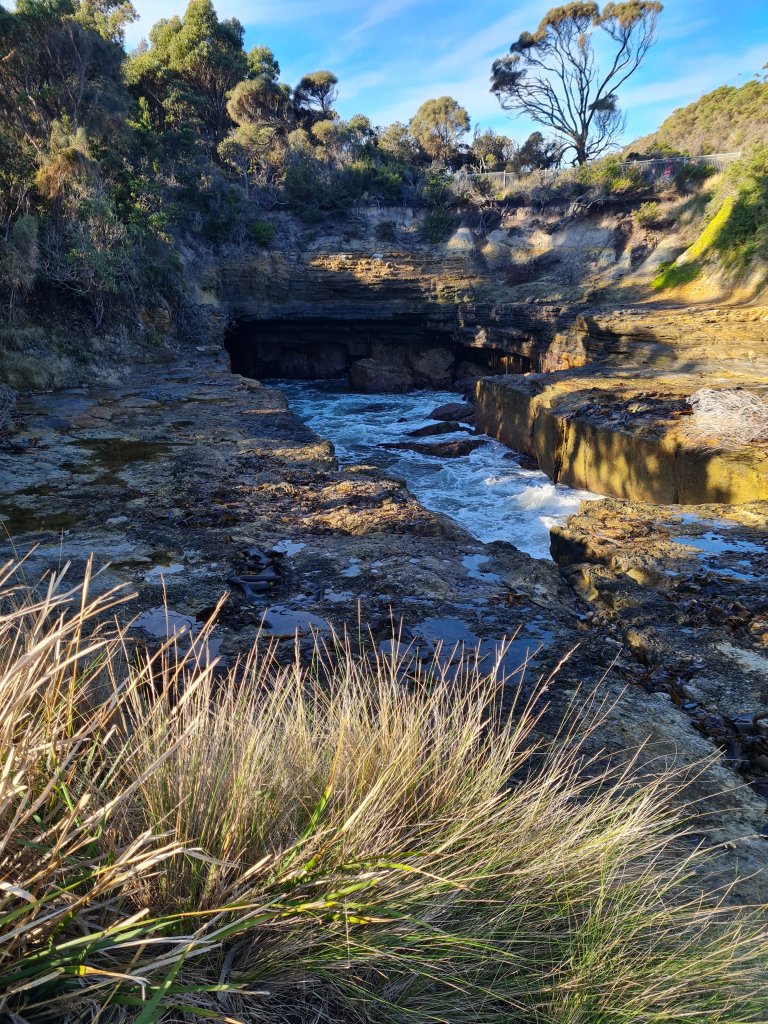
This is a blow hole, where the sea meets a rocking shoreline, and when there’s a big enough swell, crashes through to the other side.

On a quiet day, there’s nothing to see.

On a stormy day, when the waves are crashing into the base of the cliffs, water comes crashing through, and leaves the swirling, foamy water that can be seen above.

An interesting oddity, but nothing to fuel the imagination.

But…

What if, aside from the blowhole, there are caves, or there’s an underwater opening, and a channel leading up to it?

What if those caves were supposedly used by pirates to store treasure.

What if there is an underwater channel, and it is being used by small submarines to get to a base that has been hewn our of the rock?

What if no one knew until one night, a photographer, looking for caves to photograph and explore is investigating when people suddenly appear from nowhere?

Writing a book in 365 days – 150

Day 150

Cliches

So, standard practice tells us that as writers we must avoid cliches at all costs.

It’s a great idea. Because you are writing to potentially a great many people, the notion that most of them will have no idea what you are talking about, or understand the relevance, it’s best not to leave them perplexed when they read something they don’t understand.

A great example of this was many years ago when I worked with a chap who was a recent immigrant from Russia. His English was reasonable, that is, he could speak in a manner I could understand, but there were times when he stopped, searching for the English equivalent.

I would have called it a quaint accent. Others would be less accommodating.

But…

I found that I tended to speak with a lot of English idioms and cliches, some of which he did not understand, and so I spent a lot of time translating them. He was not at all ashamed of not knowing them, but wanted to.

Thus, for a few months, I became an ESL teacher and found it quite amusing, especially when he told me what the Russian equivalents were. And, yes, Russians do have their own cliches, and we westerners cop a few really interesting ones.

And, yes, I use cliches in stories, or at least until the third draft when I realise that they don’t belong, and even when they last a little longer, the editor’s blue pencil gets them every time.

But, and there’s always a but…

What if your protagonist speaks in cliches?

Searching for locations: The Mary Valley Rattler, Gympie, Queensland, Australia

I have a passion for visiting transport museums, to see old trains, planes, buses, cars, even ships if it’s possible.

This has led to taking a number of voyages on the TSS Earnslaw in Queenstown, New Zealand.

Many, many, many years ago on Puffing Billy, a steam train in the Dandenongs, Victoria, Australia.

The steam train in Kingston, New Zealand, before it was closed down, but hopefully it will reopen sometime in the future.

The London Transport Museum in London England, which had a lot of buses.

The Workshops Railway Museum in Ipswich, Queensland, where once the many steam engines were built and maintained, and now had only a handful of engines remaining.

However, in the quest for finding and experiencing old transportation methods, we came across the Mary Valley Rattler, which runs out of Gympie, Queensland, Australia.

The ride begins in Gympie at the old Gympie Railway station, and as can be seen below, is one of the relics of the past, and, nothing like the new more modern stations.  Thankfully.

If you’re going to have a vintage train, then you have to have a vintage station.

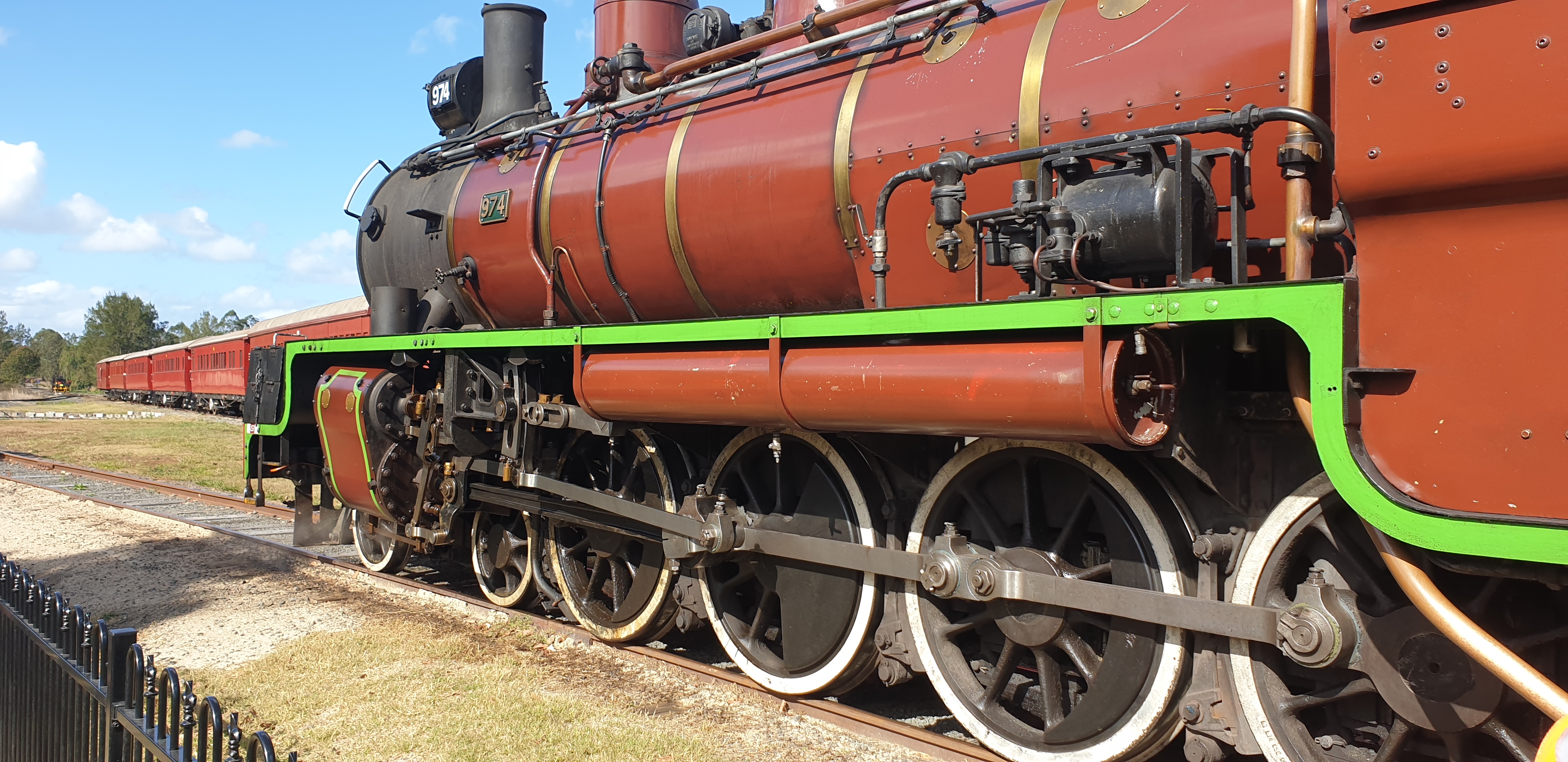
The Class of engine, seen below, is the C17, a superheated upgrade to the C16 it was based on, and first run in 1903.  This particular engine was built in 1951, although the first of its type was seen in  1920 and the last of 227 made in 1953.  It was the most popular of the steam engines used by Queensland Railways.

The C designation meant it had four driving axels and 17 was the diameter of the cylinder, 17 inches.  It is also known as a 4-8-0 steam locomotive
 and nicknamed one of the “Brown Bombers” because of its livery, brown with green and red trimming.

Also, this engine was built in Maryborough, not far from Gympie by Walkers Limited, one of 138.

This photo was taken as the train returned from Amamoor, a trip that takes up to an hour.

The locomotive is detached from the carriages, then driven to the huge turntable to turn around for the return journey to Amamoor.

This is the locomotive heading down to the water station, and then taking on water.  After that, it will switch lines, and reverse back to reconnect the carriages for the trip to Amamoor.

The carriages are completely restored and are extremely comfortable.  It brings back, for me, many memories of riding in older trains in Melbourne when I was a child.

The trains, then, were called Red Rattlers.

This is the locomotive climbing one of the hilly parts of the line before crossing over the Mary River on a trestle bridge.

This is the engine at Amamoor near the picnic area where young children and excited parents and grandparents can get on the locomotive itself and look inside where the driver sits.

And, no, I didn’t volunteer to shovel coal.

This particular locomotive spent most of its working life between Townsville and Mount Isa and was based in Cloncurry, Charters Towers, and Townsville, before being sent, at the end of its useful days in the late 1960s, to the Ipswich Railway Workshops.

The cinema of my dreams – I always wanted to go on a treasure hunt – Episode 46

Here’s the thing…

Every time I close my eyes, I see something different.

I’d like to think the cinema of my dreams is playing a double feature but it’s a bit like a comedy cartoon night on Fox.

But these dreams are nothing to laugh about.

Once again there’s a new installment of an old feature, and we’re back on the treasure hunt.

Aside from working on what I was going to tell my mother, and Boggs for that matter, where I’d been all night, the last thing I could say was that I spent the night with Nadia.

It had a curious ring to it when I said to myself, I slept with Nadia.  Most people would take it the wrong way, but, by a quirk of fate, it was true.  I guess that little gem of truth would have to stay locked away in my head.

One the other hand, if I told my mother I was out doing reconnaissance work for Boggs, she would get very angry, messing around in Boggs’ fantasies.  She had no time for people who didn’t want to get a job, and work hard for a living.

At least I’d gone up in her estimation when I started working for the Benderby’s.

But the reconnaissance line would work with Boggs, and all I had to do was come up with a plausible set of circumstances he would believe.  At the moment, all I had was Alex going to the mall, and that I waited to see when he came out.  The question I would pose, what was he doing in there for four or five hours.

All I had to do was hope Alex had been out of town and Boggs hadn’t seen him.  Always a chance of coming unstuck.  Perhaps I should just not volunteer anything.

As for my mother, I couldn’t say I was working overtime for Benderby.  She was likely to call him and tell him off for making me work so hard. 

I was still no further advanced on that point when I got to the library. 

It was a familiar place for me, and I had spent a lot of my time there escaping the real world, and of course, being able to keep away from Alex and Vince.

The librarian, Gwen, had been there for a hundred years or more, or so they said, and she should have retired about 20 years ago.

Pity the poor mayor who got the job of telling her to leave.  Three had tried, and three had failed.  The current incumbent was smarter than that.  He just hired an assistant and told her that she had no problems handing over the reins when she was ready.

That woman, Winifred Pankhurst, no relation to the suffragette, was quiet, polite but firm in doing her duties and dealing with the public.  She and I had butted heads a few times, especially when Gwen wasn’t in, but today was not going to be one of those days.

I could see Gwen in her office, and headed straight there, under Winnie’s watchful eye.  And no, I didn’t dare call her Winnie.  Her name, she said, was Miss Pankhurst thank you very much.

Gwen looked up as I knocked on the door, and she smiled.

“Long time no see.”

It had been several weeks.  The job and everything else had made it less of a priority to get there,

“New job, crazy hours.  Never thought I’d become a working stiff.”

“About time.  All that talent being wasted.”

I came in and sat down opposite her.

“How are you?”

“Getting old.”

For her to admit that was a worry.  She was, last time I checked, somewhere between 93 and 95.  She never quite told anyone her actual date of birth, not even the Mayor’s office who employed her.  And she didn’t look a day over 80.  Good, clean living she said.

“Isn’t that inevitable?”

“For some of us.  Now, enough of being maudlin, what can I do for you?”

“What makes you think I want something?”

“That expression.  A cat’s curiosity.”

She could still see through me.  The only other people who could was my English teacher in the final year at school and my mother.

“What do you know about the Ormiston’s.”

A change in expression on her face told me it was not a surprise I was asking.  Alex’s thug had been here earlier, had someone else?

“They’re popular this week.  Young Elmer was in here a few days ago asking the same question.  I suspect he was working for Alex Benderby.”

The way she said his name, it was with the usual venom used for him.  She had a run in with Benderby a long time ago, and she’d never forgotten.  Or ever will.  That’s why Alex would never get anything from her about anything.

“He was.”

“Is this in relation to the treasure you and that lad Boggs are searching for?”

Of course, she’d know who and what was going on in this town.  No one could keep a secret from her.  Or her extensive network of old ladies in the knitting club.

“Boggs seems to think he had some idea of where it might be, though I’m not so sure.  I just go along for the ride, it balances out the depressive life we have to live living here.”

“Oh, come now.  It’s not all that bad.”

“Perhaps not, now that I have a job.  What can you tell me, if there’s anything to tell?”

“Ormiston was as bad if not worse than the Boggs, father and son alike.  He had the treasure bug too.  Obsessed.  In the end drove away his wife and family, eventually ran out of money after mounting six different search operations, and then, when that happened, sold the land to the Navy.  Quite an extensive area, about 100 square miles or so, from the coast back to the fault line.  Used to be a lake, once, now it’s just a dustbowl.”

A fault line?  This was something Boggs didn’t know about, and it could be significant.  But just how significant?

© Charles Heath 2020