Searching for locations – Port Macquarie – Day 2 – Part 2

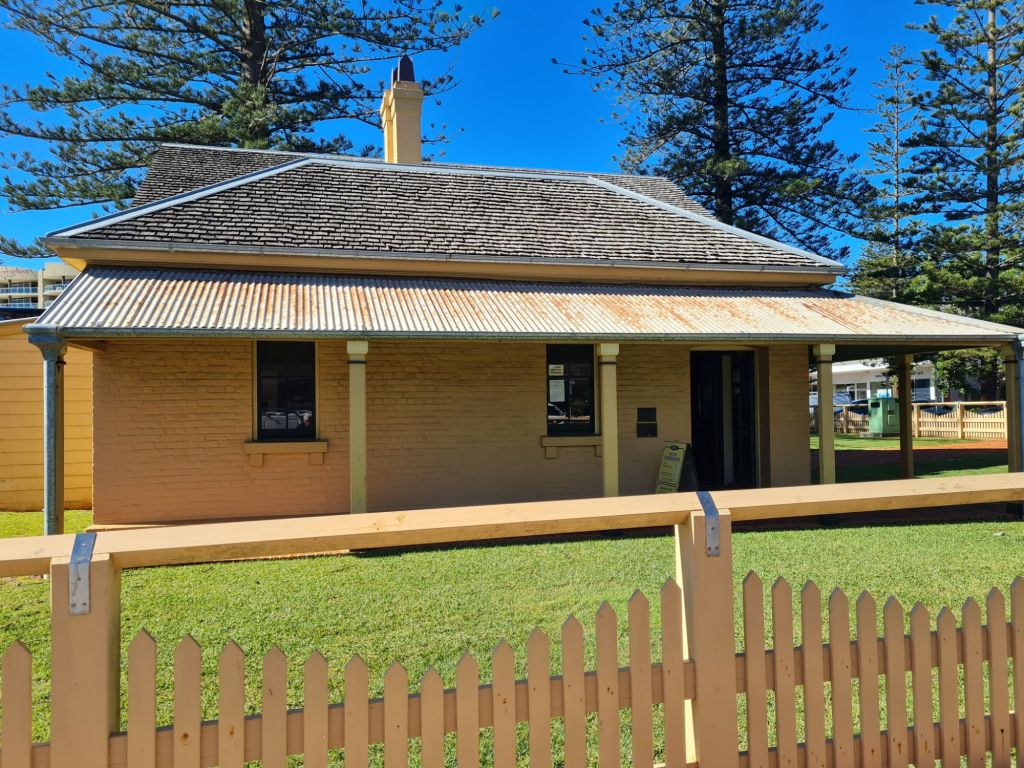
The old courthouse

A number of the historical sites are conveniently located in the town centre, making it easy to stop for a morning coffee and unique muffin, visit some history, and then go shopping.

The courthouse is one such site on the corner of Clarence and Hay Streets.

It was designed by a Scottish architect responsible for a large number of courthouses, post offices, police stations, and lighthouses.

It was built in 1867 for 875 pounds and opened for business in 1869 and in use until 1986.

It was one of the early designs for the interior

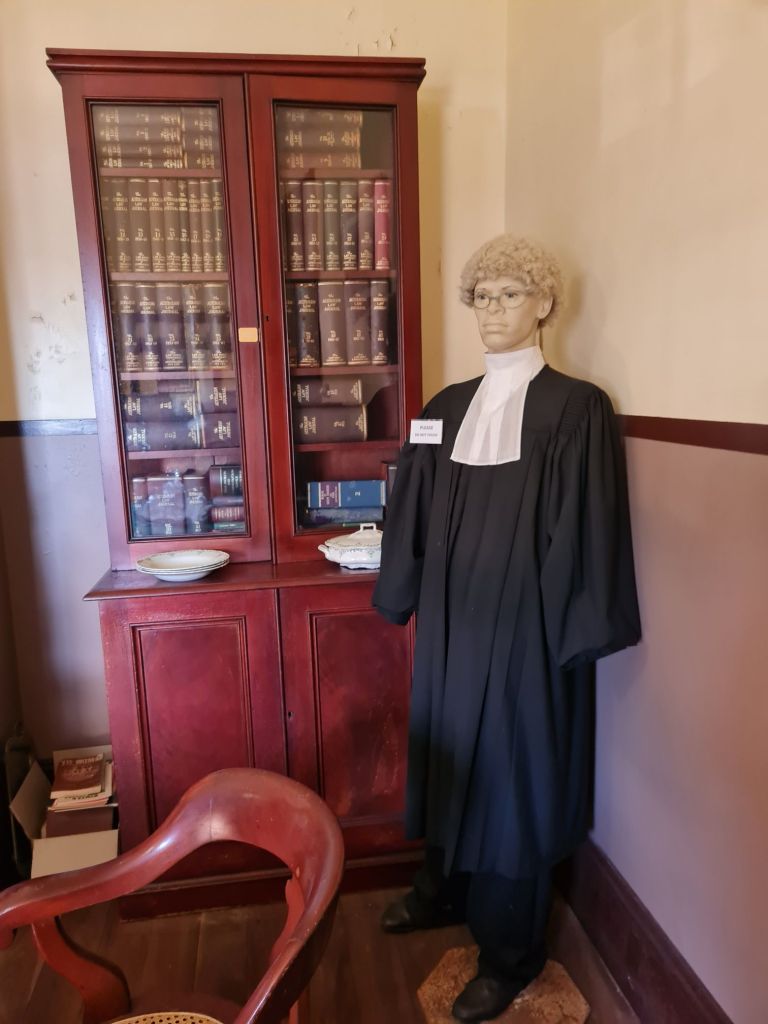
There’s even an opportunity to dress up as the judge

You can lock people in in the cage, though perhaps not a good idea.

There is the judge’s room to one side, complete with fire for cold days, and a lot of dusty reading

And a room for the clerk, and perhaps a soldier or two to guard the prisoners

Skeletons in the closet, and doppelgangers

A story called “Mistaken Identity”

How many of us have skeletons in the closet that we know nothing about? The skeletons we know about generally stay there, but those we do not, well, they have a habit of coming out of left field when we least expect it.

In this case, when you see your photo on a TV screen with the accompanying text that says you are wanted by every law enforcement agency in Europe, you’re in a state of shock, only to be compounded by those same police, armed and menacing, kicking the door down.

I’d been thinking about this premise for a while after I discovered my mother had a boyfriend before she married my father, a boyfriend who was, by all accounts, the man who was the love of her life.

Then, in terms of coming up with an idea for a story, what if she had a child by him that we didn’t know about, which might mean I had a half brother or sister I knew nothing about. It’s not an uncommon occurrence from what I’ve been researching.

There are many ways of putting a spin on this story.

Then, in the back of my mind, I remembered a story an acquaintance at work was once telling us over morning tea, that a friend of a friend had a mother who had a twin sister and that each of the sisters had a son by the same father, without each knowing of the father’s actions, both growing up without the other having any knowledge of their half brother, only to meet by accident on the other side of the world.

It was an encounter that in the scheme of things might never have happened, and each would have remained oblivious of the other.

For one sister, the relationship was over before she discovered she was pregnant, and therefore had not told the man he was a father. It was no surprise the relationship foundered when she discovered he was also having a relationship with her sister, a discovery that caused her to cut all ties with both of them and never speak to either from that day.

It’s a story with more twists and turns than a country lane!

And a great idea for a story.

That story is called ‘Mistaken Identity’.

Writing a book in 365 days – 116/117

Days 116 and 117

Secondary characters – Writing exercise

Relation to protagonist, are they trusted, dialogue differences, what is their purpose, one thing to remember them…

There were a few years of animosity between Alan and Jay.  And a healthy dose of resentment.

Alan was the eldest son and, as such, should have commanded some respect and, to be fair, had been treated very well.

Until Jay was born.

It didn’t matter that Mary had popped up in between them, except that she would always be their mother’s favourite.

But from the moment Jay arrived, he had commanded all the oxygen in any room he walked into.  He could do no wrong, not even when he was deliberately bad.  And no matter what Alan did, he was always wrong, or jealous, or worse, very childish.

Alan suffered it until he could leave, which was the day after he turned 18.  He simply put what he needed into his backpack, and left for work as he did every Thursday evening, went to the bus station and took the night express to anywhere that far away from what had ceased to be his home.

Over the next five or so years, Alan kept his head down and kept himself to himself, having learned the hard way that he could not rely on anyone other than himself.

He was largely a product of his experiences, and if or when anyone asked him anything about his life, he simply said he had been orphaned in his teens, bounced around the system until he was old enough to leave and make his own way.

He finished high school.  There was no possibility of going to college. His grades and finances precluded both.  He’d initially worked as a busboy and worked his way up to waiter.  He had applied to the police academy, but they had not even deigned to write back one way or another.

Perhaps it was not in his destiny.

As for home, he had only a passing interest.  There had not been one word about his departure, and endless news about the golden boy Jay.  Basketball champ, football champ, swimming champ, Prom King, and graduated top of the class.

Of course he would.

He was everything that Alan wasn’t.  He was the pride and joy of his parents.  And in that whole article about him, there was not one word about the other son.  It was like he didn’t exist.

On the seventh anniversary of Alan’s departure, the family sat around the table as they did every Sunday.  The morning visit to the church for another of Pastor Bill’s illuminating sermons, then back home for lunch.

Those occasions after Alan left were introspective, where everyone had an opinion as to why he left.  Only Mary knew why he had gone, and where, a secret she shared with the Sheriff when her parents had requested his assistance in finding out what happened to him.

Oddly, no one believed he had become a victim of foul play, but equally oddly, no one but Mary could see that their treatment of him was going to always lead to only one eventuality.

Three times, Alan’s mother secretly hired a private detective to find him.  Three times, the detective came back to tell them he had disappeared without a trace.  Only Mary knew that on the last occasion, after telling him what she knew, he found her brother, and in accordance with her wishes, he told them one thing but gave Mary a slip of paper with her brother’s address.

That had been three days ago.

Now, sitting at the table, looking at the feast, waiting for her father to say grace.  He was at one end, her mother at the opposite end, and Jay was sitting opposite her.

It had taken every one of those seven years to hate him as much as her older brother, but for different reasons.  Jay was evil.  It was as simple as that, a boy without a conscience and no scruples whatsoever.

She, too, would have left before now, but her mother was ailing, and she couldn’t leave her, not with Jay, who wouldn’t care about her, and a father who doted more on his son than his wife.

She looked over towards her and could see she was unwell.  The latest visit to the doctor wasn’t good news.  Not knowing where Alan was only made matters worse.

“I want Alan to come home,” she said suddenly, in a tone that had more fire in it than usual.  The latest report from the detective had reduced her to tears.

“Why?” Jay muttered.  “He was a spineless moron, and showed his true colours when he left, without so much as a by your leave.”

“You think?”  Mary said, glaring at him.

“What’s your beef?”

His smug look annoyed her.  She had discovered he did nothing but trash his brother’s name to anyone who would listen.

“Tell us why Bonny went to the sheriff’s office, Jay?”

Wendy, a friend of Sally, who was a friend of Ada who worked in the sherries office, had confided that Bonny, Jay’s latest girlfriend, or if the rumours were right, ex-girlfriend, had complained that he had assaulted her.  Mary suspected it was more than just ‘assault’.

Their mother switched her glare from Jay to her husband.  “What have you two done now?”

Exactly the result Mary wanted.  Jay was looking very guilty.

“It’s just a misunderstanding,” Jay muttered, suddenly standing up, sending his chair crashing backwards.  “If this is going to be another bitch session, I’ve got better things to do.  He’s gone, get over it.”

With that said, he stomped out, slamming the door behind him.

“Now look what you’ve done,” her father said. 

“No, Jack.  This is all your fault.  If you had disciplined him years ago, we wouldn’t be here.  Whatever he’s done this time, you’re not going to smooth it over.”

He simply shook his head and followed his son out the door.

Mary reached over and took her mother’s hand in hers.  She could see the tears welling in her eyes.  Jay had finally torn their family apart.

“We’re going on a road trip.  We need to spend time together away from this place.  They can fend for themselves for a few days.”

“Where?”

“It’ll be our secret.  Go throw a few things in a bag, enough for a week or so.  We’re going now.”

“What about…”

“They can clean it up or wallow in it.  You’ve done enough for the ungrateful pigs.  It’s time they did something for you.”

It took Mary a day on the road to finally coax the truth out of her mother.  A secret so devastating that she cried all night. Cancer.  Inoperable.  And six months, perhaps a year.  Mary knew it was bad, just not this bad.

The next morning, after getting back on the road and then stopping at a diner for coffee and apple pie, Mary told her where they were going.

The change in her mother was instant and brought her back to life, the slow descent into despair suddenly arrested.

“I thought…”

“I spoke to the detective this time and told him what I knew.  I figured that Alan never wanted any of us to know where he went, but there were clues which I kept to myself, and he did tell me why he left, and swore me to secrecy.  I don’t think I need to tell you, you’re smart enough to realise what drove him away.  I heard from him a few weeks after he left to tell me he was safe, that it was best not to try and find him, and he was not coming home.”

“Were you going to tell me?  Us?”

“Not Dad or Jay.  They can live in blissful ignorance.  Besides, they’re about to find themselves in a whole world of pain.  But in your case, I had decided on a road trip later, but seeing you yesterday, I realised that I couldn’t wait.  And knowing what we know, I’m glad we’re doing it now.”

“Are you sure he will be where the detective said?  Or that he will want to see me, or you?”

“That’s why I have to initially go by myself.  I know he will be surprised to see me, and when I explain the circumstances, he will agree to see you.”

“Perhaps he might be annoyed with me not trying to reach out earlier than this?”

“I think if he wanted to see you, he knew where you lived.  It might not be you personally that kept him away, but to be fair, you didn’t stop Jay.”

“No.  You’re right.  I didn’t.  For a long time, I didn’t have the courage, and now that I have, I hope it’s not too late to right that wrong.  I’ve decided I’m not going back. I don’t want to spend my last days on God’s earth with either of them.”

©  Charles Heath  2025

An excerpt from “Amnesia”, a work in progress

I remembered a bang.

I remembered the car slewing sideways.

I remember another bang, and then it was lights out.

When I opened my eyes again, I saw the sky.

Or I could be underwater.

Everything was blurred.

I tried to focus but I couldn’t. My eyes were full of water.

What happened?

Why was I lying down?

Where was I?

I cast my mind back, trying to remember.

It was a blank.

What, when, who, why and where, are questions I should easily be able to answer. These are questions any normal person could answer.

I tried to move. Bad, bad mistake.

I did not realise the scream I heard was my own. Just before my body shut down.

“My God! What happened?”

I could hear, not see. I was moving, lying down, looking up.

I was blind. Everything was black.

“Car accident; hit a tree, sent the passenger flying through the windscreen. Pity to poor bastard didn’t get the message that seat belts save lives.”

Was I that poor bastard?

“Report?” A new voice, male, authoritative.

“Multiple lacerations, broken collar bone, broken arm in three places, both legs broken below the knees, one badly. We are not sure of internal injuries, but ruptured spleen, cracked ribs and pierced right lung are fairly evident, x-rays will confirm that and anything else.”

“What isn’t broken?”

“His neck.”

“Then I would have to say we are looking at the luckiest man on the planet.”

I heard the shuffling of pages.

“OR1 ready?”

“Yes. On standby since we were first advised.”

“Good. Let’s see if we can weave some magic.”

Magic.

It was the first word that popped into my head when I surfaced from the bottom of the lake. That first breath, after holding it for so long, was sublime, and, in reality, agonising.

Magic, because it seemed like I’d spent a long time underwater.

Or somewhere.

I tried to speak but couldn’t. The words were just in my head.

Was it night or was it day?

Was it hot, or was it cold?

Where was I?

Around me, it felt cool.

It was incredibly quiet. No noise except for the hissing of air through an air-conditioning vent. Or that was the sound of pure silence.  And with it the revelation that silence was not silent. It was noisy.

I didn’t try to move.

Instinctively, somehow, I knew not to.

A previous unpleasant experience?

I heard what sounded like a door opening, and noticeably quiet footsteps slowly came into the room. They stopped. I could hear breathing, slightly laboured, a sound I’d heard before.

My grandfather.

He had smoked all his life until he was diagnosed with lung cancer. But for years before that he had emphysema. The person in the room was on their way, down the same path. I could smell the smoke.

I wanted to tell whoever it was the hazards of smoking.

I couldn’t.

I heard a metallic clanging sound from the end of the bed. A moment later the clicking of a pen, then writing.

“You are in a hospital.” A female voice suddenly said. “You’ve been in a bad accident. You cannot talk, or move, all you can do, for the moment, is listen to me. I am a nurse. You have been here for 45 days and just came out of a medically induced coma. There is nothing to be afraid of.”

She had a very soothing voice.

Her fingers stroked the back of my hand.

“Everything is fine.”

Define fine, I thought. I wanted to ask her what ‘fine’ meant.

“Just count backwards from 10.”

Why?

I didn’t reach seven.

Over the next ten days, that voice became my lifeline to sanity. Every morning, I longed to hear it, if only for the few moments she was in the room, those few waking moments when I believed she, and someone else who never spoke, were doing tests. I knew it had to be someone else because I could smell the essence of lavender. My grandmother had worn a similar scent.

It rose above the disinfectant.

She was another doctor, not the one who had been there the day I arrived. Not the one who had used some ‘magic’ and kept me alive.

It was then, in those moments before she put me under again, that I thought, what if I was paralysed? It would explain a lot. A chill went through me.

The next morning, she was back.

“My name is Winifred. We don’t know what your name is, not yet. In a few days, you will be better, and you will be able to ask us questions. You were in an accident, and you were very severely injured, but I can assure you there will be no lasting damage.”

More tests, and then when I expected the lights to go out, they didn’t. Not for a few minutes more. This was how I would be integrated back into the world. A little bit at a time.

The next morning, she came later than usual, and I’d been awake for a few minutes. “You have bandages over your eyes and face. You had bad lacerations to your face, and glass in your eyes. We will know more when the bandages come off in a few days. Your face will take longer to heal. It was necessary to do some plastic surgery.”

Lacerations, glass in my eyes, car accidents, plastic surgery. By logical deduction, I knew I was the poor bastard thrown through the windscreen. It was a fleeting memory from the day I was admitted.

How could that happen?

That was the first of many startling revelations. The second was the fact I could not remember the crash. Equally shocking, in that same moment was the fact I could not remember before the crash either, or only vague memories after.

But the most shattering of all these revelations was the one where I realised, I could not remember my name.

I tried to calm down, sensing a rising panic.

I was just disoriented, I told myself. After 45 days in an induced coma, it had messed with my mind, and it was only a temporary lapse. Yes, that’s what it was, a temporary lapse. I will remember tomorrow. Or the next day.

Sleep was a blessed relief.

The next day I didn’t wake up feeling nauseous. I think they’d lowered the pain medication. I’d heard that morphine could have that effect. Then, how could I know that but not who I am?

Now I knew Winifred the nurse was preparing me for something unbelievably bad. She was upbeat, and soothing, giving me a new piece of information each morning. This morning, “You do not need to be afraid. Everything is going to be fine. The doctor tells me you are going to recover with little scarring. You will need some physiotherapy to recover from your physical injuries, but that’s in the future. We need to let you mend a little bit more before then.”

So, I was not going to be able to leap out of bed and walk out of the hospital any time soon. I don’t suppose I’d ever leapt out of bed, except as a young boy. I suspect I’d sustained a few broken bones. I guess learning to walk again was the least of my problems.

But there was something else. I picked it up in the timbre of her voice, a hesitation, or reluctance. It sent another chill through me.

This time I was left awake for an hour before she returned.

This time sleep was restless.

Scenes were playing in my mind, nothing I recognised, and nothing lasting longer than a glimpse. Me. Others, people I didn’t know. Or I knew them and couldn’t remember them.

Until they disappeared, slowly like the glowing dot in the centre of the computer screen, before finally fading to black.

The morning the bandages were to come off she came in early and woke me. I had another restless night, the images becoming clearer, but nothing recognisable.

“This morning the doctor will be removing the bandages over your eyes. Don’t expect an immediate effect. Your sight may come back quickly, or it may come back slowly, but we believe it will come back.”

I wanted to believe I was not expecting anything, but I was. It was human nature. I did not want to be blind as well as paralysed. I had to have at least one reason to live.

I dozed again until I felt a gentle hand on my shoulder. I could smell the lavender; the other doctor was back. And I knew the hand on my shoulder was Winifred’s. She told me not to be frightened.

I was amazed to realise at that moment, I wasn’t.

I heard the scissors cutting the bandages.

I felt the bandage being removed, and the pressure coming off my eyes. I could feel the pads covering both eyes.

Then a moment when nothing happened.

Then the pads are gently lifted and removed.

Nothing.

I blinked my eyes, once, twice. Nothing.

“Just hold on a moment,” Winifred said. A few seconds later I could feel a cool towel wiping my face, and then gently wiping my eyes. There was ointment or something else in them.

Then a flash. Well, not a flash, but like when a light is turned on and off. A moment later, it was brighter, not the inky blackness of before, but a shade of grey.

She wiped my eyes again.

I blinked a few more times, and then the light returned, and it was like looking through water, at distorted and blurry objects in the distance.

I blinked again, and she wiped my eyes again.

Blurry objects took shape. A face looking down on me, an elderly lady with a kindly face, surely Winifred, who was smiling. And on the opposite side of the bed, the doctor, a Chinese woman of indescribable beauty.

I nodded.

“You can see?”

I nodded again.

“Clearly?”

I nodded.

“Very good. We will just draw the curtains now. We don’t want to overdo it. Tomorrow we will be taking off the bandages on your face. Then, it will be the next milestone. Talking.”

I couldn’t wait.

When morning came, I found myself afraid. Winifred had mentioned scarring, there were bandages on my face. I knew, but wasn’t quite sure how I knew, I wasn’t the most handsome of men before the accident, so this might be an improvement.

I was not sure why I didn’t think it would be the case.

They came at mid-morning, the nurse, Winifred, and the doctor, the exquisite Chinese. She was the distraction, taking my mind off the reality of what I was about to see.

Another doctor came into the room before the bandages were removed, and he was introduced as the plastic surgeon who had ‘repaired’ the ravages of the accident. It had been no easy job, but, with a degree of egotism, he did say he was one of the best in the world.

I found it hard to believe, if he were, that he would be at a small country hospital.

“Now just remember, what you might see now is not how you will look in a few months.”

Warning enough.

The Chinese doctor started removing the bandages. She did it slowly and made sure it did not hurt. My skin was very tender, and I suspect still bruised, either from the accident or the surgery, I didn’t know.

Then it was done.

The plastic surgeon gave his work a thorough examination and seemed pleased with his work. “Coming along nicely,” he said to the other doctor. He issued some instructions on how to manage the skin, nodded to me, and I thanked him before he left.

I noticed Winifred had a mirror in her hand and was reticent in using it. “As I said,” she said noticing me looking at the mirror, “what you see now will not be the result. The doctor said it was going to heal with little scarring. You have been extremely fortunate he was available. Are you ready?”

I nodded.

She showed me.

I tried not to be reviled at the red and purple mess that used to be my face. At a guess, I would have to say he had to put it all back together again, but not knowing what I looked like before, I had no benchmark. All I had was a snippet of memory that told me I was not the tall, dark, and handsome type.

And I still could not talk. There was a reason, he had worked in that area too. Just breathing hurt. I think I would save up anything I had to say for another day. I could not even smile. Or frown. Or grimace.

“We’ll leave you for a while. Everyone needs a little time to get used to the change. I suspect you are not sure if there has been an improvement in last year’s model. Well, time will tell.”

A new face?

I could not remember the old one.

My memory still hadn’t returned.

©  Charles Heath  2024

In a word: Holiday

Some call time off from work whether it is for a day, a few days, a couple of weeks, or maybe longer, a holiday.

Or leave, leave of absence, annual leave, or long service leave.

Others may call it a vacation.

It depends on what part of the world you live in.

But the end result is the same, you do not go to work, so you stay home and do all those things that have mounted up, you drive up, and for some reason, it is always up, to the cabin, for a little hunting shooting fishing, or you get on a plane or a ship and try to get as far away from home and work as possible.

That’s called going overseas. It seems if there is an ocean between where you go and where you live, no one will be able to disturb you.

Sorry, I bet you didn’t leave that mobile phone or iPad at home did you?

But, of course, there are a few other obscure references to the word holiday.

For instance,

It can be a day set aside to commemorate an event or a person, a day when you are not expected to work, e.g. Memorial Day, Christmas Day, or Good Friday. In Britain, they used to be called Bank Holidays.

It can be a specified period that you may be excused from completing a task or doing something such as getting a one-year tax exemption, which might also be called a one-year tax holiday.

Yes, now that is an obscure reference, particularly when no tax department would ever grant anyone an exemption of any sort.

“The Devil You Don’t”, she was the girl you would not take home to your mother!

Now only $0.99 at https://amzn.to/2Xyh1ow

John Pennington’s life is in the doldrums. Looking for new opportunities, and prevaricating about getting married, the only joy on the horizon was an upcoming visit to his grandmother in Sorrento, Italy.

Suddenly he is left at the check-in counter with a message on his phone telling him the marriage is off, and the relationship is over.

If only he hadn’t promised a friend he would do a favour for him in Rome.

At the first stop, Geneva, he has a chance encounter with Zoe, an intriguing woman who captures his imagination from the moment she boards the Savoire, and his life ventures into uncharted territory in more ways than one.

That ‘favour’ for his friend suddenly becomes a life-changing event, and when Zoe, the woman who he knows is too good to be true, reappears, danger and death follow.

Shot at, lied to, seduced, and drawn into a world where nothing is what it seems, John is dragged into an adrenaline-charged undertaking, where he may have been wiser to stay with the ‘devil you know’ rather than opt for the ‘devil you don’t’.

newdevilcvr6

Getting the lie of the land

A lot of locations for stories are based on places that I’ve visited. So, any time I’m on holiday, I’m also discreetly observing, and noting, the places with an ulterior motive.

At some point in time, they’ll finish up in a story.

Places like Florence, London, Paris, New York and Venice have all been used in recent stories.

Of course places change, and there are some that I can’t get to, so it’s useful having Google Maps and Street View. These can either make up for lack of memory and a be a refresher.

Especially if you need to visit Africa. Parts of several stories are set in Nigeria, not exactly a place I would go, no matter how much I wanted to get the lie of the land, nor would I go to the Democratic Republic of Congo.

Rwanda, maybe, but in investigating locations, it is interesting to discover that places like Kenya and Rwanda are reasonbly safe. Uganda is more or less the same, but whether I’d visit, as inviting as it might be to see the wildlife (animals that is) I’m thinking Google Maps will do for now.

And, of course, at the moment there is another reason why I can’t get a practical look at overseas locations. Covid-19.

I have always had a fascination for other places, from way back when I was in school and we did a subject called geography. Back then, nearly 60 years ago, we had school atlases that had all of the British colonies, even if they had become independent, coloured red on the maps, and there was a lot of them.

Places like London, of which we also studied in history, always held a fascination for me, and, in particular, the royal family. Oddly enough, I knew all of the kings and queens from 1066 onwards, and yet had no idea who our Prime Ministers in Australia were.

It wasn’t until much later we learned about Australian history.

But seeing places foreign are only part of the story. I have had time during the pandemic when we were not allowed to leave home, to delve into the historical side of Australia, and it has created a fascination for writing a story that has basis in fact.

This was unwittingly pushed along when my grand daughter came home from school with the assignment of writing a story about a character that was affected by a historical event. Thus Eliza at the Eureka Stockade was created.

I remember back in university days when working on the narrative part of my literature stream we were set an assignment based on pictures from a certain period, and a series of written documents to put together a story. Mine was about a passenger on a ship from Melbourne to Geelong in the days before rail around the time of the gold rush.

I’m guessing that’s what is called historical fiction.

Well, it’s time to get back to the mists of time…


The cinema of my dreams – I always wanted to see the planets – Episode 9

What’s the worst that could happen?

Captains invariably hated the word ‘problem’. I did too, because it conjured up so many different scenarios, each more scarier than the last, and maginified exponentially because we were in space.

We took a closer look, and it was the sort of damage if it was back on Earth, one would associate with weapons fire, lasers to be exact.

Yes, in the 24th century we had ray guns, handheld, and ship bound.

The only problem was, only the cruise class vessels, like the one I was now on, were allowed to have them, and using them, well, the paperwork alone could keep a complement of 20 working day and night for a month.

Test them, yes, less paperwork, use them, no. There had never been a reason to.

But someone had, and on a freighter, which only meant one possibility, that whatever the freighter had been carrying, had been worth violating a thousand regulations and rules.

And bring their ship and selves out into the light.

It was, of course, Space Command’s worst nightmare realised, that the ideal of space exploration as a united effort by everyone, had a member who had decided against unity.

Unless, of course, the improbably had happened, there was life outside our solar system, and we were dealing with a new planet, or people.

Except I would not expect them to use something as conventional as a laser.

Myrtle had put us very close to the damaged area and taken a number of photographs, and the engineer had analysed the damaged area.

Then, cleared to enter the freighter, she took us up to the cargo doors and waited as we watched them open.

It was the same time the engineer’s hand held computer started beeping.

And a warning light on the console in front of Myrtle started flashing, accompanied by a warning klaxon.

Another vessel had just entered our proximity zone.

© Charles Heath 2021

A photograph from the inspirational bin – 9

I remeber once being told that if you shoot for the moon, you’ll land in the clouds, if you shoot for the tree tops, you’ll finish up back where you started from.

It was a silly analogy, but I always remembered it when I looked up at the sky and saw clouds.

That was back in those hazy carefree days just after you were finished with school and you had your whole life in front of you. Your parents were there as the safety net, and were still proud of your scholastic achievements, and were not in too much of a hurry to hustle you out of the house.

But what happened when there’s a recession that came upon everyone without any warning.

Stocks plummeted, people lost their life’s savings, those with mortgages and loans suddenly finding that along with unemployment came no income, no ability to pay the bills, and therefore lost everything.

Although I never said it, I was thinking what good was an education when the whole world had gone to hell in a handbasket.

Two things I remember from back then, which in the context of disaster, wasn’t all that long ago. Firstly, my father making us children go camping from before we could walk, and with it, to survive with nothing but the clothes on our backs, and our wits.

It had happened to him, as a member of am expedition in Africa in his younger days, thinking that he might become the next great explorer, or archeologist, and finishing up getting lost, even though he asserted the other members had deliberately left him behind.

And secondly, that it was essential that we forge working relationships with any and all those who were like minded, such as those who wanted to be saved, not those who expected everyone else to so the work. It was obvious he had met a lot of those type of people too.

It served us well.

When nations began turning on each other, when essential resources like electricity and fuel stopped being distributed and rationed, when food suddenly became scarce, that’s when the real trouble started. My father said, at the outset, what would happen, and was glad our mother was not there to see it.

Then, when neighbours attacked neighbours once food became scarce, it was time to leave. The pity of it was, he died defending us, even after offering up some of the food we had stored away, but that had not appeased a hungry or angry mob.

His last words, “Go to where we said we would go, and remember everything I’ve taught you” were etched in my brain, and my brother and I did as he asked.

But, even knowing where we had to go, and how to get there, a plan of action made many years before, and trialled in recent years with success, nothing in the past could have prepared us for the journey.

It was, literally, time to shoot for the moon.

© Charles Heath 2021

Writing a book in 365 days – My story 15

More about my story

If we are going to have a dictatorship with a benign president, and rebels, and a missing leader of the opposition party in what is purported to be a democracy of sorts, then there must be a revolution in the offing.

And what better time to have a coup d’état than when there is a human rights conference going on?

So far, a group of rebels have been thwarted by our protagonist, who is trying to do his job or protecting the keynote speaker, and who is a long-ago love interest.  And yes, we will get past the notion that the woman in white is his daughter.  She is not.

Then we get to the notion that some of the journalists might be agents for the various intelligence agencies in the world, and one in particular, a British journalist who may or may not be MI6.

Of course, that leader of the opposition is not dead, just missing, and the rumours of the catacombs being a vast underground network of tunnels and dungeons, and quite possibly torture chambers, is a good enough notion that someone should have a poke around.

And let’s not forget that the protagonist’s diverting assistant he didn’t want, has now managed to catch the eye of the very nasty head of the secret police.  It’s just one more thing to worry about.

While the, of course, the human rights conference carries on regardless of the antics outside.