Searching for locations: Siena, Italy

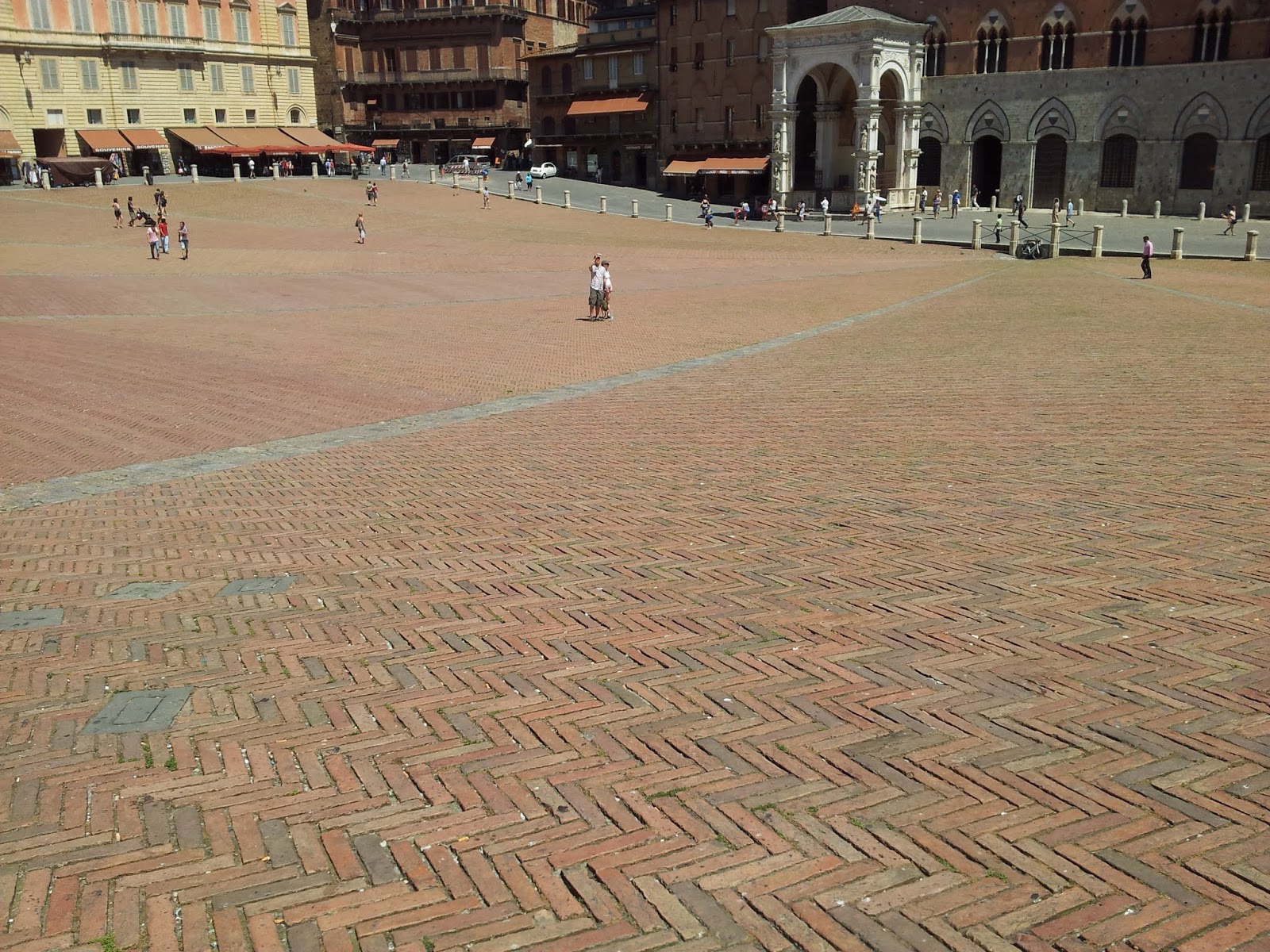
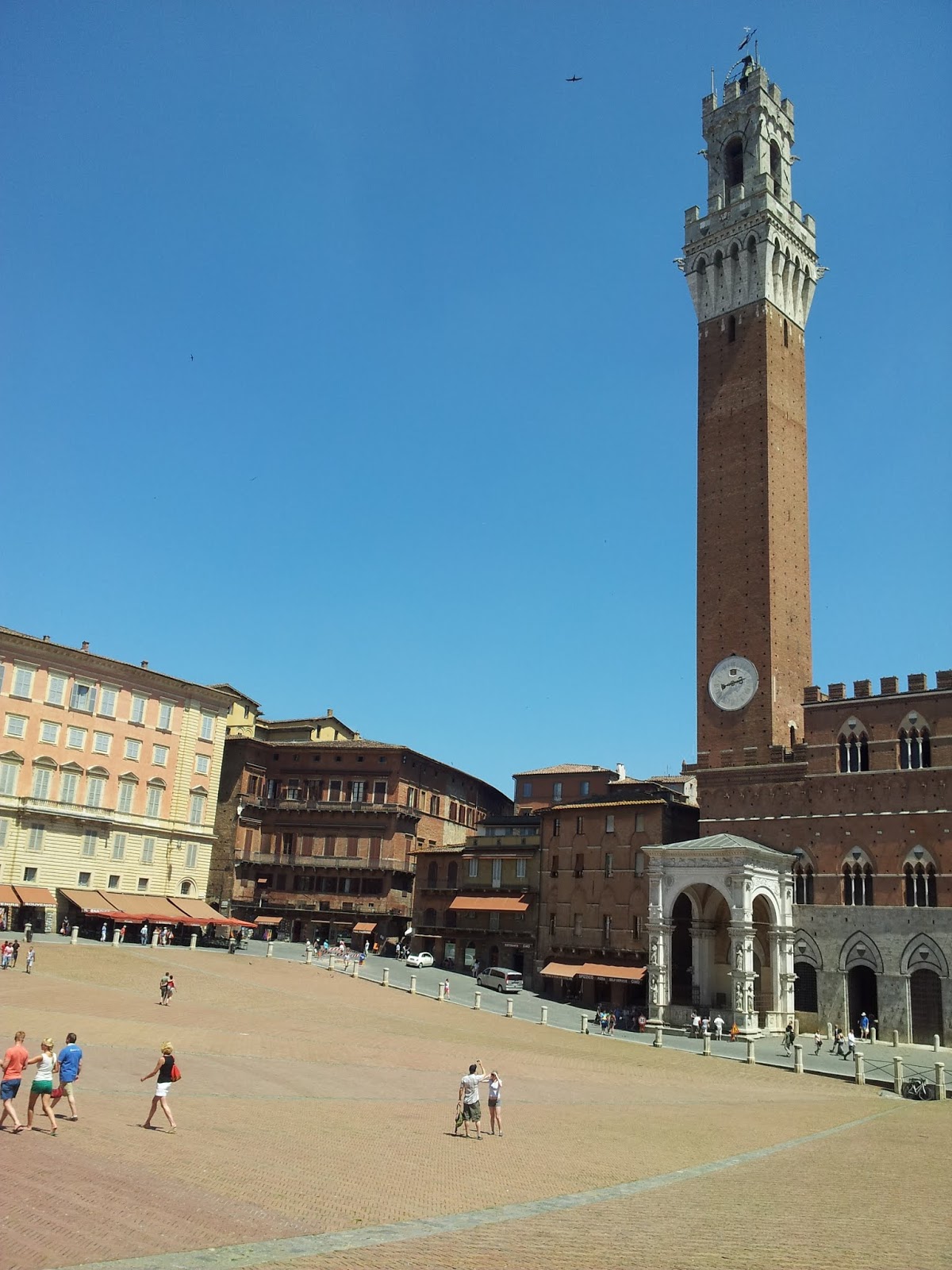
The Piazza del Campo is one of the greatest medieval squares in Europe.

It is shaped like a shell.

This is where the Palazzo Publico and the Torre del Mangia are.

At 102 meters (334 feet), the bell tower is the city’s second tallest structure.

When it was built in 1848 it was the exact same height of the Duomo to show that the state and church had equal amounts of power.

Around the edges of the Piazza are a lot of restaurants, where you can sit in the shade, have a plate of pasta and sip on a cold limonata.

The story behind the story – Echoes from the Past

The novel ‘Echoes from the past’ started out as a short story I wrote about 30 years ago, titled ‘The birthday’.

My idea was to take a normal person out of their comfort zone and led on a short but very frightening journey to a place where a surprise birthday party had been arranged.

Thus the very large man with a scar and a red tie was created.

So was the friend with the limousine who worked as a pilot.

So were the two women, Wendy and Angelina, who were Flight Attendants that the pilot friend asked to join the conspiracy.

I was going to rework the short story, then about ten pages long, into something a little more.

And like all re-writes, especially those I have anything to do with, it turned into a novel.

There was motivation.  I had told some colleagues at the place where I worked at the time that I liked writing, and they wanted a sample.  I was going to give them the re-worked short story.  Instead, I gave them ‘Echoes from the past’

Originally it was not set anywhere in particular.

But when considering a location, I had, at the time, recently been to New York in December, and visited Brooklyn and Queens, as well as a lot of New York itself.  We were there for New Years, and it was an experience I’ll never forget.

One evening we were out late, and finished up in Brooklyn Heights, near the waterfront, and there was rain and snow, it was cold and wet, and there were apartment buildings shimmering in the street light, and I thought, this is the place where my main character will live.

It had a very spooky atmosphere, the sort where ghosts would not be unexpected.  I felt more than one shiver go up and down my spine in the few minutes I was there.

I had taken notes, as I always do, of everywhere we went so I had a ready supply of locations I could use, changing the names in some cases.

Fifth Avenue near the Rockefeller center is amazing at first light, and late at night with the Seasonal decorations and lights.

The original main character was a shy and man of few friends, hence not expecting the surprise party.  I enhanced that shyness into purposely lonely because of an issue from his past that leaves him always looking over his shoulder and ready to move on at the slightest hint of trouble.  No friends, no relationships, just a very low profile.

Then I thought, what if he breaks the cardinal rule, and begins a relationship?

But it is also as much an exploration of a damaged soul, as it is the search for a normal life, without having any idea what normal was, and how the understanding of one person can sometimes make all the difference in what we may think or feel.

And, of course, I wanted a happy ending.

Except for the bad guys.

Get it here:  https://amzn.to/2CYKxu4

newechocover5rs

Writing a book in 365 days – 127

Day 127

What do you believe is your forte as a writer?

I have always liked English as a subject at school, starting at primary school and getting books for Christmas.

My favourite shop was a newsagent and bookstore up the road, and while my mother shopped in the grocery store, I would go looking at the books.

It wasn’t until secondary school and the introduction to English literature that my love of books took a new turn. The school had a library, and there I could discover all of the schoolboy heroes like Biggles and the adventures of the Famous Five and Secret Seven.

It also afforded me the chance to work as a librarian and learn the ropes, as it were, and for a while, the idea of going to university to become a proper librarian was firmly planted in my mind.

Of course, circumstances got in the way of that plan, and I finished up leaving school early and never quite making it to university.

But I did go to correspondence school and picked up English literature again, but this time, it was a study of various aspects of literature, such as poetry, fiction, plays, and nonfiction.

I didn’t like poetry. In fact, I did not understand it at all.

I liked the idea of writing a play and creating a screenplay, but I never got around to it.

No, my first foray into writing came when I started doing an off-campus degree that majored in literature and had units called narrative.

Yes, the expectation was to write stories. Short stories, and so I began. Those I wrote as assignments scored well. Those I wrote and submitted did not.

Yes, it was the beginners’ story, the pile of rejections that started crushing that desire to succeed.

There was, around this time, a novel competition run by the Australian newspaper, and, like all naive beginners, I told myself my first entry would blow them away, and the prize was mine.

Nothing could be further from the truth.

But I wrote a novel every year until I was too old to participate. Unfortunately, I can’t find the manuscripts I wrote back then; perhaps disgusted, I threw them away. Pity, I would like to see them now, just to see how bad they were.

The first case of PI Walthenson – “A Case of Working With the Jones Brothers”

This case has everything, red herrings, jealous brothers, femme fatales, and at the heart of it all, greed.

See below for an excerpt from the book…

Coming soon!

PIWalthJones1

An excerpt from the book:

When Harry took the time to consider his position, a rather uncomfortable position at that, he concluded that he was somehow involved in another case that meant very little to him.

Not that it wasn’t important in some way he was yet to determine, it was just that his curiosity had got the better of him, and it had led to this: sitting in a chair, securely bound, waiting for someone one of his captors had called Doug.

It was not the name that worried him so much, it was the evil laugh that had come after the name was spoken.

Doug what? Doug the ‘destroyer’, Doug the ‘dangerous’, Doug the ‘deadly’; there was any number of sinister connotations, and perhaps that was the point of the laugh, to make it more frightening than it was.

But there was no doubt about one thing in his mind right then: he’d made a mistake. A very big. and costly, mistake. Just how big the cost, no doubt he would soon find out.

His mother, and his grandmother, the wisest person he had ever known, had once told him never to eavesdrop.

At the time he couldn’t help himself and instead of minding his own business, listening to a one-sided conversation which ended with a time and a place. The very nature of the person receiving the call was, at the very least, sinister, and, because of the cryptic conversation, there appeared to be, or at least to Harry, criminal activity involved.

For several days he had wrestled with the thought of whether he should go. Stay on the fringe, keep out of sight, observe and report to the police if it was a crime. Instead, he had willingly gone down the rabbit hole.

Now, sitting in an uncomfortable chair, several heat lamps hanging over his head, he was perspiring, and if perspiration could be used as a measure of fear, then Harry’s fear was at the highest level.

Another runnel of sweat rolled into his left eye, and, having his hands tied, literally, it made it impossible to clear it. The burning sensation momentarily took his mind off his predicament. He cursed and then shook his head trying to prevent a re-occurrence. It was to no avail.

Let the stinging sensation be a reminder of what was right and what was wrong.

It was obvious that it was the right place and the right time, but in considering his current perilous situation, it definitely was the wrong place to be, at the worst possible time.

It was meant to be his escape, an escape from the generations of lawyers, what were to Harry, dry, dusty men who had been in business since George Washington said to the first Walthenson to step foot on American soil, ‘Why don’t you become a lawyer?” when asked what he could do for the great man.

Or so it was handed down as lore, though Harry didn’t think Washington meant it literally, the Walthenson’s, then as now, were not shy of taking advice.

Except, of course, when it came to Harry.

He was, Harry’s father was prone to saying, the exception to every rule. Harry guessed his father was referring to the fact his son wanted to be a Private Detective rather than a dry, dusty lawyer. Just the clothes were enough to turn Harry off the profession.

So, with a little of the money Harry inherited from one of his aunts, he leased an office in Gramercy Park and had it renovated to look like the Sam Spade detective agency, you know the one, Spade and Archer, and The Maltese Falcon.

There’s a movie and a book by Dashiell Hammett if you’re interested.

So, there it was, painted on the opaque glass inset of the front door, ‘Harold Walthenson, Private Detective’.

There was enough money to hire an assistant, and it took a week before the right person came along, or, more to the point, didn’t just see his business plan as something sinister. Ellen, a tall cool woman in a long black dress, or so the words of a song in his head told him, fitted in perfectly.

She’d seen the movie, but she said with a grin, Harry was no Humphrey Bogart.

Of course not, he said, he didn’t smoke.

Three months on the job, and it had been a few calls, no ‘real’ cases, nothing but missing animals, and other miscellaneous items. What he really wanted was a missing person. Or perhaps a beguiling, sophisticated woman who was as deadly as she was charming, looking for an errant husband, perhaps one that she had already ‘dispatched’.

Or for a tall, dark and handsome foreigner who spoke in riddles and in heavily accented English, a spy, or perhaps an assassin, in town to take out the mayor. The man was such an imbecile Harry had considered doing it himself.

Now, in a back room of a disused warehouse, that wishful thinking might be just about to come to a very abrupt end, with none of the romanticized trappings of the business befalling him. No beguiling women, no sinister criminals, no stupid policemen.

Just a nasty little man whose only concern was how quickly or how slowly Harry’s end was going to be.

© Charles Heath 2019-2024

In a word: Vision

I had one myself once, whether it was a peek into my future, or whether it was just playing out a scene for one of my stories, it was rather intense.

That variation of the word vision is one that uses one’s imagination. I do it quite a lot, and I call it the cinema of my dreams.

But…

Vision, in the simplest sense of the word, is sight, what you see.

People can try to make it better, like movie studios, who have called it rather interesting titles such as VistaVision or Panavision, either of which sounds quite remarkable, and it may have been back in the day, but it’s probably quite ordinary these days.

A vision, in another sense, might be something like a dream as mentioned before, which might happen when we are asleep, but if awake, it might be because we are very bored with our job and we’re imagining what it would be like at Santorini or the Bahamas, or anywhere but where you are now.

It might also describe our particular slant on what else we would like to happen, whether at work or somewhere else, but it’s usually confined to our closest circle of friends. Bosses never invite nor want to hear plebs ideas of improving their lot.

Hence, I have a vision…

But no one will listen. Perhaps if I was Martin Luther King, things might be different.

Then, at the end of it all…

There are visions and then there are visions, like seeing something that no one else can see, whether driven by hallucinogenic drugs or magic mushrooms, or you just happened to be there to see what no one else could.

Dragons, lizard people, or the Virgin Mary.

And no, I have not seen any of the above.

Yet.

‘Sunday in New York’ – A beta reader’s view

I’m not a fan of romance novels but …

There was something about this one that resonated with me.

This is a novel about a world generally ruled by perception, and how people perceive what they see, what they are told, and what they want to believe.

I’ve been guilty of it myself as I’m sure we all have at one time or another.

For the main characters Harry and Alison there are other issues driving their relationship.

For Alison, it is a loss of self-worth through losing her job and from losing her mother and, in a sense, her sister.

For Harry, it is the fact he has a beautiful and desirable wife, and his belief she is the object of other men’s desires, and one in particular, his immediate superior.

Between observation, the less than honest motives of his friends, a lot of jumping to conclusions based on very little fact, and you have the basis of one very interesting story.

When it all comes to a head, Alison finds herself in a desperate situation, she realises only the truth will save their marriage.

But is it all the truth?

What would we do in similar circumstances?

Rarely does a book have me so enthralled that I could not put it down until I knew the result. They might be considered two people who should have known better, but as is often the case, they had to get past what they both thought was the truth.

And the moral of this story, if it could be said there is one, nothing is ever what it seems.

Available on Amazon here: amzn.to/2H7ALs8

It’s not a writing room unless…

You have this incredible fully working scale model of an Airbus A380 coming into land…

20200123_202225

This plane is over a meter long and has actually flown as a model aircraft, complete with a remote control.

The thrust from the four engines was enough to almost blow the lounge room curtains off their hooks from 40 feet away … and it was a struggle to hold the plane down.

Now I can simulate tornados.

And, I have to say it’s rather awe-inspiring to look at it.

20200123_203706

For those who like the technical details:

The A380 is the largest EPO model you will ever see and with a wingspan of 1520mm and 4 x 56mm ducted fans it is sure to make an impression at any airfield!

Despite it’s size, the A380 is very light and economical to fly, only requiring a 3000mAh 3S battery.

This huge A380 (EPO) model aircraft comes 95% pre-built and includes a powerful 4 x 25A brushless EDF system and steerable nose wheel, just include your own Tx/Rx and battery.

Specs:

Length: 1410mm (55.51in)
Wing span: 1520mm (59.84in)
Flying weight: 1800g
Motor: 2826 Brushless outrunner (3200KV)
ESC: 4 x 25A
Servo: 9g * 5pcs
Battery: 3000~5000mAh 3S1P 45C~65C Lipoly Pack (Required)
EDF Diameter: 4 x 56mm

The cinema of my dreams – I always wanted to see the planets – Episode 19

Well, that was a non-event

The view in the front of me, and everyone else, didn’t change. I didn’t expect it to. It was dark and sometimes eerie out in space, and like us, eventually, hurtling towards the unknown.

But, that was yesterday.

That all changed a little over an hour ago when we made the first contact with another race. Admittedly it was not the ideal way to start a new relationship, but it was a start.

I had no doubt the diplomatic team was hard at work coming up with ideas on how we were going to approach these new people.

But in the meantime, we were, quite literary, hurtling through space faster than any human’s had before.

The chief 3ngineer was right when he said the problems were fixed, and the main drive was online and ready to go.

At first, it seemed like nothing had happened when Mr. Saville pressed the button. Then, gradually, the speed indicator moved, from 3.5 to 5, then to 7, and finally, 9. Nearly three times faster than anyone before.

Which brought a new set of issues. We would be arriving at the two ships, apparently waiting for us, a lot quicker than the original estimate of 7 hours.

It was now down to about 45 minutes, and we were going to need a plan of action.

There was a platoon of special soldiers on board, an odd addition to what was supposed to be peaceful exploration, but their inclusion was non-negotiable. I knew the previous captain was not very happy with them being on board, and the one conversation between the captain and their leader was quite acrimonious.

I hoped to improve relations and stepped off the bridge to go visit the commander.

They had a separate section of the ship, where they had quarters, training, and planning facilities. The commander, Lieutenant Colonel Baxter, had an office, and his 2ic met me at the elevator and escorted me to it.

“Not the best was to become captain of a ship,” he said.

“If I had a preference, no. I assume the Admiral had spoken to you.”

The Admiral seemed to have spoken to everyone, perhaps to ensure that I would get the support I needed. Captains were generally a lot older than I was and commanded respect through years of service and experience.

Though I didn’t lack years of service, I did lack experience in running a ship like the one I was now on. But, I told myself, I would not have been made number one if I didn’t merit it.

“We’re going after the people who took the captain and one of our scientists, yes. I see we’re about a half-hour before we encounter two alleged sentry ships.”

“Possibly. But you will need to supply a four-man team in case we have to go off ship, for security purposes only.”

“And if diplomacy doesn’t work.”

His shoot first and ask questions later policy was not going to go down well, it certainly didn’t with the previous captain, and it wouldn’t with me either.

“I’m sure we all know what that will mean when the time comes. The official book on this vessel doesn’t mention anything about armaments, but if I know anything about the military, I’m sure there are defensive weapons installed. I know you told the captain that there were none to your knowledge but we both know this ship would have never left the dock without some form of defenses.”

I could read between the lines. I had a lot of spare time on those interminable cargo runs and read a great deal about the space program, and the hopes and aspirations of a lot of countries in exploring, but not with the means to do it on their own.

Where sport was once the means to unite the world, now it was space, and I had wanted to be a part of it.

In all that reading, it was the obscure references that told the real story. Nothing could get off the grounds without military cooperation, and to get that, some concessions had to be made.

Like Baxter and his men. And for the installation of a host of new weapons, specifically for space. A little further reading showed the advances made in adapting laser technology, and I suspect this ship had a few, as well as other weapons. I hadn’t seen any ray guns, but there were prototypes, and they’d been around for several years.

“I couldn’t say, even if I wanted to. You know how it is.”

“Well, let’s hope your desire for secrecy doesn’t imperil the mission because if it does, you’ll be the first visitor in the brig.”

“Is that a threat?”

“No. That’s just a fact. Now, once more, is there anything you need to tell me, that will be useful in any negotiation with the two ships we were about to encounter.”

He looked at me with what I would have guessed was contempt, but that was how he viewed everyone. There was no doubting his capability, his service record, or his loyalty. But space was different to anything else he’d encountered.

“If they give you any trouble, you let me know. That spare console on the bridge, it controls the ship’s defenses.”

I was smart enough not to ask what those defenses were. We’d all find out soon enough if it came to that.

“Then you’d better send someone up. We might need him.”

“Her actually. Gunnery Sargent Walker.”

Going back up in the elevator I looked at my hands and they were shaking. The first day out, and I was all but ready to go to war.

Not expected, not wanted, but sadly a fact.

When I stepped onto the bridge, the viewing screen showed the two ships, very close, and very detailed.

The second officer was saying, “We arrived early, and if I may ask, why didn’t we just go around them?”

“I’m curious about what they might have to say.”

“And if they shoot at us?”

“I’m sure Baxter will have something to say about that. Is the spare console manned?”

“Yes. By a Gunnery Sargent, part of the military team on board.”

“Good. Now let’s see if we can strike up a conversation.”

© Charles Heath 2021

A photograph from the inspirational bin – 19

Does a rainy, cold, miserable sort of day usually reflect your mood?

It could be said the outlook is bleak, but from where I’m sitting, it might be more picturesque.

This photo was taken from the veranda of one of four cottages that have, one one side, a macadamia farm, and on the other, a valley with a small river running through it.

I’m told there is reasonably good fishing in the river.

But, on a good day, with blue skies and sunshine, the outlook is completely different.

This is the sort of place you go to do nothing, perhaps read a book, do a crossword, but nothing substantial.

We come here to wind down, and take several days to do it.

But, as for a story…

I have in mind a theme of a man on the run, from his past, his demons, and a very dangerous criminal.

Yes, it’s that old story of someone witnessing what they shouldn’t, and paying the price because they did.

Now, hiding out in the country, it’s only a matter of time before they are discovered.

Writing a book in 365 days – 126

Day 126

Writing exercise

Nobody believed this story when I told them, because I embellish, I omit, and I invent; in short, I lie.

I never thought the world I had woven for myself to live in would have consequences I could never have imagined.

I mean, it’s not as if I invented a spaceship and told people I was an alien posing as a human sent to suss out earth’s population before my planet sent a peace delegation.

But that didn’t mean it was on my list of stories.

This was a story about self-preservation. I already had the unenviable reputation of telling lies, and it had reached the point where everyone rolled their eyes and simply ignored me.

Except a lie turned into what could be truth, and led to the police swarming around my parents’ house and everyone being roused from their beds at gunpoint.  For me, it was particularly brutal, being dragged out of bed, thrown to the floor, and having three burly policemen hold me down until I was cuffed.

Then, after a few extra blows to reinforce the notion of I tried to escape there would be worse to come, I was unceremoniously dragged from the house in full more of the other family members and worse, the neighbours.

They were not horrified.  I heard one say, “That little shit finally got what he deserved.’  Others had similar sentiments.  My father was stony-faced, my mother was in tears, and my sister, furious

The arrest had broken two of my ribs and made it very difficult to breathe.  My complaints fell on deaf ears until I spewed up a mass of blood in the back of the police car.

Only then did they realise there had been excessive force used, not that it mattered, I was a dangerous criminal, and had to be subdued because I ‘had put up resistance to the extent the arresting officer feared for his life’.

I couldn’t make that up even if I wanted to.  And worse, as the paramedics took me to the hospital, the police officer accompanying me had said no one would believe me if I told them the truth.

The sad fact about that statement is that he was right.

Stabilised and bandaged, but not given any pain killers, I was taken from the emergency room to the police station, tossed in an interview room, and made to sit in an uncomfortable chair for two hours.

The pain was unbearable, and I realised after the first hour in that small, overly hot room, that I was only at the start of the roller-coaster ride.

The bigger question I asked myself was why, after all this time, was I there?

It was not as if I wasn’t well known for living in a fantasy world.  My foster parents, as much as they were dismayed at the trouble I’d brought to their doorstep, knew just how troubled a child I was.

Seventeen years ago, I was found in a house with five dead people: my mother, my father, two brothers, and a sister.  I was a baby, not six months old, who had been spared.

Why?  Because, it was speculated in nearly every newspaper in the country, I was too young to identify the killer or killers.  There had been no motive established, and the half dozen suspects the police had on their list had all been cleared, and, years later, with no clues or evidence available, it had become a cold case.

The thing is, it had traumatised me and for as long as I could remember, I had the recollection of the event, the gunshots that killed my family, and an image of a man or woman looking down at me. 

It was not anyone I could recognise, and had wisely kept those details to myself because no one would have believed me.

But as long as I could remember, and after being placed in foster care, I had constructed a fantasy world for myself, the people I assumed to be my family.  Foster care did that to you, bouncing from one bad home to another, until you finally land in a good one, or you end up on the wrong side of the law.

I’d finally landed in a good one when I was fifteen, but by that time, learning to dodge and weave the brutal, neglectful and horrible people, I’d become so entrenched in a world of lies that even I didn’t know truth from fiction.

But as to why I was in that interview room?

Well, that all started seventeen days ago, the seventeenth anniversary of the murders.  I was home alone, the real members of my new family out celebrating one of my step sisters’ birthdays.

I had not been invited, having been grounded after another incident at school.  I was watching the TV news and saw an item about a man who was from my hometown, a man with a face that registered in the back of my mind.

My first thought was that I’d seen him before, which was not unlikely. He had been the Assistant DA who was in charge of the investigation into my family’s murder, or so I’d been told.

And then I thought nothing more of it until I went to sleep that night and, for some odd reason, relived the events if that night seventeen years ago.

Only I could not have.  I was only a few months old. There was no way I could remember any of it.  But that was not the worst of it.  Lying in bed, I woke suddenly, and before I could clear my thoughts, a face was staring down at me, clear as day.

The man who had been on TV.  It was not possible. 

The reason, I believe, as to why I was there, I told the sheriff about the FBI agent, the fact I’d remembered something that involved Herbert W Winfield.

Seventeen hours later, I had the shit beaten out of me and awaited a fate worse than death.

Many years ago, when I had gotten into trouble as an on-the-cusp teen, I was visited by an FBI agent.  She was investigating a case that, she said, was of national importance.

I thought that the fact that she was visiting me, I had finally reached that proverbial straw that broke the camel’s back.  She told me that it was not so much the crimes I’d committed as the fact that I was a person of interest in another crime, the murder of my family.

And the fact that she was currently looking at prospective candidates for President.  We had a president.  What did my father have to do with presenting investigations? She didn’t say, just that if I remembered anything, to call her.

She left a card.  Normally, when I bounced from foster carer to foster carer, I usually took nothing with me.  It seemed serendipitous that I still had it.

I was still thinking about that card when the door opened and the sheriff came in.  Whatever I had done must have been very serious.

He closed the door and leaned against it.

I was breathing shallowly to ease the pain and sweating.  To say I was afraid was an understatement. 

“Lies, especially when they involve very important people, can have far-reaching consequences, Tim.  You and I both know that Mr Winfield had nothing to do with what happened to your family, and to involve him like this, well, I just can’t imagine why you would do so, other than it’s just another of your fantasies.  This time, however, there will be consequences.  Unless, of course, you go out there when we’re finished here and admit your lies and apologise for any harm you may have caused.”

“Then I’m free to go?”

“Unfortunately, not.  You have violated your last parole order, and that means the jail sentence is back on the table.  You will not be seeing daylight for at least five years, Tim.  As I said earlier, there will be consequences this time.  Enough is enough.”

Perhaps, I told myself, I might have been wiser not to share my thoughts, but I had assumed the sheriff would uphold the law.

“I’ll give you time to think about it.”

I had to ask.  “If I don’t agree?”

“You don’t want to go down that path, Tim.  Fifteen minutes.”

He pounded on the door, and a moment later, it opened.  I heard, “Sorry, Sheriff, but she wouldn’t take no for an answer.”

He was almost pushed to one side as the woman came into the cell.  She stopped and gasped when she saw me.

“What the hell happened to him?” She swivelled around to glare at the Sheriff.”

“He resisted arrest.”

“That’s one excuse, Sheriff, but not one that would hold up to investigation.  Come, Tim, I’m taking you out of here.”

“This is my problem, Agent…”

“Thomas, Agent Thomas. This is my problem now. You’d best find yourself a lawyer in case we come back.” Back to me, “Tim.”

I stood, slowly, and winced. It was not lost on her.

“Resisting arrest?”

Outside, in the fresh air, I couldn’t sigh in relief; it hurt too much. There was another FBI type standing next to a black Suburban car, like the ones I’d seen on TV.

“Get in,” she said, her assistant holding the door open for me.

I climbed in, and he shut the door. There was no escaping.

She got in and started driving.

“Where are we going?”

“Home.”

Except we weren’t. We drove past the exit and straight on up the road, heading for the next county. I figured it wasn’t the time to start asking stupid questions. My first thought, now, was they were not who they said they were, but agents working for Winfield, here to do what he should have done seventeen years ago.

At a railway station at the first town over the county line, she stopped the car. She nodded to the man, and he got out and walked across the road to the diner.

She turned around and looked at me. “We’re supposed to put a bullet in the back of your head and throw you down a disused mine. There are a lot of them around here, and no one would bother looking for you, not even that new family of yours. There’s a bag next to you on the seat. Money and a new identity. You take it, get on that train and then disappear. You show your head above water again, I will find you, and do what I should be doing. I get it. You got a bad break. Now, grow a brain and change your life. Completely. Think you can do that?”

“Why?”

“Because I’m one of the good ones, Tim. Now, you have five minutes before the train comes. The ticket and money are in the bag; keep your head down, and no one needs to know. Now, go.”

They had driven off before I reached the platform, just in time to see the train coming down the line. The ticket was to the other side of the country. My name was Jim Chalk. Orphan. There were the names of five restaurants looking for a general hand. I guess any of the five would take me on. There was an address for a boarding house and a lady’s name.

By the time I arrived, Tim had gone, and Jim had taken over. Finally, I could stop running.

©  Charles Heath  2025