A to Z Blog Challenge – April 2025 – D

D is for — “Damned if you do, damned if you don’t”.  Between the devil and the deep blue sea

There is always that one person.

Always there.  Nothing is too much trouble.  Always happy to help even when they know it will not be acknowledged.  Always the ones overlooked because they are, basically, invisible.

That one person had a name.

Deanna Wilkinson.

I met her on the first day at my new school, having moved from another state.  It was my fourth school in three years, and with different education systems, I was finding it harder to catch up and keep up.

Deanna Wilkinson made that easier because having lived in Dantonville all her life and more interested in learning than boys, she made a very good tutor.

And that being the case…

Over the years, from the last two of grade school and through middle school, we became friends while keeping me on track scholastically.

However, being a boy and easily distracted, especially after the try-out for the football team, and later the role I played in bringing success to a team that always fell short, I found myself popular in ways I never imagined.

The most improbable in that last year of school was being brought into the orbit of Sandra Oliphant.

Before I arrived in town, the Dantons and the Oliphants were two of the main families who had been in the district since before God, or so Archie said, and they all owned everything between them.  Why else, he said, would the town be named after them?

Nearly everything.  My father had seen a parcel of land up for sale and bought it.  A property that had been given to one of the other Dantons, who wanted to quit town because of the old man, and put it up for sale.

The recipient knew if he sold it back to old man Danton, he’d get nothing for it, hence the sale to my father.  When Danton heard about it, he offered to buy it back, cheaply, but my father refused.

Thus began hostilities.

The land belonged to the Dantons, Sandra Oliphant belonged to the Dantons, and everything else belonged to the Dantons, apparently.

Including the football team, the Dantonville Raiders.  A team that never won a championship.  Before I realised that no one with any talent joined the team. I made the mistake of trying out.

The coach then asked me to play, and that first game, we won.  Then another, and another.  Then I realised why no one joined the team.  It was all about Archie.  And his father.

I tried to quit.  My father said I couldn’t.  The coach said I couldn’t, and old man Danton made me an offer I couldn’t refuse. He’d stop giving us grief over that piece of land.

He was right, I couldn’t refuse.

Then Sandra Oliphant decided I’d make a better boyfriend than Archie.  I told her I wouldn’t, then told Archie that I was not making a play for his girlfriend. After telling her I was flattered but I was not interested.

What worried me was that she was too easily convinced.  Something else was in play, and I was going to end up in the middle of it.

I learned some very valuable lessons that year.

One.  Never volunteer for anything, whether you might be good at it or not.

Two.  Men like Archie’s father and boys like Archie and his friends used wealth and power to manipulate and bully those around them simply because they are allowed to.

Three.  Men like Dalton and my father never liked to lose and would do anything it took to win

Four.  I would never understand girls or women, and that any expectation or level of understanding I might have or thought I had could be undone or changed unexpectedly at any time.

When everything became too difficult, I would saddle up Joey, the placid horse Deanna had loaned me, and ride up to the hilltop cabin.  It was a halfway point when moving cattle from the hills to the Plains.

I planned to stay there for a day or two before the last game of the season, the championship.  That would be followed by graduation, the Prom (though I wasn’t going), and then I would be leaving to go to college.

My father said football scouts would be at the game and had frequently told anyone who would listen that I was big city team material.

Archie Danton might be, but I certainly wasn’t.  Anyone could catch a ball and run with it.

But as many times I said I didn’t care that my chances of being seen, let alone drafted into the major football league, it was as remote as my chances of being Prom King and going out with Sandra, something my mother held great stock in.

She, like my father and my sister, just didn’t listen.

I just hoped my father wasn’t the one who called the scouts, knowing that it was exactly the sort of thing he would do to bug me.  But then, that was Archie’s father, too, and there was a rivalry going on between them.

And the subject of yet another argument before I left in a huff.

I could see another horse and rider in the distance, and it wasn’t hard to tell who it was.

Deanna.

I sat on the swing seat on the front veranda and waited.  Like always, she was in no hurry.  Olivia, my pugnacious sister, must have told her where I was despite the fact I had told her not to tell anyone.

It was just like her, presuming that after all this time, Deanna and I had known each other and having spent so much time in each other’s company, we would get together.  It wasn’t as simple as that, but Olivia was not up to the stage of complicated relationships.

Deanna tied up her horse, came up the slight incline leading to the steps, gave me her usual cursory glance, and then negotiated the stairs before sitting at the other end of the seat.

As I watched her get off the horse, hitch the reins to the post, then walk the short distance to the stairs, it wasn’t hard to notice the changes from the precocious seven-year-old I first met all those years ago to the beautiful eighteen-year-old grown-up woman she had become.

I wished I could say I had grown up, too.

“Olivia said you were hiding up here.”

“If I were, you wouldn’t find me.”

“Things that bad?”

“You once said I was the master of my destiny.  You were right.  I should not have turned up to the tryouts.  You said not to.”

“When did you ever listen to me?”

“When you tutored me enough to pass my exams.  Never thanked you, but then, I don’t think I’ve ever thanked you for everything you’ve done for me.”

“No need.  It was a pleasant way to spend my spare time.”

“You could have done something more important than waste it on me.”

She gave me one of her annoyed looks and then shook her head.  “I’m not going to dignify that with a retort.”

I took a moment to give her a sidelong glance. She could ride a horse better than any cowboy I’d seen; I’d worked with her chasing strays, and she had participated in several girls’ events at rodeos.  She had even taught me to ride a horse.

If I ever became a rancher…

“What are you going to do come graduation?”  We had talked around the edges of what the end of the year might bring.

“College, maybe, but more likely look after Mom.  The fall she had a few months back; she is not getting any better.”

I was there when it happened.  We both knew her mom should not have been on that horse in the first place, but it was difficult to tell someone who’d been doing it all their life.

“And college?”

“It’ll have to wait.  Besides, you’re going to become this big-time footballer.  You’ll be far too busy settling in.”

“I’m not that good, and a lot of people are going to be disappointed.”

“Your father thinks you are.  So does the coach.”

“The coach wouldn’t dare say that in front of old man Dalton.  There is only one player on the team worthy of selection for the big time, and that’s Archie.  For once, I actually agree with them.”

“You have to admit, until you joined the team, they never looked like winning.”

“Coincidence.  I’m not going to accept if it’s offered.  I want to be a journalist and report the games, not play in them.  Or get mixed up with those cheerleaders. Archie and the rest of the team can have them.  My five minutes with Sandra was a nightmare.  Please tell me he’s been elected Prom King.”

“I can tell you Sandra is the Prom Queen, and your mother has been pleading your case.  She seems to think Archie has got everything else, someone else should be selected.”

I shook my head.  My mother was trying to curry favour with the heavyweights, both Mrs Dalston and Mrs Oliphant, and I wished her luck.  There was no room in that group for another.

“Those two have been together since they were born, would be perfect together at the Prom, which I might add I’m not going to if I can avoid it, and they will be the perfect couple when they get married.”

“If only.”

“And Archie?  Are they going to make him the king?  I mean, really, he is the only choice, given his parents’ standing in this town.”

She shrugged. “Everyone is talking about the new hometown hero.  You’d better play badly so he can shine.”

“That’s ridiculous.  I had nothing to do with winning that last game.”

“Didn’t you?  Drawing the defence left Harry open.  It was brilliant.”

“I was trying to minimise my involvement.  Get them to win without me.”

She smiled.  “Not how the coach saw it.  But, if you’re so adamant you don’t want the king, just tell the organisers to take your name off the list.  I’m sure Archie will be on it already for you.”

If I knew anything about Archie, he would have found a way to make sure I didn’t win.  In a sense, it should have annoyed me, but in another, it was a certain relief.  Having to put up with Sandra would be simply too much.

“So,” she said with just a hint of a wistful smile, “by the way, just who are you interested in?”

Good segway.  She looked at me with those piercing blue eyes, the eyes that could see into your soul.

I took her hand in mine.  “You wouldn’t believe me if I told you.”  I looked into those eyes, and that was my first mistake.

“Emily?”

I shook my head.

“Andrea?”

I shook my head and squeezed her hand gently.

She was going to say another name, then didn’t.  Instead, I could see her eyes moisten.

“It could never work.”

“I know.”

“We are friends.”

“Very good friends.”

“Special friends.  When did you come to this conclusion?”

“About a year ago, maybe a bit less.  You were so angry with me; I was sure you were going to punch my lights out.  I wanted to hug you.”

“I wanted to kiss you.”

“I’ve wanted to do that for a long time.”

“You only had to ask.”

“May I….”

©  Charles Heath  2025

The cinema of my dreams – I always wanted to write a war story – Episode 26

For a story that was conceived during those long boring hours flying in a steel cocoon, striving to keep away the thoughts that the plane and everyone in it could just simply disappear as planes have in the past, it has come a long way.

Whilst I have always had a fascination with what happened during the second world war, not the battles or fighting, but in the more obscure events that took place, I decided to pen my own little sidebar to what was a long and bitter war.

And, so, it continues…


Mayer realized something was terribly wrong when they reached the outskirts of Weimar and passed through the checkpoint on the outskirts of the city.

It was the sixth such checkpoint and each time the Standartenfuhrer told the sentries that they were escorting a valuable prisoner, and being mere German Army soldiers, most of the Obergefreiter rank, and not willing to argue with an SS Colonel.

Then he remembered there was a large Government building in the city and assumed that was where they were talking to him.

Except they were either lost or taking the long way to get there because they were taking back streets.  When he asked why, he was told to be quiet, or they would silence him.

When they reached the outskirts of the city on the other side, still heading south, he knew something else was going on.  It was then he started to think that these men might not necessarily be Nazi’s.  After all, there had to be other people who were sickened by the atrocities that were going on, particularly to the labor from the camps.

He understood the need for labor, just not the way his superiors went about getting it.

They passed through the next checkpoint without any questions and soon caught up to a convoy of trucks with what looked like prisoners in the back.

It was the first time he had seen either of the two officers look worried.

Then a soldier on a motorcycle turned around and came back to check on the vehicle and its occupants.  He flagged them to the side of the road, got off his bike and there was no mistaking the itchy trigger finger on the gun he was loosely holding.

In front of their car, the last truck in the convoy turned a corner and disappeared.

“Where are you going?” the motorcyclist asked.

Mayer noticed he was not army but SS of a lower rank Scharfuhrer, and though of a lower rank, there was still the superiority of just being SS.

The Standartenfuhrer looked the soldier up and down and then opened the door to the car and got out.  He took two steps towards the cyclist.

“Do you know who you are addressing Scharfuhrer, what is your name?  I will take this insubordination to your superior officer.”

Mayer had seen similar men in his unit back at Nordhausen, including one, when in a hotel having lunch heard one of a group of army soldiers being rowdy.  He singled the loudest of them, told him to be less noisy and the soldier laughed at him.

The next thing he remembered was the other solders carrying their dead leader out of the hotel.  The Standartenfuhrer had shot him, on the same charge, insubordination.  Would this Standartenfuhrer do the same?

He had learned that day the SS, especially the higher-ranked officers, didn’t tolerate anything, and as one, he was expected to do the same.

“Sir.  It is my job to ask questions, as you are fully aware.  I was given orders, and I obey those orders.”  Suddenly the man was less confident.

“I understand that.  It is of no concern to you where we are going, only that it is on urgent and classified Reich business.  It is of no concern to anyone but the Oberfuhrer I report to, and I will have to report to him on why I was delayed.  You name Scharfuhrer?”

“I have no wish to delay you, sir.”  He saluted, got back on his motorcycle and left, speeding up to catch up to the rest of the convoy.

The Standartenfuhrer got back in the car.

“That was close,” the driver said.  In English.

Mayer was proficient in English as his father had told him that it would stand him in good stead one day.  He just omitted to tell anyone he worked with, or when he was recruited.  They had asked, and he thought it wisest to say no.

Now, these two men were speaking English.  It was not unknown for SS officers to speak English, as well as several other languages like Dutch, French and Italian. He had a little French, and less Italian.

“Who are you?” Mayer asked again but sticking to German.

The Standartenfuhrer glared at his driver.

“This is the point where it depends on how you answer the next question whether we execute you here, or we continue.  Bear in mind that if you tell us a lie, you will be shot.”  The Standartenfuhrer also spoke in German.

The English Mayer decided was to correct to be from an Englishman, only a German who had learned it as a second language, and definitely as an SS officer.  Perhaps these two were charged with interrogating English prisoners, though that didn’t explain why they had taken him.

All of a sudden, he had a very bad feeling about this kidnapping.  It was a kidnapping, and these men were taking him to a different location, perhaps to torture him.  He had heard rumors, but since it came from a fellow SS officer, he considered it to be true.

“The question?” he stammered, nerves getting the better of him.

“Do you want to get out of Germany?”

What?  IT wasn’t [possible that anyone could know that.  He’d only admitted that sentiment to one person, and he knew he could trust them not to tell anyone.  OR could he?

And, was this a trick question.  If he answered no, it meant they could charge him with crimes against the Reich for having the blueprints of the V2 rocket?  And if he said yes, would they execute him here on the side of the road?

There was no answer that wouldn’t see him shot.

So better to say he was fed up with the conditions he’d been working under, get shot, and never return.

“Yes.”  Of course, there was a pertinent question to add to that reply, “How did you know?”

“You had the plans and specifications outside the bunker.  An executable offense.  I believe you do not like the idea of the German High Command using these rockets as weapons.”

“Most of us on the project do not, but we have to do as we are told.  For obvious reasons.”

“So far so good,” the Standartenfuhrer switched back to English.  “We know you speak English, in fact we know quite a lot about you.  As you’ve obviously guessed, we are not going to and interrogation site, but further south to Italy where there is an escape route set up by the resistance.”

“Who do you work for?”

“OSS.  We are probably worse off than you in that if we get caught, we will be shot as spies.  But, so far we’ve had good luck, except for that nosy motorcyclist.  I expect he will not keep his mouth shut and report us.”

“You won’t get that far.  With petrol rationing, this car is going to run out long before we get to the border.”

“Don’t you worry about the details.  That’s our job.  You just sit back, do as we ask, and everything should be alright.  Very few people question an SS officer of my rank.” 

He looked at his driver. 

“Now, let’s get the hell out of here before that nosy fool comes back with reinforcements.”


© Charles Heath 2020

Once Upon a Time… – A short story

Everyone knows someone who has a child that will not go to sleep.

You can set the bedtime at whatever early hour you like, but by the time they actually fall asleep, there have been two or three hours of up and down, in and out of bed, and at least one episode of a scary monster lurking under the bed, or, worse, outside the window.

After exhausting every method of achieving a result and failing, I thought I’d try reading.

The first book I picked up was, yes, you guessed it, about monsters. In fact, nearly every book for kids was about monsters, witches, ogres, dragons, and vampires.

I put them back and sighed. I would have to come up with a story of my own.

It started with, “Once upon a time…”

“But that,” Mary said, “only applies to fairy tales.”

“Well, this is going to be a fairy tale of sorts. Minus the fire-breathing dragons, and nasty trolls under drawbridges.”

“It’s not going to be much of a story, then. In fairy tales, there’s always a knight who slays the dragon and rides off with the princess.”

This was going to be a tough ask. I thought of going back to the book pile, but then, I could do this.

“So,” I began again, “Once upon a time there was a princess, who lived in a castle with her father, the king, her mother, the queen, and her brother, the steadfast and trusty knight in shining armour.”

“Why is their armour always shining?”

I was going to tell her to save the questions until after the story, by which time I had hoped I’d bored her enough to choose sleep over criticism. I was wrong.

“Because a knight always has to have shiny armour, otherwise the king would be disappointed.”

“Does the knight spend all night shining his armour?”

“No. He has an apprentice called a squire who cleans the armour and attends to anything else the knight needs.”

“And then he becomes a knight?”

“In good time. The apprentice is usually a boy of about 11 or 12 years old. First, he learns what it means to be a knight, then he has to do years of training until he comes of age.” I saw the question coming, and got in first, “When he is about 21 years old.”

She looked at me, and that meant I had to continue the story.

“The princess was very lucky and lived a very different life than her subjects, except she wished she had their freedom to play, and do ordinary things like cooking or collecting food from the markets. Because she was a princess, she had to stay in the castle and spend most of her time learning how to be a princess, and one day a queen, because when it was time, she would marry a prince who would become a king.”

“Doesn’t sound too lucky to me, being stuck at home. I like the idea of getting somebody to do everything for me though. She does have maids, doesn’t she?”

“Yes. And you’re right, she has everything done for her, including getting dressed. A maid to clean, a maid to dress her, a maid to bring her snacks. And it was these maids she envied.”

Maybe I should not make the story too interesting, or she’ll never go to sleep.

“Well, one day, she decided to change places with one of her maids. They were almost identical and when they exchanged clothes, the other maids could not tell they had changed places. At the end of the day, when the maids went home, the princess headed to the house where the maid she had taken the place of lived.

It was very different from the castle, and the room she usually had. The mother was at home, cooking the food for the evening meal, and it was nothing like what she usually had. A sort of soup with scraps of meat in it. There was a loaf of bread on the table. The father came home after working all day in the fields, very tired. They ate and then went to bed. Her bed was straw and a piece of cloth that hardly covered her. At least, by the fire, it was warm. It didn’t do anything for the pangs of hunger because there had barely been enough for all of them.

The next morning, she returned to the castle and changed places back again. When the maid she changed places with asked about her experience of what it was like in their life, the princess said she was surprised. She had never been told about how the people who served the king lived, and she had assumed that they were well looked after. Now she had experienced what it was like to be a subject, she was going to investigate it further.

After all, she told the maid, I must have all the facts if I’m going to approach the king.

And she thought to herself, a lot more courage than she had.

But, instead of lessons today, she was going to demand to be taken on a tour outside the castle and to see the people.

“This sounds like it’s not going to have a happy ending.”

No, I thought. Maybe I’ll get the dragon that her brother failed to slay to eat her.

“It will. Patience. But that’s enough for tonight. If you want to know what happens, you’ll have to go to sleep and then, tomorrow night, the story continues.”

I tucked her in, turned down the night light so it was only a glow, just enough to see where I was going, and left.

If I was lucky, she would go to sleep. The only problem was, I had to come up with more of the story.

Outside the door, her mother, Christine, was smiling. “Since when did you become an expert on Princesses?”

“When I married one.”

—-

© Charles Heath 2020-2023

Writing a book in 365 days – 78

Day 78

Do you use a style manual

A “manual of style and usage” is a reference guide that provides rules and guidelines for writing and editing, covering aspects like grammar, punctuation, capitalization, spelling, and formatting, aiming for consistency and clarity.

Style guides, also known as manuals of style and usage, are essential tools for ensuring consistency and clarity in writing and design, particularly across various industries and disciplines. They provide standardized rules for grammar, punctuation, formatting, citation, and other aspects of writing, helping writers and editors maintain a consistent style and tone.

I can think of two: The Elements of Style and Style Manual for Authors, Editors, and Printers (Australia).

I have recently stumbled upon The Chicago Manual of Style, 16th Edition, which is a style guide for American English published since 1906 by the University of Chicago Press

Why are style guides important?

  • Consistency: Style guides ensure that all documents within a specific organization, industry, or publication adhere to a consistent style, making them easier to read and understand.
  • Clarity: By following established rules, style guides help writers avoid ambiguity and ensure that their message is clear and concise.
  • Professionalism: Adhering to a style guide demonstrates professionalism and attention to detail, enhancing the credibility of the written work.
  • Standardization: Style guides provide a framework for writing and design, making it easier for different people to work together on the same project.
  • Facilitating Communication: They help ensure that all content produced by an organization or industry is consistent in its style, tone, and format, making it easier for the audience to understand the message. 

Most of the above has been derived from the internet.

Searching for locations: From Beijing to X’ian by bullet train

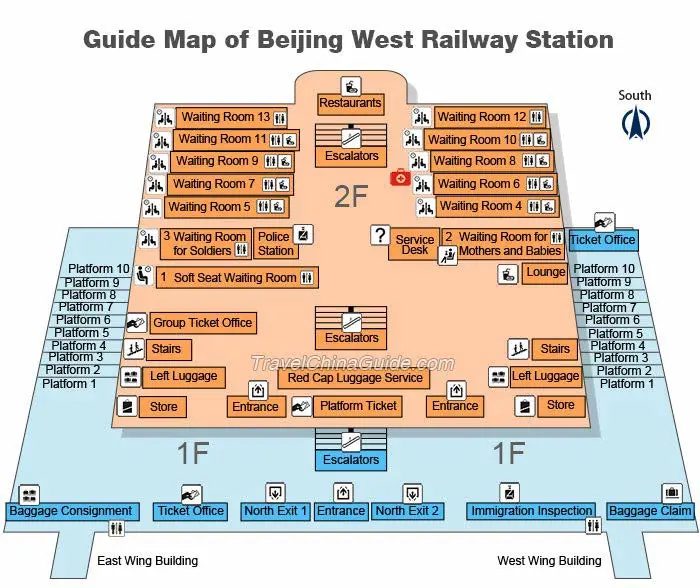
Beijing West train station.

Beijing west railway station is about eight kilometers from the Forbidden City, located at East Lianhuachi Road, Fengtai District.  Most trains traveling between south central, southwest, northwest, and south China are boarded here.

This place is huge and there are so many people here, perhaps the other half of Beijing’s population that wasn’t in the forbidden city.

Getting into the station looked like it was going to be fraught with danger but the tour guide got us into the right queue and then arranged for a separate scanner for the group to help keep us all together

Then we decided to take the VIP service and got to waiting room no 13, the VIP service waiting room which was full to overflowing.  Everyone today was a VIP.  We got the red hat guy to lead us to a special area away from the crowd.

Actually, it was on the other side of the gate, away from the hoards sitting or standing patiently in the waiting room.  It gave us a chance to get something to eat before the long train ride.

The departure is at 4 pm, the train number was G655, and we were told the trains leave on time.  As it is a high-speed train, stops are far and few between, but we’re lucky, this time, in that we don’t have to count stations to know where to get off.

We’re going to the end of the line.

However, it was interesting to note the stops which, in each case, were brief, and you had to be ready to get off in a hurry.

These stops were Shijiazhuang, Zhengzhou East, Luoyang Longmen, Huashan North, and Weinan North.  At night, you could see the lights of these cities from a distance and were like oases in the middle of a desert.  During the day, the most prominent features were high rise apartment blocks and power stations.

A train ride with a difference

G Trains at Wuhan Railway Station

China’s high-speed trains, also known as bullet or fast trains, can reach a top speed of 350 km/h (217 mph).

Over 2,800 pairs of bullet trains numbered by G, D or C run daily connecting over 550 cities in China and covering 33 of the country’s 34 provinces. Beijing-Shanghai high-speed train link the two megacities 1,318 km (819 mi) away in just 4.5 hours.

By 2019, China keeps the world’s largest high-speed rail (HSR) network with a length totaling over 35,000 km (21,750 mi).

To make the five and a half hours go quicker we keep an eye on the speed which hovers between 290 and 305 kph, and sitting there with our camera waiting for the speed to hit 305 which is a rare occurrence, and then, for 306 and then for 307, which happened when we all took a stroll up to the restaurant car to find there had nothing to eat.

I got a strange flavored drink for 20 yuan.

There was a lady manning a trolley that had some food, and fresh, maybe, fruit on it, and she had a sense of humor if not much English.

We didn’t but anything but the barrel of caramel popcorn looked good.

The good thing was, after hovering around 298, and 299 kph, it finally hit 300.

We get to the end of the line, and there is an announcement in Chinese that we don’t understand and attempts to find out if it is the last station fall on deaf ears, probably more to do with the language barrier than anything else.

Then, suddenly the train conductor, the lady with the red hat, comes and tells us it is, and we have fifteen minutes, so we’re now hurrying to get off.

As the group was are scattered up and down the platform, we all come together and we go down the escalator, and, at the bottom, we see the trip-a-deal flags.

X’ian,and the Xi’an North Railway Station

Xi’an North Railway Station is one of the most important transportation hubs of the Chinese high-speed rail network. It is about 8.7 miles (14 km) from Bell Tower (city center) and is located at the intersection of the Weiyang Road and Wenjing Road in Weiyang District.

This time we have a male guide, Sam, who meets us at the end of the platform after we have disembarked.  We have a few hiccups before we head to the bus.  Some of our travelers are not on his list, but with the other group.  Apparently a trip-a-deal mix-up or miscommunication perhaps.

Then it’s another long walk with bags to the bus.  Good thing its a nicely air-conditioned newish bus, and there’s water, and beer for 10 yuan.  How could you pass up a tsing tao for that price?

Xi’an is a very brightly lit up city at night with wide roads.  It is very welcoming, and a surprise for a city of 10 million out in the middle of China.

As with all hotels, it’s about a 50-minute drive from the railway station and we are all tired by the time we get there.

Tomorrow’s program will be up at 6, on the bus 8.40 and off to the soldiers, 2.00 late lunch, then train station to catch the 4.00 train, that will arrive 2 hours later at the next stop.  A not so late night this time.

The Grand Noble Hotel

Outdoor scene

Grand Noble Hotel Xi’an is located in the most prosperous business district within the ancient city wall in the center of Xi’an.

The Grand Noble Hotel, like the Friendship Hotel, had a very flash foyer with tons of polished marble.  It sent out warning signals, but when we got to our room, we found it to be absolutely stunning.  More room, a large bathroom, air conditioning the works.

Only one small problem, as in Beijing the lighting is inadequate.  Other than that it’s what I would call a five-star hotel.  This one is definitely better than the Friendship Hotel.

In the center of the city, very close to the bell tower, one of the few ancient buildings left in Xi’an.  It is also in the middle of a larger roundabout and had a guard with a machine gun.

Sadly there was no time for city center sightseeing.

NANOWRIMO – April 2025 – Day 4

The Fourth Son

There are some things troubleshooters can’t easily troubleshoot, and not one of the methods of solving the problem is shooting the problem.

Being an egregious member of the media might warrant such action, but foreign nationals are not immune from prosecution diplomatic immunity or not.

Our runaway prince in hiding could only do so if he remains with a personal body guard, a member of the Royal Guard, Cherise.

She keeps him safe and out of trouble, but this time, the mess is too big to handle using the usual methods.  She allows the two to have their moment in the restaurant, and then it is off to a safe house

There will be no going home because if the media can find him at a restaurant, then home is no longer safe.  The principality had a consulate and a private residence for the king on state visits.

There, Ruth will have to decide if this is the life she wants.  Notoriety, no such thing as privacy, hounded by the media, and no secret left hidden.

“Sunday in New York”, a romantic adventure that’s not a walk in the park!

“Sunday in New York” is ultimately a story about trust, and what happens when a marriage is stretched to its limits.

When Harry Steele attends a lunch with his manager, Barclay, to discuss a promotion that any junior executive would accept in a heartbeat, it is the fact his wife, Alison, who previously professed her reservations about Barclay, also agreed to attend, that casts a small element of doubt in his mind.

From that moment, his life, in the company, in deciding what to do, his marriage, his very life, spirals out of control.

There is no one big factor that can prove Harry’s worst fears, that his marriage is over, just a number of small, interconnecting events, when piled on top of each other, points to a cataclysmic end to everything he had believed in.

Trust is lost firstly in his best friend and mentor, Andy, who only hints of impending disaster, Sasha, a woman whom he saved, and who appears to have motives of her own, and then in his wife, Alison, as he discovered piece by piece damning evidence she is about to leave him for another man.

Can we trust what we see with our eyes or trust what we hear?

Haven’t we all jumped to conclusions at least once in our lives?

Can Alison, a woman whose self-belief and confidence is about to be put to the ultimate test, find a way of proving their relationship is as strong as it has ever been?

As they say in the classics, read on!

Purchase:

http://tinyurl.com/Amazon-SundayInNewYork

Searching for locations: Hutongs, Beijing, China

What are Hutongs?

In Beijing Hutongs are formed by lines of traditional courtyard residences, called siheyuan.  Neighborhoods were formed by joining many hutongs together. These siheyuan are the traditional residences, usually occupied by a single or extended family, signifying wealth, and prosperity. 

Over 500 of these still exist.Many of these hutongs have been demolished, but recently they have become protected places as a means of preserving some Chinese cultural history.  They were first established in the Yuan Dynasty (1279-1368)Many of these Hutongs had their main buildings and gates built facing south, and lanes connecting them to other hutongs also ran north to south.

Many hutongs, some several hundred years old, in the vicinity of the Bell Tower and Drum Tower and Shichahai Lake are preserved and abound with tourists, many of which tour the quarter in pedicabs.

The optional tour also includes a visit to Shichahai, a historic scenic area consisting of three lakes (Qianhai, meaning Front Sea; Houhai, meaning Back Sea and Xihai, meaning West Sea), surrounding places of historic interest and scenic beauty and remnants of old-style local residences, Hutong and Courtyard.  

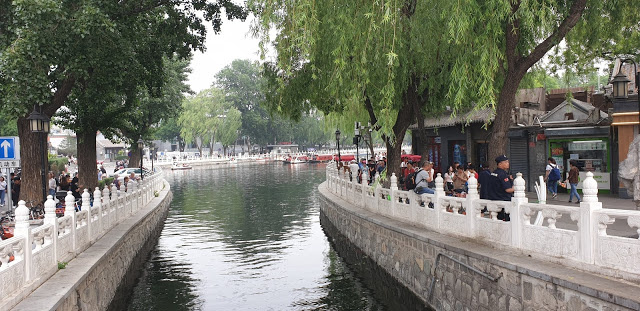
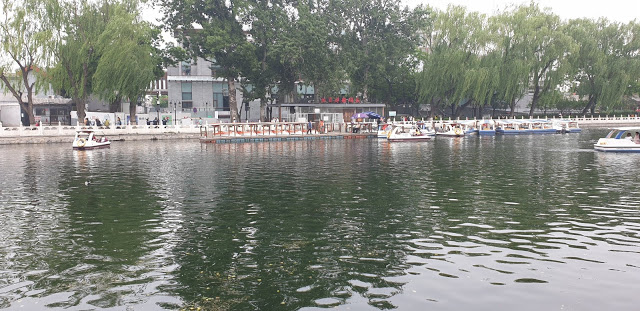
First, we had a short walk through the more modern part of the Hutong area and given some free time for shopping, but we prefer just to meander by the canal.  

There is a lake, and if we had the time, there were boats you could take.

With some time to spare, we take a quick walk down one of the alleyways where on the ground level are small shops, and above, living quarters.

Then we go to the bell and drum towers before walking through some more alleys was to where the rickshaws were waiting.
The Bell tower

And the Drum tower. Both still working today.

The rickshaw ride took us through some more back streets where it was clear renovations were being made so that the area could apply for world heritage listing.  Seeing inside some of the houses shows that they may look dumpy outside but that’s not the case inside.

The rickshaw ride ends outside the house where dinner will be served, and is a not so typical hose but does have all the elements of how the Chinese live, the boy’s room, the girl’s room, the parent’s room, the living area, and the North-south feng shui.

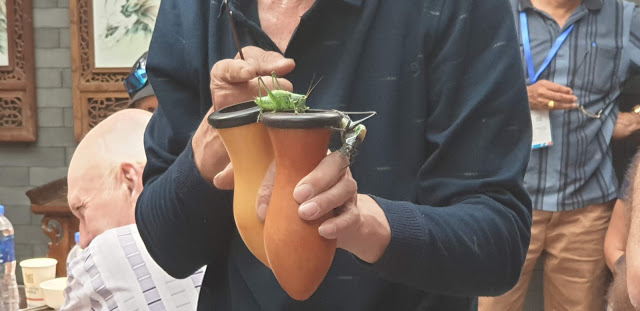
Shortly after we arrive, the cricket man, apparently someone quite famous in Beijing arrives and tells us all about crickets and then grasshoppers, then about cricket racing.  He is animated and clearly enjoys entertaining us westerners.

I’m sorry but the cricket stuff just didn’t interest me.  Or the grasshoppers.

As for dinner, it was finally a treat to eat what the typical Chinese family eats, and everything was delicious, and the endless beer was a nice touch.

And the last surprise, the food was cooked by a man.

“Echoes From The Past”, the past doesn’t necessarily stay there


What happens when your past finally catches up with you?

Christmas is just around the corner, a time to be with family. For Will Mason, an orphan since he was fourteen, it is a time for reflection on what his life could have been, and what it could be.

Until a chance encounter brings back to life the reasons for his twenty years of self-imposed exile from a life only normal people could have. From that moment Will’s life slowly starts to unravel and it’s obvious to him it’s time to move on.

This time, however, there is more at stake.

Will has broken his number one rule, don’t get involved.

With his nemesis, Eddie Jamieson, suddenly within reach, and a blossoming relationship with an office colleague, Maria, about to change everything, Will has to make a choice. Quietly leave, or finally, make a stand.

But as Will soon discovers, when other people are involved there is going to be terrible consequences no matter what choice he makes.

https://amzn.to/2CYKxu4

newechocover5rs

Writing a book in 365 days – 78

Day 78

Do you use a style manual

A “manual of style and usage” is a reference guide that provides rules and guidelines for writing and editing, covering aspects like grammar, punctuation, capitalization, spelling, and formatting, aiming for consistency and clarity.

Style guides, also known as manuals of style and usage, are essential tools for ensuring consistency and clarity in writing and design, particularly across various industries and disciplines. They provide standardized rules for grammar, punctuation, formatting, citation, and other aspects of writing, helping writers and editors maintain a consistent style and tone.

I can think of two: The Elements of Style and Style Manual for Authors, Editors, and Printers (Australia).

I have recently stumbled upon The Chicago Manual of Style, 16th Edition, which is a style guide for American English published since 1906 by the University of Chicago Press

Why are style guides important?

  • Consistency: Style guides ensure that all documents within a specific organization, industry, or publication adhere to a consistent style, making them easier to read and understand.
  • Clarity: By following established rules, style guides help writers avoid ambiguity and ensure that their message is clear and concise.
  • Professionalism: Adhering to a style guide demonstrates professionalism and attention to detail, enhancing the credibility of the written work.
  • Standardization: Style guides provide a framework for writing and design, making it easier for different people to work together on the same project.
  • Facilitating Communication: They help ensure that all content produced by an organization or industry is consistent in its style, tone, and format, making it easier for the audience to understand the message. 

Most of the above has been derived from the internet.