In a word: Saw or Sore or Soar

In the first or second instance of the word Sore, we all know this malady can sometimes fester into something a lot worse.

Or that a person could be a sore loser

Or after spending an hour on the obstacle course, they come off very sore and sorry.  I never quite understood why they should be sorry because no one ever apologises to an inanimate object.  Or do they?

Or perhaps he was sore at his friend for not telling him the truth.

Then, there’s another meaning, saw, which can mean the past tense of seeing, that is, I saw them down by the pool.

I could also use a saw, you know, that thing that cuts through wood, steel, plastic, almost anything.  And yes, it’s possible someone might actually saw through a loaf of bread.

There are hand saws, electric saws, band saws, coping saws, and even a bread knife, all of these have one thing in common, a serrated edge with teeth of different sizes, designed to cut, smoothly or roughly depending on the size.

Add it to bones, and you have Captain Kirk’s description of his medical officer on the Enterprise.  I’m not sure any doctor would like to be addressed as saw-bones.

But then, confusingly in the way only English can do, there’s another word that sounds exactly the same, soar

This, of course, means hovering up there in the heavens, with or without propulsion or oxygen.

Yes, it’s difficult to soar with eagles when you work with turkeys.  I’ve always liked this expression though most of the time people don’t quite understand what it means.

“One Last Look”, nothing is what it seems

A single event can have enormous consequences.

A single event driven by fate, after Ben told his wife Charlotte he would be late home one night, he left early, and by chance discovers his wife having dinner in their favourite restaurant with another man.

A single event where it could be said Ben was in the wrong place at the wrong time.

Who was this man? Why was she having dinner with him?

A simple truth to explain the single event was all Ben required. Instead, Charlotte told him a lie.

A single event that forces Ben to question everything he thought he knew about his wife, and the people who are around her.

After a near-death experience and forced retirement into a world he is unfamiliar with, Ben finds himself once again drawn back into that life of lies, violence, and intrigue.

From London to a small village in Tuscany, little by little Ben discovers who the woman he married is, and the real reason why fate had brought them together.

It is available on Amazon here:  http://amzn.to/2CqUBcz

The cinema of my dreams – I never wanted to go to Africa – Episode 28

Our hero knows he’s in serious trouble.

The problem is, there are familiar faces and a question of who is a friend and who is foe made all the more difficult because of the enemy, if it was the enemy, simply because it didn’t look or sound or act like the enemy.

Now, it appears, his problems stem from another operation he participated in.

I was escorted to a small room that adjoined the interview room, and I was separated from the main event by a one-way mirror.

It was a cliché, but not surprising.

The interrogation room was much the same as an office, with a table, two chairs, and on the side, a cabinet, closed up, an interesting addition to what might be called a boring room.

It was currently empty, and I was the only one in this small room, sitting at a counter, looking in.  In front of me was a stack of writing pads, pens and pencils.  I wondered if I was the only party that was about to observe Lallo and the new arrival.

Five minutes passed before the door to the room next door opened and a hooded man was led in.  His hands were cuffed, and his legs had chains, standard prisoner gear.  

From the man’s manner and body language, it appeared to me as though he was surprised he was being treated so badly, and was not forcefully resistant, but wasn’t making it easy for his captors.

He was asked to sit, and when he didn’t he was forced to sit, with some force, and then his hands were locked onto the metal bar at the table.  His legs were locked to a lower bar.  A precaution in case he decided to attack his interrogator.

One thing I knew for sure, this man would not give up information willingly.

Once he was secured, one guard took up station inside the door, and the other left.  That’s when Lallo made his appearance.  He came in, put a file on the desk, nodded to the guard who remove3d the hood, and then he sat.

I’d expected to see Lallo in full uniform.  He was not.  He was, if anything, dressed casually.  The man on the other side was in a cream suit, very crumpled and slightly stained as if he had not changed during the entire journey from capture to this room.

No doubt part of his conditioning.

“Mr Jacobi, that is your name isn’t it?”

The man stared at him sullenly.  I got the impression he was usually the one asking the questions, not the other way around.

The man lifted his head and stared straight at Lallo.  It was not a look I’d want to be on the end of, but Lallo, I suspect, had been on the end of a lot worse.  And a closer inspection of his face, and features, I noticed that someone had already started the harsher form of interrogation.

“You know this already.  I am an employee of the United States Government, your Government, and you will regret treating me like this.”

“That may be so, but you have failed to define what part of the Government it is you work for.  Is it the CIA?”

Another withering stare, followed by, “You people are so incompetent, the left-hand does not know what the right hand is doing.  I require a telephone so that I can contact my liaison, and this farce will stop, and you will be reprimanded very severely.”

“I seriously doubt anyone knows you are missing yet.  Maybe after a week or so, but we know you keep to yourself, and very few people know your business, a situation, I assure you, benefits us more than it benefits you.  So I will assume you are Jacobi.”

There was a knock on the door, and Monroe came in with a small box, handed it to Lallo, and then left again.

Lallo looked in the box, then pulled out a plastic evidence bag with a mobile phone in it, and put it on the table.  “This is the phone you use to call General Bahti, your contact inside the current government.  It seems it is not registered with a telephone network in your country, but another, shall we say neutral, country.

He reached into the box and pulled out another plastic evidence bag also with mobile phone in it.  “This phone,” he held it up, “is the one you use to talk to the, shall we call them the local resistance.  It’s so much nicer than calling them rebels.”

The man’s eyes followed each bag from the box to the table.  He was almost expressionless.

Then Lallo pulled out another bag, with another phone, “This is the phone which you make and receive calls from your American contact.  It is what we call a burner phone, and was given to you, we think, on a recent visit to this country, by that contact.  I am assuming this is the person you wish to call and who will stop this farce.”

If Lallo was expecting the man to break down there and then, he was sadly mistaken.  There was little if any movement in his expression, perhaps just enough for Lallo to assume he’d got the men behind the phones correct.  That he was basically unmoved at Lallo’s revelations told me this man had a resolve Lallo was going to find hard to shake.

Lallo took the third phone out of the evidence bag and pushed it across the table towards the man.  “You can call your contact now, and you can tell him I would like to speak to him.”

© Charles Heath 2019-2022

The cinema of my dreams – I always wanted to write a war story – Episode 28

For a story that was conceived during those long boring hours flying in a steel cocoon, striving to keep away the thoughts that the plane and everyone in it could just simply disappear as planes have in the past, it has come a long way.

Whilst I have always had a fascination with what happened during the second world war, not the battles or fighting, but in the more obscure events that took place, I decided to pen my own little sidebar to what was a long and bitter war.

And, so, it continues…


By the time they reached the outskirts of Munich, what the Standartenfuhrer considered their biggest hurdle, it was quite dark and almost impossible to see where they were going.

The whole city seemed to have disappeared so effectively was the blackout.  

But there was one benefit, there was little or no traffic on the roads, which lessened the chance of running into another car or truck.

And it was time to refill the tank with two more petrol cans, leaving two remaining.  Filling up now, the Standartenfuhrer said, would get them to Innsbruck.

He sounded confident, but Mayer got the distinct impression it was mostly that he was putting on a brave face.  There had been one instance, the checkpoint before Munich where he nearly lost his nerve.  For the first time, there had been SS guards at the checkpoint, and which had been entirely unexpected.

An SS officer of the same rank had been summoned and he had requested their written orders.  They had paperwork, but Mayer wasn’t sure if it related to their current situation, further confirming his belief this had been a very carefully planned operation to get him out of Germany, and that there was a more pressing reason why.  It definitely had something to do with the V2’s, but had their intelligence services found out about something else, something he didn’t know about?

Given the level of risk to the two men with him, and that at every turn there was a possibility of capture or death, given the level of planning and the run so far, one he would have never thought of trying on his own, he didn’t have a very high level of confidence that they would get away with it.

Those in the SS were not fools, trusted no one, believed nothing they were told, and disregarded anything written on paper.  Check, double-check, then check again.  Take nothing as read.  The document he’d been given on what made a first-class SS officer in the eyes of the Reich, was fundamentally not him, nor most of the German population.

The officer at this checkpoint reminded him of the one who had shot the shooting in the hotel, and for at least ten tense minutes, during which time the other two had conferred quietly in English, one suggestion they cut and run.

That would have invited a hail of machine-gun fire that none of them would survive.

Both looked visibly relieved when he returned, having obviously called the name of the officer who had signed the order.  The only explanation he had for this was that the level of discontent among officers Military of SS must be greater than he thought.


They managed to cross over into Austria without any problems, the route they had taken, a series of back roads and tracks which had been given to them.  Once again, Mayer was surprised that so many people could be working against their own country, but, of what he’d seen, conditions were harsh no matter which part of Germany they were in.

The war was not going the way the German people were being told, and it was hard to see any resolution of the conflict any time soon.

Perhaps everyone in the high command was hoping the new V2 rockets were going to change the country’s fortunes in the war.  If they were, they were going to be bitterly disappointed.  What they needed was the jet-propelled fighters and bombers, something that remarkably had not been implemented years earlier, and would have given them air superiority.

He’d worked on those early jet engines and they were remarkable, and faster than anything the British or the Americans had.  It was hard to comprehend why high command had not pushed forward the new jet-propelled planes that Belin had finally decided to implement.  

And just when the trio had agreed that everything would work out about 100 kilometers from Innsbruck, on the road to the Italian border crossing, they took the wrong route.  It was a mistake brought on by tiredness, and a momentary lapse in concentration.

A checkpoint where there shouldn’t be one.

© Charles Heath 2020

That word: Line – in sayings

There’s more to that word ‘line’, a lot more, making it more confusing, especially for those learning English as a second language.

I keep thinking how I could explain some of the sayings, but the fact is, it’s only my interpretation, which could possibly have nothing to do with its real meaning if it has one.

Such as,

Hook, line, and sinker

We would like to think that this is only used in a fishing depot, but while it is generally, there are other meanings, one of which is, a con artist has taken in a victim completely, or as the saying goes, hook, line, and sinker.

At the end of the line

Exactly what it t says though the connotations of this expression vary.

For me, the most common use is when you’re waiting, like for a table in a restaurant with a time-specific reservation, and you see people who arrive after you, getting a table before you, it’s like being continually sent to the end of the line.

Line ball decision

This is a little more obscure, but for me, it means the result could go either way, and it’s a matter of making a call. The problem is both decisions are right, and unfortunately, you’re the poor sod who has to decide.

It of course partners very well with you can’t please everyone all of the time.

These are the most difficult because one side is going to be aggrieved at the decision especially when it is supposed to be impartial and sometimes isn’t.

Get it over the line

This, of course, has many connotations in sport, particularly rugby when the aim is to get the ball over the try line.

But another more vicarious meaning might be from a senior salesman to a junior, get [the sale] over the line, i.e. get it signed sealed and delivered by any means possible by close of business.

Line of credit

A more straight forward use of the word, meaning the bank will extend credit up to a certain limit, but it’s generally quite large and can feel like its neverending.

Until you have to pay it back.

There’s more, but it can wait till another day.

Writing a book in 365 days – 80

Day 80

Embedding twists and contradictions

Examples: ‘I loved her like a rabbit loves a rattlesnake’, ‘stealing a man’s wife, that’s nothing, but stealing his car, that’s larceny’, and ‘Not every man’s death is a crime’.

Come up with one of your own…

What’s not to say about the notion of a good contradiction? That’s the mainstay of most people I know; you think you know them, and you suddenly realise that you don’t.

And I think this works really well with the love interest in a thriller or mystery.

How do you know whether you are falling for an axe murderer or an innocent bystander?

You don’t.

So, there she is, standing on the corner of the street, under a flickering street lamp, smoking a cigarette. You’re watching the tendrils of smoke drift upwards until a burst of air blasts it away, and then the whole process starts over again.

The burning question in your mind: Will I go up to her and ask if she’s free for a drink?

She might be waiting for someone, or she might be waiting for someone like me to go up and ask her. What have you got to lose?

That voice of the devil sitting on your shoulder chimes in, perhaps she waiting for a chump like you so she can fulfill an order for a kidney, or liver.

And that face, all the innocence of Mata Hari rolled into the epitome of the girl next door.

The thing is, I’d never seen the typical girl next door to know what one looked like.

What am I looking for, a whirlwind romance, a walk in the park, or a quick and painless death?

I took two steps in her direction, determined to make the move, and stopped as a car pulled up beside her. A flick of the butt, a smile, she gets in the car and it drives off.

Oh, well, I guess I’ll be drinking on my own. Again.

©  Charles Heath  2025

Searching for locations: From X’ian to Zhengzhou dong by bullet train, China

Lunch and then off on another high-speed train

We walked another umpteen miles from the exhibition to a Chinese restaurant that is going to serve us Chinese food again with a beer and a rather potent pomegranate wine that had a real kick.  It was definitely value for money at 60 yuan per person.

But perhaps the biggest thrill, if it could be called that, was discovering downstairs, the man who discovered the original pieces of a terracotta soldier when digging a well.  He was signing books bought in the souvenir store, but not those purchased elsewhere.

Some of us even got photographed with him.  Fifteen minutes of fame moment?  Maybe.

After lunch, it was off to the station for another high-speed train ride, this time for about two and a half hours, from X’ian to Zhangzhou dong.

It’s the standard high-speed train ride and the usual seat switching because of weird allocation issues, so a little confusion reigns until the train departs at 5:59.

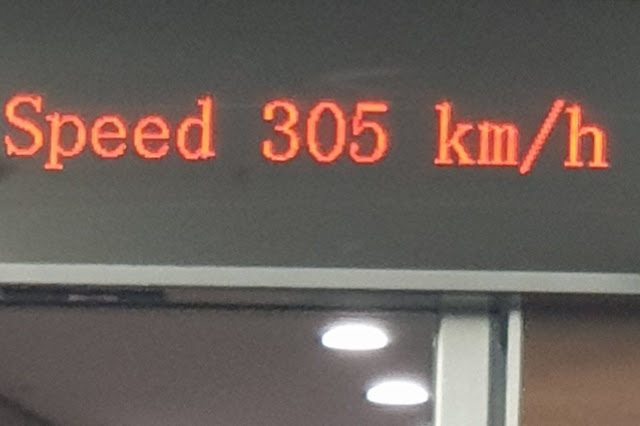
Once we were underway it didn’t take long before we hit the maximum speed

Twenty minutes before arrival, and knowing we only have three minutes to get off everyone is heading for the exit clogging up the passageway.  It wasn’t panic but with the three-minute limit, perhaps organized panic would be a better description.

As it turned out, with all the cases near the door, the moment to door opened one of our group got off, and the other just started putting cases on the platform, and in doing so we were all off in 42 seconds with time to spare.

And this was despite the fact there were about twenty passengers just about up against the door trying to get in.  I don’t think they expected to have cases flying off the train in their direction.

We find our way to the exit and our tour guide Dannie.  It was another long walk to the bus, somewhat shabbier from the previous day, with no leg room, no pocket, and no USB charging point like the day before.  Disappointing.

On the way from the station to the hotel, the tour guide usually gives us a short spiel on the next day’s activities, but instead, I think we got her life history and a song, delivered in high-pitched and rapid Chinglish that was hard to understand.

Not at this hour of the night to an almost exhausted busload of people who’d had enough from the train.  Oh, did I forget the singing, no, it was an interesting rendition of ‘You Are My Sunshine’.

The drive was interesting in that it was mostly in the dark.  There was no street lighting and in comparison to X’ian which was very bright and cheerful, this was dark and gloomy.

Then close to the hotel, our guide said that if we had any problems with the room, she would be in the lobby for half an hour.

That spoke volumes about the hotel they put us in.

NANOWRIMO – April 2025 – Day 6

The Fourth Son

Let’s get a Lear jet and fly out.  That should make an impression.

It does.

The morning our and the evening back

While in the air on the return journey, after a successful day of trying to explain where his country is and what relevance it had, other than that oracle of oracles, the internet said, a problem erupts back home.

It makes the relevance of his return all the more imperative.  That’s just while he’s in the air.  When he lands, the problem becomes a disaster, and by the time he goes to a press conference, the first and only one without much training, he is shoved into the spotlight as a result of an impossible situation.

It is the first of many for the young prince, a principal spokesman for his country alongside the ambassador.

What happened to stargazing on the roof and relaxing with a cold bottle of beer with the most difficult problem; whether hw would be able to see the stars.

It was time to find the witch who had cast a hundred years of bad luck on him.

An excerpt from “Mistaken Identity” – a work in progress

The odds of any one of us having a doppelganger are quite high. Whether or not you got to meet him or her, or be confronted by them was significantly lower. Except of course, unless you are a celebrity.

It was a phenomenon remarkable only for the fact, at times, certain high-profile people, notorious or not, had doubles if only to put off enemies or the general public. Sometimes we see people in the street, people who look like someone we knew, and made the mistake of approaching them like a long lost friend, only to discover an embarrassed individual desperately trying to get away for what they perceive is a stalker or worse.

And then sometimes it is a picture that looms up on a TV screen, an almost exact likeness of you. At first, you are fascinated, and then according to the circumstances, and narrative that is attached to that picture, either flattered or horrified.

For me one turned to the other when I saw an almost likeness of me flash up on the screen when I turned the TV on in my room. What looked to be my photo, with only minor differences, was in the corner of the screen, the newsreader speaking in rapid Italian, so fast I could only translate every second or third word.

But the one word I did recognize was murder. The photo of the man up on the screen was the subject of an extensive manhunt. The crime, the murder of a woman in the very same hotel I was staying, and it was being played out live several floors above me. The gist of the story, the woman had been seen with, and staying with the man who was my double, and, less than an hour ago, the body had been discovered by a chambermaid.

The killer, the announcer said, was believed to be still in the hotel because the woman had died shortly before she had been discovered.

I watched, at first fascinated at what I was seeing. I guess I should have been horrified, but at that moment it didn’t register that I might be mistaken for that man.

Not until another five minutes had passed, and I was watching the police in full riot gear, with a camera crew following behind, coming up a passage towards a room. Live action of the arrest of the suspected killer the breathless commentator said.

Then, suddenly, there was a pounding on the door. On the TV screen, plain to see, was the number of my room.
I looked through the peephole and saw an army of police officers. It didn’t take much to realize what had happened. The hotel staff identified me as the man in the photograph on the TV and called the police.

Horrified wasn’t what I was feeling right then.

It was fear.

My last memory was the door crashing open, the wood splintering, and men rushing into the room, screaming at me, waving guns, and when I put my hands up to defend myself, I heard a gunshot.

And in one very confused and probably near-death experience, I thought I saw my mother and thought what was she doing in Rome?

I was the archetypal nobody.

I lived in a small flat, I drove a nondescript car, had an average job in a low profile travel agency, was single, and currently not involved in a relationship, no children, and according to my workmates, no life.

They were wrong. I was one of those people who preferred their own company, I had a cat, and travelled whenever I could. And I did have a ‘thing’ for Rosalie, one of the reasons why I stayed at the travel agency. I didn’t expect anything to come of it, but one could always hope.

I was both pleased and excited to be going to the conference. It was my first, and the glimpse I had seen of it had whetted my appetite for more information about the nuances of my profession.

Some would say that a travel agent wasn’t much of a job, but to me, it was every bit as demanding as being an accountant or a lawyer. You were providing a customer with a service, and arguably more people needed a travel agent than a lawyer. At least that was what I told myself, as I watched more and more people start using the internet, and our relevance slowly dissipating.

This conference was about countering that trend.

The trip over had been uneventful. I was met at the airport and taken to the hotel where the conference was being held with a number of other delegates who had arrived on the same plane. I had mingled with a number of other delegates at the pre conference get together, including one whose name was Maryanne.

She was an unusual young woman, not the sort that I usually met, because she was the one who was usually surrounded by all the boys, the life of the party. In normal circumstances, I would not have introduced myself to her, but she had approached me. Why did I think that may have been significant? All of this ran through my mind, culminating in the last event on the highlight reel, the door bursting open, men rushing into my room, and then one of the policemen opened fire.

I replayed that last scene again, trying to see the face of my assailant, but it was just a sea of men in battle dress, bullet proof vests and helmets, accompanied by screaming and yelling, some of which I identified as “Get on the floor”.

Then came the shot.

Why ask me to get on the floor if all they were going to do was shoot me. I was putting my hands up at the time, in surrender, not reaching for a weapon.

Then I saw the face again, hovering in the background like a ghost. My mother. Only the hair was different, and her clothes, and then the image was going, perhaps a figment of my imagination brought on by pain killing drugs. I tried to imagine the scene again, but this time it played out, without the image of my mother.

I opened my eyes took stock of my surroundings. What I felt in that exact moment couldn’t be described. I should most likely be dead, the result of a gunshot wound. I guess I should be thankful the shooter hadn’t aimed at anything vital, but that was the only item on the plus side.

I was in a hospital room with a policeman by the door. He was reading a newspaper, and sitting uncomfortably on a small chair. He gave me a quick glance when he heard me move slightly, but didn’t acknowledge me with either a nod, or a greeting, just went back to the paper.

If I still had a police guard, then I was still considered a suspect. What was interesting was that I was not handcuffed to the bed. Perhaps that only happened in TV shows. Or maybe they knew I couldn’t run because my injuries were too serious. Or the guard would shoot me long before my feet hit the floor. I knew the police well enough now to know they would shoot first and ask questions later.

On the physical side, I had a large bandage over the top left corner of my chest, extending over my shoulder. A little poking and prodding determined the bullet had hit somewhere between the top of my rib cage and my shoulder. Nothing vital there, but my arm might be somewhat useless for a while, depending on what the bullet hit on the way in, or through.

It didn’t feel like there were any broken or damaged bones.

That was the good news.

On the other side of the ledger, my mental state, there was only one word that could describe it. Terrified. I was looking at a murder charge and jail time, a lot of it. Murder usually had a long time in jail attached to it.

Whatever had happened, I didn’t do it. I know I didn’t do it, but I had to try and explain this to people who had already made up their minds. I searched my mind for evidence. It was there, but in the confused state brought on by the medication, all I could think about was jail, and the sort of company I was going to have.

I think death would have been preferable.

Half an hour later, maybe longer, I was drifting in an out of consciousness, a nurse, or what I thought was a nurse, came into the room. The guard stood, checked her ID card, and then stood by the door.

She came over and stood beside the bed. “How are you?” she asked, first in Italian, and when I pretended I didn’t understand, she asked the same question in accented English.

“Alive, I guess,” I said. “No one has come and told what my condition is yet. You are my first visitor. Can you tell me?”

“Of course. You are very lucky to be alive. You will be fine and make a full recovery. The doctors here are excellent at their work.”

“What happens now?”

“I check you, and then you have a another visitor. He is from the British Embassy I think. But he will have to wait until I have finished my examination.”

I realized then she was a doctor, not a nurse.

My second visitor was a man, dressed in a suit the sort of which I associated with the British Civil Service.  He was not very old which told me he was probably a recent graduate on his first posting, the junior officer who drew the short straw.

The guard checked his ID but again did not leave the room, sitting back down and going back to his newspaper.

My visitor introduced himself as Alex Jordan from the British Embassy in Rome and that he had been asked by the Ambassador to sort out what he labelled a tricky mess.

For starters, it was good to see that someone cared about what happened to me.  But, equally, I knew the mantra, get into trouble overseas, and there is not much we can do to help you.  So, after that lengthy introduction, I had to wonder why he was here.

I said, “They think I am an international criminal by the name of Jacob Westerbury, whose picture looks just like me, and apparently for them it is an open and shut case.”  I could still hear the fragments of the yelling as the police burst through the door, at the same time telling me to get on the floor with my hands over my head.

“It’s not.  They know they’ve got the wrong man, which is why I’m here.  There is the issue of what had been described as excessive force, and the fact you were shot had made it an all-round embarrassment for them.”

“Then why are you here?  Shouldn’t they be here apologizing?”

“That is why you have another visitor.  I only took precedence because I insisted I speak with you first.  I have come, basically to ask you for a favour.  This situation has afforded us with an opportunity.  We would like you to sign the official document which basically indemnifies them against any legal proceedings.”

Curious.  What sort of opportunity was he talking about?  Was this a matter than could get difficult and I could be charged by the Italian Government, even if I wasn’t guilty, or was it one of those hush hush type deals, you do this for us, we’ll help you out with that.  “What sort of opportunity?”

“We want to get our hands on Jacob Westerbury as much as they do.  They’ve made a mistake, and we’d like to use that to get custody of him if or when he is arrested in this country.  I’m sure you would also like this man brought into custody as soon as possible so you will stop being confused with him.  I can only imagine what it was like to be arrested in the manner you were.  And I would not blame you if you wanted to get some compensation for what they’ve done.  But.  There are bigger issues in play here, and you would be doing this for your country.”

I wondered what would happen if I didn’t agree to his proposal.  I had to ask, “What if I don’t?”

His expression didn’t change.  “I’m sure you are a sensible man Mr Pargeter, who is more than willing to help his country whenever he can.  They have agreed to take care of all your hospital expenses, and refund the cost of the Conference, and travel.  I’m sure I could also get them to pay for a few days at Capri, or Sorrento if you like, before you go home.  What do you say?”

There was only one thing I could say.  Wasn’t it treason if you went against your country’s wishes?

“I’m not an unreasonable man, Alex.  Go do your deal, and I’ll sign the papers.”

“Good man.”

After Alex left, the doctor came back to announce the arrival of a woman, by the way she had announced herself, the publicity officer from the Italian police. When she came into the room, she was not dressed in a uniform.

The doctor left after giving a brief report to the civilian at the door. I understood the gist of it, “The patient has recovered excellently and the wounds are healing as expected. There is no cause for concern.”

That was a relief.

While the doctor was speaking to the civilian, I speculated on who she might be. She was young, not more than thirty, conservatively dressed so an official of some kind, but not necessarily with the police. Did they have prosecutors? I was unfamiliar with the Italian legal system.

She had long wavy black hair and the sort of sultry looks of an Italian movie star, and her presence made me more curious than fearful though I couldn’t say why.

The woman then spoke to the guard, and he reluctantly got up and left the room, closing the door behind him.
She checked the door, and then came back towards me, standing at the end of the bed. Now alone, she said, “A few questions before we begin.” Her English was only slightly accented. “Your name is Jack Pargeter?”

I nodded. “Yes.”

“You are in Rome to attend the Travel Agents Conference at the Hilton Hotel?”

“Yes.”

“You attended a preconference introduction on the evening of the 25th, after arriving from London at approximately 4:25 pm.”

“About that time, yes. I know it was about five when the bus came to collect me, and several others, to take us to the hotel.”

She smiled. It was then I noticed she was reading from a small notepad.

“It was ten past five to be precise. The driver had been held up in traffic. We have a number of witnesses who saw you on the plane, on the bus, at the hotel, and with the aid of closed circuit TV we have established you are not the criminal Jacob Westerbury.”

She put her note book back in her bag and then said, “My name is Vicenza Andretti and I am with the prosecutor’s office. I am here to formally apologize for the situation that can only be described as a case of mistaken identity. I assure you it is not the habit of our police officers to shoot people unless they have a very strong reason for doing so. I understand that in the confusion of the arrest one of our officers accidentally discharged his weapon. We are undergoing a very thorough investigation into the circumstances of this event.”

I was not sure why, but between the time I had spoken to the embassy official and now, something about letting them off so easily was bugging me. I could see why they had sent her. It would be difficult to be angry or annoyed with her.

But I was annoyed.

“Do you often send a whole squad of trigger happy riot police to arrest a single man?” It came out harsher than I intended.

“My men believed they were dealing with a dangerous criminal.”

“Do I look like a dangerous criminal?” And then I realized if it was mistaken identity, the answer would be yes.

She saw the look on my face, and said quietly, “I think you know the answer to that question, Mr. Pargeter.”

“Well, it was overkill.”

“As I said, we are very sorry for the circumstances you now find yourself in. You must understand that we honestly believed we were dealing with an armed and dangerous murderer, and we were acting within our mandate. My department will cover your medical expenses, and any other amounts for the inconvenience this has caused you. I believe you were attending a conference at your hotel. I am very sorry but given the medical circumstances you have, you will have to remain here for a few more days.”

“I guess, then, I should thank you for not killing me.”

Her expression told me that was not the best thing I could have said in the circumstances.

“I mean, I should thank you for the hospital and the care. But a question or two of my own. May I?”

She nodded.

“Did you catch this Jacob Westerbury character?”

“No. In the confusion created by your arrest he escaped. Once we realized we had made a mistake and reviewed the close circuit TV, we tracked him leaving by a rear exit.”

“Are you sure it was one of your men who shot me?”

I watched as her expression changed, to one of surprise.

“You don’t think it was one of my men?”

“Oddly enough no. But don’t ask me why.”

“It is very interesting that you should say that, because in our initial investigation, it appeared none of our officer’s weapons had been discharged. A forensic investigation into the bullet tells us it was one that is used in our weapons, but…”

I could see their dilemma.

“Have you any enemies that would want to shoot you Mr Pargeter?”

That was absurd because I had no enemies, at least none that I knew of, much less anyone who would want me dead.

“Not that I’m aware of.”

“Then it is strange, and will perhaps remain a mystery. I will let you know if anything more is revealed in our investigation.”

She took an envelope out of her briefcase and opened it, pulling out several sheets of paper.

I knew what it was. A verbal apology was one thing, but a signed waiver would cover them legally. They had sent a pretty girl to charm me. Perhaps using anyone else it would not have worked. There was potential for a huge litigation payout here, and someone more ruthless would jump at the chance of making a few million out of the Italian Government.

“We need a signature on this document,” she said.

“Absolving you of any wrong doing?”

“I have apologized. We will take whatever measures are required for your comfort after this event. We are accepting responsibility for our actions, and are being reasonable.”

They were. I took the pen from her and signed the documents.

“You couldn’t add dinner with you on that list of benefits?” No harm in asking.

“I am unfortunately unavailable.”

I smiled. “It wasn’t a request for a date, just dinner. You can tell me about Rome, as only a resident can. Please.”

She looked me up and down, searching for the ulterior motive. When she couldn’t find one, she said, “We shall see once the hospital discharges you in a few days.”

“Then I’ll pencil you in?”

She looked at me quizzically. “What is this pencil me in?”

“It’s an English colloquialism. It means maybe. As when you write something in pencil, it is easy to erase it.”

A momentary frown, then recognition and a smile. “I shall remember that. Thank-you for your time and co-operation Mr. Pargeter. Good morning.”

© Charles Heath 2015-2021

Searching for locations: Terracotta Warriors and Horses Museum, X’ian, China

Terracotta Warriors and Horses Museum

A little history, and anecdotal advice first:

In 1974 a 26-year-old farmer, Yang Jide, was drilling a well and found fragments of the terracotta soldiers and bronze weapons.

What was discovered later was one of the biggest attended burial pits of China’s first feudal Emperor, Qin Shi Huang.  In the following years remains had been found in 3 pits, yielding at least 8,000 soldiers and horses, and over 100 chariots.  The soldiers were infantry, cavalry, and others.

Emperor Qin was born in 259 BC and died in 210 BC.  He began building a mausoleum for himself at the foot of Mount Li when he was 13.  Construction took 38 years, from 247 BC to 208 BC.  It was divided into 3 stages and involved 720,000 conscripts.

The pits of pottery figures are 1.5 km east of Emperor Qin’s mausoleum.  Pit 1 has about 6,000 terracotta armored warriors and horses and 40 wooden chariots.  Pit 2 is estimated to have over 900 terracotta warriors and 350 terracotta horses with about 90 wooden chariots.  Pit 3 had so far yielded only 66 pottery figures and one chariot drawn by four horses.

Official records say it was discovered later that it was likely Xiang Yu, a rebel, intentionally damaged the Mausoleum and the soldiers in the pits, by setting fire to the wooden roof rafters, and these fell on and broke the warriors into pieces.

However, we were told that after the terracotta warriors were completed, the Emperor ordered the builders to be killed so that they would not tell anyone about the warriors, and then of those that remained alive deliberately smashed all of the artifacts.

The thing is, all of the terracotta figures that have been found are in pieces, and they need computers to piece them back together again.

The visit:
The first impression is the size of the car park and the number of buses parked in the lot, and a hell of a lot more outside up the road an off on side streets.  Obviously, it costs money to park in the parking lot.

The other first impressions; the numbers waiting to get in were not as many as yesterday outside the forbidden city, in fact, a lot less.

Be warned there’s a long walk from the entrance gate where your bags are scanned and a body scan as well, before admittance.  This walk is through a landscaped area which it is expect might sometime in the future reveal more soldiers, or other artifacts.

At the end of the walk that takes about ten minutes, you can get a one-way ride to the second checkpoint, but we opted not to as no one else in our group did.

That walk is the warm-up exercise to an organized viewing of the exhibits after going through a second ticket checkpoint.  On the other side, we had to hand our tickets back to the tour guide which was disappointing not to end up with a memento of actually having been there.

So, on the other side in the courtyard, the guide told us the most important parts of the exhibition, that we should spend most of the time looking at pit 1, and then spent a little time in 2 which is only there in the first stages of excavation.  Then move onto the museum if only to see the replica chariots.

We do.

The chariots were small but interesting

The horses were better and intricately detailed

These are soldiers, perhaps complete examples of those types found in the end pit.

This is one of the archers.  You can tell by the way he wears his hair.

Pit 2

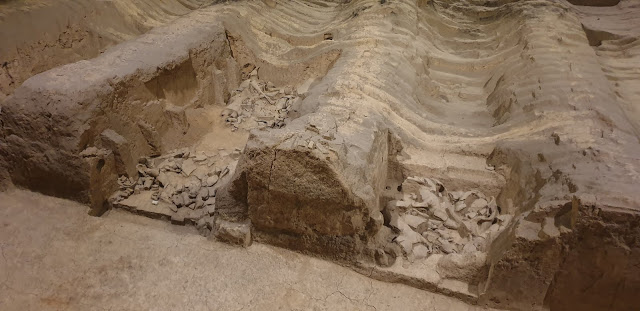
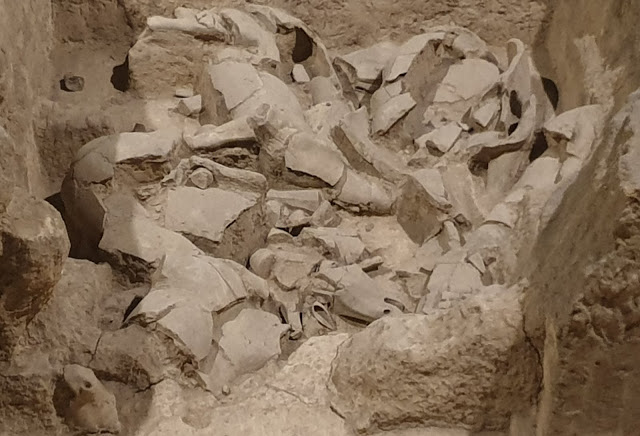
The excavation of this pit has only just begun, so it is possible to see where they have carefully removed the top cover, and you can see the broken parts of the warriors lying in a heap.

Some parts of the warriors are more discernible closer up

These parts are carefully extracted and taken to the ‘hospital’ where they are digitised and the computer will match each part with the warrior it belongs to.

Pit 1

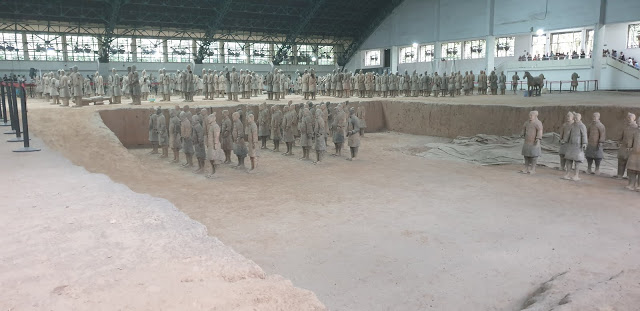
This has quite a number of standing soldiers that have been glued back together, but not necessarily complete and I notice a number if the statues were incomplete. And if they cannot find the missing pieces, then they are not added to or filled in.

The scale of the pit is enormous, and they have hardly scratched the surface in the restoration process.

What is there is a number of horses as well.

That’s at the front of the pit, a long line of statues, and what is clear is the location of the well where the first fragments were found by a farmer.

There are about eight lines of soldiers, and some lining the sides.

Midway down there is a large area currently under excavation

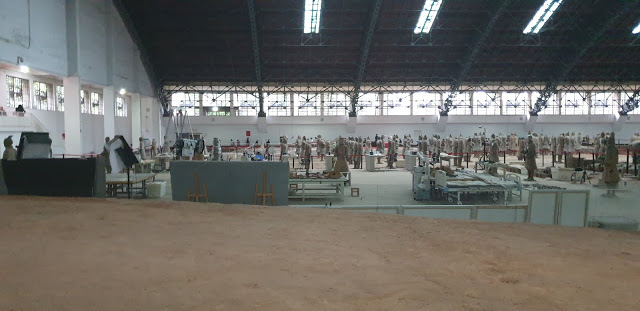
At the back is the hospital where the soldiers are reassembled.  There’s nearly a hundred in the various stages of rebuilding.  These days the soldiers are rebuilt using computer imaging.

The hospital area is where they are put back together

And these are some of the statues in various stages of reconstruction

Another two views of the size and scale of the reconstruction project

The coffee shop is also a sales centre, but there are too many people waiting for coffee and too few places to sit down.