This case has everything, red herrings, jealous brothers, femme fatales, and at the heart of it all, greed.
See below for an excerpt from the book…
Coming soon!
An excerpt from the book:
When Harry took the time to consider his position, a rather uncomfortable position at that, he concluded that he was somehow involved in another case that meant very little to him.
Not that it wasn’t important in some way he was yet to determine, it was just that his curiosity had got the better of him, and it had led to this: sitting in a chair, securely bound, waiting for someone one of his captors had called Doug.
It was not the name that worried him so much, it was the evil laugh that had come after the name was spoken.
Doug what? Doug the ‘destroyer’, Doug the ‘dangerous’, Doug the ‘deadly’; there was any number of sinister connotations, and perhaps that was the point of the laugh, to make it more frightening than it was.
But there was no doubt about one thing in his mind right then: he’d made a mistake. A very big. and costly, mistake. Just how big the cost, no doubt he would soon find out.
His mother, and his grandmother, the wisest person he had ever known, had once told him never to eavesdrop.
At the time he couldn’t help himself and instead of minding his own business, listening to a one-sided conversation which ended with a time and a place. The very nature of the person receiving the call was, at the very least, sinister, and, because of the cryptic conversation, there appeared to be, or at least to Harry, criminal activity involved.
For several days he had wrestled with the thought of whether he should go. Stay on the fringe, keep out of sight, observe and report to the police if it was a crime. Instead, he had willingly gone down the rabbit hole.
Now, sitting in an uncomfortable chair, several heat lamps hanging over his head, he was perspiring, and if perspiration could be used as a measure of fear, then Harry’s fear was at the highest level.
Another runnel of sweat rolled into his left eye, and, having his hands tied, literally, it made it impossible to clear it. The burning sensation momentarily took his mind off his predicament. He cursed and then shook his head trying to prevent a re-occurrence. It was to no avail.
Let the stinging sensation be a reminder of what was right and what was wrong.
It was obvious that it was the right place and the right time, but in considering his current perilous situation, it definitely was the wrong place to be, at the worst possible time.
It was meant to be his escape, an escape from the generations of lawyers, what were to Harry, dry, dusty men who had been in business since George Washington said to the first Walthenson to step foot on American soil, ‘Why don’t you become a lawyer?” when asked what he could do for the great man.
Or so it was handed down as lore, though Harry didn’t think Washington meant it literally, the Walthenson’s, then as now, were not shy of taking advice.
Except, of course, when it came to Harry.
He was, Harry’s father was prone to saying, the exception to every rule. Harry guessed his father was referring to the fact his son wanted to be a Private Detective rather than a dry, dusty lawyer. Just the clothes were enough to turn Harry off the profession.
So, with a little of the money Harry inherited from one of his aunts, he leased an office in Gramercy Park and had it renovated to look like the Sam Spade detective agency, you know the one, Spade and Archer, and The Maltese Falcon.
There’s a movie and a book by Dashiell Hammett if you’re interested.
So, there it was, painted on the opaque glass inset of the front door, ‘Harold Walthenson, Private Detective’.
There was enough money to hire an assistant, and it took a week before the right person came along, or, more to the point, didn’t just see his business plan as something sinister. Ellen, a tall cool woman in a long black dress, or so the words of a song in his head told him, fitted in perfectly.
She’d seen the movie, but she said with a grin, Harry was no Humphrey Bogart.
Of course not, he said, he didn’t smoke.
Three months on the job, and it had been a few calls, no ‘real’ cases, nothing but missing animals, and other miscellaneous items. What he really wanted was a missing person. Or perhaps a beguiling, sophisticated woman who was as deadly as she was charming, looking for an errant husband, perhaps one that she had already ‘dispatched’.
Or for a tall, dark and handsome foreigner who spoke in riddles and in heavily accented English, a spy, or perhaps an assassin, in town to take out the mayor. The man was such an imbecile Harry had considered doing it himself.
Now, in a back room of a disused warehouse, that wishful thinking might be just about to come to a very abrupt end, with none of the romanticized trappings of the business befalling him. No beguiling women, no sinister criminals, no stupid policemen.
Just a nasty little man whose only concern was how quickly or how slowly Harry’s end was going to be.
A convoluted explanation on the reasons for this memorial came down to it being about the deaths of those involved in the 1923 Erqi strike, though we’re not really sure what the strike was about.
So, after a little research, this is what I found:
The current Erqi Tower was built in 1971 and was, historically, the tallest building in the city. It is a memorial to the Erqi strike and in memory of Lin Xiangqian and other railway workers who went on strike for their rights, which happened on February 7, 1923.
It has 14 floors and is 63 meters high. One of the features of this building is the view from the top, accessed by a spiral staircase, or an elevator, when it’s working (it was not at the time of our visit).
There seems to be an affinity with the number 27 with this building, in that
It’s the 27th memorial to be built
to commemorate the 27th workers’ strike
located in the 27th plaza of Zhengzhou City.
We drive to the middle of the city where we once again find traveling in kamikaze traffic more entertaining than the tourist points
When we get to the drop-off spot, it’s a 10-minute walk to the center square where the tower is located on one side. Getting there we had to pass a choke point of blaring music and people hawking goods, each echoing off the opposite wall to the point where it was deafening. Too much of it would be torture.
But, back to the tower…
It has 14 levels, but no one seemed interested in climbing the 14 or 16 levels to get to the top. The elevator was broken, and after the great wall episode, most of us are heartily sick of stairs.
The center square was quite large but paved in places with white tiles that oddly reflected the heat rather than absorb it. In the sun it was very warm.
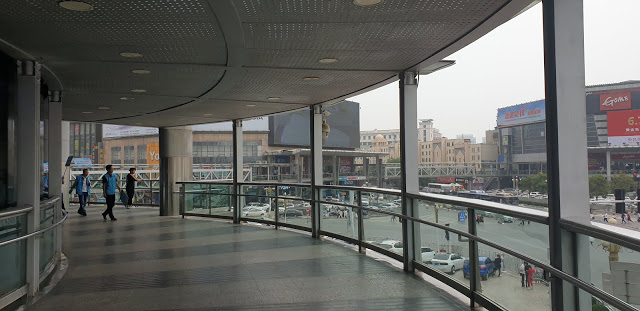
Around the outside of two-thirds of the square, and crossing the roads, was an elevated walkway, which if you go from the first shops and around to the other end, you finish up, on the ground level, at Starbucks.
This is the Chinese version and once you get past the language barrier, the mixology range of cold fruity drinks are to die for, especially after all that walking. Mine was a predominantly peach flavor, with some jelly and apricot at the bottom. I was expecting sliced peaches but I prefer and liked the apricot half.
A drink and fruit together was a surprise.
Then it was the walk back to the meeting point and then into the hotel to use the happy house before rejoining the kamikaze traffic.
We are taken then to the train station for the 2:29 to our next destination, Suzhou, the Venice of the East.
There was something about this one that resonated with me.
This is a novel about a world generally ruled by perception, and how people perceive what they see, what they are told, and what they want to believe.
I’ve been guilty of it myself as I’m sure we all have at one time or another.
For the main characters Harry and Alison there are other issues driving their relationship.
For Alison, it is a loss of self-worth through losing her job and from losing her mother and, in a sense, her sister.
For Harry, it is the fact he has a beautiful and desirable wife, and his belief she is the object of other men’s desires, and one in particular, his immediate superior.
Between observation, the less than honest motives of his friends, a lot of jumping to conclusions based on very little fact, and you have the basis of one very interesting story.
When it all comes to a head, Alison finds herself in a desperate situation, she realises only the truth will save their marriage.
But is it all the truth?
What would we do in similar circumstances?
Rarely does a book have me so enthralled that I could not put it down until I knew the result. They might be considered two people who should have known better, but as is often the case, they had to get past what they both thought was the truth.
And the moral of this story, if it could be said there is one, nothing is ever what it seems.
Is there a reason why you would not want to tell it or that if you did, some people might find it uncomfortable?
The problem is, no matter what you write someone out there isn’t going to like it.
And there is a raft of subjects to write about that causes concern, but these are sometimes stories that have to be told.
I have one such story, and to me, the telling of it would not fit the mainstream opinion because people are very divided over it. There are reasons for this, and they are being, in my opinion, sensationalised to polarise a particular stance.
The subject: Transgenders.
Like I said, it’s a story I would like to write about, but I know what the response is going to be.
And that isn’t to say that I do not have my own biases, the baggage that we are given when we are younger, where schools and teachers teach us what is supposedly the norms they will need to work within for the rest of their lives.
In my day it was that the man went to work to earn the living that provided a house, food, and everything else, while the woman stayed home, had children and looked after the man.
Yes, I can hear 50 percent of the population laughing at that one, but how different is that societal norm to that where we are now taught that transgenders are sub humans that should be scorned and abandoned because they don’t fit the definition of man or woman?
Thankfully, I grew out of that, and women can vote, work, drive cars, and do anything they desire, though it seems there is a new movement that wants to take away all those rights and go back to the Stone Age.
Again, another very touchy subject, and that will eventually prevent the possibility of writers putting forward the various viewpoints for larger discussion.
Try going back another hundred years, when women were the sub-human species, little more than a man’s possession.
This is probably the only time I will raise the subject, as an instance of what writers may or may not write about, a highlight that public opinion fueled by people in power does eventually affect what can be written.
It’s something that we should all be mindful of, as well as keeping an open mind.
With my attention elsewhere, I walked into a man who was hurrying in the opposite direction. He was a big man with a scar running down the left side of his face from eye socket to mouth, and who was also wearing a black shirt with a red tie.
That was all I remembered as my heart almost stopped.
He apologized as he stepped to one side, the same way I stepped, as I also muttered an apology.
I kept my eyes down. He was not the sort of man I wanted to recognize later in a lineup. I stepped to the other side and so did he. It was one of those situations. Finally getting out of sync, he kept going in his direction, and I towards the bus, which was now pulling away from the curb.
Getting my breath back, I just stood riveted to the spot watching it join the traffic. I looked back over my shoulder, but the man I’d run into had gone. I shrugged and looked at my watch. It would be a few minutes before the next bus arrived.
Wait, or walk? I could also go by subway, but it was a long walk to the station. What the hell, I needed the exercise.
At the first intersection, the ‘Walk’ sign had just flashed to ‘Don’t Walk’. I thought I’d save a few minutes by not waiting for the next green light. As I stepped onto the road, I heard the screeching of tires.
A yellow car stopped inches from me.
It was a high powered sports car, perhaps a Lamborghini. I knew what they looked like because Marcus Bartleby owned one, as did every other junior executive in the city with a rich father.
Everyone stopped to look at me, then the car. It was that sort of car. I could see the driver through the windscreen shaking his fist, and I could see he was yelling too, but I couldn’t hear him. I stepped back onto the sidewalk, and he drove on. The moment had passed and everyone went back to their business.
My heart rate hadn’t come down from the last encounter. Now it was approaching cardiac arrest, so I took a few minutes and several sets of lights to regain composure.
At the next intersection, I waited for the green light, and then a few seconds more, just to be sure. I was no longer in a hurry.
At the next, I heard what sounded like a gunshot. A few people looked around, worried expressions on their faces, but when it happened again, I saw it was an old car backfiring. I also saw another yellow car, much the same as the one before, stopped on the side of the road. I thought nothing of it, other than it was the second yellow car I’d seen.
At the next intersection, I realized I was subconsciously heading towards Harry’s new bar. It was somewhere on 6th Avenue, so I continued walking in what I thought was the right direction.
I don’t know why I looked behind me at the next intersection, but I did. There was another yellow car on the side of the road, not far from me. It, too, looked the same as the original Lamborghini, and I was starting to think it was not a coincidence.
Moments after crossing the road, I heard the roar of a sports car engine and saw the yellow car accelerate past me. As it passed by, I saw there were two people in it, and the blurry image of the passenger; a large man with a red tie.
Now my imagination was playing tricks.
It could not be the same man. He was going in a different direction.
In the few minutes I’d been standing on the pavement, it had started to snow; early for this time of year, and marking the start of what could be a long cold winter. I shuddered, and it was not necessarily because of the temperature.
I looked up and saw a neon light advertising a bar, coincidentally the one Harry had ‘found’ and, looking once in the direction of the departing yellow car, I decided to go in. I would have a few drinks and then leave by the back door if it had one.
It can relate to an object such as an engine in a car when sitting at traffic lights. Then the engine is not in gear or under any load, therefore it is idle.
That he is idle might mean he is currently not working or refuses to work. Then it could be said he is bone idle which is to say he is any or all of lazy, or shiftless, even indolent
It could refer to the time when nothing is happening.
It could also refer to money in accounts not earning any interest
How many of us indulge in idle chatter, which is meaningless?
And how many of us have made an idle threat, especially to a child who refuses to go to bed, or sleep.
This is not to be confused with idol
An idol is generally thought of as a representation of a god, one used as an object of worship.
An idol can also be a person who is greatly admired, like a celebrity or superstar or a hero.
It could also be a figment of the imagination.
Then there is idyll which could be an extremely happy place, or a picturesque period or situation, one that is unsustainable
50 photographs, 50 stories, of which there is one of the 50 below.
They all start with –
A picture paints … well, as many words as you like. For instance:
And the story:
It was once said that a desperate man has everything to lose.
The man I was chasing was desperate, but I, on the other hand, was more desperate to catch him.
He’d left a trail of dead people from one end of the island to the other.
The team had put in a lot of effort to locate him, and now his capture was imminent. We were following the car he was in, from a discrete distance, and, at the appropriate time, we would catch up, pull him over, and make the arrest.
There was nowhere for him to go.
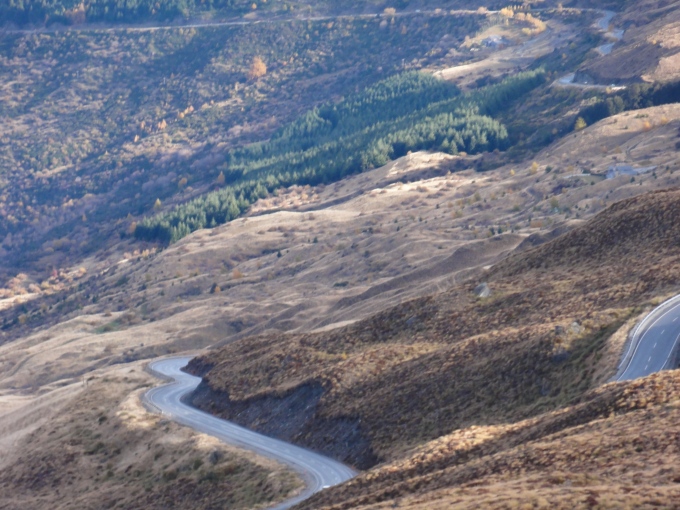
The road led to a dead-end, and the only way off the mountain was back down the road were now on. Which was why I was somewhat surprised when we discovered where he was.
Where was he going?
“Damn,” I heard Alan mutter. He was driving, being careful not to get too close, but not far enough away to lose sight of him.
“What?”
“I think he’s made us.”
“How?”
“Dumb bad luck, I’m guessing. Or he expected we’d follow him up the mountain. He’s just sped up.”
“How far away?”
“A half-mile. We should see him higher up when we turn the next corner.”
It took an eternity to get there, and when we did, Alan was right, only he was further on than we thought.”
“Step on it. Let’s catch him up before he gets to the top.”
Easy to say, not so easy to do. The road was treacherous, and in places just gravel, and there were no guard rails to stop a three thousand footfall down the mountainside.
Good thing then I had the foresight to have three agents on the hill for just such a scenario.
Ten minutes later, we were in sight of the car, still moving quickly, but we were going slightly faster. We’d catch up just short of the summit car park.
Or so we thought.
Coming quickly around another corner we almost slammed into the car we’d been chasing.
“What the hell…” Aland muttered.
I was out of the car, and over to see if he was in it, but I knew that it was only a slender possibility. The car was empty, and no indication where he went.
Certainly not up the road. It was relatively straightforward for the next mile, at which we would have reached the summit. Up the mountainside from here, or down.
I looked up. Nothing.
Alan yelled out, “He’s not going down, not that I can see, but if he did, there’s hardly a foothold and that’s a long fall.”
Then where did he go?
Then a man looking very much like our quarry came out from behind a rock embedded just a short distance up the hill.
“Sorry,” he said quite calmly. “Had to go if you know what I mean.”
I’d lost him.
It was as simple as that.
I had been led a merry chase up the hill, and all the time he was getting away in a different direction.
I’d fallen for the oldest trick in the book, letting my desperation blind me to the disguise that anyone else would see through in an instant.
It was a lonely sight, looking down that road, knowing that I had to go all that way down again, only this time, without having to throw caution to the wind.
The problem is, there are familiar faces and a question of who is a friend and who is foe made all the more difficult because of the enemy, if it was the enemy, simply because it didn’t look or sound or act like the enemy.
Now, it appears, his problems stem from another operation he participated in, and because of it, he has now been roped into what might be called a suicide mission.
Onboard the plane shortly after it took off, I watched Monroe go to each of the team and give them a folder with their role, and, no doubt, instructions on what they had to do, and to handle the equipment they were assigned. The list I’d seen required a sound technician, a grip, a cameraman, his assistant, the director, the producer, which I took to be Monroe, and a few other production assistants.
None looked happy, and probably already knew what the cover story would be. I didn’t see or hear any objections, each just took their folder and started on their homework.
She didn’t spend much time with Jacobi, just enough to tell him he was going to be the guide. It was a role he was most suited to, and that of local liaison. At least it would explain why he was with us.
After that, she came to see me.
“Was it your idea or Lallo’s?” I asked.
“Lallo’s. I’m as surprised as you, but you have to admit it’s a great cover story.”
“For a group who wouldn’t know one end of the camera from the other.”
“Plenty of time to learn. You don’t have to worry. All you have to do is be perennially bad-tempered and yell a lot. I’m sure you can do that without having me tell you how to.”
“No. probably not. Bamfield said it all the equipment worked.”
“When we take the C4, detonators, grenades, and a few other assorted armaments out it will.”
“You know where the other stuff is,” I said, hoping she understood that it was the diamonds I was talking about.
“Somewhere in one of the boxes. It was best not to tell anyone, so if anything happens, we can’t give it away. We can worry about that once we get past the border. I suggest you get your head down. At least one of us has to be sharp at the other end when we land.”
With that, she went back to her corner, ran her eye over the team now deep in their studies, then looked like she was going to get some sleep.
After a few hours, the enthusiasm to learn had died down, and each of the team members made themselves comfortable. There would be more time to study on the other side of the fuel stop. Everyone on board got what sleep they could, not that it was the best of places in the cargo hold of a C-130. One destination we were all familiar with was that of Djibouti when we would set down to refuel at the airbase there.
It was a half-hour stop, and, as Monroe advised, we didn’t leave the plane. It was best no one knew we were aboard or what we were doing, a feat I thought quite remarkable because if it was my airbase, I’d want to know.
But, as airbases went, it was the same as the rest.
Back in the air, we were heading for Uganda. It was another 6 or 7 hours, so it was a good time to get some more rest before we landed. I had no idea when the next time would be that there would be time for some shuteye.
I’d been keeping an eye on Monroe. She appeared to be the liaison for everything, and had accompanied the pilot to the base tower, most likely to file the flight plan, one of several I imagine, and to report back to Bamfield. It explained why the pilot returned without her, and she didn’t get back until 15 minutes before we were due to leave.
Should I be worried? There wasn’t much point.
After an hour, I went up the back of the plane and sat next to Jacobi. He had been ostracised by the rest of the team; an order given by Monroe for them to leave him alone. He’d been escorted onto the plane by two burly military policemen, and his bag of equipment given to Monroe for safekeeping, so we were sure from the time he left the cell at the black site to getting on the plane he had communicated with anyone.
Even so, I was sure he had been in similar situations before, and he was still alive to tell about it. If he had a plan, whatever that plan was, we would soon find out.
In the meantime, I thought he might have an interesting story to tell, and I had a few hours to kill.
He sullenly watched me come down the fuselage, and then sit next to him, loosely putting what passed as a seat belt on just in case we hit an air pocket. The flight was not as smooth as it might be on a commercial airliner and was certainly a lot noisier.
“Have you spoken to the right people yet?” I almost had to yell in his ear.
Lallo had said he was going to get Jacobi to call his friendly General in the Congo army to smooth the way, and it would be interesting to know under what circumstances Jacobi had explained our arrival at his border. And another to tell the kidnappers we were on our way. Monroe said he had made several supervised phone calls, but not exactly who to.
We had to pray that the General would be among those to also help us locate the targets and, once the exchange was made, assist us in our departure, for a small sum to compensate them for the inconvenience.
He knew why I’d come to see him. “The captors know we are coming, and hopefully before the time limit has passed. They will kill them this time if we don’t get there in time.”
“I’m sure they’d like us to think that, but you know as well as I do they need the ransom for their ongoing operations. Let’s hope it doesn’t come down to plan f which is where they kill us, the hostages, and just take the ransom. Either way, I hate to be the one who is only going to make things worse, but I don’t get to decide what’s right or wrong.”
“It’s how it works out there. Everyone is available for a price. If it wasn’t this lot, it’d be another or another.”
“Or the military, maybe, looking to cash in because the state doesn’t pay them enough. That’s why we’re putting you at the head of the procession. If we’re ambushed, you’ll be the first to go.”
“I admire your lack of faith in me.”
“You haven’t done anything to inspire faith, Jacobi. But so long as you keep your word, and do everything right, I won’t have to shoot you.”
There was no horrified look. He knew the score of being in the ‘Mr. In-Between’ business. He would no doubt get a share of the diamonds for brokering the deal, on top of whatever Lallo offered him, and a cut of the General and his men’s fees for guaranteeing our safety. I guess his business also had its hazards, wasn’t for the faint-hearted, and for those working all sides of the fence, a particularly exciting time.
Generals, soldiers, kidnappers, rebels, practically every man and his dog had an itchy trigger finger.
“It’s not me you have to worry about.”
“How so?”
“I didn’t betray them the last time, and that person was never identified.”
A good point. “Then let’s hope no one else knows we’re coming, or what we’re bringing as ransom.”
He looked at me, a look that told me I thought he might just make a play for the diamonds himself and forget about the targets. It was a very tempting ransom.
“You know how it is. Spies are everywhere.”
“Just make sure you’re not one of them.”
I think I said it with just enough sincerity that he believed me.
“It’s not worth my while, I assure you. Once you’re involved in a double-cross, you cease to be of worth to anyone. I will not be the source of your problems if there are any.”
For a man who’d already been caught out in a raft of lies, there was nothing he could say that would make me trust him. He was going to require an escort once we landed.
I had two perfect candidates for the job. Williamson and Shurl. From what I had observed on the ground before we boarded the plane, and in the plane, they stuck together. I got the impression they knew each other.
After I left Jacobi, I told them what I wanted them to do.
It was the day for sullen responses. They didn’t want to be babysitters. Tough.
Next, I went and visited Mobley, sitting closer to the front of the plane, by himself. Monroe had sat with him for an hour or so before we reached Djibouti, and it had raised a small flag.
I staggered towards him, the pilots deciding to take the rough path through the sky, and almost fell into the seat next to him.
He didn’t look at me the whole time, even when I’d sat down. Was he pretending to ignore me, or had he decided he was above taking my orders?
“I’ve got a few hours to waste so if you think I’m going away forget it,” I said, loud enough to get his attention.
A slight flutter of an eyelid. Not asleep.
“Monroe tells me you’re in charge of this motley crew,” he said, still not looking at me.
“Not because I want to be. I’m not sure what your reason is to be here, and, frankly, I don’t care, but I really don’t want to be here. I wasn’t given a choice. I’m guessing you did from what I’ve been told. We don’t have time to debate the issue. What I want you to do is when we arrive at the base, is hang back, come up with whatever excuse will fly, and give us several hours head start. You’ll be with one of Chiswick’s men. What’s important is to check no one follows us.”
“You think someone might?” A look of almost interest.
“I’m sure of it. There’s no way we will get to the base in Uganda, no matter how far from civilization it is, and not be noticed, or worse, that someone already knows we’re coming.”
“What’s the ultimate rendezvous?”
“Over the border in the Congo.” I passed him a hand-drawn map of the area, from the landing strip to the GPS co-ordinates of the exchange point in the Congo, but not the track that we would be taking, some of which I hoped might be by the river. I think Monroe had given him as much detail of the job as she could, as she probably had all of them.
“Monroe in the loop?”
“She will be by the time we land.”
“Good.”
Eyes closed again; the conversation was over.
Time to have a talk to Monroe.
“Got some good news,” she said when I sat next to her.
“We’re turning around and going home?”
“Where is home?”
It was an interesting question. I’d been bounced around so many airbases, I don’t think I’d had a permanent fixed address from the day I signed up. Was it where I used to live? No point going back, everyone I’d known back then had either moved on or died. Technically I was now an orphan, and unlike others, I had no family of my own to go home to.
“No idea anymore, I’m afraid. So, what’s this good news.”
“We have an exit strategy. Bamfield told me to tell you everything is in place. All we have to do is liberate a plane and we’re on our way home. It’s the reason why Davies is on the mission, Bamfield says she can fly anything.”
“I’ve never heard of a plane called ‘anything’.”
“You know what I mean.”
“Any other details?”
“We’ll know exactly what the score is when we get there. That’s all I know at the moment.”
“There’s more?”
“Hopefully through the pilot’s last contact with Bamfield. Otherwise, it’s going to be just another boring day at the office.”
For a story that was conceived during those long boring hours flying in a steel cocoon, striving to keep away the thoughts that the plane and everyone in it could just simply disappear as planes have in the past, it has come a long way.
Whilst I have always had a fascination with what happened during the second world war, not the battles or fighting, but in the more obscure events that took place, I decided to pen my own little sidebar to what was a long and bitter war.
And, so, it continues…
…
Neither of us knew what to expect, and I had tried to steel myself for the worst. It was war, and I’d seen some awful things, but when it had happened to people you knew, and to a certain extent civilians that were nothing to do with the war, it was all that much harder to both understand why, and see.
There were dead, I counted at least ten, villagers who were innocent of any crime other than the fact they didn’t like Leonardo. They had no chance, shot and left to die in almost the same positions I’d seen them when I’d left earlier.
But, after checking everywhere, I could not find Martina.
Then Jack appeared. He came up to me and tugged on my trouser leg. “So this is where you got to?” I said. Why had he come back, though?
He headed back further into the cavern near where we had been earlier, a doorway I had not seen. It was ajar. Jack simply stood still, looking at it.
I pulled out my service pistol, not wanting to be caught unaware, and moved quietly towards the door, then slowly pulled it open.
At first, I saw nothing, then, looking down, I saw a figure on the floor. I knelt down to see who it was. The boy, Enrico. I’d seen his parents earlier, both dead. He must have escaped and hidden in the room, and, luckily, no one had followed him.
Except for Jack. Or had Jack come back, having sensed something awful had happened?
I checked him but there didn’t seem to be any wounds, and, when I shook his shoulder, he jolted, and jumped up ready to attack me, until he saw who it was, then grabbed hold of me. He was shaking, and suddenly sobbing. He had seen what had happened, and it was not something he was going to forget.
And he was going to want to exact revenge.
He was not the only one.
It took ten minutes before he had calmed, and managed to sit, leaning back against the wall. The room was where empty bottles were stored on wooden boxes, and he must have hidden among the crates. Anyone searching quickly wouldn’t venture much past the doorway.
It had saved his life.
Then, when I asked, he related what happened.
It was over very quickly. There had been a pounding on the door, and Martina had assumed it was Chiara returning. Chiara, he said, had said she had a small errand to run before locking herself in with the others.
When Martina opened the door, Leonardo was there, and they captured her, then set about killing everyone else. Enrico had been in the rear of the cavern looking for extra places for the others to camp when he heard the shots being fired.
Instead of going back to see what was happening, he hid in the bottle room, afraid for his life. Afraid for his parents and the others, but he had quickly realized there was nothing he could do. Leonardo had used the act of surprise.
One of Leonardo’s men had come back to where he was hiding, and just as he put his head in the door, Leonardo had called him back. They had to leave before Carlo and I returned. One of his men suggested they remain and capture us when we came back, but Leonardo said we’d come to him as soon as we saw what had happened.
He was right.
Carlo had made up a list of the dead and found that not only Martina was missing, so was Giuseppe and Francesco.
I told him Chiara was still alive, but barely, that Leonardo and his men had almost killed her, extracting the other’s whereabouts.
Martina and the others were most likely receiving the same punishment Chiara had received, up at the castle in one of the dungeons.
We were going to have to rescue them if they were still alive.
In fact, now that Thompson had sent reinforcements, the fight was going to be a little more in our favor with six of us, instead of two. Perhaps seven, if I could not persuade Enrico not to come, but that was going to be difficult. In his place, I would feel exactly the same.
When Enrico was ready, we went back out to the main cavern where Carlo was sitting, head in hands. It was probably the only time he would get to mourn his fellow villagers/
Jack was seeking forgiveness for deserting me, but I was not mad at him. That he was able to give some form of companionship to Enrico probably saved him from making a mistake thinking he could exact revenge on his own.
I told him Leonardo would pay for this, and, predictably, he told me that he would be coming with us. I promised myself that I would find some way of keeping him safe.
J is for — Journey through danger. The travails of people seeking a new place
…
There were four stages of recovery, each approximately six weeks in length. Alpha, Beta, Gamma, and Delta.
Sitting around the table discussing in detail what was expected, it was assumed that the fallout would be between an extinction event and a totally destroyed planet surface, that our plans were to be optimistic, assuming the lesser of the two evils, and that we would be out and about sooner rather than later.
Six years advance notice, three years of denying it would hit us, one year of squabbling between major political parties, and now leadership, or lack of it, that was dictated by the oligarchs, made it difficult, if not impossible, for those who wanted to help to enact plans. Everything that required funding had to be approved, and that approval was subject to profiteering.
It basically created two factions. The idea of making money off a crisis situation, abhorrent as it was, had become the driver for everything and eventually spawned It created the newspaper headline, “The race to save the world, but not by whom you think it is!”
I don’t think those who were in control realised there wasn’t going to be a world in which wealth would mean anything. It was why, with one year to go, a group of other billionaires realised they were going to be left out in the cold and unilaterally decided to create their own solution, one that went against the prevailing government, one that was only going to be able to pick up the pieces, if there were any pieces left.
A meteor was coming, all efforts to knock it off course had failed, and there was a last-ditch plan to try and blow it to pieces. It was the ultimate Hail Mary, but it wasn’t our bailiwick.
They were building underground rescue centres, and after the meteor hit or shattered, the military that wasn’t aligned with the government would be running their own rescue effort. There was no time or space to save everyone.
That was the plan. And I and thousands of others were also part of the plan.
Lieutenant Giselle Landers, the closest thing we had to a meteor and space expert, had just concluded the presentation to a packed hall of about one thousand servicemen and women of all ranks and branches, one of a dozen held around the country.
There was stunned silence.
I was not surprised.
In the alpha phase, we just stayed underground and hoped for the best. Either the meteor hit us and, like in dinosaur times, obliterated the life-giving rays of the sun, or if the Hail Mary worked, the meteor was destroyed, and then it rained shrapnel down for days, weeks, or months.
No one knew for sure what would happen, other than life as we knew it would be over. And quite possible for all those who didn’t get an invite to a shelter, what amounted to 95 per cent of the population.
Gabby’s final statement, that most of the 95 per cent would die in the first six months, was that moment when it started to feel real. She had run model after model, scenario after scenario, but the result was the same. The government had left it too late to do anything to help the people, only themselves.
The best case scenario:
In the beta phase, the teams sent to individual recovery centres would start monitoring the outside to see when it was safe to commence operations.
Gamma phase, six weeks after impact, it was assumed that by this time, it would be reasonably safe to go out and start searching for survivors
Delta phase, having collected our first quota of survivors ready to transport to the new city that was expected to be under construction and ready to take refugees, we called base and started moving people.
Like I said, it all sounded feasible when sitting around that table.
Then came the reality.
They succeeded in destroying the meteor, shattering it into a million or more pieces, pieces that broke through the atmosphere and rained down for a week. What no one knew was that there was a smaller meteor in the tail of the larger one, totally undetectable until too late, and it hit the earth in the middle of Africa.
It made all the plans we made almost irrelevant.
Each phase was meant to be measured in weeks, but in the end, by the time we could execute the Gamma phase, nearly eight months had passed, and most of us believed that no one could have survived the aftermath, let alone the actual event.
The collision created a huge crater, set off a chain reaction of explosions, and set in motion a large number of volcanoes, all in turn heating the atmosphere and the oceans, creating steam and ash that blotted everything. In the end, the meteor storms were the least of the planet’s problems.
And we, buried in our bunkers, barely survived ourselves. It was a tribute to the designers and builders, and the redundancy that was built in kept us alive.
Until everything outside settled down. There was still ash in the air, and the landscape that we could see was desolate, destroyed, and uninhabitable.
Giselle and I, and four others, were in the first team to go outside, initially to see if life could be sustained, and if not, to begin operations to find anyone who survived.
We were dressed in special Hazmat suits with independent oxygen supplies. The air was still polluted with dust, and for 10 am, it was very gloomy, the sun barely penetrating the thick air.
All around us, the once lush forest was simply a swauve of blackened rocks and scree and charred stumps where trees once grew. Nothing could survive very long in those conditions.
Nothing.
The outside temperature was registered at 45 degrees Celsius. The air had 400 times the required level of pollution and was, therefore, unbreathable.
Our facility was built deep in the forest, about five miles from a highway, about 20 miles from the nearest town. We had managed to save a hundred and fifty people from the town, those that hadn’t tried to escape north. They were told their best chance of survival would be to head for the Arctic Circle, which Giselle said would have been good advice if there were shelters.
We could have saved more if they had listened to reason.
Each facility had a version of the vehicles that were used on the moon landings, specifically designed to traverse rough terrain. It was rough between the facility and the highway, and we had to go slowly.
When we reached the highway, there were thousands of cars in every direction, with bodies inside and out as far as the eye could see. They would not have died straight away. It would have taken a few days, a week, perhaps longer for the nearest volcanic activity to overcome them.
From the highway, we drove down to the town with no break in the traffic that had clogged the road. The town wasn’t much better, the buildings relatively intact and filled with those people who thought it would protect them.
It did not. Those bodies were not charred like those outside. We checked all the buildings, and in local government offices that housed the sheriff’s station and law courts, the inside was remarkably intact and almost as it would have been before the event.
Giselle was intrigued and found on investigation that the walls were made of mud bricks and over two feet thick. The doors were three inch cast iron and the window shutters about the same, closed and locked.
It was odd that the door was closed but not locked.
And unlike the other buildings crammed with people trying to hide, it was relatively empty. A quick search uncovered three bodies, remarkably intact.
We brought a doctor, and his examination told us they had only recently died.
People who had almost lived to tell about it.
That’s when Giselle said, “There will be more, somewhere. These places have basements, deep underground. Start looking.”
It didn’t take long. Another cast iron door led to a passage and stairs going down. At the bottom, another door unlocked and easily opened.
I took the lead and drew my weapon in case there might be trouble. I switched on my torch and walked slowly down the passage towards an underground room.
It was in darkness, and standing at the entrance, I moved the light around the room. 20 cots with 17 people on them. None were moving or had reacted to the light.
I called out to the doctor. “17 people, they don’t look like they have survived.”
The doctor followed me in and went to the first cot. I held the light over the body while he examined it. It was a middle-aged woman who looked malnourished but otherwise in reasonable condition.
Then he almost yelled, “She’s alive, barely.” And them went to each cot and after a brief examination, “and another, and another…”
We had brought water and rations, and I sent two up to get the supplies.
I kneeled down beside the cot and looked at her more closely. I knew the face and then remembered who she was. The Mayor. We had stopped briefly on our way to tell her we would be back to collect anyone who wanted to come with us. She had rounded up all the townspeople she could but volunteered to stay behind to fetch the rest. I guess she had found them, and by then it was too late..
When the others returned, I shook her gently by the shoulder, and after a minute, her eyelids fluttered, then opened.
“You made it.”
“Did I.” Her voice was more a dry rasp. “I thought I was in heaven. The others?”
“I’m checking them now.” I handed her a bottle of water after removing the lid. It might be an idea to sip first.”
“How long since…”
“Three weeks the food ran out, four days the water. I told everyone to lie down and conserve energy. I think we all knew our time was up. Did you make it with the others?”
“Yes. We saved about a hundred and fifty.”
The doctor yelled out, “Fifteen alive, two dead, but only in the last hour or so. Ration the water for a few minutes so they can recover.”
“What happened, other than the end of the world?”
“Have you seen outside?”
She shook her head. One day there was endless traffic passing through, the next the skies turned black, with rocks falling like hail, tje air swirling with ash and smoke so thick you couldn’t see, with the sound of continuous thunder, and people just started dying, slowly at first, the screams made it feel like we’re were in hell, and then nothing. By that time, we had locked ourselves in and came down here and barricaded the doors. It was nearly six months before we came out to look. Is it all like this?”
“We don’t know. This is the first time we’ve left the facility. No one can survive yet, so we’ll take you back in suits. Soon.”
She reached out and took my hand in hers. “Is there any hope?”
When I set out earlier, I didn’t have any. I expected to discover we were the only people left, other than those on other facilities. Now, finding these people alive, even if barely, there was hope.
“Yes. There’s nearly three hundred of us, and there’s more. If you can survive, then others will have. So, let’s pray we find them as quickly as we found you. Are there any other places in town we might find people?”
“Thank you. And yes, there might. But I will need a few minutes.”
“OK.” I looked over at Giselle, who was talking to a young girl. She glanced my way and smiled.
The first step, she had said to the team before we left the facility, of a very long journey into danger.






 Thrills, Spills, and just a dash of Romance