The cinema of my dreams – I always wanted to write a war story – Episode 42

For a story that was conceived during those long boring hours flying in a steel cocoon, striving to keep away the thoughts that the plane and everyone in it could just simply disappear as planes have in the past, it has come a long way.

Whilst I have always had a fascination with what happened during the second world war, not the battles or fighting, but in the more obscure events that took place, I decided to pen my own little sidebar to what was a long and bitter war.

And, so, it continues…

——

The Standartenfuhrer checked his gun and settled his nerves for an onslaught.  If they were going to die, then he was going to kill as many of them as he could.

He threw his hand pistol to Mayer.  “Shoot anything that comes in the door.”

Mayer fumbled the weapon, dropping it on the floor, then finding it hard, with cold hands, to pick it up.  Perhaps his life wasn’t sufficiently in danger to be more proactive.

The Standartenfuhrer shook his head.  Boffins were all the same.  The slightest threat and they went weak at the knees. And Mayer was no exception.

Mayer managed to get the gun into his hand.

“Don’t forget to turn off the safety.”

Mayer looked at the gun, and found the switch.

At the same time, another burst of gunfire ricocheted off the walls of the hut.  It was followed by a harsh order to stop firing, and save the ammunition for the enemy.  There was also a mutter about alerting the enemy, but that ship had sailed.

The soldiers seemed content to shoot randomly at the cabin, rather than check to see if anyone was inside, and soon the sounds of men, guns, and dogs were gone.  The dogs had not picked up their scent, and the Standartenfuhrer had managed to cover their tracks sufficiently to keep them at bay.

Relief, but not enough to rest.  The Standartenfuhrer knew they had to keep moving.

In the background, both could hear a stream locomotive at slow speed passing.  In the circuitous route they’d taken to escape, they must have circled back towards the railway line which must be on the other side of the forest.

That proximity of the railway line would work in their favor because the next phase of the journey was going to be on a train.

Just not one full of soldiers, if possible.

After a half-hour, just to ensure the soldiers didn’t return, the Standartenfuhrer dragged himself up off the ground.

“We’d better move.  They’re likely to come back, or had a second sweep when they don’t find us.”

“Surely we can have a rest.”

“If you want to get caught.  I don’t have to tell you what they’ll do to you if they capture you.”

“Probably send me back to that hell hole.”

“Hitler is not that forgiving.  The odds are you’ll be handed over to the SS and I’m sure you’ve seen what those people are capable of.”

He had, especially with the forced labor from the Jewish camps and POW camps.  At times it beggared belief.

Mayer dragged himself up off the floor.

The Standartenfuhrer checked his weapon, then looked out through the crack in the door.  It was dark and snowing, not too heavy, but enough to hide their movement.  It was a shame their coats were dark, they would stand out against the white background, but it couldn’t be helped.  That was a problem for daylight, still some hours away.

“Keep your weapon handy.  You may need it.”

Mayer was worried his hands would be too cold and stiff, and instead of having it in his hand, slipped it into his pocket.  He didn’t think too many people would be about at this hour.

“Once outside, head straight for the trees, as fast as you can.”

The Standartenfuhrer was in the doorway one second, gone the next, and Mayer followed.  He could just see the dark figure in front of him, then almost ran into him when he stopped just past the first line of trees.

He could see lights intermittently through the trees, a train or houses along the railway line perhaps.

It was much darker in the forest, and they had to go slower, picking their way through the trees, running into low branches, and getting a face full of wet snow, often trickling down the back of their necks.

It was cold, wet, and very uncomfortable.

The Standartenfuhrer stopped.  The trees had thinned and the lights became more pronounced.  They could now definitely hear a locomotive close by, and a train well lit up stopped.  The windows were fogged from condensation on the inside, but it was clear enough to see heads.

It was a passenger train, waiting.

A piercing whistle shattered the relative quiet, and another train coming in the other direction at speed flashed passed very loudly, the wheels of the carriages clanking on the track joints.  An empty freight train with many flat cars, going back to Germany.

Then suddenly shouting, a whistle, and gunfire.

A man was running towards them,, and several soldiers were in pursuit, randomly shooting in his direction, and into the forest.  A shot hit the running person and they fell.

Mayer heard a thud and a groan, then realized that the Standartenfuhrer had been hit.  By the time he turned the Standartenfuhrer over, he was dead.

Mayer ducked out of sight just before torchlight shone on the spot he was crouching.

There was another shout, and the soldiers started heading towards him.

——-

© Charles Heath 2020-2022

Sayings: Irons in the fire

There is an expression you hear a lot, here, there, and everywhere when referring to someone who is very busy, ‘oh, he has a lot of irons in the fire’.

These days we use it as an analogy not to have too many things on the go at the same time, and, in the end, none of them will be finished properly, or finished at all.

There are two old-time literal meanings that can apply to this analogy, the first being that in laundries, they used to have their irons in the fire, warming so that clothes could be ironed. Having too many meant sometimes one would be left too long, and end up scorching the clothes being ironed.

Hopefully, that didn’t happen to a very expensive dress!

The second meaning came from a blacksmith’s foundry where he had iron bars in the fire, heating up so that they could be worked on. Having too many in the fire at once sometimes meant that one became overheated, and ruined.

Conversely, having too many pieces of iron in the fire might cause the fire to be too cool to heat any of the metal bars.

These days, a lot of people need to have a lot of projects on the go at once, in the hope that one or more might suddenly become a winner.

Sadly, that doesn’t happen very often.

And, no, buying a lot of lottery tickets hoping one will win, that is not very likely either.

Writing a book in 365 days – 94

Day 94

Honesty in writing – can there be too much, as in writing an autobiography?

To me there’s honesty and there’s truth.

I read autobiographies and biographies, but there are recollections laced with factual surrounding events. However, quite often, a lot of these events can be taken with a grain of salt.

I do it myself. I tell the truth, but it’s the embellishment that makes events grander, or the strategic omissions that make it larger or smaller than life.

The more embellishment, the better the sales. Everyone wants to read about heroes, people who get things done, and sometimes just to read the other side of the story.

Fiction, though, requires no semblance of the truth, and when weaving it with real events, it’s always a good idea not to try and improve on or demean people who were real and involved. I’m always weaving real places and real events into historical stories, and I work very hard to understand the people, the places, and the events.

And just remember not to make people you know too identifiable in your stories.

As for my autobiography, it will be better than the life I wish I could lead in my books, because 300 pages of utterly boring stuff will not sell.

Searching for locations: The Maglev (Magnetic Levitation) Train, Shanghai, China

So, the first treat for the day is the high-speed magnetic train, something we only learned about after arriving in China and was not on any of the pre-tour documentation.

The train line connects Shanghai Pudong International Airport and Longyang Road Station (in the outskirts of central Pudong).  It is the oldest commercial maglev still in operation, and the first commercial high-speed maglev with cruising speed of 431 km/h (268 mph).  At full speed, the journey takes 7 minutes and 20 seconds to complete the distance of about 30 km.

Construction of the line began on March 1, 2001 and public services commenced on 1 January 2004.  It was built by a joint venture of Siemens and ThyssenKrupp from Kassel, Germany.

But, like visiting anything from a hotel, first we have to drive to the station and because we are leaving at 8, its peak hour traffic, and it takes 1 hour 10 minutes to get there.

The train also has a practical use and that is to take passengers from Shanghai to Pudong international airport as well as for those train enthusiasts, which is what we are.

On the train, it has the same sleek look as the bullet trains, but it is completely different, and you are able to see from the front of the train to the back.

Reputed to travel at 431 kph we take a seat and it is not long before the doors shut, and a loud humming noise is soon replaced by what sounds like an engine, then we start moving.  It sounds just like a normal train, and is a lot noisier than a normal bullet train.

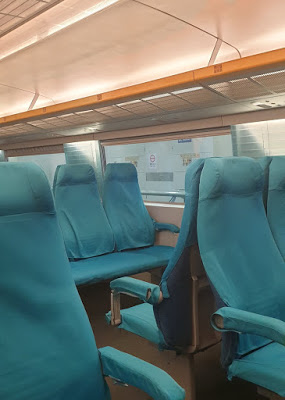
Seating on the train was nothing special, as one might expect

It didn’t take long before it hits the advertised speed of 431 kph.  This is not sustained for very long, because the distance is on 40 odd kilometers, and the whole trip takes about 7 minutes.

We go to the airport, and then we come back.  Is it worth the price, yes.  If you are a train enthusiast.

Searching for locations: The Maglev (Magnetic Levitation) Train, Shanghai, China

So, the first treat for the day is the high-speed magnetic train, something we only learned about after arriving in China and was not on any of the pre-tour documentation.

The train line connects Shanghai Pudong International Airport and Longyang Road Station (in the outskirts of central Pudong).  It is the oldest commercial maglev still in operation, and the first commercial high-speed maglev with cruising speed of 431 km/h (268 mph).  At full speed, the journey takes 7 minutes and 20 seconds to complete the distance of about 30 km.

Construction of the line began on March 1, 2001 and public services commenced on 1 January 2004.  It was built by a joint venture of Siemens and ThyssenKrupp from Kassel, Germany.

But, like visiting anything from a hotel, first we have to drive to the station and because we are leaving at 8, its peak hour traffic, and it takes 1 hour 10 minutes to get there.

The train also has a practical use and that is to take passengers from Shanghai to Pudong international airport as well as for those train enthusiasts, which is what we are.

On the train, it has the same sleek look as the bullet trains, but it is completely different, and you are able to see from the front of the train to the back.

Reputed to travel at 431 kph we take a seat and it is not long before the doors shut, and a loud humming noise is soon replaced by what sounds like an engine, then we start moving.  It sounds just like a normal train, and is a lot noisier than a normal bullet train.

Seating on the train was nothing special, as one might expect

It didn’t take long before it hits the advertised speed of 431 kph.  This is not sustained for very long, because the distance is on 40 odd kilometers, and the whole trip takes about 7 minutes.

We go to the airport, and then we come back.  Is it worth the price, yes.  If you are a train enthusiast.

NANOWRIMO – April 2025 – Day 20

The Fourth Son

So there’s nothing like an angry sister who never got to be queen, who sits gleefully in her office, plotting to put the new king in his place.

Yes, royal shenanigans indeed

Queen Isobel of the next-door principality is coming for a state visit, ostensibly to welcome the new king into his new role.

Why then does she burst into his office and gleefully announce the forthcoming arrival of the wicked with odd the west

Because in the old days when he was just a boy, Isobel and her used to torture him mercilessly, yo the point where it, and the treatment from his brothers at the behest of the old king forced him to run away to America.

Yes, survival of the fittest, the bullying was supposed to make a man of him/and his brothers, as it turned out, treatment that after he left was transferred to Edward and then down the line.

But..

As always, there’s more to the story, and it appeared from the briefing document that the annual negotiations between the two principalities had not been completed and signed, and there was a formal request that some items needed further discussion.

When he saw the draft contract, he could see why, but the negotiators had made the concessions so he could if he wanted to.

A lot would depend on that first face-to-face meeting and what her attitude towards him would be.  He had not seen her in the last 15 years, and he had expected he never would again, if he could help it, but things never quite go the way people want them to.

Something you steel himself for over the next few days before she arrived.

In the meantime, his sister could go and meet the Queen at the airport as his official representative, and he would make the formal welcome at the castle.

She will not be impressed.

“The Things We Do For Love”

Would you give up everything to be with the one you love?

Is love the metaphorical equivalent to ‘walking the plank’; a dive into uncharted waters?

For Henry, the only romance he was interested in was a life at sea, and when away from it, he strived to find sanctuary from his family and perhaps life itself.  It takes him to a small village by the sea, a place he never expected to find another just like him, Michelle, whom he soon discovers is as mysterious as she is beautiful.

Henry had long since given up the notion of finding romance, and Michelle couldn’t get involved for reasons she could never explain, but in the end, both acknowledge that something happened the moment they first met.  

Plans were made, plans were revised, and hopes were shattered.

A chance encounter causes Michelle’s past to catch up with her, and whatever hope she had of having a normal life with Henry, or anyone else, is gone.  To keep him alive she has to destroy her blossoming relationship, an act that breaks her heart and shatters his.

But can love conquer all?

It takes a few words of encouragement from an unlikely source to send Henry and his friend Radly on an odyssey into the darkest corners of the red-light district in a race against time to find and rescue the woman he finally realizes is the love of his life.

The cover, at the moment, looks like this:

lovecoverfinal1

Is love the metaphorical equivalent to ‘walking the plank’; a dive into uncharted waters?

For Henry, the only romance he was interested in was a life at sea, and when away from it, he strived to find sanctuary from his family and perhaps life itself.  It takes him to a small village by the sea, s place he never expected to find another just like him, Michelle, whom he soon discovers is as mysterious as she is beautiful.

Henry had long since given up the notion of finding romance, and Michelle couldn’t get involved for reasons she could never explain, but in the end, both acknowledge that something happened the moment they first met.  

Plans were made, plans were revised, and hopes were shattered.

A chance encounter causes Michelle’s past to catch up with her, and whatever hope she had of having a normal life with Henry, or anyone else, is gone.  To keep him alive she has to destroy her blossoming relationship, an act that breaks her heart and shatters his.

But can love conquer all?

It takes a few words of encouragement from an unlikely source to send Henry and his friend Radly on an odyssey into the darkest corners of the red-light district in a race against time to find and rescue the woman he finally realizes is the love of his life.

The cover, at the moment, looks like this:

lovecoverfinal1

Searching for locations: Old Shanghai, China

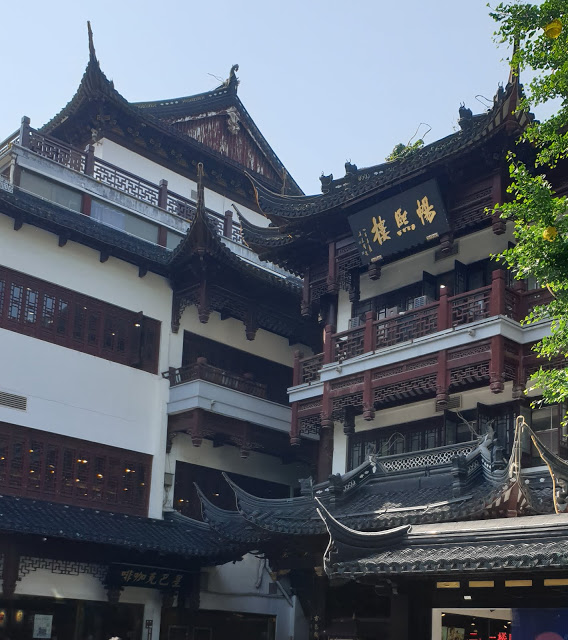
The old Shanghai refers to a small area of Shanghai that used to be walled in and remained that way until about 1912 when all but a small section of the wall was demolished.  With the advent of the concessions, Old Shanghai became the administrative center until later when it became a shopping complex.

Now it has many restored historical buildings as well as new buildings in a somewhat traditional style that has become one of Shanghai’s main tourist attractions, housing many shops and restaurants.

The “Old Town” is not exclusively old, as you still have a chance to take in the atmosphere if you wander into the quaint side streets.

But, on first viewing walking down the street towards the complex, I’m not sure I’d go as far as to say this is in reality old Shanghai, except for what appears to be a true representation of it architecturally. 

The buildings, which are shops and restaurants, are set out symmetrically, with streets, alleyways, and squares which may prove that it was specially built for the tourists, and no mechanized traffic.

Anyway…

The buildings are magnificent, and a photographer’s delight, and you’d finish up having hundreds of photos by the time you leave.  All the buildings are exquisite representations of traditional Chinese architecture. 

As for buying stuff, remember if you’re not Chinese you have the sucker tourist stamp on your forehead, so be prepared to walk away if the vendors will not bargain.  

Nothing here is worth the price tag and in our group discounts like from 130 RMB to 50 RMB and from 1 for 1,200 to 2 for 950 RMB are common.

Here common t-shirts that we can get for 3 dollars back home start at 150 RMB which is roughly 35 dollars.  It’s that kind of market.

We end up is a tea room, on the third floor of the meeting point below, and discover all the tour guides sitting around a table counting money, and I have to say it’s the most $50 notes I’ve ever seen in one place.  
It is, we were told, where they discussed ‘strategy’.

“One Last Look”, nothing is what it seems

A single event can have enormous consequences.

A single event driven by fate, after Ben told his wife Charlotte he would be late home one night, he left early, and by chance discovers his wife having dinner in their favourite restaurant with another man.

A single event where it could be said Ben was in the wrong place at the wrong time.

Who was this man? Why was she having dinner with him?

A simple truth to explain the single event was all Ben required. Instead, Charlotte told him a lie.

A single event that forces Ben to question everything he thought he knew about his wife, and the people who are around her.

After a near-death experience and forced retirement into a world he is unfamiliar with, Ben finds himself once again drawn back into that life of lies, violence, and intrigue.

From London to a small village in Tuscany, little by little Ben discovers who the woman he married is, and the real reason why fate had brought them together.

It is available on Amazon here:  http://amzn.to/2CqUBcz

Writing a book in 365 days – 94

Day 94

Honesty in writing – can there be too much, as in writing an autobiography?

To me there’s honesty and there’s truth.

I read autobiographies and biographies, but there are recollections laced with factual surrounding events. However, quite often, a lot of these events can be taken with a grain of salt.

I do it myself. I tell the truth, but it’s the embellishment that makes events grander, or the strategic omissions that make it larger or smaller than life.

The more embellishment, the better the sales. Everyone wants to read about heroes, people who get things done, and sometimes just to read the other side of the story.

Fiction, though, requires no semblance of the truth, and when weaving it with real events, it’s always a good idea not to try and improve on or demean people who were real and involved. I’m always weaving real places and real events into historical stories, and I work very hard to understand the people, the places, and the events.

And just remember not to make people you know too identifiable in your stories.

As for my autobiography, it will be better than the life I wish I could lead in my books, because 300 pages of utterly boring stuff will not sell.