How many of us have skeletons in the closet that we know nothing about? The skeletons we know about generally stay there, but those we do not, well, they have a habit of coming out of left field when we least expect it.
In this case, when you see your photo on a TV screen with the accompanying text that says you are wanted by every law enforcement agency in Europe, you’re in a state of shock, only to be compounded by those same police, armed and menacing, kicking the door down.
I’d been thinking about this premise for a while after I discovered my mother had a boyfriend before she married my father, a boyfriend who was, by all accounts, the man who was the love of her life.
Then, in terms of coming up with an idea for a story, what if she had a child by him that we didn’t know about, which might mean I had a half brother or sister I knew nothing about. It’s not an uncommon occurrence from what I’ve been researching.
There are many ways of putting a spin on this story.
Then, in the back of my mind, I remembered a story an acquaintance at work was once telling us over morning tea, that a friend of a friend had a mother who had a twin sister and that each of the sisters had a son by the same father, without each knowing of the father’s actions, both growing up without the other having any knowledge of their half brother, only to meet by accident on the other side of the world.
It was an encounter that in the scheme of things might never have happened, and each would have remained oblivious of the other.
For one sister, the relationship was over before she discovered she was pregnant, and therefore had not told the man he was a father. It was no surprise the relationship foundered when she discovered he was also having a relationship with her sister, a discovery that caused her to cut all ties with both of them and never speak to either from that day.
It’s a story with more twists and turns than a country lane!
A relationship, a bad day, a friendship, a long, monotonous lecture, and dinner.
It’s basically the light at the end of the tunnel, when it’s not the 6:32 express from Clapton, entering the other end of that same tunnel.
You could go over the top, which means, in one sense, over and above the expected, or way beyond the expected but not in a good way.
You could go over the waterfall in a leaky boat. Not advisable, but sometimes a possibility, if someone fails to tell you at the end of the rapids there is a waterfall. Just make sure it’s not the same as Niagara falls.
Still, someone has gone over Niagara in a barrel.
Then we could say that my lodging is over the garage, which simply means someone built it on top of the garage.
Branches of trees quite ofter grow over the roofs of houses, until a severe storm brings them down and suddenly they are in your house, no longer over it.
You can have editorial control over a newspaper
In a fight, the combatants are equally trying to shout over the top of each other
And sometimes, when trying to paint a different picture to what is real, you could say the temperature is sometimes over 40 degrees centigrade when you know for a fact it is usually 56 degrees centigrade. No need for the literal truth here or no one will come.
Then you could say I came over land, assuming that you took a car, or walked when in actual fact you came by plane. And yes, the whole flight was, truthfully, over land.
I don’t accept my lot in fife, nor do I want a small lot on which to build my mansion!
But the oddest use of the word over is when we describe, in cricket, the delivery of 6 balls.
I’ve listened to cricket commentary, and aside from trying to pronounce the names of the players, if you were unfamiliar with the game, being told this ball was outside leg stump, one of several deliveries, the last of which was the end of the over. If the delivery hit the stumps, it is then a wicket, and the batsman is out.
I remember another bang, and then it was lights out.
When I opened my eyes again, I saw the sky.
Or I could be underwater.
Everything was blurred.
I tried to focus but I couldn’t. My eyes were full of water.
What happened?
Why was I lying down?
Where was I?
I cast my mind back, trying to remember.
It was a blank.
What, when, who, why and where, are questions I should easily be able to answer. These are questions any normal person could answer.
I tried to move. Bad, bad mistake.
I did not realise the scream I heard was my own. Just before my body shut down.
“My God! What happened?”
I could hear, not see. I was moving, lying down, looking up.
I was blind. Everything was black.
“Car accident; hit a tree, sent the passenger flying through the windscreen. Pity to poor bastard didn’t get the message that seat belts save lives.”
Was I that poor bastard?
“Report?” A new voice, male, authoritative.
“Multiple lacerations, broken collar bone, broken arm in three places, both legs broken below the knees, one badly. We are not sure of internal injuries, but ruptured spleen, cracked ribs and pierced right lung are fairly evident, x-rays will confirm that and anything else.”
“What isn’t broken?”
“His neck.”
“Then I would have to say we are looking at the luckiest man on the planet.”
I heard the shuffling of pages.
“OR1 ready?”
“Yes. On standby since we were first advised.”
“Good. Let’s see if we can weave some magic.”
Magic.
It was the first word that popped into my head when I surfaced from the bottom of the lake. That first breath, after holding it for so long, was sublime, and, in reality, agonising.
Magic, because it seemed like I’d spent a long time underwater.
Or somewhere.
I tried to speak but couldn’t. The words were just in my head.
Was it night or was it day?
Was it hot, or was it cold?
Where was I?
Around me, it felt cool.
It was incredibly quiet. No noise except for the hissing of air through an air-conditioning vent. Or that was the sound of pure silence. And with it the revelation that silence was not silent. It was noisy.
I didn’t try to move.
Instinctively, somehow, I knew not to.
A previous unpleasant experience?
I heard what sounded like a door opening, and noticeably quiet footsteps slowly came into the room. They stopped. I could hear breathing, slightly laboured, a sound I’d heard before.
My grandfather.
He had smoked all his life until he was diagnosed with lung cancer. But for years before that he had emphysema. The person in the room was on their way, down the same path. I could smell the smoke.
I wanted to tell whoever it was the hazards of smoking.
I couldn’t.
I heard a metallic clanging sound from the end of the bed. A moment later the clicking of a pen, then writing.
“You are in a hospital.” A female voice suddenly said. “You’ve been in a bad accident. You cannot talk, or move, all you can do, for the moment, is listen to me. I am a nurse. You have been here for 45 days and just came out of a medically induced coma. There is nothing to be afraid of.”
She had a very soothing voice.
Her fingers stroked the back of my hand.
“Everything is fine.”
Define fine, I thought. I wanted to ask her what ‘fine’ meant.
“Just count backwards from 10.”
Why?
I didn’t reach seven.
Over the next ten days, that voice became my lifeline to sanity. Every morning, I longed to hear it, if only for the few moments she was in the room, those few waking moments when I believed she, and someone else who never spoke, were doing tests. I knew it had to be someone else because I could smell the essence of lavender. My grandmother had worn a similar scent.
It rose above the disinfectant.
She was another doctor, not the one who had been there the day I arrived. Not the one who had used some ‘magic’ and kept me alive.
It was then, in those moments before she put me under again, that I thought, what if I was paralysed? It would explain a lot. A chill went through me.
The next morning, she was back.
“My name is Winifred. We don’t know what your name is, not yet. In a few days, you will be better, and you will be able to ask us questions. You were in an accident, and you were very severely injured, but I can assure you there will be no lasting damage.”
More tests, and then when I expected the lights to go out, they didn’t. Not for a few minutes more. This was how I would be integrated back into the world. A little bit at a time.
The next morning, she came later than usual, and I’d been awake for a few minutes. “You have bandages over your eyes and face. You had bad lacerations to your face, and glass in your eyes. We will know more when the bandages come off in a few days. Your face will take longer to heal. It was necessary to do some plastic surgery.”
Lacerations, glass in my eyes, car accidents, plastic surgery. By logical deduction, I knew I was the poor bastard thrown through the windscreen. It was a fleeting memory from the day I was admitted.
How could that happen?
That was the first of many startling revelations. The second was the fact I could not remember the crash. Equally shocking, in that same moment was the fact I could not remember before the crash either, or only vague memories after.
But the most shattering of all these revelations was the one where I realised, I could not remember my name.
I tried to calm down, sensing a rising panic.
I was just disoriented, I told myself. After 45 days in an induced coma, it had messed with my mind, and it was only a temporary lapse. Yes, that’s what it was, a temporary lapse. I will remember tomorrow. Or the next day.
Sleep was a blessed relief.
The next day I didn’t wake up feeling nauseous. I think they’d lowered the pain medication. I’d heard that morphine could have that effect. Then, how could I know that but not who I am?
Now I knew Winifred the nurse was preparing me for something unbelievably bad. She was upbeat, and soothing, giving me a new piece of information each morning. This morning, “You do not need to be afraid. Everything is going to be fine. The doctor tells me you are going to recover with little scarring. You will need some physiotherapy to recover from your physical injuries, but that’s in the future. We need to let you mend a little bit more before then.”
So, I was not going to be able to leap out of bed and walk out of the hospital any time soon. I don’t suppose I’d ever leapt out of bed, except as a young boy. I suspect I’d sustained a few broken bones. I guess learning to walk again was the least of my problems.
But there was something else. I picked it up in the timbre of her voice, a hesitation, or reluctance. It sent another chill through me.
This time I was left awake for an hour before she returned.
This time sleep was restless.
Scenes were playing in my mind, nothing I recognised, and nothing lasting longer than a glimpse. Me. Others, people I didn’t know. Or I knew them and couldn’t remember them.
Until they disappeared, slowly like the glowing dot in the centre of the computer screen, before finally fading to black.
The morning the bandages were to come off she came in early and woke me. I had another restless night, the images becoming clearer, but nothing recognisable.
“This morning the doctor will be removing the bandages over your eyes. Don’t expect an immediate effect. Your sight may come back quickly, or it may come back slowly, but we believe it will come back.”
I wanted to believe I was not expecting anything, but I was. It was human nature. I did not want to be blind as well as paralysed. I had to have at least one reason to live.
I dozed again until I felt a gentle hand on my shoulder. I could smell the lavender; the other doctor was back. And I knew the hand on my shoulder was Winifred’s. She told me not to be frightened.
I was amazed to realise at that moment, I wasn’t.
I heard the scissors cutting the bandages.
I felt the bandage being removed, and the pressure coming off my eyes. I could feel the pads covering both eyes.
Then a moment when nothing happened.
Then the pads are gently lifted and removed.
Nothing.
I blinked my eyes, once, twice. Nothing.
“Just hold on a moment,” Winifred said. A few seconds later I could feel a cool towel wiping my face, and then gently wiping my eyes. There was ointment or something else in them.
Then a flash. Well, not a flash, but like when a light is turned on and off. A moment later, it was brighter, not the inky blackness of before, but a shade of grey.
She wiped my eyes again.
I blinked a few more times, and then the light returned, and it was like looking through water, at distorted and blurry objects in the distance.
I blinked again, and she wiped my eyes again.
Blurry objects took shape. A face looking down on me, an elderly lady with a kindly face, surely Winifred, who was smiling. And on the opposite side of the bed, the doctor, a Chinese woman of indescribable beauty.
I nodded.
“You can see?”
I nodded again.
“Clearly?”
I nodded.
“Very good. We will just draw the curtains now. We don’t want to overdo it. Tomorrow we will be taking off the bandages on your face. Then, it will be the next milestone. Talking.”
I couldn’t wait.
When morning came, I found myself afraid. Winifred had mentioned scarring, there were bandages on my face. I knew, but wasn’t quite sure how I knew, I wasn’t the most handsome of men before the accident, so this might be an improvement.
I was not sure why I didn’t think it would be the case.
They came at mid-morning, the nurse, Winifred, and the doctor, the exquisite Chinese. She was the distraction, taking my mind off the reality of what I was about to see.
Another doctor came into the room before the bandages were removed, and he was introduced as the plastic surgeon who had ‘repaired’ the ravages of the accident. It had been no easy job, but, with a degree of egotism, he did say he was one of the best in the world.
I found it hard to believe, if he were, that he would be at a small country hospital.
“Now just remember, what you might see now is not how you will look in a few months.”
Warning enough.
The Chinese doctor started removing the bandages. She did it slowly and made sure it did not hurt. My skin was very tender, and I suspect still bruised, either from the accident or the surgery, I didn’t know.
Then it was done.
The plastic surgeon gave his work a thorough examination and seemed pleased with his work. “Coming along nicely,” he said to the other doctor. He issued some instructions on how to manage the skin, nodded to me, and I thanked him before he left.
I noticed Winifred had a mirror in her hand and was reticent in using it. “As I said,” she said noticing me looking at the mirror, “what you see now will not be the result. The doctor said it was going to heal with little scarring. You have been extremely fortunate he was available. Are you ready?”
I nodded.
She showed me.
I tried not to be reviled at the red and purple mess that used to be my face. At a guess, I would have to say he had to put it all back together again, but not knowing what I looked like before, I had no benchmark. All I had was a snippet of memory that told me I was not the tall, dark, and handsome type.
And I still could not talk. There was a reason, he had worked in that area too. Just breathing hurt. I think I would save up anything I had to say for another day. I could not even smile. Or frown. Or grimace.
“We’ll leave you for a while. Everyone needs a little time to get used to the change. I suspect you are not sure if there has been an improvement in last year’s model. Well, time will tell.”
The problem is, there are familiar faces and the question of who a friend is and who is a foe is made all the more difficult because of the enemy, if it was the enemy, simply because it didn’t look or sound or act like the enemy.
Now, it appears, his problems stem from another operation he participated in, and because of it, he has now been roped into what might be called a suicide mission.
I spent another hour trading stories of Army life, none of mine bearing any resemblance to the truth before the party started.
I said to him, several times, that in my estimation, a part would start at a particular time. He seemed intrigued by how that could be possible when all my men were locked up and guarded.
The captain, it seemed, was a man of limited intellect.
Or just plain overconfident that he had quelled the incursion and attempted to take the prisoner’s home.
I was under house arrest, just not in the house with the rest of the men. The captain decided, being the ranking officer of our group, that I should be accorded facilities befitting my rank. It didn’t change my opinion of the captain, but it did raise the respect level slightly.
As an officer and a gentleman, as he described himself, he was also a student of Army procedures and practices, not only of his own army but that of others. I admired his hobby outside of working hours.
We were just discussing aspects of the First World War, and the part Africa played in it when both of us suddenly heard gunshots. So did the guard picked up his gun and carefully went out the front door.
The captain pulled his pistol from out of the top drawer and made sure the magazine had bullets in it. Just in case he needed to use it. All the men, suddenly increased to six, armed and dangerous, in that room had a gun, like the captain. They were commanded by another soldier dressed in fatigues, perhaps a Colonel or higher.
I’d notice some African countries had a higher proportion of Generals, to say Lieutenants, and deduced from that, field promotions were a regular thing. That was not my experience here. So far.
I heard another gunshot, this time closer to the hut. Was it my people, mounting their attack? Or was it the Commander, back to retake what was his?
There would be no love lost between the captain and the commander, and if was a betting man, in a fight, my money would be on the commander.
The sounds of gunfire continued for about ten minutes, then it became sporadic, then none. There were footsteps on the boards at the front of the hut, and then a cautious entry, gun barrel first, “if you have a gun pointed at the door, I suggest you put it down.” Monroe.
Having caught the captain’s attention from the front, the Colonel came in the rear and had his gun barrel pointing to the small of the captain’s back. “Drop it now.”
The captain did as he was told.
“You had more men on the perimeter?” he said with a sigh.
“Yes. I thought it prudent to have more than one sniper, a fact that the Militia commander hadn’t given a thought to.” I looked over at Monroe. “Have we secured the airfield?”
“Yes. 10 surviving soldiers, some of them in a bad way, are in the second barracks. They won’t be mounting a counterattack.”
I heard an engine; a large plane engine being started.
“That will be Davies playing with her new toy. Someone is on the runway lights; the rest are heading for the plane. Where are the hostages?” She glared at the captain.
He shrugged.
Shurl burst in the door. “Out, back through that door,” I said. “Be careful there isn’t a guard waiting for you.”
Monroe looked at me. “Can I shoot the insubordinate bastard?”
A look of surprise, not terror, crossed the captain’s face.
“Just take him back to the cells and lock him up.”
Shurl came out with the two hostages, just as the second plane engine fired. Monroe took the captain back to the cells and returned a minute or so later. Shurl had taken the hostages to the plane. Baines would be waiting to switch on the lights at the last minute, and hopefully, the rest were on board.
They would be waiting for Monroe and me.
Both engines were running smoothly, and Davies was testing the rudder and flaps. Suddenly the runway lights came on, and Baines came running towards the plane. Monroe and I jumped aboard, and then Baines followed, pulling the door shut behind him.
I heard the engine noise increase, and then we were moving.
I headed up to the cockpit and joined Davies. She was now in her element, her face a picture of concentration. We were slowly moving to the end of the runway, and I could see her working her way through the preflight checklist.
I tried to speak to her, but she couldn’t hear. She had headphones on. There was a pair near the co-pilot’s seat. I sat down and put them on.
“Everything OK?”
“Nearly. Be quiet for a minute.”
We were at the end of the strip and she turned the plane. She would have checked the wind, not that I’d felt any, and adjusted the take-off direction accordingly.
Then, after what looked like a deep breath and slow exhale, she pushed the engine controls to maximum, and we started moving, slowly gathering speed. The runway surface wasn’t exactly flat, but it was enough not to impede forward motion. Not long after the rear of the plane rose, and then in what seemed effortless, we were in the air.
Odd then, when we passed through 2,000 feet, I wondered who this plane belonged to.
For a story that was conceived during those long boring hours flying in a steel cocoon, striving to keep away the thoughts that the plane and everyone in it could just simply disappear as planes have in the past, it has come a long way.
Whilst I have always had a fascination with what happened during the second world war, not the battles or fighting, but in the more obscure events that took place, I decided to pen my own little sidebar to what was a long and bitter war.
And, so, it continues…
——
Mayer was woken by the abrupt jolting of the guard van, and for a few moments was disorientated. It was no longer dark, and the light was coming in through the cracks of the windows, and he could see now the van was quite old and battered.
And that odd smell was the residue of many fires in the potbelly stove, that presumably kept the guard warm in winter. There were a few scattered coals on the floor.
Then he remembered he was in the van and it felt like it was being connected to a shunting loco.
That, and the sound of voices outside the van.
“How long has this lot been sitting here?”
“Three weeks, the shunting crew seem to have just forgotten about these wagons. They were supposed to be sent back south months ago.”
Suddenly there was the sound of footsteps on the stones outside.
Mayer slipped down off the bunk, taking the blanket with him, and looked for somewhere to hide. There was a door in the panel under the bed; he opened it and saw an empty space.
It was not very big, and in places, daylight could be seen through cracks in the outside wall. It was smelly but manageable, and he wriggled into the space and jammed the door closed so if they tried to open it, it would not, and they would assume it had not been used in a long time. Or he was hoping that’s what they’d think.
Just in time, steps on the ladder, and the door bang open.
“Ghastly, it’s ready for the scrap heap.”
“It’s for the war effort, even scrap is good. You staying?”
“Until they hook it up, but outside. This place feels like someone died in it.”
Mayer squirmed until he was in a more comfortable position, thankful that the space was large enough to stretch out, though cold.
He could see through the cracks, back up the track where another train was waiting.
His watch said it was near seven in the morning, and that mean he had slept for about four hours. He had intended to get off before anyone would notice, but it was too late for that now.
At least he would be going in the right direction, it was just a matter of where the wagons would end up. Maybe he would get lucky, and that would be Florence.
But, the chances were he would be discovered before then because if the man who had boarded before was going to stay with the train, the chances were he’d come back to the van, it would very likely he’d explore out of sheer boredom, and that would include that space behind the door.
For now, though, the two men were still outside beside the van, waiting for the signal to get aboard.
Another hour passed before there was more clanking and jolting as another engine connected to the wagons. It was only a matter of time before the men came back.
A minute passed, two, five, ten, then the shrill sound of the whistle of a steam engine, followed by the stretching of wagon joiners and the slow movement forward. The men had not returned, but, Mayer knew, they were aboard the train somewhere.
For the moment, it didn’t matter. With each passing minute, he was closer to his objective, Florence.
It was slow progress, with a stop nearly once an hour, shunted aside while a more important train raced by. People going about their business as if there was no war. Mayer had time to lament his foolishness of being swept up inthe fervor of restoring the Reich to its rightful place in the world.
It had also sounded legitimate, but, as it wore on, the news that they were winning the war and it would all be over soon, turned to disenchantment. They could not have so many victories and not have won already.
Several of his friends had private said they believed the war was going badly, hence the pressure on his group to create better weapons so they could turn the tide. Of course, no one would openly say things were going bad, that would invite the Gestapo on your doorstep, but people were beginning to suspect.
Mayer was not the first to consider turning himself over to the other side before it was too late.
The sporadic stop-start motion of the train went on all day, and into the night, after passing through several large rail yards, and cities. He couldn’t be sure, but he believed they had passed through Verona, and then hours later, Bologna.
At Bologna, the stay was protracted, and once again the men came to the wagon, and this time, as he feared, they had a look around, rattled the door that he had barricaded, and at least they didn’t stay, one of them saying it had probably rusted with age.
Still, he didn’t breathe again until they left.
Nighttime, and very cold, he tried to get comfortable, and finally fell into a fitful sleep.
It was a perfect day for a funeral. Overcast, cold, snow imminent, after a week of gentle falls culminating in a blizzard the night before.
I shivered. Was it her ghost?
No one had told me Gwen had died, and I had to find out from a newspaper. I guess that was the price to be paid, being an ex.
It was not my choice; she had decided to move on to bigger and better things with a man who would, in her words, more likely aspire to far more than I ever would.
At the time, I would have agreed with her. I didn’t make a fuss when I discovered the affair, nor did I make it difficult for her to do as she wished. I loved her, always would, and it was better to let her follow her heart.
The children, Ben and Amber, decided they wanted to go with her, the thought of living in a mansion, and having a life of luxury, was more appealing than staying with me.
Again, I didn’t object, believing they would be happier there.
And now, twenty years almost to the day she left, here we were. A cemetery. The last place I expected to be ten days before Christmas.
Oh, by the way, I hadn’t been invited to the funeral service, so I didn’t get into the church, which was for families and celebrities only. I was at the burial plot, waiting to have the last word.
Perhaps not getting an invite was a blessing in disguise.
To say that I abhorred Jerry Northington-Jobson from the very first moment I saw him would be an understatement.
He was the only child of perhaps the fifth richest noble family in the country, spoilt beyond reason, indolent, rude, and the last man I expected Gwen would so much as look once at let alone twice.
When his parents died, in suspicious circumstances, I might add, he became the seventh Earl of something or other, the owner of a dozen estates in England and throughout Europe, and then Gwen’s second husband.
He was a lucky man.
Until she died.
In the last week, there was little else in the newspapers, every minute detail of his affairs, of his company’s misdemeanours, and the most telling of all, how he had, in twenty years spent every penny of his inheritance, and then some, on bad investments, gambling, and simply travelling around the world.
Had Gwen been alive to see it, it would have destroyed her. I honestly believed she had no idea what their financial state would have been.
Nor would she, or any of her friends, had they been invited, have appreciated the funeral he had planned.
My cell phone vibrated in my hand.
“It’s over, sir.”
“Thank you.”
I felt, for a second, like I was in a spy novel. It was nothing like that, just a friend who had got into the church where the service was being held, so I’d know when the coffin would arrive at the plot.
It seemed an odd way of seeing her to her final resting place, but it was the only way. My request for a seat in the church had been denied.
It took about ten minutes before the procession came into view, with the priest leading the way. Jerry Northington-Jobson, at the lead of the coffin bearers, looked every bit the stricken husband over the loss of his wife.
Yet, according to the message I just received about the service, he had delivered a somewhat emotional eulogy that lacked, yes, real emotion.
It took five more minutes before the coffin was laid on the struts over the open grave, and those willing to brave the minus temperature to hear the last eulogy before her body was committed to the ground.
Fittingly, light snow began to fall at the same time the priest uttered his first words, in Latin.
I had forgotten they were both Roman Catholic. That had been another strike against me, I did not have the same faith in God.
“Are you really an irascible old man?”
I turned, then looked down. It was a girl, dressed in black, about five or six years old.
“It depends on who told you that.”
“My mother. She tells me you are my long-lost grandfather, the one we never talk about.”
OK, that was a surprise. Having not heard about any grandchildren, my two children too busy making asses of themselves in public as befitting the rich and somewhat famous, it was not improbable that this was my granddaughter.
“And why is that?” I kept my voice in the same low, conspiratorial tone.
“He deserted my grandmother, but I think he dodged a bullet.”
I almost laughed, just managing to keep a straight face. She was obviously repeating what she had heard elsewhere, but it was hard to believe it would come from Amber. Last words I spoke to her, she hated me.
“What’s your name?”
“Daisy “
“I’m Ken. Sometimes irascible, but I don’t go out very often.”
“Do you always hide?”
“Not usually, but today it was prudent. I don’t want to cause trouble at your grandmother’s funeral.”
“You don’t have to worry. My other grandfather has already done that. My mother says he’s an ass too, so it must be something all grandfathers have in common.”
A distinct possibility, I thought. I scanned the few people remaining, the snow falling harder now, and her mother was not one of them, or at least anyone I might recognise as Amber. It had been so long that she may have changed, and I’d not know her.
“It is most likely because we are old. Where is your mother?”
“In the church still. She is not very well. She told me to come out and see if you had come. Her description was quite accurate.”
I had changed, too, so how could she know what I looked like? Unless she had put two and two together. She never used to be that clever.
“Do you think she might want to see me?”
“I think so. It’s a bit hard sometimes to tell what she’s thinking. Perhaps we should go and find out.”
The last of the mourners had gone, and the snow had settled in. It was time to get indoors, preferably near a large fire. There was one waiting for me back at the inn I was staying for a few days.
“OK. Lead the way.”
Her little hand slipped into mine, and we headed towards the church. A thought did cross my mind that she was far too trusting of strangers, but then, I didn’t feel like one. Perhaps she had sensed that.
Still. I would have a word with her mother about it.
We dusted off the snow before going into the church. Not far from the entrance, a solitary person was sitting, head on hands.
Daisy left me and went up to her mother, shaking her. “Mummy, mummy, I found the man.”
Her mother lifted her head slowly and turned towards me.
That was the first shock, that she was the spitting image of her mother, exactly as I had seen her that first day. So flawless, so beautiful, so English.
The second shock, that she was very, very ill.
“Hello, daddy.”
I walked over as she stood and held out her arms. The next moment, she collapsed, and I just managed to catch her.
She was not just ill; she was very near death. I recognised the signs; she had the disease that finally killed her mother.
“Can you fix her?” Daisy asked, tears welling in her eyes.
“Yes. I know what to do.” I looked at Amber, her eyes watery but open. I gently lay her down. “How long have you been like this?”
“About six months. It’s been getting progressively worse. I told my mother, but she refused to listen.”
Just then, Jerry Northington-Jobson came in the entrance, obviously looking for Amber. “What the devil…” he yelled out. “What are you doing here?”
“I think you know why I’m here.”
“She wanted nothing to do with you.”
“Which is why I’m waiting outside to say goodbye. Amber is not well.”
“Attention seeking, more likely. Well, it may have worked on her mother, but it will not work with me.”
He came up to her and grabbed her arm.
Wrong move. I pulled it off, and then I hit him as hard as I could. There were twenty years of venom in that punch.
My personal assistant came in looking for me and stopped. It coincided with Jerry Northington-Jobson hitting the floor.
“Sir?”
“Get the helicopter fired up. Tell the pilot we need to go to London. Then call the fleet manager and tell him I need the jet. We’ll be going to Cannes, France.”
When she blinked as if it was indecipherable gibberish, I said, “Now, Bethany. We’re wasting seconds.”
Amber looked up, her expression less pained, and then stood. “I’m better now.”
“But not for long. You’re going to the clinic that your mother went to. I just hope we haven’t left it too late.”
Amber looked down at her stepfather. “What happened?”
“He spoke,” Daisy said, “and then your real daddy thumped him. I would have myself if I were grown up.”
“Violence doesn’t solve anything.”
The look on Daisy’s face said something different.
The priest came down from the altar end of the church and was aghast at seeing Jerry Northington-Jobson on the ground, and leaned over to help him up. “What happened here?”
I answered for him, “He made a comment about his stepdaughter that I found offensive. It’s quite common for weddings and funerals.”
Amber and Daisy headed for the door, not waiting to speak to Jerry Northington-Jobson. I didn’t blame her.
He glared at me. “This isn’t over?”
“I agree. You’ll be hearing from my lawyers. Now, it’s been a pleasure, Jerry.”
I caught up with Amber and Daisy just as the helicopter landed in the field opposite the church.
“Wow. A real helicopter. Are you rich too?” Daisy was surprised.
I shrugged. “I just know people who know people.”
It was a short walk to the aircraft, and when the co-pilot opened the door and activated the stairs, he came over and escorted us inside. He shut the door and went back to the flight deck. A few minutes later, we took off.
The rear cabin was insulated from the noise of the engines, but we wore headphones just the same.
“I was going to come and see you, but my mother died suddenly. She only just found out where you were, who you were. How did you have a different name?”
“My mother’s maiden name. I figured Gwen would want to know that I might have actually done something with my life. She was happy where she was.”
“And Ben and I?”
“She made me sign a document. We asked you who you wanted to be with, and you both chose your mother. I wasn’t going to argue the point or make demands. It was her idea of a clean break.”
“You could have waited a few years and then come back.”
I shook my head. I tried that, but she stopped it. It was before I made my first million, and not in the same class. But I did watch her and Ben grow up from afar, and at times. Make life easier for them, just don’t let them know about it.
“It was better this way. I was always hoping there would come a time, and I was very sad that it had to be at her funeral. How long have you been this way?”
“Six months. I knew something was wrong with my mother, but I didn’t think I had the same condition. I don’t have all the symptoms. If it is, I assume you know what it is? My doctor really has no idea.”
“Gwen didn’t tell you?”
“No. I guess she didn’t want me to fret over it, or she thought it would miss my generation.”
“It doesn’t. When we get to London, is there anything you need?”
“I have everything I need.” She glanced down at Daisy.
“No husband?”
“Never married. One steady boyfriend who was steady until he learned I was pregnant and then disappeared. Gave up on men after that.” She leaned back and closed her eyes. “I’m tired now. Wake me when we get there.”
I leaned back also and rested. It was a good idea to come to the funeral. All that remained was to discover where Ben was, and why he didn’t come to his mother’s funeral.
This is an exercise in getting you to work on book titles, looking at the existing titles and working on whether there could be a better alternative, and as an aside, considering why you chose the one you did.
Often, to me, it seems like it’s very much akin to plucking a piece of paper out of the air, one of about a thousand.
The quest for a title for my current project took many a twist and turn, starting out with When The Planets Line Up, which, of course, was going to happen, but it was not the crux of the story. What came to me, when the story moved from a short story to a novel was “The Fourth Son, simple because that was what he is, and from all the woes and sour grapes we’ve endlessly heard from the infamous Second Son, or Spare, I thought, what if the impossible happened.
Titles have not always been that easy, and my editor sometimes has a few words to say about the titles I pick.
It was just the case with my David and Susan novels. I was going with Double Trouble and the Triple Trouble, but it seems What Sets Us Apart and Strangers We’ve Become were more suitable. There’s a third, and I have tentatively titled it “From Russia With…” but that might not last.
Quite often, stories I have written quite a few years back are still looking for an appropriate title, and three in particular that I wrote as a trilogy suddenly found themselves with titles after I read a series of Robert Ludlum novels and noted how he titled his stories.
The bottom line is that sometimes finding the right title is like creating the right cover, and then editing.
Nearly every city has a high building, a tower, or a large Ferris wheel.
London had the London eye Paris has the Eiffel tower The Galata in Istanbul The CN Tower in Toronto The towers of San Gimignano Pisa has a leaning tower
We’ve managed to see all of the above bar the Galata in Istanbul. One day we might get there.
But, on this side of the world, there are two, the Sydney Tower, and the Sky Tower in Auckland, which we just visited recently.
It’s not a tall tower, but it definitely gives great vies of Auckland, particularly to the north
The mountain in the background at the top of the photo is of a volcano on Rangitoto Island. When we were visiting, there were reports that it might become active again.
To give a height perspective, it didn’t seem all that far down to the apartment building and gardens nearby.
Diplomacy, or what keeps the wheels of international relations turning.
And sadly, not having much involvement in diplomacy except for the odd ball in New York stage by on of another of the dozens of countries who had Embassies there, the idea of coping with those events horrified him.
Step into the breach, the number one personal assistant who was conversant in a foreign language knew everything about his country and was familiar with all of the ambassadors in the city.
And who had expressed the desire to meet with the new king and congratulate him on his accession.
Yes, another state dinner.
And, if Ruth had her way, dancing.
He invites Ruth and Susie at short notice, and Susie is gobsmacked and overwhelmed like the girl she is, and he promises to rustle up a few princes for her to meet.
But.
No fainting allowed.
And definitely no fairy godmothers turning pumpkins into carriages. They already had a gold coach, and she could use it if she wanted to
Rurh doesn’t think they will ever get her to go home after it.
John Pennington’s life is in the doldrums. Looking for new opportunities, and prevaricating about getting married, the only joy on the horizon was an upcoming visit to his grandmother in Sorrento, Italy.
Suddenly he is left at the check-in counter with a message on his phone telling him the marriage is off, and the relationship is over.
If only he hadn’t promised a friend he would do a favour for him in Rome.
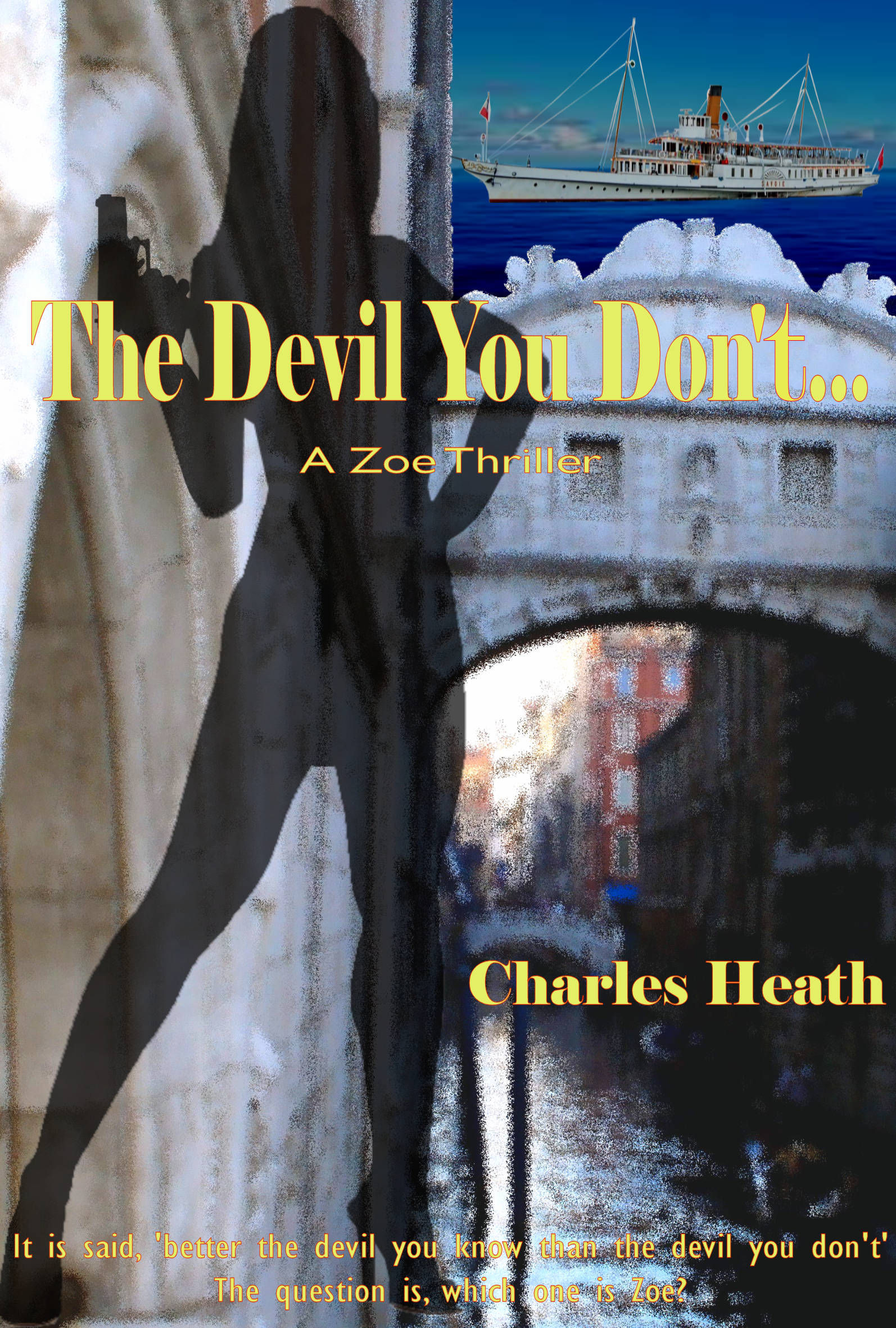
At the first stop, Geneva, he has a chance encounter with Zoe, an intriguing woman who captures his imagination from the moment she boards the Savoire, and his life ventures into uncharted territory in more ways than one.
That ‘favour’ for his friend suddenly becomes a life-changing event, and when Zoe, the woman who he knows is too good to be true, reappears, danger and death follow.
Shot at, lied to, seduced, and drawn into a world where nothing is what it seems, John is dragged into an adrenaline-charged undertaking, where he may have been wiser to stay with the ‘devil you know’ rather than opt for the ‘devil you don’t’.


 Thrills, Spills, and just a dash of Romance