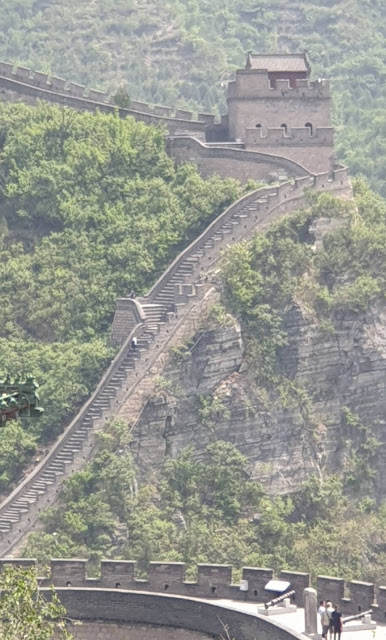
Searching for locations: The Great Wall of China, near Beijing, China

This is in a very scenic area and on the first impression; it is absolutely stunning in concept and in viewing.

As for the idea of walking on it, well, that first view of the mountain climb when getting off the bus, my first question was where the elevator is?  Sorry, there is none.  It’s walk on up or stay down the bottom.

Walk it is.  As far as you feel you are able.  There are quite a few who don’t make it to the top.  I didn’t.  I only made it to the point where the steps narrowed.

But as for the logistics, there’s the gradual incline to the starting point, and what will be the end meeting place.  From there, it’s a few steps up to the guard station no 7, and a few more to get up to the start of the main climb.  The top of the wall is guard station no 12.

Ok, those first few steps are a good indication of what it’s was going to be like and it’s more the awkwardness of the uneven heights of the steps that’s the killer, some as high as about 15 inches.  This photo paints an illusion, that it’s easy.  It’s not.

If you make it to the first stage, then it augers well you will get about 100 steps before you both start feeling it in your legs, particularly the knees, and then suffering from the height if you have a problem with heights as the air is thinner.  And if you have a thing with heights, never look down.

This was from where we stopped, about a third of the way up.  The one below, from almost at the bottom.  One we’re looking almost down on the buildings, the other, on the same level.

It requires rest before you come down, and that’s when you start to feel it in the knees, our tour guide called it jelly legs, but it’s more in the knees down.  Descending should be slow, and it can be more difficult negotiating the odd height steps, and particularly those high ones.  You definitely need to hang onto the rail, even try going backward.

And, no, that rail hasn’t been there as long as the wall.

While you are waiting for the guide to return to the meeting place at the appointed time, there should be time to have some jasmine tea.  Highly refreshing after the climb.

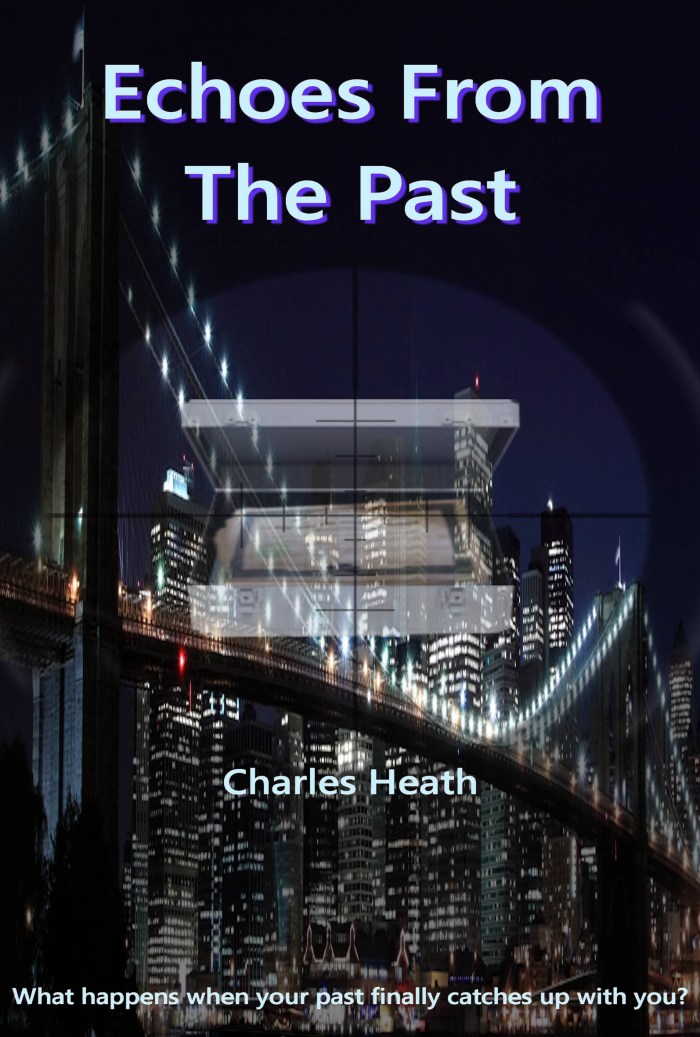
The story behind the story – Echoes from the Past

The novel ‘Echoes from the past’ started out as a short story I wrote about 30 years ago, titled ‘The birthday’.

My idea was to take a normal person out of their comfort zone and led on a short but very frightening journey to a place where a surprise birthday party had been arranged.

Thus the very large man with a scar and a red tie was created.

So was the friend with the limousine who worked as a pilot.

So were the two women, Wendy and Angelina, who were Flight Attendants that the pilot friend asked to join the conspiracy.

I was going to rework the short story, then about ten pages long, into something a little more.

And like all re-writes, especially those I have anything to do with, it turned into a novel.

There was motivation.  I had told some colleagues at the place where I worked at the time that I liked writing, and they wanted a sample.  I was going to give them the re-worked short story.  Instead, I gave them ‘Echoes from the past’

Originally it was not set anywhere in particular.

But when considering a location, I had, at the time, recently been to New York in December, and visited Brooklyn and Queens, as well as a lot of New York itself.  We were there for New Years, and it was an experience I’ll never forget.

One evening we were out late, and finished up in Brooklyn Heights, near the waterfront, and there was rain and snow, it was cold and wet, and there were apartment buildings shimmering in the street light, and I thought, this is the place where my main character will live.

It had a very spooky atmosphere, the sort where ghosts would not be unexpected.  I felt more than one shiver go up and down my spine in the few minutes I was there.

I had taken notes, as I always do, of everywhere we went so I had a ready supply of locations I could use, changing the names in some cases.

Fifth Avenue near the Rockefeller center is amazing at first light, and late at night with the Seasonal decorations and lights.

The original main character was a shy and man of few friends, hence not expecting the surprise party.  I enhanced that shyness into purposely lonely because of an issue from his past that leaves him always looking over his shoulder and ready to move on at the slightest hint of trouble.  No friends, no relationships, just a very low profile.

Then I thought, what if he breaks the cardinal rule, and begins a relationship?

But it is also as much an exploration of a damaged soul, as it is the search for a normal life, without having any idea what normal was, and how the understanding of one person can sometimes make all the difference in what we may think or feel.

And, of course, I wanted a happy ending.

Except for the bad guys.

Get it here:  https://amzn.to/2CYKxu4

newechocover5rs

Writing a book in 365 days – 73

Day 73

Editing – getting the reader invested

There are two, possibly more, but two fundamental questions you have to ask yourself when you are reading through your work, and perhaps for the first time after finishing writing that first draft.

What am I saying?

What happens next for the characters?

Here’s the thing…

What your saying is what the reader wants to know, what sets the tone, what sets up the story. I like to throw readers in the deep right from the start, to give the reader a sense of who they’re going on the journey with.

In my opinion, a book is a journey and the more compelling you can make it, the more invested the reader will be.

Your ultimate aim: that the reader cannot put the book down. They just have to read a bit more to see what happens.

It is always going to be what happens next, whether our protagonist is hanging out of a helicopter trying to avoid being killed, or chasing a lead (or person), chasing a suspect or a person of interest, or just a red herring or entanglement.

And there is always that trope, the cliff hanger at the end of every chapter.

The first case of PI Walthenson – “A Case of Working With the Jones Brothers”

This case has everything, red herrings, jealous brothers, femme fatales, and at the heart of it all, greed.

See below for an excerpt from the book…

Coming soon!

PIWalthJones1

An excerpt from the book:

When Harry took the time to consider his position, a rather uncomfortable position at that, he concluded that he was somehow involved in another case that meant very little to him.

Not that it wasn’t important in some way he was yet to determine, it was just that his curiosity had got the better of him, and it had led to this: sitting in a chair, securely bound, waiting for someone one of his captors had called Doug.

It was not the name that worried him so much, it was the evil laugh that had come after the name was spoken.

Doug what? Doug the ‘destroyer’, Doug the ‘dangerous’, Doug the ‘deadly’; there was any number of sinister connotations, and perhaps that was the point of the laugh, to make it more frightening than it was.

But there was no doubt about one thing in his mind right then: he’d made a mistake. A very big. and costly, mistake. Just how big the cost, no doubt he would soon find out.

His mother, and his grandmother, the wisest person he had ever known, had once told him never to eavesdrop.

At the time he couldn’t help himself and instead of minding his own business, listening to a one-sided conversation which ended with a time and a place. The very nature of the person receiving the call was, at the very least, sinister, and, because of the cryptic conversation, there appeared to be, or at least to Harry, criminal activity involved.

For several days he had wrestled with the thought of whether he should go. Stay on the fringe, keep out of sight, observe and report to the police if it was a crime. Instead, he had willingly gone down the rabbit hole.

Now, sitting in an uncomfortable chair, several heat lamps hanging over his head, he was perspiring, and if perspiration could be used as a measure of fear, then Harry’s fear was at the highest level.

Another runnel of sweat rolled into his left eye, and, having his hands tied, literally, it made it impossible to clear it. The burning sensation momentarily took his mind off his predicament. He cursed and then shook his head trying to prevent a re-occurrence. It was to no avail.

Let the stinging sensation be a reminder of what was right and what was wrong.

It was obvious that it was the right place and the right time, but in considering his current perilous situation, it definitely was the wrong place to be, at the worst possible time.

It was meant to be his escape, an escape from the generations of lawyers, what were to Harry, dry, dusty men who had been in business since George Washington said to the first Walthenson to step foot on American soil, ‘Why don’t you become a lawyer?” when asked what he could do for the great man.

Or so it was handed down as lore, though Harry didn’t think Washington meant it literally, the Walthenson’s, then as now, were not shy of taking advice.

Except, of course, when it came to Harry.

He was, Harry’s father was prone to saying, the exception to every rule. Harry guessed his father was referring to the fact his son wanted to be a Private Detective rather than a dry, dusty lawyer. Just the clothes were enough to turn Harry off the profession.

So, with a little of the money Harry inherited from one of his aunts, he leased an office in Gramercy Park and had it renovated to look like the Sam Spade detective agency, you know the one, Spade and Archer, and The Maltese Falcon.

There’s a movie and a book by Dashiell Hammett if you’re interested.

So, there it was, painted on the opaque glass inset of the front door, ‘Harold Walthenson, Private Detective’.

There was enough money to hire an assistant, and it took a week before the right person came along, or, more to the point, didn’t just see his business plan as something sinister. Ellen, a tall cool woman in a long black dress, or so the words of a song in his head told him, fitted in perfectly.

She’d seen the movie, but she said with a grin, Harry was no Humphrey Bogart.

Of course not, he said, he didn’t smoke.

Three months on the job, and it had been a few calls, no ‘real’ cases, nothing but missing animals, and other miscellaneous items. What he really wanted was a missing person. Or perhaps a beguiling, sophisticated woman who was as deadly as she was charming, looking for an errant husband, perhaps one that she had already ‘dispatched’.

Or for a tall, dark and handsome foreigner who spoke in riddles and in heavily accented English, a spy, or perhaps an assassin, in town to take out the mayor. The man was such an imbecile Harry had considered doing it himself.

Now, in a back room of a disused warehouse, that wishful thinking might be just about to come to a very abrupt end, with none of the romanticized trappings of the business befalling him. No beguiling women, no sinister criminals, no stupid policemen.

Just a nasty little man whose only concern was how quickly or how slowly Harry’s end was going to be.

© Charles Heath 2019-2024

In a word: Angle

We all know this to be an intersection of two lines like a crossroad is at a 90-degree angle

But…

It’s an angle bracket that keeps the shelf up, hopefully with books on it.

Did you know that it was something someone did in order to get something?

She began to angle for an invitation to a party that she would not normally be invited to, or he has angled his answers to the prospective employer in a bid to be more likely to be selected for the position.

It can also refer to a position, or judgement, so that someone might say, try and see it from my angle, or another angle.

Or that it refers to fishing, and the fisherman or woman is known as an angler.

It can be a position from which something is viewed, or in crime parlance, the CSI people will work out the angle of the bullet’s entry do they can locate the position of the shooter.

Angle can refer to people of Germanic origin, such as an Anglo Saxon

And, here’s something even I didn’t know, in Astrology, it is each of the four cardinal points of a chart, from which the first, fourth, seventh, and tenth houses extend anticlockwise respectively.

‘Sunday in New York’ – A beta reader’s view

I’m not a fan of romance novels but …

There was something about this one that resonated with me.

This is a novel about a world generally ruled by perception, and how people perceive what they see, what they are told, and what they want to believe.

I’ve been guilty of it myself as I’m sure we all have at one time or another.

For the main characters Harry and Alison there are other issues driving their relationship.

For Alison, it is a loss of self-worth through losing her job and from losing her mother and, in a sense, her sister.

For Harry, it is the fact he has a beautiful and desirable wife, and his belief she is the object of other men’s desires, and one in particular, his immediate superior.

Between observation, the less than honest motives of his friends, a lot of jumping to conclusions based on very little fact, and you have the basis of one very interesting story.

When it all comes to a head, Alison finds herself in a desperate situation, she realises only the truth will save their marriage.

But is it all the truth?

What would we do in similar circumstances?

Rarely does a book have me so enthralled that I could not put it down until I knew the result. They might be considered two people who should have known better, but as is often the case, they had to get past what they both thought was the truth.

And the moral of this story, if it could be said there is one, nothing is ever what it seems.

Available on Amazon here: amzn.to/2H7ALs8

The cinema of my dreams – I never wanted to go to Africa – Episode 20

Our hero knows he’s in serious trouble.

The problem is, there are familiar faces and a question of who is a friend and who is foe made all the more difficult because of the enemy, if it was the enemy, simply because it didn’t look or sound or act like the enemy.

Now, it appears, his problems stem from another operation he participated in.

Lallo gave me a minute or two to read what amounted to two lines, that my co-operation was expected, and to be given.  It wasn’t exactly addressed to me personally, but a blanket authorization to interview anyone involved in that operation.

I handed the letter back, but not before I noticed it had been unfolded and refolded several times as if it had been used before.  Had Lallo already interrogated Treen, the only other survivor?

Lallo’s first question: “Do you know who was responsible for organising that operation?”

It was rather an odd question, asking a Sergeant who was assigned at the last minute.

“Look, at the time I was assigned to non-combat duties, not as an on-call commando.  I was a late replacement for the member of the team who had to withdraw due to an accident. I was simply ordered to join the team at the airfield.  Given the results, I’m hoping whoever it was that organized and authorized that operation got the bollicking they deserved.”

I had been annoyed at the time, but I’d got over it.  In keeping with a lot of the operations I’d been involved with; very few had a successful outcome, but usually with fewer casualties.

He gave me a sidelong glance, close to an admonishment.  “Just stick to the facts when answering questions.  The other survivor was Lieutenant Treen, correct?”

Not a happy man was the Lieutenant.  Not happy that the operation was changed at the last minute or the fact the odds had been stacked against us, and not happy I’d been flown in as a replacement what he regarded as his personal group.

“Yes.”

“Are you aware he requested an investigation into that operation?”

It came as no surprise.  On the flight over, he had expressed more than one concern about the lack of intelligence and what the real situation was like on the ground.

“No.”

“Were you aware that a week ago Lieutenant Treen was found dead in his quarters, from an apparent suicide?”

Treen if anything was a soldier’s soldier, and the last man to contemplate suicide for any reason.  Surviving, just, that botched operation would not be a catalyst for such an event for such a man.

“No.”

“Odd then, don’t you think, you are nearly sent to your death the day after?”

If that was the case, and on the face of it, it seemed so, that wasn’t the only oddity about this whole affair.  I remembered the date of the General’s letter, the one telling me to be co-operative. It was the day before Treen’s suicide.

I didn’t think it was a coincidence?

It was quite clear someone didn’t want the General or whoever Lallo was working for, to question the last two survivors.

The question now was: what did we know, or what they thought we knew that was so important, that silencing us was necessary.

And would ‘they’ try again?

© Charles Heath 2019-2022

The cinema of my dreams – I always wanted to write a war story – Episode 20

For a story that was conceived during those long boring hours flying in a steel cocoon, striving to keep away the thoughts that the plane and everyone in it could just simply disappear as planes have in the past, it has come a long way.

Whilst I have always had a fascination in what happened during the second world war, not the battles or fighting, but in the more obscure events that took place, I decided to pen my own little sidebar to what was a long and bitter war.

And, so, it continues…


Wallace was furious, and despite his attempts to stay clear of his commanding officer, Thompson discovered he couldn’t hide forever.

“Where is Atherton?”  Wallace asked the moment Johannsson walked into the room.

It was a question he couldn’t answer and had been equally as furious as Wallace when he learned of what had happened.  It was not supposed to go the way it did.  Atherton was to lead them to the remnants of the Resistance, and then Burke and Richardson had orders to kill them all.

The first part of the plan had worked as Burke had said it would.  It was his idea to ‘break’ Atherton out and then he would lead them to the resistance.  London would know where they were, and Atherton would also know, nay not exactly where they were, but how to contact them.  There were only about six left, according to Leonardo.

But he had been wrong before.  He’d labelled the remnants of the resistance as useless but to his chagrin discovered they were anything but.  He had three dead men to prove it.  And given the restraints on his current mission, he couldn’t go into the village and execute a like number of villagers for those men.

That would give away the fact they were not British, but Germans in disguise.  Best, he had been told, to let the matter be until their current mission was completed.  Then, Wallace told him, he could do what he liked with the villagers.

But like all plans, this one had gone awry.  Burke had lost Atherton approaching the village, and a thorough search of every building hadn’t found him.  Atherton, according to Burke, had completely disappeared.

Now Wallace was on the warpath because he didn’t like loose ends and not one as dangerous as Atherton.

“My men lost him by the time they reached the village.  They did a thorough search but he wasn’t there.”

“And you believe that?”

“I trust my men.  Atherton is a fully trained soldier with a few extra tricks up his sleeve, otherwise, London would not have sent him out.  There is a positive in this if he’s out of the way he can’t stir up any trouble.”

“But those so

Called remnants of the resistance can, and I assure you, will.  And more so now they know that we’re not exactly the British liberators they were hoping for.”

“You can’t believe that he found them.  We’ve seen none of them since Leonardo defected.  He told us he killed them all.”

“Well, he’s a liar.  Here’s an idea, get him and tell him to take his men down the hill and find them.  Promise him anything, as long he brings back Atherton and the rest of them dead or alive, preferably dead.  Unless you think you can do a better job.”

“Sir…”

A soldier came running in, then stood to attention until Wallace addressed him.  “What is it?”

“Carmichael hasn’t returned.”

“What do you mean, hasn’t returned.  I thought everyone was confined to the castle?’  He turned around to look at Johannsson.  “What the devil is going on?”

“Some men don’t exactly respond well to curfews.  Carmichael was one of them.”

“Carmichael?  Isn’t he the one who knows the Reich Marshall by sight?”

“Yes, sir.”

“And now he’s missing.  You still don’t think there is resistance out there, and making us look like monkeys?  This has Atherton written all over it.  How much did he find out?  I thought you had that situation covered.”

“I couldn’t exactly put him under house arrest, could I, not unless you wanted to hand out a sign that said German outpost.”

“Don’t get snippy with me Johannsson. Just get a team of five or six and find the bastard.  And while you’re at it, find this Carmichael.  Take those two fools that lost him, and if you accidentally shoot them, we’ll call them casualties of war.”

“Yes, sir.”  And how long before I share their fate, he thought.  Blame was transferable, so he’d kick it down the line.  “Jackerby,” he yelled out.  I’ve got a job for you.”

© Charles Heath 2019

“Anyone can have a bad day” – a short story

It had been one of those days, you know, the sort where you hoped when you woke up again, it would be a distant memory if not gone altogether. Everything had gone wrong, the handover from my shift to the next was longer than usual, I got home late to find the building’s security system malfunctioning, and after everything that could have gone wrong had, I was late getting to bed, which meant I was going to be tired and cranky even before my shift started.

But what topped it all off was that the alarm didn’t go off. It was not as if I hadn’t set it, I remembered doing it. There was something else in play.

I rolled over and instantly noticed how dark it was. It was never this dark. It was why I chose an apartment as high up as I could, there would always be light coming from the advertising sign on the roof of the building over the road at night, or direct sunlight not blotted out by surrounding buildings.

I also left the curtains open, deliberately. I liked the notion of being able to see out, sometimes looking at the stars, other times watching the rain, but mostly to see that I was not in a dark place.

Not like now.

I got out of bed and went over to the window. Yes, there were lights, but they were all the way down on the street level. Everywhere else, nothing. It had to be a power blackout. Our first in a long time. I should have noticed the air conditioning was not on, and it was almost silent inside the room.

The apartment had windows that opened, not very far, but enough to allow some airflow, and the room feeling stuffy, I opened one in the bedroom. Instantly, sounds drifted up from street level, and looking down I could see the flashing lights of police cars and fire trucks, as well as the sounds of sirens.

The cold air was refreshing.

It took a few minutes before I realized the elevators would not be working, and I remembered the only pitfall of having a high-up apartment, it was a long way down by the stairs, and even longer going back up.

In the distance, I could see other buildings, about ten blocks away, with their lights on. It had to be a localized blackout, or perhaps a brownout. We had been having problems across the city with the power supply caused by an unexplained explosion at several power stations on the grid.

Some were saying it was a terrorist attack, others were saying the antiquated infrastructure had finally given out.

My attention was diverted from the activity below by the vibration of my cell phone on the bedside table. I looked over at the clock and saw it was 3:10 in the morning, not a time I usually got a phone call.

I crossed the room and looked at the screen, just as the vibrating stopped. Louis Bernard. Who was Louis Bernard? It was not a name I was familiar with, so I ignored it. It wasn’t the first wrong number to call me, though I was beginning to think I had been given a recycled phone number when I bought the phone. Perhaps the fact it was a burner may have had something to do with it.

About the go back to the window, the phone started ringing again. The same caller, Louis Bernard.

Curiosity got the better of me.

“Yes?” I wasn’t going to answer with my name.

“Get out of that room now.”

“Who….” It was as far as I got before the phone went dead.

The phone displayed the logo as it powered off, a sign the battery was depleted. I noticed then although I’d plugged the phone in to recharge, I’d forgotten to turn the power on.

Damn.

Get out of that room now? Who could possibly know firstly who I was, and where I was living, to the point they could know I was in any sort of danger?

It took another minute of internal debate before I threw on some clothes and headed for the door.

Just in case.

As I went to open the door, someone started pounding on it, and my heart almost stopped.

“Who is it?” I yelled out. First thought; don’t open it.

“Floor warden, you need to evacuate. There’s a small fire on one of the floors below.”

“OK. Give me a minute or so and I’ll be right out.”

“Don’t take too long. Take the rear stairs on the left.”

A few seconds later I heard him pounding on the door next to mine. I waited until he’d moved on and went out into the passage.

It was almost dark, the security lighting just above floor level giving off a strange and eerie orange glow. I thought there was a hint of smoke in the air, but that might have been the power of suggestion taking over my mind.

There were two sets of stairs down, both at the rear, one on the left and one on the right, designed to aid quick evacuation in the event of a calamity like a fire. He had told me to take the left. I deliberately ignored that and went to the right side, passing several other tenants who were going towards where they’d been told. I didn’t recognize them, but then, I didn’t try to find out who my fellow tenants were.

A quick look back up the passage, noting everyone heading to the left side stairs, I ducked into the right stairwell and stopped for a moment. Was that smoke I could smell. From above I could hear a door slam shut, and voices. Above me, people had entered the stairwell and were coming down.

I started heading down myself.

I was on the 39th floor, and it was going to be a long way down. In a recent fire drill, the building had been evacuated from the top floor down, and it proceeded in an orderly manner. The idea was that starting at the top, there would not be a logjam if the lower floors were spilling into the stairwell and creating a bottleneck. Were those above stragglers?

I descended ten floors and still hadn’t run into anyone, but the smell of smoke was stronger. I stopped for a moment and listened for those who had been above me. Nothing. Not a sound. Surely there had to be someone above me, coming down.

A door slammed, but I couldn’t tell if it was above or below.

Once again, I descended, one floor, two, three, five, all the way down to ten. The smoke was thicker here, and I could see a cloud on the other side of the door leading out of the stairwell into the passage. The door was slightly ajar, odd, I thought, for what was supposed to be a fire door. I could see smoke being sucked into the fire escape through the door opening.

Then I saw several firemen running past, axes in hand. Was the fire on the tenth floor?

Another door slammed shut, and then above me, I could hear voices. Or were they below? I couldn’t tell. My eyes were starting to tear up from the smoke, and it was getting thicker.

I headed down.

I reached the ground floor and tried to open the door leading out of the fire escape. It wouldn’t open. A dozen other people came down the stairs and stopped when they saw me.

One asked, “Can we get out here?”

I tried the door again with the same result. “No. It seems to be jammed.”

Several of the people rushed past me, going down further, yelling out, “there should be a fire door leading out into the underground garage.”

Then, after another door slammed shut, silence. Another person said, “They must have found a way out,” and started running down the stairs, the others following. For some odd reason I couldn’t explain, I didn’t follow, a mental note popping up in my head telling me that there was only an exit into the carport from the other stairs, on this side, the exit led out onto an alley at the back of the building.

If the door would open. It should push outwards, and there should also be a bar on it, so when pushed, it allows the door to open.

The smoke was worse now, and I could barely see, or breathe, overcome with a coughing fit. I banged on the door, yelling out that I was stuck in the stairwell, but there was no reply, nor could I hear movement on the other side of the door.

Just as I started to lose consciousness, I thought I could hear a banging sound on the door, then a minute later what seemed like wood splintering. A few seconds after that I saw a large black object hovering over me, then nothing.

It was the culmination of a bad night, a bad day, and another bad night. Was it karma trying to tell me something?

When I woke, I was in a hospital, a room to myself which seemed strange since my insurance didn’t really cover such luxuries. I looked around the room and stopped when I reached the window and the person who was standing in front of it, looking out.

“Who are you?” I asked and realized the moment the words came out, they made me sound angry.

“No one of particular importance. I came to see if you were alright. You were very lucky by the way. Had you not stayed by that door you would have died like all the rest.”

Good to know, but not so good for the others. Did he know that the fire door was jammed? I told him what happened.

“Someone suspected that might be the case which is why you were told to take the other stairs. Why did you not do as you were told?”

“Why did the others also ignore the advice.” It was not a question I would deign to answer.

“They didn’t know any better, but you did, and it begs the question, why did you take those stairs.”

Persistent, and beginning to bother me. He sounded like someone else I once knew in another lifetime, one who never asked a question unless he knew the answer.

The man still hadn’t turned around to show me his face, and it was not likely I’d be getting out of bed very soon.

“You tell me?”

He turned slightly and I could see his reflection in the window. I thought, for a moment, that was a familiar face. But I couldn’t remember it from where.

“The simple truth is you suspected the fire was lit to flush you out of the building and you thought taking those stairs would keep you away from trouble. We both know you’ve been hiding there.”

Then he did turn. Hiding, yes. A spot of trouble a year or so before had made leaving Florida a necessity, and I’d only just begun to believe I was finally safe.

I was not.

They had found me.

And it only took a few seconds, to pull the silenced gun out of his coat pocket, point it directly at me, and pull the trigger.

Two stabbing pains in the chest, and for a moment it was as if nothing happened, and then, all of a sudden, I couldn’t breathe.

The last thing I saw and heard, was several rounds from at least two guns, voices yelling out on the passage, and people running.

As I lay dying, my last thought was, that it had been a good run, but no one can run forever.


© Charles Heath 2021-2022

Writing a book in 365 days – 72

Day 72

Originality

So, can you write a completely original fiction story? Some would say they could, but every time you pick up a book, can you say that you have not seen parts of it before, in one form or another?

It is said that there are only seven basic plots that are used over and over again.

Others will say there are three, six, or thirty-six. No one can seem to agree on a number, but they all believe there is just a small number of master plots from which every story is written.

  1. Overcoming the Monster
  2. Rags to Riches
  3. The Quest
  4. Voyage and Return
  5. Rebirth
  6. Comedy
  7. Tragedy

This is from The Seven Basic Plots: Why We Tell Stories by Christopher Booker.

There are endless variations, some end happy, others sad, and what is left in tragedy.

I like to have happy endings and am not a fan of sad endings, there’s enough of those on TV, and I think the last thing we want before we go to bed is to see a show that reflects daily life. I like to see the good guys win every now and then just to restore my faith in human nature.