“The Things We Do For Love”

Would you give up everything to be with the one you love?

Is love the metaphorical equivalent to ‘walking the plank’; a dive into uncharted waters?

For Henry, the only romance he was interested in was a life at sea, and when away from it, he strived to find sanctuary from his family and perhaps life itself.  It takes him to a small village by the sea, a place he never expected to find another just like him, Michelle, whom he soon discovers is as mysterious as she is beautiful.

Henry had long since given up the notion of finding romance, and Michelle couldn’t get involved for reasons she could never explain, but in the end, both acknowledge that something happened the moment they first met.  

Plans were made, plans were revised, and hopes were shattered.

A chance encounter causes Michelle’s past to catch up with her, and whatever hope she had of having a normal life with Henry, or anyone else, is gone.  To keep him alive she has to destroy her blossoming relationship, an act that breaks her heart and shatters his.

But can love conquer all?

It takes a few words of encouragement from an unlikely source to send Henry and his friend Radly on an odyssey into the darkest corners of the red-light district in a race against time to find and rescue the woman he finally realizes is the love of his life.

The cover, at the moment, looks like this:

lovecoverfinal1

Is love the metaphorical equivalent to ‘walking the plank’; a dive into uncharted waters?

For Henry, the only romance he was interested in was a life at sea, and when away from it, he strived to find sanctuary from his family and perhaps life itself.  It takes him to a small village by the sea, s place he never expected to find another just like him, Michelle, whom he soon discovers is as mysterious as she is beautiful.

Henry had long since given up the notion of finding romance, and Michelle couldn’t get involved for reasons she could never explain, but in the end, both acknowledge that something happened the moment they first met.  

Plans were made, plans were revised, and hopes were shattered.

A chance encounter causes Michelle’s past to catch up with her, and whatever hope she had of having a normal life with Henry, or anyone else, is gone.  To keep him alive she has to destroy her blossoming relationship, an act that breaks her heart and shatters his.

But can love conquer all?

It takes a few words of encouragement from an unlikely source to send Henry and his friend Radly on an odyssey into the darkest corners of the red-light district in a race against time to find and rescue the woman he finally realizes is the love of his life.

The cover, at the moment, looks like this:

lovecoverfinal1

The cinema of my dreams – I never wanted to go to Africa – Episode 8

Was that a battle of wits?

I think I won the battle of wits, or whatever it was.

A few moments later he sat on the other side, pushing the chair back from the table, and me, as a deliberate act.

Distancing.

Besides adopting the speak when spoken to route, I was also adopting that age old modus operandi of not volunteering anything. If they knew anything they would have to tell me what they knew.

So, to begin with, another round of silence.

Then, after a few more minutes, s thin knowing smile, as if he knew everything I’d do before I did. Perhaps he was a psychology professor.

“What we you doing in a no fly zone?”

Well that answered at least two questions right there. We were where we were not supposed to be, and, as a stab in the dark, knowing how good the pilot was, we had deliberately strayed there.

On orders, or curiosity. No, orders.

Reason, suspected enemy or other activity in a designated area being used as cover. Had the Commander known about this and ordered a discreet incursion.

It felt more like a routine operation.

“I was not the pilot. You’d have to ask him, although that might be difficult now he’s dead.”

“The nature of you pre op briefing, then?”

“There wasn’t one, or if there was, I wasn’t included.”

“That would be a violation of regulations would it not?”

“You’d have to ask the military lawyers. I just make up the numbers, and do as I’m told.” I could add more but don’t volunteer information. Let them dig for it.

“Then why were you on board?”

He asked that question as if it was a surprise to him or someone else.

I think at that moment I realised there might be bigger fish that might get fried from this interview. There was an arrangement in place that if the pilot wanted to go up for extra hours, he had to take someone like me along, for situations like that which had happened.

This had been sanctioned by the Commander, but I don’t think it included heading out to hot spots. If this man was from our side, he might be on a witch hunt.

I looked at him in a new light.

This man was trouble of a different sort.

© Charles Heath 2019-2021

The cinema of my dreams – I always wanted to write a war story – Episode 8

This is a story inspired by a visit to an old castle in Italy. It was, of course, written while travelling on a plane, though I’m not sure if it was from Calgary to Toronto, or New York to Vancouver.

But, there’s more to come. Those were long flights…

And sadly when I read what I’d written, off the plane and in the cold hard light of dawn, there were problems, which now in the second draft, should provide the proper start.

A voice with a German accent, a male, middle-aged.  A scientist?  He sounded very frightened.

“Apparently I’m on the wrong side.”

“Englander?”  The voice sounded very close, perhaps the cell next to mine.

“Yes.  Seems the men upstairs are not, even though they look like my fellow soldiers, so you can imagine my surprise when I discovered they were German.  Did you come here looking for a better life away from the Reich?”

“I heard rumours of such a place in Italy where if you had certain information, they, the British and Americans would help you escape.  I thought it was another SS ruse, but a friend told me he believed it was true, and we came together.”

“Is he still here?”

“No.  He was granted safe passage with another group who left a week ago, or so I was told.”

“And why are you still here?”

“Waiting to be sent in the next group.”

I arrived a week ago, probably just after the last group had been dispatched, more than likely to their deaths, or back to the Reich.  No more had been processed since I’d arrived.  No one had come or gone.

“How did you specifically get here?”

“The Resistance.  We had a name to contact in the town not far from here.  He then arranged for us to be brought here.”

Not the resistance that may have originally been involved, but a collaborator.  I’d been having problems communicating with the resistance cells in this area, and now I think I knew why.  They’d been informed on by one of their own.  Because of the problems, we’d decided not to use the normal channels to get, and because they didn’t know I was coming it was the reason why there ‘d been the last minute botched attempt on my life in transit.

The problem was far worse than any of us had imagined.

And there was a lot less hope for a rescue by the local resistance.

“How many others are here?”

“Three.  There have been no new arrivals for several days.  And I think there are a few prisoners who are being tortured by the sound of it.”

And if Jackerby gets his way, I might be added to the list of suspects to be questioned.  I’m sure it wouldn’t be long before they realised I had usable information, especially about the resistance cells.  It certainly gave credence as to why Jackerby hadn’t been so rough with me.

It looked like it wasn’t going to be long before being asked a few sticky questions.

© Charles Heath 2019

“Going out of my mind…” – a short story


Accidents can happen.

Sometimes they’re your fault, sometimes they’re not.

The accident I was in was not. Late at night driving home from work, a car came speeding out of a side street and T-boned my car.

It could have been worse, though the person who said it had a quite different definition of the word worse than I did.

To start with, I lost three months of my life in a coma, and even when I surfaced, it took another month to realize what had happened. Then came two months of working out my recovery plan.

If that wasn’t trial enough, what someone else might describe as the ‘last straw that broke the camel’s back’, my wife of 22 years decided to send me a text that morning, what was six months in hospital, to the day.

“I’m sorry, Joe, but enough is enough. I cannot visit you anymore, and for the sake of both our sanity, I think it’s time to draw a line in the sand. I know what happened isn’t your fault but given the prognosis, I don’t think I can cope with the situation. I need time to think about what will happen next and to do so, I’ll be going home to spend some time with family. Once again, I’m so sorry not to be doing this in person. I’ll let you know what I decide in due course. In the meantime, you have my best wishes for your recovery.”

In other words, goodbye. Her family lived in England, about 12,000 miles away in another hemisphere, and the likelihood of her returning was remote. We had meant to visit them, and had, in fact, booked the tickets shortly before the accident. I guess she couldn’t wait any longer.

My usual nurse came in for the first visit on this shift. She had become the familiar face on my journey, the one who made it worth waking up every morning.

“You look a little down in the dumps this morning. What’s up?”

She knew it couldn’t be for medical reasons because the doctor just yesterday had remarked how remarkable my recovery had been in the last week or so. Even I had been surprised given all the previous negative reports.

“Ever broken up by text?”

“What do you mean?”

“Frances has decided she no longer wants to be involved. I can’t say I blame her, she has put her whole life on hold because of this.”

“That’s surprising. She’s never shown any disappointment.”

“Six months have been a long time for everyone. We were supposed to be going home so she could see her family. Maybe that’s what it’s all about.”

I gave her the phone and she read the message.

Then she handed it back. “That’s goodbye, Tom. I’m sorry. And no, I’ve never had a breakup by text, but I guess there could always be a first time.”

She spent the next ten minutes going through the morning ritual, then said, “I’ve heard there’s a new doctor coming to visit you. Whatever has happened in the last few days had tongues wagging, and you might just become the next modern miracle. Fame and fortune await.”

“Just being able to walk again will be miracle enough.”

That had been the worst of it. The prognosis that it was likely I’d never be able to walk again, or work, and the changes to our lives that would cause. I knew Frances was bitterly disappointed that she might become the spouse who had to spend the rest of her life looking after me, and though she had said it didn’t matter, that she would be there for me, deep down I knew a commitment like that took more internal fortitude than she had.

She ran her own business, managed three children into adulthood, and had a life other than what we had together. When I was fit and able, and nothing got in the way, it had worked. Stopping everything to cater to my problems had severely curtailed her life. Something had to give, and it had.

But, as I said, I didn’t blame her. She had tried, putting in a brave face day after day but once the daily visits slipped to every other day, to once a week, I knew then the ship was heading towards the rocks.

This morning it foundered.

I pondered the situation for an hour before I sent a reply. “I believe you have made the right decision. It’s time to call it, go home and take some time to consider what to do next is right. In normal circumstances, we would not be considering any of this, but these are not normal circumstances. But, just in case you are worried about the effect of all of this on me, don’t. I will get over it, whatever the result is, and what you need to do first and foremost is to concentrate on what is best for you. If that means drawing a line on this relationship, so be it. All I want for you is for you to be happy, and clearly, having to contend with this, and everything else on your plate, is not helping. I am glad we had what time we had together and will cherish the memories forever, and I will always love you, no matter what you decide.”

It was heartfelt, and I meant it. But life was not going to be the same without her.

I’d dozed off after sending the message, and only woke again when my usual doctor came into the room on his morning rounds, the usual entourage of doctors and interns in tow. I’d been a great case for sparking endless debate on the best route for my recovery among those fresh out of medical school. Some ideas were radical, others pie in the sky, but one that seemed implausible had got a hearing, and then the go-ahead, mainly because there was little else that apparently could be done.

That doctor, and now another I hadn’t seen before was standing in the front row, rather than at the back.

The doctor in charge went through the basics of the case, as he did every day, mainly because the entourage changed daily. Then, he deferred to the radical doctor as I decided to call her.

She went through the details of a discovery she had made, and the recommendation she’d made as a possible road to recovery, one which involved several radical operations which had been undertaken by the elderly man standing beside her. When I first met him, I thought he was an escaped patient from the psychiatric ward, not the pre-eminent back surgeon reputed to be the miracle worker himself.

It seemed, based on the latest x-rays, that a miracle had occurred, but whether it was or not would not be known for another week. Then, if all went well, I would be able to get out of bed, and, at the very least, be able to stand on my own. In the meantime, I had endless sessions of physio in the lead-up to the big event. Six months in bed had taken its toll on everything, and the week’s work was going to correct some of that.

It meant there was hope, and despite what I said and thought, hope was what I needed.

There had been ups and downs before this, fuelled by a morning when I woke up and found I could wriggle my toes. It was after the second operation, and I thought, given the number of painkillers, it had been my imagination.

When I mentioned it, there was some initial excitement, and, yes, it was true, I wasn’t going out of my mind, it was real. The downside was, that I couldn’t move anything else, and other than an encouraging sign, as the days passed, and nothing more happened, the faces got longer.

Then, the physiotherapist moved in and started working on the areas that should be coming back to life. I felt little, maybe the painkillers again, until the next, and perhaps the last operation. I managed to lift my left leg a fraction of an inch.

But we’d been here before, and I wasn’t going to hold my breath.

Annabel, the daughter who lived on the other side of the country, finally arrived to visit me. I had thought, not being so far away she might have come earlier, but a few phone calls had sorted out her absence. Firstly, there was not much use visiting a coma patient, second, she was in a delicate stage of her professional career and a break might be the end of it, and thirdly, she accepted that I didn’t want to see her until I was much better.

She was not very happy about it, but it was a costly venture for her, in terms of time, being away from a young family, and just getting there.

Now, the time had come. She had a conference to attend, and I was happy to play second fiddle.

After the hugs and a few tears, she settled in the uncomfortable bedside chair.

“You don’t look very different than the last time I saw you,” she said.

“Hospitals have perfected the art of hiding the worst of it, but it’s true. The swelling had receded, the physios have revived the muscles, and I have a little movement again.”

“The injuries are not permanent?”

“Oh, they’re permanent but not as bad as first thought.”

“Pity my mother isn’t here.”

“She was day after day, through the darkest period. I wouldn’t wish that on anyone. But your mother is an independent woman, and she has always been free to do what she wants, and I would not have had it any other way.”

“But deserting you in the middle of all this…”

“It’s been very debilitating on her. I can understand her reasons, and so should you. She will still be your mother no matter what happens to us.”

There had been a number of phone calls, from each of the children, decrying her actions after she had sent a text message to each of them telling them what she was doing. She had not told them she was leaving, in so many words, but leaving the door ajar, perhaps to allay their fears she was deserting them too. Annabel had been furious. The other two, not so much.

“And this latest development?”

I had also told her about the miracle worker, and the possibilities, without trying to get hopes up.

“On a scale of one to ten, it’s a three. We’ve been here before, so I’m going to save the excitement for when it happens, if it happens.”

“And if it doesn’t?”

It was a question I’d asked myself a number of times, one that I didn’t want an answer to. Hope was staving it off, each day a new day of discovery, and a day closer to the idea I might walk again. I had to believe it would happen, if not the next day, the next week, month, year, that it would eventually happen.

For now, all I had to do was stand on my own two feet.

It was ironic, in a way, that simple statement. ‘Stand on your own two feet’. Right then, it seemed so near, and yet, at the same time, so far away.

I didn’t answer that question, but did what I usually did with visitors, run a distraction and talk about everything else. This visit was no exception. I had a lot of catching up to do.

It’s odd how some call the day of momentous events D-Day because to me nothing would be more momentous than the invasion of France during the Second World War.

Others were not quite of the same opinion. It was going to be a momentous day.

It started the same as any other.

The morning routine was when the duty nurse came to do the checks. Then the physio, now a permanent fixture mid-morning, just after the tea lady arrived. Deliberate, I thought, to deprive me of my tea break, and some unbelievably delicious coconut cookies.

Then the routine changed, and the escort arrived to take me down to the room where the physio had set up an obstacle course. It looked like one, and I’d told him so when I first saw it, and he had said by the time he was finished with me, I’d be able to go from start to finish without breaking a sweat.

In my mind perhaps, but not with this broken body. I didn’t say that because I was meant to be positive.

An entourage arrived for the main event. I would have been happier to fail in front of the doctor, the miracle worker, and the physio, but it seemed everyone wanted a front-row seat. If it worked, the physio confided in me, there was fame and fortune being mentioned in Lancet, which was a prestigious medical journal.

Expectations were running high.

The physio had gone through the program at least a hundred times, and the previous day we had got to the point where I was sitting on the side of the bed. We’d tried this ordinary maneuver several times, previously without success under my own steam but this morning, for some reason it was different.

I was able to sit up, and then, with a struggle move my legs part of the way, and with a little help for the rest.

What was encouraging, was being able to swing my legs a short distance. It was those simple things that everyone could do without thinking, that had seemed impossible not a month before, that got people excited. I didn’t know how I felt other than I missed those simple things.

Then the moment had arrived. Hushed silence.

There was a structure in place. All I had to do was pull myself across, at the same time sliding off the bed and into a standing position. There was a safety harness attached so that if my grip slipped it would prevent me from falling.

It was probably not the time to tell them the pain in my lower back was getting worse.

So, like I’d been instructed, and going one step further than the day before, I reached out, grabbed the bars, and pulled myself up and over, at the same time, sliding off the side of the bed. I could feel the tug of the safety harness which told me I had left the safety of the bed, and was in mid-motion.

I could feel my legs straightening, and then a very softly landing on the floor, the safety harness letting my body drop down slowly.

The pain increased exponentially as the weight came down onto my legs, but my body had stopped moving. I could not feel the tightness of the harness, but a rather odd sensation in my legs.

All that time I had been concentrating so hard that I had heard nothing, not even the encouraging words from the physio.

Until I realized, from the noise around me, that it had worked. I was standing on my own two feet, albeit a little shakily.

And I heard the physio say, in his inimitable way, “Today you just landed on the moon. Tomorrow, it’s going to be one small step for mankind. Well done.”

© Charles Heath 2021

Writing a book in 365 days – My Story 7

More about my story

Now that we’ve established where we are, it’s time to get out and about.

When you arrive in a new city and are supposed to be a tourist, the first thing you do is go out and take a look. Aside from spending a little time reading up on the main sightseeing tours/sites, it’s the time when you find out whether the hype is correct.

The places to eat, the places to get coffee, the places where there might be problems near and by the convention centre where the conference is going to be held.

Of course, whilst our protagonist is not a tourist, he needs an adequate cover story to tell the authorities if, no, when they ask why he’s there.  Of course, it is such a country that the chief of police will already know he’s there, where he’s staying, and why.

His cover?  Journalist.  Covering the conference.  A legitimate reason to be wandering around checking out the sights, and the conference centre.  The point here is that a good agent always has a rock-solid cover story, and our protagonist does.  He is actually a journalist, and well enough known by a number of others who are attending the conference. It’s possible they will all have a get-together, most likely in the hotel he’s staying.

It’s the sort of three-and-a-half-star hotel their papers will book for them

So, just to get the ball rolling, he is going to meet the chief of police, and we’re not going to make him a monster, just a dedicated policeman in a place where police are known to be less polite when handling the public, and even less so handling suspects.

Best to tread lightly.

Searching for locations: Vancouver, Canada – 2

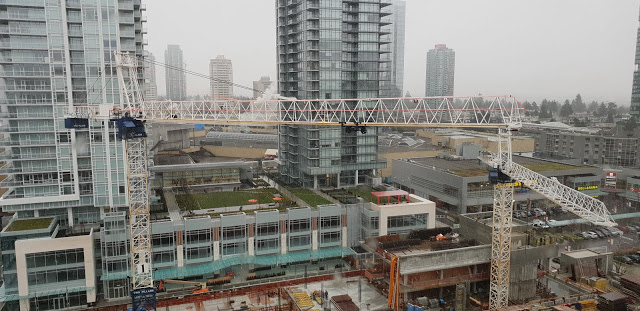
This morning we wake up to rain.  Or so we thought.  Taking a closer look out the window of our room on the 16th floor, we notice the rain is speckled with snowflakes.  As the morning progressed the snow got harder until there were flurries.

 Later we discover this is called wet snow by the local Vancouverians, and whilst they winge a lot over the endless rain, to them rain is infinitely better than snow.

To us, by the afternoon, it was almost blizzard conditions, with lots of snow.  Then the only thing is that it does not accumulate on most of the ground so there are no drifts to play in.

Because the weather is so dismal we decided not to go into Vancouver to do some sightseeing because the clouds were down to the ground and then the snow set in.

Another interesting fact is that construction workers do not go off the job if it’s raining, or worse when it is snowing.  Our room overlooks a new apartment complex under construction and the workers battled on through what seemed like appalling conditions.

At four in the afternoon, the Maple Leafs are playing the Ohio Blue Jackets, in Ohio.  It is a game we expect they will win.  Sparks is the goalkeeper, not Anderson, they’re playing back to back games and Anderson’s starting tomorrow.

They win, four goals to two.  

Just before darkness falls, about four thirty, the snow stops and there is a little rain, which melts the snow.

Time to go up to the executive lounge to get some snacks and coffee, then sleep because the next day we’re taking on the Trans Canada highway from Vancouver to Kamloops.

The forecast is for snow, more snow, and just for a change, more snow.

I am making progress, really…

It’s been a long time, or what seems to be a long time.

A few weeks ago I was sitting in front of the computer screen, the ever-pervasive cursor flashing on a blank piece of digitized paper, and that was as far as I got.

No, the house didn’t burn down, no major catastrophe nor family member or friend was in dire need of my help.

I just didn’t know what to write next.

I have been writing, but not necessarily in the normal sense.  I have SomNote on my phone, and when I’m waiting, usually for doctors or Government offices, I write.  A bit of this, a bit of that, but sometimes the YA novel I’m writing for, and not necessarily about, my 19-year-old granddaughter.  Other times it might be a blog post about the experience, or someone who stands out in the crowd.

I find SomNote excellent for just putting words down quickly, as narrative, or just points, emailing it my myself and rehashing it later.  It has basically been used to write the first 37 chapters of the YA novel.

But as for the other writing?

Strangers We’ve Become, the follow-up to What Sets Us Apart took a new direction.  As this is the next book to be published, and I have completed the revisions the editor asked for. we might see this finally get to the publisher.

Never let anyone tell you there’s not something else to be done after 10 edits, and re-writes.

The Things We Do For Love, a little story I wrote many years ago, is finally through its last edit and ready for the final approval from the editor, and will be ready for publication.  It will be categorized as Romantic Suspense, along with Sunday In New York.

Look for those to be released in June or July this year.

My other story, the tales of PI Walthenson, private detective, had taken a back burner for a while, as I continue to muddle through the second case, now at about 60 episodes, of which 40 odd have been published.

I have no idea how it will end, but it’s going to be fun getting there.

This is a link to the latest episode here:  https://www.walthensonpi.com/

After that, Zoe will be back.  After the trials and tribulations in The Devil You Don’t, she finds that the past she tried to leave behind had come back to bite her, in the tentatively titled ”First Dig Two Graves’, because it is about revenge and whether or not it’s best served cold.  And whether or not John’s romantic aspirations are fulfilled.

Now, I guess, it’s back to work!

“One Last Look”, nothing is what it seems

A single event can have enormous consequences.

A single event driven by fate, after Ben told his wife Charlotte he would be late home one night, he left early, and by chance discovers his wife having dinner in their favourite restaurant with another man.

A single event where it could be said Ben was in the wrong place at the wrong time.

Who was this man? Why was she having dinner with him?

A simple truth to explain the single event was all Ben required. Instead, Charlotte told him a lie.

A single event that forces Ben to question everything he thought he knew about his wife, and the people who are around her.

After a near-death experience and forced retirement into a world he is unfamiliar with, Ben finds himself once again drawn back into that life of lies, violence, and intrigue.

From London to a small village in Tuscany, little by little Ben discovers who the woman he married is, and the real reason why fate had brought them together.

It is available on Amazon here:  http://amzn.to/2CqUBcz

Searching for locations:  Vancouver, Canada – 1

It’s raining.  There should be no surprise there.  And cold.  It’s late December and well into winter.

Perhaps not as cold as it could be, somewhere between three and four degrees.

We are staying at the Hilton Metrotown, at Burnaby.  Metrotown is also the largest shopping mall in British Columbia.  I agree that it is large and found it a great way to get some exercise after being in and off planes for the previous 24 hours.

The first discovery for the day was a trolley bus, something that I thought didn’t exist anymore. 

The second was to discover so many global brands, but how different the products are to what we can get back in Australia.  This is particularly so for cars where we discover that GM-based vehicles and Mazdas are so much better than what is available for us.

The third was to discover it seems we are almost in the heart of Chinatown, where going out an exit on the second floor takes you to a Chinese food court, with all manner of food types, and, it seems, tea bars.  It also explained why, in one supermarket we went in, signs were in both Chinese and English.

Being still tired from the travel, we don’t venture further than the mall where we have lunch, for me, the Canadian version of KFC, which seems to defeat the purpose of trying local food.  It seems most of the food that I can see in the food shops does not seem that appetizing.

Later we go out and find a Boston Pizza with a sports bar where we indulge in a 21 ounce Molton on tap, and a lime mojito, while watching the ice hockey on the big and surrounding small screens.  The ice hockey is some world junior championship (but mostly north hemisphere hockey playing nations) and seems as ferocious as the NHL.

But it does raise a question, why isn’t there a female NHL?  I guess this wasn’t the time to canvass opinions in the bar.

Something else we discover is that alcohol is relatively cheap, and get a case of Molten Canadian ale, Bacardi Black label, and maple flavored whiskey, for about a third of what it would cost at home.  Of course, it must be cheaper than firewood in keeping Canadians warm in the dead of winter.

We didn’t try the pizza, which kind of defeated the purpose of going there.

Meanwhile back at the room, we find the local ice hockey channel, and then to make sure we get to see the Maple Leafs, plug in the computer so that we can test it.  Good to go.  

That’s tomorrow, tonight we watching the Vancouver Canucks.

An excerpt from “Mistaken Identity” – a work in progress

The odds of any one of us having a doppelganger are quite high. Whether or not you got to meet him or her, or be confronted by them was significantly lower. Except of course, unless you are a celebrity.

It was a phenomenon remarkable only for the fact, at times, certain high-profile people, notorious or not, had doubles if only to put off enemies or the general public. Sometimes we see people in the street, people who look like someone we knew, and made the mistake of approaching them like a long lost friend, only to discover an embarrassed individual desperately trying to get away for what they perceive is a stalker or worse.

And then sometimes it is a picture that looms up on a TV screen, an almost exact likeness of you. At first, you are fascinated, and then according to the circumstances, and narrative that is attached to that picture, either flattered or horrified.

For me one turned to the other when I saw an almost likeness of me flash up on the screen when I turned the TV on in my room. What looked to be my photo, with only minor differences, was in the corner of the screen, the newsreader speaking in rapid Italian, so fast I could only translate every second or third word.

But the one word I did recognize was murder. The photo of the man up on the screen was the subject of an extensive manhunt. The crime, the murder of a woman in the very same hotel I was staying, and it was being played out live several floors above me. The gist of the story, the woman had been seen with, and staying with the man who was my double, and, less than an hour ago, the body had been discovered by a chambermaid.

The killer, the announcer said, was believed to be still in the hotel because the woman had died shortly before she had been discovered.

I watched, at first fascinated at what I was seeing. I guess I should have been horrified, but at that moment it didn’t register that I might be mistaken for that man.

Not until another five minutes had passed, and I was watching the police in full riot gear, with a camera crew following behind, coming up a passage towards a room. Live action of the arrest of the suspected killer the breathless commentator said.

Then, suddenly, there was a pounding on the door. On the TV screen, plain to see, was the number of my room.
I looked through the peephole and saw an army of police officers. It didn’t take much to realize what had happened. The hotel staff identified me as the man in the photograph on the TV and called the police.

Horrified wasn’t what I was feeling right then.

It was fear.

My last memory was the door crashing open, the wood splintering, and men rushing into the room, screaming at me, waving guns, and when I put my hands up to defend myself, I heard a gunshot.

And in one very confused and probably near-death experience, I thought I saw my mother and thought what was she doing in Rome?

I was the archetypal nobody.

I lived in a small flat, I drove a nondescript car, had an average job in a low profile travel agency, was single, and currently not involved in a relationship, no children, and according to my workmates, no life.

They were wrong. I was one of those people who preferred their own company, I had a cat, and travelled whenever I could. And I did have a ‘thing’ for Rosalie, one of the reasons why I stayed at the travel agency. I didn’t expect anything to come of it, but one could always hope.

I was both pleased and excited to be going to the conference. It was my first, and the glimpse I had seen of it had whetted my appetite for more information about the nuances of my profession.

Some would say that a travel agent wasn’t much of a job, but to me, it was every bit as demanding as being an accountant or a lawyer. You were providing a customer with a service, and arguably more people needed a travel agent than a lawyer. At least that was what I told myself, as I watched more and more people start using the internet, and our relevance slowly dissipating.

This conference was about countering that trend.

The trip over had been uneventful. I was met at the airport and taken to the hotel where the conference was being held with a number of other delegates who had arrived on the same plane. I had mingled with a number of other delegates at the pre conference get together, including one whose name was Maryanne.

She was an unusual young woman, not the sort that I usually met, because she was the one who was usually surrounded by all the boys, the life of the party. In normal circumstances, I would not have introduced myself to her, but she had approached me. Why did I think that may have been significant? All of this ran through my mind, culminating in the last event on the highlight reel, the door bursting open, men rushing into my room, and then one of the policemen opened fire.

I replayed that last scene again, trying to see the face of my assailant, but it was just a sea of men in battle dress, bullet proof vests and helmets, accompanied by screaming and yelling, some of which I identified as “Get on the floor”.

Then came the shot.

Why ask me to get on the floor if all they were going to do was shoot me. I was putting my hands up at the time, in surrender, not reaching for a weapon.

Then I saw the face again, hovering in the background like a ghost. My mother. Only the hair was different, and her clothes, and then the image was going, perhaps a figment of my imagination brought on by pain killing drugs. I tried to imagine the scene again, but this time it played out, without the image of my mother.

I opened my eyes took stock of my surroundings. What I felt in that exact moment couldn’t be described. I should most likely be dead, the result of a gunshot wound. I guess I should be thankful the shooter hadn’t aimed at anything vital, but that was the only item on the plus side.

I was in a hospital room with a policeman by the door. He was reading a newspaper, and sitting uncomfortably on a small chair. He gave me a quick glance when he heard me move slightly, but didn’t acknowledge me with either a nod, or a greeting, just went back to the paper.

If I still had a police guard, then I was still considered a suspect. What was interesting was that I was not handcuffed to the bed. Perhaps that only happened in TV shows. Or maybe they knew I couldn’t run because my injuries were too serious. Or the guard would shoot me long before my feet hit the floor. I knew the police well enough now to know they would shoot first and ask questions later.

On the physical side, I had a large bandage over the top left corner of my chest, extending over my shoulder. A little poking and prodding determined the bullet had hit somewhere between the top of my rib cage and my shoulder. Nothing vital there, but my arm might be somewhat useless for a while, depending on what the bullet hit on the way in, or through.

It didn’t feel like there were any broken or damaged bones.

That was the good news.

On the other side of the ledger, my mental state, there was only one word that could describe it. Terrified. I was looking at a murder charge and jail time, a lot of it. Murder usually had a long time in jail attached to it.

Whatever had happened, I didn’t do it. I know I didn’t do it, but I had to try and explain this to people who had already made up their minds. I searched my mind for evidence. It was there, but in the confused state brought on by the medication, all I could think about was jail, and the sort of company I was going to have.

I think death would have been preferable.

Half an hour later, maybe longer, I was drifting in an out of consciousness, a nurse, or what I thought was a nurse, came into the room. The guard stood, checked her ID card, and then stood by the door.

She came over and stood beside the bed. “How are you?” she asked, first in Italian, and when I pretended I didn’t understand, she asked the same question in accented English.

“Alive, I guess,” I said. “No one has come and told what my condition is yet. You are my first visitor. Can you tell me?”

“Of course. You are very lucky to be alive. You will be fine and make a full recovery. The doctors here are excellent at their work.”

“What happens now?”

“I check you, and then you have a another visitor. He is from the British Embassy I think. But he will have to wait until I have finished my examination.”

I realized then she was a doctor, not a nurse.

My second visitor was a man, dressed in a suit the sort of which I associated with the British Civil Service.  He was not very old which told me he was probably a recent graduate on his first posting, the junior officer who drew the short straw.

The guard checked his ID but again did not leave the room, sitting back down and going back to his newspaper.

My visitor introduced himself as Alex Jordan from the British Embassy in Rome and that he had been asked by the Ambassador to sort out what he labelled a tricky mess.

For starters, it was good to see that someone cared about what happened to me.  But, equally, I knew the mantra, get into trouble overseas, and there is not much we can do to help you.  So, after that lengthy introduction, I had to wonder why he was here.

I said, “They think I am an international criminal by the name of Jacob Westerbury, whose picture looks just like me, and apparently for them it is an open and shut case.”  I could still hear the fragments of the yelling as the police burst through the door, at the same time telling me to get on the floor with my hands over my head.

“It’s not.  They know they’ve got the wrong man, which is why I’m here.  There is the issue of what had been described as excessive force, and the fact you were shot had made it an all-round embarrassment for them.”

“Then why are you here?  Shouldn’t they be here apologizing?”

“That is why you have another visitor.  I only took precedence because I insisted I speak with you first.  I have come, basically to ask you for a favour.  This situation has afforded us with an opportunity.  We would like you to sign the official document which basically indemnifies them against any legal proceedings.”

Curious.  What sort of opportunity was he talking about?  Was this a matter than could get difficult and I could be charged by the Italian Government, even if I wasn’t guilty, or was it one of those hush hush type deals, you do this for us, we’ll help you out with that.  “What sort of opportunity?”

“We want to get our hands on Jacob Westerbury as much as they do.  They’ve made a mistake, and we’d like to use that to get custody of him if or when he is arrested in this country.  I’m sure you would also like this man brought into custody as soon as possible so you will stop being confused with him.  I can only imagine what it was like to be arrested in the manner you were.  And I would not blame you if you wanted to get some compensation for what they’ve done.  But.  There are bigger issues in play here, and you would be doing this for your country.”

I wondered what would happen if I didn’t agree to his proposal.  I had to ask, “What if I don’t?”

His expression didn’t change.  “I’m sure you are a sensible man Mr Pargeter, who is more than willing to help his country whenever he can.  They have agreed to take care of all your hospital expenses, and refund the cost of the Conference, and travel.  I’m sure I could also get them to pay for a few days at Capri, or Sorrento if you like, before you go home.  What do you say?”

There was only one thing I could say.  Wasn’t it treason if you went against your country’s wishes?

“I’m not an unreasonable man, Alex.  Go do your deal, and I’ll sign the papers.”

“Good man.”

After Alex left, the doctor came back to announce the arrival of a woman, by the way she had announced herself, the publicity officer from the Italian police. When she came into the room, she was not dressed in a uniform.

The doctor left after giving a brief report to the civilian at the door. I understood the gist of it, “The patient has recovered excellently and the wounds are healing as expected. There is no cause for concern.”

That was a relief.

While the doctor was speaking to the civilian, I speculated on who she might be. She was young, not more than thirty, conservatively dressed so an official of some kind, but not necessarily with the police. Did they have prosecutors? I was unfamiliar with the Italian legal system.

She had long wavy black hair and the sort of sultry looks of an Italian movie star, and her presence made me more curious than fearful though I couldn’t say why.

The woman then spoke to the guard, and he reluctantly got up and left the room, closing the door behind him.
She checked the door, and then came back towards me, standing at the end of the bed. Now alone, she said, “A few questions before we begin.” Her English was only slightly accented. “Your name is Jack Pargeter?”

I nodded. “Yes.”

“You are in Rome to attend the Travel Agents Conference at the Hilton Hotel?”

“Yes.”

“You attended a preconference introduction on the evening of the 25th, after arriving from London at approximately 4:25 pm.”

“About that time, yes. I know it was about five when the bus came to collect me, and several others, to take us to the hotel.”

She smiled. It was then I noticed she was reading from a small notepad.

“It was ten past five to be precise. The driver had been held up in traffic. We have a number of witnesses who saw you on the plane, on the bus, at the hotel, and with the aid of closed circuit TV we have established you are not the criminal Jacob Westerbury.”

She put her note book back in her bag and then said, “My name is Vicenza Andretti and I am with the prosecutor’s office. I am here to formally apologize for the situation that can only be described as a case of mistaken identity. I assure you it is not the habit of our police officers to shoot people unless they have a very strong reason for doing so. I understand that in the confusion of the arrest one of our officers accidentally discharged his weapon. We are undergoing a very thorough investigation into the circumstances of this event.”

I was not sure why, but between the time I had spoken to the embassy official and now, something about letting them off so easily was bugging me. I could see why they had sent her. It would be difficult to be angry or annoyed with her.

But I was annoyed.

“Do you often send a whole squad of trigger happy riot police to arrest a single man?” It came out harsher than I intended.

“My men believed they were dealing with a dangerous criminal.”

“Do I look like a dangerous criminal?” And then I realized if it was mistaken identity, the answer would be yes.

She saw the look on my face, and said quietly, “I think you know the answer to that question, Mr. Pargeter.”

“Well, it was overkill.”

“As I said, we are very sorry for the circumstances you now find yourself in. You must understand that we honestly believed we were dealing with an armed and dangerous murderer, and we were acting within our mandate. My department will cover your medical expenses, and any other amounts for the inconvenience this has caused you. I believe you were attending a conference at your hotel. I am very sorry but given the medical circumstances you have, you will have to remain here for a few more days.”

“I guess, then, I should thank you for not killing me.”

Her expression told me that was not the best thing I could have said in the circumstances.

“I mean, I should thank you for the hospital and the care. But a question or two of my own. May I?”

She nodded.

“Did you catch this Jacob Westerbury character?”

“No. In the confusion created by your arrest he escaped. Once we realized we had made a mistake and reviewed the close circuit TV, we tracked him leaving by a rear exit.”

“Are you sure it was one of your men who shot me?”

I watched as her expression changed, to one of surprise.

“You don’t think it was one of my men?”

“Oddly enough no. But don’t ask me why.”

“It is very interesting that you should say that, because in our initial investigation, it appeared none of our officer’s weapons had been discharged. A forensic investigation into the bullet tells us it was one that is used in our weapons, but…”

I could see their dilemma.

“Have you any enemies that would want to shoot you Mr Pargeter?”

That was absurd because I had no enemies, at least none that I knew of, much less anyone who would want me dead.

“Not that I’m aware of.”

“Then it is strange, and will perhaps remain a mystery. I will let you know if anything more is revealed in our investigation.”

She took an envelope out of her briefcase and opened it, pulling out several sheets of paper.

I knew what it was. A verbal apology was one thing, but a signed waiver would cover them legally. They had sent a pretty girl to charm me. Perhaps using anyone else it would not have worked. There was potential for a huge litigation payout here, and someone more ruthless would jump at the chance of making a few million out of the Italian Government.

“We need a signature on this document,” she said.

“Absolving you of any wrong doing?”

“I have apologized. We will take whatever measures are required for your comfort after this event. We are accepting responsibility for our actions, and are being reasonable.”

They were. I took the pen from her and signed the documents.

“You couldn’t add dinner with you on that list of benefits?” No harm in asking.

“I am unfortunately unavailable.”

I smiled. “It wasn’t a request for a date, just dinner. You can tell me about Rome, as only a resident can. Please.”

She looked me up and down, searching for the ulterior motive. When she couldn’t find one, she said, “We shall see once the hospital discharges you in a few days.”

“Then I’ll pencil you in?”

She looked at me quizzically. “What is this pencil me in?”

“It’s an English colloquialism. It means maybe. As when you write something in pencil, it is easy to erase it.”

A momentary frown, then recognition and a smile. “I shall remember that. Thank-you for your time and co-operation Mr. Pargeter. Good morning.”

© Charles Heath 2015-2021