Searching for locations: Vancouver, Canada – 4

Staying at Hampton Inn and Suites downtown, whatever that means because it looks like we are in the middle of nowhere.

But, judging by the crowd in the breakfast room, it’s a popular hotel.  Of course, it is Sunday morning so this could be the weekend escape people.

Two things I remember about staying in Hampton Inns is firstly the waffles and whipped butter.  It’s been five years but nothing has changed, they are as delicious as ever.  The other, its where I discovered vanilla flavored milk for coffee, and it, too, is addictive.

They also used to have flat burgers that were made out of sausage meat which was delicious, but on the first day, they were not on the menu.

Nevertheless, it was still a very yummy breakfast.

After some research into where we might find this pixmi unicorn, it appears that it is available at a ‘toys are us’ store in one of the suburbs of Vancouver.  So, resuming the quest, we took a taxi to West Broadway, the street the store is located.

A quick search of the store finds where the toys we’re looking for are, after asking one of the sales staff, and we find there are at least a dozen of them.  Apparently, they are not as popular in Canada as the might be in America.  Cheaper too, because the exchange rate for Canadian dollars is much better than for American dollars.  Still, 70 dollars for a stuffed toy is a lot of money.

We also get some slime, stuff that our middle granddaughter seems to like playing with.

After shopping we set off down West Broadway, the way we had come, looking for a taxi to return us to the hotel.  There’s no question of walking back to the hotel.

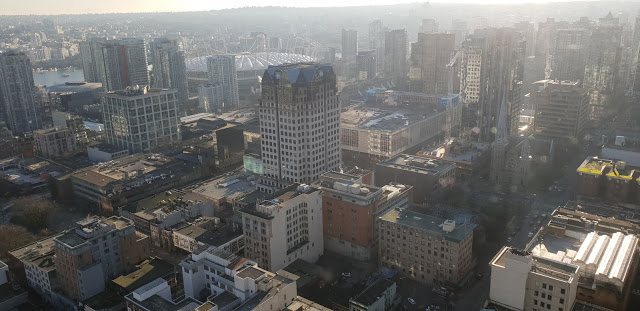
A few hours later we walk to the observation tower, which was not very far from the hotel,

a place where we could get a 360-degree view of the city of Vancouver although it was very difficult to see any of the old buildings because they were hidden by the newer buildings, nor could we see the distant mountains because of the haze.

After leaving the tower we walked down Water Street to see the steam clock and the old world charm of a cobbled street and old buildings

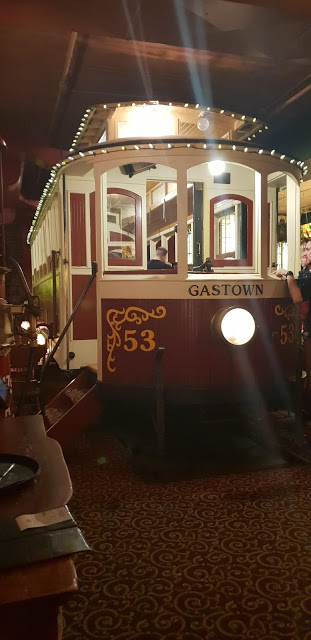
We stopped at the Spaghetti Factory Italian restaurant for dinner and is so popular that we have to wait, 10 minutes to start with.  It doesn’t take all that long to order and have the food delivered to the table.  Inside the restaurant, there is an actual cable car but we didn’t get to sit in it.

I have steak, rare, mushrooms, and spaghetti with marinara sauce.  No, marinara doesn’t mean seafood sauce but a very tasty tomato-based sauce.  The steak was absolutely delicious and extremely tender which made it more difficult to cut with a steak knife.

The write up for the marinara sauce is, ‘it tastes so fresh because it is made directly from vine-ripened tomatoes, not from concentrate, packed within 6 hours of harvest.  We combine them with fresh, high-quality ingredients such as caramelised onions, roasted garlic and extra virgin olive oil’.

Oh, and did I mention they have a streetcar right there in the middle of the restaurant

I’m definitely going to try and make this when we get home.

After dinner, we return to the observation tower,  the ticket allowing us to go back more than once, and see the sights at night time.  I can’t say it was all that spectacular.

Another day has gone, we are heading home tomorrow.

Writing a book in 365 days – 63

Day 63

A writing exercise

She was so ruthless in her pursuit that soon she forgot why she had started.

It was the only way I could describe the actions of Evelyn Johnson, a mild-mannered young lady who at first sight seemed to be the type of person who anyone would give a second glance; totally out of character.

i remembered that day well because it shook up the working environment that had taken our section head nearly a year to get settled. The right staff with the right qualifications, with the right amount of experience, and able to do their designated jobs.

It was a rare place indeed.

And then the department head arrived one morning and told Kendra, the section head, that there was a new officer starting and she was to be shown all of the processes in turn. That new officer, Evelyn Johnson, recently from Chicago, a big city girl moving to small-town America, in the Midwest. It was the proverbial doubly whammy.

No explanation was given, but the Department Head did have a curious expression on his face when he introduced her. Kendra just shook her head.

This was not the first time it happened. Jeffrey Quirke, the Department Head, had introduced three other young ladies into our department with varying consequences. What we learned afterwards, they were his ‘special projects’, and they didn’t last too long.

Evelyn seemed different, and to me, she looked vaguely familiar, in stature and manner.

Jeffrey Quirke’s expression remained the same, and so we assumed she was going to be another transient ‘special project’.

….

A month later, it was my turn to spend a week introducing her to my specialisation, filing and cataloguing. We used computers, everything passed through a system and was stored in particular places, with a cross index so that there were often four or five categories in the index for a single document.

Before submitting their files for storage the authors had to use several keywords. Of course, most of them didn’t, not because they couldn’t but more they were lazy and knew we would do it for them.

By the time Evelyn got to me, the others had made up their minds about her, she was not who she said she was, certainly she had never been to university, or if she had, not taken anything in, and that she did;t seem to understand the concept of work. She was always late, and had extended lunch hours and disappeared before the official going home time.

She did not attend any of our staff gatherings and didn’t come to the Friday night drinks, our way of winding down so that we could enjoy the weekend. Kendra said she was going to give her the lecture, despite the fact she might go straight to Quirke, but I said I would talk to her first.

“I don’t think you are her type, Joshua,” she said, and she was probably right.

Any time I had tried to talk to her, she simply ignored me. Except if it was work-related. It was going to be a challenge.

Once again she was late, this time an improvement, only ten minutes, and I watched her hasten from the door to the staff room, then emerge a minute or two later and head straight for my desk. she brought herself, and her cell phone. She didn’t take notes. It was not possible she could remember everything we had told her.

After she said, there was no apology, and the smile was thin and annoying.

“You seem to have a problem with time.”

“I’m sorry? What business is it of yours.”

“We all make the effort to get here on time. The section’s performance is measured and a report is compiled, and we were the best in the building, and no we’re not. You may not care, but that performance report is the basis for our productivity bonus. You might ask what business it is of mine, it is very much our business when you are letting the team down.”

“It’s not deliberate.”

“I think it is. You could take an earlier train or bus, or get whoever it is who brings you to leave earlier or find some other way. Unless, of course, you think you are more privileged than we are, or you hail from very rich parents who indulge your every whim and you don’t need the mon ey like everyone else here.”

OK, I think I’d finally stepped over the line, but, if I had, we would find out very soon who she really was.

“You don’t know anything about me.”

“Then enlighten me so I can understand.”

She sighed. “Just show me what you have to show me and I’ll be out of your hair soon enough.”

“Why are you here, anyway?”

“To learn about the systems and the processes.”

“You don’t take notes.”

“Photographic memory. Don’t need to.”

I shook my head. “I don’t believe you.”

She frowned, the took me through the system, from the specifications of the computer server system, the workstations, the filing system, the operating system, the administrative role and tasks, the whole box and dice. The last time I read about the system, before I sat down with it, was reading the system manually, which was 2,000 pages long. My bailiwick was only 150 pages or so.

She concluded about thirty-three minutes later. “So far, collectively between you, you have misquoted the system procedures forty-seven times. My report will make interesting reading for someone…”

There was no mistaking who that someone was in her supercilious tone.

I guess she had proverbially put me in my place.

….

Friday couldn’t come soon enough, and I had managed to get through my part of the system without, I believed, making too many mistakes. The system had varied a little from the manual in places, but by and large, we were still dependent on the manual for guidance.

This Friday was odd, Evelyn was still at work long after she usually left, and it was just after the last employee left, telling me that she would see me at the bar, and not to be too long. The company did not pay overtime and any extra time we spent there was on us. Routinely the only people still in the building after knock-off time was management.

I wondered if she was waiting for Quirke, and they would be on their way to dinner and… I tried not to go there in my mind. Quirke was not what I would call an attractive proposition.

I had gone to the breakout area to put my coffee cup in the dishwasher while she was processing a sample files, and indexing it. When I came back, she had a list of files on the screen. There should only be the one she had just filed.

“What are you doing?” I had to ask, because bringing up files, any files in the system, left an imprint of your login and the date.

Just before she cleared the screen I did see one name of interest, Jocelyn Trent. It was a name I hadn’t heard or seen in at least five years, and quite oddly, one of the first of Quirke’s so-called ‘special projects’.

“I created a few cross-indexes and filed it, and when I did, it brought up all these other files, obviously with the same index keywords. I had no idea that would happen. I didn’t mean for it to.”

Her excuse seemed just a little too pat for my liking. Someone would have to know those keywords to get those files, and there was no way they could be randomly guessed. And now that I thought about it, I had seen her scanning lists of available keywords to use, as if she was looking for something.”

“Who are you really? We all think you’re Quirke’s special project, but I’m beginning to think you’re something else entirely. How do you know Jocelyn Trent?”

“Who?” She tried to look innocent, but I wasn’t buying it.

“don;t play dumb. To get those files you needed to know the secret code.”

“How do you know there’s a secret code?”

“I work in filing and cataloguing. It’d be a bit strange if I didn’t know the system inside out for when the idiots out there forget where they put their documents. But you, you haven;t been here long enough, and those codes are not in any manual. Again, who are you?”

There were two choices here, she was a spy from another company trying to see how we’d improved the system, or she was from the company that supplied the software, a company that was displeased with us because we were locked in a battle over the latest round of licencing fees, after an update that we had all but financed. Then there was how she got past Quirke, though that needed very little imagination.

It just surprised me that she would.

“I’m not sure I like the tone when you call me a special project.”

“You obviously are in tight with Quirke.”

“You are prone to making the wildest of assumptions, aren’t you?”

“Either that and you’re a spy, in which case I will have to call security. And they are not the most pleasant of fellows.

They were not. We all thought they were ex-mercenaries, and then people were escorted from the building we all believed they would never be seen again. I had personally seen Jocelyn Trent escorted from the building, and she was never seen again. Kendra said she heard a rumour she got pregnant with Quirke’s child and he sent her to the other side of the country. A rational explanation rather than the rumour mill conspiracy theory. I preferred the latter.

“I’m no one, Joshua, believe me. Certainly not a spy, and definitely not Quirke’s whore.”

Well, that was pretty definitive, and when she pronounced Quirke’s name there was a very dangerous undertone to it. She hated him.

Then, in the light, daylight giving over to the overhead lighting the way she moved her head, the profile, was exactly the same as Jocelyn Trent. The hair would have been the same if it had been much longer and several shades darker. This girl was much thinner, but if I was to hazard a guess, she was either her twin or younger sister though by only a year.

I tried to remember the conversation Jocelyn and I had about her family. She had been as tight-lipped at this one. We had been friends until something happened, and then I saw her escorted from the building. I tried to find out but there was nothing, and she couldn’t be found.

I’d also tried to find the documents that Evelyn had just brought up and hadn’t because I didn’t know the special code. It was obvious Evelyn did.

“You’re not Evelyn, your real name is Whilomena Trent, isn’t it, Willie for short. Jocelyn said, once, she had a younger sister who hated her name and used her second name which I can’t remember for the moment, but looking at you, I believe you are her twin, and in that younger boy a few minutes.”

She had that look that said she was going to deny it, but then she shrugged. She looked around but there was no one else in the room.

“She liked you Josh.”

Josh was her special name for me. When we were friends.

“She said if I was ever here that I should look you up, but when she left and didn’t come home, I sort of forgot about this place, and everyone in it.”

“Why are you here?”

“I believe she was murdered.”

“By Quirke?”

“He got her pregnant.”

“You know that for sure?”

“That was the last thing she told me while being escorted out of the building. She said she had to clear her things at the apartment and she would be coming home. It was what she told me from the apartment that night. The next day her stuff, phone, everything, was found scattered all over the apartment, apparently tossed by someone who didn’t find what they were looking for. There was a police search for her that lasted a month. Then we got a postcard from her, telling us she had moved to California, and they arrived every few months. It was her writing, and her manner, and she told us she would be home soon, she just had to work through some stuff. I figured she was going to have the baby, adopt it out, then come home. Then she wrote a letter, she’d found a nice Englishman and moved to England, and when she was settled she would send us invites to come and see her. Three months ago, when she was living in California, a man walking his dog came across some bones. Those bones were identified as Jocelyn’s. The police there are trying to piece together her movements, but so much time has passed, they may never solve the crime.”

“And you think there are answers here?”

“I know the answers are here.” She pulled an envelope out of her handbag and gave it to me.

It was addressed to Willie Trent. I took out the single sheet and unfolded it. There was a single line witten in capital letters, “Jeffrey Quirke killed Jocelyn Trent. I saw him do it.”

©  Charles Heath  2025


An excerpt from “Amnesia”, a work in progress

I remembered a bang.

I remembered the car slewing sideways.

I remember another bang, and then it was lights out.

When I opened my eyes again, I saw the sky.

Or I could be underwater.

Everything was blurred.

I tried to focus but I couldn’t. My eyes were full of water.

What happened?

Why was I lying down?

Where was I?

I cast my mind back, trying to remember.

It was a blank.

What, when, who, why and where, are questions I should easily be able to answer. These are questions any normal person could answer.

I tried to move. Bad, bad mistake.

I did not realise the scream I heard was my own. Just before my body shut down.

“My God! What happened?”

I could hear, not see. I was moving, lying down, looking up.

I was blind. Everything was black.

“Car accident; hit a tree, sent the passenger flying through the windscreen. Pity to poor bastard didn’t get the message that seat belts save lives.”

Was I that poor bastard?

“Report?” A new voice, male, authoritative.

“Multiple lacerations, broken collar bone, broken arm in three places, both legs broken below the knees, one badly. We are not sure of internal injuries, but ruptured spleen, cracked ribs and pierced right lung are fairly evident, x-rays will confirm that and anything else.”

“What isn’t broken?”

“His neck.”

“Then I would have to say we are looking at the luckiest man on the planet.”

I heard the shuffling of pages.

“OR1 ready?”

“Yes. On standby since we were first advised.”

“Good. Let’s see if we can weave some magic.”

Magic.

It was the first word that popped into my head when I surfaced from the bottom of the lake. That first breath, after holding it for so long, was sublime, and, in reality, agonising.

Magic, because it seemed like I’d spent a long time underwater.

Or somewhere.

I tried to speak but couldn’t. The words were just in my head.

Was it night or was it day?

Was it hot, or was it cold?

Where was I?

Around me, it felt cool.

It was incredibly quiet. No noise except for the hissing of air through an air-conditioning vent. Or that was the sound of pure silence.  And with it the revelation that silence was not silent. It was noisy.

I didn’t try to move.

Instinctively, somehow, I knew not to.

A previous unpleasant experience?

I heard what sounded like a door opening, and noticeably quiet footsteps slowly came into the room. They stopped. I could hear breathing, slightly laboured, a sound I’d heard before.

My grandfather.

He had smoked all his life until he was diagnosed with lung cancer. But for years before that he had emphysema. The person in the room was on their way, down the same path. I could smell the smoke.

I wanted to tell whoever it was the hazards of smoking.

I couldn’t.

I heard a metallic clanging sound from the end of the bed. A moment later the clicking of a pen, then writing.

“You are in a hospital.” A female voice suddenly said. “You’ve been in a bad accident. You cannot talk, or move, all you can do, for the moment, is listen to me. I am a nurse. You have been here for 45 days and just came out of a medically induced coma. There is nothing to be afraid of.”

She had a very soothing voice.

Her fingers stroked the back of my hand.

“Everything is fine.”

Define fine, I thought. I wanted to ask her what ‘fine’ meant.

“Just count backwards from 10.”

Why?

I didn’t reach seven.

Over the next ten days, that voice became my lifeline to sanity. Every morning, I longed to hear it, if only for the few moments she was in the room, those few waking moments when I believed she, and someone else who never spoke, were doing tests. I knew it had to be someone else because I could smell the essence of lavender. My grandmother had worn a similar scent.

It rose above the disinfectant.

She was another doctor, not the one who had been there the day I arrived. Not the one who had used some ‘magic’ and kept me alive.

It was then, in those moments before she put me under again, that I thought, what if I was paralysed? It would explain a lot. A chill went through me.

The next morning, she was back.

“My name is Winifred. We don’t know what your name is, not yet. In a few days, you will be better, and you will be able to ask us questions. You were in an accident, and you were very severely injured, but I can assure you there will be no lasting damage.”

More tests, and then when I expected the lights to go out, they didn’t. Not for a few minutes more. This was how I would be integrated back into the world. A little bit at a time.

The next morning, she came later than usual, and I’d been awake for a few minutes. “You have bandages over your eyes and face. You had bad lacerations to your face, and glass in your eyes. We will know more when the bandages come off in a few days. Your face will take longer to heal. It was necessary to do some plastic surgery.”

Lacerations, glass in my eyes, car accidents, plastic surgery. By logical deduction, I knew I was the poor bastard thrown through the windscreen. It was a fleeting memory from the day I was admitted.

How could that happen?

That was the first of many startling revelations. The second was the fact I could not remember the crash. Equally shocking, in that same moment was the fact I could not remember before the crash either, or only vague memories after.

But the most shattering of all these revelations was the one where I realised, I could not remember my name.

I tried to calm down, sensing a rising panic.

I was just disoriented, I told myself. After 45 days in an induced coma, it had messed with my mind, and it was only a temporary lapse. Yes, that’s what it was, a temporary lapse. I will remember tomorrow. Or the next day.

Sleep was a blessed relief.

The next day I didn’t wake up feeling nauseous. I think they’d lowered the pain medication. I’d heard that morphine could have that effect. Then, how could I know that but not who I am?

Now I knew Winifred the nurse was preparing me for something unbelievably bad. She was upbeat, and soothing, giving me a new piece of information each morning. This morning, “You do not need to be afraid. Everything is going to be fine. The doctor tells me you are going to recover with little scarring. You will need some physiotherapy to recover from your physical injuries, but that’s in the future. We need to let you mend a little bit more before then.”

So, I was not going to be able to leap out of bed and walk out of the hospital any time soon. I don’t suppose I’d ever leapt out of bed, except as a young boy. I suspect I’d sustained a few broken bones. I guess learning to walk again was the least of my problems.

But there was something else. I picked it up in the timbre of her voice, a hesitation, or reluctance. It sent another chill through me.

This time I was left awake for an hour before she returned.

This time sleep was restless.

Scenes were playing in my mind, nothing I recognised, and nothing lasting longer than a glimpse. Me. Others, people I didn’t know. Or I knew them and couldn’t remember them.

Until they disappeared, slowly like the glowing dot in the centre of the computer screen, before finally fading to black.

The morning the bandages were to come off she came in early and woke me. I had another restless night, the images becoming clearer, but nothing recognisable.

“This morning the doctor will be removing the bandages over your eyes. Don’t expect an immediate effect. Your sight may come back quickly, or it may come back slowly, but we believe it will come back.”

I wanted to believe I was not expecting anything, but I was. It was human nature. I did not want to be blind as well as paralysed. I had to have at least one reason to live.

I dozed again until I felt a gentle hand on my shoulder. I could smell the lavender; the other doctor was back. And I knew the hand on my shoulder was Winifred’s. She told me not to be frightened.

I was amazed to realise at that moment, I wasn’t.

I heard the scissors cutting the bandages.

I felt the bandage being removed, and the pressure coming off my eyes. I could feel the pads covering both eyes.

Then a moment when nothing happened.

Then the pads are gently lifted and removed.

Nothing.

I blinked my eyes, once, twice. Nothing.

“Just hold on a moment,” Winifred said. A few seconds later I could feel a cool towel wiping my face, and then gently wiping my eyes. There was ointment or something else in them.

Then a flash. Well, not a flash, but like when a light is turned on and off. A moment later, it was brighter, not the inky blackness of before, but a shade of grey.

She wiped my eyes again.

I blinked a few more times, and then the light returned, and it was like looking through water, at distorted and blurry objects in the distance.

I blinked again, and she wiped my eyes again.

Blurry objects took shape. A face looking down on me, an elderly lady with a kindly face, surely Winifred, who was smiling. And on the opposite side of the bed, the doctor, a Chinese woman of indescribable beauty.

I nodded.

“You can see?”

I nodded again.

“Clearly?”

I nodded.

“Very good. We will just draw the curtains now. We don’t want to overdo it. Tomorrow we will be taking off the bandages on your face. Then, it will be the next milestone. Talking.”

I couldn’t wait.

When morning came, I found myself afraid. Winifred had mentioned scarring, there were bandages on my face. I knew, but wasn’t quite sure how I knew, I wasn’t the most handsome of men before the accident, so this might be an improvement.

I was not sure why I didn’t think it would be the case.

They came at mid-morning, the nurse, Winifred, and the doctor, the exquisite Chinese. She was the distraction, taking my mind off the reality of what I was about to see.

Another doctor came into the room before the bandages were removed, and he was introduced as the plastic surgeon who had ‘repaired’ the ravages of the accident. It had been no easy job, but, with a degree of egotism, he did say he was one of the best in the world.

I found it hard to believe, if he were, that he would be at a small country hospital.

“Now just remember, what you might see now is not how you will look in a few months.”

Warning enough.

The Chinese doctor started removing the bandages. She did it slowly and made sure it did not hurt. My skin was very tender, and I suspect still bruised, either from the accident or the surgery, I didn’t know.

Then it was done.

The plastic surgeon gave his work a thorough examination and seemed pleased with his work. “Coming along nicely,” he said to the other doctor. He issued some instructions on how to manage the skin, nodded to me, and I thanked him before he left.

I noticed Winifred had a mirror in her hand and was reticent in using it. “As I said,” she said noticing me looking at the mirror, “what you see now will not be the result. The doctor said it was going to heal with little scarring. You have been extremely fortunate he was available. Are you ready?”

I nodded.

She showed me.

I tried not to be reviled at the red and purple mess that used to be my face. At a guess, I would have to say he had to put it all back together again, but not knowing what I looked like before, I had no benchmark. All I had was a snippet of memory that told me I was not the tall, dark, and handsome type.

And I still could not talk. There was a reason, he had worked in that area too. Just breathing hurt. I think I would save up anything I had to say for another day. I could not even smile. Or frown. Or grimace.

“We’ll leave you for a while. Everyone needs a little time to get used to the change. I suspect you are not sure if there has been an improvement in last year’s model. Well, time will tell.”

A new face?

I could not remember the old one.

My memory still hadn’t returned.

©  Charles Heath  2024

In a word: bath

Everyone knows that Bath is a city in England where the rich and pampered used to ‘take the waters’, whatever that meant.  I’ve been to Bath, and it has many terrace houses built in a crescent shape.

I’ve been to the baths, too, which is another use of the word bath, a place where you clean yourself, or just soak away the troubles of the day, usually with a glass or three of champagne.

Apparently, the Bath baths have been there since Roman times and having been there and seen how old they look, I can attest to that fact.

We had a bath before we had a shower, and these days, a bathtub is usually a garden bed full of flowers rather than a body.

Being given a bath sometimes means you were comprehensively beaten in a game, like football.

Throwing the baby out with the bath water is a rather quaint expression that means nothing like it literally does but describes a wife or husband cleaning up a spouse’s space without due regard to what she or he might want to keep—that is, throwing everything out.

If you take a bath, yes, you might get wet, but in another sense, it might be when you take a large hit financially.  And, these days, it doesn’t take much for super funds to suddenly have negative growth.

A bathhouse could be a place where there might be a swimming pool, not just a bath, where people gather.  A notable one was seen in the movie ‘Gorky Park’.

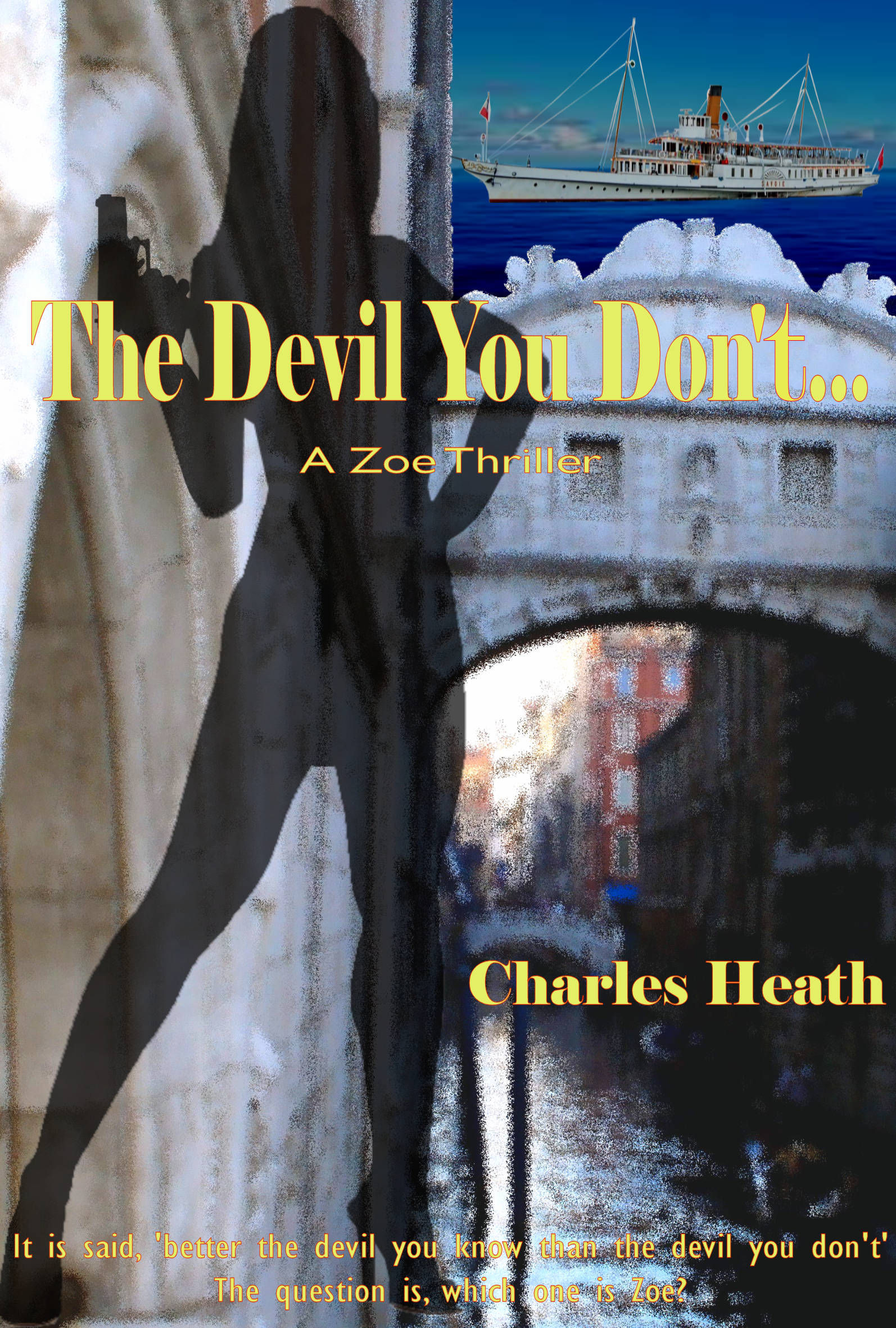
“The Devil You Don’t”, she was the girl you would not take home to your mother!

Now only $0.99 at https://amzn.to/2Xyh1ow

John Pennington’s life is in the doldrums. Looking for new opportunities, and prevaricating about getting married, the only joy on the horizon was an upcoming visit to his grandmother in Sorrento, Italy.

Suddenly he is left at the check-in counter with a message on his phone telling him the marriage is off, and the relationship is over.

If only he hadn’t promised a friend he would do a favour for him in Rome.

At the first stop, Geneva, he has a chance encounter with Zoe, an intriguing woman who captures his imagination from the moment she boards the Savoire, and his life ventures into uncharted territory in more ways than one.

That ‘favour’ for his friend suddenly becomes a life-changing event, and when Zoe, the woman who he knows is too good to be true, reappears, danger and death follow.

Shot at, lied to, seduced, and drawn into a world where nothing is what it seems, John is dragged into an adrenaline-charged undertaking, where he may have been wiser to stay with the ‘devil you know’ rather than opt for the ‘devil you don’t’.

newdevilcvr6

The cinema of my dreams – I never wanted to go to Africa – Episode 10

It’s still a battle of wits, but our hero knows he’s in serious trouble.

The problem is, there are familiar faces and a question of who is a friend and who is foe made all the more difficult because the enemy if it is the enemy, doesn’t look or sound or act like the enemy.

Nor does it help when his old mentor walks through the door.


I don’t like surprises.  This dislike had started with a surprise birthday party about 10 years ago and since then I’ve assiduously tried to avoid them.

Of course, there are also surprises you have no control over, and I liked them even less.

Bluff and bravado would only carry me so far.  These people whoever they were would not accept that I knew nothing about what had just happened.

Which I didn’t.

It was not the A interrogation team with a chest full of torture tools and dressed in hazmat suits, but when the harbinger of my fate walked into the room, it was something a lot scarier.

A man I knew well or thought I did until he walked in the door, I had the utmost respected for.

Colonel Bamfield.  My first Commanding Officer, the man who cut me some slack, and made me into a soldier.

Now, all I had was questions, but I was on the wrong side of the table.

The first, what the hell was going on here?

My first inclination was to stand and salute a superior officer, but he was not wearing the uniform, not the proper uniform I was used to seeing him in.  My second inclination was to ask him what he was doing in that room with me, but I didn’t.

Speak when spoken to, and don’t volunteer information.

He too tried the silent treatment, or maybe it was that he was as surprised to see me as I was to see him.

Then, still standing behind the table, looking down on me, he said, “That was some jump you made from a moving helicopter.”  Was there a touch of admiration in his tone?

“Life or death.  Anyone one else is that situation would do the same.”

“Less than you’d think.”

Establishing camaraderie.  Or trying to.  I waited for the next question.

It wasn’t a question but a statement, “We have a problem Alan, and it’s not just with you.”


© Charles Heath 2019

The cinema of my dreams – I always wanted to write a war story – Episode 10

For a story that was conceived during those long boring hours flying in a steel cocoon, striving to keep away the thoughts that the plane and everyone in it could just simply disappear as planes have in the past, it has come a long way.

Whilst I have always had a fascination in what happened during the second world war, not the battles or fighting, but in the more obscure events that took place, I decided to pen my own little sidebar to what was a long and bitter war.

And, so, it continues…

We walked slowly towards the end of the passage, each time I passed a cell I had a look in, and noted if it had a prisoner or not.  By the end of the passage, I counted six prisoners, and one was a woman.’

She just looked at me sullenly, and I guess if it was light enough, that look would be with pleading eyes.  Sadly, I couldn’t save her, or the other five.

At the end of the corridor, we retraced our steps towards the hall, along the passage where I counted another three prisoners, then up the stairs to the ground level.  We came out into a better-lit alcove with arches leading in three directions.

Straight ahead was the hall.

We turned to the left.  Along another passage that seemed to run the length of the wall, what I thought was the stone battlement that made up one side of the castle, looking out over fields, with a village in the distance.

What I thought was the opposite side to the guard tower I’d been in earlier.

I tried to figure out if that’s where we were, and if my memory served me correctly, we were heading towards the wall that was built into the mountainside, in which case we’d go up another set of stairs, at the top of which would be an exit, or turning right, to a room that once served as the guards quarters, now used for kitchen supplies.

What else was here?  My mind was blank.

Up the steps, so far I was right, ahead of a thick wooden door, locked, so we turned right and passed a small room.  I’d forgotten it, but it was the radio room, wires leading out a small arrow slit window to the aerial.   The man in front stumbled, then regained his gait.

I could hear the man behind me shaking his head.

“Halt,” the man behind me barked. 

The man in front stopped dead, and I crashed into him.  I felt rather than saw the fist come towards me; it was not for me, but the other guard, who, preoccupied with not falling, never saw it coming.

He went down like the proverbial ask of potatoes, no idea what happened.

My turn?

A hand landed on my shoulder, thrusting me towards the door to the storeroom.  “Go, now.  The door on the other side is open, head down to the creek and follow it.  Someone will meet you.”

I half turned, “Who…”

“No time.  Go.  And shut the door behind you.”  I felt him thrust a gun in my hand.  “Hit me.”

I hesitated.

“Do it, or I’ll be shot.”

I shrugged and hit him.  He slowly slid to the floor.  A second glance, no, I didn’t know who he was, the headed for the back of the storeroom.  The door was open.  A cautious look before stepping out, I  saw no one but heard breathing.  Jack.  How did the dog know I’d be here?

I closed the door behind me and heard the lock engage, then after a pat on Jack’s head, he led the way.

© Charles Heath 2019

“Knowledge can be dangerous…” – A short story

It was, perhaps, the saddest week of my life.

It started with a phone call, and then a visit by two police officers.  It was about my parents, but the news could not be imparted over the phone, only in person.  That statement alone told me it was very bad news, so I assumed the worst.

The two police officers, standing at the front door, with grim expressions on their faces, completed the picture.  The news, my parents were dead, killed in a freak car accident.

At first, it didn’t sink in.  They were on their way back from another of their extensive holidays, one of many since my father had retired.  I’d seen them probably six months out of the last five years, and the only reason they were returning this time was that my mother needed an operation.

They hadn’t told me why, not that they ever told me very much any time since the day I’d been born, but that was who they were.  I thought them eccentric, being older when I’d come along, and others thought them, well, eccentric.

And being an only child, they packed me off to boarding school, then university, and then found me a job in London, and set me up so that I would only see them weekends if they were home.

I had once wondered if they ever cared about me, keeping me at arm’s length, but my mother some time ago had taken me aside and explained why.  It was my father’s family tradition.  The only part I’d missed was a nanny.

It most likely explained why I didn’t feel their passing as much as I should.

A week later, after a strange funeral where a great many people I’d never met before, and oddly who knew about me, I found myself sitting in the sunroom, a glass of scotch in one hand, and an envelope with my name on it, in the other.

The solicitor, a man I’d never met before, had given it to me at the funeral.   We had, as far as I knew an elderly fellow, one of my father’s old school friends, as the family solicitor, but he hadn’t shown at the funeral and wasn’t at home when I called in on my way home.

It was all very odd.

I refilled the glass and took another look at the envelope.  It was not new, in fact, it had the yellow tinge of age, with discolouration where the flap was.  The writing was almost a scrawl, but identifiable as my father’s handwriting, perhaps an early version as it was now definitely an illegible scrawl.

I’d compared it with the note he’d left me before they had embarked on their last adventure, everything I had to do while caretaking their house.  The last paragraph was the most interesting, instructing me to be present when the cleaning lady came, he’d all but accused her of stealing the candlesticks.

To be honest, I hadn’t realized there were candlesticks to steal, but there they were, on the mantlepiece over the fire in the dining room.  The whole house was almost like being in an adventure park, with stairs going up to an array of rooms, mostly no longer used, and a staircase to the attic, and then another going down to the cellar.  The attic was locked and had been for as long as I could remember, and the cellar was dank and draughty.

Much like the whole house, but not surprisingly, it was over 200 years old.

And perhaps it was now mine.  The solicitor, a man by the name of Sir Percival Algernon Bridgewater, had intimated that it might be the last will and testament and had asked me to tell him if it was.  I was surprised that Sir Percival didn’t have the document in question.

And equally. so that the man I knew as his solicitor, Lawerence Wellingham, didn’t have a copy of my father’s last will and testament either.

I finished the drink, picked up the envelope, and opened it.

It contained two sheets of paper, the will, and a letter.  A very short letter.

“If you are reading this I have died before my time.  You will need to find Albert Stritching, and ask him to help you find the murderer.”

Even the tenor of that letter didn’t faze me as it should have, because at this point nothing would surprise me.  In fact, as I  unfolded the document that proclaimed it was the will, I was ready for it to say that the whole of his estate and belongings were to be left to some charity, and I would get an annual stipend of a thousand pounds.

In fact, it didn’t.  The whole of his estate was left to my mother should she outlive him, or in the event of her prior decease, to me.

I had to put all of those surprises on hold to answer a knock on the door.

Lawerence Wellingham.

I stood to one side, let him pass, closed the door, and followed him into the front room, the one my mother called the ‘drawing room’ though I never knew why.

He sat in one of the large, comfortable lounge chairs.  I sat in the other.

I showed him the will.  I kept the other back, not knowing what to make of it.

“No surprise there,” Wellingham said.

“Did you have any idea what my father used to do, beyond being, as he put it, a freelance diplomat?”

I thought it a rather odd description but it was better than one he once proffered, ‘I do odd jobs for the government’.

“I didn’t ask.  Knowledge can be dangerous, particularly when associated with your father.  Most of us prefer not to know, but one thing I can tell you.  If anyone tries to tell you what happened to your parents was not an accident, ignore them.  Go live your life, and keep those memories you have of them in the past, and don’t look back.  They were good people, Ken, remember them as such.”

We reminisced for the next hour, making a dent in the scotch, one of my father’s favourite, and he left.

Alone again, the thoughts went back to the second note from my father.  That’s when the house phone rang.

Before I could answer it, a voice said, “My name is Stritching.  Your father might have mentioned me?  We need to talk.”

—-

© Charles Heath 2020-2021

Writing a book in 365 days – 62

Day 62

Editing – 1

The message I’m getting from the inspirational piece is quite bluntly telling you, the author, to be ruthless.

But, is it as much about cutting words, as it is rearranging those you have better?

There are writers who write chapters instead of paragraphs, paragraphs instead of sentences, and end up with a book the size of War and Peace. That is not to say Tolstoy should have taken a blue pencil to his work and made it 250 pages. It would not have made sense.

A friend of mine once told me that Harold Robbins was one of those writers who needed to be concise rather than verbose. I didn’t agree with him. I read all of Robbins’ books and loved them.

But…

It is always suggested that first, you write the story. Just get it all down of paper, or in a file on your computer. However long it takes to get it there. One of mine came in at 85,000 words. At the time, I was told the optimum size was around 50 to 60,000 words.

So, it came time for the first edit. I reduced it to around 45,000 words by tasking out what I first deemed unnecessary verbosity. Then I sent it to the editor who told me there were gaps, gaps that ruined the continuity. He then asked for the missing pages.

I then made the second edit and it came back at 78,000 words.

Three visits to the editor and four rewrites, the story now has 85,000 words again, but it reads much, much better. It was in fact a story I wrote originally about 50 years ago, at a time when love was new to me, and I didn’t understand girls or the myriad of mistakes you could make, and I think what I did back then was chronicle the path I took.

If I was hoping it would make it easier I was wrong. It was not a revelation to discover that all women are different.

But I digress…

Editing can be about ruthless cutting, but it can also be about adding for clarity and continuity or to make a part of the story clearer by using context or backstory.

Searching for locations: Vancouver, Canada – 4

Staying at Hampton Inn and Suites downtown, whatever that means because it looks like we are in the middle of nowhere.

But, judging by the crowd in the breakfast room, it’s a popular hotel.  Of course, it is Sunday morning so this could be the weekend escape people.

Two things I remember about staying in Hampton Inns is firstly the waffles and whipped butter.  It’s been five years but nothing has changed, they are as delicious as ever.  The other, its where I discovered vanilla flavored milk for coffee, and it, too, is addictive.

They also used to have flat burgers that were made out of sausage meat which was delicious, but on the first day, they were not on the menu.

Nevertheless, it was still a very yummy breakfast.

After some research into where we might find this pixmi unicorn, it appears that it is available at a ‘toys are us’ store in one of the suburbs of Vancouver.  So, resuming the quest, we took a taxi to West Broadway, the street the store is located.

A quick search of the store finds where the toys we’re looking for are, after asking one of the sales staff, and we find there are at least a dozen of them.  Apparently, they are not as popular in Canada as the might be in America.  Cheaper too, because the exchange rate for Canadian dollars is much better than for American dollars.  Still, 70 dollars for a stuffed toy is a lot of money.

We also get some slime, stuff that our middle granddaughter seems to like playing with.

After shopping we set off down West Broadway, the way we had come, looking for a taxi to return us to the hotel.  There’s no question of walking back to the hotel.

A few hours later we walk to the observation tower, which was not very far from the hotel,

a place where we could get a 360-degree view of the city of Vancouver although it was very difficult to see any of the old buildings because they were hidden by the newer buildings, nor could we see the distant mountains because of the haze.

After leaving the tower we walked down Water Street to see the steam clock and the old world charm of a cobbled street and old buildings

We stopped at the Spaghetti Factory Italian restaurant for dinner and is so popular that we have to wait, 10 minutes to start with.  It doesn’t take all that long to order and have the food delivered to the table.  Inside the restaurant, there is an actual cable car but we didn’t get to sit in it.

I have steak, rare, mushrooms, and spaghetti with marinara sauce.  No, marinara doesn’t mean seafood sauce but a very tasty tomato-based sauce.  The steak was absolutely delicious and extremely tender which made it more difficult to cut with a steak knife.

The write up for the marinara sauce is, ‘it tastes so fresh because it is made directly from vine-ripened tomatoes, not from concentrate, packed within 6 hours of harvest.  We combine them with fresh, high-quality ingredients such as caramelised onions, roasted garlic and extra virgin olive oil’.

Oh, and did I mention they have a streetcar right there in the middle of the restaurant

I’m definitely going to try and make this when we get home.

After dinner, we return to the observation tower,  the ticket allowing us to go back more than once, and see the sights at night time.  I can’t say it was all that spectacular.

Another day has gone, we are heading home tomorrow.