Is there a reason to get out of bed?

I sometimes wonder if there is.

Is that depression speaking, or am I just tired from all the late nights?

Unlike most writers, authors and bloggers I don’t have a day job.  You could say it’s one of the benefits of getting old, this retirement thing, but after a while, not having a reason to get out of bed starts working on your subconscious.

The idea of having a job, and going to work, is a good reason to drag yourself out of bed every morning.  And because of this, the idea of sleeping in takes on a whole new meaning.

You know, I’ll just lie here for a few more minutes, and then I’ll get up.  Having turned off the alarm, the eyelids flutter, and before you know it, half an hour had passed, and you wake up in fright, knowing you’re going to be late.

In retirement, that doesn’t happen.  There is no alarm, there is no guilty pleasure in spending those extra minutes in bed.

Of course, this tardiness, or lack of desire could be because I find I do my best writing in the dead of night, often not getting to bed before 2 a.m.   Last night it was a little later because of a story I’m working on came to life with a new idea.

It had been stagnating because it’s part two and whilst I had an idea about where it was going to go, in the end, we’re off in a different direction, and the words flowed.  You just don’t stop writing when you hit a vein.

But this isn’t always the case.  This morning I have an excuse to stay in bed, but most others I don’t.

Perhaps I should find something else to do, something that will give me that same reason I used to have to get up every morning.

Or maybe I should be more organized in my retirement life, you know, set a schedule and do things according to a timetable.  I was never one for being organized, but perhaps it’s time to start.

Just let me lie here for a few more minutes and think about that.

“Sunday in New York”, a romantic adventure that’s not a walk in the park!

“Sunday in New York” is ultimately a story about trust, and what happens when a marriage is stretched to its limits.

When Harry Steele attends a lunch with his manager, Barclay, to discuss a promotion that any junior executive would accept in a heartbeat, it is the fact his wife, Alison, who previously professed her reservations about Barclay, also agreed to attend, that casts a small element of doubt in his mind.

From that moment, his life, in the company, in deciding what to do, his marriage, his very life, spirals out of control.

There is no one big factor that can prove Harry’s worst fears, that his marriage is over, just a number of small, interconnecting events, when piled on top of each other, points to a cataclysmic end to everything he had believed in.

Trust is lost firstly in his best friend and mentor, Andy, who only hints of impending disaster, Sasha, a woman whom he saved, and who appears to have motives of her own, and then in his wife, Alison, as he discovered piece by piece damning evidence she is about to leave him for another man.

Can we trust what we see with our eyes or trust what we hear?

Haven’t we all jumped to conclusions at least once in our lives?

Can Alison, a woman whose self-belief and confidence is about to be put to the ultimate test, find a way of proving their relationship is as strong as it has ever been?

As they say in the classics, read on!

Purchase:

http://tinyurl.com/Amazon-SundayInNewYork

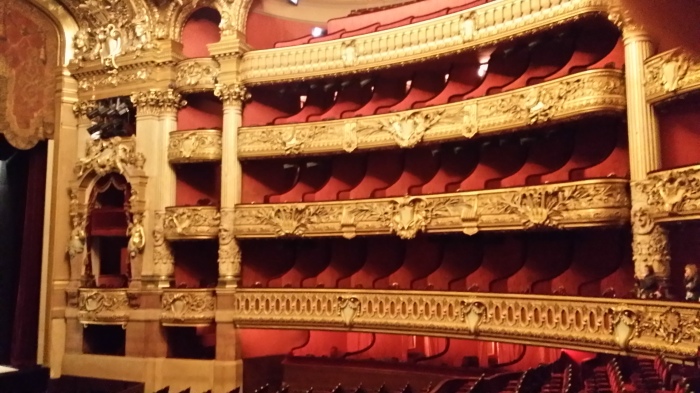
Searching for locations: The Opera House, Paris, France

This was one of the more interesting experiences for the grandchildren as they were, as all young girls are, interested in ballet.

We thoroughly enjoyed our visit which included some time watching ballet practice.

I could not convince anyone to take the elevator back down to the ground floor as it was suspected we might be ‘attacked’ by the ‘phantom’.  Certainly, the elevator was very old and I think at the time it was being repaired.

20140108_124100

Part of the Grand Staircase in Palais Garnier Opera de Paris

20140108_125843

The ceiling above the main staircase.  The ceiling above the staircase was painted by Isidore Pils to depict The Triumph of ApolloThe Enchantment of Music Deploying its CharmsMinerva Fighting Brutality Watched by the Gods of Olympus, and The City of Paris Receiving the Plan of the New Opéra.

20140108_123338

The ceiling of Chagall at the Palais Garnier

On 23 September 1964, the new ceiling of the Opéra Garnier was inaugurated with great pomp.  It was painted by Marc Chagall at the request of André Malraux

20140108_125807

Amphitheatre and Orchestra Pit entrance

20140108_122243

Interior, and doorways to boxes

20140108_123500

Box seats in the auditorium

20140108_123512

Ornate ceilings and columns

20140108_123332

Seating inside the auditorium

20140108_125603

The day we were leaving Paris, was the first night of the Bolshoi Ballet.  My two granddaughters were greatly disappointed at missing out on the opportunity of a lifetime, to see the Bolshoi Ballet at the Paris Opera House.

20140108_123359

But we did get to see the principals practicing.

“Echoes From The Past”, the past doesn’t necessarily stay there


What happens when your past finally catches up with you?

Christmas is just around the corner, a time to be with family. For Will Mason, an orphan since he was fourteen, it is a time for reflection on what his life could have been, and what it could be.

Until a chance encounter brings back to life the reasons for his twenty years of self-imposed exile from a life only normal people could have. From that moment Will’s life slowly starts to unravel and it’s obvious to him it’s time to move on.

This time, however, there is more at stake.

Will has broken his number one rule, don’t get involved.

With his nemesis, Eddie Jamieson, suddenly within reach, and a blossoming relationship with an office colleague, Maria, about to change everything, Will has to make a choice. Quietly leave, or finally, make a stand.

But as Will soon discovers, when other people are involved there is going to be terrible consequences no matter what choice he makes.

https://amzn.to/2CYKxu4

newechocover5rs

Writing a novel in 365 days – 24

Day 24

Today we’re talking about do’s and don’ts.

We’re not supposed to use cliches.

Well, long ago someone told me that, but I don’t think the message stuck because every now and then a cliche will appear.

Of course, the reason we don’t use them is that people generally will not know what they mean, and I dread to think what the translators must do when translating English to another language.

I mean, who doesn’t know what a wild goose chase is?

For those who don’t: “a foolish and hopeless search for or pursuit of something unattainable”.

Some might use it to describe their efforts to be published. I know, at times, that almost became my mantra until I discovered self-publishing.

Where it came from: In 1593, when discussing horsemanship, ‘a type of 16th-century horse race where everyone had to try to follow the erratic course of the lead horse like wild geese have to follow their leader in formation’.

I would have liked to have been there to see it.

By and large, they should not be used, and I only use them because they fit the character who is using them.

And, just the other day I was writing a short story which, it turns out, uses a number of metaphors or cliches for dramatic effect, and which are also explained

An excerpt from “What Sets Us Apart”, a mystery with a twist

See the excerpt from the story below, just a taste of what’s in store…

http://amzn.to/2Eryfth

whatsetscover

McCallister was old school, a man who would most likely fit in perfectly campaigning on the battlefields of Europe during the Second World War. He’d been like a fish out of water in the army, post-Falklands, and while he retired a hero, he still felt he’d more to give.

He’d applied and was accepted as head of a SWAT team, and, watching him now as he and his men disembarked from the truck in almost military precision, a look passed between Annette, the police liaison officer, and I that said she’d seen it all before. I know I had.

There was a one in four chance his team would be selected for this operation, and she had been hoping it would be one of the other three. While waiting for them to arrive she filled me in on the various teams. His was the least co-operative, and the more likely to make ad-hoc decisions rather than adhere to the plan, or any orders that may come from the officer in charge.

This, she said quite bluntly, was going to end badly.

I still had no idea why Prendergast instructed me to attend the scene of what looked to be a normal domestic operation, but as the nominated expert in the field in these types of situations, it was fairly clear he wasn’t taking any chances. It was always a matter of opinion between us, and generally I lost.

In this case, it was an anonymous report identifying what the authorities believed were explosives in one of the dockside sheds where explosives were not supposed to be.

The only reason why the report was given any credence was the man, while not identifying himself by name, said he’d been an explosive expert once and recognized the boxes. That could mean anything, but the Chief Constable was a cautious man.

With his men settled and preparing their weapons, McCallister came over to the command post, not much more than the SUV my liaison and I arrived in, with weapons, bulletproof vests, and rolls of tape to cordon off the area afterward. We both had coffee, steaming in the cold early morning air. Dawn was slowly approaching and although rain had been forecast it had yet to arrive.

A man by the name of Benson was in charge. He too had groaned when he saw McCallister.

“A fine morning for it.” McCallister was the only enthusiastic one here.

He didn’t say what ‘it’ was, but I thought it might eventually be mayhem.

“Let’s hope the rain stays away. It’s going to be difficult enough without it,” Benson said, rubbing his hands together. We had been waiting for the SWAT team to arrive, and another team to take up their position under the wharf, and who was in the final stages of securing their position.

While we were waiting we drew up the plan. I’d go in first to check on what we were dealing with, and what type of explosives. The SWAT team, in the meantime, were to ensure all the exits to the shed were covered. When I gave the signal, they were to enter and secure the building. We were not expecting anyone inside or out, and no movement had been detected in the last hour since our arrival and deployment.

“What’s the current situation?”

“I’ve got eyes on the building, and a team coming in from the waterside, underneath. Its slow progress, but they’re nearly there. Once they’re in place, we’re sending McKenzie in.”

He looked in my direction.

“With due respect sir, shouldn’t it be one of us?” McCallister glared at me with the contempt that only a decorated military officer could.

“No. I have orders from above, much higher than I care to argue with, so, McCallister, no gung-ho heroics for the moment. Just be ready to move on my command, and make sure you have three teams at the exit points, ready to secure the building.”

McCallister opened his mouth, no doubt to question those orders, but instead closed it again. “Yes sir,” he muttered and turned away heading back to his men.

“You’re not going to have much time before he storms the battlements,” Benson quietly said to me, a hint of exasperation in his tone. “I’m dreading the paperwork.”

It was exactly what my liaison officer said when she saw McCallister arriving.

The water team sent their ‘in position’ signal, and we were ready to go.

In the hour or so we’d been on site nothing had stirred, no arrivals, no departures, and no sign anyone was inside, but that didn’t mean we were alone. Nor did it mean I was going to walk in and see immediately what was going on. If it was a cache of explosives then it was possible the building was booby-trapped in any number of ways, there could be sentries or guards, and they had eyes on us, or it might be a false alarm.

I was hoping for the latter.

I put on the bulletproof vest, thinking it was a poor substitute for full battle armor against an exploding bomb, but we were still treating this as a ‘suspected’ case. I noticed my liaison officer was pulling on her bulletproof vest too.

“You don’t have to go. This is my party, not yours,” I said.

“The Chief Constable told me to stick to you like glue, sir.”

I looked at Benson. “Talk some sense into her please, this is not a kindergarten outing.”

He shrugged. Seeing McCallister had taken all the fight out of him. “Orders are orders. If that’s what the Chief Constable requested …”

Madness. I glared at her, and she gave me a wan smile. “Stay behind me then, and don’t do anything stupid.”

“Believe me, I won’t be.” She pulled out and checked her weapon, chambering the first round. It made a reassuring sound.

Suited up, weapons readied, a last sip of the coffee in a stomach that was already churning from nerves and tension, I looked at the target, one hundred yards distant and thought it was going to be the longest hundred yards I’d ever traversed. At least for this week.

A swirling mist rolled in and caused a slight change in plans.

Because the front of the buildings was constantly illuminated by large overhead arc lamps, my intention had been to approach the building from the rear where there was less light and more cover. Despite the lack of movement, if there were explosives in that building, there’d be ‘enemy’ surveillance somewhere, and, after making that assumption, I believed it was going to be easier and less noticeable to use the darkness as a cover.

It was a result of the consultation, and studying the plans of the warehouse, plans that showed three entrances, the main front hangar type doors, a side entrance for truck entry and exit and a small door in the rear, at the end of an internal passage leading to several offices. I also assumed it was the exit used when smokers needed a break. Our entry would be by the rear door or failing that, the side entrance where a door was built into the larger sliding doors. In both cases, the locks would not present a problem.

The change in the weather made the approach shorter, and given the density of the mist now turning into a fog, we were able to approach by the front, hugging the walls, and moving quickly while there was cover. I could feel the dampness of the mist and shivered more than once.

It was nerves more than the cold.

I could also feel rather than see the presence of Annette behind me, and once felt her breath on my neck when we stopped for a quick reconnaissance.

It was the same for McCallister’s men. I could feel them following us, quickly and quietly, and expected, if I turned around, to see him breathing down my neck too.

It added to the tension.

My plan was still to enter by the back door.

We slipped up the alley between the two sheds to the rear corner and stopped. I heard a noise coming from the rear of the building, and the light tap on the shoulder told me Annette had heard it too. I put my hand up to signal her to wait, and as a swirl of mist rolled in, I slipped around the corner heading towards where I’d last seen the glow of a cigarette.

The mist cleared, and we saw each other at the same time. He was a bearded man in battle fatigues, not the average dockside security guard.

He was quick, but my slight element of surprise was his undoing, and he was down and unconscious in less than a few seconds with barely a sound beyond the body hitting the ground. Zip ties secured his hands and legs, and tape his mouth. Annette joined me a minute after securing him.

A glance at the body then me, “I can see why they, whoever they are, sent you.”

She’d asked who I worked for, and I didn’t answer. It was best she didn’t know.

“Stay behind me,” I said, more urgency in my tone. If there was one, there’d be another.

Luck was with us so far. A man outside smoking meant no booby traps on the back door, and quite possibly there’d be none inside. But it indicated there were more men inside, and if so, it appeared they were very well trained. If that were the case, they would be formidable opponents.

The fear factor increased exponentially.

I slowly opened the door and looked in. A pale light shone from within the warehouse itself, one that was not bright enough to be detected from outside. None of the offices had lights on, so it was possible they were vacant. I realized then they had blacked out the windows. Why hadn’t someone checked this?

Once inside, the door closed behind us, progress was slow and careful. She remained directly behind me, gun ready to shoot anything that moved. I had a momentary thought for McCallister and his men, securing the perimeter.

At the end of the corridor, the extent of the warehouse stretched before us. The pale lighting made it seem like a vast empty cavern, except for a long trestle table along one side, and, behind it, stacks of wooden crates, some opened. It looked like a production line.

To get to the table from where we were was a ten-yard walk in the open. There was no cover. If we stuck to the walls, there was equally no cover and a longer walk.

We needed a distraction.

As if on cue, the two main entrances disintegrated into flying shrapnel accompanied by a deafening explosion that momentarily disoriented both Annette and I. Through the smoke and dust kicked up I saw three men appear from behind the wooden crates, each with what looked like machine guns, spraying bullets in the direction of the incoming SWAT members.

They never had a chance, cut down before they made ten steps into the building.

By the time I’d recovered, my head heavy, eyes watering and ears still ringing, I took several steps towards them, managing to take down two of the gunmen but not the third.

I heard a voice, Annette’s I think, yell out, “Oh, God, he’s got a trigger,” just before another explosion, though all I remember in that split second was a bright flash, the intense heat, something very heavy smashing into my chest knocking the wind out of me, and then the sensation of flying, just before I hit the wall.

I spent four weeks in an induced coma, three months being stitched back together and another six learning to do all those basic actions everyone took for granted. It was twelve months almost to the day when I was released from the hospital, physically, except for a few alterations required after being hit by shrapnel, looking the same as I always had.

But mentally? The document I’d signed on release said it all, ‘not fit for active duty; discharged’.

It was in the name of David Cheney. For all intents and purposes, Alistair McKenzie was killed in that warehouse, and for the first time ever, an agent left the Department, the first to retire alive.

I was not sure I liked the idea of making history.

© Charles Heath 2016-2020
In a word: Not

You will not go outside, you will not go to the movies.

The word not, when used by your parents when you are a child is the key in the lock keeping you from having fun.

It is the very definition of everything negative, and much harsher than just a plain no.

That you will ‘not…’ has been the gateway for many an exploit or adventure, because anything you have done contrary to the ‘not’ is all that much sweeter.

Until you get into trouble, but, then, isn’t that how you learn life’s lessons?

But if you are a programmer like me, not takes on a whole new meaning in a language like,

‘If not like …. then’

meaning in layman’s terms if something isn’t like a specific value then do something else.

Hang on, isn’t that a bit like reality?

This is not to be confused with the word Knot which is,

A blemish in a piece of wood

The speed of a ship, winds, and sometimes a plane

But basically,

Something you tie to keep your shoes on, or around your finger to remind you to tie your shoes before getting on the 36-knot high-speed ferry made of knotty wood.

It is also something you find in tangled hair and is very painful trying to remove it.

It is also an unpleasant tightness in body muscles and you need a masseuse to get rid of them.

The cinema of my dreams – It continued in London – Episode 37

A talk with Juliet

If I had the time over again, I might have chosen a different path in advising her of the possible connection to the Burkhardt’s, but that cat was now out of the bag.  I had to play that card when the police started asking difficult questions.  It’s a bit hard to give a plausible reason for people shooting at you.

“It’s possible but unlikely, but it seems someone thinks you might be, hence the assassination attempt.”

“Do you think my father was the Count, and my mother one of the servants?”  There was a curious inflection in her tone like she was mentally calculating the billions she might be worth.

“What did your adoptive mother tell you about your father, other than he was important?

“Nothing.”

“Then the description ‘important person’ could be the butler or the head gardener to a lowly servant girl, so I wouldn’t be getting too many ideas.  The count has never admitted to having any children outside of marriage, and, in fact, had only one surviving family member, the countess.  Have you ever met her?”

“Seen her only in papers, and once from afar when I was watching the house in Sorrento.  Head gardener or butler, you do know how to dash a girl’s dreams.”

“Better to understand the reality before the family lawyers shred you in court if you try to press any sort of a claim.  And if they do know about you, and they believed you were an heir, then you could be in trouble.”

“You seem to know a lot about the family.  Are you working for them?”

An astute observation.  “The answer to that question is no.  My only interest in this was to escort the countess to the Opera as a favour to the man whom I used to work for, yes, I’m still retired, or getting there.  So, I’ve met the countess, but she never mentioned anything about children, only the count dying on her, and now, from my boss, the fact she is missing.  The truth of the matter, I’m only here to find the countess, then I’m back to Venice, or Paris, or anywhere other than here.”

“But there’s more to it than that.  I know you, there’s wheels within wheels.”

There might be, but I wasn’t going to humour her.  “Well, if she’s missing and doesn’t sign the inheritance papers, the estate goes to the next brother, Alessandro.  If he was aware there was a possibly more direct heir, if the count was your father, his situation would demand that you were eliminated from the list.  If he was that way inclined.”

“Then he’s your man.”

“He’s not.  I’ve spoken to him already.  But I have another more viable candidate, your birth mother, who could tell us if the count was your father, though, as a servant girl, and later criminal, I doubt the courts would believe her.”

“You know who my birth mother is then?”  it was spoken with a little more curiosity than she should, which told me she already knew and was covering it.  I wondered if Ceceila had any success.  I would sneak away and send her a text soon.  And ask her to drop in if she could.

“We think we do.”  After analysing everything Juliet said, and the physical evidence we had, like the photograph, it was possible that Vittoria was not.  All the evidence we had was circumstantial.

The waiter chose to arrive at our table with the pizza, and I decided we had to eat first, leaving her with a look of annoyance.  It could wait another few minutes, time taken to look at her and for any resemblance to Vittoria and the Count.  It seemed to me there was none, but Cecilia would know.  Time to send her a text to meet us at the restaurant, and what I wanted her to do.  I excused myself and went to the restrooms.

Just before I went in the door I glanced back and saw she was on the phone.  Who could she be calling?

When I came back, I decided to keep going down the direct route.  “Do you know a woman by the name of Vittoria Romano?”

I watched her carefully as I asked the question.  Everyone had a tell, and I think I knew hers.

“Should I?”

The curious thing about that reply was another of those inflections in her tone, one that told me she did.

That just added a whole new layer to the game.  It also told me why she was not so shaken up by the turn of events.  It might have been a surprise to see me, but not getting shot at.

“I have reason to believe she is your mother.  She has been trying to get closer to Alessandro, but the countess had warned him of her intentions.  We understand this Vittoria was getting a payment to look after you, whether by blackmail or otherwise, and when that stopped, she started making trouble.    She is, by the way, in London at the moment though we don’t know where.”

“And you think I might?”

“If I accompanied you to your apartment, would she be there?”

“I said I didn’t know her.”  She tried to put on an aggrieved tome that I would think that she was lying.

“You’ve said a lot of things in the past, especially to me, that are not true.  We know each other fairly well, Juliet.”

That tone was now accompanied by a pained expression that was mean to convey annoyance.  “I should get up and walk out, but as you say, we know each other fairly well, and I’m guessing you’d construe that as guilt.  I am disappointed.”

I saw Cecilia arrive outside, and now that the restaurant was quite full, she was easily able to get to our table without Juliet seeing her, not until she dropped into the third seat, and sigh, “Do you have any idea what it’s like getting across this city in the rush hour?”

The look on Juliet’s face was priceless.

© Charles Heath 2023

The cinema of my dreams – Was it just another surveillance job – Episode 39

I’m back home and this story has been sitting on a back burner for a few months, waiting for some more to be written.

The trouble is, there are also other stories to write, and I’m not very good at prioritizing.

But, here we are, a few minutes opened up and it didn’t take long to get back into the groove.

Chasing leads, maybe

Sometimes the best-laid plans worked out, but today it was as if the Gods were trying to ruin my day.  Earlier days this week had been getting darkish between three and four, but today it was a little later.

It meant we had to spend a little more quality time together before we embarked on some breaking and entering.

Of course, it might have helped if I’d told her what I was intending to do before I brought her along for the ride, but it was exactly for that reason I did because if she didn’t like the idea, there would be little option to change he mind.

But the initial displeasure was expected.

“Breaking and entering is not exactly how I envisioned my first few days on the job market.”

“You learned all of the requisite skills in training.  I know, I was your partner in crime more than once.”

And that was a question I had once told myself I’d ask her if I ever ran into her again outside of work.

Which I did now.  “Why was that?”

At a guess, it had to be because I knew what I was doing whereas the other men were more like blunt instruments.  They’d taught us the finesse in breaking into a wide variety of entrances, but they seemed to like and use bashing the door in.

“I knew I had a better chance of success if I stuck with you.”

“What about Yolanda?”

She was another woman I had put into the same category as Jennifer, she was possessed of a calm demeanor in a crisis, and actually took the time to lean the subtitles of her tradecraft.  I had been disappointed when she didn’t make the final cut, though I suspect there was more to her ‘failing’ than met the eye.

And, I never got to find out the real reason.

I had liked her and had thought the feelings were mutual, but after she left, I’d not heard from her again.  I guess I could have tried to reach out, and might still do if this ever came to an end where I didn’t finish up dead.

“She was never going to stick the distance.  I got the impression she wasn’t happy about one of the others making life uncomfortable for her.”

“Student or instructor?”

Interesting she should say that because I had thought there was something going on between her and Maury, and when I asked her she didn’t deign to answer.

“Both.  She considered it was best just to leave.”

Which apparently, she did.

But, back to our current problem.  “All I need you to do is have my back.  I’ll go in, see if he is there, or anyone else, and if the coast is clear, we’ll search the place and leave.  No need to be there one second longer than we have to be.”

But I will; be disappointed if the USB is not there.

“That means we have about an hour to kill,” she said.

Which is why I decided to stop off at a traditional English pub and have an early dinner of bangers and mash.  I was not sure why it just appealed to me.  I’d feel so much better breaking in with a full stomach.

And a mobile phone with the sound turned off.

© Charles Heath 2020

A photograph from the inspirational bin – 34

This is the moon, unexpectedly observable in the late afternoon.

For me, the moon provided inspiration for an episodic story I have entitled, for now, ‘I always wanted to see the planets’.

It’s about a freighter captain who gets a gig as First Officer on an exploratory starship, who by a series of inexplicable events gets promoted to captain, and has to navigate not only the outer reaches of space, but new species.

But in the back of my mind there is that expression ‘shoot for the moon’, which could mean almost anything.

It could mean going for the unobtainable, whether it be a job, or the partner of your dreams. Failing can be heartbreak. Success might mean you’d be ‘over the moon’.

Them there’s travelling to moon, perhaps the next logical step for regular people, heading off the spend a week on a moon base hotel. I’m not sure what we would see out there in space; Perhaps a UFO?

Fictionalised, a moon base might just be the meeting place for various species, and being the mystery writer I am, what if there was a murder?

As always, the possibilities are endless.