A photograph from the inspirational bin – 20

20191216_175251

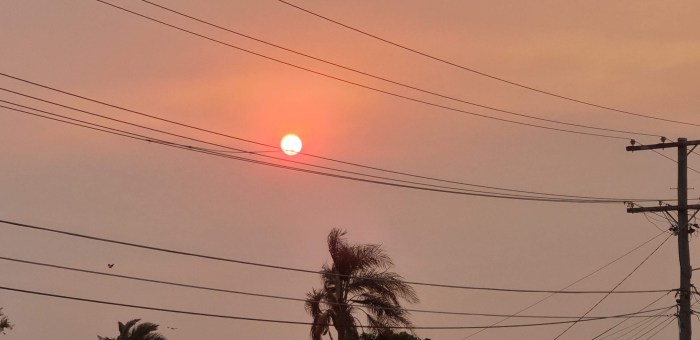
Suburbia, yes, reddish sky at night, yes, but what else might it be?

For just a moment, close your eyes, toss away everything you might accept as normal, and then, after a minute, open them again, and look at the photo with a new perspective.

Imagine…


It took two days for the dust to settle, figuratively and literally.

We heard screaming jet fighters overhead, followed by multiple explosions, then nothing but smoke and ash.  We assumed one of the jets had crashed.

Two days the media was saying it was an unfortunate accident.

On the third day, we discovered it was the result of multiple missile strikes on our power stations and oil refineries.  The jets had arrived too late to stop the attack.

And we only found out because an Army officer who lived in our street came home to collect his family and told us to leave, go anywhere but stay in the city.

The ash in the air was going to get worse, the sun was going to disappear altogether, and, well, he didn’t stay long enough to tell us the rest, but already the air was almost unbreathable.

But the leaving was easy, just take what we could in the car.  The problem was, everyone had the same idea, and by the time we reached the highway, it was a virtual carpark.

By then, it was day four.

That’s when the bombs started to fall.


It might not be an exact match for the photo, but that was the idea that came from it.

I’m sure there could be a far simpler and more pleasant story to be told.


Writing a novel in 365 days – 9

Day 9

OK. We’re not doing much writing, and today, we have another suggestion, one that might cause an unnecessary rush at the stationary store for pencils.

I was in one today, a place called Office Works, getting some folders to put the printed copies of my latest books about to be published.

I’d previously bought, pencils – a box of 24, a motorised pencil sharpener, cards – though I intend to use these for a non fiction book, pens – red, blue, black, erasable – for doing crosswords. I’ve not had to buy notebooks for a while, small and large, but last time I got some journalist note books.

But, I digress…

It is suggested and I think it’s a great idea that at times it is better to write down the story, mainly because I can write as fast as the ideas come, and I cannot type that fast. Not without a million errors and a lot of indecipherable words.

There are exponents for both means of getting words on paper, but I have to say the majority of my original books were written in small notepads, at work and elsewhere because ideas and storylines come to me at the sometimes most awkward moments.

Consider carrying around d a notebook and pencil or pen.

Otherwise, my other means of getting ideas down is a note-taking app on my phone, the best at the moment being Somnote.

And tired of waiting for the moment when the book gets underway, stand by, news on that front is coming.

Searching for locations: Auckland, New Zealand – Another city that has a tower

Nearly every city has a high building, a tower, or a large Ferris wheel.

London had the London eye
Paris has the Eiffel tower
The Galata in Istanbul
The CN Tower in Toronto
The towers of San Gimignano
Pisa has a leaning tower

We’ve managed to see all of the above bar the Galata in Istanbul.  One day we might get there.

But, on this side of the world, there are two, the Sydney Tower, and the Sky Tower in Auckland, which we just visited recently.

20140522_153338

It’s not a tall tower, but it definitely gives great vies of Auckland, particularly to the north

20140522_150952

The mountain in the background at the top of the photo is of a volcano on Rangitoto Island.  When we were visiting, there were reports that it might become active again.

20140522_151039

To give a height perspective, it didn’t seem all that far down to the apartment building and gardens nearby.

I’d like to write a political thriller


But, I don’t understand politics.

The question is, do you really have to?

I mean all you have to do is read the papers and read between the lines. It doesn’t take much imagination to find something worth writing about

For instance,

How could it possibly happen that a leader of a very powerful country become a spy for another?

It doesn’t seem plausible, but is it possible?

It depends I’m guessing, on power and wealth, well, perhaps not so much the power, but it is true that money and wealth are great motivators.

How could it happen when the leader is in the public eye nearly all of the time? And even if that leader has closed-door conversations, which is doubtful he would be on his own, the red not really be an opportunity to sell out to the other side.

Even an exchange of gifts, like apartments or a dacha, wouldn’t be enough of an incentive, well, not for me anyway. But a clear path to investment in a rival country, maybe.

Perhaps then rather than becoming a spy, the leader could adopt a policy of appeasement.

We have history to tell us how well that works, and the fact giving concessions to another county only emboldens it to take advantage of apparent weakness, and then, hey presto, we have another war.

So…

What do we really have?

A lot of speculation and conjecture. It’s easy to construe what might be the truth from a set of circumstances and behavioral patterns of the individuals involved.

It could be likened to two cats circling each other in a cage before the fight begins.

The waters can be muddied by a constant stream of incendiary tweets which fire the readers’ imagination, all intended as a smoke screen, or feelers to see which was the wind is blowing.

Is that leader masterful and clever or is he a naive fool?

My political thriller might have a working title of,

‘Which Way Does The Wind Blow’

I don’t usually have a title for any of the books until after the first draft, or sometimes something might spring out as it’s being written.

But, for now, let’s sit back and see which way the wind is blowing.

But, I don’t understand politics.

The question is, do you really have to?

I mean all you have to do is read the papers and read between the lines. It doesn’t take much imagination to find something worth writing about

For instance,

How could it possibly happen that a leader of a very powerful country become a spy for another?

It doesn’t seem plausible, but is it possible?

It depends I’m guessing, on power and wealth, well, perhaps not so much the power, but it is true that money and wealth are great motivators.

How could it happen when the leader is in the public eye nearly all of the time? And even if that leader has closed-door conversations, which is doubtful he would be on his own, the red not really be an opportunity to sell out to the other side.

Even an exchange of gifts, like apartments or a dacha, wouldn’t be enough of an incentive, well, not for me anyway. But a clear path to investment in a rival country, maybe.

Perhaps then rather than becoming a spy, the leader could adopt a policy of appeasement.

We have history to tell us how well that works, and the fact giving concessions to another county only emboldens it to take advantage of apparent weakness, and then, hey presto, we have another war.

So…

What do we really have?

A lot of speculation and conjecture. It’s easy to construe what might be the truth from a set of circumstances and behavioral patterns of the individuals involved.

It could be likened to two cats circling each other in a cage before the fight begins.

The waters can be muddied by a constant stream of incendiary tweets which fire the readers’ imagination, all intended as a smoke screen, or feelers to see which was the wind is blowing.

Is that leader masterful and clever or is he a naive fool?

My political thriller might have a working title of,

‘Which Way Does The Wind Blow’

I don’t usually have a title for any of the books until after the first draft, or sometimes something might spring out as it’s being written.

But, for now, let’s sit back and see which way the wind is blowing.

An excerpt from “Sunday in New York”

Now available on Amazon at:  https://amzn.to/2H7ALs8

Williams’ Restaurant, East 65th Street, New York, Saturday, 8:00 p.m.

We met the Blaine’s at Williams’, a rather upmarket restaurant that the Blaine’s frequently visited, and had recommended.

Of course, during the taxi ride there, Alison reminded me that with my new job, we would be able to go to many more places like Williams’.  It was, at worst, more emotional blackmail, because as far as Alison was concerned, we were well on our way to posh restaurants, the Trump Tower Apartments, and the trappings of the ‘executive set’.

It would be a miracle if I didn’t strangle Elaine before the night was over.  It was she who had filled Alison’s head with all this stuff and nonsense.

Aside from the half frown half-smile, Alison was looking stunning.  It was months since she had last dressed up, and she was especially wearing the dress I’d bought her for our 5th anniversary that cost a month’s salary.  On her, it was worth it, and I would have paid more if I had to.  She had adored it, and me, for a week or so after.

For tonight, I think I was close to getting back on that pedestal.

She had the looks and figure to draw attention, the sort movie stars got on the red carpet, and when we walked into the restaurant, I swear there were at least five seconds silence, and many more gasps.

Even I had a sudden loss of breath earlier in the evening when she came out of the dressing room.  Once more I was reminded of how lucky I was that she had agreed to marry me.  Amid all those self-doubts, I couldn’t believe she had loved me when there were so many others ‘out there’ who were more appealing.

Elaine was out of her seat and came over just as the Head Waiter hovered into sight.  She personally escorted Alison to the table, allowing me to follow like the Queen’s consort, while she and Alison basked in the admiring glances of the other patrons.

More than once I heard the muted question, “Who is she?”

Jimmy stood, we shook hands, and then we sat together.  It was not the usual boy, girl, boy, girl seating arrangement.  Jimmy and I on one side and Elaine and Alison on the other.

The battle lines were drawn.

Jimmy was looking fashionable, with the permanent blade one beard, unkempt hair, and designer dinner suit that looked like he’d slept in it.  Alison insisted I wear a tuxedo, and I looked like the proverbial penguin or just a thinner version of Alfred Hitchcock.

The bow tie had been slightly crooked, but just before we stepped out she had straightened it.  And took the moment to look deeply into my soul.  It was one of those moments when words were not necessary.

Then it was gone.

I relived it briefly as I sat and she looked at me.  A penetrating look that told me to ‘behave’.

When we were settled, Elaine said, in that breathless, enthusiastic manner of hers when she was excited, “So, Harry, you are finally moving up.”  It was not a question, but a statement.

I was not sure what she meant by ‘finally’ but I accepted it with good grace.  Sometimes Elaine was prone to using figures of speech I didn’t understand.  I guessed she was talking about the new job.  “It was supposed to be a secret.”

She smiled widely.  “There are no secrets between Al and I, are there Al?”

I looked at ‘Al’ and saw a brief look of consternation.

I was not sure Alison liked the idea of being called Al.  I tried it once and was admonished.  But it was interesting her ‘best friend forever’ was allowed that distinction when I was not.  It was, perhaps, another indicator of how far I’d slipped in her estimation.

Perhaps, I thought, it was a necessary evil.  As I understood it, the Blaine’s were our mentors at the Trump Tower, because they didn’t just let ‘anyone’ in.  I didn’t ask if the Blaine’s thought we were just ‘anyone’ before I got the job offer.

And then there was that look between Alison and Elaine, quickly stolen before Alison realized I was looking at both of them.  I was out of my depth, in a place I didn’t belong, with people I didn’t understand.  And yet, apparently, Alison did.  I must have missed the memo.

“No,” Alison said softly, stealing a glance in my direction, “No secrets between friends.”

No secrets.  Her look conveyed something else entirely.

The waiter brought champagne, Krug, and poured glasses for each of us.  It was not the cheap stuff, and I was glad I brought a couple of thousand dollars with me.  We were going to need it.

Then, a toast.

To a new job and a new life.

“When did you decide?”  Elaine was effusive at the best of times, but with the champagne, it was worse.

Alison had a strange expression on her face.  It was obvious she had told Elaine it was a done deal, even before I’d made up my mind.  Perhaps she’d assumed I might be ‘refreshingly honest’ in front of Elaine, but it could also mean she didn’t really care what I might say or do.

Instead of consternation, she looked happy, and I realized it would be churlish, even silly if I made a scene.  I knew what I wanted to say.  I also knew that it would serve little purpose provoking Elaine, or upsetting Alison.  This was not the time or the place.  Alison had been looking forward to coming here, and I was not going to spoil it.

Instead, I said, smiling, “When I woke up this morning and found Alison missing.  If she had been there, I would not have noticed the water stain on the roof above our bed, and decide there and then how much I hated the place.” I used my reassuring smile, the one I used with the customers when all hell was breaking loose, and the forest fire was out of control.  “It’s the little things.  They all add up until one day …”  I shrugged.  “I guess that one day was today.”

I saw an incredulous look pass between Elaine and Alison, a non-verbal question; perhaps, is he for real?  Or; I told you he’d come around.

I had no idea the two were so close.

“How quaint,” Elaine said, which just about summed up her feelings towards me.  I think, at that moment, I lost some brownie points.  It was all I could come up with at short notice.

“Yes,” I added, with a little more emphasis than I wanted.  “Alison was off to get some study in with one of her friends.”

“Weren’t the two of you off to the Hamptons, a weekend with some friends?” Jimmy piped up, and immediately got the ‘shut up you fool’ look, that cut that line of conversation dead.  Someone forgot to feed Jimmy his lines.

It was followed by the condescending smile from Elaine, and “I need to powder my nose.  Care to join me, Al?”

A frown, then a forced smile for her new best friend.  “Yes.”

I watched them leave the table and head in the direction of the restroom, looking like they were in earnest conversation.  I thought ‘Al’ looked annoyed, but I could be wrong.

I had to say Jimmy looked more surprised than I did.

There was that odd moment of silence between us, Jimmy still smarting from his death stare, and for me, the Alison and Elaine show.  I was quite literally gob-smacked.

I drained my champagne glass gathering some courage and turned to him.  “By the way, we were going to have a weekend away, but this legal tutorial thing came up.  You know Alison is doing her law degree.”

He looked startled when he realized I had spoken.  He was looking intently at a woman several tables over from us, one who’d obviously forgotten some basic garments when getting dressed.  Or perhaps it was deliberate.  She’d definitely had some enhancements done.

He dragged his eyes back to me.  “Yes.  Elaine said something or other about it.  But I thought she said the tutor was out of town and it had been postponed until next week.  Perhaps I got it wrong.  I usually do.”

“Perhaps I’ve got it wrong.”  I shrugged, as the dark thoughts started swirling in my head again.  “This week or next, what does it matter?”

Of course, it mattered to me, and I digested what he said with a sinking heart.  It showed there was another problem between Alison and me; it was possible she was now telling me lies.  If what he said was true and I had no reason to doubt him, where was she going tomorrow morning, and had she really been with a friend studying today?

We poured some more champagne, had a drink, then he asked, “This promotion thing, what’s it worth?”

“Trouble, I suspect.  Definitely more money, but less time at home.”

“Oh,” raised eyebrows.  Obviously, the women had not talked about the job in front of him, or, at least, not all the details.  “You sure you want to do that?”

At last the voice of reason.  “Me?  No.”

“Yet you accepted the job.”

I sucked in a breath or two while I considered whether I could trust him.  Even if I couldn’t, I could see my ship was sinking, so it wouldn’t matter what I told him, or what Elaine might find out from him.  “Jimmy, between you and me I haven’t as yet decided one way or another.  To be honest, I won’t know until I go up to Barclay’s office and he asks me the question.”

“Barclay?”

“My boss.”

“Elaine’s doing a job for a Barclay that recently moved in the tower a block down from us.  I thought I recognized the name.”

“How did Elaine get the job?”

“Oh, Alison put him onto her.”

“When?”

“A couple of months ago.  Why?”

I shrugged and tried to keep a straight face, while my insides were churning up like the wake of a supertanker.  I felt sick, faint, and wanting to die all at the same moment.  “Perhaps she said something about it, but it didn’t connect at the time.  Too busy with work I expect.  I think I seriously need to get away for a while.”

I could hardly breathe, my throat was constricted and I knew I had to keep it together.  I could see Elaine and Alison coming back, so I had to calm down.  I sucked in some deep breaths, and put my ‘manage a complete and utter disaster’ look on my face.

And I had to change the subject, quickly, so I said, “Jimmy, Elaine told Alison, who told me, you were something of a guru of the cause and effects of the global economic meltdown.  Now, I have a couple of friends who have been expounding this theory …”

Like flicking a switch, I launched into the well-worn practice of ‘running a distraction’, like at work when we needed to keep the customer from discovering the truth.  It was one of the things I was good at, taking over a conversation and pushing it in a different direction.  It was salvaging a good result from an utter disaster, and if ever there was a time that it was required, it was right here, right now.

When Alison sat down and looked at me, she knew something had happened between Jimmy and I.  I might have looked pale or red-faced, or angry or disappointed, it didn’t matter.  If that didn’t seal the deal for her, the fact I took over the dining engagement did.  She knew well enough the only time I did that was when everything was about to go to hell in a handbasket.  She’d seen me in action before and had been suitably astonished.

But I got into gear, kept the champagne flowing and steered the conversation, as much as one could from a seasoned professional like Elaine, and, I think, in Jimmy’s eyes, he saw the battle lines and knew who took the crown on points.  Neither Elaine nor Jimmy suspected anything, and if the truth be told, I had improved my stocks with Elaine.  She was at times both surprised and interested, even willing to take a back seat.

Alison, on the other hand, tried poking around the edges, and, once when Elaine and Jimmy had got up to have a cigarette outside, questioned me directly.  I chose to ignore her, and pretend nothing had happened, instead of telling her how much I was enjoying the evening.

She had her ‘secrets’.  I had mine.

At the end of the evening, when I got up to go to the bathroom, I was physically sick from the pent up tension and the implications of what Jimmy had told me.  It took a while for me to pull myself together; so long, in fact, Jimmy came looking for me.  I told him I’d drunk too much champagne, and he seemed satisfied with that excuse.  When I returned, both Alison and Elaine noticed how pale I was but neither made any comment.

It was a sad way to end what was supposed to be a delightful evening, which to a large degree it was for the other three.  But I had achieved what I set out to do, and that was to play them at their own game, watching the deception, once I knew there was a deception, as warily as a cat watches its prey.

I had also discovered Jimmy’s real calling; a professor of economics at the same University Alison was doing her law degree.  It was no surprise in the end, on a night where surprises abounded, that the world could really be that small.

We parted in the early hours of the morning, a taxi whisking us back to the Lower East Side, another taking the Blaine’s back to the Upper West Side.  But, in our case, as Alison reminded me, it would not be for much longer.  She showed concern for my health, asked me what was wrong.  It took all the courage I could muster to tell her it was most likely something I ate and the champagne, and that I would be fine in the morning.

She could see quite plainly it was anything other than what I told her, but she didn’t pursue it.  Perhaps she just didn’t care what I was playing at.

And yet, after everything that had happened, once inside our ‘palace’, the events of the evening were discarded, like her clothing, and she again reminded me of what we had together in the early years before the problems had set in.

It left me confused and lost.

I couldn’t sleep because my mind had now gone down that irreversible path that told me I was losing her, that she had found someone else, and that our marriage was in its last death throes.

And now I knew it had something to do with Barclay.

© Charles Heath 2015-2020

Sunday In New York

An excerpt from “What Sets Us Apart”, a mystery with a twist

See the excerpt from the story below, just a taste of what’s in store…

http://amzn.to/2Eryfth

whatsetscover

McCallister was old school, a man who would most likely fit in perfectly campaigning on the battlefields of Europe during the Second World War. He’d been like a fish out of water in the army, post-Falklands, and while he retired a hero, he still felt he’d more to give.

He’d applied and was accepted as head of a SWAT team, and, watching him now as he and his men disembarked from the truck in almost military precision, a look passed between Annette, the police liaison officer, and I that said she’d seen it all before. I know I had.

There was a one in four chance his team would be selected for this operation, and she had been hoping it would be one of the other three. While waiting for them to arrive she filled me in on the various teams. His was the least co-operative, and the more likely to make ad-hoc decisions rather than adhere to the plan, or any orders that may come from the officer in charge.

This, she said quite bluntly, was going to end badly.

I still had no idea why Prendergast instructed me to attend the scene of what looked to be a normal domestic operation, but as the nominated expert in the field in these types of situations, it was fairly clear he wasn’t taking any chances. It was always a matter of opinion between us, and generally I lost.

In this case, it was an anonymous report identifying what the authorities believed were explosives in one of the dockside sheds where explosives were not supposed to be.

The only reason why the report was given any credence was the man, while not identifying himself by name, said he’d been an explosive expert once and recognized the boxes. That could mean anything, but the Chief Constable was a cautious man.

With his men settled and preparing their weapons, McCallister came over to the command post, not much more than the SUV my liaison and I arrived in, with weapons, bulletproof vests, and rolls of tape to cordon off the area afterward. We both had coffee, steaming in the cold early morning air. Dawn was slowly approaching and although rain had been forecast it had yet to arrive.

A man by the name of Benson was in charge. He too had groaned when he saw McCallister.

“A fine morning for it.” McCallister was the only enthusiastic one here.

He didn’t say what ‘it’ was, but I thought it might eventually be mayhem.

“Let’s hope the rain stays away. It’s going to be difficult enough without it,” Benson said, rubbing his hands together. We had been waiting for the SWAT team to arrive, and another team to take up their position under the wharf, and who was in the final stages of securing their position.

While we were waiting we drew up the plan. I’d go in first to check on what we were dealing with, and what type of explosives. The SWAT team, in the meantime, were to ensure all the exits to the shed were covered. When I gave the signal, they were to enter and secure the building. We were not expecting anyone inside or out, and no movement had been detected in the last hour since our arrival and deployment.

“What’s the current situation?”

“I’ve got eyes on the building, and a team coming in from the waterside, underneath. Its slow progress, but they’re nearly there. Once they’re in place, we’re sending McKenzie in.”

He looked in my direction.

“With due respect sir, shouldn’t it be one of us?” McCallister glared at me with the contempt that only a decorated military officer could.

“No. I have orders from above, much higher than I care to argue with, so, McCallister, no gung-ho heroics for the moment. Just be ready to move on my command, and make sure you have three teams at the exit points, ready to secure the building.”

McCallister opened his mouth, no doubt to question those orders, but instead closed it again. “Yes sir,” he muttered and turned away heading back to his men.

“You’re not going to have much time before he storms the battlements,” Benson quietly said to me, a hint of exasperation in his tone. “I’m dreading the paperwork.”

It was exactly what my liaison officer said when she saw McCallister arriving.

The water team sent their ‘in position’ signal, and we were ready to go.

In the hour or so we’d been on site nothing had stirred, no arrivals, no departures, and no sign anyone was inside, but that didn’t mean we were alone. Nor did it mean I was going to walk in and see immediately what was going on. If it was a cache of explosives then it was possible the building was booby-trapped in any number of ways, there could be sentries or guards, and they had eyes on us, or it might be a false alarm.

I was hoping for the latter.

I put on the bulletproof vest, thinking it was a poor substitute for full battle armor against an exploding bomb, but we were still treating this as a ‘suspected’ case. I noticed my liaison officer was pulling on her bulletproof vest too.

“You don’t have to go. This is my party, not yours,” I said.

“The Chief Constable told me to stick to you like glue, sir.”

I looked at Benson. “Talk some sense into her please, this is not a kindergarten outing.”

He shrugged. Seeing McCallister had taken all the fight out of him. “Orders are orders. If that’s what the Chief Constable requested …”

Madness. I glared at her, and she gave me a wan smile. “Stay behind me then, and don’t do anything stupid.”

“Believe me, I won’t be.” She pulled out and checked her weapon, chambering the first round. It made a reassuring sound.

Suited up, weapons readied, a last sip of the coffee in a stomach that was already churning from nerves and tension, I looked at the target, one hundred yards distant and thought it was going to be the longest hundred yards I’d ever traversed. At least for this week.

A swirling mist rolled in and caused a slight change in plans.

Because the front of the buildings was constantly illuminated by large overhead arc lamps, my intention had been to approach the building from the rear where there was less light and more cover. Despite the lack of movement, if there were explosives in that building, there’d be ‘enemy’ surveillance somewhere, and, after making that assumption, I believed it was going to be easier and less noticeable to use the darkness as a cover.

It was a result of the consultation, and studying the plans of the warehouse, plans that showed three entrances, the main front hangar type doors, a side entrance for truck entry and exit and a small door in the rear, at the end of an internal passage leading to several offices. I also assumed it was the exit used when smokers needed a break. Our entry would be by the rear door or failing that, the side entrance where a door was built into the larger sliding doors. In both cases, the locks would not present a problem.

The change in the weather made the approach shorter, and given the density of the mist now turning into a fog, we were able to approach by the front, hugging the walls, and moving quickly while there was cover. I could feel the dampness of the mist and shivered more than once.

It was nerves more than the cold.

I could also feel rather than see the presence of Annette behind me, and once felt her breath on my neck when we stopped for a quick reconnaissance.

It was the same for McCallister’s men. I could feel them following us, quickly and quietly, and expected, if I turned around, to see him breathing down my neck too.

It added to the tension.

My plan was still to enter by the back door.

We slipped up the alley between the two sheds to the rear corner and stopped. I heard a noise coming from the rear of the building, and the light tap on the shoulder told me Annette had heard it too. I put my hand up to signal her to wait, and as a swirl of mist rolled in, I slipped around the corner heading towards where I’d last seen the glow of a cigarette.

The mist cleared, and we saw each other at the same time. He was a bearded man in battle fatigues, not the average dockside security guard.

He was quick, but my slight element of surprise was his undoing, and he was down and unconscious in less than a few seconds with barely a sound beyond the body hitting the ground. Zip ties secured his hands and legs, and tape his mouth. Annette joined me a minute after securing him.

A glance at the body then me, “I can see why they, whoever they are, sent you.”

She’d asked who I worked for, and I didn’t answer. It was best she didn’t know.

“Stay behind me,” I said, more urgency in my tone. If there was one, there’d be another.

Luck was with us so far. A man outside smoking meant no booby traps on the back door, and quite possibly there’d be none inside. But it indicated there were more men inside, and if so, it appeared they were very well trained. If that were the case, they would be formidable opponents.

The fear factor increased exponentially.

I slowly opened the door and looked in. A pale light shone from within the warehouse itself, one that was not bright enough to be detected from outside. None of the offices had lights on, so it was possible they were vacant. I realized then they had blacked out the windows. Why hadn’t someone checked this?

Once inside, the door closed behind us, progress was slow and careful. She remained directly behind me, gun ready to shoot anything that moved. I had a momentary thought for McCallister and his men, securing the perimeter.

At the end of the corridor, the extent of the warehouse stretched before us. The pale lighting made it seem like a vast empty cavern, except for a long trestle table along one side, and, behind it, stacks of wooden crates, some opened. It looked like a production line.

To get to the table from where we were was a ten-yard walk in the open. There was no cover. If we stuck to the walls, there was equally no cover and a longer walk.

We needed a distraction.

As if on cue, the two main entrances disintegrated into flying shrapnel accompanied by a deafening explosion that momentarily disoriented both Annette and I. Through the smoke and dust kicked up I saw three men appear from behind the wooden crates, each with what looked like machine guns, spraying bullets in the direction of the incoming SWAT members.

They never had a chance, cut down before they made ten steps into the building.

By the time I’d recovered, my head heavy, eyes watering and ears still ringing, I took several steps towards them, managing to take down two of the gunmen but not the third.

I heard a voice, Annette’s I think, yell out, “Oh, God, he’s got a trigger,” just before another explosion, though all I remember in that split second was a bright flash, the intense heat, something very heavy smashing into my chest knocking the wind out of me, and then the sensation of flying, just before I hit the wall.

I spent four weeks in an induced coma, three months being stitched back together and another six learning to do all those basic actions everyone took for granted. It was twelve months almost to the day when I was released from the hospital, physically, except for a few alterations required after being hit by shrapnel, looking the same as I always had.

But mentally? The document I’d signed on release said it all, ‘not fit for active duty; discharged’.

It was in the name of David Cheney. For all intents and purposes, Alistair McKenzie was killed in that warehouse, and for the first time ever, an agent left the Department, the first to retire alive.

I was not sure I liked the idea of making history.

© Charles Heath 2016-2020

Searching for locations: Auckland, New Zealand, a rare day for the port

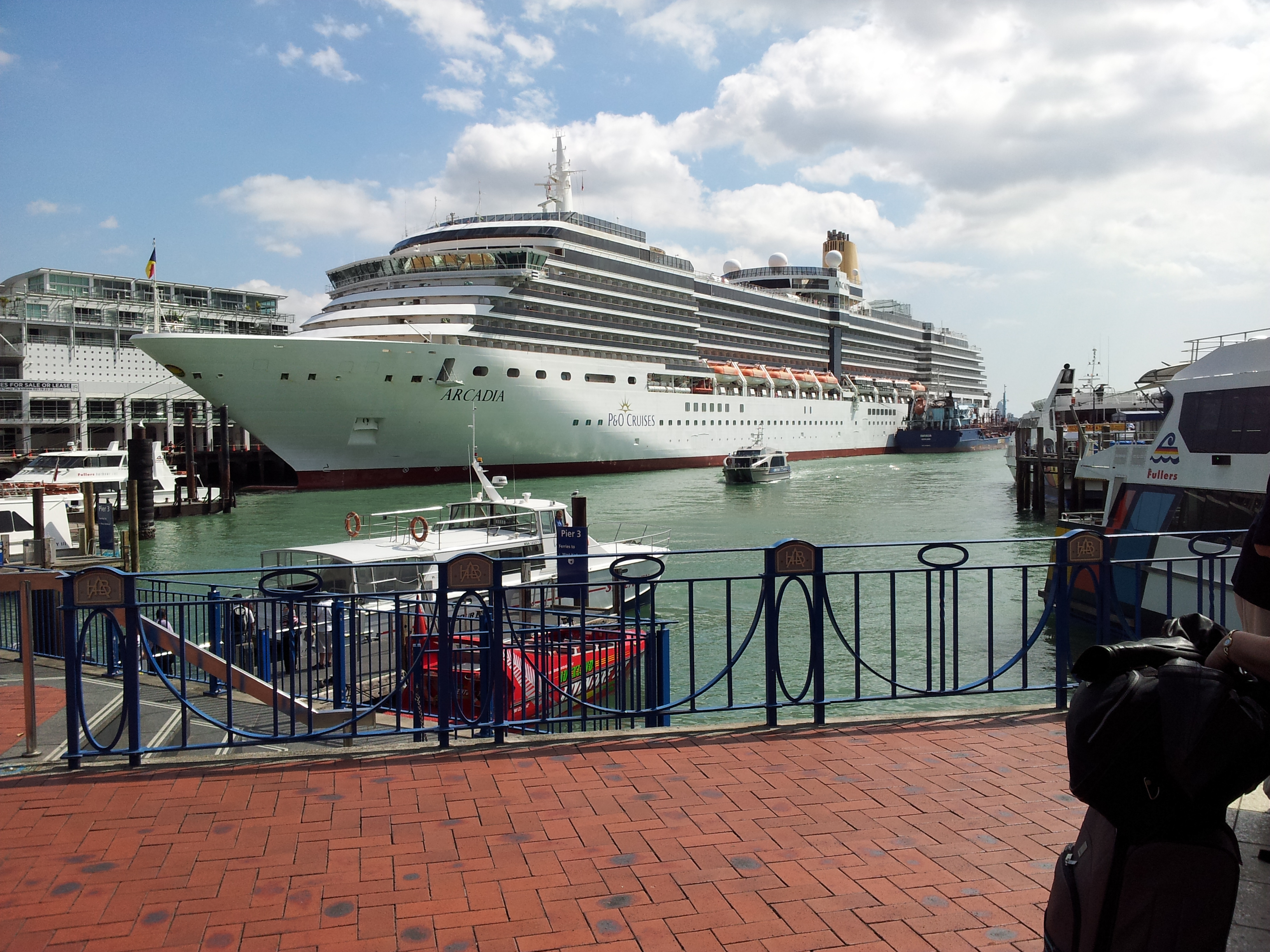
We were staying at the Hilton and advised there would be a large cruise liner berthing next to the hotel.  There was the Arcadia.

2013-03-08 11.51.48

This is the view from the other side of the hotel.  Where our room was, we could almost walk onto the aft end of the ship.

We were also told this was a rather extraordinary day because there were two cruise ships in the port. particularly because it was near the end of the cruising season.

The other ship was two berths along, the Sun Princess.

2013-03-08 11.56.17

Not as big as the Arcadia, up close it was still very impressive.

Skeletons in the closet, and doppelgangers

A story called “Mistaken Identity”

How many of us have skeletons in the closet that we know nothing about? The skeletons we know about generally stay there, but those we do not, well, they have a habit of coming out of left field when we least expect it.

In this case, when you see your photo on a TV screen with the accompanying text that says you are wanted by every law enforcement agency in Europe, you’re in a state of shock, only to be compounded by those same police, armed and menacing, kicking the door down.

I’d been thinking about this premise for a while after I discovered my mother had a boyfriend before she married my father, a boyfriend who was, by all accounts, the man who was the love of her life.

Then, in terms of coming up with an idea for a story, what if she had a child by him that we didn’t know about, which might mean I had a half brother or sister I knew nothing about. It’s not an uncommon occurrence from what I’ve been researching.

There are many ways of putting a spin on this story.

Then, in the back of my mind, I remembered a story an acquaintance at work was once telling us over morning tea, that a friend of a friend had a mother who had a twin sister and that each of the sisters had a son by the same father, without each knowing of the father’s actions, both growing up without the other having any knowledge of their half brother, only to meet by accident on the other side of the world.

It was an encounter that in the scheme of things might never have happened, and each would have remained oblivious of the other.

For one sister, the relationship was over before she discovered she was pregnant, and therefore had not told the man he was a father. It was no surprise the relationship foundered when she discovered he was also having a relationship with her sister, a discovery that caused her to cut all ties with both of them and never speak to either from that day.

It’s a story with more twists and turns than a country lane!

And a great idea for a story.

That story is called ‘Mistaken Identity’.

Writing a novel in 365 days – 9

Day 9

OK. We’re not doing much writing, and today, we have another suggestion, one that might cause an unnecessary rush at the stationary store for pencils.

I was in one today, a place called Office Works, getting some folders to put the printed copies of my latest books about to be published.

I’d previously bought, pencils – a box of 24, a motorised pencil sharpener, cards – though I intend to use these for a non fiction book, pens – red, blue, black, erasable – for doing crosswords. I’ve not had to buy notebooks for a while, small and large, but last time I got some journalist note books.

But, I digress…

It is suggested and I think it’s a great idea that at times it is better to write down the story, mainly because I can write as fast as the ideas come, and I cannot type that fast. Not without a million errors and a lot of indecipherable words.

There are exponents for both means of getting words on paper, but I have to say the majority of my original books were written in small notepads, at work and elsewhere because ideas and storylines come to me at the sometimes most awkward moments.

Consider carrying around d a notebook and pencil or pen.

Otherwise, my other means of getting ideas down is a note-taking app on my phone, the best at the moment being Somnote.

And tired of waiting for the moment when the book gets underway, stand by, news on that front is coming.

An excerpt from “Amnesia”, a work in progress

I remembered a bang.

I remembered the car slewing sideways.

I remember another bang, and then it was lights out.

When I opened my eyes again, I saw the sky.

Or I could be underwater.

Everything was blurred.

I tried to focus but I couldn’t. My eyes were full of water.

What happened?

Why was I lying down?

Where was I?

I cast my mind back, trying to remember.

It was a blank.

What, when, who, why and where, are questions I should easily be able to answer. These are questions any normal person could answer.

I tried to move. Bad, bad mistake.

I did not realise the scream I heard was my own. Just before my body shut down.

“My God! What happened?”

I could hear, not see. I was moving, lying down, looking up.

I was blind. Everything was black.

“Car accident; hit a tree, sent the passenger flying through the windscreen. Pity to poor bastard didn’t get the message that seat belts save lives.”

Was I that poor bastard?

“Report?” A new voice, male, authoritative.

“Multiple lacerations, broken collar bone, broken arm in three places, both legs broken below the knees, one badly. We are not sure of internal injuries, but ruptured spleen, cracked ribs and pierced right lung are fairly evident, x-rays will confirm that and anything else.”

“What isn’t broken?”

“His neck.”

“Then I would have to say we are looking at the luckiest man on the planet.”

I heard the shuffling of pages.

“OR1 ready?”

“Yes. On standby since we were first advised.”

“Good. Let’s see if we can weave some magic.”

Magic.

It was the first word that popped into my head when I surfaced from the bottom of the lake. That first breath, after holding it for so long, was sublime, and, in reality, agonising.

Magic, because it seemed like I’d spent a long time underwater.

Or somewhere.

I tried to speak but couldn’t. The words were just in my head.

Was it night or was it day?

Was it hot, or was it cold?

Where was I?

Around me, it felt cool.

It was incredibly quiet. No noise except for the hissing of air through an air-conditioning vent. Or that was the sound of pure silence.  And with it the revelation that silence was not silent. It was noisy.

I didn’t try to move.

Instinctively, somehow, I knew not to.

A previous unpleasant experience?

I heard what sounded like a door opening, and noticeably quiet footsteps slowly came into the room. They stopped. I could hear breathing, slightly laboured, a sound I’d heard before.

My grandfather.

He had smoked all his life until he was diagnosed with lung cancer. But for years before that he had emphysema. The person in the room was on their way, down the same path. I could smell the smoke.

I wanted to tell whoever it was the hazards of smoking.

I couldn’t.

I heard a metallic clanging sound from the end of the bed. A moment later the clicking of a pen, then writing.

“You are in a hospital.” A female voice suddenly said. “You’ve been in a bad accident. You cannot talk, or move, all you can do, for the moment, is listen to me. I am a nurse. You have been here for 45 days and just came out of a medically induced coma. There is nothing to be afraid of.”

She had a very soothing voice.

Her fingers stroked the back of my hand.

“Everything is fine.”

Define fine, I thought. I wanted to ask her what ‘fine’ meant.

“Just count backwards from 10.”

Why?

I didn’t reach seven.

Over the next ten days, that voice became my lifeline to sanity. Every morning, I longed to hear it, if only for the few moments she was in the room, those few waking moments when I believed she, and someone else who never spoke, were doing tests. I knew it had to be someone else because I could smell the essence of lavender. My grandmother had worn a similar scent.

It rose above the disinfectant.

She was another doctor, not the one who had been there the day I arrived. Not the one who had used some ‘magic’ and kept me alive.

It was then, in those moments before she put me under again, that I thought, what if I was paralysed? It would explain a lot. A chill went through me.

The next morning, she was back.

“My name is Winifred. We don’t know what your name is, not yet. In a few days, you will be better, and you will be able to ask us questions. You were in an accident, and you were very severely injured, but I can assure you there will be no lasting damage.”

More tests, and then when I expected the lights to go out, they didn’t. Not for a few minutes more. This was how I would be integrated back into the world. A little bit at a time.

The next morning, she came later than usual, and I’d been awake for a few minutes. “You have bandages over your eyes and face. You had bad lacerations to your face, and glass in your eyes. We will know more when the bandages come off in a few days. Your face will take longer to heal. It was necessary to do some plastic surgery.”

Lacerations, glass in my eyes, car accidents, plastic surgery. By logical deduction, I knew I was the poor bastard thrown through the windscreen. It was a fleeting memory from the day I was admitted.

How could that happen?

That was the first of many startling revelations. The second was the fact I could not remember the crash. Equally shocking, in that same moment was the fact I could not remember before the crash either, or only vague memories after.

But the most shattering of all these revelations was the one where I realised, I could not remember my name.

I tried to calm down, sensing a rising panic.

I was just disoriented, I told myself. After 45 days in an induced coma, it had messed with my mind, and it was only a temporary lapse. Yes, that’s what it was, a temporary lapse. I will remember tomorrow. Or the next day.

Sleep was a blessed relief.

The next day I didn’t wake up feeling nauseous. I think they’d lowered the pain medication. I’d heard that morphine could have that effect. Then, how could I know that but not who I am?

Now I knew Winifred the nurse was preparing me for something unbelievably bad. She was upbeat, and soothing, giving me a new piece of information each morning. This morning, “You do not need to be afraid. Everything is going to be fine. The doctor tells me you are going to recover with little scarring. You will need some physiotherapy to recover from your physical injuries, but that’s in the future. We need to let you mend a little bit more before then.”

So, I was not going to be able to leap out of bed and walk out of the hospital any time soon. I don’t suppose I’d ever leapt out of bed, except as a young boy. I suspect I’d sustained a few broken bones. I guess learning to walk again was the least of my problems.

But there was something else. I picked it up in the timbre of her voice, a hesitation, or reluctance. It sent another chill through me.

This time I was left awake for an hour before she returned.

This time sleep was restless.

Scenes were playing in my mind, nothing I recognised, and nothing lasting longer than a glimpse. Me. Others, people I didn’t know. Or I knew them and couldn’t remember them.

Until they disappeared, slowly like the glowing dot in the centre of the computer screen, before finally fading to black.

The morning the bandages were to come off she came in early and woke me. I had another restless night, the images becoming clearer, but nothing recognisable.

“This morning the doctor will be removing the bandages over your eyes. Don’t expect an immediate effect. Your sight may come back quickly, or it may come back slowly, but we believe it will come back.”

I wanted to believe I was not expecting anything, but I was. It was human nature. I did not want to be blind as well as paralysed. I had to have at least one reason to live.

I dozed again until I felt a gentle hand on my shoulder. I could smell the lavender; the other doctor was back. And I knew the hand on my shoulder was Winifred’s. She told me not to be frightened.

I was amazed to realise at that moment, I wasn’t.

I heard the scissors cutting the bandages.

I felt the bandage being removed, and the pressure coming off my eyes. I could feel the pads covering both eyes.

Then a moment when nothing happened.

Then the pads are gently lifted and removed.

Nothing.

I blinked my eyes, once, twice. Nothing.

“Just hold on a moment,” Winifred said. A few seconds later I could feel a cool towel wiping my face, and then gently wiping my eyes. There was ointment or something else in them.

Then a flash. Well, not a flash, but like when a light is turned on and off. A moment later, it was brighter, not the inky blackness of before, but a shade of grey.

She wiped my eyes again.

I blinked a few more times, and then the light returned, and it was like looking through water, at distorted and blurry objects in the distance.

I blinked again, and she wiped my eyes again.

Blurry objects took shape. A face looking down on me, an elderly lady with a kindly face, surely Winifred, who was smiling. And on the opposite side of the bed, the doctor, a Chinese woman of indescribable beauty.

I nodded.

“You can see?”

I nodded again.

“Clearly?”

I nodded.

“Very good. We will just draw the curtains now. We don’t want to overdo it. Tomorrow we will be taking off the bandages on your face. Then, it will be the next milestone. Talking.”

I couldn’t wait.

When morning came, I found myself afraid. Winifred had mentioned scarring, there were bandages on my face. I knew, but wasn’t quite sure how I knew, I wasn’t the most handsome of men before the accident, so this might be an improvement.

I was not sure why I didn’t think it would be the case.

They came at mid-morning, the nurse, Winifred, and the doctor, the exquisite Chinese. She was the distraction, taking my mind off the reality of what I was about to see.

Another doctor came into the room before the bandages were removed, and he was introduced as the plastic surgeon who had ‘repaired’ the ravages of the accident. It had been no easy job, but, with a degree of egotism, he did say he was one of the best in the world.

I found it hard to believe, if he were, that he would be at a small country hospital.

“Now just remember, what you might see now is not how you will look in a few months.”

Warning enough.

The Chinese doctor started removing the bandages. She did it slowly and made sure it did not hurt. My skin was very tender, and I suspect still bruised, either from the accident or the surgery, I didn’t know.

Then it was done.

The plastic surgeon gave his work a thorough examination and seemed pleased with his work. “Coming along nicely,” he said to the other doctor. He issued some instructions on how to manage the skin, nodded to me, and I thanked him before he left.

I noticed Winifred had a mirror in her hand and was reticent in using it. “As I said,” she said noticing me looking at the mirror, “what you see now will not be the result. The doctor said it was going to heal with little scarring. You have been extremely fortunate he was available. Are you ready?”

I nodded.

She showed me.

I tried not to be reviled at the red and purple mess that used to be my face. At a guess, I would have to say he had to put it all back together again, but not knowing what I looked like before, I had no benchmark. All I had was a snippet of memory that told me I was not the tall, dark, and handsome type.

And I still could not talk. There was a reason, he had worked in that area too. Just breathing hurt. I think I would save up anything I had to say for another day. I could not even smile. Or frown. Or grimace.

“We’ll leave you for a while. Everyone needs a little time to get used to the change. I suspect you are not sure if there has been an improvement in last year’s model. Well, time will tell.”

A new face?

I could not remember the old one.

My memory still hadn’t returned.

©  Charles Heath  2024