An excerpt from “The Devil You Don’t”

Available on Amazon Kindle here:  https://amzn.to/2Xyh1ow

By the time I returned to the Savoie, the rain had finally stopped, and there was a streak of blue sky to offer some hope the day would improve.

The ship was not crowded, the possibility of bad weather perhaps holding back potential passengers.  Of those I saw, a number of them would be aboard for the lunch by Phillippe Chevrier.  I thought about it, but the Concierge had told me about several restaurants in Yvoire and had given me a hand-drawn map of the village.  I think he came from the area because he spoke with the pride and knowledge of a resident.

I was looking down from the upper deck observing the last of the boarding passengers when I saw a woman, notable for her red coat and matching shoes, making a last-minute dash to get on board just before the gangway was removed.  In fact, her ungainly manner of boarding had also captured a few of the other passenger’s attention.  Now they would have something else to talk about, other than the possibility of further rain.

I saw her smile at the deckhand, but he did not smile back.  He was not impressed with her bravado, perhaps because of possible injury.  He looked at her ticket then nodded dismissively, and went back to his duties in getting the ship underway.  I was going to check the departure time, but I, like the other passengers, had my attention diverted to the woman in red.

From what I could see there was something about her.  It struck me when the light caught her as she turned to look down the deck, giving me a perfect profile.  I was going to say she looked foreign, but here, as in almost anywhere in Europe, that described just about everyone.  Perhaps I was just comparing her to Phillipa, so definitively British, whereas this woman was very definitely not.

She was perhaps in her 30’s, slim or perhaps the word I’d use was lissom, and had the look and manner of a model.  I say that because Phillipa had dragged me to most of the showings, whether in Milan, Rome, New York, London, or Paris.  The clothes were familiar, and in the back of my mind, I had a feeling I’d seen her before.

Or perhaps, to me, all models looked the same.

She looked up in my direction, and before I could divert my eyes, she locked on.  I could feel her gaze boring into me, and then it was gone as if she had been looking straight through me.  I remained out on deck as the ship got underway, watching her disappear inside the cabin.  My curiosity was piqued, so I decided to keep an eye out for her.

I could feel the coolness of the air as the ship picked up speed, not that it was going to be very fast.  With stops, the trip would take nearly two hours to get to my destination.  It would turn back almost immediately, but I was going to stay until the evening when it returned at about half eight.  It would give me enough time to sample the local fare, and take a tour of the medieval village.

Few other passengers ventured out on the deck, most staying inside or going to lunch.  After a short time, I came back down to the main deck and headed forward.  I wanted to clear my head by concentrating on the movement of the vessel through the water, breathing in the crisp, clean air, and let the peacefulness of the surroundings envelope me.

It didn’t work.

I knew it wouldn’t be long before I started thinking about why things hadn’t worked, and what part I played in it.  And the usual question that came to mind when something didn’t work out.  What was wrong with me?

I usually blamed it on my upbringing.

I had one of those so-called privileged lives, a nanny till I was old enough to go to boarding school, then sent to the best schools in the land.  There I learned everything I needed to be the son of a Duke, or, as my father called it in one of his lighter moments, nobility in waiting.

Had this been five or six hundred years ago, I would need to have sword and jousting skills, or if it had been a few hundred years later a keen military mind.  If nothing else I could ride a horse, and go on hunts, or did until they became not the thing to do.

I learned six languages, and everything I needed to become a diplomat in the far-flung British Empire, except the Empire had become the Commonwealth, and then, when no-one was looking, Britain’s influence in the world finally disappeared.  I was a man without a cause, without a vocation, and no place to go.

Computers were the new vogue and I had an aptitude for programming.  I guess that went hand in hand with mathematics, which although I hated the subject, I excelled in.  Both I and another noble outcast used to toss ideas around in school, but when it came to the end of our education, he chose to enter the public service, and I took a few of those ideas we had mulled over and turned them into a company.

About a year ago, I was made an offer I couldn’t refuse.  There were so many zeroes on the end of it I just said yes, put the money into a very grateful bank, and was still trying to come to terms with it.

Sadly, I still had no idea what I was going to do with the rest of my life.  My parents had asked me to come back home and help manage the estate, and I did for a few weeks.  It was as long as it took for my parents to drive me insane.

Back in the city, I spent a few months looking for a mundane job, but there were very few that suited the qualifications I had, and the rest, I think I intimidated the interviewer simply because of who I was.  In that time I’d also featured on the cover of the Economist, and through my well-meaning accountant, started involving myself with various charities, earning the title ‘philanthropist’.

And despite all of this exposure, even making one of those ubiquitous ‘eligible bachelor’ lists, I still could not find ‘the one’, the woman I wanted to spend the rest of my life with.  Phillipa seemed to fit the bill, but in time she proved to be a troubled soul with ‘Daddy’ issues.  I knew that in building a relationship compromise was necessary, but with her, in the end, everything was a compromise and what had happened was always going to be the end result.

It was perhaps a by-product of the whole nobility thing.  There was a certain expectation I had to fulfill, to my peers, contemporaries, parents and family, and those who either liked or hated what it represented.  The problem was, I didn’t feel like I belonged.  Not like my friend from schooldays, and now obscure acquaintance, Sebastian.  He had been elevated to his Dukedom early when his father died when he was in his twenties.  He had managed to fade from the limelight and was rarely mentioned either in the papers or the gossip columns.  He was one of the lucky ones.

I had managed to keep a similarly low profile until I met Phillipa.  From that moment, my obscurity disappeared.  It was, I could see now, part of a plan put in place by Phillipa’s father, a man who hogged the limelight with his daughter, to raise the profile of the family name and through it their businesses.  He was nothing if not the consummate self-advertisement.

Perhaps I was supposed to be the last piece of the puzzle, the attachment to the establishment, that link with a class of people he would not normally get in the front door.  There was nothing refined about him or his family, and more than once I’d noticed my contemporaries cringe at the mention of his name, or any reference of my association with him.

Yet could I truthfully say I really wanted to go back to the obscurity I had before Phillipa?  For all her faults, there were times when she had been fun to be with, particularly when I first met her when she had a certain air of unpredictability.  That had slowly disappeared as she became part of her father’s plan for the future.  She just failed to see how much he was using her.

Or perhaps, over time, I had become cynical.

I thought about calling her.  It was one of those moments of weakness when I felt alone, more alone than usual.

I diverted my attention back to my surroundings and the shoreline.  Out of the corner of my eye, I could see the woman in the red coat, making a move.  The red coat was like a beacon, a sort of fire engine red.  It was not the sort of coat most of the women I knew would wear, but on her, it looked terrific.  In fact, her sublime beauty was the one other attribute that was distinctly noticeable, along with the fact her hair was short, rather than long, and jet black.

I had to wrench my attention away from her.

A few minutes later several other passengers came out of the cabin for a walk around the deck, perhaps to get some exercise, perhaps checking up on me, or perhaps I was being paranoid.  I waited till they passed on their way forward, and I turned and headed aft.

I watched the wake sluicing out from under the stern for a few minutes, before retracing my steps to the front of the ship and there I stood against the railing, watching the bow carve its way through the water.  It was almost mesmerizing.  There, I emptied my mind of thoughts about Phillipa, and thoughts about the woman in the red coat.

Until a female voice behind me said, “Having a bad day?”

I started, caught by surprise, and slowly turned.  The woman in the red coat had somehow got very close me without my realizing it.  How did she do that?  I was so surprised I couldn’t answer immediately.

“I do hope you are not contemplating jumping.  I hear the water is very cold.”

Closer up, I could see what I’d missed when I saw her on the main deck.  There was a slight hint of Chinese, or Oriental, in her particularly around the eyes, and of her hair which was jet black.  An ancestor twice or more removed had left their mark, not in a dominant way, but more subtle, and easily missed except from a very short distance away, like now.

Other than that, she was quite possibly Eastern European, perhaps Russian, though that covered a lot of territory.  The incongruity of it was that she spoke with an American accent, and fluent enough for me to believe English was her first language.

Usually, I could ‘read’ people, but she was a clean slate.  Her expression was one of amusement, but with cold eyes.  My first thought, then, was to be careful.

“No.  Not yet.”  I coughed to clear my throat because I could hardly speak.  And blushed, because that was what I did when confronted by a woman, beautiful or otherwise.

The amusement gave way to a hint of a smile that brightened her demeanor as a little warmth reached her eyes.  “So that’s a maybe.  Should I change into my lifesaving gear, just in case?”

It conjured up a rather interesting image in my mind until I reluctantly dismissed it.

“Perhaps I should move away from the edge,” I said, moving sideways until I was back on the main deck, a few feet further away.  Her eyes had followed me, and when I stopped she turned to face me again.  She did not move closer.

I realized then she had removed her beret and it was in her left side coat pocket.  “Thanks for your concern …?”

“Zoe.”

“Thanks for your concern, Zoe.  By the way, my name is John.”

She smiled again, perhaps in an attempt to put me at ease.  “I saw you earlier, you looked so sad, I thought …”

“I might throw myself overboard?”

“An idiotic notion I admit, but it is better to be safe than sorry.”

Then she tilted her head to one side then the other, looking intently at me.  “You seem to be familiar.  Do I know you?”

I tried to think of where I may have seen her before, but all I could remember was what I’d thought earlier when I first saw her; she was a model and had been at one of the showings.  If she was, it would be more likely she would remember Phillipa, not me.  Phillipa always had to sit in the front row.

“Probably not.”  I also didn’t mention the fact she may have seen my picture in the society pages of several tabloid newspapers because she didn’t look the sort of woman who needed a daily dose of the comings and goings, and, more often than not, scandal associated with so-called celebrities.

She gave me a look, one that told me she had just realized who I was.  “Yes, I remember now.  You made the front cover of the Economist.  You sold your company for a small fortune.”

Of course.  She was not the first who had recognized me from that cover.  It had raised my profile considerably, but not the Sternhaven’s.  That article had not mentioned Phillipa or her family.  I suspect Grandmother had something to do with that, and it was, now I thought about it, another nail in the coffin that was my relationship with Phillipa.

“I wouldn’t say it was a fortune, small or otherwise, just fortunate.”  Each time, I found myself playing down the wealth aspect of the business deal.

“Perhaps then, as the journalist wrote, you were lucky.  It is not, I think, a good time for internet-based companies.”

The latter statement was an interesting fact, one she read in the Financial Times which had made that exact comment recently.

“But I am boring you.”  She smiled again.  “I should be minding my own business and leaving you to your thoughts.  I am sorry.”

She turned to leave and took a few steps towards the main cabin.

“You’re not boring me,” I said, thinking I was letting my paranoia get the better of me.  It had been Sebastian on learning of my good fortune, who had warned me against ‘a certain element here and abroad’ whose sole aim would be to separate me from my money.  He was not very subtle when he described their methods.

But I knew he was right.  I should have let her walk away.

She stopped and turned around.  “You seem nothing like the man I read about in the Economist.”

A sudden and awful thought popped into my head.  Those words were part of a very familiar opening gambit.  “Are you a reporter?”

I was not sure if she looked surprised, or amused.  “Do I look like one?”

I silently cursed myself for speaking before thinking, and then immediately ignored my own admonishment.  “People rarely look like what they are.”

I saw the subtle shake of the head and expected her to take her leave.  Instead she astonished me.

“I fear we have got off on the wrong foot.  To be honest, I’m not usually this forward, but you seemed like you needed cheering up when probably the opposite is true.  Aside from the fact this excursion was probably a bad idea.  And,” she added with a little shrug, “perhaps I talk too much.”

I was not sure what I thought of her after that extraordinary admission. It was not something I would do, but it was an interesting way to approach someone and have them ignoring their natural instinct.  I would let Sebastian whisper in my ear for a little longer and see where this was going.

“Oddly enough, I was thinking the same thing.  I was supposed to be traveling with my prospective bride.  I think you can imagine how that turned out.”

“She’s not here?”

“No.”

“She’s in the cabin?”  Her eyes strayed in that direction for a moment then came back to me.  She seemed surprised I might be traveling with someone.

“No.  She is back in England, and the wedding is off.  So is the relationship.  She dumped me by text.”

OK, why was I sharing this humiliating piece of information with her?  I still couldn’t be sure she was not a reporter.

She motioned to an empty seat, back from the edge.  No walking the plank today.  She moved towards it and sat down.  She showed no signs of being cold, nor interested in the breeze upsetting her hair.  Phillipa would be having a tantrum about now, being kept outside, and freaking out over what the breeze might be doing to her appearance.

I wondered, if only for a few seconds if she used this approach with anyone else.  I guess I was a little different, a seemingly rich businessman alone on a ferry on Lake Geneva, contemplating the way his life had gone so completely off track.

She watched as I sat at the other end of the bench, leaving about a yard between us.  After I leaned back and made myself as comfortable as I could, she said, “I have also experienced something similar, though not by text message.  It is difficult, the first few days.”

“I saw it coming.”

“I did not.”  She frowned, a sort of lifeless expression taking over, perhaps brought on by the memory of what had happened to her.  “But it is done, and I moved on.  Was she the love of your life?”

OK, that was unexpected.

When I didn’t answer, she said, “I am sorry.  Sometimes I ask personal questions without realizing what I’m doing.  It is none of my business.”  She shivered.  “Perhaps we should go back inside.”

She stood, and held out her hand.  Should I take it and be drawn into her web?  I thought of Sebastian.  What would he do in this situation?

I took her hand in mine and let her pull me gently to my feet.  “Wise choice,” she said, looking up at the sky.

It just started to rain.

© Charles Heath 2015-2023

newdevilcvr6

Searching for locations: The Henan Museum, Zhengzhou, Henan Province, China

The Henan Museum is one of the oldest museums in China.  In June 1927, General Feng Yuxiang proposed that a museum be built, and it was completed the next year.  In 1961, along with the move of the provincial capital, Henan Museum moved from Kaifeng to Zhengzhou.

It currently holds about 130,000 individual pieces, more of which are mostly cultural relics, bronze vessels of the Shang and Zhou Dynasties, and pottery and porcelain wares of the various dynasties.

Eventually, we arrive at the museum and get off the bus adjacent to a scooter track and despite the efforts of the guide, there’s no stopping them from nearly running us over.

We arrive to find the museum has been moved to a different and somewhat smaller building nearby as the existing, and rather distinctively designed, building is being renovated.

While we are waiting for the tickets to enter, we are given another view of industrial life in that there is nothing that resembles proper health and safety on worksites in this country, and the workers are basically standing on what looks to be a flimsy bamboo ladder with nothing to stop them from falling off.

The museum itself has exhibits dating back a few thousand years and consist of bronze and ceramic items.  One of the highlights was a tortoiseshell with reportedly the oldest know writing ever found.

Other than that it was a series of cooking utensils, a table, and ceramic pots, some in very good condition considering their age.


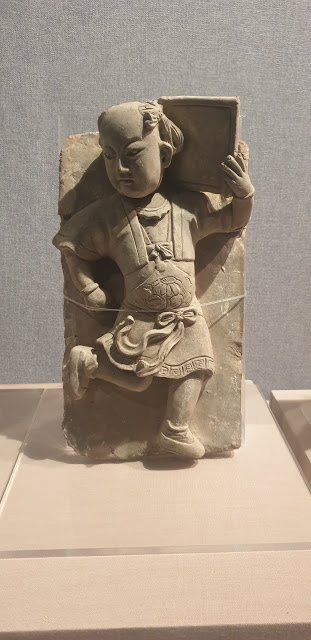
There were also small sculptures

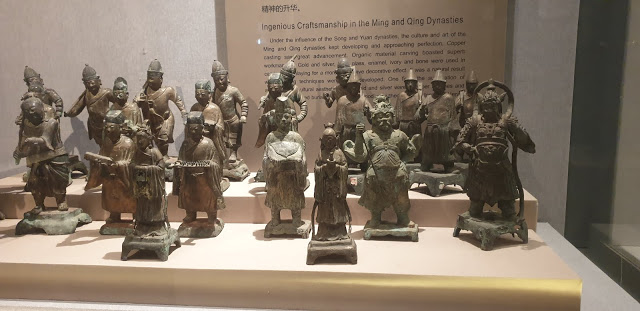
an array of small figures

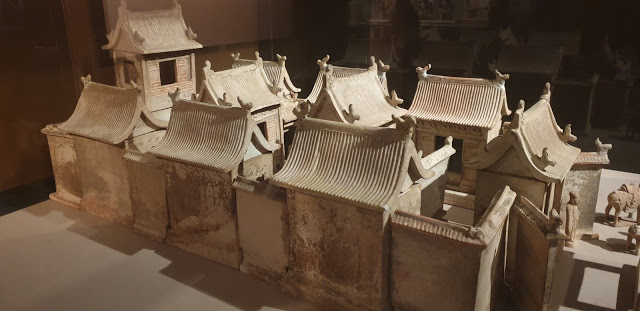
and a model of a settlement

20 minutes was long enough.

“What Sets Us Apart”, a mystery with a twist

David is a man troubled by a past he is trying to forget.

Susan is rebelling against a life of privilege and an exasperated mother who holds a secret that will determine her daughter’s destiny.

They are two people brought together by chance. Or was it?

When Susan discovers her mother’s secret, she goes in search of the truth that has been hidden from her since the day she was born.

When David realizes her absence is more than the usual cooling off after another heated argument, he finds himself being slowly drawn back into his former world of deceit and lies.

Then, back with his former employers, David quickly discovers nothing is what it seems as he embarks on a dangerous mission to find Susan before he loses her forever.

Find the kindle version on Amazon here:  http://amzn.to/2Eryfth

whatsetscover

Writing a book about a book – Day 35

Time now to bring in the police and this is in the form of Chief Inspector Gator, an odd sort of man who fits the mold of those ubiquitous policemen who don’t look like policemen but have a very sharp mind.

I guess watching too many Columbo episodes has had an effect on me.

The police officer who came to interview Aitchison arrived as I was leaving.   He nodded at me and announced himself as Chief Inspector Gator as I closed the door behind him.  My only thought of him was that he didn’t look like a policeman, and didn’t give him another thought.

Merrilyn’s expression had transformed into one of dismay, like the moment the sun went behind a cloud, and no doubt the result of learning Richardson’s fate.

“Shocking news isn’t it?” she said.

“Not good for the company.  Who found him?”

“One of the building security guards doing his rounds.  He literally fell over him, or so I heard.  There was a blackout or power failure and the lights failed to go back on.  We have been advised it was something to do with a circuit breaker.”

“So there was power everywhere, except that floor?”

“I don’t know.  But news has also just come through advising there was a burglary attempt in the basement computer storeroom.  No one can tell if any equipment has been stolen yet.  I’m sure you will be informed about it soon.”

“Another excuse for Benton to pester me,” I sighed.  “Security must have had a rough night last night.”

“That, and pleading that they are understaffed.  Mr. Aitchison thinks they are trying to use that as an excuse to draw attention away from their lack of responsibility.”  She looked at me with a serious expression, and lowered her voice, “I have to organize an emergency board meeting, and to be honest, I don’t know where to start.  On top of everything, Mr. Halligan is also dead, in tragic circumstances.  I could not imagine dying at home, alone.”

“It’s a terrible business.  By the way, I didn’t get that promotion.  You were right.  There’s a very long list ahead of me.  Until I am summoned again, try not to let it upset you.”

She tried to smile, but her heart was not in it.

When I stepped into the elevator and reached for the 18th-floor button, I realized I had acquired a case of the shakes.  Aitchison’s fear was infections, and perhaps I should have had a drink before I left his office.

As the doors closed, I felt a shiver go down my spine as a thought came into my head, the ramifications of which had many possibilities.  In the greater scheme of things, it would not have registered, not until now.

There was an instance when this new, or other, network could have been installed.

Some months ago we had the telephone system re-engineered to move away from the conventional land-based systems offered by the major Telcos and moved to VOIP, a less expensive option.  These new desktop phones, though looking exactly like those they replaced, used the network connection to run.

I had not been asked to supervise their installation, which had been done by a team of experts from the United States, flown out especially to do the work, and at the time, the whole building had been closed off for the entire weekend in order to carry it out.  I came in, just to make sure nothing on our network system had been compromised, but it would have been a perfect opportunity to lay down the foundations of another system.

Whether it was the case or not, the installation crew had given me full access to look over their work, and I’d not seen any indications of anything other than the installation of the telephones.  Of course, I was not looking for anything else, and it was possible they could install almost anything, and I would be none the wiser, simply because I was not a wiring expert.  Even if I looked now, I was not sure what I’d be looking for.

And then there was the ongoing office refurbishment, where whole floors were being evacuated, gutted, and rebuilt.  It had recently been our turn, but our renovation had one minor difference.  The refurbishment had worked around the server room.  It could not be moved or taken offline.

But during the renovation our movements to that floor and the server room had been restricted, and, at times, we had not been allowed near it.

Planned, coincidental, or something else.

Now away from Aitchison, I was able to think more rationally and consider the points he made.

It was common knowledge Halligan had a bad heart and scheduled to have surgery soon.  His death would not surprise some considering his workload and stress factor, and it was understandable he could have died of a heart attack.  The fact it had occurred now was probably the only reason why it appeared suspicious.

The question was, did Aitchison know more about Halligan than he was letting on?

The elevator arrived on my floor, and I sent those thoughts to the back of my mind.  I’d worry about them later.

© Charles Heath 2016-2025

“The Things We Do For Love”

Would you give up everything to be with the one you love?

Is love the metaphorical equivalent to ‘walking the plank’; a dive into uncharted waters?

For Henry, the only romance he was interested in was a life at sea, and when away from it, he strived to find sanctuary from his family and perhaps life itself.  It takes him to a small village by the sea, a place he never expected to find another just like him, Michelle, whom he soon discovers is as mysterious as she is beautiful.

Henry had long since given up the notion of finding romance, and Michelle couldn’t get involved for reasons she could never explain, but in the end, both acknowledge that something happened the moment they first met.  

Plans were made, plans were revised, and hopes were shattered.

A chance encounter causes Michelle’s past to catch up with her, and whatever hope she had of having a normal life with Henry, or anyone else, is gone.  To keep him alive she has to destroy her blossoming relationship, an act that breaks her heart and shatters his.

But can love conquer all?

It takes a few words of encouragement from an unlikely source to send Henry and his friend Radly on an odyssey into the darkest corners of the red-light district in a race against time to find and rescue the woman he finally realizes is the love of his life.

The cover, at the moment, looks like this:

lovecoverfinal1

Is love the metaphorical equivalent to ‘walking the plank’; a dive into uncharted waters?

For Henry, the only romance he was interested in was a life at sea, and when away from it, he strived to find sanctuary from his family and perhaps life itself.  It takes him to a small village by the sea, s place he never expected to find another just like him, Michelle, whom he soon discovers is as mysterious as she is beautiful.

Henry had long since given up the notion of finding romance, and Michelle couldn’t get involved for reasons she could never explain, but in the end, both acknowledge that something happened the moment they first met.  

Plans were made, plans were revised, and hopes were shattered.

A chance encounter causes Michelle’s past to catch up with her, and whatever hope she had of having a normal life with Henry, or anyone else, is gone.  To keep him alive she has to destroy her blossoming relationship, an act that breaks her heart and shatters his.

But can love conquer all?

It takes a few words of encouragement from an unlikely source to send Henry and his friend Radly on an odyssey into the darkest corners of the red-light district in a race against time to find and rescue the woman he finally realizes is the love of his life.

The cover, at the moment, looks like this:

lovecoverfinal1

In a word: Bill

Yes, it is a name, short for William, though I’m not sure how Bill was derived from William.

But…

As you know, like many words this one has a number of other meanings, like,

A bird has a bill, particularly those birds with webbed feet

A bill is something you are sent to pay for goods or services, and often turn up when least expected, or when money is tight

And, sadly, they are neverending.

Then there’s fit the bill, which means it is suitable.

It could also be a list of people who appear in a programme.

It is used to describe banknotes, such as a twenty dollar bill.

It could be a waybill, used for the consignment of goods.

It could also be a piece of legislation introduced into parliament.

In some places in the world, it could be the peak of a cap

But the most obscure use of the word bill goes to:  the point of an anchor fluke.

“One Last Look”, nothing is what it seems

A single event can have enormous consequences.

A single event driven by fate, after Ben told his wife Charlotte he would be late home one night, he left early, and by chance discovers his wife having dinner in their favourite restaurant with another man.

A single event where it could be said Ben was in the wrong place at the wrong time.

Who was this man? Why was she having dinner with him?

A simple truth to explain the single event was all Ben required. Instead, Charlotte told him a lie.

A single event that forces Ben to question everything he thought he knew about his wife, and the people who are around her.

After a near-death experience and forced retirement into a world he is unfamiliar with, Ben finds himself once again drawn back into that life of lies, violence, and intrigue.

From London to a small village in Tuscany, little by little Ben discovers who the woman he married is, and the real reason why fate had brought them together.

It is available on Amazon here:  http://amzn.to/2CqUBcz

The cinema of my dreams – It all started in Venice – Episode 13

Cecilia changes the subject

Being an up-and-coming movie star was not all beer and skittles, as the saying goes.

Juliet gave her a look that I thought was her death stare, annoyed by her arrival at what might have been a critical point in the conversation.

Cecilia saw her and shook her head.  “Oops, I’m intruding.  Sorry.”  She stood

“You’re not,” I said, which earned me a harsh look too, “We’re just having coffee, but you might want something stronger.”

“No, I’d better go.”  She was looking directly at Juliet, putting the onus directly on her.

“Stay.  We’re just having coffee.”

Cecilia waved to a waitress and sat down again.  “Great, I wasn’t looking forward to going back to an empty room.”

For effect, she touched me on my arm, her seat being closer, and I could see what she was doing. 

We opted for more coffee, Cecilia ordered a bottle of champagne, and three glasses, an attempt to smooth the rocky waters.

Juliet was definitely annoyed.  Another death stare in Cecilia’s direction, then, “would I have seen anything you’ve starred in?”

“Me?  I’m not a star, not a big name, just bit parts in series like Midsommer Murders, and Silent Witness.  I get to play dead bodies and murder victims.  My last role was a little better, I got a half dozen lines.  But I’m just one of the hundreds of hopefuls out there.”

“Do you have a day job, then, if parts are so few and far apart?”

Interesting question, Juliet was thinking on her feet.

If she was trying to catch Cecilia out, but she was ahead of Juliet.  “I do.  I’d like to say that it’s being a high-class escort, but they make more money than I’d know what to do with, so I toil away as a supermarket checkout girl.  Gives me the most flexibility regarding time off, and I get to meet so many different people, who become part of my repertoire of characters.  What do you do?”

“Pathology.”

“A doctor.”

“A disgraced doctor that can’t practice medicine.  Perhaps that might be material enough for another of your characters.”

Cecilia had one glass of champagne the moment it came, and then refilled for a second.  She offered it to us, and I nodded, taking half a glass.  Juliet declined.

“Played a hospital patient, a bomb victim, swathed in bloody bandages, been a doctor in the background once, got to spill coffee over another doctor.”

“What is the best part you’ve had?”

 “A fallen nun.”

The best said about that the better, but not before my mind went to places it shouldn’t.  I changed the subject.  “What will you be doing after the festival is over?”

“Going home.  I have an audition for a part in a film about mercenaries, they want me to be a mercenary would you believe?”

Apparently Juliet didn’t think so.

“But I have a spare few days if you want to show me more of Italy.  I’d like to see a little of Tuscany, try some wine.”

Another touch and a smile.

“I thought you were going to Sorrento.”  Not unexpected from Juliet.

“It can wait.  I’ve been thinking of going home, and can take Cecilia to Tuscany, send her on her way, and go visit Larry’s mother at Sorrento “

“And if I take up your tour offer to come with you?”

Cecilia gave me a Juliet look.

“Then I’ll send you a text saying where and when I’ll meet you.”

Change bottle empty, Cecilia gave me one last look, one that would no doubt get a reaction from Juliet, and sauntered away.

Juliet watched her leave, and after she disappeared out of sight, said, “it seems to me she’s more than just a friend.”

“That’s just her, no doubt playing a role.  She asked me if you were a girlfriend, and I said, once maybe, but not now.  Seems she didn’t quite believe me.”

“I think we both know where that ship is headed.”

The rocks, perhaps.  “It’s too soon after Violetta to contemplate anything like that.  But, that doesn’t mean I can’t be friends for now, and see what the future brings.”

“Not much if what you say about this Larry character is true.”

“That said, you might also want to be careful.  Larry’s not averse to using or killing close contacts of only to send a message.  So, if feel unsafe, or he makes an overture, tell me and I’ll pass it on to my minders.”

“If he does, I’ll definitely let you know.”

“Good.  It’s getting later.  We should get back to the hotel.”

© Charles Heath 2022

Writing a book in 365 days

Day 14

Writing is nothing more than a guided dream. So says Jorge Luis Borges in Doctor Brodies report.

Wow! If only I could guide my dreams.

They are a mess at the best of times and always end before I get to the good part.

That’s why I am writing a series called The Cinema of My Dreams. I lie awake at night staring at the ceiling, and instead of seeing darkness, I see the plots of my stories playing out. They never go where I want them to, but that’s because life doesn’t always play ball.

It’s the way my stories are written, an episode at a time, and not fully knowing what’s going to happen, as I write. i am writing like I’m the reader, hanging on every word, leaping from cliffhanger to cliffhanger.

Admittedly it can be nerve wracking especially when an idea for the next episode doesn’t materialise, but I get there. Inspiration sometimes comes from anywhere at any time.

But most people like to have a plan, and that to me, means you know every aspect of the story before you write it. I don’t like that because it would take too like to create the outline.

The cinema of my dreams – Was it just another surveillance job – Episode 15

I’m back home and this story has been sitting on a back burner for a few months, waiting for some more to be written.

The trouble is, there are also other stories to write, and I’m not very good at prioritising.

But, here we are, a few minutes opened up and it didn’t take long to get back into the groove.

Was I working for a ghost?


The question that was foremost in my mind was whether I should call Nobbin, and let him know that I’d met Severin and that his ‘information’ was on a USB.

When I’d mentioned the fact O’Connor said the evidence was somewhere, I knew this evidence was on a USB and could be in one of the hiding places O’Connor had set up with Nobbin.  If not, then it had to be somewhere else, somewhere only O’Connor would know about.

Somehow, I got the impression O’Connor had not trusted either side.  Yes, he was about to tell me where the evidence was, but if that was the case, it meant it was not anywhere where anyone else would know about.

Severin should have curbed his desire for execution a little, and taken O’Connor into custody, and then interrogated him.  It made me wonder, briefly, why Severin would want him dead.  In cases like that, it was because Severin didn’t want O’Connor to talk to me, or anyone else.

Still, he could have tranquilized O’Connor.  I would not have known the difference.

That meant I had to find out more information on O’Connor.

Of course, in just saying that out loud, over a half-full glass of scotch, just to steady the nerves after seeing Severin again, made it sound almost like a running joke.

As if I would be able to find someone who was, for all intents and purposes, a ghost.  That was how we were supposed to be, ghosts, to everyone we knew, including family.  We could no longer talk to anyone because they might become a target used as leverage against us.

That part of my training had been the scariest.  I didn’t have any friends, not real friends anyway, and no family, other than a half-brother who hated me.  I had toyed with the idea of meeting him, after I’d completed the training, just to see if anyone would try to use him as leverage, and then tell them he meant nothing to me.

It was an idea, I doubt if I could do it in reality.  But the thought of it gave me some measure of revenge for all the bullying he had inflicted on me when I was young.  Perhaps that was why I took this job, to prove I was nothing like the person he considered me to be.

Enough of the delving into the shadowy past.

I had a problem that needed solving.  How to find O’Connor.

After a long night of fitful sleep, I woke the next morning with the shreds of a plan.  I’d go into the office and use their computer system to look for him.  Of course, I didn’t expect that there would be any information available to an agent with my security clearance, which was basically to get in and out of the front door and log on to the computer to fill out reports and a timesheet.

It was a surprise, after what Nobbin had said about my employment, that my pass got me in the door.  It did, but I had no doubt somewhere it had register my name in a log somewhere.  I figured I had about half an hour before someone came checking up on me.

The same went for the computer system.  There was a bank of about a dozen computers in a room where the agents could do information searches, and private work, such as reports.  Three others were occupied, and none of those using them looked up when I entered the room.

Not a surprise.  We were taught to keep to ourselves and say nothing about the missions we were attached to anyone else.  In our line of work, secrets were paramount.  We were to become consummate liars because we could never tell anyone the truth about what we did.  If we wanted a cover story, we were to say we were international confidential couriers of documents for legal institutions.

It sounded interesting, but it was quite boring, or at least that was how I described it if anyone asked.

So, ignoring the others, I logged in and found I was still on the employee list.  And, I still had the same level of access I had before.

I ran a search on the name O’Connor.

It came back with five documents, the first of which was his personnel record.  First name, Donald.  A date of birth that made him 27 years old, and an address, in Putney.  I wrote it down.  Marital status, single.  Status, deceased.  Section worked for:  Eight.

There were supposedly eight sections, and the one I worked for was Seven.  Out of interest, I brought up my records.  It was how Severin had found me because my address was on file.  But more interesting was my status, transferred, and my section, three.  Was Nobbin’s section three?

I would ask if I got an opportunity to.

The other four documents were reports, most of which were redacted, or marked restricted.  Or above my pay grade, whatever that was.

But, at least one thing was clear, I had not been fired, just transferred.  I guess I would have to call Nobbin after all.  After I visited O’Connor’s last known residence.

I wasn’t holding my breath expecting to find anything.


© Charles Heath 2019