Searching for locations: The Maglev (Magnetic Levitation) Train, Shanghai, China

So, the first treat for the day is the high-speed magnetic train, something we only learned about after arriving in China and was not on any of the pre-tour documentation.

The train line connects Shanghai Pudong International Airport and Longyang Road Station (in the outskirts of central Pudong).  It is the oldest commercial maglev still in operation, and the first commercial high-speed maglev with cruising speed of 431 km/h (268 mph).  At full speed, the journey takes 7 minutes and 20 seconds to complete the distance of about 30 km.

Construction of the line began on March 1, 2001 and public services commenced on 1 January 2004.  It was built by a joint venture of Siemens and ThyssenKrupp from Kassel, Germany.

But, like visiting anything from a hotel, first we have to drive to the station and because we are leaving at 8, its peak hour traffic, and it takes 1 hour 10 minutes to get there.

The train also has a practical use and that is to take passengers from Shanghai to Pudong international airport as well as for those train enthusiasts, which is what we are.

On the train, it has the same sleek look as the bullet trains, but it is completely different, and you are able to see from the front of the train to the back.

Reputed to travel at 431 kph we take a seat and it is not long before the doors shut, and a loud humming noise is soon replaced by what sounds like an engine, then we start moving.  It sounds just like a normal train, and is a lot noisier than a normal bullet train.

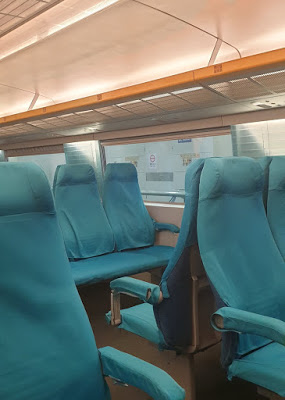
Seating on the train was nothing special, as one might expect

It didn’t take long before it hits the advertised speed of 431 kph.  This is not sustained for very long, because the distance is on 40 odd kilometers, and the whole trip takes about 7 minutes.

We go to the airport, and then we come back.  Is it worth the price, yes.  If you are a train enthusiast.

An excerpt from “The Things We Do For Love”; In love, Henry was all at sea!

In the distance, he could hear the dinner bell ringing and roused himself.  Feeling the dampness of the pillow, and fearing the ravages of pent-up emotion, he considered not going down but thought it best not to upset Mrs. Mac, especially after he said he would be dining.

In the event, he wished he had reneged, especially when he discovered he was not the only guest staying at the hotel.

Whilst he’d been reminiscing, another guest, a young lady, had arrived.  He’d heard her and Mrs. Mac coming up the stairs and then shown to a room on the same floor, perhaps at the other end of the passage.

Henry caught his first glimpse of her when she appeared at the door to the dining room, waiting for Mrs. Mac to show her to a table.

She was in her mid-twenties, slim, with long brown hair, and the grace and elegance of a woman associated with countless fashion magazines.  She was, he thought, stunningly beautiful with not a hair out of place, and make-up flawlessly applied.  Her clothes were black, simple, elegant, and expensive, the sort an heiress or wife of a millionaire might condescend to wear to a lesser occasion than dinner.

Then there was her expression; cold, forbidding, almost frightening in its intensity.  And her eyes, piercingly blue and yet laced with pain.  Dracula’s daughter was his immediate description of her.

All in all, he considered, the only thing they had in common was, like him, she seemed totally out of place.

Mrs. Mac came out of the kitchen, wiping her hands on her apron.  She was, she informed him earlier, chef, waitress, hotelier, barmaid, and cleaner all rolled into one.  Coming up to the new arrival she said, “Ah, Miss Andrews, I’m glad you decided to have dinner.  Would you like to sit with Mr. Henshaw, or would you like to have a table of your own?”

Henry could feel her icy stare as she sized up his appeal as a dining companion, making the hair on the back of his neck stand up.  He purposely didn’t look back.  In his estimation, his appeal rating was minus six.  Out of a thousand!

“If Mr. Henshaw doesn’t mind….”  She looked at him, leaving the query in mid-air.

He didn’t mind and said so.  Perhaps he’d underestimated his rating.

“Good.”  Mrs. Mac promptly ushered her over.  Henry stood, made sure she was seated properly and sat.

“Thank you.  You are most kind.”  The way she said it suggested snobbish overtones.

“I try to be when I can.”  It was supposed to nullify her sarcastic tone but made him sound a little silly, and when she gave him another of her icy glares, he regretted it.

Mrs. Mac quickly intervened, asking, “Would you care for the soup?”

They did, and, after writing the order on her pad, she gave them each a look, imperceptibly shook her head, and returned to the kitchen.

Before Michelle spoke to him again, she had another quick look at him, trying to fathom who and what he might be.  There was something about him.

His eyes, they mirrored the same sadness she felt, and, yes, there was something else, that it looked like he had been crying?  There was a tinge of redness.

Perhaps, she thought, he was here for the same reason she was.

No.  That wasn’t possible.

Then she said, without thinking, “Do you have any particular reason for coming here?”  Seconds later she realized she’d spoken it out loud, had hadn’t meant to actually ask, it just came out.

It took him by surprise, obviously not the first question he was expecting her to ask of him.

“No, other than it is as far from civilization, and home, as I could get.”

At least we agree on that, she thought.

It was obvious he was running away from something as well.

Given the isolation of the village and lack of geographic hospitality, it was, from her point of view, ideal.  All she had to do was avoid him, and that wouldn’t be difficult.

After getting through this evening first.

“Yes,” she agreed.  “It is that.”

A few seconds passed, and she thought she could feel his eyes on her and wasn’t going to look up.

Until he asked, “What’s your reason?”

Slightly abrupt in manner, perhaps, because of her question and how she asked it.

She looked up.  “Rest.  And have some time to myself.”

She hoped he would notice the emphasis she had placed on the word ‘herself’ and take due note.  No doubt, she thought, she had completely different ideas of what constituted a holiday than he, not that she had said she was here for a holiday.

Mrs. Mac arrived at a fortuitous moment to save them from further conversation.

Over the entree, she wondered if she had made a mistake coming to the hotel.  Of course, there had been no conceivable way she could know that anyone else might have booked the same hotel, but realized it was foolish to think she might end up in it by herself.

Was that what she was expecting?

Not a mistake then, but an unfortunate set of circumstances, which could be overcome by being sensible.

Yet, there he was, and it made her curious, not that he was a man, by himself, in the middle of nowhere, hiding like she was, but for quite varied reasons.

On discreet observance, whilst they ate, she gained the impression his air of light-heartedness was forced, and he had no sense of humour.

This feeling was engendered by his looks, unruly dark hair, and permanent frown.  And then there was his abysmal taste in clothes on a tall, lanky frame.  They were quality but totally unsuited to the wearer.

Rebellion was written all over him.

The only other thought crossing her mind, and incongruously, was he could do with a decent feed.  In that respect, she knew now from the mountain of food in front of her, he had come to the right place.

“Mr. Henshaw?”

He looked up.  “Henshaw is too formal.  Henry sounds much better,” he said, with a slight hint of gruffness.

“Then my name is Michelle.”

Mrs. Mac came in to take their order for the only main course, gather up the entree dishes, and then return to the kitchen.

“Staying long?” she asked.

“About three weeks.  Yourself?”

“About the same.”

The conversation dried up.

Neither looked at the other, rather at the walls, out the window, towards the kitchen, anywhere.  It was, she thought, unbearably awkward.

Mrs. Mac returned with a large tray with dishes on it, setting it down on the table next to theirs.

“Not as good as the usual cook,” she said, serving up the dinner expertly, “but it comes a good second, even if I do say so myself.  Care for some wine?”

Henry looked at Michelle.  “What do you think?”

“I’m used to my dining companions making the decision.”

You would, he thought.  He couldn’t help but notice the cutting edge of her tone.  Then, to Mrs. Mac, he named a particular White Burgundy he liked, and she bustled off.

“I hope you like it,” he said, acknowledging her previous comment with a smile that had nothing to do with humour.

“Yes, so do I.”

Both made a start on the main course, a concoction of chicken and vegetables that were delicious, Henry thought when compared to the bland food he received at home and sometimes aboard my ship.

It was five minutes before Mrs Mac returned with the bottle and two glasses.  After opening it and pouring the drinks, she left them alone again.

Henry resumed the conversation.  “How did you arrive?  I came by train.”

“By car.”

“Did you drive yourself?”

And he thought, a few seconds later, that was a silly question, otherwise she would not be alone, and certainly not sitting at this table. With him.

“After a fashion.”

He could see that she was formulating a retort in her mind, then changed it, instead, smiling for the first time, and it served to lighten the atmosphere.

And in doing so, it showed him she had another more pleasant side despite the fact she was trying not to look happy.

“My father reckons I’m just another of ‘those’ women drivers,” she added.

“Whatever for?”

“The first and only time he came with me I had an accident.  I ran up the back of another car.  Of course, it didn’t matter to him the other driver was driving like a startled rabbit.”

“It doesn’t help,” he agreed.

“Do you drive?”

“Mostly people up the wall.”  His attempt at humour failed.  “Actually,” he added quickly, “I’ve got a very old Morris that manages to get me where I’m going.”

The apple pie and cream for dessert came and went and the rapport between them improved as the wine disappeared and the coffee came.  Both had found, after getting to know each other better, their first impressions were not necessarily correct.

“Enjoy the food?” Mrs. Mac asked, suddenly reappearing.

“Beautifully cooked and delicious to eat,” Michelle said, and Henry endorsed her remarks.

“Ah, it does my heart good to hear such genuine compliments,” she said, smiling.  She collected the last of the dishes and disappeared yet again.

“What do you do for a living,” Michelle asked in an off-hand manner.

He had a feeling she was not particularly interested, and it was just making conversation.

“I’m a purser.”

“A what?”

“A purser.  I work on a ship doing the paperwork, that sort of thing.”

“I see.”

“And you?”

“I was a model.”

“Was?”

“Until I had an accident, a rather bad one.”

“Oh, I’m sorry.”

So that explained the odd feeling he had about her.

As the evening wore on, he began to think there might be something wrong, seriously wrong with her because she didn’t look too well.  Even the carefully applied makeup, from close, didn’t hide the very pale, and tired look, or the sunken, dark-ringed eyes.

“I try not to think about it, but it doesn’t necessarily work.  I’ve come here for peace and quiet, away from doctors and parents.”

“Then you will not have to worry about me annoying you.  I’m one of those fall-asleep-reading-a-book types.”

Perhaps it would be like ships passing in the night and then smiled to himself about the analogy.

Dinner over, they separated.

Henry went back to the lounge to read a few pages of his book before going to bed, and Michelle went up to her room to retire for the night.

But try as he might, he was unable to read, his mind dwelling on the unusual, yet compellingly mysterious person he would be sharing the hotel with.

Overlaying that original blurred image of her standing in the doorway was another of her haunting expressions that had, he finally conceded, taken his breath away, and a look that had sent more than one tingle down his spine.

She may not have thought much of him, but she had certainly made an impression on him.

© Charles Heath 2015-2024

lovecoverfinal1

Writing a novel in 365 days – 8

Day 8

I guess before you actually begin writing, or planning, or however it will be when you finally get started, there are a number of preparations to be made, and advice to be taken.

Advice is always good, and today’s is probably more relevant in a few months when the creativity might start flagging.

Writing a novel requires stamina and dedication. That saying ‘when the going gets tough, the tough get going’ is probably a sign on the wall of your writing room.

But that’s only one aspect of this particular item.

It is also relevant when you’ve finally finished the novel, firstly when you sit down and do that first reading, before the editing, or perhaps that first edit.

You are going to think perhaps it’s not as good as you thought it would be.

No, we don’t think like that. it can be fixed by some editing, by you or someone else. Just remember all those days, weeks, and months you put into it, working your fingers to the bone, sharpening the two hundred pencils you wrote it with. Or smudgy biros or leaking ink pens.

Don’t lose heart.

Don’t give up.

There are days when I write absolute drivel, but I always go back, rewrite, re-read, and rewrite until I’m happy.

That first draft is just the ideas, strung together, that will, eventually become that best-selling novel.

An excerpt from “If Only” – a work in progress

Investigation of crimes doesn’t always go according to plan, nor does the perpetrator get either found or punished.

That was particularly true in my case.  The murderer was incredibly careful in not leaving any evidence behind, to the extent that the police could not rule out whether it was a male or a female.

At one stage the police thought I had murdered my own wife though how I could be on a train at the time of the murder was beyond me.  I had witnesses and a cast-iron alibi.

The officer in charge was Detective First Grade Gabrielle Walters.  She came to me on the day after the murder seeking answers to the usual questions like, when was the last time you saw your wife, did you argue, the neighbors reckon there were heated discussions the day before.

Routine was the word she used.

Her fellow detective was a surly piece of work whose intention was to get answers or, more likely, a confession by any or all means possible.  I could sense the raging violence within him.  Fortunately, common sense prevailed.

Over the course of the next few weeks, once I’d been cleared of committing the crime, Gabrielle made a point of keeping me informed of the progress.

After three months the updates were more sporadic, and when, for lack of progress, it became a cold case, communication ceased.

But it was not the last I saw of Gabrielle.

The shock of finding Vanessa was more devastating than the fact she was now gone, and those images lived on in the same nightmare that came to visit me every night when I closed my eyes.

For months I was barely functioning, to the extent I had all but lost my job, and quite a few friends, particularly those who were more attached to Vanessa rather than me.

They didn’t understand how it could affect me so much, and since it had not happened to them, my tart replies of ‘you wouldn’t understand’ were met with equally short retorts.  Some questioned my sanity, even, for a time, so did I.

No one, it seemed, could understand what it was like, no one except Gabrielle.

She was by her own admission, damaged goods, having been the victim of a similar incident, a boyfriend who turned out to be an awfully bad boy.  Her story varied only in she had been made to witness his execution.  Her nightmare, in reliving that moment in time, was how she was still alive and, to this day, had no idea why she’d been spared.

It was a story she told me one night, some months after the investigation had been scaled down.  I was still looking for the bottom of a bottle and an emotional mess.  Perhaps it struck a resonance with her; she’d been there and managed to come out the other side.

What happened become our secret, a once-only night together that meant a great deal to me, and by mutual agreement, it was not spoken of again.  It was as if she knew exactly what was required to set me on the path to recovery.

And it had.

Since then, we saw each about once a month in a cafe.   I had been surprised to hear from her again shortly after that eventful night when she called to set it up, ostensibly for her to provide me with any updates on the case, but perhaps we had, after that unspoken night, formed a closer bond than either of us wanted to admit.

We generally talked for hours over wine, then dinner and coffee.  It took a while for me to realize that all she had was her work, personal relationships were nigh on impossible in a job that left little or no spare time for anything else.

She’d always said that if I had any questions or problems about the case, or if there was anything that might come to me that might be relevant, even after all this time, all I had to do was call her.

I wondered if this text message was in that category.  I was certain it would interest the police and I had no doubt they could trace the message’s origin, but there was that tiny degree of doubt, about whether or not I could trust her to tell me what the message meant.

I reached for the phone then put it back down again.  I’d think about it and decide tomorrow.

© Charles Heath 2018-2020

In a word: Flight

There is a saying, if God wanted us to fly then he would have given us wings.

Unfortunately, he didn’t, so we do not get to know what it’s like to be in flight,

Unless…

We take an aeroplane, which usually has a flight number such as QF607, or in conversation, ‘I’ll be taking the 6 o’clock flight’.

If someone runs away, then we say they have taken flight.

If we roll back a few years, say about 80, to World War 2, flight tales on a whole new meaning.

It refers to a group of planes, in one case a number of spitfires, or,

The man in charge, a flight lieutenant, also colloquially known as ‘flight’.

This is not be confused with the word flite which has several very obscure meanings,

First, it means to quarrel or argue, or engage in a debate, and

Second, to make a complaint.

But one that sticks in my my mind is Flyte, from Brideshead Revisited.  they were a very interesting family.

‘What Sets Us Apart’ – A beta readers view

There’s something to be said for a story that starts like a James Bond movie, throwing you straight in the deep end, a perfect way of getting to know the main character, David, or is that Alistair?

A retired spy, well not so much a spy as a retired errand boy, David’s rather wry description of his talents, and a woman that most men would give their left arm for, not exactly the ideal couple, but there is a spark in a meeting that may or may not have been a setup.

But as the story progressed, the question I kept asking myself was why he’d bother.

And, page after unrelenting page, you find out.

Susan is exactly the sort of woman to pique his interest.  Then, inexplicably, she disappears.  That might have been the end to it, but Prendergast, that shadowy enigma, David’s ex-boss who loves playing games with real people, gives him an ultimatum, find her or come back to work.

Nothing like an offer that’s a double-edged sword!

A dragon for a mother, a sister he didn’t know about, Susan’s BFF who is not what she seems or a friend indeed, and Susan’s father who, up till David meets her, couldn’t be less interested, his nemesis proves to be the impossible dream, and he’s always just that one step behind.

When the rollercoaster finally came to a halt, and I could start breathing again, it was an ending that was completely unexpected.

I’ve been told there’s a sequel in the works.

Bring it on!

The book can be purchased here:  http://amzn.to/2Eryfth

The cinema of my dreams – It all started in Venice – Episode 21

An Invitation to Dinner

I did not go back to the hotel, but instead went home from the airport, half expecting to find Cecilia still there.

She wasn’t, but the lingering scent of her perfume hung in the air as a reminder.  I entered if it might stir up Violetta’s ghost because more than once I thought I heard her moving about the house.

It was, of course, my imagination, but just the same it was a slim possibility.  I guess talking to her even though she was not there didn’t help.

I had no intention of seeing or talking to Juliet lest she alerted Larry to my visit.  It needed to stay anonymous for it to be effective.

A shower, a change of clothes and into the anonymous car that looked like a million others on the road.

Oh, and a little deft driving to lose the car that followed me away from the garage.  The Frenchman was persistent, I’ll give him that.

Larry’s mother lived in a mansion overlooking the Mediterranean, and I’d spent a few afternoons on the patio sampling the energy and cheese of a country that knew how to excel in both.

When Violetta first got sick, we had been invited to stay for a few months and she had loved it.  It had made her feel better, but in the end, there was no beating cancer that was very aggressively attacking her.

Perhaps it was fitting she took her last breath in the place she loved so much.

I hadn’t been back since, and passing through the gates brought back a flood of sad memories and a tear or two.

Not enough to blur my sight, and take down the two guards Larry had lurking near the gate, supposedly in hiding, with a tranquilizer gun.

I dragged the bodies deeper into the hedgerow.  They wouldn’t be waking up for at least 12 hours, time enough to do what I had to.

It was a pleasant but invigoration walk up the hill keeping to the cover the garden provided until I stepped out just in front of the patio, and beyond the open doors the dining room where five people were seated.

“What, not waiting for the guest of honor?” I said, stepping out into full view of the diners.

Two men on the door turned swiftly and both were tranquilized before they could take a step.  I turned and looked over my shoulder at the site I thought Cecilia would take, then turned back to see both Larry and his mother out of their seats.

First observation, I didn’t know Larry had three children only two.  The son was a replica of him, the girls, both more than ten, were identical twins and like their mother.  Once again, I had to wonder why a woman like Brenda would be interested in a man like him.

“What are you doing here?” Larry growled, stopping short of approaching me, eyes on the tranquilizing gun.

The thought crossed my mind that I should just put him to sleep, taken away, to have a less civilized conversation, something he would understand.

“I invited him to dinner.  He is an old friend, and you know him as well as I do.”

Her eyes were on the bodyguards on the ground, and Larry, waiting for his reaction.  She came over and hugged me.  “So nice to see you again.”

“You were in London,” he said tonelessly.  It was a statement, not a question.

“Marvels of modern transport.  You should stop using leaking rowboats to come and go and embrace the jet age.  Sit down Larry, you’re making a scene in front of your family.”

“Who is he dear,” his wife asked as he threw himself back in the chair next to her.  The three children looked me over like they would a new toy, the son in particular, with a trademark scowl on his face.

“A policeman of sorts.”

“I didn’t know you were working with the police.”

It was an interesting statement, and if I didn’t know better, it seemed to me she was pushing a button.  The look she gave him was priceless.

“Perhaps you and the children should leave the table and let me sort this small problem out.”

“No dear.  I want to hear what he has to say.”

He turned to glare at her, a particularly dark expression, whether it was the result of my unexpected arrival or her defiance which I thought was brave under the circumstances, whatever the reason, it showed her to be vastly different from the description of her in the department’s files.

“I told you…”

“You do not raise your voice at me, or anyone, at the dinner table.  You also apparently have some explaining to do because when I asked you what happened to your brother, Trevor, you told me the police killed him.  I’m assuming that by police you mean in the form of our dining companion who just arrived.”

He looked surprised, no I would say that he was shocked.  “You seem remarkably well-informed about something you really know nothing about.”  He was showing remarkable restraint because I knew if it was anyone else, they’d be all but dead.

“I know that Trevor told you several times he wanted nothing to do with the business.  We used to spend time talking about what he wanted to do with his life and lament the fact you wouldn’t let him.  I know you coerced him into running that errand for you because he rang and told me, no asked me, to intervene on his behalf.  It seems he knew that there was a traitor in your organization, that he told you his suspicions, but you said it couldn’t possibly be that person.  Then when it all went, as he said, to hell in a handbasket, he called me to tell me what happened, and then called your mother, at the behest of your so-called police assassin, and she was talking to her when you arrived.  So, Larry, the key question here is, what did you do that took a brother who was alive when you arrived, to dead on arrival at the hospital?  You were there, so only you know what happened.”

“I did nothing.  He was alive when I put him in the ambulance.”

“Who went with him to the hospital?”

“Jimmy.”

“The person he told you was the traitor.  The person you said couldn’t possibly be one.  He didn’t go with Trevor to the drop-off, so how did he get there?”

I’ll be honest, I was fascinated, if not hanging on every word.  One nuance I did pick up on, was the way she spoke about Trevor told me they had more than just conversations.  Had Larry known that also?

“He was not a traitor.”

“And yet you have no explanation as to why he disappeared shortly after Trevor died.  Convenient, don’t you think?”

She sat there, face to face, with the man she had married twenty years before, then a relatively naive young woman who knew who he was, but not what he was to become.  She didn’t rate highly in the files simply because she purposely stayed out of the limelight, and distanced herself from the business, and Larry’s business associates.  I suspected it was to shield her children from the uglier side of the criminal world.  Now, I got the impression Larry was trying to induct his son into the business, although only 16, and she was not happy with it or with him.

“You have no idea what you’re talking about.”  Less bluster, it was odd to see Larry in a situation where he wasn’t in charge.

“You mean, for once in your life, you don’t have the lies at your fingertips.  Let’s leave that for the moment and move on to Jaime Meyers.”

Now he was truly shocked, like a man who just received an umpteen-volt jolt.

“How do you know…”  He turned and glared at me.

“Don’t look at me, Larry.  I haven’t told anyone about our conversation in London, as per the agreement I made with her.  I think you might want to consider the possibility that your wife is not the dumb blonde you tell your friends she is.”

A cat among the pigeons’ statement drew a very dark look from her.  “Trevor told me you called me a dumb blonde and I didn’t want to think that was true, but when Elaine told me she overheard Lorenzo talking to his friends using those exact words, I was disappointed.”

That was when Cecilia crashed the party.

© Charles Heath 2022

Writing a novel in 365 days – 22

Day 22

Today we’re discussing dialogue, and sometimes that’s the hardest part to write.

Making a conversation sound like a normal conversation is sometimes impossible because who can define normal? People speak in many different ways, with different accents, tones, and sometimes completely different words.

My grandchildren are sometimes completely incomprehensible because the modern vernacular is based on writing a text on a cell in which the squiggles used as words sometimes make no sense to me.

I have received messages that

I have not understood, or have on occasion suffered that new blight on our writing, the corrector, and some of my texts, well, people have got upset and I can understand why.

So, it may not be that in the story we are writing, and the characters we have decided to use, that we have an understanding of their language or manner of speaking. If we are using our own manner of speaking, it might not lend credence to the characters we’re looking for.

Or if you’re lucky and know someone who has the vernacular, then it’s good. If not, then our task would be to find and talk to people with that character’s voice. I have often spent lunch or dinner out just to listen to the people around me talking. I’m not interested in the content, though sometimes it can be quite interesting, but just the words and the way they are spoken.

Try it, you will be amazed at just how many different ways there are to speak the same word.

I was.

The cinema of my dreams – Was it just another surveillance job – Episode 23

I’m back home and this story has been sitting on a back burner for a few months, waiting for some more to be written.

The trouble is, there are also other stories to write, and I’m not very good at prioritizing.

But, here we are, a few minutes opened up and it didn’t take long to get back into the groove.

An unlikely ally?


The bar in the hotel was tucked away in a small area behind the dining room, or perhaps it was part of the dining room, I wasn’t quite sure.  There were indoor shrubs blocking the view from the front entrance, so we could feel safe enough, and less strenuous in watching the continuous comings and goings of the hotel’s guests and their friends.

For a small hotel, it was quite busy.

We were lucky it was not yet dinner time, so the restaurant was still being set up for the evening dinner service.  I had a look at one of the menus, and the Shepherd’s Pie looked good.  It was mostly hearty British staples like Bangers and Mask and Toad in the Hole.  I guess by calling sausages by their real name sausages, no one really wanted them.

Three drinks down, and looking for the restroom, it ended up an exploration of the passage that led to a rear door, one that could be used by guests, but was mostly used by smoking staff.  When I went outside, there were two housekeepers and a concierge boy talking about the couple in 506.  I hope Jan and I were not labeled an ‘interesting couple’.

“Let’s go outside and make some calls.”  She finished her drink and slid off the barstool.  

I joined her and we went out the back entrance, along an alley to the next main street, then along the busy road to an underground station.  There were two other hotels I noticed along the way, so we would not be making it easy for them if they could track us.

I called Nobbin first using the card he left under the name Wilson, leaving the phone on speaker.

“Yes.”  There was no ring on the other end of the line.

“Wilson?”

“Yes.  Who is this?”

“Sam Jackson.  You said to call you if anything happened.  I have managed to track down an address for O’Connell.  I went there and found two women, one named Josephine, who was definitely not a resident or his friend as she claimed.  Then I met another, whose name I can’t remember, but I suspect she’s not who she said she was, nor a friend.”

“Were they looking for the USB?”

“I don’t know.  One was on the floor when I arrived, and I assumed she had been rendered unconscious by someone else.  I roused her, but she had nothing conclusive to say.  I think she was one of your operatives.”

Silence, then, “Why would you say that?”

“I followed her out onto the street.”

More silence, then, “She was asked to search the flat.”

“For what?”

“Anything that would be useful in telling us what he was doing.”

“I’m sure I told you that Severin was after a USB, so I thoroughly searched O’Connell’s flat and didn’t find it, or anything else.”

“Neither did she, which is unfortunate, but not unexpected.  O’Connell must have been worried about the information he’d uncovered, enough to not be carrying it with him.”

“Well, I don’t think it was his primary residence.  Still too many price tags on the furniture.  He had somewhere else to go, and that might be where the USB is.  I’m surprised you don’t seem to know very much about him or what he was doing given he was one of your operatives.  Unless, of course, he went off-book.”

“I assure you that isn’t the case, and O’Connell’s activities were on a need to know basis.  All I can say is that he was using a Journalist cover, investigating cyber currency being used to purchase weapons.  We were scheduled to meet for a report on his progress late afternoon on the day he was killed.  Are you sure there was no one else near the alley where he was killed?”

“It was empty except for Severin and Maury.

“And you.”

“Are you implying that I took it?”

“No, but there’s a compelling case that might fit you in the frame.  Do you know who the other woman was in O’Connell’s flat?”

“No.  Like I said, she gave me a name, but I don’t think it was real.  She claimed to be his neighbor, but so did Josephine, so it’s likely she wasn’t.  Other than that, she could be anyone.  If he had another place, you might want to try and find out where it was.  I’m going to take up the search tomorrow morning.”

“Are you sure there was nothing to point you in that direction lying around in the flat?”

“The man was a neatness freak.  I doubt it.  And now he’s dead.  The only possibility I can see is that he found out what Severin and Maury are about to do, and by now they will be far more desperate to find it.  We need to get to it first, so perhaps if you have some analysts looking for something to do, see if they can find that second residence.  I’m sure you can get a hold of any CCTV there is.  You might be able to find him that way.  If you do and you get an address, let me know and I’ll go straight there.”

“Yes, of course.  Keep in touch.”

The line went dead.

“Interesting man,” Jan said, “but not a trustworthy one.  You listen to the modulation of his voice.  That’s a man who wouldn’t know the truth even if he fell over it.  And if he does find that address, you will not be the first person he calls.”

I shrugged.  “Probably not.  As for Nobbin, isn’t that the very nature of our business, to tell endless lies in order to get to the truth?”

“Remind me, one day, to tell you about pathological liars.”

© Charles Heath 2019-2020

A photograph from the inspirational bin – 18

On a clear day you can see forever.

Perhaps, it just depends on what you want to see.

What I first see, looking at this view, is a horizon that is so far away, I cannot reach it.

Is that the one goal in life that I have?

Or is it time to change that goal and try to reach one that is attainable?

What sacrifice does that entail?

Does it come to pass that you must make sacrifices in order to get what you want?

It’s one of those perennial questions that has an answer, mostly, that no one wants to hear, or wants to be told.

Everything has a price. It’s whether you want to pay for it.

This subject, this situation, is manna from heaven for a writer.

So, for instance…

I stood on the edge of the cliff and took in the view, which on any given day could be either magnificent or like being in hell.

Today, while being majestic, it was also like being in hell.

37 days.

I didn’t think I’d last 2.  Yet here I was, having survived the worst that could be thrown at me.

The question was,  did I want to go back, did I want the life that was being offered?

Or was it time to simply walk away?

That, of course, is another story, and you’ll have to wait just a little longer to find out.

© Charles Heath 2023