“What Sets Us Apart”, a mystery with a twist

David is a man troubled by a past he is trying to forget.

Susan is rebelling against a life of privilege and an exasperated mother who holds a secret that will determine her daughter’s destiny.

They are two people brought together by chance. Or was it?

When Susan discovers her mother’s secret, she goes in search of the truth that has been hidden from her since the day she was born.

When David realizes her absence is more than the usual cooling off after another heated argument, he finds himself being slowly drawn back into his former world of deceit and lies.

Then, back with his former employers, David quickly discovers nothing is what it seems as he embarks on a dangerous mission to find Susan before he loses her forever.

Find the kindle version on Amazon here:  http://amzn.to/2Eryfth

whatsetscover

“The Enemy Within” – the editor’s third draft – Day 26

This book has been sitting in the ‘to-be-done’ tray, so this month it is going to get the final revision.

And so it begins…

Who can you trust?

In the shadowy world of espionage, the new recruits are taught to trust no one, only their instincts.

Everyone lies.  Even they will, and very convincingly, during the execution of their duties.  The first time, they assumed a cover identity, and have a legend that is nothing like who they really are.

In other words, spies start out being normal people, and over time they are moulded into someone, and something, they were not.  Whatever ideals, thoughts, and beliefs they had before are discarded, in a sense, so that they can be someone else.

Someone who is ready and prepared to do what is necessary to keep the world safe from…

Well, pretty much people they gradually become.  It takes a monster, really, to do what is necessary, to kill another human being, justifying it by saying they are wrong, and you are right, to blackmail; cajole, and force others to do basically what is wrong just so right will prevail.

The story evolved a little in the rewrite, where our protagonist is a new agent in the field.  Things go wrong, and he wants to know why.

He’s told that’s not for him to decide, or question, that in essence he is merely a blunt instrument who takes orders and executes them, without question, trusting the people who send him that it is in the name of justice.

You can’t be an agent in the field with a conscience.

Perhaps Jack will be one of the first.

An excerpt from “The Things We Do For Love”; In love, Henry was all at sea!

In the distance, he could hear the dinner bell ringing and roused himself.  Feeling the dampness of the pillow, and fearing the ravages of pent-up emotion, he considered not going down but thought it best not to upset Mrs. Mac, especially after he said he would be dining.

In the event, he wished he had reneged, especially when he discovered he was not the only guest staying at the hotel.

Whilst he’d been reminiscing, another guest, a young lady, had arrived.  He’d heard her and Mrs. Mac coming up the stairs and then shown to a room on the same floor, perhaps at the other end of the passage.

Henry caught his first glimpse of her when she appeared at the door to the dining room, waiting for Mrs. Mac to show her to a table.

She was in her mid-twenties, slim, with long brown hair, and the grace and elegance of a woman associated with countless fashion magazines.  She was, he thought, stunningly beautiful with not a hair out of place, and make-up flawlessly applied.  Her clothes were black, simple, elegant, and expensive, the sort an heiress or wife of a millionaire might condescend to wear to a lesser occasion than dinner.

Then there was her expression; cold, forbidding, almost frightening in its intensity.  And her eyes, piercingly blue and yet laced with pain.  Dracula’s daughter was his immediate description of her.

All in all, he considered, the only thing they had in common was, like him, she seemed totally out of place.

Mrs. Mac came out of the kitchen, wiping her hands on her apron.  She was, she informed him earlier, chef, waitress, hotelier, barmaid, and cleaner all rolled into one.  Coming up to the new arrival she said, “Ah, Miss Andrews, I’m glad you decided to have dinner.  Would you like to sit with Mr. Henshaw, or would you like to have a table of your own?”

Henry could feel her icy stare as she sized up his appeal as a dining companion, making the hair on the back of his neck stand up.  He purposely didn’t look back.  In his estimation, his appeal rating was minus six.  Out of a thousand!

“If Mr. Henshaw doesn’t mind….”  She looked at him, leaving the query in mid-air.

He didn’t mind and said so.  Perhaps he’d underestimated his rating.

“Good.”  Mrs. Mac promptly ushered her over.  Henry stood, made sure she was seated properly and sat.

“Thank you.  You are most kind.”  The way she said it suggested snobbish overtones.

“I try to be when I can.”  It was supposed to nullify her sarcastic tone but made him sound a little silly, and when she gave him another of her icy glares, he regretted it.

Mrs. Mac quickly intervened, asking, “Would you care for the soup?”

They did, and, after writing the order on her pad, she gave them each a look, imperceptibly shook her head, and returned to the kitchen.

Before Michelle spoke to him again, she had another quick look at him, trying to fathom who and what he might be.  There was something about him.

His eyes, they mirrored the same sadness she felt, and, yes, there was something else, that it looked like he had been crying?  There was a tinge of redness.

Perhaps, she thought, he was here for the same reason she was.

No.  That wasn’t possible.

Then she said, without thinking, “Do you have any particular reason for coming here?”  Seconds later she realized she’d spoken it out loud, had hadn’t meant to actually ask, it just came out.

It took him by surprise, obviously not the first question he was expecting her to ask of him.

“No, other than it is as far from civilization, and home, as I could get.”

At least we agree on that, she thought.

It was obvious he was running away from something as well.

Given the isolation of the village and lack of geographic hospitality, it was, from her point of view, ideal.  All she had to do was avoid him, and that wouldn’t be difficult.

After getting through this evening first.

“Yes,” she agreed.  “It is that.”

A few seconds passed, and she thought she could feel his eyes on her and wasn’t going to look up.

Until he asked, “What’s your reason?”

Slightly abrupt in manner, perhaps, because of her question and how she asked it.

She looked up.  “Rest.  And have some time to myself.”

She hoped he would notice the emphasis she had placed on the word ‘herself’ and take due note.  No doubt, she thought, she had completely different ideas of what constituted a holiday than he, not that she had said she was here for a holiday.

Mrs. Mac arrived at a fortuitous moment to save them from further conversation.

Over the entree, she wondered if she had made a mistake coming to the hotel.  Of course, there had been no conceivable way she could know that anyone else might have booked the same hotel, but realized it was foolish to think she might end up in it by herself.

Was that what she was expecting?

Not a mistake then, but an unfortunate set of circumstances, which could be overcome by being sensible.

Yet, there he was, and it made her curious, not that he was a man, by himself, in the middle of nowhere, hiding like she was, but for quite varied reasons.

On discreet observance, whilst they ate, she gained the impression his air of light-heartedness was forced, and he had no sense of humour.

This feeling was engendered by his looks, unruly dark hair, and permanent frown.  And then there was his abysmal taste in clothes on a tall, lanky frame.  They were quality but totally unsuited to the wearer.

Rebellion was written all over him.

The only other thought crossing her mind, and incongruously, was he could do with a decent feed.  In that respect, she knew now from the mountain of food in front of her, he had come to the right place.

“Mr. Henshaw?”

He looked up.  “Henshaw is too formal.  Henry sounds much better,” he said, with a slight hint of gruffness.

“Then my name is Michelle.”

Mrs. Mac came in to take their order for the only main course, gather up the entree dishes, and then return to the kitchen.

“Staying long?” she asked.

“About three weeks.  Yourself?”

“About the same.”

The conversation dried up.

Neither looked at the other, rather at the walls, out the window, towards the kitchen, anywhere.  It was, she thought, unbearably awkward.

Mrs. Mac returned with a large tray with dishes on it, setting it down on the table next to theirs.

“Not as good as the usual cook,” she said, serving up the dinner expertly, “but it comes a good second, even if I do say so myself.  Care for some wine?”

Henry looked at Michelle.  “What do you think?”

“I’m used to my dining companions making the decision.”

You would, he thought.  He couldn’t help but notice the cutting edge of her tone.  Then, to Mrs. Mac, he named a particular White Burgundy he liked, and she bustled off.

“I hope you like it,” he said, acknowledging her previous comment with a smile that had nothing to do with humour.

“Yes, so do I.”

Both made a start on the main course, a concoction of chicken and vegetables that were delicious, Henry thought when compared to the bland food he received at home and sometimes aboard my ship.

It was five minutes before Mrs Mac returned with the bottle and two glasses.  After opening it and pouring the drinks, she left them alone again.

Henry resumed the conversation.  “How did you arrive?  I came by train.”

“By car.”

“Did you drive yourself?”

And he thought, a few seconds later, that was a silly question, otherwise she would not be alone, and certainly not sitting at this table. With him.

“After a fashion.”

He could see that she was formulating a retort in her mind, then changed it, instead, smiling for the first time, and it served to lighten the atmosphere.

And in doing so, it showed him she had another more pleasant side despite the fact she was trying not to look happy.

“My father reckons I’m just another of ‘those’ women drivers,” she added.

“Whatever for?”

“The first and only time he came with me I had an accident.  I ran up the back of another car.  Of course, it didn’t matter to him the other driver was driving like a startled rabbit.”

“It doesn’t help,” he agreed.

“Do you drive?”

“Mostly people up the wall.”  His attempt at humour failed.  “Actually,” he added quickly, “I’ve got a very old Morris that manages to get me where I’m going.”

The apple pie and cream for dessert came and went and the rapport between them improved as the wine disappeared and the coffee came.  Both had found, after getting to know each other better, their first impressions were not necessarily correct.

“Enjoy the food?” Mrs. Mac asked, suddenly reappearing.

“Beautifully cooked and delicious to eat,” Michelle said, and Henry endorsed her remarks.

“Ah, it does my heart good to hear such genuine compliments,” she said, smiling.  She collected the last of the dishes and disappeared yet again.

“What do you do for a living,” Michelle asked in an off-hand manner.

He had a feeling she was not particularly interested, and it was just making conversation.

“I’m a purser.”

“A what?”

“A purser.  I work on a ship doing the paperwork, that sort of thing.”

“I see.”

“And you?”

“I was a model.”

“Was?”

“Until I had an accident, a rather bad one.”

“Oh, I’m sorry.”

So that explained the odd feeling he had about her.

As the evening wore on, he began to think there might be something wrong, seriously wrong with her because she didn’t look too well.  Even the carefully applied makeup, from close, didn’t hide the very pale, and tired look, or the sunken, dark-ringed eyes.

“I try not to think about it, but it doesn’t necessarily work.  I’ve come here for peace and quiet, away from doctors and parents.”

“Then you will not have to worry about me annoying you.  I’m one of those fall-asleep-reading-a-book types.”

Perhaps it would be like ships passing in the night and then smiled to himself about the analogy.

Dinner over, they separated.

Henry went back to the lounge to read a few pages of his book before going to bed, and Michelle went up to her room to retire for the night.

But try as he might, he was unable to read, his mind dwelling on the unusual, yet compellingly mysterious person he would be sharing the hotel with.

Overlaying that original blurred image of her standing in the doorway was another of her haunting expressions that had, he finally conceded, taken his breath away, and a look that had sent more than one tingle down his spine.

She may not have thought much of him, but she had certainly made an impression on him.

© Charles Heath 2015-2024

lovecoverfinal1

In a word: Might

We might have to use some might to beat the mite.  Confused?

Might is force, so expending might be much the same as what Thor does with his hammer.

We might expend some force; this might be a maybe.  You’re never quite sure when someone uses the word might, whether or not they will actually do it.

I might do a lot of things, but somehow, I never seem to get around to actually doing them,

Of and just for the record, it’s the past tense of the word may.  You know, you may do something, or you might not.

You might also use the word might when being polite, which seems to be a rarity these days because everyone is terse, tense, and in a hurry.

So might I go to the movie will always get a resounding no if it means you get home late at night.   And you’re only 10 years old.

I might be interested, but I don’t think so.  Let me think about it.  Which also means no.

Of course, if you’re slack in doing homework, you might want to try a little harder next time.

What might have been if only you tried harder?

Then there’s that little pest called a mite, though it goes by a lot of other names, one of which is everywhere, a termite.

Or a dust mite.

It also could be used slangily for a child in distress, that is, look at that poor little mite, he looks so tired.

Or another word for slightly, for example, the girl seemed a mite embarrassed.

“One Last Look”, nothing is what it seems

A single event can have enormous consequences.

A single event driven by fate, after Ben told his wife Charlotte he would be late home one night, he left early, and by chance discovers his wife having dinner in their favourite restaurant with another man.

A single event where it could be said Ben was in the wrong place at the wrong time.

Who was this man? Why was she having dinner with him?

A simple truth to explain the single event was all Ben required. Instead, Charlotte told him a lie.

A single event that forces Ben to question everything he thought he knew about his wife, and the people who are around her.

After a near-death experience and forced retirement into a world he is unfamiliar with, Ben finds himself once again drawn back into that life of lies, violence, and intrigue.

From London to a small village in Tuscany, little by little Ben discovers who the woman he married is, and the real reason why fate had brought them together.

It is available on Amazon here:  http://amzn.to/2CqUBcz

The cinema of my dreams – I always wanted to go on a treasure hunt – Episode 35

Here’s the thing…

Every time I close my eyes, I see something different.

I’d like to think the cinema of my dreams is playing a double feature but it’s a bit like a comedy cartoon night on Fox.

But these dreams are nothing to laugh about.

Once again there’s a new installment of an old feature, and we’re back on the treasure hunt.

It was an understatement to say I was dreading going to Boggs’ place.

In fact, in the hour it took to get through the morning chores I had time to consider how and why I was in this position.  Boggs was a friend.  We were friends at school and as best we could we had each other’s back when the bullies came out to play.

At times that didn’t amount to much because as everyone knows, bullies hunt in packs.  Six against two wasn’t much of an equation.  And it those days, the teachers spent more time hiding from the students than being in front of them.

It was simply a case of what doesn’t kill you makes you stronger.

It didn’t feel like that, not for a very long time.

But, in the end, misfortune can make strange bedfellows, and in a town that depended on a single industry, it soon became apparent that there were more people against the Benderby’s and the Cossatino’s than for, and in small-town politics, that was more than an evening up.  Out of school and separated from their acolytes, both Alex and Vince found that whatever influence they had once, was now gone, and all that was left was a grunt, and we were basically left alone.

Boggs was the dreamer.

He had idolized his father and when he went missing it broke him.

This map thing was the first signs of Boggs finally coming back to life, but the problem was, it was all pinned on false hopes.  The Sherriff was right.  Boggs was in over his head, playing with the two most vicious families from around here, and it was bad enough that his father had fallen foul of them, the Sherriff was not about to see his son go the same way.  I was going to try and talk Boggs out of it.

Yet, on the other hand, it was people like us who needed a win, just to show there was still hope in this place.  With threats every day that the factory might have to close, there were dark clouds hanging over everyone’s head.

If the factory closed, there was going to be a very large hole in the local economy and a lot of people in financial trouble.  I’m not sure how finding the treasure might solve all of that, but I suspect Boggs’ had something up his sleeve.

I knocked on the door and his mother answered.  She looked harried.  She was a nurse and looked as though she just got home from the night shift at the hospital.  

“Boggs is in his room.”

“How are you this morning?”

“Tired.  And an afternoon shift, which I might not get to if I don’t get some sleep.  You know where he is.  Try not to make any noise.”

“Will do.”

I came in and closed the door, watching her dash off down the passage to the other end of the house.

She could not work endless double shifts for much longer, but like all of us, it was not out of desire but necessity.  She had implored Boggs to get a job and help, but he seemed oblivious to the problem.  I’d tried to speak to him, but he had that insufferable way of just not listening.

Boggs was in his room, sitting on the bed and staring at the ceiling.

I looed up too, but there was nothing there.

“Don’t tell me,” I said, “but you’ve suddenly discovered you’ve got X-Ray vision.”

“If only.  I could use it right now to find something that’s missing>”

“Your cell phone?”  Boggs was always misplacing something, of forgetting it.  I’d lost count how many times he’d misplaced his phone.

“No.  An underground river.”

OK.  That was out of left field.  I had no idea any rivers were missing, or, in fact, they could actually go missing.

Apparently, they could.

“There’s two,” he said.  300 years ago five or take this part of the coastline had several rivers that ran down from the mountain range.  What we now call the hills on the edge of the coastal plain.  There was also a lake, not very large, but it used to have several streams flow into it all year round and had an aqua flow that came out along the coastline.”

“And you figured all of this out from what?  A copy of the treasure map.”

The moment he started quoting rivers, streams, and lakes, I remembered each of those geographical features appeared on several of the map versions.  I had suggested, rather comically, that it would be funny if the treasure was buried in the lake.

It wasn’t all that funny.  It was also possible.

“Imagine this.  Drop anchor out to sea, in other words on the other side of the natural sandbar that formed at the seaward side of the river, get in the longboats and row inshore to the lake, across the lake, up another river to the base of the hills.  Then do a little exploring, north or south, and find a cave.  I reckon the treasure was buried in a cave.  We know there are caves up there, not many, but I think there used to be more.”

“Someone already did a survey with some rather fancy electronic equipment with the same idea in mind.  He found three, not very long, and certainly without treasure.  Two had substantial falls inside, which is why they were buried.”

“There’s more.”

He jumped up off the bed and went over to the robe and opened the door.  Tacked on the back was a copy of an ordnance survey map of this part of the coastline, and a tracing of the treasure map, to the same scale on top.

“As you can see, I think ‘I’ve found the correlation between the real, and what was real 300 years ago.”

Except there’s no rivers and no lake.  And no sand bar as I recall.  There was a small marina in what might have been where the river met the sea, but that’s gone.  They filled it in and build a shopping mall on it.  A huge, now half empty, shopping mall.  A modern wonder 40 years ago that was supposed to bring business and shoppers to the town.  For a few years it did, until another town 50 miles away got the same idea, sold the land for half the price, and made the rents a quarter of what they were here.

They called it progress.

We called it piracy.

“Then we can hardly row our boat inshore and up the stream, if it’s not there.”

I hated to state the obvious.

“But,” he said, looking like the cat who’d swallowed the canary.  “What if it is still there, but we just can’t see it?”

© Charles Heath 2020

The cinema of my dreams – I always wanted to write a war story – Episode 10

For a story that was conceived during those long boring hours flying in a steel cocoon, striving to keep away the thoughts that the plane and everyone in it could just simply disappear as planes have in the past, it has come a long way.

Whilst I have always had a fascination in what happened during the second world war, not the battles or fighting, but in the more obscure events that took place, I decided to pen my own little sidebar to what was a long and bitter war.

And, so, it continues…

We walked slowly towards the end of the passage, each time I passed a cell I had a look in, and noted if it had a prisoner or not.  By the end of the passage, I counted six prisoners, and one was a woman.’

She just looked at me sullenly, and I guess if it was light enough, that look would be with pleading eyes.  Sadly, I couldn’t save her, or the other five.

At the end of the corridor, we retraced our steps towards the hall, along the passage where I counted another three prisoners, then up the stairs to the ground level.  We came out into a better-lit alcove with arches leading in three directions.

Straight ahead was the hall.

We turned to the left.  Along another passage that seemed to run the length of the wall, what I thought was the stone battlement that made up one side of the castle, looking out over fields, with a village in the distance.

What I thought was the opposite side to the guard tower I’d been in earlier.

I tried to figure out if that’s where we were, and if my memory served me correctly, we were heading towards the wall that was built into the mountainside, in which case we’d go up another set of stairs, at the top of which would be an exit, or turning right, to a room that once served as the guards quarters, now used for kitchen supplies.

What else was here?  My mind was blank.

Up the steps, so far I was right, ahead of a thick wooden door, locked, so we turned right and passed a small room.  I’d forgotten it, but it was the radio room, wires leading out a small arrow slit window to the aerial.   The man in front stumbled, then regained his gait.

I could hear the man behind me shaking his head.

“Halt,” the man behind me barked. 

The man in front stopped dead, and I crashed into him.  I felt rather than saw the fist come towards me; it was not for me, but the other guard, who, preoccupied with not falling, never saw it coming.

He went down like the proverbial ask of potatoes, no idea what happened.

My turn?

A hand landed on my shoulder, thrusting me towards the door to the storeroom.  “Go, now.  The door on the other side is open, head down to the creek and follow it.  Someone will meet you.”

I half turned, “Who…”

“No time.  Go.  And shut the door behind you.”  I felt him thrust a gun in my hand.  “Hit me.”

I hesitated.

“Do it, or I’ll be shot.”

I shrugged and hit him.  He slowly slid to the floor.  A second glance, no, I didn’t know who he was, the headed for the back of the storeroom.  The door was open.  A cautious look before stepping out, I  saw no one but heard breathing.  Jack.  How did the dog know I’d be here?

I closed the door behind me and heard the lock engage, then after a pat on Jack’s head, he led the way.

© Charles Heath 2019

A photograph from the inspirational bin – 22

I found this…


So near and yet so far.

What I found was the moon out in the late afternoon, a phenomenon that might happen on a regular basis, but this one of the few times I’ve seen it.

And it reminds me of something I was told a long time ago. Shoot for the moon. I never quite understood what the person meant, not until a long time later when I realised that I was being told nothing was impossible.

Had I ever achieved the impossible?

The thing is, each of us define what is possible and what is impossible ourselves, and is therefore different for every person. If you tell yourself it is impossible, then it requires a mind shift to get past that barrier.

But, the question still remains the same, did I achieve the impossible?

I never thought I’d write a book, or have it published. Some would say I still haven’t achieved that goal because I self published it on Amazon.

I think I achieved what I set out to do.

I never thought I’d get a university degree, but people had faith in me, and yes, I got it in the end.

I never thought, when I was younger, I would be a father, and sometimes I wonder whether it was worth it, but having grandchildren dispelled any perceived disappointment.

And what is on the impossible list now?

Not a lot. At my age, I don’t think it’s possible I will travel to the moon, nor afford to skirt the edge of space, as much as it would be amazing to look back at the planet.

I don’t think I’ll ever become a CEO, but then I don’t want to. Too much responsibility.

What’s left that is achievable?

Tracing my family history, and going back to where my ancestors came from, and, hopefully finding someone who was ‘famous’.

“The Enemy Within” – the editor’s third draft – Day 25

This book has been sitting in the ‘to-be-done’ tray, so this month it is going to get the final revision.

And so it begins…

What is the truth?

When I first started writing this story, I had an idea in mind where it would lead.

All I knew was that by the end of the story, a person who thought he knew what was right or wrong, would discover that the concept of right and wrong was just a matter of who told you what was right, even if it was wrong.

After all, he was on the right side, and doing good often meant doing anything and everything to ensure the bad buys didn’t win.

You know, the ends justify the means.

What if the one person you thought was on the side of truth and justice, was simply someone who wanted wealth and power and didn’t care how it was achieved?

The first draft of this story saw the main character, our protagonist, get sent on a mission that was compromised before it started.  What he thought was a mentor, and killed in action, and only just avoiding the same fate himself, was later portrayed as anything but the honourable man he thought he was.

It was meant to be a glimpse into the smile and mirrors world where nothing is as it seems.

In editing, the story seemed to take on a new life, and the true meaning of what the Enemy Within is about starts to come through.

It’s what I think I originally intended.

Searching for locations: Hutongs, Beijing, China

What are Hutongs?

In Beijing Hutongs are formed by lines of traditional courtyard residences, called siheyuan.  Neighborhoods were formed by joining many hutongs together. These siheyuan are the traditional residences, usually occupied by a single or extended family, signifying wealth, and prosperity. 

Over 500 of these still exist.Many of these hutongs have been demolished, but recently they have become protected places as a means of preserving some Chinese cultural history.  They were first established in the Yuan Dynasty (1279-1368)Many of these Hutongs had their main buildings and gates built facing south, and lanes connecting them to other hutongs also ran north to south.

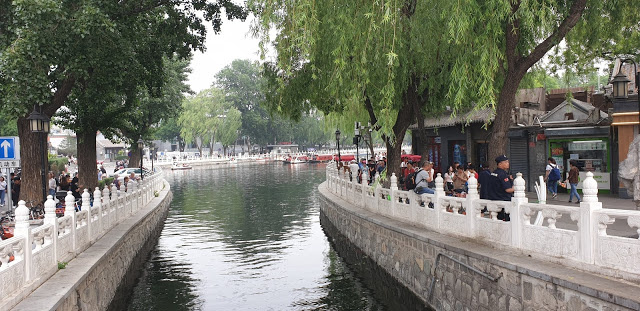
Many hutongs, some several hundred years old, in the vicinity of the Bell Tower and Drum Tower and Shichahai Lake are preserved and abound with tourists, many of which tour the quarter in pedicabs.

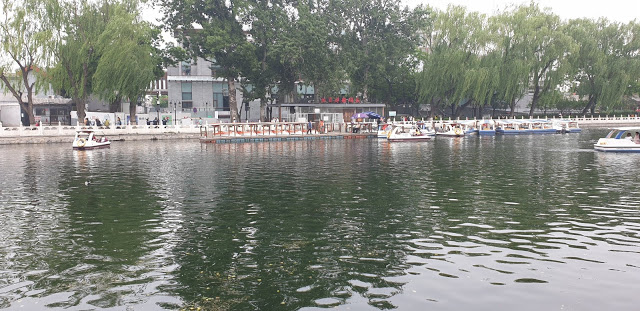
The optional tour also includes a visit to Shichahai, a historic scenic area consisting of three lakes (Qianhai, meaning Front Sea; Houhai, meaning Back Sea and Xihai, meaning West Sea), surrounding places of historic interest and scenic beauty and remnants of old-style local residences, Hutong and Courtyard.  

First, we had a short walk through the more modern part of the Hutong area and given some free time for shopping, but we prefer just to meander by the canal.  

There is a lake, and if we had the time, there were boats you could take.

With some time to spare, we take a quick walk down one of the alleyways where on the ground level are small shops, and above, living quarters.

Then we go to the bell and drum towers before walking through some more alleys was to where the rickshaws were waiting.
The Bell tower

And the Drum tower. Both still working today.

The rickshaw ride took us through some more back streets where it was clear renovations were being made so that the area could apply for world heritage listing.  Seeing inside some of the houses shows that they may look dumpy outside but that’s not the case inside.

The rickshaw ride ends outside the house where dinner will be served, and is a not so typical hose but does have all the elements of how the Chinese live, the boy’s room, the girl’s room, the parent’s room, the living area, and the North-south feng shui.

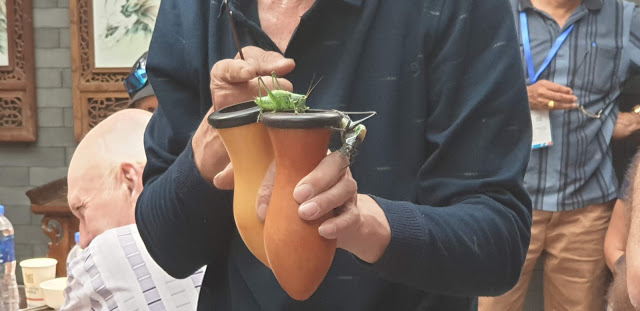
Shortly after we arrive, the cricket man, apparently someone quite famous in Beijing arrives and tells us all about crickets and then grasshoppers, then about cricket racing.  He is animated and clearly enjoys entertaining us westerners.

I’m sorry but the cricket stuff just didn’t interest me.  Or the grasshoppers.

As for dinner, it was finally a treat to eat what the typical Chinese family eats, and everything was delicious, and the endless beer was a nice touch.

And the last surprise, the food was cooked by a man.