Just when you think you’ve found the right word processor

It was as if Microsoft Word was sent down from that place in the universe where a group of torturers sit around a table to find new ways of making our lives just that little bit more difficult.

I mean, most of the time it works really well and behaves itself.

But…

Then there are the times, usually when you are stressed about a deadline, or you are nearly at the end of what you believe to be the most brilliant writing you have ever put on paper.

Then…

Disaster strikes.

It could be the power goes off, even for just a few seconds, but it’s enough to kill the computer.  It could be that you have reached the end and closed Word down, thinking that it had autosaved, all the while ignoring that little pop up that says, ‘do you want to save your work’?

It’s been a long day, night, or session.  You’re tired and your mind is elsewhere, as it always is at the end.

You always assume that autosave is on.  It was the last time, it has been since the day you installed it however long ago that was.

So…

When the power comes back on, you start the computer, go into Word, and it brings back all the windows you had open when the power failed, and the one with the brilliant piece you just wrote, it’s just a blank sheet.

Or up to where it last autosaved, which is nowhere near the end.

Or it didn’t save at all.

You forget the software updated recently and that always brings changes.  Usually unwanted changes.

By which time you have that sinking feeling that all is lost, deadline missed, brilliant work lost, it’s the end of the world.

You promise yourself you’re going to get Scrivener, or something else, where this doesn’t happen.

Or if you’re like me, you put the cat on the keyboard and tell him to sort the mess out.

An excerpt from “If Only” – a work in progress

Investigation of crimes doesn’t always go according to plan, nor does the perpetrator get either found or punished.

That was particularly true in my case.  The murderer was incredibly careful in not leaving any evidence behind, to the extent that the police could not rule out whether it was a male or a female.

At one stage the police thought I had murdered my own wife though how I could be on a train at the time of the murder was beyond me.  I had witnesses and a cast-iron alibi.

The officer in charge was Detective First Grade Gabrielle Walters.  She came to me on the day after the murder seeking answers to the usual questions like, when was the last time you saw your wife, did you argue, the neighbors reckon there were heated discussions the day before.

Routine was the word she used.

Her fellow detective was a surly piece of work whose intention was to get answers or, more likely, a confession by any or all means possible.  I could sense the raging violence within him.  Fortunately, common sense prevailed.

Over the course of the next few weeks, once I’d been cleared of committing the crime, Gabrielle made a point of keeping me informed of the progress.

After three months the updates were more sporadic, and when, for lack of progress, it became a cold case, communication ceased.

But it was not the last I saw of Gabrielle.

The shock of finding Vanessa was more devastating than the fact she was now gone, and those images lived on in the same nightmare that came to visit me every night when I closed my eyes.

For months I was barely functioning, to the extent I had all but lost my job, and quite a few friends, particularly those who were more attached to Vanessa rather than me.

They didn’t understand how it could affect me so much, and since it had not happened to them, my tart replies of ‘you wouldn’t understand’ were met with equally short retorts.  Some questioned my sanity, even, for a time, so did I.

No one, it seemed, could understand what it was like, no one except Gabrielle.

She was by her own admission, damaged goods, having been the victim of a similar incident, a boyfriend who turned out to be an awfully bad boy.  Her story varied only in she had been made to witness his execution.  Her nightmare, in reliving that moment in time, was how she was still alive and, to this day, had no idea why she’d been spared.

It was a story she told me one night, some months after the investigation had been scaled down.  I was still looking for the bottom of a bottle and an emotional mess.  Perhaps it struck a resonance with her; she’d been there and managed to come out the other side.

What happened become our secret, a once-only night together that meant a great deal to me, and by mutual agreement, it was not spoken of again.  It was as if she knew exactly what was required to set me on the path to recovery.

And it had.

Since then, we saw each about once a month in a cafe.   I had been surprised to hear from her again shortly after that eventful night when she called to set it up, ostensibly for her to provide me with any updates on the case, but perhaps we had, after that unspoken night, formed a closer bond than either of us wanted to admit.

We generally talked for hours over wine, then dinner and coffee.  It took a while for me to realize that all she had was her work, personal relationships were nigh on impossible in a job that left little or no spare time for anything else.

She’d always said that if I had any questions or problems about the case, or if there was anything that might come to me that might be relevant, even after all this time, all I had to do was call her.

I wondered if this text message was in that category.  I was certain it would interest the police and I had no doubt they could trace the message’s origin, but there was that tiny degree of doubt, about whether or not I could trust her to tell me what the message meant.

I reached for the phone then put it back down again.  I’d think about it and decide tomorrow.

© Charles Heath 2018-2020

Searching for locations: At large in Paris, France

We have been to Paris a number of times over the years.

The last time we visited Paris we brought the two eldest grandchildren.   We took the Eurostar train from St Pancras station direct to Disneyland, then took the free bus from the station to the hotel.  The train station was directly outside Disneyland.

We stayed at the Dream Castle Hotel, rather than Disneyland itself as it was a cheaper option and we had a family room that was quite large and breakfast was included every morning.  Then it was a matter of getting the free bus to Disneyland.

We spent three days, time which seem to pass far too quickly, and we didn’t get to see everything.  They did, however, find the time to buy two princess dresses, and then spent the rest of the time playing dress-ups whenever they could.

In Paris, we stayed at the Crown Plaza at Republique Square.

We took the children to the Eiffel Tower where the fries, and the carousel at the bottom of the tower, seemed to be more memorable than the tower itself.  The day we visited, the third level was closed.  The day was cold and windy so that probably accounted for the less than memorable visit.  To give you some idea of conditions, it was the shortest queue to get in I’ve ever seen.

We traveled on the Metro where it was pointed out to me that the trains actually ran on rubber tires, something I had not noticed before.  It was a first for both children to travel on a double-decker train.

The same day, we went to the Louvre.

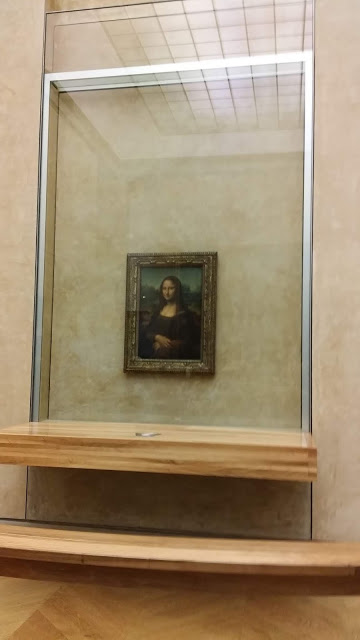
Here, it was cold, wet and windy while we waited,  Once inside we took the girls to the Mona Lisa, and after a walk up and down a considerable numkber of stairs, one said, “and we walked all this way to see this small painting”.

It quickly became obvious their idea of paintings were the much larger ones hanging in other galleries.

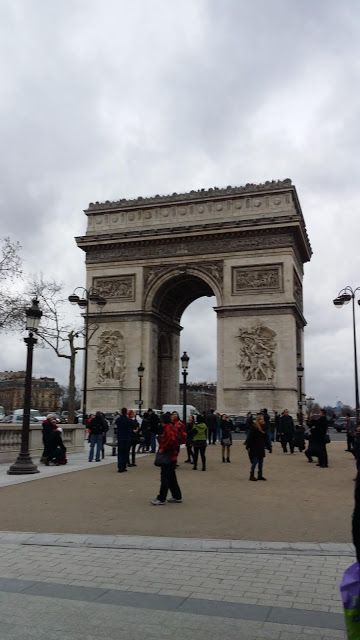
We also took them to the Arc de Triomphe.

We passed, and for some reason had to go into, the Disney shop, which I’m still wondering why after spending a small fortune at Disneyland itself.

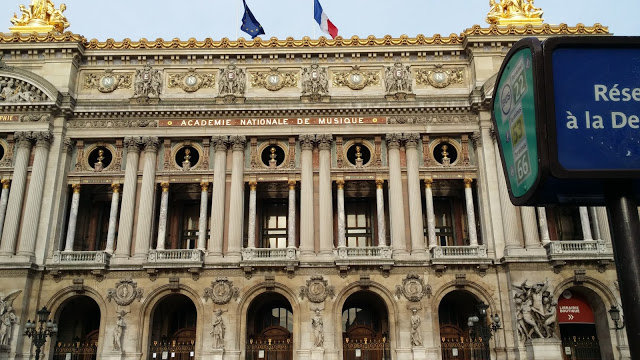
Next on the tour list was the Opera House.

 where one of the children thought she saw the ghost and refused to travel in one of the elevators.  At least it was quite amazing inside with the marble, staircases, and paintings on the roof.

Sadly, I don’t think they were all that interested in architecture, but at the Opera House, they did actually get to see some ballet stars from the Russian Bolshoi ballet company practicing.  As we were leaving the next day we could not go and see a performance.

Last but not least was Notre Dame with its gargoyles and imp[osing architecture.

All in all, traveling with children and experiencing Paris through their eyes made it a more memorable experience.

The first we visited Paris was at the end of a whirlwind bus tour, seven countries in seven days or something like that.  It was a relief to get to Paris and stay two nights if only to catch our breath.

I remember three events from that tour, the visit to the Eiffel Tower, the tour of the night lights, not that we were able to take much in from the inside of the bus, and the farewell dinner in one of the tour guides specially selected restaurants.  The food and atmosphere were incredible.  It was also notable for introducing us to a crepe restaurant in Montmartre, another of the tour guide’s favorite places.

On that trip to Paris, we also spent an afternoon exploring the Palace of Versailles.

The next time we visited Paris we flew in from London.  OK, it was a short flight, but it took all day.  From the hotel to the airport, the wait at the airport, departure, flying through time zones, arrival at Charles De Gaulle airport, now there’s an experience, and waiting for a transfer that never arrived, but that’s another story.

I can’t remember where we stayed the first time, it was somewhere out in the suburbs, but the second time we stayed at the Hilton near both the Eiffel Tower and the Australian Embassy, notable only because the concierge was dating an Australian girl working in the Embassy.  That was our ticket for special treatment, which at times you need to get around in Paris.

It was the year before 2000 and the Eiffel Tower was covered in lights, and every hour or so it looked like a bubbling bottle of champagne.  It was the first time we went to Level 3 of the Tower, and it was well worth it.  The previous tour only included Level 2.  This time we were acquainted with the fries available on the second level, and down below under the tower.

This time we acquainted ourselves with the Metro, the underground railway system, to navigate our way around to the various tourist spots, such as Notre Dame de Paris, The Louvre, Sacre-Coeur Basilica, and Les Invalides, and, of course, the trip to the crepe restaurant.

We also went to the Louvre for the express purpose of seeing the Mona Lisa, and I came away slightly disappointed.  I had thought it to be a much larger painting.  We then went to see the statue of Venus de Milo and spent some time trying to get a photo of it without stray visitors walking in front of us.  Aside from that, we spent the rest of the day looking at the vast number of paintings, and Egyptian artifacts in the Museum.

We also visited the Opera House which was architecturally magnificent.

The third time we visited Paris we took our daughter, who was on her first international holiday.  This time we stayed in a quaint Parisian hotel called Hotel Claude Bernard Saint Germain, (43 Rue Des Ecoles, Paris, 75005, France),  recommended to us by a relation who’d stayed there the year before.  It was small, and the elevator could only fit two people or one person and a suitcase.  Our rooms were on the 4th floor, so climbing the stairs with luggage was out of the question.

It included breakfast and wifi, and it was quite reasonable for the four days we stayed there.

It was close to everything you could want, down the hill to the railway station, and a square where on some days there was a market, and for those days when we were hungry after a day’s exploring, a baguette shop where rolls and salad were very inexpensive and very delicious.

To our daughter we appeared to be experienced travelers, going on the Metro, visiting the Louvre, going, yes once again, to the crepe restaurant and the Basilica at Montmartre, Notre Dame, and this time by boat to the Eiffel Tower.  We were going to do a boat rode on the Seine the last time but ran out of time.

We have some magnificent photos of the Tower from the boat.

Lunch on one of the days was at a restaurant not far from the Arc de Triomphe, where our daughter had a bucket of mussels.  I was not as daring and had a hamburger and fries.  Then we went to the center of the Arch and watched the traffic.

Our first time in Paris the bus driver got into the roundabout just to show us the dangers of driving in an unpredictable situation where drivers seem to take huge risks to get out at their exit.  Needless to say, we survived that experience, though we did make a number of circuits.

“The Document” – the editor’s final draft – Day 26

This book has been sitting in the ‘to-be-done’ tray, so this month it is going to get the final revision.

And so it begins…

Something had to change

And that, my friends, is the words on the document.

When I conceived the original story, the words were quite simple, a memo from one man to another, words that should not be committed to paper.

Ah, yes, the dreaded paper trail.

Those words were adequate at the time, but now, with developments in the story and a shift or two in the plotline, it’s time to change those words.

They need to be damaging enough to kill a lot of people in the line of making both the words and the document they appear on, disappear forever.

And here’s the thing…

No one ever counted on the fact deleting on a computer is not deleting.

The story behind the story: A Case of Working With the Jones Brothers

To write a private detective serial has always been one of the items at the top of my to-do list, though trying to write novels and a serial, as well as a blog, and maintain a social media presence, well, you get the idea.

But I made it happen, from a bunch of episodes I wrote a long, long time ago, used these to start it, and then continue on, then as now, never having much of an idea where it was going to end up, or how long it would take to tell the story.

That, I think is the joy of ad hoc writing, even you, as the author, have as much idea of where it’s going as the reader does.

It’s basically been in the mill since 1990, and although I finished it last year, it looks like the beginning to end will have taken exactly 30 years.  Had you asked me 30 years ago if I’d ever get it finished, the answer would be maybe?

My private detective, Harry Walthenson

I’d like to say he’s from that great literary mold of Sam Spade, or Mickey Spillane, or Phillip Marlow, but he’s not.

But, I’ve watched Humphrey Bogart play Sam Spade with much interest, and modelled Harry and his office on it.  Similarly, I’ve watched Robert Micham play Phillip Marlow with great panache, if not detachment, and added a bit of him to the mix.

Other characters come into play, and all of them, no matter what period they’re from, always seem larger than life.  I’m not above stealing a little of Mary Astor, Peter Lorre or Sidney Greenstreet, to breathe life into beguiling women and dangerous men alike.

Then there’s the title, like

The Case of the Unintentional Mummy – this has so many meanings in so many contexts, though I imagine that back in Hollywood in the ’30s and ’40s, this would be excellent fodder for Abbott and Costello

The Case of the Three-Legged Dog – Yes, I suspect there may be a few real-life dogs with three legs, but this plot would involve something more sinister.  And if made out of plaster, yes, they’re always something else inside.

But for mine, to begin with, it was “The Case of the …”, because I had no idea what the case was going to be about, well, I did, but not specifically.

Then I liked the idea of calling it “The Case of the Brother’s Revenge” because I began to have a notion there was a brother no one knew about, but that’s stuff for other stories, not mine, so then went the way of the others.

Now it’s called ‘A Case of Working With the Jones Brothers’, finished the first three drafts, and at the editor for the last.

I have high hopes of publishing it in early 2021.  It even has a cover.

PIWalthJones1

An excerpt from “The Devil You Don’t”

Available on Amazon Kindle here:  https://amzn.to/2Xyh1ow

By the time I returned to the Savoie, the rain had finally stopped, and there was a streak of blue sky to offer some hope the day would improve.

The ship was not crowded, the possibility of bad weather perhaps holding back potential passengers.  Of those I saw, a number of them would be aboard for the lunch by Phillippe Chevrier.  I thought about it, but the Concierge had told me about several restaurants in Yvoire and had given me a hand-drawn map of the village.  I think he came from the area because he spoke with the pride and knowledge of a resident.

I was looking down from the upper deck observing the last of the boarding passengers when I saw a woman, notable for her red coat and matching shoes, making a last-minute dash to get on board just before the gangway was removed.  In fact, her ungainly manner of boarding had also captured a few of the other passenger’s attention.  Now they would have something else to talk about, other than the possibility of further rain.

I saw her smile at the deckhand, but he did not smile back.  He was not impressed with her bravado, perhaps because of possible injury.  He looked at her ticket then nodded dismissively, and went back to his duties in getting the ship underway.  I was going to check the departure time, but I, like the other passengers, had my attention diverted to the woman in red.

From what I could see there was something about her.  It struck me when the light caught her as she turned to look down the deck, giving me a perfect profile.  I was going to say she looked foreign, but here, as in almost anywhere in Europe, that described just about everyone.  Perhaps I was just comparing her to Phillipa, so definitively British, whereas this woman was very definitely not.

She was perhaps in her 30’s, slim or perhaps the word I’d use was lissom, and had the look and manner of a model.  I say that because Phillipa had dragged me to most of the showings, whether in Milan, Rome, New York, London, or Paris.  The clothes were familiar, and in the back of my mind, I had a feeling I’d seen her before.

Or perhaps, to me, all models looked the same.

She looked up in my direction, and before I could divert my eyes, she locked on.  I could feel her gaze boring into me, and then it was gone as if she had been looking straight through me.  I remained out on deck as the ship got underway, watching her disappear inside the cabin.  My curiosity was piqued, so I decided to keep an eye out for her.

I could feel the coolness of the air as the ship picked up speed, not that it was going to be very fast.  With stops, the trip would take nearly two hours to get to my destination.  It would turn back almost immediately, but I was going to stay until the evening when it returned at about half eight.  It would give me enough time to sample the local fare, and take a tour of the medieval village.

Few other passengers ventured out on the deck, most staying inside or going to lunch.  After a short time, I came back down to the main deck and headed forward.  I wanted to clear my head by concentrating on the movement of the vessel through the water, breathing in the crisp, clean air, and let the peacefulness of the surroundings envelope me.

It didn’t work.

I knew it wouldn’t be long before I started thinking about why things hadn’t worked, and what part I played in it.  And the usual question that came to mind when something didn’t work out.  What was wrong with me?

I usually blamed it on my upbringing.

I had one of those so-called privileged lives, a nanny till I was old enough to go to boarding school, then sent to the best schools in the land.  There I learned everything I needed to be the son of a Duke, or, as my father called it in one of his lighter moments, nobility in waiting.

Had this been five or six hundred years ago, I would need to have sword and jousting skills, or if it had been a few hundred years later a keen military mind.  If nothing else I could ride a horse, and go on hunts, or did until they became not the thing to do.

I learned six languages, and everything I needed to become a diplomat in the far-flung British Empire, except the Empire had become the Commonwealth, and then, when no-one was looking, Britain’s influence in the world finally disappeared.  I was a man without a cause, without a vocation, and no place to go.

Computers were the new vogue and I had an aptitude for programming.  I guess that went hand in hand with mathematics, which although I hated the subject, I excelled in.  Both I and another noble outcast used to toss ideas around in school, but when it came to the end of our education, he chose to enter the public service, and I took a few of those ideas we had mulled over and turned them into a company.

About a year ago, I was made an offer I couldn’t refuse.  There were so many zeroes on the end of it I just said yes, put the money into a very grateful bank, and was still trying to come to terms with it.

Sadly, I still had no idea what I was going to do with the rest of my life.  My parents had asked me to come back home and help manage the estate, and I did for a few weeks.  It was as long as it took for my parents to drive me insane.

Back in the city, I spent a few months looking for a mundane job, but there were very few that suited the qualifications I had, and the rest, I think I intimidated the interviewer simply because of who I was.  In that time I’d also featured on the cover of the Economist, and through my well-meaning accountant, started involving myself with various charities, earning the title ‘philanthropist’.

And despite all of this exposure, even making one of those ubiquitous ‘eligible bachelor’ lists, I still could not find ‘the one’, the woman I wanted to spend the rest of my life with.  Phillipa seemed to fit the bill, but in time she proved to be a troubled soul with ‘Daddy’ issues.  I knew that in building a relationship compromise was necessary, but with her, in the end, everything was a compromise and what had happened was always going to be the end result.

It was perhaps a by-product of the whole nobility thing.  There was a certain expectation I had to fulfill, to my peers, contemporaries, parents and family, and those who either liked or hated what it represented.  The problem was, I didn’t feel like I belonged.  Not like my friend from schooldays, and now obscure acquaintance, Sebastian.  He had been elevated to his Dukedom early when his father died when he was in his twenties.  He had managed to fade from the limelight and was rarely mentioned either in the papers or the gossip columns.  He was one of the lucky ones.

I had managed to keep a similarly low profile until I met Phillipa.  From that moment, my obscurity disappeared.  It was, I could see now, part of a plan put in place by Phillipa’s father, a man who hogged the limelight with his daughter, to raise the profile of the family name and through it their businesses.  He was nothing if not the consummate self-advertisement.

Perhaps I was supposed to be the last piece of the puzzle, the attachment to the establishment, that link with a class of people he would not normally get in the front door.  There was nothing refined about him or his family, and more than once I’d noticed my contemporaries cringe at the mention of his name, or any reference of my association with him.

Yet could I truthfully say I really wanted to go back to the obscurity I had before Phillipa?  For all her faults, there were times when she had been fun to be with, particularly when I first met her when she had a certain air of unpredictability.  That had slowly disappeared as she became part of her father’s plan for the future.  She just failed to see how much he was using her.

Or perhaps, over time, I had become cynical.

I thought about calling her.  It was one of those moments of weakness when I felt alone, more alone than usual.

I diverted my attention back to my surroundings and the shoreline.  Out of the corner of my eye, I could see the woman in the red coat, making a move.  The red coat was like a beacon, a sort of fire engine red.  It was not the sort of coat most of the women I knew would wear, but on her, it looked terrific.  In fact, her sublime beauty was the one other attribute that was distinctly noticeable, along with the fact her hair was short, rather than long, and jet black.

I had to wrench my attention away from her.

A few minutes later several other passengers came out of the cabin for a walk around the deck, perhaps to get some exercise, perhaps checking up on me, or perhaps I was being paranoid.  I waited till they passed on their way forward, and I turned and headed aft.

I watched the wake sluicing out from under the stern for a few minutes, before retracing my steps to the front of the ship and there I stood against the railing, watching the bow carve its way through the water.  It was almost mesmerizing.  There, I emptied my mind of thoughts about Phillipa, and thoughts about the woman in the red coat.

Until a female voice behind me said, “Having a bad day?”

I started, caught by surprise, and slowly turned.  The woman in the red coat had somehow got very close me without my realizing it.  How did she do that?  I was so surprised I couldn’t answer immediately.

“I do hope you are not contemplating jumping.  I hear the water is very cold.”

Closer up, I could see what I’d missed when I saw her on the main deck.  There was a slight hint of Chinese, or Oriental, in her particularly around the eyes, and of her hair which was jet black.  An ancestor twice or more removed had left their mark, not in a dominant way, but more subtle, and easily missed except from a very short distance away, like now.

Other than that, she was quite possibly Eastern European, perhaps Russian, though that covered a lot of territory.  The incongruity of it was that she spoke with an American accent, and fluent enough for me to believe English was her first language.

Usually, I could ‘read’ people, but she was a clean slate.  Her expression was one of amusement, but with cold eyes.  My first thought, then, was to be careful.

“No.  Not yet.”  I coughed to clear my throat because I could hardly speak.  And blushed, because that was what I did when confronted by a woman, beautiful or otherwise.

The amusement gave way to a hint of a smile that brightened her demeanor as a little warmth reached her eyes.  “So that’s a maybe.  Should I change into my lifesaving gear, just in case?”

It conjured up a rather interesting image in my mind until I reluctantly dismissed it.

“Perhaps I should move away from the edge,” I said, moving sideways until I was back on the main deck, a few feet further away.  Her eyes had followed me, and when I stopped she turned to face me again.  She did not move closer.

I realized then she had removed her beret and it was in her left side coat pocket.  “Thanks for your concern …?”

“Zoe.”

“Thanks for your concern, Zoe.  By the way, my name is John.”

She smiled again, perhaps in an attempt to put me at ease.  “I saw you earlier, you looked so sad, I thought …”

“I might throw myself overboard?”

“An idiotic notion I admit, but it is better to be safe than sorry.”

Then she tilted her head to one side then the other, looking intently at me.  “You seem to be familiar.  Do I know you?”

I tried to think of where I may have seen her before, but all I could remember was what I’d thought earlier when I first saw her; she was a model and had been at one of the showings.  If she was, it would be more likely she would remember Phillipa, not me.  Phillipa always had to sit in the front row.

“Probably not.”  I also didn’t mention the fact she may have seen my picture in the society pages of several tabloid newspapers because she didn’t look the sort of woman who needed a daily dose of the comings and goings, and, more often than not, scandal associated with so-called celebrities.

She gave me a look, one that told me she had just realized who I was.  “Yes, I remember now.  You made the front cover of the Economist.  You sold your company for a small fortune.”

Of course.  She was not the first who had recognized me from that cover.  It had raised my profile considerably, but not the Sternhaven’s.  That article had not mentioned Phillipa or her family.  I suspect Grandmother had something to do with that, and it was, now I thought about it, another nail in the coffin that was my relationship with Phillipa.

“I wouldn’t say it was a fortune, small or otherwise, just fortunate.”  Each time, I found myself playing down the wealth aspect of the business deal.

“Perhaps then, as the journalist wrote, you were lucky.  It is not, I think, a good time for internet-based companies.”

The latter statement was an interesting fact, one she read in the Financial Times which had made that exact comment recently.

“But I am boring you.”  She smiled again.  “I should be minding my own business and leaving you to your thoughts.  I am sorry.”

She turned to leave and took a few steps towards the main cabin.

“You’re not boring me,” I said, thinking I was letting my paranoia get the better of me.  It had been Sebastian on learning of my good fortune, who had warned me against ‘a certain element here and abroad’ whose sole aim would be to separate me from my money.  He was not very subtle when he described their methods.

But I knew he was right.  I should have let her walk away.

She stopped and turned around.  “You seem nothing like the man I read about in the Economist.”

A sudden and awful thought popped into my head.  Those words were part of a very familiar opening gambit.  “Are you a reporter?”

I was not sure if she looked surprised, or amused.  “Do I look like one?”

I silently cursed myself for speaking before thinking, and then immediately ignored my own admonishment.  “People rarely look like what they are.”

I saw the subtle shake of the head and expected her to take her leave.  Instead she astonished me.

“I fear we have got off on the wrong foot.  To be honest, I’m not usually this forward, but you seemed like you needed cheering up when probably the opposite is true.  Aside from the fact this excursion was probably a bad idea.  And,” she added with a little shrug, “perhaps I talk too much.”

I was not sure what I thought of her after that extraordinary admission. It was not something I would do, but it was an interesting way to approach someone and have them ignoring their natural instinct.  I would let Sebastian whisper in my ear for a little longer and see where this was going.

“Oddly enough, I was thinking the same thing.  I was supposed to be traveling with my prospective bride.  I think you can imagine how that turned out.”

“She’s not here?”

“No.”

“She’s in the cabin?”  Her eyes strayed in that direction for a moment then came back to me.  She seemed surprised I might be traveling with someone.

“No.  She is back in England, and the wedding is off.  So is the relationship.  She dumped me by text.”

OK, why was I sharing this humiliating piece of information with her?  I still couldn’t be sure she was not a reporter.

She motioned to an empty seat, back from the edge.  No walking the plank today.  She moved towards it and sat down.  She showed no signs of being cold, nor interested in the breeze upsetting her hair.  Phillipa would be having a tantrum about now, being kept outside, and freaking out over what the breeze might be doing to her appearance.

I wondered, if only for a few seconds if she used this approach with anyone else.  I guess I was a little different, a seemingly rich businessman alone on a ferry on Lake Geneva, contemplating the way his life had gone so completely off track.

She watched as I sat at the other end of the bench, leaving about a yard between us.  After I leaned back and made myself as comfortable as I could, she said, “I have also experienced something similar, though not by text message.  It is difficult, the first few days.”

“I saw it coming.”

“I did not.”  She frowned, a sort of lifeless expression taking over, perhaps brought on by the memory of what had happened to her.  “But it is done, and I moved on.  Was she the love of your life?”

OK, that was unexpected.

When I didn’t answer, she said, “I am sorry.  Sometimes I ask personal questions without realizing what I’m doing.  It is none of my business.”  She shivered.  “Perhaps we should go back inside.”

She stood, and held out her hand.  Should I take it and be drawn into her web?  I thought of Sebastian.  What would he do in this situation?

I took her hand in mine and let her pull me gently to my feet.  “Wise choice,” she said, looking up at the sky.

It just started to rain.

© Charles Heath 2015-2023

newdevilcvr6

In a word: crane

Yes, it’s that huge device that is attached to a tall building and either raises or lowers building materials.  I’ve often wondered how the drive, so far up in the air can see where to pick up or drop a load.

Typically cranes are used to move large or heavy loads, like large fiberglass swimming pools from the roadside into the front or back yard.

The are train breakdown cranes, dock side cranes and broken down cranes, usually on the road in the middle of rush hour.

They used to have dog men, people who hung on grimly, going up or down with the load.  Not me when the building is sixty or seventy floors up.

There can be smaller cranes built on trucks that are for smaller jobs like lifting boats, sometimes parts of houses.  We had one near us once lifting a swimming pool into a front yard.

Then there is the crane, a bird.  Cranes are usually tall birds with long legs.

In Asia the crane symbolises happiness and eternal youth whereas in Japan the crane symbolises good fortune and longevity.

And other uses such as:

The boy craned his neck to see the batter hit a home run.  

Usually if I crane my neck, it causes days of muscular pain, ie literally the definition of a pain in the neck!

It means to distort your body or neck in order to see something more clearly, especially if you are in a bad position, like behind a pylon or tree.

It can also be used to describe a trolley with a large boom with a camera attached.

The cinema of my dreams – It ended in Sorrento – Episode 43

I’m off to Rome to see a lawyer

Before I went to Italy I called in on Anthony and his assistant Alessia and got them to give me a briefing on the mother of the man who had become and died the countess’s husband.

Along with a warning that the mother was not in the brief, and he was reluctant to share what information they had.  I left thinking something had happened or changed, and Anthony had been told to respond only to specific questions; Rodby was trying to keep my attention on his orders.

The question burning at the back of my mind:  what was Rodby hiding?

I also asked for a copy of the coroner’s report on the death of the count, and even before I got through the first paragraph, there was enough evidence to prove he had been murdered.

Did the countess get a copy of the report, or was that left in the hands of the family?  I suspect the latter, because of one statement she made, the Count’s family handled all the ‘detail’s’.  I was beginning to think that she was about to become a detail herself and be handled accordingly.

It was also clear that the Count’s mother, a countess herself, was the one who ruled with an iron fist, even before the count was dead. She had run the business.  And now he had died, their cosy arrangement was about to be signed away into the hands of a woman who was not going to let the older countess run it.

That was probably for a reason, the old countess was doing stuff that she didn’t want anyone to know about.  Had her son discovered the truth and she had him killed.  At least I could discount Alessandro and Fabio.  They were both the most unlikely assassins and if they had tried, they would have botched it.  And I doubt either would have anything to do with killing their brother.

The briefing had a slim folder that contained several sheets of paper that outlined the nature of the Burkehardt businesses.  It seemed the companies never made profits, which made it odd as to how the family members could live such extravagant lifestyles.

The old countess’s name was Anna, rather plain, I thought, and had been the daughter of a poor wine grower.  His was not a large vineyard, but they were very good grapes and sought after by the bigger winemakers.  She had grandiose ideas and had virtually blackmailed the man she married.

Of course, it wasn’t hard to see that the family were also making a few other distilled products.  Without telling the government.  But if you read between the lines, Anna wasn’t exactly a law-abiding citizen., and she had some very rough-and-tumble acquaintances, not the least of which had ties to the mafia.

I was going to create a splash, on both sides of the channel, when I landed in her drawing room.

My first stop when I arrived in Italy was to go and visit the countess’s private legal representative in Rome.  I had asked Cecelia to get the name and address from the countess, and she texted the details as I got off the plane at the airport.

Cecelia also sent me a photo of Anna, at the house in Sorrento, along with both Alessandro and Fabio, who must have taken a flight the previous day.  It seems their concern the countess was missing was not a priority.

I hated driving in Rome, so I left the car in a parking garage on the way to Sorrento on the outskirts of the city and took public transport.  I had one of those back-of-neck sensations when I collected my bag off the carousel, and it was as I suspected, a man trying very hard to look like a fellow passenger watching me.

He passed me off to someone else after I collected the rental car, and drove to bus terminus out in the suburbs on the way to Sorrento.  Whoever was tailing me in the car was very good, and I only saw them twice.

Rodby checking up, or someone else.  I didn’t see Alfie, and after the last debacle, he may have been replaced, but whoever that was, they would be less conspicuous than my current minder.

I took the bus but wasn’t joined by anyone, but that didn’t mean they had lost sight of me.  I checked and thought I’d made the car following the bus.  These people were relentless.  And there were a few of them, and whoever their boss was, he had deep pockets.  Not Rodby then.

From the bus terminus, it was a short walk to the building that housed many lawyers.  In England, they were called chambers.  In Italy, they were called camere degli avvocati, or something like that.

I could speak almost fluent Italian because of Violetta, though she used to tease me over some of the word translations, and many a day was spent teaching me the language.  Even so, I still didn’t always get it right, but these days I liked pretending I had only schoolboy Italian and see if people helped.

This was going to be one of those occasions, not because I had the time, but I had picked up another tail and they were very good.  It added some interest to my day where otherwise it might have been boring.  This time it was a woman, not much older than me, but not conspicuous and had I not been looking, would have missed her.  She hadn’t entered the building yet, and if I wanted to draw her in, I might have to force her hand.

So I stood there, in front of the board, trying to make head or tail of the names, and descriptions on the board that listed the tenants of the building, and I pretended I was having difficulty.  Perhaps looking confused was more of a help than a hindrance because it gave the girl that I assumed was following me the perfect excuse to stop and ask, in almost perfect English, “You are lost perhaps?”

“I am, and not perhaps.”  I gave her the piece of paper with the avvocati’s name on it, and after a quick perusal of the board, she pointed him out.

“Fourth floor, I’m going there myself.”

We crossed to the elevator and waited with several other people who definitely looked like lawyers, barristers, or wealthy clients.  My impression of the building with ornate marble on the floor and walls, was that only the rich could afford to work her and afford the services of them.

© Charles Heath 2023

Motive, means, and opportunity – Episode 13

Just who is this Alexander Bergman?

Bryson was fully aware that you can only get answers to the questions according to what you know about a victim.  It’s why no one told him about Bergman having any military service or anything that might be relevant outside his usual business, and affairs.

A conversation between Worthey and Bergman’s daughter raised the possibility of military service, most likely in the Army, and equally likely somewhere in the Middle East, but a follow-up conversation between Worthey and her over the phone produced no further results.

It did yield one more interesting fact, that the daughter was from an earlier rather brief marriage and that Sandra had remained with the mother and had known nothing about her father until the mother had died and left his details in a letter to be given to her.

Her acquaintance with him had been relatively brief, six months at most, and in that time, she had failed to find out anything about him other than he was selfish and inconsiderate, and that it was no surprise her mother had not told her about him.

She was surprised to learn that he had made her a beneficiary of his will, not that it would amount to much.

Bryson then moved on to his most recent spouse, Stacy.  She had been number four.  The most she could say about the other three was that the first was a mistake, the second lasted exactly six weeks, and the third was to an older woman, a rich widow, Stacy said, who died in suspicious circumstances.

It was where Stacy said, Bergman got the funds to set up his business.

Stacy had first met Bergman in a night club where she was a dancer, no, not an exotic dancer, and he had been with wife number three at the time.  She should have realized that Bergman was not trustworthy when he asked to date her on the pretext that he and his current wife were estranged and were in the process of divorcing.

She hadn’t realized at the time that her death might have been suspicious, just that she had conveniently died so she and Bergman were free to marry.

She knew nothing about any military service, he did not mention it.  He said he had once worked for an international aid organization and had often travelled and remained overseas for months at a time, but those visits had been curtailed once he married her.  However, he frequently made flying visits to both suppliers and clients, but these, she was assured, were all in America.

She had never seen him with a passport, had seen his travel arrangements from time to time in the form of itineraries, and on several occasions had asked her to go with him, but she had declined.  She did not travel well in aeroplanes.

Wendy Anderson proved to be a more difficult case to get information out of.

It was clear from the outset she knew a lot more than she admitted to.  The call on the telephone started badly and ended abruptly.  He sent Worthey and several officers to arrest her and bring her back to the station.

Once in the interview room, a lawyer by her side, Bryson told her, “At the moment I’m half inclined to charge you with obstruction.  I asked a simple question, do you know whether Alexander Berman was in the military/  It isn’t a difficult question.”

“It is as if what he did was something he was not supposed to mention or talk about.”

“He obviously told you.”

“I can keep a secret.  I made a solemn promise never to repeat to anyone what he told me.”

“He’s now dead, that hardly seems relevant.  What is relevant is the fact that whatever it is he did might have some direct effect on why he’s dead.”

“It wasn’t that spectacular.  If you’re looking for a murderer look no further than James.”

‘So you keep saying, but the facts say otherwise.  I assume you knew he had four wives, the most recent Stacy, and that he has a daughter, Sandra.”

“Did he?”

“You mean in all of the thirty-odd years you have known him he never mentioned it?  Or the fact he was briefly married to one Annabelle Bentley, shortly after he graduated from University?”

Bryson was observing Wendy Anderson very carefully and when he mentioned the daughter, she showed genuine surprise.  That wasn’t the same when he asked her about military service.

“If he did have a daughter, I’m sure it was a surprise to him as well.  Perhaps they had parted, and she was pregnant and forgot or deliberately didn’t tell him. 

It was a logical assumption, Bryson thought.

“And as far as I was aware, Alex was in the National Guard for a brief period, arising from his time in a cadet corps when he was much younger, something his father made him do.  I had no idea if he carried that forward, and he never mentioned it.”

“How do you explain the obvious absences?”

“The charity work involved staying overseas for long periods.  From time to time I would visit him in various locations.  Not one was he in uniform, or anywhere near military action.  If he was, he hid it well.”

Or she just wasn’t all that observant.

“You have other matters you wish to ask me about?: she asked.

Perhaps it was time to throw the car among the pigeons.

“We have managed to get access to the text messages on one of Bergman’s cell phones, and there is a considerable exchange of sometimes very explicit tests between yourself and the deceased, as well as some attached photographs which suggest that your relationship is not what you are portraying it as.  That phone is currently missing.  Now, I will ask you once again, what was the nature of your relationship with the deceased.”

An almost priceless expression on her face, surely she had some idea if anything happened to her boyfriend the police would be looking at his phone records.

“And you were not the only woman he was conducting this type of relationship with.  We have, so far, found three others, equally as intense, shall we say.  The nature of the text messages and the tenor of one of the last he sent you, which I’m sure you are aware of, where he said he would have no hesitation in showing your husband those photographs, gives you a clear motive.  And, if you say your husband has a gun, I’m assuming you know where it is, and how to gain access to it, if you follow my meaning.”

It was very clear by her expression she did.  “I did not kill him.  He did not tell me what he was about to do, though I did ask him to destroy those photographs.  Equally, if Bergman intended to use those photographs to get my husband to sign the divorce papers, for whatever reason, then would that equally give James motive?”

It would, or it might have been a case of good riddance, but Bryson could not allow his snap judgement of wither to interfere in an unbiased investigation.

Yes, the expression had changed again, he thought, having realised what she’d said.  It was apparent to him she was truly angry at a husband, but for different reasons, none of which were attached to Bergman, but she had been handed a perfect opportunity to set him up for the murder.

And one thing was certain about her.  She was making it noticeably clear to him that she wanted her husband to take the fall for the murder.

“Just so you know, we believe there is another phone, the one that he received a message to meet him at the Zoo carpark at 10pm.  There was evidence in the car and on his person of perfume, Mrs Anderson, not unlike what you are wearing now.”

© Charles Heath 2019-2023

The cinema of my dreams – Was it just another surveillance job – Episode 31

I’m back home and this story has been sitting on a back burner for a few months, waiting for some more to be written.

The trouble is, there are also other stories to write, and I’m not very good at prioritizing.

But, here we are, a few minutes opened up and it didn’t take long to get back into the groove.

Chasing leads, maybe


Was it too late to admit that I was way in over my head?

Of course, it should not come as a surprise that Jan would know of his alter ego if she was the friend she said she was.  Her name was on that scrap of paper with part of the address, and I should have guessed.

Again, my lack of knowledge and training was letting me down.

Now it seemed I had both Severin and Maury, Nobbin and Josephine, and Jan all working against me.

He had more enemies that I did, which begged the question, what the hell was he in to?  What could he possibly have found that was so damaging?

Perhaps I’d find that out if or when I found the missing USB drive.

In the meantime, I had to get back to the hotel before Jan did and try and keep a straight face.

But just as I started to put the seat belt on, another figure was walking from the road towards the front door.  A man, tall, with a purposeful stride.  

The light was still on so I would get to see who it was once he reached the door.  Then I saw the front door open, and Jan standing in it.  A second later I saw the face, just as he passed through the doorway and the door shut.

Severin.

She had lied.  So, why was it making me so angry?

I should have realized the whole Maury thing was a setup.  She hadn’t called her office, she had called Severin, and he can’t have been far away to get there in the time he had.

So, why didn’t he drag me off?

Easy.  So I would see the need to keep working with Jan, and in doing so, when I found the USB I’d tell her, and the next minute I’d get whacked over the head, and lose it.

Damn.

I was being played like a finely tuned fiddle.

But at least I knew about the car and had removed any evidence and the letters that were left on the ground inside the door.  It was something, and she would not find anything to help her, even if she knew he had a car.  It meant I was one step ahead of her.

After thanking a last look at the block, I left.  Better to find somewhere else to stay, just for tonight, and then go back to the hotel in Charing Cross and see if she returned.

I found a small hotel just off Bromley Road, a short distance down Avondale Road.  Out of the way and unassuming, with car parking that couldn’t be seen from the main road.  The late hour raised an eyebrow, but I used the excuse of getting in late from the airport.  After all, it was 02:30 in the morning and I was surprised there was anyone available on the front counter.

He gave me a room tucked away in a corner where there was only one entrance, and I could see anyone coming.  I wasn’t expecting anything, but just in case I had checked the car for a tracker.

None that I could find.

I needed sleep, but lying there staring at the ceiling, I replayed the arrival of Jan at the flat, followed by Severin.  It was a reminder that I should not believe or trust anyone.

It reminded me of the words of one of the instructors who said, one morning, quite abruptly, that we were about to become the loneliest people in the world.  If we trusted anyone, even if they were from our own side, it could mean one thing and one thing only.  Death.

We could not and should not trust anyone.

We should not believe a word of anything anyone tells us.

We should not recruit anyone from outside the service because unless they could be fully vetted, they could be your undoing.

We could not have friends, and certainly no romantic interests otherwise they would be used as leverage against us.

It was the worse hour lecture we’d been given, and the instructor had told us he had left the best till last.  It was time to decide whether we wanted to go on or bail.  Several had.

I didn’t think, then, it would be a problem.

Now, I was beginning to think otherwise.


© Charles Heath 2020