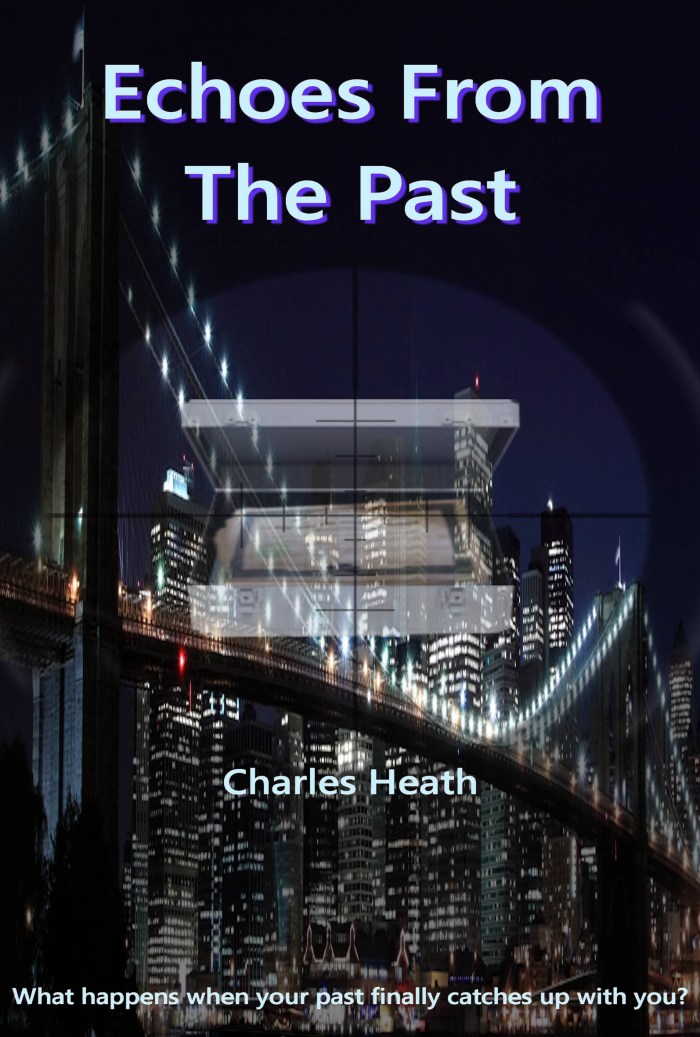
The story behind the story – Echoes from the Past

The novel ‘Echoes from the past’ started out as a short story I wrote about 30 years ago, titled ‘The birthday’.

My idea was to take a normal person out of their comfort zone and led on a short but very frightening journey to a place where a surprise birthday party had been arranged.

Thus the very large man with a scar and a red tie was created.

So was the friend with the limousine who worked as a pilot.

So were the two women, Wendy and Angelina, who were Flight Attendants that the pilot friend asked to join the conspiracy.

I was going to rework the short story, then about ten pages long, into something a little more.

And like all re-writes, especially those I have anything to do with, it turned into a novel.

There was motivation.  I had told some colleagues at the place where I worked at the time that I liked writing, and they wanted a sample.  I was going to give them the re-worked short story.  Instead, I gave them ‘Echoes from the past’

Originally it was not set anywhere in particular.

But when considering a location, I had, at the time, recently been to New York in December, and visited Brooklyn and Queens, as well as a lot of New York itself.  We were there for New Years, and it was an experience I’ll never forget.

One evening we were out late, and finished up in Brooklyn Heights, near the waterfront, and there was rain and snow, it was cold and wet, and there were apartment buildings shimmering in the street light, and I thought, this is the place where my main character will live.

It had a very spooky atmosphere, the sort where ghosts would not be unexpected.  I felt more than one shiver go up and down my spine in the few minutes I was there.

I had taken notes, as I always do, of everywhere we went so I had a ready supply of locations I could use, changing the names in some cases.

Fifth Avenue near the Rockefeller center is amazing at first light, and late at night with the Seasonal decorations and lights.

The original main character was a shy and man of few friends, hence not expecting the surprise party.  I enhanced that shyness into purposely lonely because of an issue from his past that leaves him always looking over his shoulder and ready to move on at the slightest hint of trouble.  No friends, no relationships, just a very low profile.

Then I thought, what if he breaks the cardinal rule, and begins a relationship?

But it is also as much an exploration of a damaged soul, as it is the search for a normal life, without having any idea what normal was, and how the understanding of one person can sometimes make all the difference in what we may think or feel.

And, of course, I wanted a happy ending.

Except for the bad guys.

Get it here:  https://amzn.to/2CYKxu4

newechocover5rs

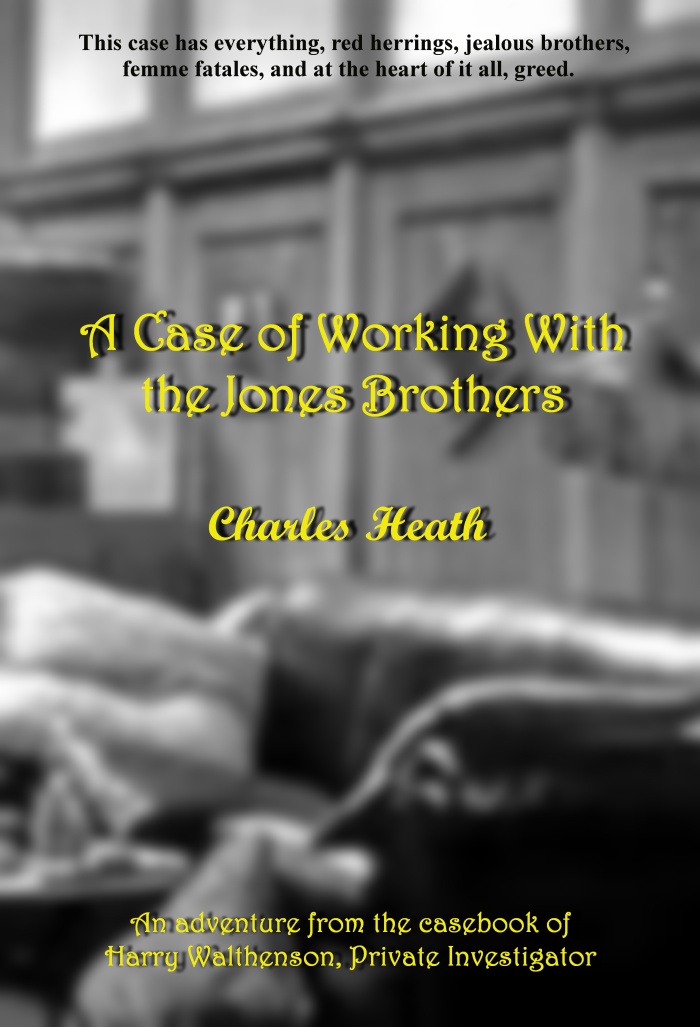
The first case of PI Walthenson – “A Case of Working With the Jones Brothers”

This case has everything, red herrings, jealous brothers, femme fatales, and at the heart of it all, greed.

See below for an excerpt from the book…

Coming soon!

PIWalthJones1

An excerpt from the book:

When Harry took the time to consider his position, a rather uncomfortable position at that, he concluded that he was somehow involved in another case that meant very little to him.

Not that it wasn’t important in some way he was yet to determine, it was just that his curiosity had got the better of him, and it had led to this: sitting in a chair, securely bound, waiting for someone one of his captors had called Doug.

It was not the name that worried him so much, it was the evil laugh that had come after the name was spoken.

Doug what? Doug the ‘destroyer’, Doug the ‘dangerous’, Doug the ‘deadly’; there was any number of sinister connotations, and perhaps that was the point of the laugh, to make it more frightening than it was.

But there was no doubt about one thing in his mind right then: he’d made a mistake. A very big. and costly, mistake. Just how big the cost, no doubt he would soon find out.

His mother, and his grandmother, the wisest person he had ever known, had once told him never to eavesdrop.

At the time he couldn’t help himself and instead of minding his own business, listening to a one-sided conversation which ended with a time and a place. The very nature of the person receiving the call was, at the very least, sinister, and, because of the cryptic conversation, there appeared to be, or at least to Harry, criminal activity involved.

For several days he had wrestled with the thought of whether he should go. Stay on the fringe, keep out of sight, observe and report to the police if it was a crime. Instead, he had willingly gone down the rabbit hole.

Now, sitting in an uncomfortable chair, several heat lamps hanging over his head, he was perspiring, and if perspiration could be used as a measure of fear, then Harry’s fear was at the highest level.

Another runnel of sweat rolled into his left eye, and, having his hands tied, literally, it made it impossible to clear it. The burning sensation momentarily took his mind off his predicament. He cursed and then shook his head trying to prevent a re-occurrence. It was to no avail.

Let the stinging sensation be a reminder of what was right and what was wrong.

It was obvious that it was the right place and the right time, but in considering his current perilous situation, it definitely was the wrong place to be, at the worst possible time.

It was meant to be his escape, an escape from the generations of lawyers, what were to Harry, dry, dusty men who had been in business since George Washington said to the first Walthenson to step foot on American soil, ‘Why don’t you become a lawyer?” when asked what he could do for the great man.

Or so it was handed down as lore, though Harry didn’t think Washington meant it literally, the Walthenson’s, then as now, were not shy of taking advice.

Except, of course, when it came to Harry.

He was, Harry’s father was prone to saying, the exception to every rule. Harry guessed his father was referring to the fact his son wanted to be a Private Detective rather than a dry, dusty lawyer. Just the clothes were enough to turn Harry off the profession.

So, with a little of the money Harry inherited from one of his aunts, he leased an office in Gramercy Park and had it renovated to look like the Sam Spade detective agency, you know the one, Spade and Archer, and The Maltese Falcon.

There’s a movie and a book by Dashiell Hammett if you’re interested.

So, there it was, painted on the opaque glass inset of the front door, ‘Harold Walthenson, Private Detective’.

There was enough money to hire an assistant, and it took a week before the right person came along, or, more to the point, didn’t just see his business plan as something sinister. Ellen, a tall cool woman in a long black dress, or so the words of a song in his head told him, fitted in perfectly.

She’d seen the movie, but she said with a grin, Harry was no Humphrey Bogart.

Of course not, he said, he didn’t smoke.

Three months on the job, and it had been a few calls, no ‘real’ cases, nothing but missing animals, and other miscellaneous items. What he really wanted was a missing person. Or perhaps a beguiling, sophisticated woman who was as deadly as she was charming, looking for an errant husband, perhaps one that she had already ‘dispatched’.

Or for a tall, dark and handsome foreigner who spoke in riddles and in heavily accented English, a spy, or perhaps an assassin, in town to take out the mayor. The man was such an imbecile Harry had considered doing it himself.

Now, in a back room of a disused warehouse, that wishful thinking might be just about to come to a very abrupt end, with none of the romanticized trappings of the business befalling him. No beguiling women, no sinister criminals, no stupid policemen.

Just a nasty little man whose only concern was how quickly or how slowly Harry’s end was going to be.

© Charles Heath 2019

In a word: Air

Yep, another of those interesting little words that mean more than it appears.

Aside from the fact it is the air that we breathe, it can also be used to describe music.

It can be a breath of fresh air, though it’s hard to say where in this ever increasingly polluted atmosphere than we could literally draw one, except on a mountain top, where conversely it would be hard to breathe at all.

Have the air sucked out of us, well, that literally isn’t possible unless some madman comes up with a weird sort of vacuum cleaner, but that might be an episode for the X-Files.

He had an air about him, or her, as the case might be, which might refer to a sort of deference or manner.   There again that air might be one of boredom, which is what a lot of students seem to have in class.

Sorry, been a teacher, and know well the expressions on their faces.  Had one myself once, and finished up on the end of a chalkboard eraser.  Yep, in the good old day’s teachers used to chuck stuff at us recalcitrant students to get our attention, and not undergo a storm of protest from irate parents.

These days those same parents would most likely air their grievance, opinion, or view to the headmaster.

I’m guessing that same headmaster would be wishing those same parents to vanish into thin air, though I’m not sure how that would be possible.

And lastly, television stations air shows.

Weird, eh, how such a simple word can be used in so many contexts.

‘Sunday in New York’ – A beta reader’s view

I’m not a fan of romance novels but …

There was something about this one that resonated with me.

This is a novel about a world generally ruled by perception, and how people perceive what they see, what they are told, and what they want to believe.

I’ve been guilty of it myself as I’m sure we all have at one time or another.

For the main characters Harry and Alison there are other issues driving their relationship.

For Alison, it is a loss of self-worth through losing her job and from losing her mother and, in a sense, her sister.

For Harry, it is the fact he has a beautiful and desirable wife, and his belief she is the object of other men’s desires, and one in particular, his immediate superior.

Between observation, the less than honest motives of his friends, a lot of jumping to conclusions based on very little fact, and you have the basis of one very interesting story.

When it all comes to a head, Alison finds herself in a desperate situation, she realises only the truth will save their marriage.

But is it all the truth?

What would we do in similar circumstances?

Rarely does a book have me so enthralled that I could not put it down until I knew the result. They might be considered two people who should have known better, but as is often the case, they had to get past what they both thought was the truth.

And the moral of this story, if it could be said there is one, nothing is ever what it seems.

Available on Amazon here: amzn.to/2H7ALs8

Motive, means, and opportunity – Episode 1

The Jaded Detective

The victim was found just after dawn by a man walking his dog.

Detective Louis Bryson was just about to call it a day, or in this case since he was on the graveyard shift, call it a morning, when the call came in.

Why was it, he thought, that victims were always discovered by someone walking a dog.  Maybe the dog was walking them, because at that hour of the morning, if he owned a dog, he would be on autopilot.

And that was because Detective Louis Bryson was not a morning person.

He hated mornings, he hated traffic, and he hated people, especially in the morning peak hours.  Everyone always seemed angry and irritable.  It was bad enough going home, against the flow.  Worse when he had to drive out to a crime scene.

Like now.  The only thing saving his sanity was classical music.

The crime scene was a car parked in a designated parking area of the Queens Botanical Gardens.  How the car got there, who the victim was, and why the victim was there were questions he was going to ask.

He was stopped at the gate by an officer assigned to keep people out.  He showed his shield and the officer let him pass.

Crime scene investigators and the medical examiner were already on the scene, as was another detective, Sam Worthey, who was usually assigned to work with him.  Bryson was a hard man to work with, but Worthey had become used to his eccentricities.

Worthey had started walking towards the car the moment he saw Bryson pass the cordon and was at the door when Bryson stepped out.

Bryson had seen the lone car sitting off the roadway, back in rather than driven in, telling him the killer knew he had the time to do what he had to and that it was not a quick or opportunistic killing.  At first glance, this looked to be deliberate and planned.

A quick look around showed that it was unlikely there would be any witnesses who could identify the possible killer from the buildings, or the roadway that bordered the park.  He saw the man, and the dog sitting obediently by his side, who discovered the victim.

Worthey followed his eyes and when it stopped on the man he said, “The man who discovered the victim, Jack Bentine.  The dog’s name is Freddie, believe it or not, and they were going for a walk starting shortly after 7 am from a residence three streets away, on their usual early morning exercise in the park, for the dog that is, and found the deceased at approximately 7:15.  Not the best start to the day.”

“Do I need to talk to him?”

“No.  Got the details, and asked him to come to the station to sign a statement.  Pretty shaken up.”

“Then tell him to go.”

Bryson watched Worthey go over to the man, have a brief word, and then come back. 

Bentine shook his head and left with the reluctant dog.  He was going to miss out on his morning exercise.

Bryson walked towards the car and stopped about 20 feet short.  He looked closely at the ground, moving slowly towards the side of the car.  No footprints.  The surface was rough but very hard.  Pity, it hadn’t snowed overnight and left behind some very clear footprints.

He asked the investigators in and around the car to give him a few minutes, and he waited until they moved out of the way.

The door was open.  A closer look showed the man had been shot in the side of the head, blood spatter stretching to the other side of the car.

The victim was still in the driver’s seat.  The driver’s side window hadn’t been wound down, and the bullet had been shot through the glass.

So, had the killer been waiting, either in the parking space or somewhere near?  He looked around.  Nowhere to really hide.  So, was it possible the killer was waiting for the victim to arrive, which could mean the victim knew his killer?  It didn’t seem to fit the facts.  The scene seemed to Bryson to be a little off.

Another look inside the car showed the key to the car was in the driver’s hand, so that meant the victim had arrived, took the key out of the ignition, and was about to get out of the car.  Would he do that if the killer was standing in the spot?  Possibly not.  Bryson thought in the same position, he would just wind the window down, and not get out of the car.

Last night was very, very cold.

So that would mean the killer wasn’t visible to the victim when he arrived.

The victim was dressed in a suit, tie still on, so he had come from somewhere requiring formal clothing, work, a meeting, or dinner?

He took a couple of steps backward where Worthey was waiting.  He motioned the investigators to return.

“Do we know who he is?”

Worthey was holding an evidence bag with a wallet in it.  “Yes.  James Burgman, 45, currently single, but recently exiting from a very nasty divorce, in which his ex-wife is very angry.”

“And you know this because?”

“I read the newspapers.  It’s been in the news.  I didn’t need the wallet to identify him.”

“Approximate time of death?”

“Josie thinks sometime between midnight and two am.  She’ll know more when she gets the body.”

Josie was a good pathologist and was rarely wrong in her first estimation.”

“CCTV?” He had to ask just in case he missed something.

“One camera covering the carpark.” 

Worthey pointed to a spot where there were tree branches and, if he looked carefully, the metal of a pole.  Not easy to see it for the branches.

“And the bad news?”  He could detect the disappointment in Worthey’s tone.

“Casing only.  The unit has been in the repair shop for over a month waiting for a new board.  The fancier they are, the easier for them to fail.”

Or had it been sabotaged by a well-informed or well-prepared killer?  Whoever it was, this wasn’t a crime of opportunity.

“Was there a mobile phone or anything else?”

“We haven’t found one yet.”

Perhaps the killer took it to cover the fact he may have called him or left a message to come to this park.   It might be a break if Burgman had a mobile phone account.

“Right.  I’ll tackle the wife, and let her know what’s happened.  You see if you can track down a mobile phone or account, where he worked, and if possible, what he was supposed to be doing last night.”

Worthey groaned inwardly.  There was another case he was working on, but it looked like it would have to wait.  “On it.”

© Charles Heath 2023

A score to settle – The Second Editor’s draft – Day 32

The time has come to work on the second draft for the editor, taking into account all of the suggested changes, and there are quite a few. So much for thinking I could put in an almost flawless manuscript.

I’ve taken some time to work on a few other projects, working through the notes with ideas and getting them into some semblance of a timeline.

It seems taking time away from some of them has helped in getting a better idea of where I’m heading with them.

It seems as though I had hit an impasse on several of the stories in progress, and a lesson could be learned.  I just have to realize I’ve hit a roadblock, which sometimes isn’t readily discernable because when it happens we tend to deny we need to walk away and reset the creative juices.

As for this project, I finally understand what was bugging me for the last few days – I need to make a timeline for the revolution, and figure out where everyone is going to be, and what their role is.

Yes, there is no substitute for proper planning. After all, if this was a real revolution, it would fall apart very quickly if there was no coordination.

It just brings home the magnitude of the exercise, and it will take a few days to pull it all together. It just may be the first revolution planned using Microsoft Project.

“The Price of Fame”, A Short Story

I looked at the invitation, a feeling of dread coming over me.  It was not entirely unexpected but like a great many things that had suddenly come into my life, it caused equal measures of fear and excitement.

The gold edging and the perfect script displaying my name in the exact centre of the envelope made it almost unique.  Very few people ever received such an invitation.

I held it in my hand for a longer than necessary, then put it down on the desk carefully, as if it would explode if I dropped it.

My first instinct, driven by fear, was not to accept.

But, fear or not, there was no question of me not attending.  Circumstances had painted me into a corner; I’d agreed to go a long time ago when I thought there was no chance it would come to pass.

Way back then, I had been compared to the aspiring painter in an attic having to die before I made any sort of impression.  In those days people thought it amusing.  I thought it was amusing.  Kirsty, in particular, had thought it was as impossible as I had.

Now it was not amusing.  Not even remotely.

My life was once quiet, peaceful, sedate, even boring.  That didn’t mean I lacked imagination, it was just not out on display for everyone to see.  Inspired by reading endless books, I had the capacity to transport myself into another world, divorced from reality, where my boring existence became whatever I wanted it to be.

It was also instrumental in bringing Kirsty into my life.  In reality, I thought she’d never take a second look at me, let alone a first.  So I pretended to be someone else.  Original, witty, charming, underneath more scared than I’d ever known.

And yet she knew, she’d always known and didn’t care.

As we spent more time together, she discovered I liked to write, not finish anything, just start, write a hundred pages, then lose interest.  Like everything I did.  Start, and never finish.

Why not?  It would never be published.  It would never succeed.

So she bribed me.  If I didn’t finish my first book and send it away, I couldn’t marry her.  It didn’t matter if it was rejected, all I had to do was finish a book, and send it.

The thought of marrying her had not entered my mind, because I hadn’t thought she would.  Incentive enough, I picked out one of the unfinished manuscripts and humoured her.  She read bits of it, not saying a word.  Sometimes she’d put a note or two on the manuscript, her equivalent to sweet nothings, and with it I gained inner confidence in my own ability, not only to write but in many other aspects of my life.

When it was finished, it was Kirsty who sent it off.  She read it, packaged it, addressed it, and sent it before I had a chance to change her mind.  Once gone, I heaved a huge sigh of relief.  It was done. That was, as far as I was concerned, the end of it.

It was not possible that one letter could change a person’s life so dramatically.  I came home to the all-knowing smile, and mischievous whimsicality that had always suggested trouble.

Trouble indeed!

My book was accepted.  With a cheque called an advance.  For more money than I knew what to do with.

This was followed not long after by publication.  And a dramatic change to my life, one I didn’t want.  To become a public person, to face an enormous number of people, people I didn’t know.

I went back to being scared.

Kirsty smiled at me and told me how wonderful I looked in my monkey suit.  Why couldn’t I go in jeans and a dress shirt?  All the best actors in Hollywood did it.

“This is not Hollywood.  You’re not an actor.”  It was a simple, practical, answer.

The hell I wasn’t.  I could act sick, dying, fake a heart attack, anything.  “What am I going to say?”

“You could talk about books.”  Quiet, efficient, oozing the confidence I didn’t feel.

She didn’t fuss.  She took it in her stride.  She dressed in her usual simple elegance, in a manner that made me love to be seen with her.  I couldn’t tie my tie, so she did it for me.  She straightened my jacket because I couldn’t do that either.  Nerves.  Can’t live with them, can’t live without them.  Or was that a reference to wives, or mistresses, or something else?

The palms of my hands were sweating.  Meatball hands, I thought, the sort of palms that betrayed the pretenders.  Me, I was the pretender.  My neck felt too large for the shirt.  Beads of sweat formed on my brow.  Where was a sponge when you needed one?

“I can’t do this.”

“You can.”

We hadn’t even left the hotel yet.

“How long before the execution.”

She looked at me with her whimsical smile.  “Long enough for me to give you a hard time.”

I lost count of the number of times I had to go to the bathroom, for one thing, or another.  Nerves I said.  Perhaps a dozen Valium or something similar.  Did I have any?  Had she hidden them?  Why did she keep smiling?

In the car, I looked at my watch at least a dozen times.  I couldn’t breathe.  It was too hot, too cold.  She held my hand, and it served best to stop the trembling that had set in.  Why did I agree to this?  Why?

We were greeted by the Events Manager, who was polite and genuinely interested.  He took us inside where he introduced the interviewer, another woman who oozed confidence and charm, who went over the format and generally tried to set me at ease.

I didn’t let Kirsty’s hand go.  Not yet.  She was my lifeline, the umbilical cord.  When it was severed, I knew I was going to die.

Bathroom?  Where was the bathroom?  Hell, five minutes to go, and I felt like passing out.  No, Kirsty couldn’t come in.  Comb my hair.  Straighten my tie, no it was straight.  Maybe I could hide in here?  I looked around.  No, maybe not.

Time.

The cue man was standing beside me, hand gently on my back.  He knew the score.  He knew I would turn and run the first chance I got.  Kirsty was on the other side, smiling.  Did she know too?

Then the announcement, my cue to walk on.

The gentle shove, the bright lights, the deafening applause, the seemingly endless walk to the chair, dear God, would I make it without tripping over?

How many times had I made this trip?  I stood, facing the audience, waved, then sat.  It was the fifteenth.  You’d think I’d learned by now.

There was nothing to it.

© Charles Heath 2016-2022
The cinema of my dreams – I always wanted to see the planets – Episode 31

A meeting with a nuclear scientist

Tara Benson was not my idea of a typical nuclear physicist, but then I always had been a bad judge of matching occupations to personnel.

I had read her biography and service record, mainly the one-paragraph summary, and it said she was one of the best in the world.

Criteria indeed for anyone on this ship apparently, though I didn’t regard myself as fitting into the category, someone must have thought I had the potential.

On the way down I had a few moments to contemplate her ordeal, not only being taken prisoner, but being transported back in the manner we had used, when it was a means I would not willingly use on myself.

It was why the first thought I had when I saw her was to apologise.

She was sitting in one of the special chairs that could analyse everything about you, what ailed you, what diseases you had, the state of your body.

When I had my first medical examination, they put me in an earlier model of that chair and it picked up the missing anatomical parts, the fact I once had several broken bones, that I was slightly anaemic, and the reason why I sometimes had bouts of indigestion.

They fixed all that, and a slight imperfection in my eyesight which I didn’t know about.

The doctor was looking at the monitor when I arrived.

“How is she?”

“Better than we expected. Other than being exposed to radiation for longer than prescribed, and which we can fix, she is in perfect health.”

“Mentally?”

“You can ask her yourself. I’m about to sign off on her going back to work, after a good night’s sleep.”

He spoke to her for a minute or so, then helped her up out of the chair.

“I assume you are the new captain,” she said when she saw me.

“Not by choice, but for the time being, yes.”

“I have a few questions, if I may?”

“Now?”

“If it’s possible”

There was a consultation room free, so I escorted her inside and closed the door. It was odd, I thought, that she sat behind the desk.

I also felt like she was making a mental assessment of me, perhaps thinking that I was not what she might have considered Captain material. To a certain extent, I may have once agreed with her, because everyone expected a captain to be much older and therefore wiser.

It was an analogy I’d heard before.

“Whose idea was it to transport me across to this vessel?”

I had expected that the means might be questionable, but in the moment, and considered along with the course of action I’d taken, it was the right decision.

“Mine. After discussion, of course, with the relevant experts. The risk was acceptable, proven by the fact you’re here now, and relatively unharmed.”

“It was a surprise, I’ll grant you that, and a first. From what I managed to overhear, the plutonium was sent down to their bunker to provide power to the facility, under the surface of the moon, and only accessible by the transporter. Given the risks, it also surprised me they were so committed to using it.”

“Since most of that crew were escaped convicts from the Mars mining prison, any means would be acceptable.”

“Prisoners, not aliens?”

“Yes. The ships were old personnel transports, and the big ship, where you were being held, an old freighter.”

“The Orion.”

I knew it well and surprised that I’d not recognised it. They had managed to disguise it well.

“A ship, I’m sure, you might be familiar with,” she added.

Perhaps my captain’s bland expression was not so bland.

“Ancient history,” I said, “from a time that I would rather leave in the past.”

There was a story, and not a pretty one, of a voyage not so long after commissioning, where systems failed and crew members died, all part of the experience in those early years in space. The quest for profits had outweighed the necessity for proper testing, and we had borne the brunt of the ‘test as you go’ mentality that had reigned before Space Command had taken over.

“You must tell me, one day.”

Her expression was one of curiosity and not one to be mistaken for anything else.

“Is there anything else?”

“If you are considering retrieving the plutonium, let me know and I’ll be happy to help. I suspect the people on Venus would like to see it sooner rather than later.”

“You know where this base is?”

“Of course.”

“Good. I’ll let you know after I’ve spoken to the security people.”

© Charles Heath 2021-2023

“Opposites Attract” – The Editor’s first draft – Day 1

This book was the effort put into the last NaNoWriMo November 2023 exercise. I have now picked it back up, and working on a more polished first draft for the Editor.

An invitation to the ball

Every story starts somewhere, and there is a catalyst.

This story was going to be a short story, which is why the first chapter is so long.  In rough form, it is nearly 5,000 words.  Today I write it, tomorrow I’ll edit it.

But…

How did we get here in the first place?

Firstly:  I heard a Viennese waltz way back when I used to watch Walt Disney on a Sunday night, and one of his shows over two weeks was about Johann Strauss.  It stuck with me all these years, until…

Secondly:  I heard it again on the radio when I was looking for the classic music station.  All at once I was back in that brief period of my childhood.

That’s another story, moving on.

Thirdly:  When my wife and I started out nearly 50 years ago, we hated each other at the start.  I mean seriously.  Then, over time, when you see who the person is rather than what you think they are, things change.

It’s a common story, this love-hate relationship.

Just what happens to kick this off … you’ll have to wait until tomorrow.

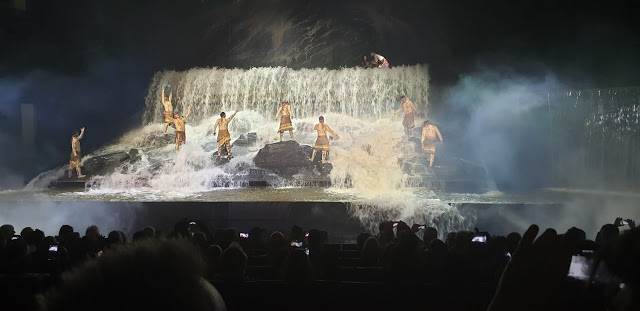
Searching for locations: The Golden Mask Dynasty Show, Beijing, China

The Golden Mask Dynasty Show was located at the OCT Theatre in Beijing’s Happy Valley. 

The theatre was quite full and the seats we had were directly behind the VIP area; as our guide told us, we had the best seats in the house. 

The play has 20 different dance scenes that depict war, royal banquets, and romance.  There are eight chapters and over 200 actors, and throughout the performance we were entertained by dancers, acrobats, costumes, lighting, and acoustics.

The story:

It is of romantic legend and historical memories, the Golden Mask Queen leads her army in defeating the invading Blue Mask King’s army, and afterwards the lands return to a leisurely pastoral life until the Queen forges a ‘mysterious tree’.  When the tree has grown, the Queen has a grand celebration, and releases the captured Blue soldiers, much to the admiration of the Blue Mask King.
This is followed by monstrous floods, and to save her people, and on the advice from the ‘mysterious tree’, the Queen sacrifices herself to save her people.  The Queen then turns into a golden sunbird flying in the sky blessing the people and that of the dynasty.

Billed as the best live show in China, described as a large scale dramatic musical, “The Golden Mask Dynasty” it lived up to its reputation and was thoroughly enjoyed by all.

It was not just singing dancing and acrobatics, it had a story and it was told so that language and cultural issues aside, it worked.  There was a narration of the story running beside the stage, but it was hard to divide attention between what was happening, and what was being related.

Then came the peacock dance, with live peacocks

And this was followed by a waterfall, well, I don’t think anyone in that audience could believe what they were seeing.

I know I was both astonished and in awe of the performance.

What a way to finish off our first day in Beijing.

Oh, sorry, that high was dented slightly when we had to go back to our room.