“Opposites Attract” – The Editor’s first draft  – Day 13

This book was the effort put into the last NaNoWriMo November 2023 exercise. I have now picked it back up, and working on a more polished first draft for the Editor.

A little time in Emily’s world

After the meeting with Mrs Bakersfield is over, our boy realises that Emily is going to be staying with her grandmother until the end.

Perhaps he will be too, but nothing is really set in concrete.

Time to spend a little time with Emily in her world of luxury and privilege.

It’s not what he wants, but he didn’t say no to the limousine ride to the airport, or no to the ride in the corporate jet, or no to the suite he was put in in the hotel.

I mean, only a fool would, wouldn’t they?

He calls his sister Darcy and lets her know that he is swilling it up, for the moment, it won’t last, and she says she is jealous, maybe. 

Then, of course, there are the other members of Emily’s family, especially her stepmother, whom Emily despises, and rather niggardly calls Mrs Winkle, her former married name, and not as Mrs Rothstein, and definitely not Mom.

Our boy is going to take a seat on the sidelines and see just how unhappy families get along.

An excerpt from “Echoes from the Past”

Available on Amazon Kindle here:  https://amzn.to/2CYKxu4

With my attention elsewhere, I walked into a man who was hurrying in the opposite direction.  He was a big man with a scar running down the left side of his face from eye socket to mouth, and who was also wearing a black shirt with a red tie.

That was all I remembered as my heart almost stopped.

He apologized as he stepped to one side, the same way I stepped, as I also muttered an apology.

I kept my eyes down.  He was not the sort of man I wanted to recognize later in a lineup.  I stepped to the other side and so did he.  It was one of those situations.  Finally getting out of sync, he kept going in his direction, and I towards the bus, which was now pulling away from the curb.

Getting my breath back, I just stood riveted to the spot watching it join the traffic.  I looked back over my shoulder, but the man I’d run into had gone.  I shrugged and looked at my watch.  It would be a few minutes before the next bus arrived.

Wait, or walk?  I could also go by subway, but it was a long walk to the station.  What the hell, I needed the exercise.

At the first intersection, the ‘Walk’ sign had just flashed to ‘Don’t Walk’.  I thought I’d save a few minutes by not waiting for the next green light.  As I stepped onto the road, I heard the screeching of tires.

A yellow car stopped inches from me.

It was a high powered sports car, perhaps a Lamborghini.  I knew what they looked like because Marcus Bartleby owned one, as did every other junior executive in the city with a rich father.

Everyone stopped to look at me, then the car.  It was that sort of car.  I could see the driver through the windscreen shaking his fist, and I could see he was yelling too, but I couldn’t hear him.  I stepped back onto the sidewalk, and he drove on.  The moment had passed and everyone went back to their business.

My heart rate hadn’t come down from the last encounter.   Now it was approaching cardiac arrest, so I took a few minutes and several sets of lights to regain composure.

At the next intersection, I waited for the green light, and then a few seconds more, just to be sure.  I was no longer in a hurry.

At the next, I heard what sounded like a gunshot.  A few people looked around, worried expressions on their faces, but when it happened again, I saw it was an old car backfiring.  I also saw another yellow car, much the same as the one before, stopped on the side of the road.  I thought nothing of it, other than it was the second yellow car I’d seen.

At the next intersection, I realized I was subconsciously heading towards Harry’s new bar.   It was somewhere on 6th Avenue, so I continued walking in what I thought was the right direction.

I don’t know why I looked behind me at the next intersection, but I did.  There was another yellow car on the side of the road, not far from me.  It, too, looked the same as the original Lamborghini, and I was starting to think it was not a coincidence.

Moments after crossing the road, I heard the roar of a sports car engine and saw the yellow car accelerate past me.  As it passed by, I saw there were two people in it, and the blurry image of the passenger; a large man with a red tie.

Now my imagination was playing tricks.

It could not be the same man.  He was going in a different direction.

In the few minutes I’d been standing on the pavement, it had started to snow; early for this time of year, and marking the start of what could be a long cold winter.  I shuddered, and it was not necessarily because of the temperature.

I looked up and saw a neon light advertising a bar, coincidentally the one Harry had ‘found’ and, looking once in the direction of the departing yellow car, I decided to go in.  I would have a few drinks and then leave by the back door if it had one.

Just in case.

© Charles Heath 2015-2020

newechocover5rs

In a word: Page

We as authors always like to see two little words in every review, page turner.

Alas, sometimes they’re not, but usually this applied to non fiction simple because they’re reference books. Then another two words apply: boat anchor.

The good stuff is usually over the page.

Page in this instance refers to a leaf in a book, which generally has many pages.

Then the is a page boy, not what you’d find lurking around these days but were more common in days past, but refers to a boy in training to become a knight, or an errand boy for a nobleman.

These days a page boy opens doors and runs messages in a hotel.

Another variation is being paged over the P.A. system, always a major cause of embarrassment because you and everyone else thinks your in trouble.

Of course, before there were mobile phones, there were pagers, and sometimes in the deathly silence of the classroom, it went off. Definitely not advisable to have one on you if you are trying to sneak up on someone. Same goes for the modern equivalent, the mobile phone.

For the person who uses a word processor, you are familiar with pages, and having the software generate page numbers, of course, not for the title page, and a different numbering for other pages like an index, before the story starts.

Complicated? Sometimes.

And many years ago a boss of mine often used to say I needed to turn over a new page, and it did make much sense to me. That might have been because I was young and stupid. But, later on I realised what he was really saying was that I needed to turn over a new leaf.

Kind of strange, but then a lot saying are.

And did I?

Eventually.

And just to end on a high note, Paige is also the name of a girl, I think, and one I’ve decided to use in a story.

Inspiration, maybe – Volume 1

50 photographs, 50 stories, of which there is one of the 50 below.

They all start with –

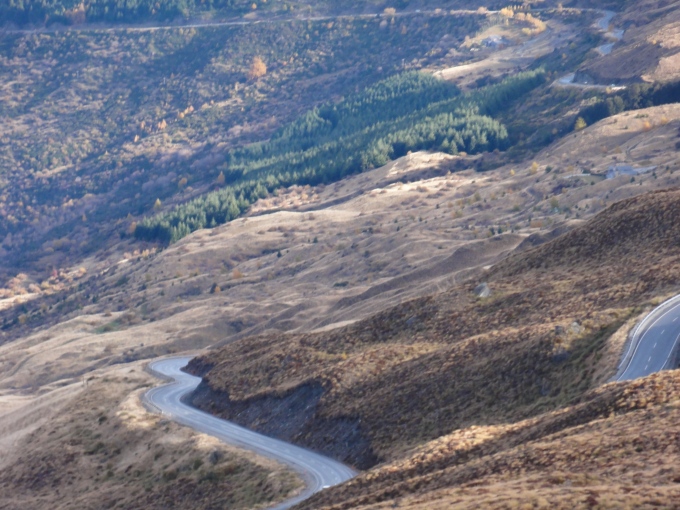
A picture paints … well, as many words as you like.  For instance:

lookingdownfromcoronetpeak

And the story:

It was once said that a desperate man has everything to lose.

The man I was chasing was desperate, but I, on the other hand, was more desperate to catch him.

He’d left a trail of dead people from one end of the island to the other.

The team had put in a lot of effort to locate him, and now his capture was imminent.  We were following the car he was in, from a discrete distance, and, at the appropriate time, we would catch up, pull him over, and make the arrest.

There was nowhere for him to go.

The road led to a dead-end, and the only way off the mountain was back down the road were now on.  Which was why I was somewhat surprised when we discovered where he was.

Where was he going?

“Damn,” I heard Alan mutter.  He was driving, being careful not to get too close, but not far enough away to lose sight of him.

“What?”

“I think he’s made us.”

“How?”

“Dumb bad luck, I’m guessing.  Or he expected we’d follow him up the mountain.  He’s just sped up.”

“How far away?”

“A half-mile.  We should see him higher up when we turn the next corner.”

It took an eternity to get there, and when we did, Alan was right, only he was further on than we thought.”

“Step on it.  Let’s catch him up before he gets to the top.”

Easy to say, not so easy to do.  The road was treacherous, and in places just gravel, and there were no guard rails to stop a three thousand footfall down the mountainside.

Good thing then I had the foresight to have three agents on the hill for just such a scenario.

Ten minutes later, we were in sight of the car, still moving quickly, but we were going slightly faster.  We’d catch up just short of the summit car park.

Or so we thought.

Coming quickly around another corner we almost slammed into the car we’d been chasing.

“What the hell…” Aland muttered.

I was out of the car, and over to see if he was in it, but I knew that it was only a slender possibility.  The car was empty, and no indication where he went.

Certainly not up the road.  It was relatively straightforward for the next mile, at which we would have reached the summit.  Up the mountainside from here, or down.

I looked up.  Nothing.

Alan yelled out, “He’s not going down, not that I can see, but if he did, there’s hardly a foothold and that’s a long fall.”

Then where did he go?

Then a man looking very much like our quarry came out from behind a rock embedded just a short distance up the hill.

“Sorry,” he said quite calmly.  “Had to go if you know what I mean.”

I’d lost him.

It was as simple as that.

I had been led a merry chase up the hill, and all the time he was getting away in a different direction.

I’d fallen for the oldest trick in the book, letting my desperation blind me to the disguise that anyone else would see through in an instant.

It was a lonely sight, looking down that road, knowing that I had to go all that way down again, only this time, without having to throw caution to the wind.

“Maybe next time,” Alan said.

“We’ll get him.  It’s just a matter of time.”

© Charles Heath 2019-2021

Find this and other stories in “Inspiration, maybe”  available soon.

InspirationMaybe1v1

Motive, means, and opportunity – Episode 14

Detective Worthey investigates a car crash

Detective Worthey had some experience with arguments and death.

It was a simple scenario and it happened more than one thought.  Only recently there had been a case where a husband and wife had an extreme argument, a number of residents in the apartment block attested to it, and to the fact the husband left in a fit of pique, and not thirty minutes later was killed in a car crash caused by his inattentiveness.

For all intents and purposes, it was an open and shut case.

The case notes before him were anything but an open and shut case, even though the investigating detective had considered it so.  On the surface it was.

The son was a recovering drug addict.  His mother refused to accept that the boy was an addict, that he had a problem that could easily be overcome and was being handled.  According to her statement, the son had told her it was not a problem, as it was being made out to be.

The father knew the extent of the problem and had been working with the medical team to look after his son, and the considered opinion of the medical team and the father was for an extra period in rehab.  The problem: the treatment was working but the son was not strictly adhering to the program.

It was that old story, the son didn’t think he had a problem and had fallen off the wagon.

And, of course, the program was not like jail.  The participant was not obligated to stay if they didn’t want to, and the son had considered he was sorted and signed himself out.

Only to go and visit his old friends, and, that mistake made, he was convinced just a little wouldn’t harm him.  Define ‘just a little’.

Another statement had the son returning home, clearly under the influence, and a meltdown ensues.  The wife takes the son’s side, not acknowledging the son was back on drugs, the father tries to convince them that the son needed to return to rehab, and while the parents are fighting, the son takes the car and leaves.

Not twenty minutes later the son was involved in a car accident, failing to stop at a red light, and cleaned up by a car who had a green light.  The son is severely injured, and the car is wrecked.  The other car is also disabled, but the driver just got out and ran.

There were seven witness statements covering the crash and aftermath.

Each was different.

Each said the son’s car ran the red light and the other car had nowhere to go.

Each said the driver of the car that hit the son’s car got out and simply walked away.

Seven descriptions of the fleeing driver were basically the same in that it was a man, he was wearing a dark blue suit, and he had short reddish hair.

That was it.  Two said he was tall, two said her was short, and the rest of average height.

Three said he was a black man, and the others said he was Mexican.

Four said the man stopped to look in the car that he’d hit, saw the driver, and completely changed expression, to one of recognition followed by shock.

The others said he looked in the car, shook his head, and then walked off.  The detectives’ notes said the car was registered to a man named…

Phillip Megarry.

Worthey re-read the paragraph again, and then shook his head.

The report then went on to say that Megarry had been contacted, did not match the description of the man who had ran not the son’s car, and then reported the fact the car was stolen, having not realised that it was not in the garage where it should be.

That man showed the Detective the garage where the car was stored and provided the registration papers for the car.  The Megarry then, was not the Megarry aka Bergman now.

But, that Megarry was short, slight, and spoke with a German accent.  The Bergman Megarry was American with no sign of any accent.

Worthy made a note: Follow up interview with Megarry the owner of the car that hit the son’s car.

But, if the Megarry that did hit the son’s car was the Bergman alias, then the killing of the son was from the very person Wendy was having an affair with, whom she had known for a long time, and was the cause of all Anderson’s problems.

What are the odds of it being such a small world? Worthey asked himself.

This was adding a new level of complication that he was sure none of the family knew about.

The accident wasn’t James Anderson’s fault.  Whether or not he could have prevented his son taking the car, that could also be applicable to the mother.  That accident was always going to happen, one way of another, because the son’s ability to do anything was impaired by drugs.

And Worthey was curious what the mother would say when she learned who it was driving the car that caused the death of her son.  No, that was Bryson’s problem to sort out as the lead detective on the case.

But there was one lingering possibility, had James Anderson known it was his best friend who had virtually killed his son, and did he kill him because of it?

© Charles Heath 2019-2023

“Knowledge can be dangerous…” – A short story

It was, perhaps, the saddest week of my life.

It started with a phone call, and then a visit by two police officers.  It was about my parents, but the news could not be imparted over the phone, only in person.  That statement alone told me it was very bad news, so I assumed the worst.

The two police officers, standing at the front door, with grim expressions on their faces, completed the picture.  The news, my parents were dead, killed in a freak car accident.

At first, it didn’t sink in.  They were on their way back from another of their extensive holidays, one of many since my father had retired.  I’d seen them probably six months out of the last five years, and the only reason they were returning this time was that my mother needed an operation.

They hadn’t told me why, not that they ever told me very much any time since the day I’d been born, but that was who they were.  I thought them eccentric, being older when I’d come along, and others thought them, well, eccentric.

And being an only child, they packed me off to boarding school, then university, and then found me a job in London, and set me up so that I would only see them weekends if they were home.

I had once wondered if they ever cared about me, keeping me at arm’s length, but my mother some time ago had taken me aside and explained why.  It was my father’s family tradition.  The only part I’d missed was a nanny.

It most likely explained why I didn’t feel their passing as much as I should.

A week later, after a strange funeral where a great many people I’d never met before, and oddly who knew about me, I found myself sitting in the sunroom, a glass of scotch in one hand, and an envelope with my name on it, in the other.

The solicitor, a man I’d never met before, had given it to me at the funeral.   We had, as far as I knew an elderly fellow, one of my father’s old school friends, as the family solicitor, but he hadn’t shown at the funeral and wasn’t at home when I called in on my way home.

It was all very odd.

I refilled the glass and took another look at the envelope.  It was not new, in fact, it had the yellow tinge of age, with discolouration where the flap was.  The writing was almost a scrawl, but identifiable as my father’s handwriting, perhaps an early version as it was now definitely an illegible scrawl.

I’d compared it with the note he’d left me before they had embarked on their last adventure, everything I had to do while caretaking their house.  The last paragraph was the most interesting, instructing me to be present when the cleaning lady came, he’d all but accused her of stealing the candlesticks.

To be honest, I hadn’t realized there were candlesticks to steal, but there they were, on the mantlepiece over the fire in the dining room.  The whole house was almost like being in an adventure park, with stairs going up to an array of rooms, mostly no longer used, and a staircase to the attic, and then another going down to the cellar.  The attic was locked and had been for as long as I could remember, and the cellar was dank and draughty.

Much like the whole house, but not surprisingly, it was over 200 years old.

And perhaps it was now mine.  The solicitor, a man by the name of Sir Percival Algernon Bridgewater, had intimated that it might be the last will and testament and had asked me to tell him if it was.  I was surprised that Sir Percival didn’t have the document in question.

And equally. so that the man I knew as his solicitor, Lawerence Wellingham, didn’t have a copy of my father’s last will and testament either.

I finished the drink, picked up the envelope, and opened it.

It contained two sheets of paper, the will, and a letter.  A very short letter.

“If you are reading this I have died before my time.  You will need to find Albert Stritching, and ask him to help you find the murderer.”

Even the tenor of that letter didn’t faze me as it should have, because at this point nothing would surprise me.  In fact, as I  unfolded the document that proclaimed it was the will, I was ready for it to say that the whole of his estate and belongings were to be left to some charity, and I would get an annual stipend of a thousand pounds.

In fact, it didn’t.  The whole of his estate was left to my mother should she outlive him, or in the event of her prior decease, to me.

I had to put all of those surprises on hold to answer a knock on the door.

Lawerence Wellingham.

I stood to one side, let him pass, closed the door, and followed him into the front room, the one my mother called the ‘drawing room’ though I never knew why.

He sat in one of the large, comfortable lounge chairs.  I sat in the other.

I showed him the will.  I kept the other back, not knowing what to make of it.

“No surprise there,” Wellingham said.

“Did you have any idea what my father used to do, beyond being, as he put it, a freelance diplomat?”

I thought it a rather odd description but it was better than one he once proffered, ‘I do odd jobs for the government’.

“I didn’t ask.  Knowledge can be dangerous, particularly when associated with your father.  Most of us prefer not to know, but one thing I can tell you.  If anyone tries to tell you what happened to your parents was not an accident, ignore them.  Go live your life, and keep those memories you have of them in the past, and don’t look back.  They were good people, Ken, remember them as such.”

We reminisced for the next hour, making a dent in the scotch, one of my father’s favourite, and he left.

Alone again, the thoughts went back to the second note from my father.  That’s when the house phone rang.

Before I could answer it, a voice said, “My name is Stritching.  Your father might have mentioned me?  We need to talk.”

—-

© Charles Heath 2020-2021

The cinema of my dreams – I always wanted to see the planets – Episode 42

We seem to have a spot of bother

The next statement from Number One, “Sir, it seems we have a hostage situation.”

A glance back at the main screen showed the Russian ship’s bridge minus the captain and flickering on, the alien ship’s Captain.

“I didn’t open a channel, Sir,” the comms officer said quickly.

I glared at the alien representative for a few seconds, hoping to convey my displeasure, but I doubted it would have any effect.

Nor was it any surprise to discover that something indeed didn’t add up. 

Potentially we had a very bad situation, facing off an alien vessel with unknown capabilities and weapons, and a ship that was not supposed to exist, having reputedly committed unknown criminal activities.

“General, you might have to make an instant decision, so if the potential threat is life or ship threatening, don’t wait for confirmation.”

“Sir.”

“Code Red, and everyone, report anything no matter how trivial.”

“Number one, a hostage situation is only a hostage situation if the hostage-taker has a hostage.  You get a clear shot, shoot them.”

“There may potentially be casualties, sir.”

“Then at your discretion, but hold that thought until I have a word with our new, so-called, friends.”

“Sir.”

To say I was annoyed was an understatement, but I had to remember that our underlying mission was to make new friends, not enemies.

“Captain,” the alien commander decided now was the moment to speak.

“You have not been quite truthful with us, have you?”

“They did commit crimes, that is the truth.”

“Then why is one of your people holding the captain hostage?”

It only just struck me then that the alien vessel had beamed one of the people onto the Russian ship after the alien ship arrived with us.  But to what purpose?

“To force them to return to the planet where the crimes were committed.  I had no reason to believe you would force the issue.  Our experience with humans is they support each other before they do the right thing.”

“Your experience is narrow-minded, generally supported by few instances, and basically does not define the human race.  Like everyone, we have a bad element, but it doesn’t define who or what we are.  You obviously heard my instructions to my boarding party.  Your turn now to give me a good reason why I should not shoot them?”

“I assume you still want to open diplomatic relations between our worlds?”

“Not at the expense of gunboat diplomacy.”

“I could destroy both your ships.”

“You could try.  If you know as much as you claim to know about humans, you’ll know that we are at our most formidable when our backs are to the wall.  My ship is an unknown quantity to you, which means you have no idea what we are capable of, but if you want yo find out, by all means, try.”

It was hard to keep an even tone when you are terrified.  Our first encounter had been nothing but threats and violence.  Was I no better than the worse of our kind?

Number one was back in my ear, “Sir, the alien and the Captain just disappeared.”

“I would like you to join us on my ship for discussions, Captain.  I’m sure this situation can be resolved amicably.”

“I’d like a skilled diplomatic negotiator with me, and not agreeing will be considered a hostile act.”

Just in case he was intending to beam me aboard his ship.  A nod in the General’s direction showed he knew what to do if the alien tried.

“Send a message to our diplomatic representative to cone to the bridge urgently.”

I preferred this to be done privately so as not to alert the crew.

I had read the file on Margaret Simpson, and it was, to say the least, extraordinary.  Her achievements at getting the most disparate parties to the table spoke for itself, and it surprised me that she would go on what could prospectively be a one-way trip.

I had not yet spoken to her since boarding, but it had been on my list before we ran into an alien species.  Now, that introduction was lost.

She looked exactly as I’d expected, just in the prime of middle age, diminutive, but not overly imposing, but distinctive enough to stop and look when she walked into a room.

“Captain, I can’t say what comes next doesn’t excite me.”

“You got a brief description of events?”

“An alien race, hostile or not, is exactly why I came.”

“Things could go pear-shaped very quickly.”

“You are exactly as described Captain, refreshingly honest, but somehow I don’t think I need to worry too much if you’re coming with me.”

“A perk of the job, I’m afraid.”

I looked at the alien captain on screen.

“Ready.”

© Charles Heath 2021-2022

“Opposites Attract” – The Editor’s first draft  – Day 12

This book was the effort put into the last NaNoWriMo November 2023 exercise. I have now picked it back up, and working on a more polished first draft for the Editor.

The inimitable Mrs Bakersfield

It’s not every day of the week you get to meet a genuine god-zillionaire.  Or so it seems to our boy.

She is Mrs Bakersfield, CEO of a conglomerate, rivalling the once fortunes of the Rockefellers, Vanderbilts, and others.  To her granddaughter, Emily, she is simply Grandma.

It doesn’t take long to see that her grandmother and Emile have a special bond, one that might have included Emily’s mother, Grandma’s daughter.

And for the record, Emily and Tim are her last two direct descendants.

Of course, Grandma has noticed the change in her granddaughter because of our boy and she has a private talk.

It is an interesting conversation.  She can see that he has the same affection for Emily as Emily does for him, enough to believe that something might come of the relationship.

She is no doubt aware of the differences in background, but sometimes those are just details.

She offers him a job, well, not so much a job, but an introduction to the HR manager, the equivalent one might say to an interview.

Oh, and one final detail, the grandmother has stage four cancer and has only a matter of weeks to live.

Searching for locations: The Erqi Memorial Tower, Zhengzhou, China

A convoluted explanation on the reasons for this memorial came down to it being about the deaths of those involved in the 1923 Erqi strike, though we’re not really sure what the strike was about.

So, after a little research, this is what I found:

The current Erqi Tower was built in 1971 and was, historically, the tallest building in the city. It is a memorial to the Erqi strike and in memory of Lin Xiangqian and other railway workers who went on strike for their rights, which happened on February 7, 1923.

It has 14 floors and is 63 meters high. One of the features of this building is the view from the top, accessed by a spiral staircase, or an elevator, when it’s working (it was not at the time of our visit).

There seems to be an affinity with the number 27 with this building, in that

  • It’s the 27th memorial to be built
  • to commemorate the 27th workers’ strike
  • located in the 27th plaza of Zhengzhou City.

We drive to the middle of the city where we once again find traveling in kamikaze traffic more entertaining than the tourist points

When we get to the drop-off spot, it’s a 10-minute walk to the center square where the tower is located on one side. Getting there we had to pass a choke point of blaring music and people hawking goods, each echoing off the opposite wall to the point where it was deafening. Too much of it would be torture.

But, back to the tower…

It has 14 levels, but no one seemed interested in climbing the 14 or 16 levels to get to the top. The elevator was broken, and after the great wall episode, most of us are heartily sick of stairs.

The center square was quite large but paved in places with white tiles that oddly reflected the heat rather than absorb it. In the sun it was very warm.

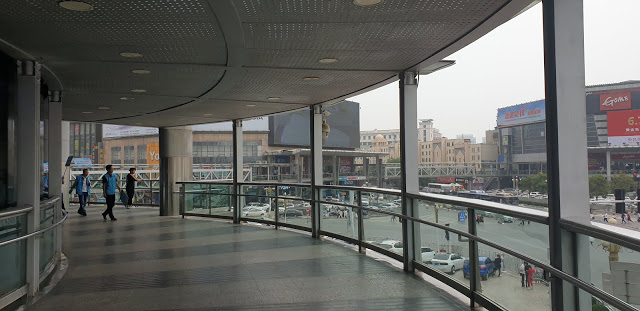
Around the outside of two-thirds of the square, and crossing the roads, was an elevated walkway, which if you go from the first shops and around to the other end, you finish up, on the ground level, at Starbucks.

This is the Chinese version and once you get past the language barrier, the mixology range of cold fruity drinks are to die for, especially after all that walking. Mine was a predominantly peach flavor, with some jelly and apricot at the bottom. I was expecting sliced peaches but I prefer and liked the apricot half.

A drink and fruit together was a surprise.

Then it was the walk back to the meeting point and then into the hotel to use the happy house before rejoining the kamikaze traffic.

We are taken then to the train station for the 2:29 to our next destination, Suzhou, the Venice of the East.

It’s all about the Cover

And, of course, the description.

Probably one of the hardest things for a first-time author is not so much the writing but what is needed after the book is written.

You need a good description.  Short, sharp, incisive!

There’s a ream of advice out there, and I have read it all.

And, still, I got it wrong.

Then there is the cover.

I wanted simplistic, a short description to give the reader a taste of what’s in store, and let the story speak for itself.

No.

Apparently, a good cover will attract the reader to the book.

When I tendered my books on various sites to advertise them, sites such as Goodreads, and ThirdScribe, all was well with what I had done.

Then I submitted my books to a third site and they rejected the covers as too simplistic and the descriptions mundane, and wouldn’t post them.

Wow.

There’s a huge blow to the ego.  And just the sort of advice that would make a writer think twice about even bothering to continue.

But…

Perhaps the person who wrote that critique was being cruel to be kind.

At any rate, I am changing the covers, and rewording the descriptions.

Will it be a case of ‘what a difference a cover makes’?