An excerpt from “What Sets Us Apart”, a mystery with a twist

See the excerpt from the story below, just a taste of what’s in store…

http://amzn.to/2Eryfth

whatsetscover

McCallister was old school, a man who would most likely fit in perfectly campaigning on the battlefields of Europe during the Second World War. He’d been like a fish out of water in the army, post-Falklands, and while he retired a hero, he still felt he’d more to give.

He’d applied and was accepted as head of a SWAT team, and, watching him now as he and his men disembarked from the truck in almost military precision, a look passed between Annette, the police liaison officer, and I that said she’d seen it all before. I know I had.

There was a one in four chance his team would be selected for this operation, and she had been hoping it would be one of the other three. While waiting for them to arrive she filled me in on the various teams. His was the least co-operative, and the more likely to make ad-hoc decisions rather than adhere to the plan, or any orders that may come from the officer in charge.

This, she said quite bluntly, was going to end badly.

I still had no idea why Prendergast instructed me to attend the scene of what looked to be a normal domestic operation, but as the nominated expert in the field in these types of situations, it was fairly clear he wasn’t taking any chances. It was always a matter of opinion between us, and generally I lost.

In this case, it was an anonymous report identifying what the authorities believed were explosives in one of the dockside sheds where explosives were not supposed to be.

The only reason why the report was given any credence was the man, while not identifying himself by name, said he’d been an explosive expert once and recognized the boxes. That could mean anything, but the Chief Constable was a cautious man.

With his men settled and preparing their weapons, McCallister came over to the command post, not much more than the SUV my liaison and I arrived in, with weapons, bulletproof vests, and rolls of tape to cordon off the area afterward. We both had coffee, steaming in the cold early morning air. Dawn was slowly approaching and although rain had been forecast it had yet to arrive.

A man by the name of Benson was in charge. He too had groaned when he saw McCallister.

“A fine morning for it.” McCallister was the only enthusiastic one here.

He didn’t say what ‘it’ was, but I thought it might eventually be mayhem.

“Let’s hope the rain stays away. It’s going to be difficult enough without it,” Benson said, rubbing his hands together. We had been waiting for the SWAT team to arrive, and another team to take up their position under the wharf, and who was in the final stages of securing their position.

While we were waiting we drew up the plan. I’d go in first to check on what we were dealing with, and what type of explosives. The SWAT team, in the meantime, were to ensure all the exits to the shed were covered. When I gave the signal, they were to enter and secure the building. We were not expecting anyone inside or out, and no movement had been detected in the last hour since our arrival and deployment.

“What’s the current situation?”

“I’ve got eyes on the building, and a team coming in from the waterside, underneath. Its slow progress, but they’re nearly there. Once they’re in place, we’re sending McKenzie in.”

He looked in my direction.

“With due respect sir, shouldn’t it be one of us?” McCallister glared at me with the contempt that only a decorated military officer could.

“No. I have orders from above, much higher than I care to argue with, so, McCallister, no gung-ho heroics for the moment. Just be ready to move on my command, and make sure you have three teams at the exit points, ready to secure the building.”

McCallister opened his mouth, no doubt to question those orders, but instead closed it again. “Yes sir,” he muttered and turned away heading back to his men.

“You’re not going to have much time before he storms the battlements,” Benson quietly said to me, a hint of exasperation in his tone. “I’m dreading the paperwork.”

It was exactly what my liaison officer said when she saw McCallister arriving.

The water team sent their ‘in position’ signal, and we were ready to go.

In the hour or so we’d been on site nothing had stirred, no arrivals, no departures, and no sign anyone was inside, but that didn’t mean we were alone. Nor did it mean I was going to walk in and see immediately what was going on. If it was a cache of explosives then it was possible the building was booby-trapped in any number of ways, there could be sentries or guards, and they had eyes on us, or it might be a false alarm.

I was hoping for the latter.

I put on the bulletproof vest, thinking it was a poor substitute for full battle armor against an exploding bomb, but we were still treating this as a ‘suspected’ case. I noticed my liaison officer was pulling on her bulletproof vest too.

“You don’t have to go. This is my party, not yours,” I said.

“The Chief Constable told me to stick to you like glue, sir.”

I looked at Benson. “Talk some sense into her please, this is not a kindergarten outing.”

He shrugged. Seeing McCallister had taken all the fight out of him. “Orders are orders. If that’s what the Chief Constable requested …”

Madness. I glared at her, and she gave me a wan smile. “Stay behind me then, and don’t do anything stupid.”

“Believe me, I won’t be.” She pulled out and checked her weapon, chambering the first round. It made a reassuring sound.

Suited up, weapons readied, a last sip of the coffee in a stomach that was already churning from nerves and tension, I looked at the target, one hundred yards distant and thought it was going to be the longest hundred yards I’d ever traversed. At least for this week.

A swirling mist rolled in and caused a slight change in plans.

Because the front of the buildings was constantly illuminated by large overhead arc lamps, my intention had been to approach the building from the rear where there was less light and more cover. Despite the lack of movement, if there were explosives in that building, there’d be ‘enemy’ surveillance somewhere, and, after making that assumption, I believed it was going to be easier and less noticeable to use the darkness as a cover.

It was a result of the consultation, and studying the plans of the warehouse, plans that showed three entrances, the main front hangar type doors, a side entrance for truck entry and exit and a small door in the rear, at the end of an internal passage leading to several offices. I also assumed it was the exit used when smokers needed a break. Our entry would be by the rear door or failing that, the side entrance where a door was built into the larger sliding doors. In both cases, the locks would not present a problem.

The change in the weather made the approach shorter, and given the density of the mist now turning into a fog, we were able to approach by the front, hugging the walls, and moving quickly while there was cover. I could feel the dampness of the mist and shivered more than once.

It was nerves more than the cold.

I could also feel rather than see the presence of Annette behind me, and once felt her breath on my neck when we stopped for a quick reconnaissance.

It was the same for McCallister’s men. I could feel them following us, quickly and quietly, and expected, if I turned around, to see him breathing down my neck too.

It added to the tension.

My plan was still to enter by the back door.

We slipped up the alley between the two sheds to the rear corner and stopped. I heard a noise coming from the rear of the building, and the light tap on the shoulder told me Annette had heard it too. I put my hand up to signal her to wait, and as a swirl of mist rolled in, I slipped around the corner heading towards where I’d last seen the glow of a cigarette.

The mist cleared, and we saw each other at the same time. He was a bearded man in battle fatigues, not the average dockside security guard.

He was quick, but my slight element of surprise was his undoing, and he was down and unconscious in less than a few seconds with barely a sound beyond the body hitting the ground. Zip ties secured his hands and legs, and tape his mouth. Annette joined me a minute after securing him.

A glance at the body then me, “I can see why they, whoever they are, sent you.”

She’d asked who I worked for, and I didn’t answer. It was best she didn’t know.

“Stay behind me,” I said, more urgency in my tone. If there was one, there’d be another.

Luck was with us so far. A man outside smoking meant no booby traps on the back door, and quite possibly there’d be none inside. But it indicated there were more men inside, and if so, it appeared they were very well trained. If that were the case, they would be formidable opponents.

The fear factor increased exponentially.

I slowly opened the door and looked in. A pale light shone from within the warehouse itself, one that was not bright enough to be detected from outside. None of the offices had lights on, so it was possible they were vacant. I realized then they had blacked out the windows. Why hadn’t someone checked this?

Once inside, the door closed behind us, progress was slow and careful. She remained directly behind me, gun ready to shoot anything that moved. I had a momentary thought for McCallister and his men, securing the perimeter.

At the end of the corridor, the extent of the warehouse stretched before us. The pale lighting made it seem like a vast empty cavern, except for a long trestle table along one side, and, behind it, stacks of wooden crates, some opened. It looked like a production line.

To get to the table from where we were was a ten-yard walk in the open. There was no cover. If we stuck to the walls, there was equally no cover and a longer walk.

We needed a distraction.

As if on cue, the two main entrances disintegrated into flying shrapnel accompanied by a deafening explosion that momentarily disoriented both Annette and I. Through the smoke and dust kicked up I saw three men appear from behind the wooden crates, each with what looked like machine guns, spraying bullets in the direction of the incoming SWAT members.

They never had a chance, cut down before they made ten steps into the building.

By the time I’d recovered, my head heavy, eyes watering and ears still ringing, I took several steps towards them, managing to take down two of the gunmen but not the third.

I heard a voice, Annette’s I think, yell out, “Oh, God, he’s got a trigger,” just before another explosion, though all I remember in that split second was a bright flash, the intense heat, something very heavy smashing into my chest knocking the wind out of me, and then the sensation of flying, just before I hit the wall.

I spent four weeks in an induced coma, three months being stitched back together and another six learning to do all those basic actions everyone took for granted. It was twelve months almost to the day when I was released from the hospital, physically, except for a few alterations required after being hit by shrapnel, looking the same as I always had.

But mentally? The document I’d signed on release said it all, ‘not fit for active duty; discharged’.

It was in the name of David Cheney. For all intents and purposes, Alistair McKenzie was killed in that warehouse, and for the first time ever, an agent left the Department, the first to retire alive.

I was not sure I liked the idea of making history.

© Charles Heath 2016-2020
Motive, means, and opportunity – Episode 13

Just who is this Alexander Bergman?

Bryson was fully aware that you can only get answers to the questions according to what you know about a victim.  It’s why no one told him about Bergman having any military service or anything that might be relevant outside his usual business, and affairs.

A conversation between Worthey and Bergman’s daughter raised the possibility of military service, most likely in the Army, and equally likely somewhere in the Middle East, but a follow-up conversation between Worthey and her over the phone produced no further results.

It did yield one more interesting fact, that the daughter was from an earlier rather brief marriage and that Sandra had remained with the mother and had known nothing about her father until the mother had died and left his details in a letter to be given to her.

Her acquaintance with him had been relatively brief, six months at most, and in that time, she had failed to find out anything about him other than he was selfish and inconsiderate, and that it was no surprise her mother had not told her about him.

She was surprised to learn that he had made her a beneficiary of his will, not that it would amount to much.

Bryson then moved on to his most recent spouse, Stacy.  She had been number four.  The most she could say about the other three was that the first was a mistake, the second lasted exactly six weeks, and the third was to an older woman, a rich widow, Stacy said, who died in suspicious circumstances.

It was where Stacy said, Bergman got the funds to set up his business.

Stacy had first met Bergman in a night club where she was a dancer, no, not an exotic dancer, and he had been with wife number three at the time.  She should have realized that Bergman was not trustworthy when he asked to date her on the pretext that he and his current wife were estranged and were in the process of divorcing.

She hadn’t realized at the time that her death might have been suspicious, just that she had conveniently died so she and Bergman were free to marry.

She knew nothing about any military service, he did not mention it.  He said he had once worked for an international aid organization and had often travelled and remained overseas for months at a time, but those visits had been curtailed once he married her.  However, he frequently made flying visits to both suppliers and clients, but these, she was assured, were all in America.

She had never seen him with a passport, had seen his travel arrangements from time to time in the form of itineraries, and on several occasions had asked her to go with him, but she had declined.  She did not travel well in aeroplanes.

Wendy Anderson proved to be a more difficult case to get information out of.

It was clear from the outset she knew a lot more than she admitted to.  The call on the telephone started badly and ended abruptly.  He sent Worthey and several officers to arrest her and bring her back to the station.

Once in the interview room, a lawyer by her side, Bryson told her, “At the moment I’m half inclined to charge you with obstruction.  I asked a simple question, do you know whether Alexander Berman was in the military/  It isn’t a difficult question.”

“It is as if what he did was something he was not supposed to mention or talk about.”

“He obviously told you.”

“I can keep a secret.  I made a solemn promise never to repeat to anyone what he told me.”

“He’s now dead, that hardly seems relevant.  What is relevant is the fact that whatever it is he did might have some direct effect on why he’s dead.”

“It wasn’t that spectacular.  If you’re looking for a murderer look no further than James.”

‘So you keep saying, but the facts say otherwise.  I assume you knew he had four wives, the most recent Stacy, and that he has a daughter, Sandra.”

“Did he?”

“You mean in all of the thirty-odd years you have known him he never mentioned it?  Or the fact he was briefly married to one Annabelle Bentley, shortly after he graduated from University?”

Bryson was observing Wendy Anderson very carefully and when he mentioned the daughter, she showed genuine surprise.  That wasn’t the same when he asked her about military service.

“If he did have a daughter, I’m sure it was a surprise to him as well.  Perhaps they had parted, and she was pregnant and forgot or deliberately didn’t tell him. 

It was a logical assumption, Bryson thought.

“And as far as I was aware, Alex was in the National Guard for a brief period, arising from his time in a cadet corps when he was much younger, something his father made him do.  I had no idea if he carried that forward, and he never mentioned it.”

“How do you explain the obvious absences?”

“The charity work involved staying overseas for long periods.  From time to time I would visit him in various locations.  Not one was he in uniform, or anywhere near military action.  If he was, he hid it well.”

Or she just wasn’t all that observant.

“You have other matters you wish to ask me about?: she asked.

Perhaps it was time to throw the car among the pigeons.

“We have managed to get access to the text messages on one of Bergman’s cell phones, and there is a considerable exchange of sometimes very explicit tests between yourself and the deceased, as well as some attached photographs which suggest that your relationship is not what you are portraying it as.  That phone is currently missing.  Now, I will ask you once again, what was the nature of your relationship with the deceased.”

An almost priceless expression on her face, surely she had some idea if anything happened to her boyfriend the police would be looking at his phone records.

“And you were not the only woman he was conducting this type of relationship with.  We have, so far, found three others, equally as intense, shall we say.  The nature of the text messages and the tenor of one of the last he sent you, which I’m sure you are aware of, where he said he would have no hesitation in showing your husband those photographs, gives you a clear motive.  And, if you say your husband has a gun, I’m assuming you know where it is, and how to gain access to it, if you follow my meaning.”

It was very clear by her expression she did.  “I did not kill him.  He did not tell me what he was about to do, though I did ask him to destroy those photographs.  Equally, if Bergman intended to use those photographs to get my husband to sign the divorce papers, for whatever reason, then would that equally give James motive?”

It would, or it might have been a case of good riddance, but Bryson could not allow his snap judgement of wither to interfere in an unbiased investigation.

Yes, the expression had changed again, he thought, having realised what she’d said.  It was apparent to him she was truly angry at a husband, but for different reasons, none of which were attached to Bergman, but she had been handed a perfect opportunity to set him up for the murder.

And one thing was certain about her.  She was making it noticeably clear to him that she wanted her husband to take the fall for the murder.

“Just so you know, we believe there is another phone, the one that he received a message to meet him at the Zoo carpark at 10pm.  There was evidence in the car and on his person of perfume, Mrs Anderson, not unlike what you are wearing now.”

© Charles Heath 2019-2023

“More or less…” – A short story

It was meant to be time to reacquaint as brothers.

Louis and I had not seen each other for decades, and when he returned, about a week before, I got the impression there was more than just ‘missing his brother’ going on.

But that was Louis. He was never one to say what or how he felt about anything, preferring to be the strong silent type, and it had not fared well for him transitioning from teenager to adult.

As for me, when our parents split up, Louis went with our father, and I stayed with our mother, and, given the amount of acrimony there was attached to the split, it was no surprise to anyone that Louis and I had effectively become estranged.

In fact, when I had tried to find them, about two years after the split and our mother had died suddenly, all I found were loose ends. They had effectively vanished.

With that part of my life effectively over, I had married, had children and watched 30 years disappear before Louis suddenly popped up. He simply knocked on the front door one afternoon, Helen answered it, and within minutes they were the best of friends. I’d had that rapport, once, many years before, but life and circumstances had all but ruined that.

Or perhaps that was just me, worn down by that same life and circumstances we were all supposed to take on the chin.

His arrival was a welcome distraction, and when, after a week, he suggested that he and I go on a hike, the sort our father used to take us on when we were a family, I agreed. Helen was happy to be rid of me, and I guess a week without our arguing would suit everyone.

It was probably fortuitous timing. Helen and I had finally got to the point where divorce lawyers were about to be called in. The children had all moved on and had children and problems of their own, and we, as parents just didn’t gel anymore.

Besides, I said, just before I joined Louis in the truck, ready to embark for the wilderness, it would be time to clear my head.

And by day two, my head was clear, and Louis, taking the lead, led us along the ridgeline, a trek he said, that would take us about seven hours. We’d stopped the previous night in a base camp and then headed out the next morning. We were the only two, it being early in the season with snow still on the ground.

Above was the clear cloudless blue sky and in front of us, trees and mountains. There was snow on the ground but it was not solid and showed no signs of human footsteps, only animals. The air was fresh, and it was good to be away from the city and its pressures.

Approaching noon, I’d asked him if we were about halfway. I knew he was holding back, being the fitter of us.

“More or less.”

“More or less what, more closer or less close than we should be.”

I watched him do a 360-degree turn, scoping out our position. It was a maneuver I was familiar with from my time with the National Guard. I’d used my backcountry experience that I’d learned from my father, as a skill I thought they might be able to, and eventually did, use. I got the feeling Louis was looking for something.

“You get the impression we’re not alone?” I asked. I had that nagging feeling something was not right, not from about two miles back in the forest. It was like my sixth sense being switched on.

“Doesn’t seem so, though there have been a few animals lurking behind us, probably surprised anyone’s about this time of the year. It’s been a while, so I’m just getting a feel for the trail. This is, for now, our mountain.”

There was a time, from a time when we were kids, that I could tell when he was lying. He was better at covering it, but it was still there.

Where we’d stopped was a small clearing, a staging point that would be used by other trekkers, still overgrown because of lack of trekkers. Ahead there were the signs of a trail, and after six months, it would become clear again. In places, as we had made our way from the base camp, sections of the distinctive trail had all but disappeared, but Louis seemed to know where he was going, and it was not long before we had picked up the trail again. This spot was a lookout, giving a spectacular view of the valley below, and a fast running river through it.

I walked to the edge and looked up and down the valley, and at the trail that ran along the cliff for a short distance. I looked down, not the wisest of things to do, but it was long enough to catch sight of several charred pieces of wood. On top of the snow. The thing is, someone had been along this trail before us, and recently, something I thought wise to keep to myself.

Back at the log, I sat for a moment and drank some water, while Louis stood patiently, but impatiently, for me to join him.

“You look like you’ve got somewhere to be.” Probably not the wisest thing to say but it was out before I could stop it.

A flicker of annoyance crossed his face, then it was gone. “If we stop too long, joints will freeze up, especially when it gets colder.”

“Sorry.” I put the container back in the pack and joined him. “Let’s go. The cold and I don’t get along very well, and it’s been a long time since the last time I ventured into the great unknown.”

“Helen said you gave up trekking when you married her.”

“She wasn’t a trekker, Robbie. We all have to give up something, sooner or later.”

Another hour, feeling rather weary, we’d come to another small clearing and a place where I could sit down.

“You always were the weak link, Robbie. Admittedly you were younger, but you never seemed to grasp the concept of exercise and fitness.”

I looked up at him and could see my father, the exact stance, the exact words, the exact same sneer in his voice. It all came rushing back as if it was yesterday, the reasons why I chose to go with our mother, that another day with his bullying would be one too many. And he was a bully. And, in an instant, I could see the apple hadn’t fallen far from the tree.

“Out of shape after languishing in an office, perhaps,” I said, “but I was never the disappointment our father always considered me.”

“You didn’t join the army, follow in his footsteps, as he wanted us to do. I did. Proudly served, too.”

I could see it. Like father, like son. No surprise Robbie had followed in his father’s footsteps. And it was a clue as to what Robbie had been doing since I saw him last.

“So, tell me about it.”

“You wouldn’t understand.”

“No, I probably wouldn’t. Let’s push on.”

I’d also thought, along the way, he might ask questions, delve further into the problems that Helen and I were having, but I knew she had told him all he needed to know. I’d been held up at the office, and had rung to ask her to take him to dinner, get to know him, she might get to learn something of my life before I met her, details of which I hadn’t told her other than that my mother was dead, my father had left and taken Robbie with him. My past, I’d told her from the outset, was not something I would talk about.

I didn’t ask what they talked about, but I could see a change in both of them. Perhaps she had succumbed to Robbie’s charm, back in school all the girls did, but they all soon learned he was not a nice person, not once you got to know him. I didn’t warn her, and perhaps that was regrettable on my part, but it reflected the state in which our relationship had reached.

I’d also tried, once or twice, to find out if our father was still alive, but he deflected it, changing the subject. That meant he was still alive, somewhere, perhaps annoyed at Robbie for coming to see me. If I was a betting man, I’d bet our father would have denied permission for
Robbie to do so, even if he was a grown man and capable of making his own decisions.

Odd, but not surprising. Even now I could remember my father had secrets, and those secrets had fed into the breakup of our parents.

“So, you’ve been dodging it for days now, but you still haven’t told me if dad is alive or dead. He’d be about seventy-odd now.”

He stopped and turned to face me. “Would it matter if he was alive? I doubt you’d want to see him after what mother must have said about him.”

Interesting that he would think so. “She never had a bad word for him, and wouldn’t hear of one spoken, by me or anyone. And I have wondered what became of him, and you. At least now I know you spent time in the Army. If I was to guess what happened, that would be high on my list.”

“No surprise then you became an office wanker.”

Blunt, but, to him, it was a fact. I’d used that expression when telling Helen one time after a very bad day.

“We can’t all be heroes, Robbie.”

I put my hand up. Alarm bells were going off in my head. “You can come out now,” I yelled.

Robbie looked puzzled.

“I know you’re there. You’ve been behind us for about a half-mile now.”

A few seconds passed before the cracking of a twig, and then a person in a camouflage kit came towards us.

He’d aged, hair and beard grey in places but almost white now, but the face was familiar.

“What brings you to this part of the woods, Dad. Or is it just an unlucky coincidence?”

—–

© Charles Heath 2020-2021

The cinema of my dreams – I always wanted to see the planets – Episode 43

Back on the alien vessel

The ‘ooh’ from Nancy was unmistakable the moment we rematerialized in the alien’s ship’s bridge.  It could be one of those awe-inspiring moments, had it not been for the circumstances.

The second time on the bridge, I realized that it was a little more sparse than it had been before, with a wall of control panels missing, along with a panel that stretched across the front of the Captain’s chair, but with no crew members present.

It was now a blank space.  The whole space could have been a large empty room with windows overlooking empty space, except in the distance, our two ships.  Beyond that, there seemed to be a thin streak of light, or colored lights, flickering.  At a guess they might be a long, long, long way away, but whether it was in the direction we had come, or where we were going, or somewhere else, I couldn’t tell.

On the other side of the bridge, the female alien was still holding the Russian Captain, some sort of weapon at his throat.

I was still feeling the tingling sensation that was the effect after re-materialization.  The first time it was disorientating, I was prepared this time.

I was also not sure what to expect, now that it was clear the aliens were not what they portrayed themselves to be.  Of course, it was naive of me to expect that others in the galaxy would be better than us.

“An explanation of what this is really about might go a long way towards preventing tragic consequences.”  I thought I’d throw out the opening gambit.

“Agreed.  I had hoped the problem could have been resolved before your arrival.  As you might be aware, we have the ability to transport our people, and I had hoped to recover the missing citizens that were taken by this,” he pointed to the Russian, “captains ship.”

“They asked for asylum, we did not take them.”

Another piece of the puzzle, the female must be one of the Aliens crew, and had beamed aboard, taken the captain hostage, and demanded the release of the citizens.

Question: why hadn’t he simply beamed them back?

To the Alien, “Is this true?”

“Semantics “

Note:  this alien had a very good grasp of the nuances of the English language.

“Semantics or not, if you know anything about earth culture, it’s that we look after those who need help, and if people come to us asking for asylum, we generally give it.  You will also be aware that those who ask for asylum generally are in fear of their lives.  The question is, why would these people ask for asylum.”

“The people aboard that ship are criminals who were serving their sentences in one of our remote facilities.  Your captain apparently came across this remote facility and assisted in setting the criminals free.  When we sent a ship to apprehend them, they were taken aboard the earth ship and it attempted to leave.  We were going to stop the earth vessel from leaving when your ship appeared, and it seemed prudent not to display hostility.  There was also the possibility you were working together.”

“We are not, as you are now aware.  Nor would I be willing to interfere with your internal matters, except that it involves another of our ships, one I didn’t know about, which only complicates matters.

Why do you have the captain.”

“He refused to set the prisoners.”

“If you could beam your operative and the captain here, why not just beam the criminals too.”

“They are currently protected in a special part of the captain’s ship that does not allow us to bring them back.  They obviously told him what our capabilities are.”

Criminals, if they were criminals, seeking asylum.  If it was me, I would be happy for someone else to take away the criminal element and make it someone else’s problem.  The unfortunate truth in our world is that criminals didn’t go to jail anymore, they were shipped off to remote mining planets where they spent the rest of their days working in very harsh conditions.  Over time it had proved to be a very good deterrent, so much so, that off plant mining operations now had to pay large sums of money to get people to work there.

“Number One.”

“Sir?”

“Find the so-called criminals the captain has stowed on his vessel and ask them what their side of the story is.  Quick as you can.”

“Yes, sir.”

I looked over to the Russian Captain.  “You might want to tell your second in command to make things easier for my crew.”

A look from me to the alien, and back, time to consider my request, then gave the order.

“On my way, sir.”

© Charles Heath 2021-2022

“Opposites Attract” – The Editor’s first draft  – Day 13

This book was the effort put into the last NaNoWriMo November 2023 exercise. I have now picked it back up, and working on a more polished first draft for the Editor.

A little time in Emily’s world

After the meeting with Mrs Bakersfield is over, our boy realises that Emily is going to be staying with her grandmother until the end.

Perhaps he will be too, but nothing is really set in concrete.

Time to spend a little time with Emily in her world of luxury and privilege.

It’s not what he wants, but he didn’t say no to the limousine ride to the airport, or no to the ride in the corporate jet, or no to the suite he was put in in the hotel.

I mean, only a fool would, wouldn’t they?

He calls his sister Darcy and lets her know that he is swilling it up, for the moment, it won’t last, and he says she is jealous, maybe. 

Then, of course, there are the other members of Emily’s family, especially her stepmother, whom Emily despises, and rather niggardly calls Mrs Winkle, her former married name, and not as Mrs Rothstein, and definitely not Mom.

Our boy is going to take a seat on the sidelines and see just how unhappy families get along.

Searching for locations: From Zhengzhou to Suzhou by train, and the Snowy Sea Hotel, Suzhou, China

For the first time on this trip, we encounter problems with Chinese officialdom at the railway station, though we were warned that this might occur.

We had a major problem with the security staff when they pulled everyone over with aerosols and confiscated them. We lost styling mousse, others lost hair spray, and the men, their shaving cream.  But, to her credit, the tour guide did warn us they were stricter here, but her suggestion to be angry they were taking our stuff was probably not the right thing to do.

As with previous train bookings, the Chinese method of placing people in seats didn’t quite manage to keep couples traveling together, together on the train.  It was an odd peculiarity which few of the passengers understood, nor did they conform, swapping seat allocations.

This train ride did not seem the same as the last two and I don’t think we had the same type of high-speed train type that we had for the last two.  The carriages were different, there was only one toilet per carriage, and I don’t think we were going as fast.

But aside from that, we had 753 kilometers to travel with six stops before ours, two of which were very large cities, and then our stop, about four and a half hours later.  With two minutes this time, to get the baggage off the team managed it in 40 seconds, a new record.

After slight disorientation getting off the train, we locate our guide, easily found by looking for the Trip-A-Deal flag.  From there it’s a matter of getting into our respective groups and finding the bus.

As usual, the trip to the hotel was a long one, but we were traveling through a much brighter, and well lit, city.

As for our guide, we have him from now until the end of the tour.  There are no more train rides, we will be taking the bus from city to city until we reach Shanghai.  Good thing then that the bus is brand new, with that new car smell.  Only issue, no USB charging point.

The Snowy Sea hotel.  

It is finally a joy to get a room that is nothing short of great.  It has a bathroom and thus privacy.

Everyone had to go find a supermarket to purchase replacements for the confiscated items.  Luckily there was a huge supermarket just up from the hotel that had everything but the kitchen sink.

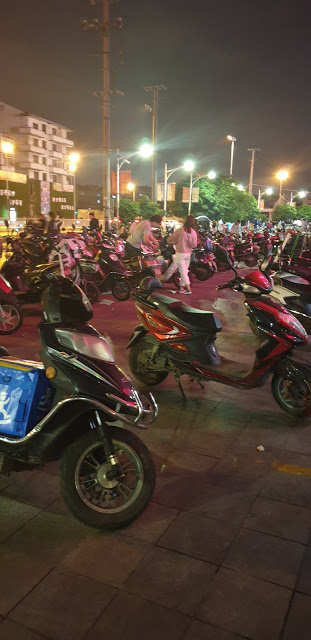
But, unlike where we live, the carpark is more of a scooter park!

It is also a small microcosm of Chinese life for the new more capitalistic oriented Chinese.

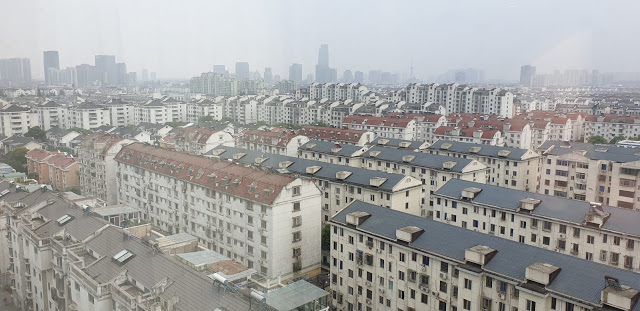
The next morning we get some idea of the scope of high-density living, though here, the buildings are not 30 stories tall, but still just as impressive.

These look like the medium density houses, but to the right of these are much larger buildings

The remarkable thing about this is those buildings stretch as far as the eye can see.

All the days seem the same

I feel like I’m on the outside looking in at this poor fellow struggling to work out what needs to be done, and in the end, getting nothing done.

Writing had suddenly become all that more difficult to do, not because I can’t, there’s an endless supply of ideas running around in my head, it’s just wanting to sit down and do it.

What are my expectations? 

I had set a list of projects I wanted to work on, more episodes for the three continuing stories, and a start to the next episodic story, ‘motive, means, and opportunity’, though for this story I have brought together all the writing I’ve been doing in past few months.

Then there is the completion of ‘the things we do for love’ which at long last now has a completed second draft with a lot of updates and changes to properly reflect the situation of the characters.  I have also got ‘strangers we’ve become’ to a point where it can finally get editorial sign-off. Publishing is not far away after that.

It would be easy to blame COVID 19 for the delays or the lack of commitment to the task, but that’s not the problem.  I’ve been home and had the time, but there have been a number of distractions, and ideas for new stories always seem to divert my attention from what I should be doing.

It’s not writer’s block.  It’s not laziness.  It seems that I just don’t have the time to work on them, and that might be because my subconscious is telling me there are problems with the narrative, and I’m just not ready to address them.

What has got my attention then?

I’m not sure how or why, but something triggered the idea of passing through a portal into another time, in the past.  I think I might have been looking for photographs to write another photo/story, and I came across a covered bridge, and which led to looking for photographs of ghost towns.  What topped it off, there was an old western in black and white, High Noon, which provoked a whole lot of memories of many westerns I’d seen in the past.

What other reason do you need to write your own story?

Then, when visiting my grandchildren, we just happened to do some stargazing, using Google Sky Map, picking out the planets.  Somehow I managed to take a photo, and looking at it, took me back to the days of Star Trek, and the many series, which sort of gave me an idea for another story, which has been running off and on over the last few months.

Equally, I’m always on the lookout for photo opportunities that I can use to write short stories, and these continue apace, the latest, number 150.  These are being formed into anthologies, stories 1 to 50, and stories 51 to 100.  The first has been assembled into book form and is awaiting the editor’s first reading and report.  I’m still working on the second.

And, now there is the next, stories 101 to 150.

Perhaps some of the time has been spent keeping up with Twitter, where over the last six months, and more recently, sales of my books on Amazon have been increasing.  Not to best-seller numbers, but people are reading my stories, and the reviews have been very good.

It has, of course, pushed me to work harder on marketing and that has consumed some of my time, which unfortunately takes me away from writing.  It sometimes feels like a self-defeating exercise, but it is the same for all of us.

Oh, and something else that cropped up this month, my brother has been digging into our family history, and around the middle of the month, he found some interesting revelations about some family members, including a pseudo-Luddite that ended up in Tasmania of all places, and then later on, when chasing down the places that we, as a family, lived, and this brought out some very interesting information about our father.

I’m discovering for what I’d always assumed was an ordinary man, he had done a lot of very interesting things in his life, and not only that, I’ve been fictionalizing the story.  I have potted pieces written over various stages, and, one day, it might come together as a sort of biography.  It is astonishing just how much you don’t know about your family, until much later on, at least for some of us.  Our relatives have always been a mystery to me, and it’s fascinating as each one is brought to life with a new detail here and there.

Looking back on what I’ve just written, perhaps the passing of time had been more productive than I first thought.  It just seems like nothing major has happened.

The first case of PI Walthenson – “A Case of Working With the Jones Brothers”

This case has everything, red herrings, jealous brothers, femme fatales, and at the heart of it all, greed.

See below for an excerpt from the book…

Coming soon!

PIWalthJones1

An excerpt from the book:

When Harry took the time to consider his position, a rather uncomfortable position at that, he concluded that he was somehow involved in another case that meant very little to him.

Not that it wasn’t important in some way he was yet to determine, it was just that his curiosity had got the better of him, and it had led to this: sitting in a chair, securely bound, waiting for someone one of his captors had called Doug.

It was not the name that worried him so much, it was the evil laugh that had come after the name was spoken.

Doug what? Doug the ‘destroyer’, Doug the ‘dangerous’, Doug the ‘deadly’; there was any number of sinister connotations, and perhaps that was the point of the laugh, to make it more frightening than it was.

But there was no doubt about one thing in his mind right then: he’d made a mistake. A very big. and costly, mistake. Just how big the cost, no doubt he would soon find out.

His mother, and his grandmother, the wisest person he had ever known, had once told him never to eavesdrop.

At the time he couldn’t help himself and instead of minding his own business, listening to a one-sided conversation which ended with a time and a place. The very nature of the person receiving the call was, at the very least, sinister, and, because of the cryptic conversation, there appeared to be, or at least to Harry, criminal activity involved.

For several days he had wrestled with the thought of whether he should go. Stay on the fringe, keep out of sight, observe and report to the police if it was a crime. Instead, he had willingly gone down the rabbit hole.

Now, sitting in an uncomfortable chair, several heat lamps hanging over his head, he was perspiring, and if perspiration could be used as a measure of fear, then Harry’s fear was at the highest level.

Another runnel of sweat rolled into his left eye, and, having his hands tied, literally, it made it impossible to clear it. The burning sensation momentarily took his mind off his predicament. He cursed and then shook his head trying to prevent a re-occurrence. It was to no avail.

Let the stinging sensation be a reminder of what was right and what was wrong.

It was obvious that it was the right place and the right time, but in considering his current perilous situation, it definitely was the wrong place to be, at the worst possible time.

It was meant to be his escape, an escape from the generations of lawyers, what were to Harry, dry, dusty men who had been in business since George Washington said to the first Walthenson to step foot on American soil, ‘Why don’t you become a lawyer?” when asked what he could do for the great man.

Or so it was handed down as lore, though Harry didn’t think Washington meant it literally, the Walthenson’s, then as now, were not shy of taking advice.

Except, of course, when it came to Harry.

He was, Harry’s father was prone to saying, the exception to every rule. Harry guessed his father was referring to the fact his son wanted to be a Private Detective rather than a dry, dusty lawyer. Just the clothes were enough to turn Harry off the profession.

So, with a little of the money Harry inherited from one of his aunts, he leased an office in Gramercy Park and had it renovated to look like the Sam Spade detective agency, you know the one, Spade and Archer, and The Maltese Falcon.

There’s a movie and a book by Dashiell Hammett if you’re interested.

So, there it was, painted on the opaque glass inset of the front door, ‘Harold Walthenson, Private Detective’.

There was enough money to hire an assistant, and it took a week before the right person came along, or, more to the point, didn’t just see his business plan as something sinister. Ellen, a tall cool woman in a long black dress, or so the words of a song in his head told him, fitted in perfectly.

She’d seen the movie, but she said with a grin, Harry was no Humphrey Bogart.

Of course not, he said, he didn’t smoke.

Three months on the job, and it had been a few calls, no ‘real’ cases, nothing but missing animals, and other miscellaneous items. What he really wanted was a missing person. Or perhaps a beguiling, sophisticated woman who was as deadly as she was charming, looking for an errant husband, perhaps one that she had already ‘dispatched’.

Or for a tall, dark and handsome foreigner who spoke in riddles and in heavily accented English, a spy, or perhaps an assassin, in town to take out the mayor. The man was such an imbecile Harry had considered doing it himself.

Now, in a back room of a disused warehouse, that wishful thinking might be just about to come to a very abrupt end, with none of the romanticized trappings of the business befalling him. No beguiling women, no sinister criminals, no stupid policemen.

Just a nasty little man whose only concern was how quickly or how slowly Harry’s end was going to be.

© Charles Heath 2019

Searching for locations: The Erqi Memorial Tower, Zhengzhou, China

A convoluted explanation on the reasons for this memorial came down to it being about the deaths of those involved in the 1923 Erqi strike, though we’re not really sure what the strike was about.

So, after a little research, this is what I found:

The current Erqi Tower was built in 1971 and was, historically, the tallest building in the city. It is a memorial to the Erqi strike and in memory of Lin Xiangqian and other railway workers who went on strike for their rights, which happened on February 7, 1923.

It has 14 floors and is 63 meters high. One of the features of this building is the view from the top, accessed by a spiral staircase, or an elevator, when it’s working (it was not at the time of our visit).

There seems to be an affinity with the number 27 with this building, in that

  • It’s the 27th memorial to be built
  • to commemorate the 27th workers’ strike
  • located in the 27th plaza of Zhengzhou City.

We drive to the middle of the city where we once again find traveling in kamikaze traffic more entertaining than the tourist points

When we get to the drop-off spot, it’s a 10-minute walk to the center square where the tower is located on one side. Getting there we had to pass a choke point of blaring music and people hawking goods, each echoing off the opposite wall to the point where it was deafening. Too much of it would be torture.

But, back to the tower…

It has 14 levels, but no one seemed interested in climbing the 14 or 16 levels to get to the top. The elevator was broken, and after the great wall episode, most of us are heartily sick of stairs.

The center square was quite large but paved in places with white tiles that oddly reflected the heat rather than absorb it. In the sun it was very warm.

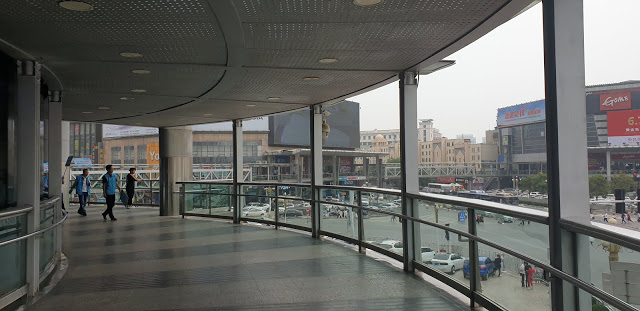
Around the outside of two-thirds of the square, and crossing the roads, was an elevated walkway, which if you go from the first shops and around to the other end, you finish up, on the ground level, at Starbucks.

This is the Chinese version and once you get past the language barrier, the mixology range of cold fruity drinks are to die for, especially after all that walking. Mine was a predominantly peach flavor, with some jelly and apricot at the bottom. I was expecting sliced peaches but I prefer and liked the apricot half.

A drink and fruit together was a surprise.

Then it was the walk back to the meeting point and then into the hotel to use the happy house before rejoining the kamikaze traffic.

We are taken then to the train station for the 2:29 to our next destination, Suzhou, the Venice of the East.

‘Sunday in New York’ – A beta reader’s view

I’m not a fan of romance novels but …

There was something about this one that resonated with me.

This is a novel about a world generally ruled by perception, and how people perceive what they see, what they are told, and what they want to believe.

I’ve been guilty of it myself as I’m sure we all have at one time or another.

For the main characters Harry and Alison there are other issues driving their relationship.

For Alison, it is a loss of self-worth through losing her job and from losing her mother and, in a sense, her sister.

For Harry, it is the fact he has a beautiful and desirable wife, and his belief she is the object of other men’s desires, and one in particular, his immediate superior.

Between observation, the less than honest motives of his friends, a lot of jumping to conclusions based on very little fact, and you have the basis of one very interesting story.

When it all comes to a head, Alison finds herself in a desperate situation, she realises only the truth will save their marriage.

But is it all the truth?

What would we do in similar circumstances?

Rarely does a book have me so enthralled that I could not put it down until I knew the result. They might be considered two people who should have known better, but as is often the case, they had to get past what they both thought was the truth.

And the moral of this story, if it could be said there is one, nothing is ever what it seems.

Available on Amazon here: amzn.to/2H7ALs8