‘Sunday in New York’ – A beta reader’s view

I’m not a fan of romance novels but …

There was something about this one that resonated with me.

This is a novel about a world generally ruled by perception, and how people perceive what they see, what they are told, and what they want to believe.

I’ve been guilty of it myself as I’m sure we all have at one time or another.

For the main characters Harry and Alison there are other issues driving their relationship.

For Alison, it is a loss of self-worth through losing her job and from losing her mother and, in a sense, her sister.

For Harry, it is the fact he has a beautiful and desirable wife, and his belief she is the object of other men’s desires, and one in particular, his immediate superior.

Between observation, the less than honest motives of his friends, a lot of jumping to conclusions based on very little fact, and you have the basis of one very interesting story.

When it all comes to a head, Alison finds herself in a desperate situation, she realises only the truth will save their marriage.

But is it all the truth?

What would we do in similar circumstances?

Rarely does a book have me so enthralled that I could not put it down until I knew the result. They might be considered two people who should have known better, but as is often the case, they had to get past what they both thought was the truth.

And the moral of this story, if it could be said there is one, nothing is ever what it seems.

Available on Amazon here: amzn.to/2H7ALs8

In a word: Brevity

Now, brevity is something that I have not been able to fully wrap my head around.

The dictionary explains Brevity as

‘concise and exact use of words in writing and speech’

So…

I remember working with a writer a long time ago who explained certain authors styles, and for James A Michener of Hawaii fame, he said Michener wrote sentences instead of words, paragraphs instead of sentences, pages instead of paragraphs and chapters instead of pages.

It was a little harsh considering I’d just read the book and had liked it, despite its length and the time it took.

But some time later I realized he was not criticizing Michener, but trying to tell me, in his, what I came to discover, interesting way, that I should strive to write more compactly.

I then came across a book by Brian Callison which was exactly that, the concise version, a story that fitted into about 200 pages.

That too was a good book and it took me a day to read it, and by his use of that economy of words, it read quickly.

Of course, I have tried over the years to emulate both styles, and to a certain degree, failing, because I think I have created my own style which is somewhere in between.

Still, when editing, it is always in the back of my mind that I should be

Using words instead of sentences

Using sentences instead of paragraphs

Using paragraphs instead of pages, and

Using pages instead of chapters.

The chapters, he said, with an air of amusement, will always take care of themselves.


An excerpt from “Echoes from the Past”

Available on Amazon Kindle here:  https://amzn.to/2CYKxu4

With my attention elsewhere, I walked into a man who was hurrying in the opposite direction.  He was a big man with a scar running down the left side of his face from eye socket to mouth, and who was also wearing a black shirt with a red tie.

That was all I remembered as my heart almost stopped.

He apologized as he stepped to one side, the same way I stepped, as I also muttered an apology.

I kept my eyes down.  He was not the sort of man I wanted to recognize later in a lineup.  I stepped to the other side and so did he.  It was one of those situations.  Finally getting out of sync, he kept going in his direction, and I towards the bus, which was now pulling away from the curb.

Getting my breath back, I just stood riveted to the spot watching it join the traffic.  I looked back over my shoulder, but the man I’d run into had gone.  I shrugged and looked at my watch.  It would be a few minutes before the next bus arrived.

Wait, or walk?  I could also go by subway, but it was a long walk to the station.  What the hell, I needed the exercise.

At the first intersection, the ‘Walk’ sign had just flashed to ‘Don’t Walk’.  I thought I’d save a few minutes by not waiting for the next green light.  As I stepped onto the road, I heard the screeching of tires.

A yellow car stopped inches from me.

It was a high powered sports car, perhaps a Lamborghini.  I knew what they looked like because Marcus Bartleby owned one, as did every other junior executive in the city with a rich father.

Everyone stopped to look at me, then the car.  It was that sort of car.  I could see the driver through the windscreen shaking his fist, and I could see he was yelling too, but I couldn’t hear him.  I stepped back onto the sidewalk, and he drove on.  The moment had passed and everyone went back to their business.

My heart rate hadn’t come down from the last encounter.   Now it was approaching cardiac arrest, so I took a few minutes and several sets of lights to regain composure.

At the next intersection, I waited for the green light, and then a few seconds more, just to be sure.  I was no longer in a hurry.

At the next, I heard what sounded like a gunshot.  A few people looked around, worried expressions on their faces, but when it happened again, I saw it was an old car backfiring.  I also saw another yellow car, much the same as the one before, stopped on the side of the road.  I thought nothing of it, other than it was the second yellow car I’d seen.

At the next intersection, I realized I was subconsciously heading towards Harry’s new bar.   It was somewhere on 6th Avenue, so I continued walking in what I thought was the right direction.

I don’t know why I looked behind me at the next intersection, but I did.  There was another yellow car on the side of the road, not far from me.  It, too, looked the same as the original Lamborghini, and I was starting to think it was not a coincidence.

Moments after crossing the road, I heard the roar of a sports car engine and saw the yellow car accelerate past me.  As it passed by, I saw there were two people in it, and the blurry image of the passenger; a large man with a red tie.

Now my imagination was playing tricks.

It could not be the same man.  He was going in a different direction.

In the few minutes I’d been standing on the pavement, it had started to snow; early for this time of year, and marking the start of what could be a long cold winter.  I shuddered, and it was not necessarily because of the temperature.

I looked up and saw a neon light advertising a bar, coincidentally the one Harry had ‘found’ and, looking once in the direction of the departing yellow car, I decided to go in.  I would have a few drinks and then leave by the back door if it had one.

Just in case.

© Charles Heath 2015-2020

newechocover5rs

The cinema of my dreams – It all started in Venice – Episode 7

A new team member

I had gone over a number of different ways I could run into Juliet, but most seemed staged, and I got the impression from her most recent conversation with Larry, that she was not silly.

In fact, in my mind, a second meeting, coincidental or not, would send up a red flag.  This was where spycraft bordered on Hollywood, we needed to set the stage, and for that, we needed extras.

And that meant a phone call to Alfie.  I told him what I needed, and he asked for 24 hours to set it up, and true to his word, I was in the arrival hall of Venice Airport, waiting for the newest member of the team.

Cecilia Walker was an aspiring actress, an ideal cover for her so-called part-time profession as an agent at large.  We all had cover stories, with both personal and legitimate reasons for being in places that we’d not normally be expected to be.  And in her case, she was never the same person twice, quite literally the master of disguise.

For Cecilia, there was a film festival in Venice she would be attending.  Timing in this case was everything.

As for me, I had a background in archaeology and journalism and was actually employed to write articles for a number of publications, a job I kept up after I left the service, along with the idea of writing a book, which became the object of a long-standing joke between Violetta and I.

One day I would finish it

But ironically, Cecilia had the perfect cover, being able to slip into any role without having to work too hard on the finer details. 

Alfie had sent a photo of her, and even though I did spend a few moments wondering if I might recognize her from some part she may have played, it didn’t stir up any recollection.  Of course, there was always a vast difference between studio poses and real life, and the woman that came out of the gate was quite different from the one I was expecting.

Although the few paparazzi that were loitering in the terminal just in case a celebrity did suddenly arrive, didn’t recognize her, that might be due to the fact she was dressed casually and had changed both hairstyle and color, and, as I had learned from the woman I’d spent a lot of time with, nuances in make-up could make all the difference.

But there was one photographer that was interested, perhaps he had seen her before, and I waited until she had spoken to him before wandering over.  She had scanned the gate area, both to familiarise herself with the layout and people there, as well as locate me, all without looking like she was doing anything other than immediately disembarking the plane.

It showed experience, and preparedness, not her first, as they say, rodeo.

She had been tracking me the whole time, so once I was in her direct line of sight, anyone observing us would assume we were old friends.

There was a hug before words were spoken, the sort that made me realize what I had been missing for some time, warm personal contact.

“You haven’t aged a bit,” she said, a smile lingering.

“It’s the wine, excellent preservative.  You, on the other hand, have grown up.” 

The script called for old friends who hadn’t seen each other for a year or so.

She performed a pirouette and then burst into giggles.  “Sorry, it’s just when I did that for one of my grandmothers, she said I was acting like a tart.”

“Grandmothers can be like that,” I said, remembering Violetta used to use the same word for her sister’s grandchildren.

“My house is a renovator’s disaster at the moment, so we’re staying in a quaint hotel on the edge of the main Canal, and some interesting restaurants.”

Alfie had booked us adjoining rooms on the same floor as Juliet, which, when she learned I would be staying there too, would give me the surprise element I was looking for.

“I am so looking forward to this week.  If we get the time, you’ll have to show me everything.”

In that short distance from the airport terminal to the water taxi berths, there was time enough to discover what had exactly been missing in my life since Violetta had died.

Yes, there was a period of mourning, a period where there had been no point in getting out of bed, a period where I felt completely lost without the one person who made my life make sense.

But in those few short minutes, there it was again, and with it the belief that perhaps there was someone else out there who could fill that gap, but never replace her because there would never be anyone else like her.  Cecilia was not the one, but she was part of the process.

I had to remember, also, she was a consummate actress, that she was playing a role, and it was totally believable.

Once we were on the water taxi and away from prying eyes and ears, I had to ask, “how did you end up on Rodby’s roster, especially in light of how good an actor you are?”

“You think so, why thank you.  But the duality, accidentally.  I got caught in the crossfire, and thinking at the time, someone had changed the script and forgot to tell me, sort of kicked some ass.  Delusions of becoming a female version of Liam Neeson.  Instead, I was offered a recurring female James Bond, in real life.”

Good to know I could depend on her in a scrap.

“This might not come to that, in fact, it might be quite boring.”

She smiled.  “A free trip to Venice, a film festival pass to everything, working with a legend, what’s not to like?”

What had Alfie told her?  Legend I was not, perhaps slightly more successful than the average agent, but I was just doing my job until I didn’t want to do it anymore.  How many of us could say we preferred to sacrifice everything for the love of the one?

“I assume you are up to speed with what’s required of you in the first instance?”

“A role is a role, Evan, and I love a good role.  This woman you’re supposed to be cozying up to, and the guy using her, it’s almost like a plotline in a B grade movie.”

I hadn’t thought of it like that, but now that she mentioned it, it felt a bit like exactly that.

“Should I make her jealous?”

“It’s not like that, or at least that’s the impression I got when I ran into her.  Depends on what Larry’s intentions are.  Chances are when we get to the hotel we might see her again, and you might get an idea.  I’m not the best person reading women’s minds.”

“No man ever is.  We have to have that element of surprise to keep you interested, but if I was in her position, and I saw you with a woman like me, and I was supposed to get close to you for whatever reason, I might be forced into making a move I didn’t want to.  The fact she’s here with you in her sights generally means one thing.”

The question was, how desperate would she be?  That would depend on the motivation, or what leverage he had.  Pushing the envelope might, as Cecilia said force her hand.

So much for a softly, softly approach.

And it might force Larry’s hand as well

“So, is it your first time in Venice?”

“No, I used to come here when younger with my mother who was I guess a Venetian.  After she died, not so much.”

“No other baggage?”  It had surprised me she had only one carrying bag.

It was always excess baggage when traveling anywhere with my ex.

“Only emotional.  I was told to pack light, anything I needed you’d get for me.” 

The accompanying wicked smile was enough.  I’d have to make sure the expense account was big enough.

After a pleasant forty-five-minute grand tour of the canals going the long way to the berths not far from St Mark’s Square, we jumped off as soon as the taxi came alongside.

The hotel wasn’t far from the bronze equestrian monument to Victor Emmanuel II statue, which she took a moment to look at, almost causing several strollers to walk into her.

That element of careless tourist didn’t make her stand-up as much as if she had purposefully walked from the berth to the hotel, a small detail in a studied persona, the role of an extra perhaps in a film.

It was the part of the day, for late summer that I liked the best, and in a week or so, the weather would slowly get colder until Christmas, and winter, was upon us.

Then, she did the complete 360-degree turn just taking it all in.  “Some things never change, I remember all of this.”

Perhaps living off and on for so long here had made me a little immune to the charm of the place, but it was hard not to get caught up in the moment.

“Your hotel awaits.”

For a few seconds the reality of the situation faded into the background, and I could push all the nastiness of Larry and his machinations aside, but then the reality came back, I remembered who I was and what I’d been, and how important it was not to lose sight of the objective.

It had not been easy while Violetta was still alive, nor was hiding the real truth of my past from her.  Yes, I had told her a version of my precious life, and the possible dangers it could present, which was why she suggested we live in a number of different places, never the same in a single location, but with Venice, it had been different.  It had a profound effect on her, and it was where she chose to spend her last days.

It had not held the same effect on me. Not since she passed, and I had been looking to leave, find somewhere new, and different to stay, more so since I learned of Larry’s plans.

Now it just made me angry.

“I’m sorry,” she said, suddenly next to me, “do we need to be someplace?”

“What, no, sorry.”

“You looked annoyed, I hope not with me.”

“No, never.  Just thinking about Larry. And Juliet, I guess I’m lamenting the nuisance the pair of them are in intruding on my solitude.  Something to note, you don’t ever get the luxury of retirement in this business, except in death.”

“Then let’s hope it doesn’t happen.”

© Charles Heath 2022

“People have a way of surprising you…” – A short story

Last days were supposed to be joyous, the end of your working life and the start of the rest of your life.

I’d spent the last 35 years working for the company, navigating through three buyouts, five name changes, and three restructures. I was surprised I was still employed after the last, only two years before.

But, here I was, sitting in the divisional manager’s office, my office for one more day, with my successor, Jerry, and best friend, sitting on the other side.

“Last day, what are you thinking?” He asked casually.

It might have been early, but we both had a glass of scotch, a single malt I’d kept aside for an important occasion and this seemed like one.

I picked up the glass and surveyed the contents, giving myself a few moments to consider an answer to what could be a difficult question. To be honest, the thinking had started on the subway on the way in, when I should have been working on the crossword, but instead, I was lamenting the fact that the next chapter of my life would be without Ellen.

We would have been married, coincidently, 43 years ago today, had she been alive. Unfortunately, she had died suddenly about four months ago, after a long battle with cancer.

And I still hadn’t had time to process it. Truth is, it had been work that kept me together, and I was worried about what was going to happen when it would no longer there.

To a certain extent, I was still on autopilot, her death coming in the middle of a major disaster concerning the company, one that had finally, and successfully, been brought to a conclusion with favorable results for everyone.

But what was I thinking right then, at that precise moment in time? Not something he would want to hear, so I made the necessary adjustment. “That I’m basically leaving you a clean slate, so don’t screw it up.”

I could see that was not what he wanted to hear.

He decided to take a different tack. “What have you got planned for the first day of retirement.”

He knew about Ellen and had been there for me, above and beyond what could have been expected from anyone. I owed him more than a platitude.

“Sleep in, probably, but I’m going to be fighting that body clock. It’s going to be difficult after so many years getting up the same time, rail hail or shine. But we had plans to go away for a few months, you know, the trip of a lifetime, then move. Ellen wanted to go back home for a while, now, I’m not sure what I’m going to do.”

“Then perhaps you should, or at the very least, go home for a while. You said you both come from there; who knows, being back among family might just be what you need.”

It was something I had been thinking about and had been issued an open-ended invitation from her parents to come and stay for as long as I wanted, one that I was seriously considering.

But, before I could tell him that, the phone rang.

Never a dull day…
The day went quickly, and as much as it was expected I’d hand over anything that happened to my successor, I couldn’t quite let go. There was the proverbial storm in a teacup, but it was a good opportunity to watch the man who was taking over in action. He had a great teacher, even if I said so myself.

But it was the end of the day and the moment I had been dreading. I’d asked the personnel manager not to make a big deal out of my departure, and that I didn’t want the usual sendoff, where everyone in the office came and I would find myself at a loss of words and feel like I had to speak to a lot of people I didn’t really know.

There were only about a dozen that I really knew, a dozen that had survived the layoffs and restructuring, and although there were others, I didn’t have anything to do with them. My last job took me out of the office more than being there, and so many of the other people were from offices scattered all up and down the east coast.

I’d mostly said my goodbyes to them on the last quarterly visit. Sixteen offices, fifty-odd employees who were as much friends as they were staff who worked for me. There had been small dinners and heartfelt moments.

This I was hoping would be the same.

Jerry had been charged with the responsibility of getting me to the presentation; they called it a presentation because I had no doubt there would be a presentation of some sort. I had told the CEO a handshake and a couple of drinks would suffice, and he just congenially nodded.

Jerry had taken the manager’s chair and I was sitting on the other side of the table. We’d finished off the last of the single malt, and dirt was time to go. I closed the door to the office for the last time, and we walked along the passage towards the dining room. It was a perk I’d fought hard to keep during the last restructure when the money men were trying to cut costs.

It was one of the few battles I won.

He opened the door and stood to one side, and ushered me through.

It was a very large space, usually filled with tables, chairs, and diners. Now it was filled with people, leaving a passageway from the door to a podium that had been set up in front of the servery, where a large curtain stretched across the width of the building with the company logo displayed on it.

There were 2,300 people who worked in this office and another 700 from the regional offices. By the look of the crowd, every single one of them was there.

It took fifteen minutes to get from the door to the podium. Faces of people I’d seen every day, faces I’d seen a few times a year, and faces I’d never seen before. On the podium there was a dozen more, faces I’d only seen in the Annual Accounts document, except for the General Manager and the CEO.

“You will be pleased to know everyone here wanted to come and bid you farewell,” the General Manager said.

“Everyone? Why?”

“Well, I’ve learned a lot about this company and its people over the last week, and frankly, people have a way of surprising you. And given the impact you have had on each and every one of them, I’m not surprised. So much so, they wanted to give you something to remember them by.”

A nod of the head and the curtains were pulled back, and behind them was an original 1968 XJ6 Jaguar, fully restored, a very familiar XJ6. The car had belonged to Helen and I had to sell it to help pay the medical bills. It had been a gut-wrenching experience, coming at a time when everything that was happened to her almost overwhelmed me.

“Jerry told us about this particular car, so all of your friends thought, as a fitting memory to you and of her, that we should find it and restore it. Everyone here contributed. It is our gift to you for everything you have done for us.”

So much for the usual sendoff…

—-

© Charles Heath 2020-2021

The cinema of my dreams – I always wanted to see the planets – Episode 49

A matter of diplomacy

I had to wonder, in that brief moment standing there, how I had come from a contented life plying space in a nomadic cargo vessel, to this, in charge of over 2000 crew, on a spaceship the size of a small town, on a mission to find new life out beyond the known edge of space.

And succeeding beyond all expectations without the loss of a single life, or perhaps that wasn’t quite true, the previous captain had become a casualty in exceptional circumstances.

I looked over at the head of Diplomacy.  “Have you given any thought to my suggestion?”

After coming back from the alien vessel, I had immediately gone to the head of the Diplomatic mission and told him to pick a team to go down to the alien planet, telling him that we had been given permission to learn about their culture and others in their galaxy.

There had been no shortage of volunteers, and they had left not much more than an hour after I arrived back on board.  It was an opportunity not to be missed.

The other matter was about leaving some people there until we came back, or the next earth vessel arrived.  It was not what had been considered back on earth before the mission left, but to me it had some merit, perhaps setting up what might be a galactic embassy smoothing the way for other vessels like ours.

A sea of expectant faces, only one asked the question on everyone’s mind, giving my diplomatic chief a little more time to come up with an answer.

“Who are they, and are they like us?”  The fourth officer had finally appeared from his room in engineering where his interest lay, but from a practical standpoint, was there in case the bridge was lost.

“No.  And yes.  They are consciousness in an artificial body that looks like us, but I imagine it would take the form of any being they came in contact with.  I suspect they have evolved beyond the need for a body that wears out over time, which it seems is our problem, and we are only at the threshold of robotics as replacement parts, even bodies.  I don’t know the whole story, but that’s one for the medical people.  But…”

I turned back to my diplomatic expert, “we are going to have to talk to these people and not only that, we need to understand them and their customs before more of us blunder into their territory and do everything wrong.  You have permission to send two representatives to the planet to talk to their scribes, which I believe are most likely historians.  They are going to tell us about the peoples of this galaxy and perhaps beyond.  It will at least give us something to work with before as they rightly put it blunder our way into possible diplomatic nightmares.”

“Do you think they’d let us set up a diplomatic outpost?”

“You could work on a proposal, but for now we have about six days or so to get as much information as we can.  Anything else is your department, and for you to decide.  I understand there are some in your department who signed on in the hope they might get to stay in a new world, but, again, you will have to make a threat assessment based on all of the contacts so far.  I have endured all of the recordings of our encounters are available.”

“How long have I got?”

“Until we reach the Princesses home planet in about three days’ time.”

Not a lot of time to review and assess given most of the encounters were hostile.  But an arrangement with these people would be considered advantageous as a first stop on the way to other galaxies.  And I had no doubt they had a vast store of knowledge of other alien life forms which would be invaluable.

“How did we get stuck with taking the Princess home, and how do we know they will want her back?  We don’t know the precise circumstances of how she got there in the first place.”

The second officer was not backwards in voicing concerns.  He was the ship’s resident Mr doom and gloom.  But for all that, his was a view that could be used as a counterbalance when making a decision.

“A good question and one I intend to get answers to right after we finish here.”

That left general business on the table, departmental reports, crew statuses, and the all-important ship systems.

Good to know the crew was reasonably happy, all performing their duties through the various crises, and systems had only minor failed that the skeleton shipbuilders crew were able to fix, one way or another.

Best of all, the chief engineer was happy, so far.

An hour later, it was time to visit the Princess.

© Charles Heath 2021-2022

“Opposites Attract” – The Editor’s first draft – Day 19

This book was the effort put into the last NaNoWriMo November 2023 exercise. I have now picked it back up, and working on a more polished first draft for the Editor.

Plans made, people to talk to

There’s no time to think about the overwhelming occasion that will soon be upon them.

Our boy has absolutely no idea what our girl is thinking or going to say when he delivers the proposal, he just has to make it memorable.

And, of course, being a boy, that sometimes is harder than it sounds.

That’s why he has the services of the best Personal Assistant in the world.

And she knows his bride to be better than her parents.

She is going to help.  Phew!

A call to his sister is basically to tell her he hasn’t screwed it up yet, but the romance is young, and she knows him better than he does himself.

This train might be going a little fast, but he explains the circumstances.

It’s one of those moments.

Is it cybersickness or something else?

There’s this new affliction going about.

Everyone seems to be talking to themselves and I think it has something to do with smoking, perhaps a side effect.

You know how it is, you are walking by and someone near you starts talking.  You think they are talking to you, but they are not.

And then they take a puff of a cigarette.

It’s not an uncommon assumption.

But the thing is, if you take a closer look you notice they have a Bluetooth device in their ear and they are really talking to someone out there in cyberspace.

Or for the uninitiated, they’re talking on their mobile phone.

Not many years ago men in white suits would be collecting these people and taking them to an asylum typically called Bellevue.  The stuff of 1950’s horror films.  You really didn’t want to be caught talking to yourself.

It, of course, has a number of symptoms, this condition we’ll call cybersickness.  Like, for instance, wandering aimlessly and either bumping into people or in front of cars on the street.

Is it the voices in their head telling them what to do?

Can we say we have just created a viable excuse for these people, or should they be locked up?  Maybe we’re too late because I think a lot of them are already living in their own world.

Searching for locations: The Maglev (Magnetic Levitation) Train, Shanghai, China

So, the first treat for the day is the high-speed magnetic train, something we only learned about after arriving in China and was not on any of the pre-tour documentation.

The train line connects Shanghai Pudong International Airport and Longyang Road Station (in the outskirts of central Pudong).  It is the oldest commercial maglev still in operation, and the first commercial high-speed maglev with cruising speed of 431 km/h (268 mph).  At full speed, the journey takes 7 minutes and 20 seconds to complete the distance of about 30 km.

Construction of the line began on March 1, 2001 and public services commenced on 1 January 2004.  It was built by a joint venture of Siemens and ThyssenKrupp from Kassel, Germany.

But, like visiting anything from a hotel, first we have to drive to the station and because we are leaving at 8, its peak hour traffic, and it takes 1 hour 10 minutes to get there.

The train also has a practical use and that is to take passengers from Shanghai to Pudong international airport as well as for those train enthusiasts, which is what we are.

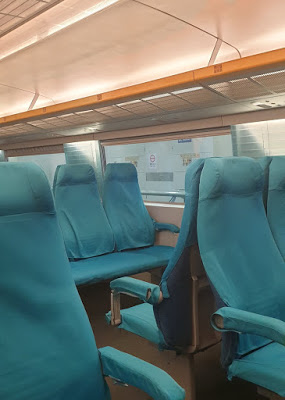
On the train, it has the same sleek look as the bullet trains, but it is completely different, and you are able to see from the front of the train to the back.

Reputed to travel at 431 kph we take a seat and it is not long before the doors shut, and a loud humming noise is soon replaced by what sounds like an engine, then we start moving.  It sounds just like a normal train, and is a lot noisier than a normal bullet train.

Seating on the train was nothing special, as one might expect

It didn’t take long before it hits the advertised speed of 431 kph.  This is not sustained for very long, because the distance is on 40 odd kilometers, and the whole trip takes about 7 minutes.

We go to the airport, and then we come back.  Is it worth the price, yes.  If you are a train enthusiast.

An excerpt from “What Sets Us Apart”, a mystery with a twist

See the excerpt from the story below, just a taste of what’s in store…

http://amzn.to/2Eryfth

whatsetscover

McCallister was old school, a man who would most likely fit in perfectly campaigning on the battlefields of Europe during the Second World War. He’d been like a fish out of water in the army, post-Falklands, and while he retired a hero, he still felt he’d more to give.

He’d applied and was accepted as head of a SWAT team, and, watching him now as he and his men disembarked from the truck in almost military precision, a look passed between Annette, the police liaison officer, and I that said she’d seen it all before. I know I had.

There was a one in four chance his team would be selected for this operation, and she had been hoping it would be one of the other three. While waiting for them to arrive she filled me in on the various teams. His was the least co-operative, and the more likely to make ad-hoc decisions rather than adhere to the plan, or any orders that may come from the officer in charge.

This, she said quite bluntly, was going to end badly.

I still had no idea why Prendergast instructed me to attend the scene of what looked to be a normal domestic operation, but as the nominated expert in the field in these types of situations, it was fairly clear he wasn’t taking any chances. It was always a matter of opinion between us, and generally I lost.

In this case, it was an anonymous report identifying what the authorities believed were explosives in one of the dockside sheds where explosives were not supposed to be.

The only reason why the report was given any credence was the man, while not identifying himself by name, said he’d been an explosive expert once and recognized the boxes. That could mean anything, but the Chief Constable was a cautious man.

With his men settled and preparing their weapons, McCallister came over to the command post, not much more than the SUV my liaison and I arrived in, with weapons, bulletproof vests, and rolls of tape to cordon off the area afterward. We both had coffee, steaming in the cold early morning air. Dawn was slowly approaching and although rain had been forecast it had yet to arrive.

A man by the name of Benson was in charge. He too had groaned when he saw McCallister.

“A fine morning for it.” McCallister was the only enthusiastic one here.

He didn’t say what ‘it’ was, but I thought it might eventually be mayhem.

“Let’s hope the rain stays away. It’s going to be difficult enough without it,” Benson said, rubbing his hands together. We had been waiting for the SWAT team to arrive, and another team to take up their position under the wharf, and who was in the final stages of securing their position.

While we were waiting we drew up the plan. I’d go in first to check on what we were dealing with, and what type of explosives. The SWAT team, in the meantime, were to ensure all the exits to the shed were covered. When I gave the signal, they were to enter and secure the building. We were not expecting anyone inside or out, and no movement had been detected in the last hour since our arrival and deployment.

“What’s the current situation?”

“I’ve got eyes on the building, and a team coming in from the waterside, underneath. Its slow progress, but they’re nearly there. Once they’re in place, we’re sending McKenzie in.”

He looked in my direction.

“With due respect sir, shouldn’t it be one of us?” McCallister glared at me with the contempt that only a decorated military officer could.

“No. I have orders from above, much higher than I care to argue with, so, McCallister, no gung-ho heroics for the moment. Just be ready to move on my command, and make sure you have three teams at the exit points, ready to secure the building.”

McCallister opened his mouth, no doubt to question those orders, but instead closed it again. “Yes sir,” he muttered and turned away heading back to his men.

“You’re not going to have much time before he storms the battlements,” Benson quietly said to me, a hint of exasperation in his tone. “I’m dreading the paperwork.”

It was exactly what my liaison officer said when she saw McCallister arriving.

The water team sent their ‘in position’ signal, and we were ready to go.

In the hour or so we’d been on site nothing had stirred, no arrivals, no departures, and no sign anyone was inside, but that didn’t mean we were alone. Nor did it mean I was going to walk in and see immediately what was going on. If it was a cache of explosives then it was possible the building was booby-trapped in any number of ways, there could be sentries or guards, and they had eyes on us, or it might be a false alarm.

I was hoping for the latter.

I put on the bulletproof vest, thinking it was a poor substitute for full battle armor against an exploding bomb, but we were still treating this as a ‘suspected’ case. I noticed my liaison officer was pulling on her bulletproof vest too.

“You don’t have to go. This is my party, not yours,” I said.

“The Chief Constable told me to stick to you like glue, sir.”

I looked at Benson. “Talk some sense into her please, this is not a kindergarten outing.”

He shrugged. Seeing McCallister had taken all the fight out of him. “Orders are orders. If that’s what the Chief Constable requested …”

Madness. I glared at her, and she gave me a wan smile. “Stay behind me then, and don’t do anything stupid.”

“Believe me, I won’t be.” She pulled out and checked her weapon, chambering the first round. It made a reassuring sound.

Suited up, weapons readied, a last sip of the coffee in a stomach that was already churning from nerves and tension, I looked at the target, one hundred yards distant and thought it was going to be the longest hundred yards I’d ever traversed. At least for this week.

A swirling mist rolled in and caused a slight change in plans.

Because the front of the buildings was constantly illuminated by large overhead arc lamps, my intention had been to approach the building from the rear where there was less light and more cover. Despite the lack of movement, if there were explosives in that building, there’d be ‘enemy’ surveillance somewhere, and, after making that assumption, I believed it was going to be easier and less noticeable to use the darkness as a cover.

It was a result of the consultation, and studying the plans of the warehouse, plans that showed three entrances, the main front hangar type doors, a side entrance for truck entry and exit and a small door in the rear, at the end of an internal passage leading to several offices. I also assumed it was the exit used when smokers needed a break. Our entry would be by the rear door or failing that, the side entrance where a door was built into the larger sliding doors. In both cases, the locks would not present a problem.

The change in the weather made the approach shorter, and given the density of the mist now turning into a fog, we were able to approach by the front, hugging the walls, and moving quickly while there was cover. I could feel the dampness of the mist and shivered more than once.

It was nerves more than the cold.

I could also feel rather than see the presence of Annette behind me, and once felt her breath on my neck when we stopped for a quick reconnaissance.

It was the same for McCallister’s men. I could feel them following us, quickly and quietly, and expected, if I turned around, to see him breathing down my neck too.

It added to the tension.

My plan was still to enter by the back door.

We slipped up the alley between the two sheds to the rear corner and stopped. I heard a noise coming from the rear of the building, and the light tap on the shoulder told me Annette had heard it too. I put my hand up to signal her to wait, and as a swirl of mist rolled in, I slipped around the corner heading towards where I’d last seen the glow of a cigarette.

The mist cleared, and we saw each other at the same time. He was a bearded man in battle fatigues, not the average dockside security guard.

He was quick, but my slight element of surprise was his undoing, and he was down and unconscious in less than a few seconds with barely a sound beyond the body hitting the ground. Zip ties secured his hands and legs, and tape his mouth. Annette joined me a minute after securing him.

A glance at the body then me, “I can see why they, whoever they are, sent you.”

She’d asked who I worked for, and I didn’t answer. It was best she didn’t know.

“Stay behind me,” I said, more urgency in my tone. If there was one, there’d be another.

Luck was with us so far. A man outside smoking meant no booby traps on the back door, and quite possibly there’d be none inside. But it indicated there were more men inside, and if so, it appeared they were very well trained. If that were the case, they would be formidable opponents.

The fear factor increased exponentially.

I slowly opened the door and looked in. A pale light shone from within the warehouse itself, one that was not bright enough to be detected from outside. None of the offices had lights on, so it was possible they were vacant. I realized then they had blacked out the windows. Why hadn’t someone checked this?

Once inside, the door closed behind us, progress was slow and careful. She remained directly behind me, gun ready to shoot anything that moved. I had a momentary thought for McCallister and his men, securing the perimeter.

At the end of the corridor, the extent of the warehouse stretched before us. The pale lighting made it seem like a vast empty cavern, except for a long trestle table along one side, and, behind it, stacks of wooden crates, some opened. It looked like a production line.

To get to the table from where we were was a ten-yard walk in the open. There was no cover. If we stuck to the walls, there was equally no cover and a longer walk.

We needed a distraction.

As if on cue, the two main entrances disintegrated into flying shrapnel accompanied by a deafening explosion that momentarily disoriented both Annette and I. Through the smoke and dust kicked up I saw three men appear from behind the wooden crates, each with what looked like machine guns, spraying bullets in the direction of the incoming SWAT members.

They never had a chance, cut down before they made ten steps into the building.

By the time I’d recovered, my head heavy, eyes watering and ears still ringing, I took several steps towards them, managing to take down two of the gunmen but not the third.

I heard a voice, Annette’s I think, yell out, “Oh, God, he’s got a trigger,” just before another explosion, though all I remember in that split second was a bright flash, the intense heat, something very heavy smashing into my chest knocking the wind out of me, and then the sensation of flying, just before I hit the wall.

I spent four weeks in an induced coma, three months being stitched back together and another six learning to do all those basic actions everyone took for granted. It was twelve months almost to the day when I was released from the hospital, physically, except for a few alterations required after being hit by shrapnel, looking the same as I always had.

But mentally? The document I’d signed on release said it all, ‘not fit for active duty; discharged’.

It was in the name of David Cheney. For all intents and purposes, Alistair McKenzie was killed in that warehouse, and for the first time ever, an agent left the Department, the first to retire alive.

I was not sure I liked the idea of making history.

© Charles Heath 2016-2020