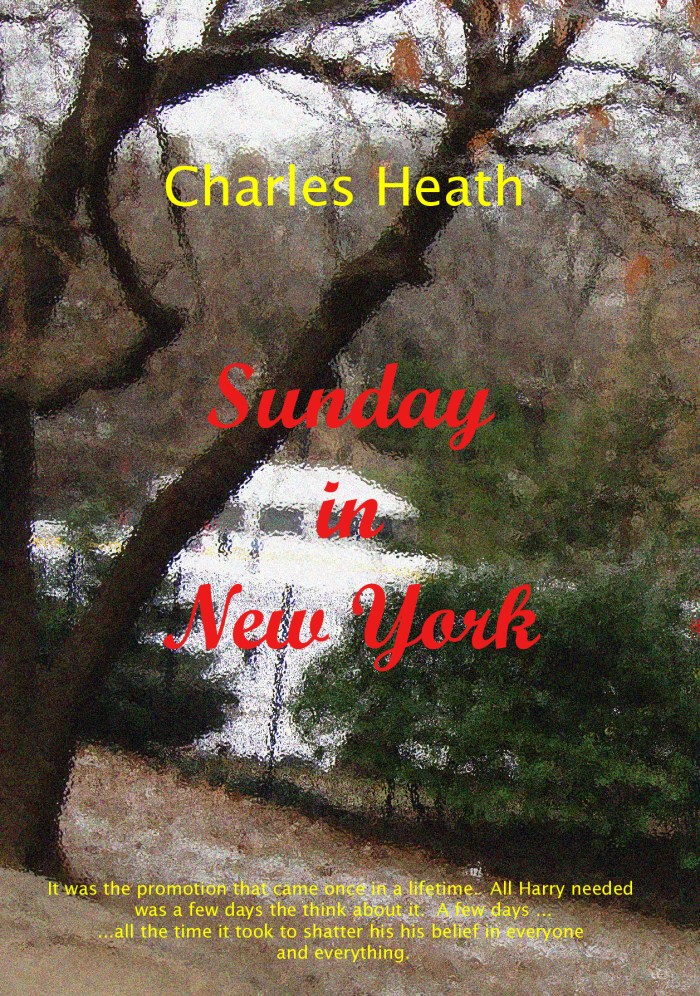
“Sunday in New York” is ultimately a story about trust, and what happens when a marriage is stretched to its limits.
When Harry Steele attends a lunch with his manager, Barclay, to discuss a promotion that any junior executive would accept in a heartbeat, it is the fact his wife, Alison, who previously professed her reservations about Barclay, also agreed to attend, that casts a small element of doubt in his mind.
From that moment, his life, in the company, in deciding what to do, his marriage, his very life, spirals out of control.
There is no one big factor that can prove Harry’s worst fears, that his marriage is over, just a number of small, interconnecting events, when piled on top of each other, points to a cataclysmic end to everything he had believed in.
Trust is lost firstly in his best friend and mentor, Andy, who only hints of impending disaster, Sasha, a woman whom he saved, and who appears to have motives of her own, and then in his wife, Alison, as he discovered piece by piece damning evidence she is about to leave him for another man.
Can we trust what we see with our eyes or trust what we hear?
Haven’t we all jumped to conclusions at least once in our lives?
Can Alison, a woman whose self-belief and confidence is about to be put to the ultimate test, find a way of proving their relationship is as strong as it has ever been?
This book has finally reached the Final Editor’s draft, so this month it is going to get the last revision, and a reread for the beta readers.
…
How many of us would ever get caught up in a dangerous situation in a lifetime?
How many of us have skeletons in the closet that we don’t know about?
I had been thinking about it a lot when I discovered my mother’s previous boyfriend, the man who was the love of her life.
Then, in terms of coming up with an idea for a story, what if she had a child by him that we didn’t know about, a half-brother or sister.
There were many ways of putting a spin on this premise.
Then, in the back of my mind, I remembered a story an acquaintance at works was once telling us over morning tea, that a friend of a friend had a mother who had a twin sister and that each of the sisters had a son by the same father, without each knowing of the father’s actions, both growing up without the other knowing of their half-brother only to meet by accident on the other side of the world.
It was an enormous coincidence.
And we all wondered what the sisters had planned as retribution for the man who had lied to them both.
Of course, it could also be said that they could have spoken to each other long before it came to that, but like a lot of families, small problems become much larger ones when allowed to fester and cause almost unhealable rifts. It had in this case.
Sometimes the backstory can be just as interesting as the story itself.
What happens when your past finally catches up with you?
…
Christmas is just around the corner, a time to be with family. For Will Mason, an orphan since he was fourteen, it is a time for reflection on what his life could have been, and what it could be.
Until a chance encounter brings back to life the reasons for his twenty years of self-imposed exile from a life only normal people could have. From that moment Will’s life slowly starts to unravel and it’s obvious to him it’s time to move on.
This time, however, there is more at stake.
Will has broken his number one rule, don’t get involved.
With his nemesis, Eddie Jamieson, suddenly within reach, and a blossoming relationship with an office colleague, Maria, about to change everything, Will has to make a choice. Quietly leave, or finally, make a stand.
But as Will soon discovers, when other people are involved there is going to be terrible consequences no matter what choice he makes.
McCallister was old school, a man who would most likely fit in perfectly campaigning on the battlefields of Europe during the Second World War. He’d been like a fish out of water in the army, post-Falklands, and while he retired a hero, he still felt he’d more to give.
He’d applied and was accepted as head of a SWAT team, and, watching him now as he and his men disembarked from the truck in almost military precision, a look passed between Annette, the police liaison officer, and I that said she’d seen it all before. I know I had.
There was a one in four chance his team would be selected for this operation, and she had been hoping it would be one of the other three. While waiting for them to arrive she filled me in on the various teams. His was the least co-operative, and the more likely to make ad-hoc decisions rather than adhere to the plan, or any orders that may come from the officer in charge.
This, she said quite bluntly, was going to end badly.
I still had no idea why Prendergast instructed me to attend the scene of what looked to be a normal domestic operation, but as the nominated expert in the field in these types of situations, it was fairly clear he wasn’t taking any chances. It was always a matter of opinion between us, and generally I lost.
In this case, it was an anonymous report identifying what the authorities believed were explosives in one of the dockside sheds where explosives were not supposed to be.
The only reason why the report was given any credence was the man, while not identifying himself by name, said he’d been an explosive expert once and recognized the boxes. That could mean anything, but the Chief Constable was a cautious man.
With his men settled and preparing their weapons, McCallister came over to the command post, not much more than the SUV my liaison and I arrived in, with weapons, bulletproof vests, and rolls of tape to cordon off the area afterward. We both had coffee, steaming in the cold early morning air. Dawn was slowly approaching and although rain had been forecast it had yet to arrive.
A man by the name of Benson was in charge. He too had groaned when he saw McCallister.
“A fine morning for it.” McCallister was the only enthusiastic one here.
He didn’t say what ‘it’ was, but I thought it might eventually be mayhem.
“Let’s hope the rain stays away. It’s going to be difficult enough without it,” Benson said, rubbing his hands together. We had been waiting for the SWAT team to arrive, and another team to take up their position under the wharf, and who was in the final stages of securing their position.
While we were waiting we drew up the plan. I’d go in first to check on what we were dealing with, and what type of explosives. The SWAT team, in the meantime, were to ensure all the exits to the shed were covered. When I gave the signal, they were to enter and secure the building. We were not expecting anyone inside or out, and no movement had been detected in the last hour since our arrival and deployment.
“What’s the current situation?”
“I’ve got eyes on the building, and a team coming in from the waterside, underneath. Its slow progress, but they’re nearly there. Once they’re in place, we’re sending McKenzie in.”
He looked in my direction.
“With due respect sir, shouldn’t it be one of us?” McCallister glared at me with the contempt that only a decorated military officer could.
“No. I have orders from above, much higher than I care to argue with, so, McCallister, no gung-ho heroics for the moment. Just be ready to move on my command, and make sure you have three teams at the exit points, ready to secure the building.”
McCallister opened his mouth, no doubt to question those orders, but instead closed it again. “Yes sir,” he muttered and turned away heading back to his men.
“You’re not going to have much time before he storms the battlements,” Benson quietly said to me, a hint of exasperation in his tone. “I’m dreading the paperwork.”
It was exactly what my liaison officer said when she saw McCallister arriving.
The water team sent their ‘in position’ signal, and we were ready to go.
In the hour or so we’d been on site nothing had stirred, no arrivals, no departures, and no sign anyone was inside, but that didn’t mean we were alone. Nor did it mean I was going to walk in and see immediately what was going on. If it was a cache of explosives then it was possible the building was booby-trapped in any number of ways, there could be sentries or guards, and they had eyes on us, or it might be a false alarm.
I was hoping for the latter.
I put on the bulletproof vest, thinking it was a poor substitute for full battle armor against an exploding bomb, but we were still treating this as a ‘suspected’ case. I noticed my liaison officer was pulling on her bulletproof vest too.
“You don’t have to go. This is my party, not yours,” I said.
“The Chief Constable told me to stick to you like glue, sir.”
I looked at Benson. “Talk some sense into her please, this is not a kindergarten outing.”
He shrugged. Seeing McCallister had taken all the fight out of him. “Orders are orders. If that’s what the Chief Constable requested …”
Madness. I glared at her, and she gave me a wan smile. “Stay behind me then, and don’t do anything stupid.”
“Believe me, I won’t be.” She pulled out and checked her weapon, chambering the first round. It made a reassuring sound.
Suited up, weapons readied, a last sip of the coffee in a stomach that was already churning from nerves and tension, I looked at the target, one hundred yards distant and thought it was going to be the longest hundred yards I’d ever traversed. At least for this week.
A swirling mist rolled in and caused a slight change in plans.
Because the front of the buildings was constantly illuminated by large overhead arc lamps, my intention had been to approach the building from the rear where there was less light and more cover. Despite the lack of movement, if there were explosives in that building, there’d be ‘enemy’ surveillance somewhere, and, after making that assumption, I believed it was going to be easier and less noticeable to use the darkness as a cover.
It was a result of the consultation, and studying the plans of the warehouse, plans that showed three entrances, the main front hangar type doors, a side entrance for truck entry and exit and a small door in the rear, at the end of an internal passage leading to several offices. I also assumed it was the exit used when smokers needed a break. Our entry would be by the rear door or failing that, the side entrance where a door was built into the larger sliding doors. In both cases, the locks would not present a problem.
The change in the weather made the approach shorter, and given the density of the mist now turning into a fog, we were able to approach by the front, hugging the walls, and moving quickly while there was cover. I could feel the dampness of the mist and shivered more than once.
It was nerves more than the cold.
I could also feel rather than see the presence of Annette behind me, and once felt her breath on my neck when we stopped for a quick reconnaissance.
It was the same for McCallister’s men. I could feel them following us, quickly and quietly, and expected, if I turned around, to see him breathing down my neck too.
It added to the tension.
My plan was still to enter by the back door.
We slipped up the alley between the two sheds to the rear corner and stopped. I heard a noise coming from the rear of the building, and the light tap on the shoulder told me Annette had heard it too. I put my hand up to signal her to wait, and as a swirl of mist rolled in, I slipped around the corner heading towards where I’d last seen the glow of a cigarette.
The mist cleared, and we saw each other at the same time. He was a bearded man in battle fatigues, not the average dockside security guard.
He was quick, but my slight element of surprise was his undoing, and he was down and unconscious in less than a few seconds with barely a sound beyond the body hitting the ground. Zip ties secured his hands and legs, and tape his mouth. Annette joined me a minute after securing him.
A glance at the body then me, “I can see why they, whoever they are, sent you.”
She’d asked who I worked for, and I didn’t answer. It was best she didn’t know.
“Stay behind me,” I said, more urgency in my tone. If there was one, there’d be another.
Luck was with us so far. A man outside smoking meant no booby traps on the back door, and quite possibly there’d be none inside. But it indicated there were more men inside, and if so, it appeared they were very well trained. If that were the case, they would be formidable opponents.
The fear factor increased exponentially.
I slowly opened the door and looked in. A pale light shone from within the warehouse itself, one that was not bright enough to be detected from outside. None of the offices had lights on, so it was possible they were vacant. I realized then they had blacked out the windows. Why hadn’t someone checked this?
Once inside, the door closed behind us, progress was slow and careful. She remained directly behind me, gun ready to shoot anything that moved. I had a momentary thought for McCallister and his men, securing the perimeter.
At the end of the corridor, the extent of the warehouse stretched before us. The pale lighting made it seem like a vast empty cavern, except for a long trestle table along one side, and, behind it, stacks of wooden crates, some opened. It looked like a production line.
To get to the table from where we were was a ten-yard walk in the open. There was no cover. If we stuck to the walls, there was equally no cover and a longer walk.
We needed a distraction.
As if on cue, the two main entrances disintegrated into flying shrapnel accompanied by a deafening explosion that momentarily disoriented both Annette and I. Through the smoke and dust kicked up I saw three men appear from behind the wooden crates, each with what looked like machine guns, spraying bullets in the direction of the incoming SWAT members.
They never had a chance, cut down before they made ten steps into the building.
By the time I’d recovered, my head heavy, eyes watering and ears still ringing, I took several steps towards them, managing to take down two of the gunmen but not the third.
I heard a voice, Annette’s I think, yell out, “Oh, God, he’s got a trigger,” just before another explosion, though all I remember in that split second was a bright flash, the intense heat, something very heavy smashing into my chest knocking the wind out of me, and then the sensation of flying, just before I hit the wall.
I spent four weeks in an induced coma, three months being stitched back together and another six learning to do all those basic actions everyone took for granted. It was twelve months almost to the day when I was released from the hospital, physically, except for a few alterations required after being hit by shrapnel, looking the same as I always had.
But mentally? The document I’d signed on release said it all, ‘not fit for active duty; discharged’.
It was in the name of David Cheney. For all intents and purposes, Alistair McKenzie was killed in that warehouse, and for the first time ever, an agent left the Department, the first to retire alive.
I was not sure I liked the idea of making history.
Some things happen randomly. Some things are unexplainable. Some things happen for a reason.
What happened to us didn’t happen for a reason, nor was it random or unexplainable.
Well, not at first.
…
I remember that day as if it were yesterday. I came home from school and there were seven police cars in the street.
I was not sure what I thought from the top of the street, but it wasn’t that the police were in our house.
They were.
I had to plead my case that I actually lived in what they were calling a crime scene. No one would tell me what happened until a woman about the same age as my mother came out to see what the shouting was about.
I was trying to tell people who wouldn’t listen that it was my house.
I’ll never forget the way she looked down on me like I was dirt beneath her feet. A person who would want to reach me would have come down to my level. She did not.
“Who are you making all this noise?”
“I live here. This is my house. My father and mother and my sister live here. Is my mother here?”
“Wait here.”
She went back inside and came back with my mother. My mother’s face was expressionless, and I only saw that look once before in my life, when she was told her brother had died.
I remembered that day too, and what she said. ‘Do not trust these English people, they lie, they twist your words. They say they do not hold grudges, but they never forget. Never.’
I had no idea what she meant at the time, but seeing the woman and the fact a man was standing close to her as if she were a criminal, was enough.
“Your father is dead.” It was a simple and succinct statement. She would say no more until the police left.
The only question in my mind then was who that woman was because she certainly wasn’t the police. Not the normal police that is.
They said my father committed suicide. I didn’t get to see the crime scene but was taken to a friends place where my sister was, and we were not allowed to return home for a few days.
My mother had been questioned for three days by both the police and other people, people she thought were security agents, though she had no idea why my father would interest them.
Except, of course, he was German.
We were never asked any questions and allowed back after the house had been cleaned and restored to normalcy. A day later, when looking for the first time ever, since we were never allowed in his study, I found a small smudge of blood.
It didn’t seem significant.
My mother, our mother, outwardly was the same as she had been, except now, without her husband, she seemed different, not so frightened. I could see the fear in her eyes every time he came home. In her eyes and my sisters. I didn’t know why and didn’t ask.
Not then.
A week passed, and I came home to the same scenario. Five police cars, flashing lights, and they were at my house.
Again.
I didn’t have to go through the same identification. The policeman at the door knew who I was.
He asked me to wait, and a few minutes later, the same woman came out.
“This is getting to be a regular event,” I said.
“It won’t happen again. Come inside.”
From the front door, I could see the tail of destruction. Someone had searched the place and looked everywhere.
And I mean everywhere, down to ripping the plaster off the walks and ripping up floorboards.
“Who would do something like this,” I asked.
“Exactly the question we would ask. It seems someone thought your father had something worth stealing. It’s equally obvious by the damage they didn’t find it.”
“That’s because he didn’t have anything.”
She gave me that grown-up, I don’t believe you looked and then took me to my mother. Equally resolute and angry as the time before.
“You might want to consider moving. These people might come back. They did not find what they were looking for. I suggest you think long and hard about what it might be these people want.”
“I do not know anything about my husband’s business. I did not want to know, and he didn’t tell me. I never went into his office. None of us did. We are not being chased out of my home. My husband did nothing wrong, I have done nothing wrong, and we are not moving anywhere.”
We were forced to stay with a friend while the house was put back together, and life returned to a semblance of normalcy. An elaborate alarm system provided security so we could sleep at night, but odd noises kept me awake for a long time after.
But they did not come back. Whoever they were. At times, I used to think there was a similar car sitting down the street watching us.
In time, it all passed. In sccprdabc3 with my father’s wishes, I studied engineering and eventually graduated. My sister eventually married the boy she started dating at university and then moved to France for his work, leaving my mother and me alone.
My mother found a job, something she had not been allowed to do while my father was alive and kept mostly to herself. We kept the house, and my father’s study exactly as it had been before he died, and life went on.
Then, instead of taking up an appointment at my father’s old engineering company, I changed my mind and decided to do journalism instead. My mother wasn’t pleased but didn’t try to change my mind. She just stopped talking to me.
Then, almost to the day, ten years later, it all started again.
This time, the person who broke in hardly left a trace, and everything had been put back, all except one piece of paper.
Whoever it was, they were interrupted because I thought I heard a mouse from downstairs, and instinctively, I knew it was in the study.
At first, I thought it was my mother. She sometimes went down there to read a book. All of the novels on two of the shelves were written in German.
It was not her, but I did see a shadow, and by the time I reached the back door, that shadow had disappeared. That door had been opened with a key because I had stuffed the lock with a putty substance and fragments if it were on the inside floor under the lock.
Back in the study, I checked the papers in the top drawer, and one was out of place. In the middle, as if it had been hastily replaced.
I looked at it. A letter from his father to his son, very short, reminding him to send the book he had recently mentioned. That was all.
Except…
It could not possibly be from my father’s father he had died many years before the date on the letter. Or could it? A fragment of a conversation I overheard a long time ago when my grandparents had visited, came back, a name, and if I was not mistaken, a very familiar name.
I put it back neatly and went back to bed.
I will check everything else that was in the drawers tomorrow. And I would send a letter to the German Government in charge of Stasi files. If I was not mistaken, my father’s parents had been stranded in East Germany when the wall went up, and that made my father East German too.
And if that were the case, it would explain everything.
…
If you were to ask any child what their first scary memory was, it would more than likely involve a relative. I think I was unlucky. I had two, relatives that is, and both were scary.
It might be that they were from a different country, across the sea, and for a child what was a long, long way away. We were not rich so unless they visited, which as far as I was aware, was once when I was about very young, we never saw them at all.
My only memory of them was that they were tall, dressed in dark clothes, and spoke differently to us, though it surprised me that my mother could speak that way too. Later I learned a different way was a language called German, and my mother decided to teach me it. My father wasn’t pleased, especially when she and I spoke in German, because he never bothered to learn it himself.
It should not have come as a surprise that I was told not to annoy them. Perhaps someone forgot to tell my parents I was a child, and invariably inquisitive, and that we rarely did as we were told. Pity then that first encounter was fleeting and decidedly unmemorable, and being too young to care, erased the almost from my mind. I don’t think I endeared myself to them.
Move forward 20 years, and although there were some references to these strange people that my mother referred to as distant and unforgiving members of an intransigent and disinterested family, we had not seen them again, but my mother had travelled to where they lived several times, always returning very upset and angry.
Until one dark and gloomy morning when a letter arrived, delivered to the door by the postman.
That morning she had been putting away some of my father’s stuff in the study, and, being nearest to the front door, went to see who it was. When I called out to ask her who it was, there was silence, except for the ticking sound of the grandfather clock in the entrance hall. Yes, it was that loud and, at night, sometimes annoying.
I slowly came down the stairs, unconscious trying to avoid the creaking steps, and stopped at the bottom.
“Mother.”
I knew she had been in the study, so I went up the passage and stopped in the doorway. She was sitting in my father’s chair, something that would have been forbidden, for any of us, when he was alive.
She looked as though she had seen a ghost.
“Is everything alright?” I could clearly see that it wasn’t.
In her hand was a piece of paper and what I assumed was the envelope it came in on the floor.
She looked up at me. “Your grandfather is dead. My mother wants us to go to the funeral.”
Was it significant that she called her father my grandfather, and did not refer to her mother as my grandmother? But what was more significant was the look on her face was the same as it had been when she had been attacked.
It wasn’t hard to put two and two together; the breaking had something to do with my grandfather, and she had been dreading this day.
“Where?” It was a question I knew the answer.
“Germany.”
We had in recent times started to have conversations about where she came from and how she arrived in England. We’d got as far as her mother’s grandparents leaving before the second world war to escape the Nazi regime, how she had returned to Germany as a child and met and married a German engineer, my father, a boy from a good German family approved by her father. It felt, she said, as if it had all been arranged in her absence, but he had been attentive, polite and generous in those first years before and after marriage. It was only later he changed.
She said after she married him and they returned to England where he had transferred for his work, that he became a vain and possessive husband who had virtually cut her off from all her friends and relations until his death. My father’s parents had passed away at the time of the pandemic, much to my mother’s relief, and as for her father, it seemed that he and her mother were more supportive of her husband than her daughter.
Since my father’s death she had been a lot more at ease if not wary of people she didn’t know, although she still tended to prefer her own company.
“Perhaps it would be prudent to simply ignore the letter, pretend you didn’t get it.”
“I had to sign for it. They are nothing if not thorough in dealing with matters such as this. It would have been far worse if Gerhardt had been alive.”
“Do you have to go?”
“You know the answer to that question as well as I do. It might have been better if I had returned to Germany after Gerhardt had died, but I refused, and it resulted in being excommunicated. I can’t for the life of me understand why I’m being summoned now. I told them then, when I was leaving, I never wanted to see or speak to them again. When his parents died and we had to return for the funeral, he wanted to stay there, telling me only after we got there that he was going to transfer back to Germany, and we could live near my parents. Gerhardt was always their favourite, and when my parents insisted, I obeyed my husband’s wishes I told them my life was in England and I had no intention of moving back to Germany especially anywhere near them. Gerhard admonished me, taking their side, and I told him in no uncertain terms that if he still wanted to have a wife when he returned to England, he should not speak of the matter again.”
This I was learning for the first time, and it explained the frosty relations on their return, though that had been when I was younger and didn’t understand why grown-ups were always so cranky.
“What would have happened if we had gone back?”
“You would have been taken away from me.”
It was a simple response, but one if I let my imagination run wild could have had any number of connotations. My father had always told me I was going to be an engineer like him and his father before him. It was not a request or a suggestion.
It was not what I wanted, but I was terrified of him.
It was only after he died that I was able to switch to a less intense field of study, a journalist, and one day, to become a best-selling author. It was hardly the occupation of a Schroder would be what he would say in barely restrained anger, his usual mode of addressing me.
“Then we have much to be thankful for. I guess it means we have to go, but this time I’m old enough to look after you.”
“It may not be that simple. My family are not noted for being what one might subjectively call normal.”
“Then let’s be unpredictable.”
I remember a few weeks before my father died, he had dragged me into the study and proceeded to give me a dressing down, not for the first time, but that time I had deliberately pushed him. It was the lecture on what the Schroeders stood for, and that was not flippancy. Then when I back chatted with him, for the first time, he completely lost it.
And wittingly or unwittingly he let slip that family honour went back centuries that generations of his family had served their country proudly in many wars and that if his great-grandfather was alive, I would be shot. German soldiers, given the wealth and standing of his family, were the chances…
At the time I just didn’t want to think about it.
When she didn’t respond, I said “I think it might be time to let you into a secret. I have been seeing a girl who works with me at the newspaper. I didn’t think she liked me but apparently, she does. And surprise, surprise, she speaks German, as well as French, Spanish, and Russian. I’ll ask her if she would like to come with us. They won’t know what hit them.”
For the first time, in the wake of what was the worst news, there was a glimmer of a smile.
“I knew there was something. Perhaps you are right.”
The story fleshed out for the second section, discussed in Point of View
Annalisa looked at the two men facing her, a shopkeeper who, despite his protestations, was a dealer, and the other man, a customer scared shitless.
The poor bastard was not the only one scared.
It was meant to be simple, arrive at the shop just before closing, force the shopkeeper to hand over the shit, and leave.
What had happened?
The shopkeeper laughed at them and told them to get out. Simmo started ranting and waving the gun around, then all of a sudden collapsed.
There was a race for the gun which spilled out of Simmo’s hand, and she won. No more arguments, the shopkeeper was getting the stuff when the customer burst into the shop.
This was worse than any bad hair day, or getting out of the wrong side of bed day, this was, she was convinced, the last day of her life.
Her mother said she would never amount to anything, and here she was with a drug addict coming apart because she had been cut off from her money and could no longer pay for his supply, which had led them to this inevitable ending.
She heard a strange sound come from beside her and looked down. Simmo was getting worse, like he had a fever, and was moaning.
If Alphonse had thought his day was going to get any better after the delivery disaster earlier that day, he was wrong.
If he thought he could maintain his real business and his under the counter business with no one finding out, in that he was wrong too. He’s know, inevitably, some useless punk would come and do exactly what Simmo was doing.
It might have been salvageable before the customer came in the door, but now it was not. The customer had heard the words, and given him ‘the look’. A drug addict telling the cops he was a dealer, it was his word against an unreliable addict, but this local chap, he had that air of respectability the cops would listen too.
Damn.
But he had to try and salvage the situation, there was a lot of money involved, and other people depending on him. He looked at the boy, on the floor, then the girl.
“Listen to me, young lady, I have no idea what you are talking about. Please, put the gun down before someone gets hurt. Your friend needs medical help and I can call an ambulance.”
The girl switched her attention back to him. “Shut up, let me think. Shit.”
The storekeeper glanced over at the customer. He’s been in once or twice, probably lived in the neighborhood, but looked the sort who’d prefer to be anywhere but in his shop. More so now. If only he hadn’t burst in when he did. He would have the gun, called the police, and brazened his way out of trouble. Now, that remedy was off the table.
Now he had to deal with the fallout, especially if the girl started talking.
This story is now on the list to be finished so over the new few weeks, expect a new episode every few days.
The reason why new episodes have been sporadic, there are also other stories to write, and I’m not very good at prioritizing.
But, here we are, a few minutes opened up and it didn’t take long to get back into the groove.
Things are about to get complicated…
“Turn around and head towards the trees, we’re not very far from you,” the voice in my head said.
I turned, saw the trees and moved towards them.
“Straight ahead.”
Then I could just see her, beside one of the tree trunks, under the cover of the canopy.
For the moment we would not be seen, but if someone was looking intently, we would be seen.
Jennifer was kneeling, her knees and weight keeping the assailant on the ground. She handed me the gun, a silenced Baretta, with the distinct aroma of a discharged bullet.
Jennifer had pulled off the balaclava. Jan.
Not working for Severin, but Dobbin. Or someone else?
“Who ordered the hit?”
“Go fuck yourself.”
Not entirely unexpected.
I pulled out my phone and dialled the number for the Detective Inspector that had been at Maury’s crime scene. I knew there was going to be a need to call her in the not-too-distant future. And Jan needed to be in a safe place where she couldn’t be got at.
“Who is this?”
My number would have come up as a ‘private number’.
“We met at the hotel where Maury died.”
“The spy?”
“Of sorts. I’m sorry to say that his companion, Severin, is also now very dead in the rotunda at the Italian Gardens at Hyde Park. I’d get someone down here before the body is removed or found by a member of the public.”
I heard a scream and deduced it came from the rotunda.
“Too late. Hurry before the crime scene is contaminated.”
“Where are you?”
“Nearby. And if you’re especially quick, we have a surprise for you.”
Two constables arrived in four minutes, most likely nearby for another reason. The Detective Inspector and her Sergeant arrived within 20 minutes, but by that time Jennifer and Jan had retreated to the car, parked away from the gardens.
Anyone seeing us heading away would have picked us for three drunken fools escorting a friend who had passed out. Jan had struggled to get free, and it had been necessary to subdue her.
I had wanted to ask further questions, but circumstances didn’t allow it. Not yet.
Leaving Jennifer with Jan, securely tied up, but looking like she was sleeping of a long drinking session, I went back to the crime scene just as the Detective Inspector was coming out of the rotunda.
She recognised me and called me over to the tape that separated the public from the scene. The forensic team had just arrived and was setting up. I doubted she would let me into the crime scene area, but I had seen enough when I’d been there with Severin.
“Why are you here, and give me a good reason not to take you into custody.”
“He called me earlier and wanted to talk. I think he found out Maury was dead, and he was next. I didn’t kill him, but I know who did, but I’m not sure we’re going to be able to prove it.”
“That weedy little man that saved your ass the last time?”
“Richards or Dobbin? Either or together or one of their henchmen. Not sure, to be honest. All I knop is it’s possible Maury was killed during an intense interrogation. I suspect Severin was killed to silence him.”
“Because of what?”
“I believe it is about the existence of a formula for a biological weapon.”
This book has finally reached the Final Editor’s draft, so this month it is going to get the last revision, and a reread for the beta readers.
…
Jack’s mother is missing, well, not technically missing, but dumping the package and disappearing seemed a very close equivalent.
Maryanne has finally dropped the pretence and told Jack the truth, she is working with the authorities (but will not tell him who exactly they are) and that she is only interested in the diary, which everyone now assumes was in the package.
Who does it belong to? That will be revealed soon.
Failing her mission, Maryanne tells Jack she’s been taken off the case, and when Jack tells her is going after Jacob, she decides to tag along, perhaps for his protection.
Looking like Jacob, and going to look for him has some irony attached to it, and it would not be unreasonable to assume Jack is about to find himself in some very hot water, from good people and bad alike.
Then, if that isn’t enough on his plate, McCallister, the reputed owner of the diary, and Jacob’s father, and probably likely his, calls. He wants the diary back, or Jack’s mother will be harmed.
The search is now not for Jacob, but for his mother.
This morning started with a visit to the car rental place in Vancouver. It reinforced the notion that you can be given the address and still not find the place. It happened in Washington where it was hiding in the back of the main railway station, and it happened again in Vancouver when it was hidden inside a hotel.
We simply walked straight past it. Pity there wasn’t a sign to let people know.
However…
We went in expecting a Grand Jeep Cherokee and walked out with a Ford Flex, suitable for three people and four large suitcases. It actually seats 7, but forget the baggage, you’d be lucky to get two large suitcases in that configuration.
It is more than adequate for our requirements.
Things to note, it was delivered with just over a quarter of a tank of gas, and it had only done about 11,000 km, so it’s relatively new. It’s reasonably spacious, and when the extra seats are folded down, there is plenty of baggage space.
So far, so good.
We finally leave the hotel about half-past ten, and it is raining. It is a simple task to get on Highway 1, the TransCanada Highway, initially, and then onto Highway 5, the Coquihalla highway for the trip to Kamloops.
It rains all the way to the top of the mountain, progress hampered from time to time by water sprays from both vehicles and trucks. The rain is relentless. At the top of the mountain, the rain turns into snow and the road surface to slush. It’s 0 degrees, but being the afternoon, I was not expecting it to turn to ice very quickly.
On the other side of the mountain, closer to Kamloops, there was sleet, then rain, then nothing, the last 100kms or so, in reasonably dry conditions.
Outside Kamloops, and in the town itself, there was evidence of snow recently cleared, and slushy roads. Cars in various places were covered in snow, indicating the most recent falls had been the night before.
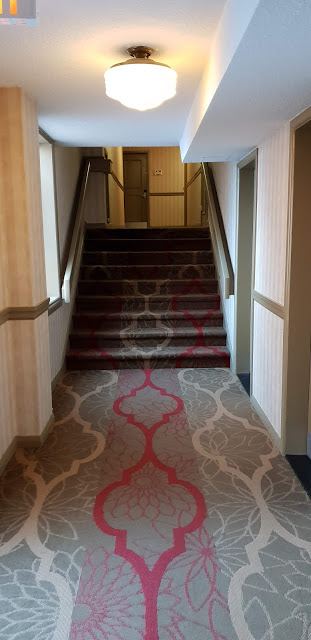
We’re staying at the Park Hotel, a heritage building, apparently built in the later 1920s. In the style of the time, it is a little like a rabbit warren with passages turning off in a number of directions, and showing it is spread across a number of different buildings.
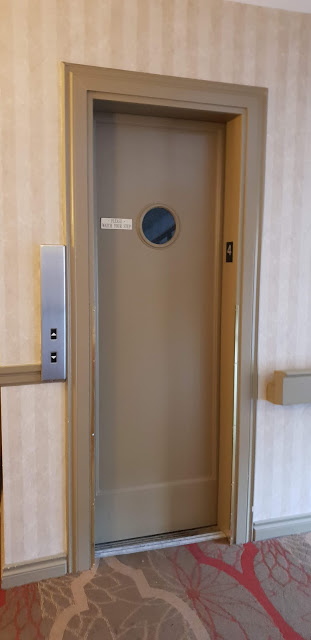
It has the original Otis elevator that can take a maximum of four passengers, and a sign on the wall that says “no horseplay inside the elevator” which is a rather interesting expression that only someone of my vintage would understand. And, for those without a sense of humor, you definitely couldn’t fit a horse in it to play with.
The thing is, how do you find a balance between keeping the old world charm with modern day expectations. You can’t. Some hotels try valiantly to get that balance. Here, it is simply old world charm, which I guess we should be grateful for because sooner rather than later it’s going to disappear forever.
In my writer’s mind, given the importance of the railways, this was probably a thriving place for travelers and once upon a time, there were a lot more hotels like this one.






 Thrills, Spills, and just a dash of Romance