In a word: birth

The most common use of the word, giving birth to a child, is perhaps one of the more miraculous and inspiring events ever to be witnessed.

But it can be used similarly in giving birth to an idea. More generally it could be said that it is the coming into existence of something, animate or inanimate.

It can be used to state lineage or descent, i.e. he was Italian by birth, or he was a Duke by birth, but a politician by trade.

You could use birth pain in other expressions like trying to get a club or team together, those initial stages where everything goes wrong.

And that old favourite, wanted by every man and his dog, what is your date of birth?

On the other hand, a berth is a place where a ship or boat ties up after a long or short voyage.

It’s also a bed on a ship, not necessarily in a stateroom, but could be in one of those shared cabins below the waterline that do not cost a lot, and only a place to sleep, or for some, to recuperate. It doesn’t necessarily have to be on a ship, it could be on a train.

It could be the distance between two ships or the shore.

You could also use it to describe your job or position in the company.

Then, you could say you gave the enemy’s camp a wide berth, or just a group of people we don’t want to pass in the street.

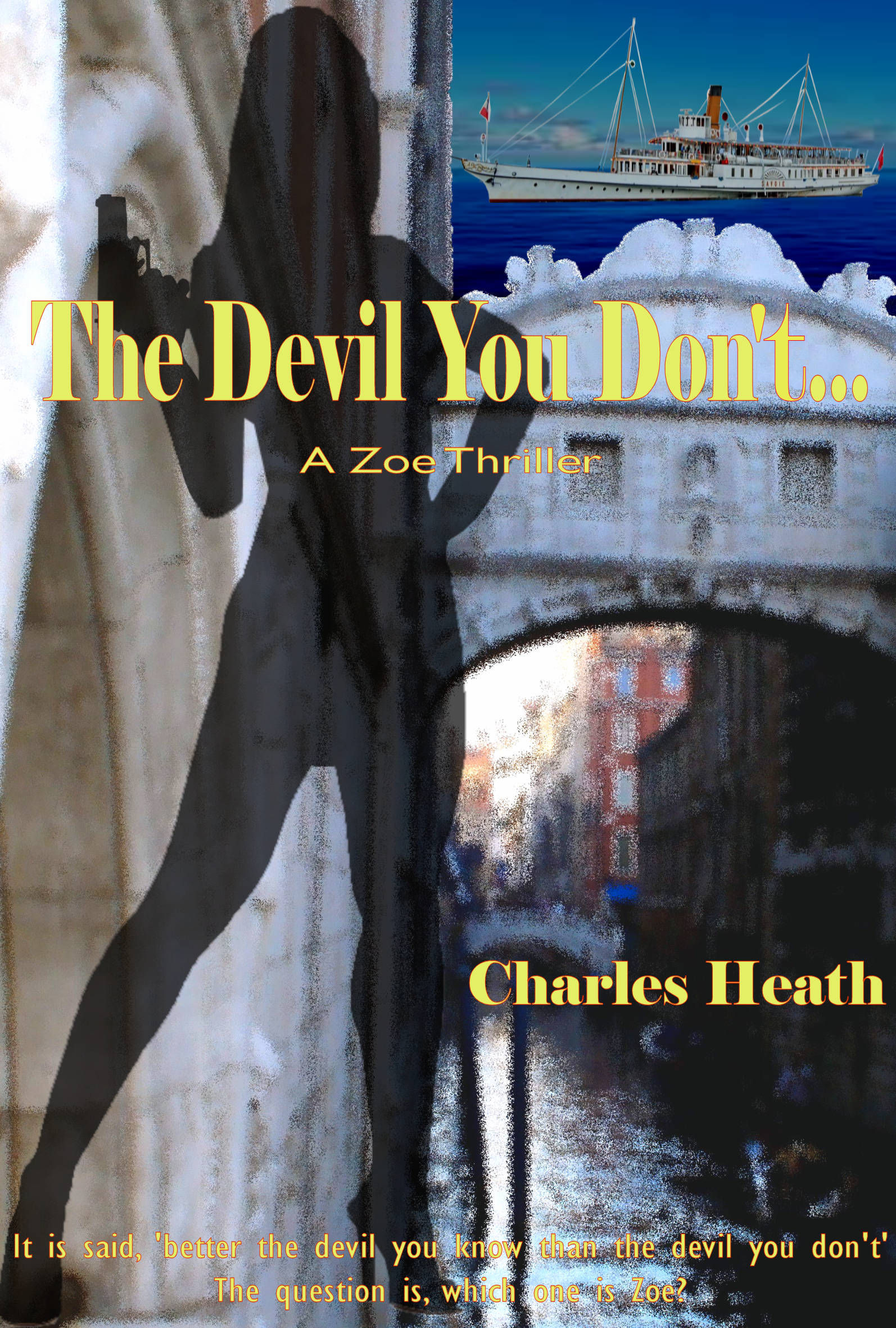
“The Devil You Don’t”, she was the girl you would not take home to your mother!

Now only $0.99 at https://amzn.to/2Xyh1ow

John Pennington’s life is in the doldrums. Looking for new opportunities, and prevaricating about getting married, the only joy on the horizon was an upcoming visit to his grandmother in Sorrento, Italy.

Suddenly he is left at the check-in counter with a message on his phone telling him the marriage is off, and the relationship is over.

If only he hadn’t promised a friend he would do a favour for him in Rome.

At the first stop, Geneva, he has a chance encounter with Zoe, an intriguing woman who captures his imagination from the moment she boards the Savoire, and his life ventures into uncharted territory in more ways than one.

That ‘favour’ for his friend suddenly becomes a life-changing event, and when Zoe, the woman who he knows is too good to be true, reappears, danger and death follow.

Shot at, lied to, seduced, and drawn into a world where nothing is what it seems, John is dragged into an adrenaline-charged undertaking, where he may have been wiser to stay with the ‘devil you know’ rather than opt for the ‘devil you don’t’.

newdevilcvr6

Writing about writing a book – Day 27

Well, it’s been a monumental process to get to the point where I think I can start writing Chapter One.

This, of course, might not be the first chapter, it might finish up somewhere else.

If there was a plan, then this would be chapter one.  In fact, right now, I’m going to sit down and do a plan with as much as I know about where the book is heading.

One, about Bill and his introduction to the reader

Two, a phone call to interrupt the dream

Three, having to go into work – there’s a disaster going on, and he’s the only one who can fix it.

Well, not necessarily others, but this is the nineteen seventies/eighties, and women were still not looked upon or considered as being able to hold the same position as Bill – we’ve certainly come a long way in forty years.

And that, of course, is anther stream in the book, proving that woman, and one in particular is clever and given the recognition she deserves.

I’ve also got to remember that there is no internet, and there are no mobile phones and a lot of other stuff that is now regarded as commonplace and taken for granted.

We had telephone boxes, telephones on desks that connected to a switchboard, dumb terminals connected to mainframes, modems that were bulky and very very slow, and comms ran very differently to those today, and networking was a variety of technologies that mostly don’t exist anymore, like ethernet and token ring, and software like 3Com and Novell.

I know I’m going to forget sometimes because it’s going to be hard not to have the MC pull out his cellphone and call on the spot.

Anyway, here’s the first attempt…


A cool breeze blew briskly across meadows of tall grass, giving the impression of the ocean in a storm.  High above, clouds scudded across the sky, occasionally allowing the sun to shine through to bathe the ground in the sunshine, intensifying the richness of the greens and browns.

It was spring.  Trees were displaying new growth, and flowers were starting to show the promise of summery delight.  An occasional light shower of rain added to the delightful aromas, particularly where the grass had recently been mowed.

I was there, too, with my grandmother, the woman who had, for the most part, brought me up at her country residence.  But, as I got older, the dream changed and sometimes there were storm clouds on the horizon, or I was caught in the rain, alone and frightened, or lost in the woods in the dark.

There were other visions like these from my childhood, now a million years away somewhere in a distant past that was hard to remember or say where and when they belonged.  It was a pity some were now based on images stolen from the start of a movie seen on TV late at night as I was trying to get to sleep.  Or that the psychiatrist had said there was some trauma from my early childhood, trying to work its way out.

Like every other morning, these images came to me as I was hovering somewhere between conscious and unconscious, just before the alarm went off.  Then it did, filling the room with a shrill noise that would have woken the dead.

I cursed, and then dragged myself over to the other side of the bed where I’d put the alarm clock, and hit it, killing the shrill sound.  I’d put it there so I would have to wake up to turn it off.  And, worse, I’d forgotten to turn it off the night before because it was, technically, the first day of my holiday.

Not that I really wanted one because since Ellen left, my life consisted of work, work, and more work.  It kept my mind off being alone, and in an empty apartment except for the books, a bed, a table, and two chairs, a desk, and a well-worn lounge chair.  I’d been there for years and still hadn’t bought any new furniture or anything else for that matter.

And the last holiday I’d gone on had been organized by Ellen fifteen years ago in Italy after our two daughters had finished school and graduated almost top of their class.  We’d been happier then, but happiness was fleeting for me, and soon after the rot had set in, and it was the beginning of the end.

I remembered it only too clearly, coming home, opening a letter addressed to her, and finding proof of what I think I’d known all along.  She was having an affair, had been for quite some time.

It should not have been a surprise given what I had put her through over the years, since my discharge from the Army, and the nightmares active service had fueled, but it was and sent me spiraling to a new low.

But that was five years ago.  I came out of the fog a year after that.  Ellen was gone, the girls came to see me from time to time, and all I had left were memories.

I rolled over and tried to go back to sleep.  I was on holiday.  No work, no pressure, nothing.  I could go back to my grandmother’s house and visit.  I had been promising myself I’d do that soon, even if it was now a country hotel.  From the advertising it had not changed one bit, the house and grounds intact.

Or I could throw a dart at a map and get on the next plane there, though knowing my ability with a dart, it would be in the middle of the ocean.

I could do almost anything I wanted.


It’s not much, just a taste.  But it’s enough for now.  I’ve made a start.  Now, all I have to do is come up with the next 100,000 words or so.


© Charles Heath 2016-2020

Trying to get off, or is that on, the merry-go-round

Self-published authors are fully aware that perhaps the easiest part of the writing journey is the actual writing.  Well, compared to the marketing aspect I believe it is.

I have read a lot of articles, suggestions and tips and tricks to market the book to the reading public.  It is, to say the least, a lot harder to market eBooks than perhaps their hard or paper-covered relatives.

This is despite the millions of eReaders out there.

Then there is that other fickle part of the publishing cycle, the need for reviews.

Proper reviews of course.

As we are learning, reviews can be bought, and in more ways than one.  What happened to finding writers of the same genre and offering to buy one copy and write a review in return for a buy one copy and write a review.

I’ve noticed that all the current best selling novelists do the same for their fellow novelists though I guess when you get to be a best-seller, you might not have to buy a copy, so I can only dream of attaining such lofty heights in the publishing world.

But until I reach such rarefied air, I guess I have to figure out how to appeal to my fellow writers, and, of course, hope that my work is good enough.

It might be a start in getting through that difficult cycle, more reviews means more sales, etc.  And getting those first sales and reviews  …

Therein lies the conundrum.  It is a question of paying for advertising or working it out for ourselves.  I guess if I were to get more sales, I could afford the advertising … yes, back on the merry-go-round!

And yet, the harder the road, the more I enjoy what I do.  It is exhilarating while writing, it is a joy to finish the first draft, it is an accomplishment when it is published, but when you sell that first book, well, there is no other feeling like it.

I am inspired.

Now as for that advertisement and where to post it…

The cinema of my dreams – I always wanted to see the planets – Episode 13

Our first contact didn’t go so well

As soon as I stepped off the shuttle in the cargo bay, the third officer was waiting for me.

“The captain asked me to escort you up to his day room.”

Unusual. The captain could have just called me on the private communicator if there was a need for secrecy, if that was what this was.

“Any reason why he would send you?”

“Didn’t want you getting lost, sir.”

I knew I should not have admitted to him that I had got a little confused finding my way around, but that was because the dockyard people had blocked off several passageways.

“No. I guess not.”

The Third was a man of little humour, and particularly didn’t think any of my jokes were funny. On station, he was all serious and unamused.

Now, he had his serious face on, and I thought it best not to ask what to expect.

He took a different route to the bridge than what I would have taken, a much shorter and more direct route. It was obvious he had studied the plans of the ship and knew it backwards. I on the other hand, was not that prepared, but it meant I would have to.

He went as far as the door to the day room, and left me there. I didn’t need to announce myself, the doors just opened, whisper quiet, showing me the room I could expect one day when I got my own ship.

Or at the very least, I could dream.

The doors closed behind me, and I walked forward into the room proper, and first saw the captain sitting at his desk, and then a figure standing beside and back a step, behind him.

There was a weapon in his hand, but it was by his side.

And something else I noticed, the figure looked just like the three I’d seen on the other ship.

The captain saw me looking at him.

“This is the captain from the vessel that just arrived as those assailants on the cargo ship were ‘rescued’.

He, or she, looked human under the clothes and helmet, but could be almost anything.

“Does he…”

“Speak our language, yes, and a lot of others. And he would like our help.”

© Charles Heath 2021

“The Price of Fame”, A Short Story

I looked at the invitation, a feeling of dread coming over me.  It was not entirely unexpected but like a great many things that had suddenly come into my life, it caused equal measures of fear and excitement.

The gold edging and the perfect script displaying my name in the exact centre of the envelope made it almost unique.  Very few people ever received such an invitation.

I held it in my hand for a longer than necessary, then put it down on the desk carefully, as if it would explode if I dropped it.

My first instinct, driven by fear, was not to accept.

But, fear or not, there was no question of me not attending.  Circumstances had painted me into a corner; I’d agreed to go a long time ago when I thought there was no chance it would come to pass.

Way back then, I had been compared to the aspiring painter in an attic having to die before I made any sort of impression.  In those days people thought it amusing.  I thought it was amusing.  Kirsty, in particular, had thought it was as impossible as I had.

Now it was not amusing.  Not even remotely.

My life was once quiet, peaceful, sedate, even boring.  That didn’t mean I lacked imagination, it was just not out on display for everyone to see.  Inspired by reading endless books, I had the capacity to transport myself into another world, divorced from reality, where my boring existence became whatever I wanted it to be.

It was also instrumental in bringing Kirsty into my life.  In reality, I thought she’d never take a second look at me, let alone a first.  So I pretended to be someone else.  Original, witty, charming, underneath more scared than I’d ever known.

And yet she knew, she’d always known and didn’t care.

As we spent more time together, she discovered I liked to write, not finish anything, just start, write a hundred pages, then lose interest.  Like everything I did.  Start, and never finish.

Why not?  It would never be published.  It would never succeed.

So she bribed me.  If I didn’t finish my first book and send it away, I couldn’t marry her.  It didn’t matter if it was rejected, all I had to do was finish a book, and send it.

The thought of marrying her had not entered my mind, because I hadn’t thought she would.  Incentive enough, I picked out one of the unfinished manuscripts and humoured her.  She read bits of it, not saying a word.  Sometimes she’d put a note or two on the manuscript, her equivalent to sweet nothings, and with it I gained inner confidence in my own ability, not only to write but in many other aspects of my life.

When it was finished, it was Kirsty who sent it off.  She read it, packaged it, addressed it, and sent it before I had a chance to change her mind.  Once gone, I heaved a huge sigh of relief.  It was done. That was, as far as I was concerned, the end of it.

It was not possible that one letter could change a person’s life so dramatically.  I came home to the all-knowing smile, and mischievous whimsicality that had always suggested trouble.

Trouble indeed!

My book was accepted.  With a cheque called an advance.  For more money than I knew what to do with.

This was followed not long after by publication.  And a dramatic change to my life, one I didn’t want.  To become a public person, to face an enormous number of people, people I didn’t know.

I went back to being scared.

Kirsty smiled at me and told me how wonderful I looked in my monkey suit.  Why couldn’t I go in jeans and a dress shirt?  All the best actors in Hollywood did it.

“This is not Hollywood.  You’re not an actor.”  It was a simple, practical, answer.

The hell I wasn’t.  I could act sick, dying, fake a heart attack, anything.  “What am I going to say?”

“You could talk about books.”  Quiet, efficient, oozing the confidence I didn’t feel.

She didn’t fuss.  She took it in her stride.  She dressed in her usual simple elegance, in a manner that made me love to be seen with her.  I couldn’t tie my tie, so she did it for me.  She straightened my jacket because I couldn’t do that either.  Nerves.  Can’t live with them, can’t live without them.  Or was that a reference to wives, or mistresses, or something else?

The palms of my hands were sweating.  Meatball hands, I thought, the sort of palms that betrayed the pretenders.  Me, I was the pretender.  My neck felt too large for the shirt.  Beads of sweat formed on my brow.  Where was a sponge when you needed one?

“I can’t do this.”

“You can.”

We hadn’t even left the hotel yet.

“How long before the execution.”

She looked at me with her whimsical smile.  “Long enough for me to give you a hard time.”

I lost count of the number of times I had to go to the bathroom, for one thing, or another.  Nerves I said.  Perhaps a dozen Valium or something similar.  Did I have any?  Had she hidden them?  Why did she keep smiling?

In the car, I looked at my watch at least a dozen times.  I couldn’t breathe.  It was too hot, too cold.  She held my hand, and it served best to stop the trembling that had set in.  Why did I agree to this?  Why?

We were greeted by the Events Manager, who was polite and genuinely interested.  He took us inside where he introduced the interviewer, another woman who oozed confidence and charm, who went over the format and generally tried to set me at ease.

I didn’t let Kirsty’s hand go.  Not yet.  She was my lifeline, the umbilical cord.  When it was severed, I knew I was going to die.

Bathroom?  Where was the bathroom?  Hell, five minutes to go, and I felt like passing out.  No, Kirsty couldn’t come in.  Comb my hair.  Straighten my tie, no it was straight.  Maybe I could hide in here?  I looked around.  No, maybe not.

Time.

The cue man was standing beside me, hand gently on my back.  He knew the score.  He knew I would turn and run the first chance I got.  Kirsty was on the other side, smiling.  Did she know too?

Then the announcement, my cue to walk on.

The gentle shove, the bright lights, the deafening applause, the seemingly endless walk to the chair, dear God, would I make it without tripping over?

How many times had I made this trip?  I stood, facing the audience, waved, then sat.  It was the fifteenth.  You’d think I’d learned by now.

There was nothing to it.

© Charles Heath 2016-2022
Searching for locations: The Bund, Shanghai, China

The Bund

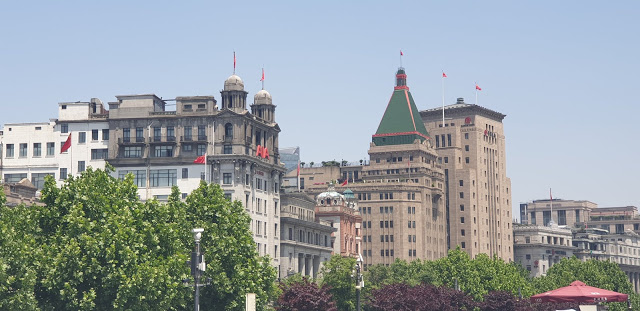
The architecture along the Bund or Waitan is a living museum of the colonial history of the 1800s.  The area centers on a section of Zhongshan Road within the former Shanghai International Settlement.

The word bund means an embankment or an embanked quay.   It was initially a British settlement; later the British and American settlements were combined in the International Settlement.

The Bund is a mile-long stretch of waterfront promenade along the Huangpu River. There are 52 buildings of various architectural styles, including Gothic, baroque, and neoclassical styles. The area is often referred to as “the museum of buildings”.

Building styles include Romanesque Revival, Gothic Revival, Renaissance Revival, Baroque Revival, Neo-Classical or Beaux-Arts, as well as a number in Art Deco style.

Having seen these buildings initially the night before, mostly lit up, our viewing this morning was from the land side, and particularly interesting in that the colonial architecture was really fascinating considering their location, but not surprising given Shanghai’s history.  A lot of these buildings would be more at home in London, that out in the far east.

The Bund waterfront is about two kilometers long and impossible to cover in the time allowed for this part of the tour.

There was just enough time to get photos of the waterfront and the old buildings.

Some of these buildings had odd shapes, like one on the far right that looks like a bottle opener.

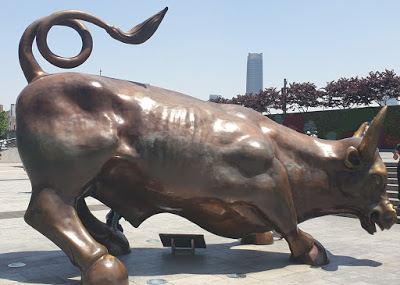
And, for some odd reason, a bull.

On the other side of the water, the sights that had been quite colorful the night before, were equally impressive though somewhat diminished by the haze.

Let’s talk history

What happened yesterday is history, but that’s not necessarily how we view what is history and what isn’t.

Similarly what is and what isn’t history is usually decided on by academics, because history texts that are used in schools are not written by ‘the man in the street’ authors. They’re usually university types who specialise in a particular field, or specialise section of history.

Even then one doubts that what is written is not a consensus of a panel.

So, when we talk about re-writing history, that takes a very brave bunch of people who want to buck the norm.

Our history, that which was taught when I went to school,. about our own country, Australia, started in 1770. Some brave soul tried to say it began earlier than that, before Captain Cook and the British arrived, out up a flag pole, and declared it belonged to Britain, like in 1606 when the Dutch explorer Willem Janszoon landed on the Cape York peninsula, only it wasn’t called that then.

And he might have been as surprised as Captain Cook that there were people here to observe their arrival. Yes, people had been living in this country for tens of thousands of years before the Europeans arrived.

But that was not what we were taught. No, Captain Cook, 1770, the a fleet of ships in 1788, and off we run as a new country, and a dumping ground for Britain’s convicts. Our history starts there, and then meanders through time, dividing the country up into states, having famous explorers like Burke and Wills, and Blaxland, Wentworth, and Lawson, Hume and Hovell.

And we commemorate all these people and those who were in charge over the years, with names of states, cities, rivers, mountains, everything under the sun. You’ve only got to glance at the list of hundreds of these forefathers and explorers to see just how many places in this country were named after them.

No heed was taken of what they may have been called before because no one really understood the languages of the first people who lived here. And they never seem to rate as a matter of study for us children back then.

Now, as people have begun to realise our history goes way, way back, and that there should be a nod to those inhabitants, they are considering re-writing some of our history to incorporate these people. And change the names of places to their original. A famous instance of recent renaming is of Ayers Rock, now called Uluru.

Even then, Australian History didn’t rate very highly, and I have to say, as a child at school 50 odd years ago, I learned more about the British Empire/Commonwealth, and about the English kings and queens, than we did about our own Governor Generals, Prime Ministers and State Premiers.

Could I tell you the name of our first Prime Minister? No. I can say when Australia became Australia, yes. 1901. Can I tell you the first King of England? Yes, William the Conqueror in 1066. There were kings before that but they only ruled of parts of England.

But over the years since I have read the odd book of Australian History but for some reason it never quite seems as colourful or as interesting as that of England or Scotland, or even some of the European countries.

Now, since I’ve been reading about what’s happening in the United States I have begin to take an interest in American history, and it, too, seems to suffer the same problems we have with ours, a bunch of academics decided what it was, and what it would not include, and then there is this thing called the 1619 project.

Wow, that seems to have stirred up a hornet’s nest.

Can’t wait to see what happens next.

The cinema of my dreams – Was it just another surveillance job – Episode 48

I’m back home and this story has been sitting on the back burner for a few months, waiting for some more to be written.

The trouble is, there are also other stories to write, and I’m not very good at prioritizing.

But, here we are, a few minutes opened up and it didn’t take long to get back into the groove.

Chasing leads, maybe


“You haven’t been truthful with me, have you?” 

That was Dobbin’s opening shot once we were in the car and out in traffic.  It was as if he was worried someone would be listening in on our conversation.

“Says the spider to the fly.  Isn’t it the nature of this business not to play all your cards at once?”

“You’ve been in this business all of five minutes.  You don’t get the right to play cards.”

“I’m still alive, no thanks to anyone but my own skill.”

I could see the disdain in his expression, and the annoyance in his eyes.  Perhaps he was a man used to getting his own way.  I was expecting a retort, but he said nothing.

“How many different organizations do you work for, or is it none, and you just have fake IDs to get you in the door?”

“Need to know.  Have you found O’Connell yet?”

“He’s dead.  I saw him killed in an alley.  I’m sure Maury and Severin had him shot, no coincidence they turned up just after he hit the ground.  I searched the body, there was nothing on it.  Before he was shot, he told me to speak to you.  I did.  Anything else I’m doing is for my own protection.  Assigning Jan to befriend me, then play me would have been a good plan if I hadn’t found out.  I know she found O’Connell’s other residence, but I’m willing to bet she found as much as I did nothing.  Your people do that to Maury?”

“In a manner of speaking.  He wasn’t going to talk, and we couldn’t let him back on the street.”

“And knowing that I would go back to the hotel, what were you hoping for, that I would get arrested for his murder?”

“We were hoping you would glean information from her handler, or the police.  Seems both are either tight-lipped, or they know nothing.  Her handler is an incompetent fool.”

“Where is she?”

“Waiting for you at her apartment.  I want the pair of you to find O’Connell.  He either has the information, or he knows where it is.  They found the charred remains of a body in the cafe where the explosion was, a freelance reporter, who, according to his editor, had the story of the century.  No other details, though.”

“That either means military or industrial secrets.  Why would the reporter want to meet with O’Connell?”

“That’s not your concern.”

“Well, you’re wrong if you think O’Connell had the USB.  He didn’t get inside the cafe before it blew up, I know, I was there, and witness the whole event.  You know the drill, he goes past, checking to see if the target is in place, then makes sure the location is clear, then goes back and facilitates the handover.  He only just got past the front when the bomb went off.  I’m sure you’ve seen the CCTV footage.”

Yes, his expression told me he had.

“So how do you come to the conclusion he still has it?”

Never cite logical arguments to a man who lives in a fantasy world.

“Law of averages tells me there is a copy, and O’Connell would have made sure there was a backup plan, and location.”

It then struck me, after having talked to O’Connell, and knowing Dobbin knew O’Connell was still alive because he had rescued him from the alley and Severin’s cleaners.  It was not just a matter of getting him to admit it, and the fact O’Connell had done a runner on him.

“You seem convinced O’Connell is still alive.”

He glared at me.  Truth or dare?

“Because he is.  The trouble is, he’s gone to ground and I can’t raise him.  He was supposed to wait a few days in a safe place while we hunted down Severin and Maury.  We had one, but not the other.  I doubt he’ll surface before he gets word that Severin has been neutralized.  Every hour that information is still out there, is the chance it will fall into the wrong hands, so we need him and the information found.”

“You think he’s gone rogue.”

“I don’t think anything.

The car stopped outside O’Connell’s apartment block.

“Place nice with Jan, and find him and the information.

I got out of the car and watched it rejoin the traffic.

Before heading to the front entrance, my phone rang.  Odd, because only two people knew my number, and it was neither of those two.

Curiosity overcame reluctance to answer.  “Yes.”

“I’m texting a meeting point.  Be there at six.”  The line went dead before I could say anything.  Four hours.

No doubting the voice.  Severin.  And he sounded scared.

I wondered if he knew what had happened to his partner in crime.

© Charles Heath 2020-2022

“Echoes From The Past”, the past doesn’t necessarily stay there


What happens when your past finally catches up with you?

Christmas is just around the corner, a time to be with family. For Will Mason, an orphan since he was fourteen, it is a time for reflection on what his life could have been, and what it could be.

Until a chance encounter brings back to life the reasons for his twenty years of self-imposed exile from a life only normal people could have. From that moment Will’s life slowly starts to unravel and it’s obvious to him it’s time to move on.

This time, however, there is more at stake.

Will has broken his number one rule, don’t get involved.

With his nemesis, Eddie Jamieson, suddenly within reach, and a blossoming relationship with an office colleague, Maria, about to change everything, Will has to make a choice. Quietly leave, or finally, make a stand.

But as Will soon discovers, when other people are involved there is going to be terrible consequences no matter what choice he makes.

https://amzn.to/2CYKxu4

newechocover5rs