In a word: Clip

It was in the news, and seemed odd to me, that a word such as clip would have any significance beyond that of having a haircut, but apparently, it does.

Maybe they’re referring to the clip of ammunition for a gun?

But for us, a clip can be part of a haircut, letting the scissors loose.

And for those children who had a father who was a hard taskmaster, you would be familiar with a clip around the ears.  It can just as easily be used, say when a car clips another car when the driver loses control.

There’s a horse that runs at a fast clip, and can be anything for that matter that moves quickly.

It can be a spring-loaded device that holds all your papers together.  Or just about anything else for that matter.

You can clip an item from a newspaper, aptly known as a news clipping.

it can be a portion of a larger film or television programme, but to me, sometimes, when a series has a clip show, an episode where someone reminisces and we see clips from previous episodes.

And last but not least, clip the wings of those so-called high flyers at the office.

Inspiration, maybe – Volume 1

50 photographs, 50 stories, of which there is one of the 50 below.

They all start with –

A picture paints … well, as many words as you like.  For instance:

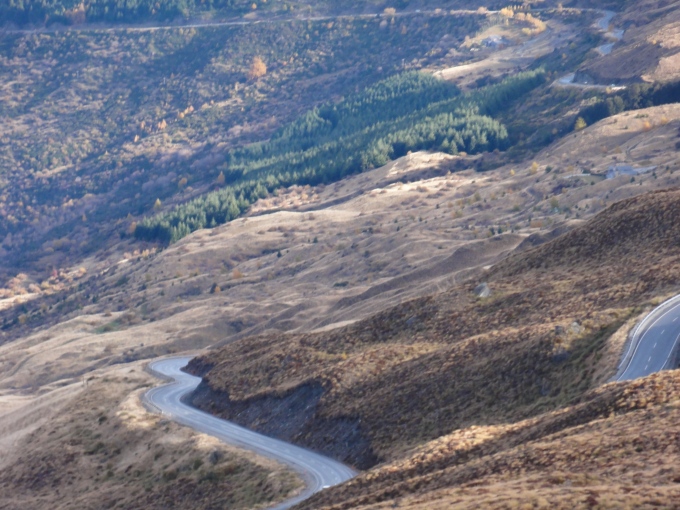
lookingdownfromcoronetpeak

And the story:

It was once said that a desperate man has everything to lose.

The man I was chasing was desperate, but I, on the other hand, was more desperate to catch him.

He’d left a trail of dead people from one end of the island to the other.

The team had put in a lot of effort to locate him, and now his capture was imminent.  We were following the car he was in, from a discrete distance, and, at the appropriate time, we would catch up, pull him over, and make the arrest.

There was nowhere for him to go.

The road led to a dead-end, and the only way off the mountain was back down the road were now on.  Which was why I was somewhat surprised when we discovered where he was.

Where was he going?

“Damn,” I heard Alan mutter.  He was driving, being careful not to get too close, but not far enough away to lose sight of him.

“What?”

“I think he’s made us.”

“How?”

“Dumb bad luck, I’m guessing.  Or he expected we’d follow him up the mountain.  He’s just sped up.”

“How far away?”

“A half-mile.  We should see him higher up when we turn the next corner.”

It took an eternity to get there, and when we did, Alan was right, only he was further on than we thought.”

“Step on it.  Let’s catch him up before he gets to the top.”

Easy to say, not so easy to do.  The road was treacherous, and in places just gravel, and there were no guard rails to stop a three thousand footfall down the mountainside.

Good thing then I had the foresight to have three agents on the hill for just such a scenario.

Ten minutes later, we were in sight of the car, still moving quickly, but we were going slightly faster.  We’d catch up just short of the summit car park.

Or so we thought.

Coming quickly around another corner we almost slammed into the car we’d been chasing.

“What the hell…” Aland muttered.

I was out of the car, and over to see if he was in it, but I knew that it was only a slender possibility.  The car was empty, and no indication where he went.

Certainly not up the road.  It was relatively straightforward for the next mile, at which we would have reached the summit.  Up the mountainside from here, or down.

I looked up.  Nothing.

Alan yelled out, “He’s not going down, not that I can see, but if he did, there’s hardly a foothold and that’s a long fall.”

Then where did he go?

Then a man looking very much like our quarry came out from behind a rock embedded just a short distance up the hill.

“Sorry,” he said quite calmly.  “Had to go if you know what I mean.”

I’d lost him.

It was as simple as that.

I had been led a merry chase up the hill, and all the time he was getting away in a different direction.

I’d fallen for the oldest trick in the book, letting my desperation blind me to the disguise that anyone else would see through in an instant.

It was a lonely sight, looking down that road, knowing that I had to go all that way down again, only this time, without having to throw caution to the wind.

“Maybe next time,” Alan said.

“We’ll get him.  It’s just a matter of time.”

© Charles Heath 2019-2021

Find this and other stories in “Inspiration, maybe”  available soon.

InspirationMaybe1v1

Writing about writing a book – Day 6

It’s been a long morning, and I sleep in.  I think the extra time is warranted because I wrote until there was nothing left in the tank.  Then, I let the plot unfold in my mind as I slept.

I had a dream.

I have IT experience.  I know the how hard it was, in the early days of networking, to get it right.  And all of the factors that have to be in place to keep it working.

I become Bill Chandler.

Servers, server software, wiring, Ethernet. Internet, wan, lan, hub, switch, meltdown.   The days when desks had terminals, not personal computers, and then the sudden disappearance of the mainframe, to local area networks.

The bottle of Scotch in the bottom drawer of the filing cabinet (in the days when occupational health and safety was not so strictly enforced) for celebrations when it worked, or commiserations when it didn’t.

So, today I’m expanding on the plot lines:

Chandler, recently divorced, and now on his first holiday on his own, contemplated what he’s going to do.  It doesn’t last long and is recalled to the office to manage a crisis.

Back in the office, Benton unavailable, Chandler goes to see Aitchison, Security chief.  There he learns of Richardson’s murder, of which suicide, the police theory, the least likely cause, and that of Halligan, whose death is also questionable.  There is also a question over the computer network and that of another running within their current system.  This is something Chandler knows nothing about.   There is a way of finding out if such a network existed.  Meanwhile, the implications are frightening, and Aitchison is clearly afraid of something.

OK, another character has popped up, Halligan, but we’ll worry about that later.

Back on familiar territory, Chandler gets down to the job of finding out what information he can.  Before beginning the physical search, he is questioned closely by Gator, the policeman, on external communications involving their computer systems.

OK, that’ll need a bit of background on Gator and what information he has.

After Gator departs, Chandler goes to find Jennifer.  By now, the whole network is down and they discover several servers have been tampered with, in fact, the very ones believed to be the gateway to the ‘hidden’ network.  Alas, the evidence had been removed.

Deciding there was nothing that could be done because the maintenance contractors have been called in, Chandler and Jennifer go to lunch.  Chandler runs into a very frightened Aitchison who cryptically says he fears for his life.  About the same time shots are fired, Aitchison is killed, and Chandler seriously wounded.

Wow, I’m getting better at this planning stuff, though it’s early days yet.  There are several ideas about the ramifications of Bill getting shot, but that can wait till later.

Time to flesh this plotline out in words.

Doesn’t look like Sunday is going to be a day off.

© Charles Heath 2016 – 2023

The day is disappearing, and nothing is getting done


Do you have days when you feel like you’ve achieved nothing, even after getting through what might appear to be a lot?  It’s the ancillary stuff that’s the bugbear of anyone who simply wants to get on with what’s important, and that’s writing.

You know, sit down in front of a blank page on the computer, for on your writing desk, if you have one, ready for the words to come.

Except there’s the email to check.

Then there are ads to be sent out on Twitter and the general Twitter feed to look at just to keep up with what’s happening out there.

Then there’s the news usually that arrives on my desktop computer, the feed from the major papers around the world, for me, the New York Times, in the US, the Times in The UK and the Australian, in my country.

And, dammit, each has a challenging crossword that I really don’t have time to do, well, not in the morning.

Then there’s the stuff that has to be done around the house, I’m home but my wife still works so there’s washing, cooking, and domestics to be done which eats into the day.

Sometimes it’s not until mid-morning before I get to sit down with a cup of tea.

The point is, it’s not conducive to writing during the day because you can’t get a run at it, time enough to think about what you’re going to write before committing it to paper.

That is, before the phone rings with another scammer, and breaks your concentration.  Right, I hear you, cut the phone off.

So, three phone calls later, I’m about to give up.  It’s time to get the dinner on with family coming.  Perhaps I’ll have a few bottles of beer instead.

This is why I write at night, sometime after ten.  No phone calls, no distractions.  Well, that’s not necessarily true because what you didn’t get done earlier had a way of backing up if you don’t get through it in a timely manner.

Perhaps I’ll get a blog post or two done, another episode of the trip to China, upload another photo to Instagram and look at the current novel I’m in the middle of editing.

By that time it will be two am, way past anyone’s decent time to go to bed.  In fact, it’s ten past two, and I’ve got an early morning.

The cinema of my dreams – I always wanted to write a war story – Episode 37

For a story that was conceived during those long boring hours flying in a steel cocoon, striving to keep away the thoughts that the plane and everyone in it could just simply disappear as planes have in the past, it has come a long way.

Whilst I have always had a fascination with what happened during the second world war, not the battles or fighting, but in the more obscure events that took place, I decided to pen my own little sidebar to what was a long and bitter war.

And, so, it continues…

Johannsen hadn’t signed up for this. He’d been in the room when Leonardo reported to Wallace, to tell him that the villagers had been neutralised, and he brought the ring leaders of the so-called resistance to the castle.

By his reckoning, Leonardo and his men had killed probably 20 or so people who had nothing to do with the war, other than try to live around the war going on in their backyard.

In fact, when he had arrived at the castle, the intention was to work with the locals and the resistance to facilitate the onward movement of prized defectors. Until Jackerby arrived, and the dynamic changed.

Johannsen hadn’t realised that Wallace was a double agent, not until it was too late.

The thing of it was, Wallace thought he was a double agent too, a belief Johannsen had taken extreme care not to dispel. And, where it was possible, he had tried to help those caught up in Wallace’s trap.

Wallace was already in situ at the castle when Johannsen arrived with another four men to join those already there, on order from London to vet the incoming defectors. Those four he had met at the plane, and he hadn’t realised they were not who they were supposed to be. By the time the four who had been replaced were found, it was too late to stop the mission.

That brought the complement to 10 including Wallace and himself. Then he received a message, one he assumed was from Thompson, advising the arrival of a further 5, Jackerby and four soldiers.

He soon discovered that those orders were false.

When Jackerby reported to Wallace, and the fact Wallace sent him out of the room, he stayed behind, hidden, to listen to the conversation. There he discovered he was in the midst of an enemy operation that had enlisted a number of double agents across Euprope from the German Army.

He then tried to warn Thompson in a coded message, but that had been substituted by Wallace with another, causing another lamb to be sent to the slaughter, Atherton. When Jackerby first arrived, he advised Wallace, not Johannsson, that Atherton was not one of them, so an attempt was made on,his life, but failed.

For a while that was the equivalent of throwing a cat among the pigeons.

By the time the paratroopers arrived, there was no effort to hide who they were or what they were doing. The castle was, for all intents and purposes, a Nazi stronghold, there to collect and execute defectors. All he had to do was play his part, and try not to rouse the suspicions of Jackerby, whom, it seemed, trusted no one.

Wallace wasn’t all that interested in being as suspicious as Jackerby, who had to be gestapo, or worse, one of the SS.

But luck was on Johansson side when he took a plan to Wallace that would essentially free Atherton, and then have Atherton lead them to the other resistance. It was also a master stroke to select Burke, a simple man who liked to think everything was his idea.

That Atherton had got away was no fault of his, but those charged with following him. Jackerby had tried to mess with him, but Wallace intervened, telling Jackerby that he had had missing people too and should be out there looking for them.

With any luck, Johansson thought, they would be dead, a likely result since none of them had come back yet.
Now, all he could do was sit and wait for Atherton and whoever was left from the resistance to come and stop Wallace, and especially Jackerby.

Johansson knew that Atherton had a good working knowledge of the castle’s architecture, because on one occasion they had discussed archaeology. Johansson was not an archaeologist, but had worked with one and an assistant, before the war, at several digs.

He was hoping Atherton had a idea where there might be a secret entrance to the castle. It was old, and in his spare time, he had been pacing out room measurements, looking for nooks and crannies, and anything else that would be useful.

He had found a room full of swords, not exactly in fighting condition, but might be useful in a situation that called for a weapon. After all, he had taken a few sword fighting lessons at the university.

He had traversed several stone passageways, found two different passageways from the upstairs down to the radio room, and beyond that, where there was an exit or entrance, what in modern terminology would be called the tradesman’s entrance.

It was for all intents and purposes, a back door.

He had also gone around the whole perimeter of the outer castle wall, looking for holes. When he thought about it, leaving holes in the wall was asking for trouble because the idea was to keep people out, not to leave quickly and quietly in the middle of a siege.

And this castle had seen a few sieges in its time. More than once if he could travel back in time, he would have like to see what it was like 200 years ago, or more.

But there were only three entrances or exits that he knew of. There were no grates on the ground, or anywhere within 20 yards of the exterior wall, or conveniently hidden in the surrounding forests.

He was also sure there were hidden passageways inside the castle that must go somewhere, a result of checking internal measurements of rooms, and a few came up oddly short a few yards.

Still down in the dungeon on another of his subterfuges, the new arrivals guard had just appeared.

“The woman is awake.”

“Thanks.”

Now, if he could just get some sense out of her.

© Charles Heath 2020-2021

Mistaken Identity – The Editor’s Draft – Day 30

I have been working on the story, the editor is asking for a second draft after making suggested changes – and I’m now working on it

It’s over, done, but not dusted.

The writing might be done, but to get through nearly 70,000 words in 30 days is quite an achievement.

It’s been a battle, and time management has been shot to hell more than once.

There were days I honestly believed I’d get nothing done. I don’t know how people who have a day job could ever get much writing done at night.

I’m looking forward to a few day’s rest, and not having to face the word processor ready to input words.

As for how it finishes, I hope, will get past that ever-inquisitive editor. Even so, the end is in sight, it may change but not substantially, and I will add a soon to tell everyone what the editor thinks.

As for now, that’s it!

Today’s effort amounts to 3,676 words, for a total, so far, of 72,594.

No more tomorrow.

Searching for locations: Venice, Italy (Again)

We have visited Venice twice, in 2006 and not so long ago.

Not much had changed from visit to visit.

Instead of staying in a hotel selected by a travel agent, the Savoia and Jolanda on the waterfront of Riva Degli Schiavoni, because I’m a Hilton Honors member, more recently we stayed at the Hilton Molino Stucky.  It was located on an island, Giudecca, and had its own transport from the hotel to St Mark’s Square for a very reasonable one-off charge for the stay.

hiltonmolinostuckey2

On our first visit, we traveled from Florence to Venice.  We were advised to take a water taxi to the hotel, not only the most direct route but to see some of Venice from the water.  The only drawback, you have to negotiate a price with the driver.

We were not very good negotiators, and it cost 60 Euros.

But, despite the cost, it was worth every Euro because the taxi driver took us by the scenic route, directly from the Station to the doorstep of our hotel.  For a first time in Venice, and you want to see it from the water, a water taxi is the best option.

2013-06-25 17.09.16

The first time we stayed at the Savoia and Jolanda Hotel, which was at the time quite old, and the room we had, on the ground floor, was comfortable enough, but being November, they had just stopped using the air conditioning, it was still quite warm and at times uncomfortable.

There were better rooms, but this was beyond the knowledge of the travel agent, and one of the reasons we stopped using agents to book hotels.

The most recent visit we had driven down from Salzburg to Venice airport where we had to return the hire car.  From there we were intending to take a private water taxi from the airport to the hotel, for an estimated 120 Euros.

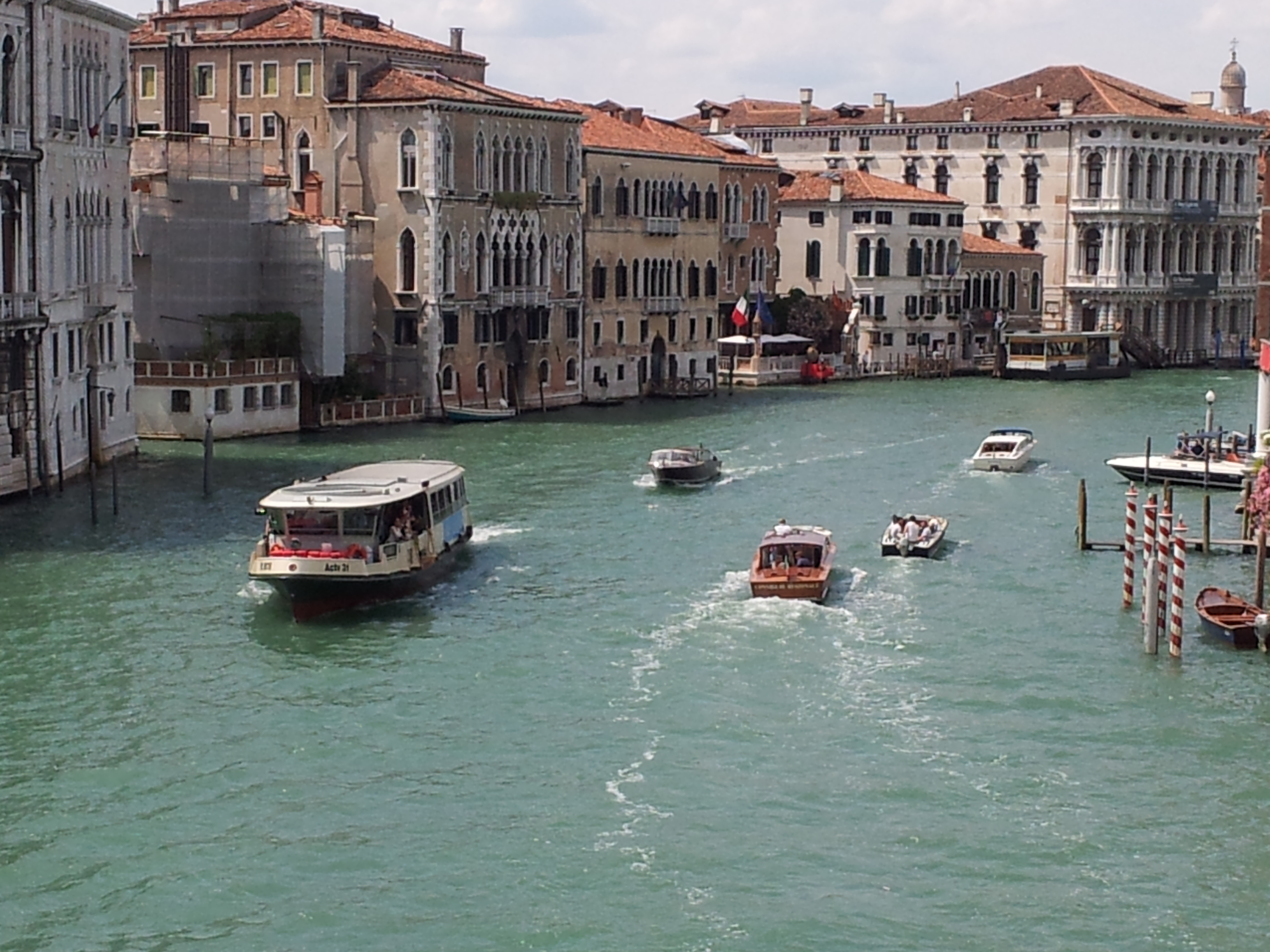
We saved our money and took the ACTV public waterbus, from the airport to the hotel, with one stop.  It took a little over an hour and was equally as scenic.

venicecanals1

Our room in the Hilton was on one of the upper levels, floor four, and had a view of the canal, the large passenger ships coming and going, as well as a remarkable view of Venice itself as far up the canal to St Marks Square in one direction, and the port for the passenger ships in the other.

20130627_081601

We got to see three or four very large passenger ships come and go, along with a lot of other craft.  I hadn’t realized how busy the waterways, and the Grand Canal, were.

20130627_174408

Each evening after a day’s exploring we would end up in the Executive Lounge, and then one of the many restaurants, usually Il Molino for breakfast, and the Rialto Lobby Bar and Lounge for dinner.  After that, it was a stroll down the waterfront taking in the night air, and perhaps to walk off the delicious dinner.

Having something to say is one thing, saying it is something else

As accomplished as we can be at putting words on paper, what is it that makes it so difficult to sit in a chair with a camera on you, and say words rather than write them?

Er and um seem to crop up a lot in verbal speech.

OK, it was a simple question; “What motivates you to write?”

Damn.

My brain just turned to mush, and the words come out sounding like a drunken sailor after a night out on the town.

The written answer to the question is simple; “The idea that someone will read what I have written, and quite possibly enjoy it; that is motivation enough.”

It highlights the difficulties of the novice author.

Not only are there the constant demands of creating a ‘brand’ and building a ‘following’, there is also the need to market oneself, and the interview is one of the more effective ways of doing this.

If only I can settle the nerves.

I mean, really, it is only my granddaughter who is conducting the interview, and the questions are relatively simple.

The trouble is, I’ve never had to do it before, well, perhaps in an interview for a job, but that is less daunting.  That usually sticks to a predefined format.

Here the narrative can go in any direction.  There are set questions, but the interviewer, in her inimitable manner, can sometimes slide a question in out of left field.

For instance, “Your character Zoe the assassin, is she based on someone you know, or an amalgam of other characters you’ve read about or seen in movies?”

That was an interesting question, and one that has several answers, but the one most relevant was; “It was the secret alter ego of one of the women I used to work with.  I asked her one day if she wasn’t doing what she was, what she would like to do.  It fascinated me that other people had the desire to be something more exotic in an alter ego.”

Of course, the next question was about what I wanted to be in an alter ego.

Maybe I’ll tell you next time.

The cinema of my dreams – Was it just another surveillance job – Episode 17

As we all know, writing by the seat of your pants is almost the same as flying by the seat of your pants, a hazardous occupation.

As it happens, I like writing this way because like the reader, I don’t know what to expect next.

And equally, at times, you can write your self into a corner, much like painting, and then have to go back, make a few changes and//or repairs and then move forward.

It’s part of the writing process, only in this case, the changes occur before you’ve finished the novel, if you finish.  Quite often a lot of writers get only so far, then the manuscript hits the bottom drawer, to be brought out on a distant rainy day.

Or your cat has mocked your writing ability one too many times.

Therefore, we’re winding back to Episode 16, and moving forward once again, from there.

Why didn’t it surprise me that Nobbin was playing all ends against the middle if that was the expression?  What really bothered was that he wasn’t prepared to tell me the truth or trust me to help find the missing information.  But he had known I might become interested and do some investigating of my own.

Perhaps Nobbin feared Severin might track me down, as he had, and if I had found the USB, run the list of losing it to his foe.

Nor was it a surprise that someone else, namely Severin, was after the information, and he would have access to everything Nobbin did, and he was equally disadvantaged.  It was either Severin or one of his agents, that was caught in O’Connell’s flat and found ‘Josephine’ there.

I didn’t believe her name was Josephine, or that she lived in the flat next door.  And I didn’t think Severin had found anything going by the way the flat had been turned over, and the fact it looked like no one had lived there.

Having now dealt with both men, I was still on the fence about who was on the right side and who was on the wrong side, or whether they were both of questionable character.  What made it difficult to understand was how Severin could run an operation inside the organisation.  Surely someone knew about it, or from a high level, sanctioned it?

Knowing I would not be interrupted this time, I went back up to the third floor, and into O’Connell’s flat, a simple job since the front door was still unlocked.  The girl had assumed it was no value to them which told me she had already searched the place before being attacked.

Just in case anyone was likely to return, or there was another party interested in O’Connell, I locked the door from the inside.  At least no one had yet crashed through the door, smashing the lock and timber.

I stood in the middle of the main room, and did a slow 360-degree turn, looking at everything intently.  The thing with searches like this, it was more likely the object of any search was hidden in plain sight.  The usual places, such as the freezer, sections of fridges, stashed in bottles or packets in the pantry, under beds, inside mattresses, pillows, or under blankets, or with a form of glue on the inside of televisions or computers would prove fruitless.

We were taught to hide things such as USB sticks where they would be least expected to be found, such as a toy on a keyring, tossed in a bowl of pens, pins, clips, or other small insignificant items that all looked uninteresting.

My first thought was in the pocket of a coat in the closet, but all his clothes were strewn over the floor in the bedroom showing signs of being turned out.  Perhaps the searcher or searchers had thought like me.

There was no keyring in the kitchen or the bedroom, no was there any sort of stand inside the door, a place to put mail, and other items such as keys.  If there were any, they would have been on him when Severin had him killed.  I had not found, not felt, any in his pockets, not unusual for an agent in the field.  If you were captured or killed, you wanted nothing on you that could identify you or what you were doing.

Next I thought, a hidden compartment.  I was not going to predict he had a safe in the flat, but just in case, I did search thoroughly where one might be located.  The cheap watercolour on the wall hid nothing but some discoloured wallpaper.

I checked all the skirting boards, and inside walls of the robes, but there was nothing.  I also checked the robes thoroughly for false backs, or sides, or compartments hidden in the roof.  The floor was made from wood, so I checked to see if there were any loose boards, but in the end, considered that was a ruse used only in the movies and on television.

An hour later, I was no wiser as to where it could be, if at all, in the flat, but, looking around, it was certainly now a little more organised because in checking everything in case the previous searchers had missed anything, I’d put everything neatly in stacks.

And, no, there was nothing under the bed.  The previous searchers had thought of that too.

But, in one corner of the main room, there was a desk that had been completely turned out, papers were strewn everywhere.  There had been a computer, now missing, because there was a cable running from the printer, and a power cable in the wall, both running into thin air.

The papers yielded nothing of interest, other than he was researching a holiday to Russia and Poland. 

For two.

A break.  There was a significant other.  I made a more serious search of the papers that I’d gathered up off the floor and found a shred of a quickly torn up piece of paper, of which only this piece remained.  A name:  Jan, scribbled on it, with half another word ‘ord’.

Did this Jan also live in this block?  Did she work at the same place?  There were a hundred variations of that theme, but it was a start.  He might have trusted the USB to her safekeeping without telling her what it was, and it was possible she didn’t know he was dead.

I’d noticed that O’Connell’s death had been reported as a John Doe on the wrong end of an alleged mugging, the small dismissive paragraph on page seven reported the body was missing when police went to investigate a pool of blood in an alley, along with several other crimes of which police were seeking further information.  That alley hadn’t any CCTV cameras, so Severin knew he could easily shoot O’Connell without anyone knowing it was him.

There was nothing else of interest in the documents, other than the holiday, if it was a holiday, was to be in a month’s time.

My work was done.  I had a lead.  It was time to leave.

Except for one small problem.  Someone was knocking on the door.

© Charles Heath 2019-2022
“One Last Look”, nothing is what it seems

A single event can have enormous consequences.

A single event driven by fate, after Ben told his wife Charlotte he would be late home one night, he left early, and by chance discovers his wife having dinner in their favourite restaurant with another man.

A single event where it could be said Ben was in the wrong place at the wrong time.

Who was this man? Why was she having dinner with him?

A simple truth to explain the single event was all Ben required. Instead, Charlotte told him a lie.

A single event that forces Ben to question everything he thought he knew about his wife, and the people who are around her.

After a near-death experience and forced retirement into a world he is unfamiliar with, Ben finds himself once again drawn back into that life of lies, violence, and intrigue.

From London to a small village in Tuscany, little by little Ben discovers who the woman he married is, and the real reason why fate had brought them together.

It is available on Amazon here:  http://amzn.to/2CqUBcz