In a word: Land


And, yes, the simple description for this word is that area of the earth that isn’t covered by water.

It could also describe that little patch that my house is built on, and is generally covered by the expression, house and land as a package.

After all, a piece of land is not much used to you unless there’s a dwelling on it, or, on rare occasions, under it.  Does that mean then that land in this instance only as what you can see?

OK, now it’s getting confusing.

What if I wanted to live off the land.  A small patch will not do, in this case, is need a large area, perhaps thousands if hectares.

It is said that the Australian aborigines have lived off the land for thousands of years, with a nomadic lifestyle.

No small patch of land for them.

Now, what if I come down out of the sky. Oddly enough this means I have to land, even if I come back to earth over later.  It’s still a landing.

Now it’s getting interesting.

So what if you wanted to refer to where you live?  That would be your homeland or motherland, and it describes a country.

So it’s my patch, my country, any area where there isn’t water.  What about describing a country, say the land of the long white cloud, or the land of the rising sun?

And just to add to the confusion

I can land a fish

Make land, after being all at sea, and,

Best of all, land that much desired job.

Wow.

I’m beginning to think it’s another one of those ‘four-letter words’

“The Devil You Don’t”, she was the girl you would not take home to your mother!

Now only $0.99 at https://amzn.to/2Xyh1ow

John Pennington’s life is in the doldrums. Looking for new opportunities, and prevaricating about getting married, the only joy on the horizon was an upcoming visit to his grandmother in Sorrento, Italy.

Suddenly he is left at the check-in counter with a message on his phone telling him the marriage is off, and the relationship is over.

If only he hadn’t promised a friend he would do a favour for him in Rome.

At the first stop, Geneva, he has a chance encounter with Zoe, an intriguing woman who captures his imagination from the moment she boards the Savoire, and his life ventures into uncharted territory in more ways than one.

That ‘favour’ for his friend suddenly becomes a life-changing event, and when Zoe, the woman who he knows is too good to be true, reappears, danger and death follow.

Shot at, lied to, seduced, and drawn into a world where nothing is what it seems, John is dragged into an adrenaline-charged undertaking, where he may have been wiser to stay with the ‘devil you know’ rather than opt for the ‘devil you don’t’.

newdevilcvr6

Writing about writing a book – Day 7 Continues – Jennifer

Jennifer again.

From Bill Chandler’s perspective,

She was a good worker, but extremely private.  Her path had been clear; work, no play, and avoid everyone.  I’d seen her deal with executives and office boys alike, and put up barriers that no one could penetrate.  She made herself deliberately unattractive and unapproachable for reasons unknown.

Over time I tried to penetrate that steely exterior with moderate success, trying to get to know her better.  And, in doing so I discovered she apparently had a bad experience early on in life with someone, and it had affected her deeply.

Of course, it didn’t progress much more than that one admission, not until the divorce.  It was long and problematical because Ellen had chosen to go the hard route rather than just call it off, perhaps to make me realize just what I had put her through.  The sad fact was, there was nothing I could do to make it right, now or in the future.

But because of that, and because it seemed to Jennifer that I needed someone to ‘lean’ on in my time of trouble, she became the only person I could talk to.  It wasn’t difficult.  We were both working long hours in each others company, and neither of us had a desire to go home.

Then three months ago, something happened and everything changed. 

Well, it changed between us, but to the outside world, no one would ever know.  That didn’t mean we hadn’t been friends of a sort before that, it was just we were, well, I don’t think I could describe it.  All I know is I knew my feelings for her had changed, or perhaps they were the same, and she had changed.  Whatever it was, I was glad.  Ellen had been dragging me down for so long; just being with Jennifer was like a breath of fresh air.

I found I could pour out the details of my sad and undistinguished life to her.  She was the one and only person to whom I could talk freely.  And, all of a sudden, apparently I was the only one she could talk freely to too.  From that point, we had become a different sort of friends, and, in the last week or so, a little more than that.

Our last encounter had been interesting to say the least.  I was still not sure of what I said, or how it ended, other than I had apologized to her the Friday night before we parted.  I hadn’t exactly wanted any vacation days, they were thrust upon me, but perhaps it was fortuitous in that it would give us both time to consider our relationship.

After Ellen, I hadn’t thought about getting involved in a relationship, or anything else for that matter, but it seemed that was where Jennifer and I could finish up, despite the fact neither of us were realistically looking for anything other than a friendship.

That very subtly changed on that Friday night.

Now I’d been thrust back into the fire, and I wondered just how I would feel seeing her. 


Jennifer is an important character in several ways, as a friend to Bill, and in a way, connected to him in a way he doesn’t yet know.  She will also have some impact when his past finally catches up with him.

I’m still working on her character background, but more will follow soon.

She is about to change, especially in the eyes of Bill.


© Charles Heath 2016-2019

Going to church on Sunday

This is my least favored option for spending a Sunday morning, but having married a Catholic and agreeing to adopt Catholicism, it’s one of those things that has to be done on rare occasions, usually a child’s milestone.

Yes, we went through our children’s moments like baptism, first communion, and confirmation, or these days in a somewhat different order.  Then it came to the turn of our grandchildren and today the last child is making her first communion, and there will end our involvement till the last rites.

Hopefully.

Church to me doesn’t hold any real significance.  It doesn’t mean that I would debunk the idea of religion and I firmly believe that if anyone believes in God, then that’s their right.

And it seems there are a lot of believers.  I’m sitting in the church now and it is packed.  It might be that it’s a captive audience given that it’s a first communion for grade three students and others. but given the enthusiasm of the children involved, I’d say the church was about to get over a hundred new followers.

Of course, a lot depends on the enthusiasm and devoutness of the parents who may wish to spend their Sundays in a different manner, but I suspect there are many here who will continue their devoutness in some form or other.

As for me, sadly, I will continue to use the only day of the week it’s possible to sleep in.

The cinema of my dreams – I always wanted to write a war story – Episode 39

For a story that was conceived during those long boring hours flying in a steel cocoon, striving to keep away the thoughts that the plane and everyone in it could just simply disappear as planes have in the past, it has come a long way.

Whilst I have always had a fascination with what happened during the second world war, not the battles or fighting, but in the more obscure events that took place, I decided to pen my own little sidebar to what was a long and bitter war.

And, so, it continues…

Leonardo was a fool, not that any of those who followed him would say that to his face, but all of them knew it and accepted that he made the best leader.

The reason for that, they all knew if anything went wrong, then the leader would be the first to be held accountable.

They all also knew that what Leonardo had done to Martina and Chiara, and the cold-blooded murder of the villagers, justifying it by saying they were collaborators, was also wrong, and had refused to take part in it.

Leonardo just thought they didn’t have the stomach to do what was necessary, failing to realize he was committing a crime, war or not.

Alberto, arguably the next man to take over the resistance group if anything happened to Leonardo, was nominally second in command and was there because he had the respect of the men, far more than their current leader.

He was the one who suspected there was something wrong at the castle, that the British soldiers there were not quite doing what they said they were there for.  He had seen, even directed, Germans seeking sanctuary in England in exchange for information, come, but not go.  Not like they did in the beginning.

And that man called Atherton, the one who arrived just before the paratroopers, he was British, and they had captured him.  The talk was that he was a German collaborator, but Alberto wasn’t convinced.

But, not having the full allegiance of all the resistance fighters, he could not say anything or try to organize the men to be more careful in their approach to those at the castle.  Leonardo still held sway with them. 

For now.

.

The Italians had their own section of the cells in the dungeons where they stayed, Leonardo, deeming it not safe in the village.  Alberto agreed because he had made several forays down there, only to discover that Leonardo would be shot on sight if he showed his face there again.  Some resistance they made, he thought, where they didn’t have the confidence of their own people.

Leonardo was up supping with the devil, as Alberto had been known to say, put of Leonardo’s earshot, and several of the men were resting.  The others, more loyal to Leonardo were in the cellar cell drinking their way through the wine stock and were most likely drunk and passed out.

Alberto didn’t care for the vintage, a subject that he was well versed in because before the war he had worked for the family of winemakers.  The wines stored, he had recognized when they’d first discovered them, as being of inferior quality, and had been left there rather than throwing it away.  Leonardo would not have known the difference.

“Something is not right.”  A voice from the corner, belonging to a man named Bolini, broke his reverie.  The truth was, he was tired and wished it were all done with.

“What makes you say that?” He asked.

“Killing the villagers.  What did they do wrong, other than just trying to survive?  It’s what we’re all trying to do.  It’s not our war.”

“You know what it’s like, stuck in the middle.  It’s a bit like the in-laws.  You don’t want them, but you’re stuck with them.”

“In-laws.  Don’t get me started.”  The other, a man named Christo, weighed in.  

“You do realize we may be held accountable for what happened back at the village,” Bolini had obviously been thinking about the repercussions.

“We brought the only witnesses here, and they sure as hell aren’t going to last long.  Not after what Leonardo did to them.”

“That’s possible, but we all know what happened.”

“But there are others outside who also know what happened, and if we want to keep out of trouble, we are going to have to take care of them,” Bolini said.

Alberto hadn’t quite got through considering the ramifications of what Fernando just did, and the fact they’d helped him.  Bolini was right, even if they hadn’t been as reckless, they were still going to be tarred with the same brush.

And Atherton was still out there.

The trouble with trying to clean up a mess is that eventually there’s a bigger mess to deal with.  Maybe it was time to get rid of Fernando.

The man called Wallace, the one who seemed to be in charge, came around the corner and stopped when he saw Alberto.

“Where’s your leader?”

Alberto pointed his head in the direction of the wine cellar.

Wallace shook his head, knowing what that meant.  “Tell him he’s got another pickup.  Two hours in the village.  A family, with two children.  Tell him to sober up, and if he doesn’t in time, you have my permission to shoot him.”

Surely the man wasn’t serious.

“Well, what are you sitting around for?  Get moving.”

Wallace cast a disapproving glance over the three, shook his head again, and left.

© Charles Heath 2020-2021

“The Document” – a thirty-day revision – Day 2

This book has been written for some time and the manuscript was sitting in a box with half a dozen others gathering dust and not quite as complete, so this month it is going to get the makeover, a first draft for the editor.

And so it begins…

At last, a chance to get words on paper

Planning is fine but it’s not much good if you are up against a deadline. I’ve given myself 30 days to get this done, using the methodology I use for NaNoWriMo. I started with only the barest of outlines to work with, but now I have that and all the scribbled notes to go with it.

(Picture me shaking my head right here!)

I know where this story is going to end up, that isn’t going to change, but some elements of it might. That’s the ramifications of yesterday’s tangent.

I guess writing a story is always a fluid situation, but it’s not a first for me.

I’m generally a fly-by-the-seat of my pants writer so let’s see where this takes me.

For now, it’s back to the pen and paper.

I haven’t written my quota of words for today yet.

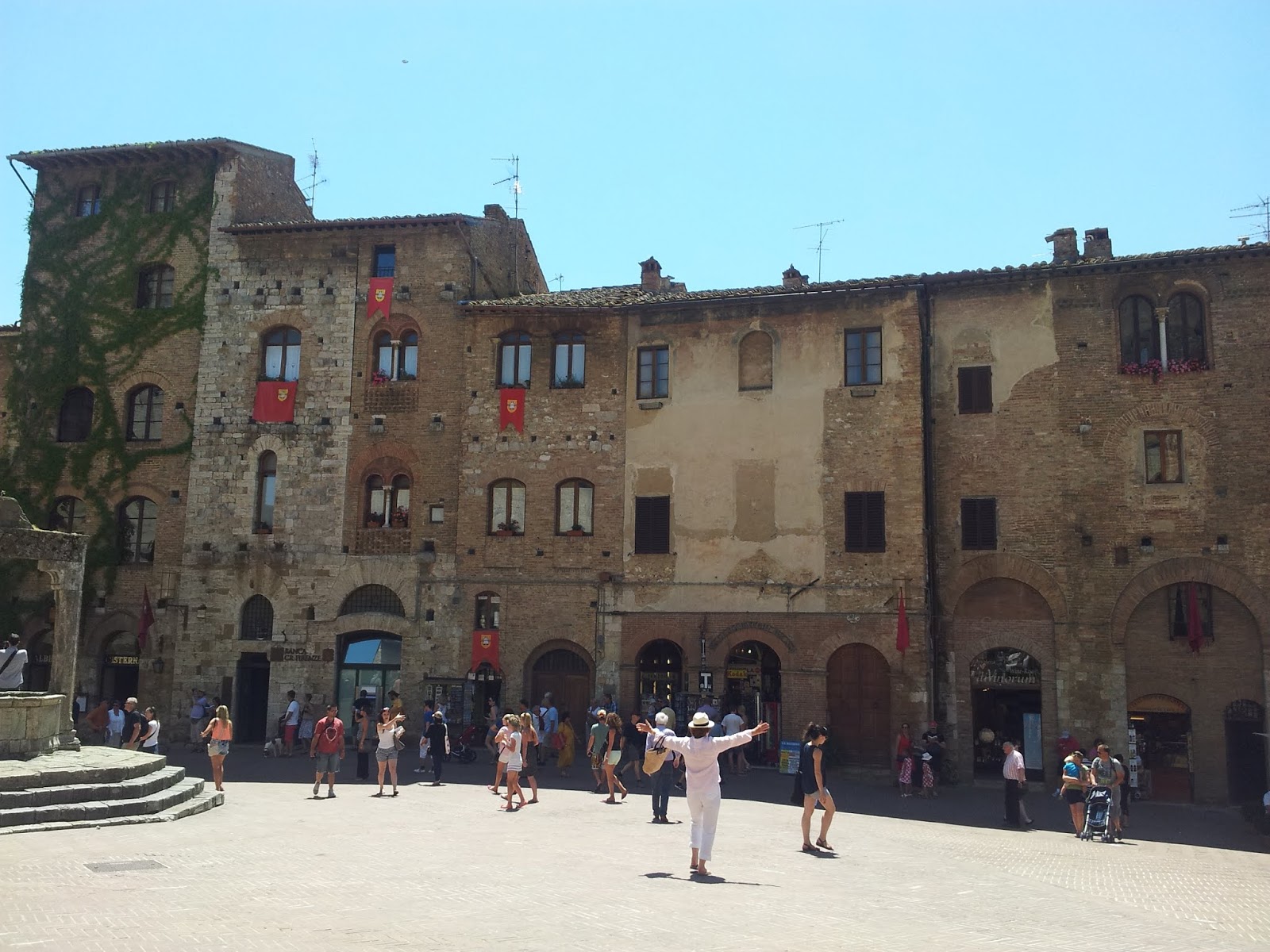
Searching for locations: San Gimignano, Italy

We have visited this town on a hill, famous for its fourteen towers, twice.  The first time we stayed in a hotel overlooking the main piazza, and the second time, for a day visit, and return to a little restaurant tucked away off the main piazza for its home cooking.

No cars are allowed inside the town and parking is provided outside the town walls.  You can drive up to the hotel to deliver your baggage, but the car must return to the carpark overnight.

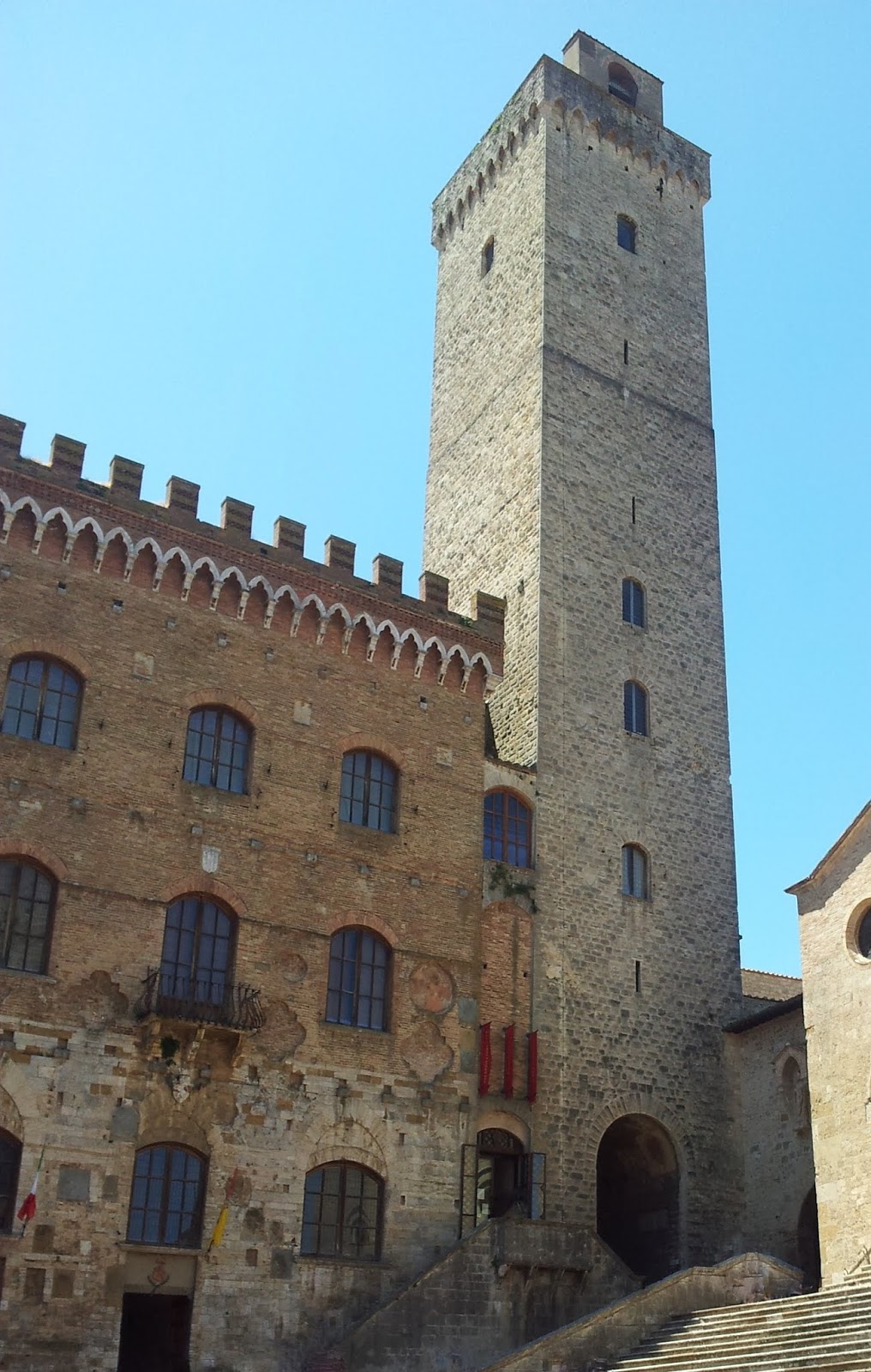
This is one of the fourteen towers

I didn’t attempt to climb to the tower, which you can do in some of them, just getting up the church steps was enough for me.  Inside the building was, if I remember correctly, a museum.

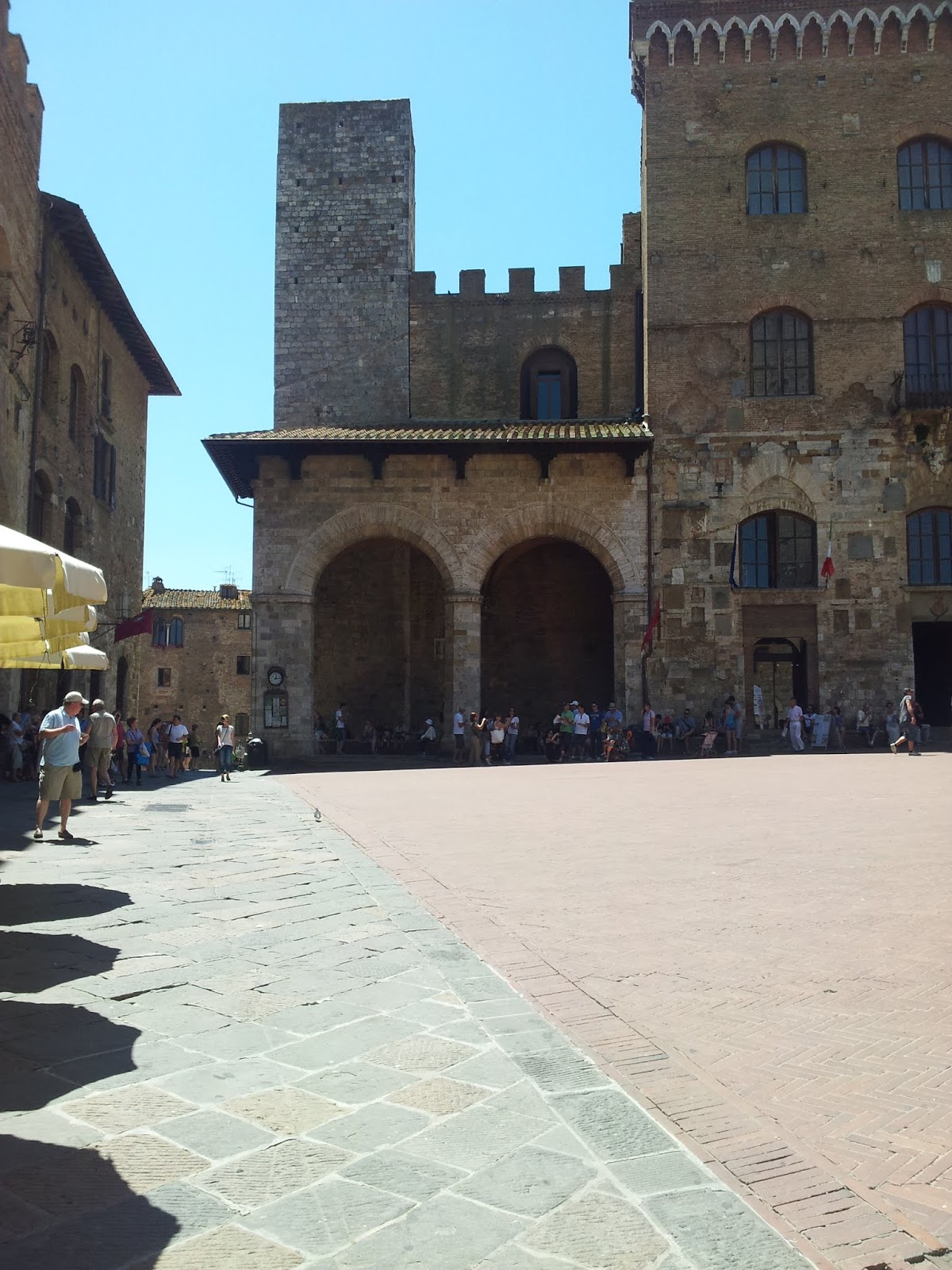
Looking up the piazza towards some battlements, and when you reach the top and turn left, there is a small restaurant on the right-hand side of the laneway that had the best wild boar pasta.

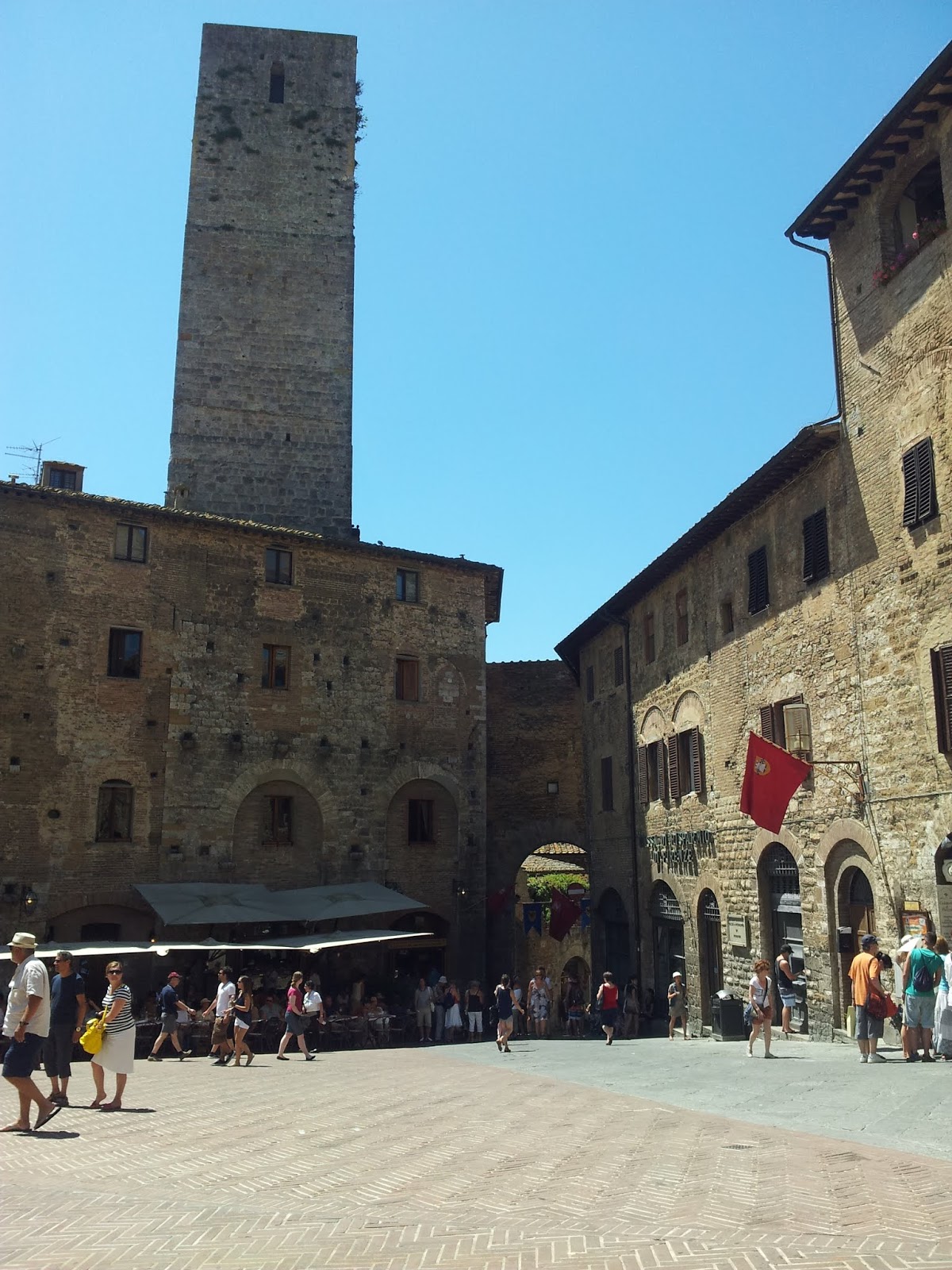
Another of the fourteen towers, and through the arch, down a lane to the gated fence that surrounds the town.  The fortifications are quite formidable and there are several places along the fence where you can stand and look down the hill at the oncoming enemy (if there was one).

Part of the main piazza which is quite large, and on the right, the wishing well where my wish for a cooler day was not granted.

Officially, the Piazza della Cisterna is the most beautiful square of the town, San Gimignano.  The well was built in 1273 and enlarged in 1346 by Podestà Guccio dei Malavolti.

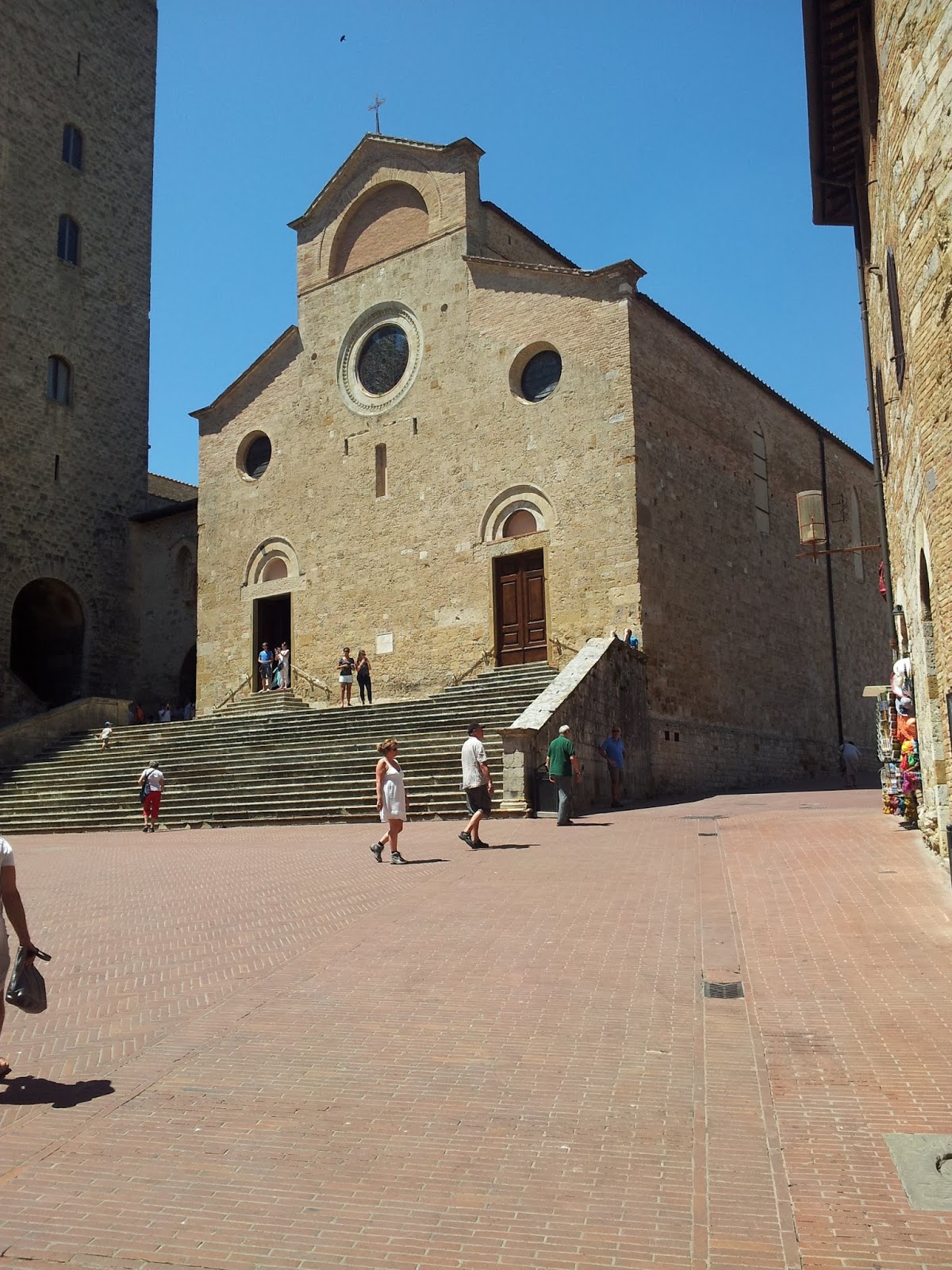
And not to be outdone by any other the other old towns, there is an old church, one of several.  It is the Collegiate Church or the Duomo di San Gimignano, a monument of Romanesque architecture built around 1000 and enlarged over time.

Next door is the Museum of Sacred Art.

And I guess it’s rather odd to see television aerials on top of houses that are quite literally about a thousand years old.  I wonder what they did back then for entertainment?

Now, where did I leave that…

There is a saying ‘you don’t know what you’ve got till it’s gone’.

For a long time, in days before the current technological age, I didn’t really understand what that meant.

Until now.

How many times, in the last few days have I heard the question, “Where’s my mobile phone?”

It seems we can lose almost anything else, but without the phone apparently, we are completely lost.

Then, the other day I heard, “We aren’t able to cook dinner because the microwave oven is broken.”

How did we manage in the days before we had such devices?  I know my grandmother used to have a wood stove and cooked everything, from bread to a roast to make a cup of tea.

I don’t think I ever had a cup of coffee at her house, but I have a lot of memories of some amazing food.  No such thing as electric kitchen appliances, or a microwave oven, not in that house.

We had the same experience ourselves when one of the fridge/freezer units broke down, and severely restricted what we could cook and store, especially the freezer.

And perhaps that’s the problem.  We take so many things for granted and live a life that is centered around convenience.

What would happen if those conveniences were taken away?

Certainly, for me, I know what it’s like to lose an important piece of equipment and having to improvise, but I’m not sure how we would react if we had a real catastrophe.

I haven’t lost my phone yet.

Let’s hope it never happens.

The cinema of my dreams – Was it just another surveillance job – Episode 18

As we all know, writing by the seat of your pants is almost the same as flying by the seat of your pants, a hazardous occupation.

As it happens, I like writing this way because like the reader, I don’t know what to expect next.

And equally, at times, you can write your self into a corner, much like painting, and then have to go back, make a few changes and//or repairs and then move forward.

It’s part of the writing process, only in this case, the changes occur before you’ve finished the novel, if you finish.  Quite often a lot of writers get only so far, then the manuscript hits the bottom drawer, to be brought out on a distant rainy day.

Or your cat has mocked your writing ability one too many times.

Therefore, we’re winding back to Episode 16, and moving forward once again, from there.  This is episode 18 revised…

Ever had the heart-stopping feeling when you’re in the wrong place, and someone has interrupted you?  Especially if you shouldn’t be there, or that you have no right to be there.

I stood quietly on the inside of the door and hoped whoever the visitor was would go away.  No answer meant no one was home, didn’t it?

Unless…

I heard a key in the door, and it turn in the lock.

I moved quickly to the other side of the door so I would be shielded when the person came into the room.  Too late to get out, I was of two minds what to do.  Hit the visitor over the head and flee, or ask them what they were doing, before they asked me that same question.

Then nothing.

Until a few seconds later I heard a voice, a man, say, “Jan, you’re back.  How was the visit to Philadelphia?”

I heard the slight rattle of Jan taking her hand off the handle and moving away from the door.  “Sad, as all funerals are.  Now, we are left with the house, and my father’s stuff; a huge collection of mostly junk over a long period of time.  Seems he never threw anything out.”

Jan?  Did she live here, with O’Connell?

“Yes, “I’m a bit like that.”

Another tenant, or the building super?

“I made sure Herman was looked after while you were away.  I don’t think he missed you at all?”

She laughed.  “He’s a cat, Fred.  We belong to them, not the other way around.”

“True.  Your friend has not been in for a week or so.”

“I know.  The last message I got from him, he was in Prague, lucky bastard.  He was going to take me with him, but at the last moment, they changed his itinerary.  Perhaps next time.  I was just going to make sure everything was OK, before going home myself.”

“I could look in if you want?”

“No.  Thanks anyway, but last time I was here I left a jacket behind.  Thanks, Fred.”

A moment later I could hear his footsteps heading away, and Jan moved back to the door, and opened it.

I heard the light switch, and then, suddenly, the room was filled with bright light.

The girl was unassuming, stepped into the room, and closed the door behind her.  Before she could take a step, I put a hand over her mouth and an arm around her neck and started squeezing.

Instinctively she started to struggle and call out for help.

I whispered in her ear, “I mean you no harm, but if you struggle, or yell out, it could turn out very bad for you.”

We had been taught how to subdue people without killing them, but that always didn’t go to plan.  There was that instinct to fight back in everyone, and it was sometimes hard not to apply excessive pressure which could, depending on the severity of resistance, see the target asphyxiated, or end up with a broken neck.

She was still struggling, which mean I had to exert more force.

“Stop fighting me or you will harm yourself,” I said, this time in a more forceful whisper.

It had an immediate effect, but I don’t think it was her obedience that caused it.  I gently lowered her to the floor and felt for a pulse.  Unconscious, not dead.  I sighed in relief.  I took a good long look at her so that I would remember what she looked like.  At some point, I was going to have to talk to her.

Then footsteps outside the door.  What else could go wrong?

Then knocking on the door.  Short and sharp.  Followed by, “Jan, are you in there?”

Fred, whoever he was.  What did he want?”

Another knock on the door, this time more urgent.  Damn.  O’Connell’s flat was like a busy store.

I looked around for an escape now there would be no going out the front door.  Not unless I had to disable another person, and assuming if he was the building super, he would not be a small man, so it would take a greater, and noisier, effort to subdue him.

A fire escape, all buildings usually had one down the side of the building, in case of fire.  I went over and checked the windows and found it.  The window needed a little force to open it, but the sound of a key in the door motivated me.

Out the window, close the window again, I made it down the stairs far enough that when I looked up, no one was following me.

That was close.  Too close.

© Charles Heath 2019-2022

The first case of PI Walthenson – “A Case of Working With the Jones Brothers”

This case has everything, red herrings, jealous brothers, femme fatales, and at the heart of it all, greed.

See below for an excerpt from the book…

Coming soon!

PIWalthJones1

An excerpt from the book:

When Harry took the time to consider his position, a rather uncomfortable position at that, he concluded that he was somehow involved in another case that meant very little to him.

Not that it wasn’t important in some way he was yet to determine, it was just that his curiosity had got the better of him, and it had led to this: sitting in a chair, securely bound, waiting for someone one of his captors had called Doug.

It was not the name that worried him so much, it was the evil laugh that had come after the name was spoken.

Doug what? Doug the ‘destroyer’, Doug the ‘dangerous’, Doug the ‘deadly’; there was any number of sinister connotations, and perhaps that was the point of the laugh, to make it more frightening than it was.

But there was no doubt about one thing in his mind right then: he’d made a mistake. A very big. and costly, mistake. Just how big the cost, no doubt he would soon find out.

His mother, and his grandmother, the wisest person he had ever known, had once told him never to eavesdrop.

At the time he couldn’t help himself and instead of minding his own business, listening to a one-sided conversation which ended with a time and a place. The very nature of the person receiving the call was, at the very least, sinister, and, because of the cryptic conversation, there appeared to be, or at least to Harry, criminal activity involved.

For several days he had wrestled with the thought of whether he should go. Stay on the fringe, keep out of sight, observe and report to the police if it was a crime. Instead, he had willingly gone down the rabbit hole.

Now, sitting in an uncomfortable chair, several heat lamps hanging over his head, he was perspiring, and if perspiration could be used as a measure of fear, then Harry’s fear was at the highest level.

Another runnel of sweat rolled into his left eye, and, having his hands tied, literally, it made it impossible to clear it. The burning sensation momentarily took his mind off his predicament. He cursed and then shook his head trying to prevent a re-occurrence. It was to no avail.

Let the stinging sensation be a reminder of what was right and what was wrong.

It was obvious that it was the right place and the right time, but in considering his current perilous situation, it definitely was the wrong place to be, at the worst possible time.

It was meant to be his escape, an escape from the generations of lawyers, what were to Harry, dry, dusty men who had been in business since George Washington said to the first Walthenson to step foot on American soil, ‘Why don’t you become a lawyer?” when asked what he could do for the great man.

Or so it was handed down as lore, though Harry didn’t think Washington meant it literally, the Walthenson’s, then as now, were not shy of taking advice.

Except, of course, when it came to Harry.

He was, Harry’s father was prone to saying, the exception to every rule. Harry guessed his father was referring to the fact his son wanted to be a Private Detective rather than a dry, dusty lawyer. Just the clothes were enough to turn Harry off the profession.

So, with a little of the money Harry inherited from one of his aunts, he leased an office in Gramercy Park and had it renovated to look like the Sam Spade detective agency, you know the one, Spade and Archer, and The Maltese Falcon.

There’s a movie and a book by Dashiell Hammett if you’re interested.

So, there it was, painted on the opaque glass inset of the front door, ‘Harold Walthenson, Private Detective’.

There was enough money to hire an assistant, and it took a week before the right person came along, or, more to the point, didn’t just see his business plan as something sinister. Ellen, a tall cool woman in a long black dress, or so the words of a song in his head told him, fitted in perfectly.

She’d seen the movie, but she said with a grin, Harry was no Humphrey Bogart.

Of course not, he said, he didn’t smoke.

Three months on the job, and it had been a few calls, no ‘real’ cases, nothing but missing animals, and other miscellaneous items. What he really wanted was a missing person. Or perhaps a beguiling, sophisticated woman who was as deadly as she was charming, looking for an errant husband, perhaps one that she had already ‘dispatched’.

Or for a tall, dark and handsome foreigner who spoke in riddles and in heavily accented English, a spy, or perhaps an assassin, in town to take out the mayor. The man was such an imbecile Harry had considered doing it himself.

Now, in a back room of a disused warehouse, that wishful thinking might be just about to come to a very abrupt end, with none of the romanticized trappings of the business befalling him. No beguiling women, no sinister criminals, no stupid policemen.

Just a nasty little man whose only concern was how quickly or how slowly Harry’s end was going to be.

© Charles Heath 2019