An excerpt from “One Last Look”: Charlotte is no ordinary girl

This is currently available at Amazon herehttp://amzn.to/2CqUBcz

I’d read about out-of-body experiences, and like everyone else, thought it was nonsense.  Some people claimed to see themselves in the operating theatre, medical staff frantically trying to revive them, and being surrounded by white light.

I was definitely looking down, but it wasn’t me I was looking at.

It was two children, a boy and a girl, with their parents, in a park.

The boy was Alan.  He was about six or seven.  The girl was Louise, and she was five years old.  She had long red hair and looked the image of her mother.

I remember it now, it was Louise’s birthday and we went down to Bournemouth to visit our Grandmother, and it was the last time we were all together as a family.

We were flying homemade kites our father had made for us, and after we lay there looking up at the sky, making animals out of the clouds.  I saw an elephant, Louise saw a giraffe.

We were so happy then.

Before the tragedy.

When I looked again ten years had passed and we were living in hell.  Louise and I had become very adept at survival in a world we really didn’t understand, surrounded by people who wanted to crush our souls.

It was not a life a normal child had, our foster parents never quite the sort of people who were adequately equipped for two broken-hearted children.  They tried their best, but their best was not good enough.

Every day it was a battle, to avoid the Bannister’s and Archie in particular, every day he made advances towards Louise and every day she fended him off.

Until one day she couldn’t.

Now I was sitting in the hospital, holding Louise’s hand.  She was in a coma, and the doctors didn’t think she would wake from it.  The damage done to her was too severe.

The doctors were wrong.

She woke, briefly, to name her five assailants.  It was enough to have them arrested.  It was not enough to have them convicted.

Justice would have to be served by other means.

I was outside the Bannister’s home.

I’d made my way there without really thinking, after watching Louise die.  It was like being on autopilot, and I had no control over what I was doing.  I had murder in mind.  It was why I was holding an iron bar.

Skulking in the shadows.  It was not very different from the way the Bannister’s operated.

I waited till Archie came out.  I knew he eventually would.  The police had taken him to the station for questioning, and then let him go.  I didn’t understand why, nor did I care.

I followed him up the towpath, waiting till he stopped to light a cigarette, then came out of the shadows.

“Wotcha got there Alan?” he asked when he saw me.  He knew what it was, and what it was for.

It was the first time I’d seen the fear in his eyes.  He was alone.

“Justice.”

“For that slut of a sister of yours.  I had nuffing to do with it.”

“She said otherwise, Archie.”

“She never said nuffing, you just made it up.”  An attempt at bluster, but there was no confidence in his voice.

I held up the pipe.  It had blood on it.  Willy’s blood.  “She may or may not have Archie, but Willy didn’t make it up.  He sang like a bird.  That’s his blood, probably brains on the pipe too, Archie, and yours will be there soon enough.”

“He dunnit, not me.  Lyin’ bastard would say anything to save his own skin.”  Definitely scared now, he was looking to run away.

“No, Archie.  He didn’t.  I’m coming for you.  All of you Bannisters.  And everyone who touched my sister.”

It was the recurring nightmare I had for years afterwards.

I closed my eyes and tried to shut out the thoughts, the images of Louise, the phone call, the visit to the hospital and being there when she succumbed to her injuries.  Those were the very worst few hours of my life.

She had asked me to come to the railway station and walk home with her, and I was running late.  If I had left when I was supposed to, it would never have happened and for years afterwards, I blamed myself for her death.

If only I’d not been late…

When the police finally caught the rapists, I’d known all along who they’d be; antagonists from school, the ring leader, Archie Bannister, a spurned boyfriend, a boy whose parents, ubiquitously known to all as ‘the Bannister’s, dealt in violence and crime and who owned the neighbourhood.  The sins of the father had been very definitely passed onto the son.

At school, I used to be the whipping boy, Archie, a few grades ahead of me, made a point of belting me and a few of the other boys, to make sure the rest did as they were told.  He liked Louise, but she had no time for a bully like him, even when he promised he would ‘protect’ me.

I knew the gang members, the boys who tow-kowed to save getting beaten up, and after the police couldn’t get enough information to prosecute them because everyone was too afraid to speak out, I went after Willy.  There was always a weak link in a group, and he was it.

He worked in a factory, did long hours on a Wednesday and came home after dark alone.  It was a half mile walk, through a park.  The night I approached him, I smashed the lights and left it in darkness.  He nearly changed his mind and went the long way home.

He didn’t.

It took an hour and a half to get the names.  At first, when he saw me, he laughed.  He said I would be next, and that was four words more than he knew he should have said.

When I found him alone the next morning I showed him the iron bar and told him he was on the list.  I didn’t kill him then, he could wait his turn, and worry about what was going to happen to him.

When the police came to visit me shortly after that encounter, no doubt at the behest of the Bannister’s, the neighbourhood closed ranks and gave me an ironclad alibi.  The Bannister’s then came to visit me and threatened me.  I told them their days were numbered and showed them the door.

At the trial, he and his friends got off on a technicality.  The police had failed to do their job properly, but it was not the police, but a single policeman, corrupted by the Bannisters.

Archie could help but rub it in my face.  He was invincible.

Joe Collins took 12 bullets and six hours to bleed out.  He apologized, he pleaded, he cried, he begged.  I didn’t care.

Barry Mills, a strong lad with a mind to hurting people, Archie’s enforcer, almost got the better of me.  I had to hit him more times than I wanted to, and in the end, I had to be satisfied that he died a short but agonizing death.

I revisited Willy in the hospital.  He’d recovered enough to recognize me, and why I’d come.  Suffocation was too good for him.

David Williams, second in command of the gang, was as tough and nasty as the Bannisters.  His family were forging a partnership with the Bannister’s to make them even more powerful.  Outwardly David was a pleasant sort of chap, affable, polite, and well mannered.  A lot of people didn’t believe he could be like, or working with, the Bannisters.

He and I met in the pub.  We got along like old friends.  He said Willy had just named anyone he could think of, and that he was innocent of any charges.  We shook hands and parted as friends.

Three hours later he was sitting in a chair in the middle of a disused factory, blindfolded and scared.  I sat and watched him, listened to him, first threatening me, and then finally pleading with me.  He’d guessed who it was that had kidnapped him.

When it was dark, I took the blindfold off and shone a very bright light in his eyes.  I asked him if the violence he had visited upon my sister was worth it.  He told me he was just a spectator.

I’d read the coroner’s report.  They all had a turn.  He was a liar.

He took nineteen bullets to die.

Then came Archie.

The same factory only this time there were four seats.  Anna Bannister, brothel owner, Spike Bannister, head of the family, Emily Bannister, sister, and who had nothing to do with their criminal activities.  She just had the misfortune of sharing their name.

Archie’s father told me how he was going to destroy me, and everyone I knew.

A well-placed bullet between the eyes shut him up.

Archie’s mother cursed me.  I let her suffer for an hour before I put her out of her misery.

Archie remained stony-faced until I came to Emily.  The death of his parents meant he would become head of the family.  I guess their deaths meant as little to him as they did me.

He was a little more worried about his sister.

I told him it was confession time.

He told her it was little more than a forced confession and he had done nothing to deserve my retribution.

I shrugged and shot her, and we both watched her fall to the ground screaming in agony.  I told him if he wanted her to live, he had to genuinely confess to his crimes.  This time he did, it all poured out of him.

I went over to Emily.  He watched in horror as I untied her bindings and pulled her up off the floor, suffering only from a small wound in her arm.  Without saying a word she took the gun and walked over to stand behind him.

“Louise was my friend, Archie.  My friend.”

Then she shot him.  Six times.

To me, after saying what looked like a prayer, she said, “Killing them all will not bring her back, Alan, and I doubt she would approve of any of this.  May God have mercy on your soul.”

Now I was in jail.  I’d spent three hours detailing the deaths of the five boys, everything I’d done; a full confession.  Without my sister, my life was nothing.  I didn’t want to go back to the foster parents; I doubt they’d take back a murderer.

They were not allowed to.

For a month I lived in a small cell, in solitary, no visitors.  I believed I was in the queue to be executed, and I had mentally prepared myself for the end.

Then I was told I had a visitor, and I was expecting a priest.

Instead, it was a man called McTavish. Short, wiry, and with an accent that I could barely understand.

“You’ve been a bad boy, Alan.”

When I saw it was not the priest I told the jailers not to let him in, I didn’t want to speak to anyone.  They ignored me.  I’d expected he was a psychiatrist, come to see whether I should be shipped off to the asylum.

I was beginning to think I was going mad.

I ignored him.

“I am the difference between you living or dying Alan, it’s as simple as that.  You’d be a wise man to listen to what I have to offer.”

Death sounded good.  I told him to go away.

He didn’t.  Persistent bugger.

I was handcuffed to the table.  The prison officers thought I was dangerous.  Five, plus two, murders, I guess they had a right to think that.  McTavish sat opposite me, ignoring my request to leave.

“Why’d you do it?”

“You know why.”  Maybe if I spoke he’d go away.

“Your sister.  By all accounts, the scum that did for her deserved what they got.”

“It was murder just the same.  No difference between scum and proper people.”

“You like killing?”

“No-one does.”

“No, I dare say you’re right.  But you’re different, Alan.  As clean and merciless killing I’ve ever seen.  We can use a man like you.”

“We?”

“A group of individuals who clean up the scum.”

I looked up to see his expression, one of benevolence, totally out of character for a man like him.  It looked like I didn’t have a choice.

Trained, cleared, and ready to go.

I hadn’t realized there were so many people who were, for all intents and purposes, invisible.  People that came and went, in malls, in hotels, trains, buses, airports, everywhere, people no one gave a second glance.

People like me.

In a mall, I became a shopper.

In a hotel, I was just another guest heading to his room.

On a bus or a train, I was just another commuter.

At the airport, I became a pilot.  I didn’t need to know how to fly; everyone just accepted a pilot in a pilot suit was just what he looked like.

I had a passkey.

I had the correct documents to get me onto the plane.

That walk down the air bridge was the longest of my life.  Waiting for the call from the gate, waiting for one of the air bridge staff to challenge me, stepping onto the plane.

Two pilots and a steward.  A team.  On the plane early before the rest of the crew.  A group that was committing a crime, had committed a number of crimes and thought they’d got away with it.

Until the judge, the jury and their executioner arrived.

Me.

Quick, clean, merciless.  Done.

I was now an operational field agent.

I was older now, and I could see in the mirror I was starting to go grey at the sides.  It was far too early in my life for this, but I expect it had something to do with my employment.

I didn’t recognize the man who looked back at me.

It was certainly not Alan McKenzie, nor was there any part of that fifteen-year-old who had made the decision to exact revenge.

Given a choice; I would not have gone down this path.

Or so I kept telling myself each time a little more of my soul was sold to the devil.

I was Barry Gamble.

I was Lenny Buckman.

I was Jimmy Hosen.

I was anyone but the person I wanted to be.

That’s what I told Louise, standing in front of her grave, and trying to apologize for all the harm, all the people I’d killed for that one rash decision.  If she was still alive she would be horrified, and ashamed.

Head bowed, tears streamed down my face.

God had gone on holiday and wasn’t there to hand out any forgiveness.  Not that day.  Not any day.

New York, New Years Eve.

I was at the end of a long tour, dragged out of a holiday and back into the fray, chasing down another scumbag.  They were scumbags, and I’d become an automaton hunting them down and dispatching them to what McTavish called a better place.

This time I failed.

A few drinks to blot out the failure, a blonde woman who pushed my buttons, a room in a hotel, any hotel, it was like being on the merry-go-round, round and round and round…

Her name was Silvia or Sandra, or someone I’d met before, but couldn’t quite place her.  It could be an enemy agent for all I knew or all I cared right then.

I was done.

I’d had enough.

I gave her the gun.

I begged her to kill me.

She didn’t.

Instead, I simply cried, letting the pent up emotion loose after being suppressed for so long, and she stayed with me, holding me close, and saying I was safe, that she knew exactly how I felt.

How could she?  No one could know what I’d been through.

I remembered her name after she had gone.

Amanda.

I remembered she had an imperfection in her right eye.

Someone else had the same imperfection.

I couldn’t remember who that was.

Not then.

I had a dingy flat in Kensington, a place that I rarely stayed in if I could help it.  After five-star hotel rooms, it made me feel shabby.

The end of another mission, I was on my way home, the underground, a bus, and then a walk.

It was late.

People were spilling out of the pub after the last drinks.  Most in good spirits, others slightly more boisterous.

A loud-mouthed chap bumped into me, the sort who had one too many, and was ready to take on all comers.

He turned on me, “Watch where you’re going, you fool.”

Two of his friends dragged him away.  He shrugged them off, squared up.

I punched him hard, in the stomach, and he fell backwards onto the ground.  I looked at his two friends.  “Take him home before someone makes mincemeat out of him.”

They grabbed his arms, lifted him off the ground and took him away.

Out of the corner of my eye, I could see a woman, early thirties, quite attractive, but very, very drunk.  She staggered from the bar, bumped into me, and finished up sitting on the side of the road.

I looked around to see where her friends were.  The exodus from the pub was over and the few nearby were leaving to go home.

She was alone, drunk, and by the look of her, unable to move.

I sat beside her.  “Where are your friends?”

“Dunno.”

“You need help?”

She looked up, and sideways at me.  She didn’t look the sort who would get in this state.  Or maybe she was, I was a terrible judge of women.

“Who are you?” she asked.

“Nobody.”  I was exactly how I felt.

“Well Mr Nobody, I’m drunk, and I don’t care.  Just leave me here to rot.”

She put her head back between her knees, and it looked to me she was trying to stop the spinning sensation in her head.

Been there before, and it’s not a good feeling.

“Where are your friends?” I asked again.

“Got none.”

“Perhaps I should take you home.”

“I have no home.”

“You don’t look like a homeless person.  If I’m not mistaken, those shoes are worth more than my weekly salary.”  I’d seen them advertised, in the airline magazine, don’t ask me why the ad caught my attention.

She lifted her head and looked at me again.  “You a smart fucking arse are you?”

“I have my moments.”

“Have them somewhere else.”

She rested her head against my shoulder.  We were the only two left in the street, and suddenly in darkness when the proprietor turned off the outside lights.

“Take me home,” she said suddenly.

“Where is your place?”

“Don’t have one.  Take me to your place.”

“You won’t like it.”

“I’m drunk.  What’s not to like until tomorrow.”

I helped her to her feet.  “You have a name?”

“Charlotte.”

The wedding was in a small church.  We had been away for a weekend in the country, somewhere in the Cotswolds, and found this idyllic spot.  Graves going back to the dawn of time, a beautiful garden tended by the vicar and his wife, an astonishing vista over hills and down dales.

On a spring afternoon with the sun, the flowers, and the peacefulness of the country.

I had two people at the wedding, the best man, Bradley, and my boss, Watkins.

Charlotte had her sisters Melissa and Isobel, and Isobel’s husband Giovanni, and their daughter Felicity.

And one more person who was as mysterious as she was attractive, a rather interesting combination as she was well over retirement age.  She arrived late and left early.

Aunt Agatha.

She looked me up and down with what I’d call a withering look.  “There’s more to you than meets the eye,” she said enigmatically.

“Likewise I’m sure,” I said.  It earned me an elbow in the ribs from Charlotte.  It was clear she feared this woman.

“Why did you come,” Charlotte asked.

“You know why.”

Agatha looked at me.  “I like you.  Take care of my granddaughter.  You do not want me for an enemy.”

OK, now she officially scared me.

She thrust a cheque into my hand, smiled, and left.

“Who is she,” I asked after we watched her depart.

“Certainly not my fairy godmother.”

Charlotte never mentioned her again.

Zurich in summer, not exactly my favourite place.

Instead of going to visit her sister Isobel, we stayed at a hotel in Beethovenstrasse and Isobel and Felicity came to us.  Her husband was not with her this time.

Felicity was three or four and looked very much like her mother.  She also looked very much like Charlotte, and I’d remarked on it once before and it received a sharp rebuke.

We’d been twice before, and rather than talk to her sister, Charlotte spent her time with Felicity, and they were, together, like old friends.  For so few visits they had a remarkable rapport.

I had not broached the subject of children with Charlotte, not after one such discussion where she had said she had no desire to be a mother.  It had not been a subject before and wasn’t once since.

Perhaps like all Aunts, she liked the idea of playing with a child for a while and then give it back.

Felicity was curious as to who I was, but never ventured too close.  I believed a child could sense the evil in adults and had seen through my facade of friendliness.  We were never close.

But…

This time, when observing the two together, something quite out of left field popped into my head.  It was not possible, not by any stretch of the imagination, but I thought she looked like my mother.

And Charlotte had seen me looking in their direction.  “You seem distracted,” she said.

“I was just remembering my mother.  Odd moment, haven’t done so for a very long time.”

“Why now?”  I think she had a look of concern on her face.

“Her birthday, I guess,” I said, the first excuse I could think of.

Another look and I was wrong.  She looked like Isobel or Charlotte, or if I wanted to believe it possible, Melissa too.

I was crying, tears streaming down my face.

I was in pain, searing pain from my lower back stretching down into my legs, and I was barely able to breathe.

It was like coming up for air.

It was like Snow White bringing Prince Charming back to life.  I could feel what I thought was a gentle kiss and tears dropping on my cheeks, and when I opened my eyes, I saw Charlotte slowly lifting her head, a hand gently stroking the hair off my forehead.

And in a very soft voice, she said, “Hi.”

I could not speak, but I think I smiled.  It was the girl with the imperfection in her right eye.  Everything fell into place, and I knew, in that instant that we were irrevocably meant to be together.

“Welcome back.”

© Charles Heath 2016-2019
onelastlookcoverfinal2

Writing about writing a book – Day 22

More of Bill’s backstory, and, if it’s possible, I’m beginning to like this guy.

I suspect, for him as well as many others, it wasn’t easy, but in war zones, it’s either hot or cold, but never any pleasant in any weather conditions, and perhaps if there was a possibility of a fine, balmy, day, there would be no time to enjoy it.

Sleep was difficult. 

Sleep was always difficult, if not impossible. 

Whilst I had lived in barracks, in the tropics as part of my training and acclimatization, it was nothing like this.  Nothing could have prepared me for the endless, oppressive heat.

It started from the day the plane had landed on the tarmac at Saigon airport, the crew opened the door to the cabin, and we walked down the stairs.  The heat came from above, and from the tarmac below.  We were soaked in sweat by the time we reached the buildings.

And it was difficult not to be exhausted, even if you were lucky enough to get a few hours sleep.  That constant feeling of exhaustion was the biggest enemy, and what caused many of the unnecessary deaths.  In the end, for many, it was just too much.  For me, it was training that kept me alive, because of that little voice in my head that kept me vigilant.

That and a keen sense of self-preservation.

Our platoon was still recovering from the shock of seeing the death of two of our mates the previous day.  Although in the camp only a week, already it felt like a year.  We’d been sent out on a patrol, trying to find a group of the enemy who was responsible for cutting one of the supply lines, and it hadn’t taken long for us to realize we didn’t really know if it was the Viet Cong or the people we were supposed to be protecting.  They all looked the same to me, and we had to rely on our South Vietnamese Army liaison to ensure we didn’t shoot the wrong people.

After an eventless day, if you discounted the rain, the heat, and the scares, the Lieutenant ordered us to make camp, just before darkness set in.  We had not seen the enemy, and, as I was finally getting to understand, we probably wouldn’t until they were prepared to show themselves.

At that moment of maximum unpreparedness, when our attention was diverted, and after a long and debilitating day, they chose to attack.

I had no doubt they had been tracking us, and for quite some distance.  I had that effect of hair standing up on the back of my neck.  It actually saved me from getting shot.

The attack killed three of our men and shattered our confidence.

No one slept that night, either from fear the attackers would return, or because we were just plain terrified.  I volunteered for guard duty.  It was easier to be up and about instead of on a camp stretcher staring at the roof of the tent waiting for the inevitable.

Seeing our mates killed so horrifically, before our eyes, had the desired effect.  In the beginning, we expected it to be a walk in the park, with some hoping that we would just stumble around in the jungle for a week or so, then go back to the camp for a well-earned rest.  None had counted on the reality of war, or the fact some of us might die.  Some were even hoping they would not have to shoot their gun.

All of those illusions had now gone after three months had passed, and as reality set in.

Some had sobbed openly, such was their preparedness.  I had to say, I was a little more prepared, but had hoped for a little more time before the battle.  And it surprised me how calm I was when all around me it was chaos.

“Bastards,” Killer muttered.

We called him ‘Killer’ because it was the nickname the Army had given him.  We were sharing the guard duty and had spoken briefly over the watch, but up till then, the silence had stretched over an hour or so.  It didn’t take long for anyone to realize he was a man of few words.

He’d been in the regular army for years and asked for the posting.  He’d made Sergeant several times, only to lose those same stripes for fighting, usually after R&R and a bout of heavy drinking.  Now assigned to our platoon to lend his experience, the conscripts were expecting him to ‘look after’ them.  Other than myself and the Lieutenant, he was the only other regular soldier.  Unfortunately for them, he hated both conscripts and the Viet Cong in varying degrees, and depending on his mood there was little tolerance left for the rest of us.

“The people who sent us here or the people trying to kill us?” I asked before I realized I’d spoken.

I didn’t hear the reply, the skies opening up with another torrential downpour that lasted for about five minutes, and going as fast as it came.  When the sun finally came up, it would make the atmosphere steamy, hot, and unbearable.  It was quite warm now, and I was feeling both uncomfortable, and fatigued.

Killer looked just as stoic as he had before the rain.  He looked at me.  “Damn weather.  Worse than home.”

“Scotland?”

“Scapa Flow, Kirkwall.  I should have been an engineer on ships like my father, but I was too stupid.  Joined the Army, finished up here.  What’s your excuse?”

“Square peg in a round hole.  The army seems to handle us in its stride.”  It was more or less the truth.  I joined the Army to get away from my parents.

“That it does.  That it does.”

The rain came and went, during which the rest of the camp roused and went about its business.  It had been a long night for some, still getting over the shock of the attack, and the ever-pervading thought the enemy was still out there, biding their time.  It would be, for them, a waiting game, waiting for the conditions to wear us down, and lose concentration as inevitably we would.

Certainly, by the time we were relieved from sentry duty, I felt I was in no condition to match wits with a donkey, let alone the enemy on his own home ground.  When I stumbled over to the mess area and looked at the tired and haggard looks on the faces of the platoon, I realized that went for all of us.

Killer and I managed to get about an hour’s rest before the call came to move out, rain or no rain, and after a breakfast to make anyone ill, we left.  For hours it rained.  No one spoke as we strained to listen over the rain spattering on the undergrowth, all the time expecting the unexpected.  That was the benefit of the surprise attack; we no longer took for granted we would be safe.

Water gathered in pools along the trail, hiding any chance of seeing landmines.  Rainwater and sweat ran into our eyes, making it difficult to see.  Water leaked everywhere, making it very uncomfortable.  This was not a war; this was utter stupidity.

I was about to remark on the futility of it all to the Lieutenant, who had taken the lead, when one second he was talking to me and the next he crashed to the ground, a sniper’s bullet killing him instantly.   Someone yelled “Contact” and we hit the ground, bullets flying all around us. 

Too late, I thought, as I felt the hit of what seemed to be a large rock, then the searing pain in my leg, just as I hit the ground…


© Charles Heath 2016-2021

Don’t do today what you can do tomorrow?

It’s a common mantra, where people honestly believe that they will live long enough to get everything done.

That is, until you go to a funeral for a person who died long before they should.

Funerals are by definition sad occasions. It is a time to reflect on the life of the deceased, a time when everyone who knew them comes together to celebrate their life, a lifetime spread over many, many years.

It is also a time when the whole family comes together, like births and weddings, where we discover the changes to those we haven’t seen in a long time, particularly when the family is spread out all over the country. And, sometimes, surprise new members, young and old.

I’ve certainly had a few of those.

It can also be a moment in time when you begin to reflect on your own mortality, especially when the deceased was in their 40s.

The fact is, death can strike you down at any time. While trying not to be morbid, with the threat of COVID hanging around, and the fact it does not discriminate age-wise, it’s not possible to discount the possibility that it might happen to you.

And, sitting in the back row, listening to the eulogy, you can’t help but think about how much or how little time you have left, and, quite possibly, what it is you have or haven’t done with your life.

Perhaps the question should be, are you going to put off till tomorrow what you can do today.

The sad fact is, we all do. We all believe we will have plenty of time to get things done. We live by a number of rather interesting mantras,

  • old enough to know better and young enough not to care
  • don’t do today what you can do tomorrow
  • there’s plenty of time to go on that overseas trip

How many people have died young, and done nothing of what they had planned to do later in life?

I know that I was one of those people, who thought if I worked hard, by the time I reached retirement everything would be paid off, the children would have moved on, and we would have enough money to live out our days in relative comfort, and we would have the time to see the world in leisure.

Then, something changed.

For our 30th wedding anniversary, we were going to go on that once-in-a-lifetime holiday, before all those goals had been reached. Perhaps we had an inkling that we might not be able to travel when older, that if we didn’t do it then, it would never happen.

It was perhaps fortuitous that we did.

Now past retirement, older but not necessarily wiser, travelling anywhere is difficult, and our financial situation is not what we had planned, and all of those dreams would have been shattered had we not moved everything forward by about 20 years.

And with the global pandemic starting about the same time we originally planned to start our worldly travels, had we stuck to the plan, it would never have eventuated.

Was it good management, foresight, or just good luck?

We’ll never know.

But something I do know, and is the best advice I can give anyone.

Don’t put off today what you can do tomorrow.

Why?

No one realises tomorrow never comes.

The cinema of my dreams – I always wanted to see the planets – Episode 6

Let’s pause a minute, in space, to get it some measurements right

Out there, in space, it’s not like being on the highway, going from one side of the country to the other.

That, effectively, is only a few thousand miles, or kilometres as we now measured distance, the influence of the European counties attached to the space alliance.

But late at night, and astrophysics, or astrology, or whatever the science of space is called, is not a subject to take up, particularly when you’re tired.

The other night I was tired, and confused, and hence got all my numbers muddled up. The thing is, when numbers go up to billions, with all them zeros, it could be confusing for everyone.

Or maybe it was just me.

But, the first constant is the speed of light. That’s approximately 1,079,251,200 km per hour, Pretty fast, eh.

But, as I’m told, nothing can go faster than the speed of light.

So, in this story, it’s a given.

Spaceship speeds, in this story, are measured as SSPD’s.

SSPD 1,000 is the speed of light.

This new spaceship will not go that fast. It is capable of SSPD 5, but even then, it’s not recommended. So, we are, from the beginning, are going to accept that it will go SSPD 4.

Trials got it to 4.5, but that was when the design engineers were aboard and could fix any problems.

So how fast are the SSPD increments?

SSPD 1 is 1,079,251 km per hour. SSPD 2 is double that. That’s the fastest cruising speed the current ships can travel.

This new ship goes twice as fast so at SSPD 4 it can cruise at 4,317,004 km per hour.

Now, where I got everything wrong, is the distance of the planets from earth, and the time it would take to get there.

Mars: about 56 million km when in line between the earth and the sun, but has a min of 54.5 million km

Venus: between 38 million and 261 million km

Mercury: averaging about 77 million km to a max of 222 million km

Jupiter: from a min of 588 million to a max of 968 million km

Saturn: from a min of 1.3 billion to 1.7 billion km

Uranus: from a min of 2.57 billion to 3.15 billion km

Neptune: from a min of 4.3 billion to 4.7 billion km

Since in the story it’s possible the ship might be stopping at Mars briefly, the time it could possibly take, given the position of mars at the time (about 60 million km), is about 14 hours.

As for the ultimate destination, Neptune, at 4.5 billion km approximately, it is going to take 1,042 hours, or 43.5 days.

Hopefully, I’m now over some of the confusion of distances between the planets, and will have some semblance of credible measurements and times.

“The Document” – a thirty-day revision – Day 24

This book has been written for some time and the manuscript was sitting in a box with half a dozen others gathering dust and not quite as complete, so this month it is going to get the makeover, a first draft for the editor.

And so it begins…

Sanity, if nothing else, returns

Got the 50,000 words, 51,540 to be exact, but the story is not done yet.

Hasty revisions, adding more words, taking out some others, it’s a long and difficult day, with the yellow post-it note collection growing exponentially.

Where would we be without them, endless scraps of paper strewn over an already cluttered desk?

All it would take was one enthusiastic cleaning lady, and it would become an ‘oh-my-god’ moment.

The end, however, is becoming clearer, and I’m working towards it from three different angles.

Searching for locations: From Zhengzhou to Suzhou by train, and the Snowy Sea Hotel, Suzhou, China

For the first time on this trip, we encounter problems with Chinese officialdom at the railway station, though we were warned that this might occur.

We had a major problem with the security staff when they pulled everyone over with aerosols and confiscated them. We lost styling mousse, others lost hair spray, and the men, their shaving cream.  But, to her credit, the tour guide did warn us they were stricter here, but her suggestion to be angry they were taking our stuff was probably not the right thing to do.

As with previous train bookings, the Chinese method of placing people in seats didn’t quite manage to keep couples traveling together, together on the train.  It was an odd peculiarity which few of the passengers understood, nor did they conform, swapping seat allocations.

This train ride did not seem the same as the last two and I don’t think we had the same type of high-speed train type that we had for the last two.  The carriages were different, there was only one toilet per carriage, and I don’t think we were going as fast.

But aside from that, we had 753 kilometers to travel with six stops before ours, two of which were very large cities, and then our stop, about four and a half hours later.  With two minutes this time, to get the baggage off the team managed it in 40 seconds, a new record.

After slight disorientation getting off the train, we locate our guide, easily found by looking for the Trip-A-Deal flag.  From there it’s a matter of getting into our respective groups and finding the bus.

As usual, the trip to the hotel was a long one, but we were traveling through a much brighter, and well lit, city.

As for our guide, we have him from now until the end of the tour.  There are no more train rides, we will be taking the bus from city to city until we reach Shanghai.  Good thing then that the bus is brand new, with that new car smell.  Only issue, no USB charging point.

The Snowy Sea hotel.  

It is finally a joy to get a room that is nothing short of great.  It has a bathroom and thus privacy.

Everyone had to go find a supermarket to purchase replacements for the confiscated items.  Luckily there was a huge supermarket just up from the hotel that had everything but the kitchen sink.

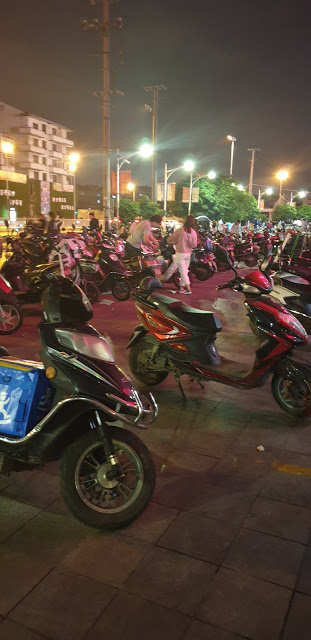
But, unlike where we live, the carpark is more of a scooter park!

It is also a small microcosm of Chinese life for the new more capitalistic oriented Chinese.

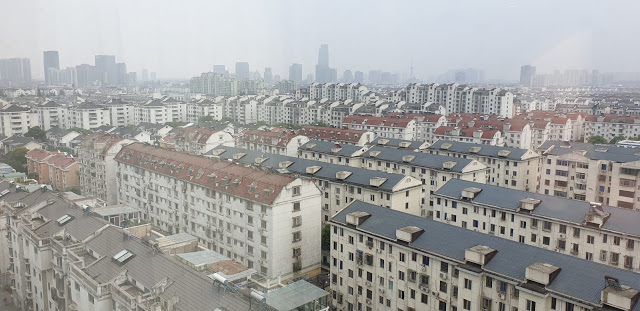
The next morning we get some idea of the scope of high-density living, though here, the buildings are not 30 stories tall, but still just as impressive.

These look like the medium density houses, but to the right of these are much larger buildings

The remarkable thing about this is those buildings stretch as far as the eye can see.

Getting the lie of the land

A lot of locations for stories are based on places that I’ve visited. So, any time I’m on holiday, I’m also discreetly observing, and noting, the places with an ulterior motive.

At some point in time they’ll finish up in a story.

Places like Florence, London, Paris, New York and Venice have all been used in recent stories.

Of course places change, and there are some that I can’t get to, so it’s useful having Google Maps and Street View. These can either make up for lack of memory and a be a refresher.

Especially if you need to visit Africa. Parts of several stories are set in Nigeria, not exactly a place I would go, no matter how much I wanted to get the lie of the land, nor would I go to the Democratic Republic of Congo.

Rwanda, maybe, but in investigating locations, it is interesting to discover that places like Kenya and Rwanda are reasonbly safe. Uganda is more or less the same, but whether I’d visit, as inviting as it might be to see the wildlife (animals that is) I’m thinking Google Maps will do for now.

And, of course, at the moment there is another reason why I can’t get a practical look at overseas locations. Covid-19.

I have always had a fascination for other places, from way back when I was in school and we did a subject called geography. Back then, nearly 60 years ago, we had school atlases that had all of the British colonies, even if they had become independent, coloured red on the maps, and there was a lot of them.

Places like London, of which we also studied in history, always held a fascination for me, and, in particular, the royal family. Oddly enough, I knew all of the kings and queens from 1066 onwards, and yet had no idea who our Prime Ministers in Australia were.

It wasn’t until much later we learned about Australian history.

But seeing places foreign are only part of the story. I have had time during the pandemic when we were not allowed to leave home, to delve into the historical side of Australia, and it has created a fascination for writing a story that has basis in fact.

This was unwittingly pushed along when my grand daughter came home from school with the assignment of writing a story about a character that was affected by a historical event. Thus Eliza at the Eureka Stockade was created.

I remember back in university days when working on the narrative part of my literature stream we were set an assignment based on pictures from a certain period, and a series of written documents to put together a story. Mine was about a passenger on a ship from Melbourne to Geelong in the days before rail around the time of the gold rush.

I’m guessing that’s what is called historical fiction.

Well, it’s time to get back to the mists of time…


The cinema of my dreams – Was it just another surveillance job – Episode 41

I’m back home and this story has been sitting on the back burner for a few months, waiting for some more to be written.

The trouble is, there are also other stories to write, and I’m not very good at prioritizing.

But, here we are, a few minutes opened up and it didn’t take long to get back into the groove.

Chasing leads, maybe

I gave it about five minutes before I think I started breathing again and then headed back to Jennifer.

Or where I thought I had left her.

She wasn’t there. I think, in the end, it didn’t surprise me. She had been reluctant from the start so if I had to guess, she had done a bunk. This was not her fight, nor mine, but she had a ticket out. Why would you want to come back after being betrayed by the likes of Severin and Maury?

I hope she left the car behind.

Now that I was here there was no point leaving, so I took a few minutes to search the surrounding area, just in case she was still here, just someplace else, and when she wasn’t, I quickly and silently made my way back to the side of the house with the open door from a different direction.

There was another set of French doors, these curtained, and with an overhead light above the doorway, so I kept my distance in case there was a movement activator, another which looked to be a servant’s entrance at the back. Neither door looked to be an easy viable entrance.

The original side door was still unlocked, with no lights or movement inside.

I waited, then opened the door wide enough to slip through. Again, I waited in case there was a silent alarm, then when nothing stirred, slipped through and closed the door behind me.

On the other side of the door, it was quite dark, except now I could see, on one wall, the dying embers of a fire. Someone had been in the room earlier and most likely gone to bed.

It meant the house was occupied.

It also meant I had to be careful.

On the other side of the doors, it was a lot warmer. Again I waited a few minutes, just in case someone came, and, when they didn’t, I pulled out a small torch and turned it on.

In front of me were two chairs and a table, one I would have walked into without a light. The walls had shelves and those shelves were filled with books. Some behind glass doors, others not. There was another chair by the fire, and beside it, a stack of cooks, and a table with had an empty glass and a bottle, and a pair of reading glasses.

The downstairs reading room.

I cross the room slowly, hoping there were no squeaky floorboards, to be expected in an old house like this one. The timber flooring was exposed only at the edges of the room, the rest of the floor covered in a large, discolored, and fraying carpet square.

It was old, like everything else in the room.

I was tempted to have a look at how far the books dated back to but resisted the urge. I was looking for information on the owner.

At the doorway to what looked like a passage, I turned off the torch and peered out. It was not exactly dark, my eyes had adjusted to the low-level light from low wattage lights about a foot above the floor.

Lights to help guide the way at night.

Left, rooms, right, rooms, at the end of the passage a wide doorway leading towards the other side of the house. Larger rooms perhaps.

I turned right and headed towards the front, and they stopped at the doorway to the next room. I’d deliberately walked on the carpet runner in the middle of the passage, and just managed to catch my foot when one part of the floor creaked softly.

The room next door was almost the same as the one I’d entered by, with chairs and shelves but only on two sides. This room had a long window and no French doors.

On one side there was a writing desk, open, with papers scatted on the writing surface. I quickly crossed the room to it, switched on the light, and checked.

Bills. In the name of Mrs. Marianne Quigley. This had to be Adam Quigley’s mother, and by deduction, O’Connell’s mother.

Proof I was in the right place.

Then I heard the squeak of a floorboard followed by the clicking sound of a gun being cocked.

“Don’t move, or I’ll shoot. Hands in the air. And don’t make me ask twice.”

Hands up it was.

© Charles Heath 2020-2022

Inspiration, Maybe – Volume Two

50 photographs, 50 stories, of which there is one of the 50 below.

They all start with –

A picture paints … well, as many words as you like.  For instance:

And, the story:

Have you ever watched your hopes and dreams simply just fly away?

Everything I thought I wanted and needed had just left in an aeroplane, and although I said I was not going to, i came to the airport to see the plane leave.  Not the person on it, that would have been far too difficult and emotional, but perhaps it was symbolic, the end of one life and the start of another.

But no matter what I thought or felt, we had both come to the right decision.  She needed the opportunity to spread her wings.  It was probably not the best idea for her to apply for the job without telling me, but I understood her reasons.

She was in a rut.  Though her job was a very good one, it was not as demanding as she had expected, particularly after the last promotion, but with it came resentment from others on her level, that she, the youngest of the group would get the position.

It was something that had been weighing down of her for the last three months, and if noticed it, the late nights, the moodiness, sometimes a flash of temper.  I knew she had one, no one could have such red hair and not, but she had always kept it in check.

And, then there was us, together, and after seven years, it felt like we were going nowhere.  Perhaps that was down to my lack of ambition, and though she never said it, lack of sophistication.  It hadn’t been an issue, well, not until her last promotion, and the fact she had to entertain more, and frankly I felt like an embarrassment to her.

So, there it was, three days ago, the beginning of the weekend, and we had planned to go away for a few days and take stock.  We both acknowledged we needed to talk, but it never seemed the right time.

It was then she said she had quit her job and found a new one.  Starting the following Monday.

Ok, that took me by surprise, not so much that it something I sort of guessed might happen, but that she would just blurt it out.

I think that right then, at that moment, I could feel her frustration with everything around her.

What surprised her was my reaction.  None.

I simply asked where who, and when.

A world-class newspaper, in New York, and she had to be there in a week.

A week.

It was all the time I had left with her.

I remember I just shrugged and asked if the planned weekend away was off.

She stood on the other side of the kitchen counter, hands around a cup of coffee she had just poured, and that one thing I remembered was the lone tear that ran down her cheek.

Is that all you want to know?

I did, yes, but we had lost that intimacy we used to have when she would have told me what was happening, and we would have brainstormed solutions. I might be a cabinet maker but I still had a brain, was what I overheard her tell a friend once.

There’s not much to ask, I said.  You’ve been desperately unhappy and haven’t been able to hide it all that well, you have been under a lot of pressure trying to deal with a group of troglodytes, and you’ve been leaning on Bentley’s shoulder instead of mine, and I get it, he’s got more experience in that place,  and the politics that go with it, and is still an ally.

Her immediate superior and instrumental in her getting the position, but unlike some men in his position he had not taken advantage of a situation like some men would.  And even if she had made a move, which I doubted, that was not the sort of woman she was, he would have politely declined.

One of the very few happily married men in that organisation, so I heard.

So, she said, you’re not just a pretty face.

Par for the course for a cabinet maker whose university degree is in psychology.  It doesn’t take rocket science to see what was happening to you.  I just didn’t think it was my place to jump in unless you asked me, and when you didn’t, well, that told me everything I needed to know.

Yes, our relationship had a use by date, and it was in the next few days.

I was thinking, she said, that you might come with me,  you can make cabinets anywhere.

I could, but I think the real problem wasn’t just the job.  It was everything around her and going with her, that would just be a constant reminder of what had been holding her back. I didn’t want that for her and said so.

Then the only question left was, what do we do now?

Go shopping for suitcases.  Bags to pack, and places to go.

Getting on the roller coaster is easy.  On the beginning, it’s a slow easy ride, followed by the slow climb to the top.  It’s much like some relationships, they start out easy, they require a little work to get to the next level, follows by the adrenaline rush when it all comes together.

What most people forget is that what comes down must go back up, and life is pretty much a roller coaster with highs and lows.

Our roller coaster had just come or of the final turn and we were braking so that it stops at the station.

There was no question of going with her to New York.  Yes, I promised I’d come over and visit her, but that was a promise with crossed fingers behind my back.  After a few months in t the new job the last thing shed want was a reminder of what she left behind.  New friends new life.

We packed her bags, three out everything she didn’t want, a free trips to the op shop with stiff she knew others would like to have, and basically, by the time she was ready to go, there was nothing left of her in the apartment, or anywhere.

Her friends would be seeing her off at the airport, and that’s when I told her I was not coming, that moment the taxi arrived to take her away forever.  I remember standing there, watching the taxi go.  It was going to be, and was, as hard as it was to watch the plane leave.

So, there I was, finally staring at the blank sky, around me a dozen other plane spotters, a rather motley crew of plane enthusiasts.

Already that morning there’s been 6 different types of plane depart, and I could hear another winding up its engines for take-off.

People coming, people going.

Maybe I would go to New York in a couple of months, not to see her, but just see what the attraction was.  Or maybe I would drop in, just to see how she was.

As one of my friends told me when I gave him the news, the future is never written in stone, and it’s about time you broadened your horizons.

Perhaps it was.


© Charles Heath 2020-2021

Coming soon.  Find the above story and 49 others like it in:

Searching for locations: The Erqi Memorial Tower, Zhengzhou, China

A convoluted explanation on the reasons for this memorial came down to it being about the deaths of those involved in the 1923 Erqi strike, though we’re not really sure what the strike was about.

So, after a little research, this is what I found:

The current Erqi Tower was built in 1971 and was, historically, the tallest building in the city. It is a memorial to the Erqi strike and in memory of Lin Xiangqian and other railway workers who went on strike for their rights, which happened on February 7, 1923.

It has 14 floors and is 63 meters high. One of the features of this building is the view from the top, accessed by a spiral staircase, or an elevator, when it’s working (it was not at the time of our visit).

There seems to be an affinity with the number 27 with this building, in that

  • It’s the 27th memorial to be built
  • to commemorate the 27th workers’ strike
  • located in the 27th plaza of Zhengzhou City.

We drive to the middle of the city where we once again find traveling in kamikaze traffic more entertaining than the tourist points

When we get to the drop-off spot, it’s a 10-minute walk to the center square where the tower is located on one side. Getting there we had to pass a choke point of blaring music and people hawking goods, each echoing off the opposite wall to the point where it was deafening. Too much of it would be torture.

But, back to the tower…

It has 14 levels, but no one seemed interested in climbing the 14 or 16 levels to get to the top. The elevator was broken, and after the great wall episode, most of us are heartily sick of stairs.

The center square was quite large but paved in places with white tiles that oddly reflected the heat rather than absorb it. In the sun it was very warm.

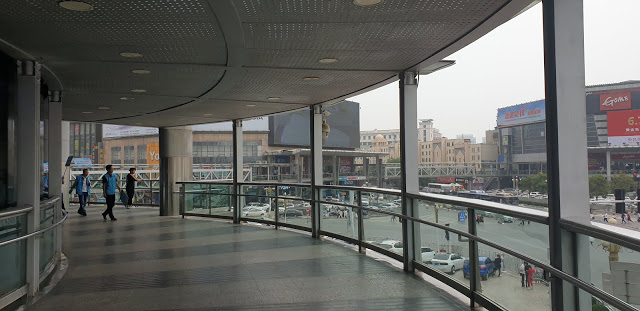
Around the outside of two-thirds of the square, and crossing the roads, was an elevated walkway, which if you go from the first shops and around to the other end, you finish up, on the ground level, at Starbucks.

This is the Chinese version and once you get past the language barrier, the mixology range of cold fruity drinks are to die for, especially after all that walking. Mine was a predominantly peach flavor, with some jelly and apricot at the bottom. I was expecting sliced peaches but I prefer and liked the apricot half.

A drink and fruit together was a surprise.

Then it was the walk back to the meeting point and then into the hotel to use the happy house before rejoining the kamikaze traffic.

We are taken then to the train station for the 2:29 to our next destination, Suzhou, the Venice of the East.