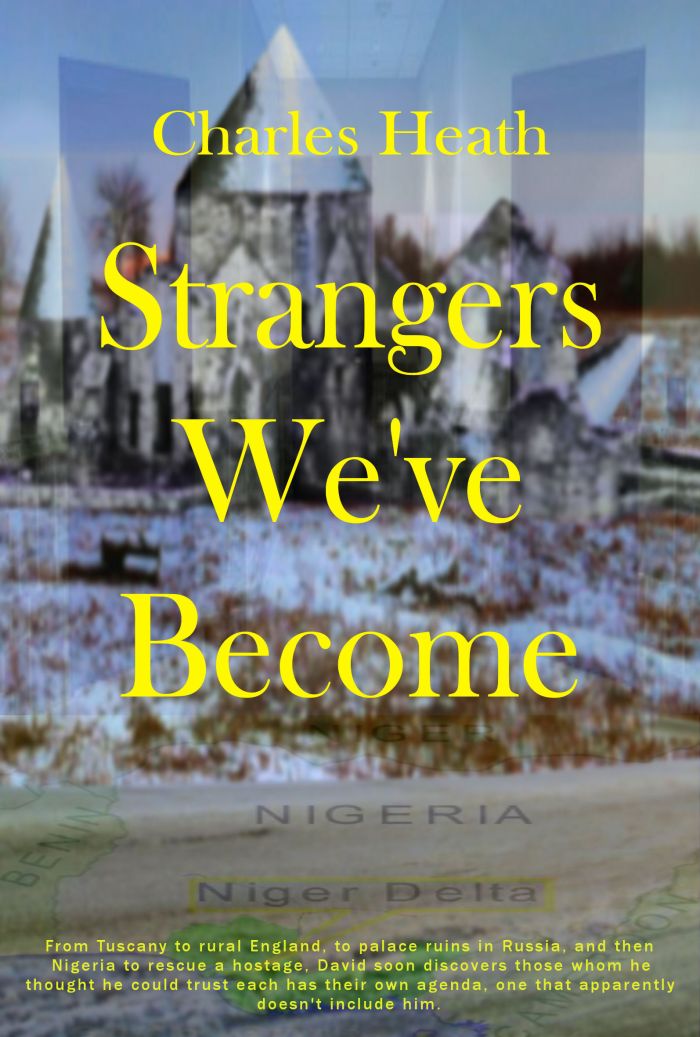
An excerpt from “Strangers We’ve Become” – Coming Soon

I wandered back to my villa.

It was in darkness.  I was sure I had left several lights on, especially over the door so I could see to unlock it.

I looked up and saw the globe was broken.

Instant alert.

I went to the first hiding spot for the gun, and it wasn’t there.  I went to the backup and it wasn’t there either.  Someone had found my carefully hidden stash of weapons and removed them.

Who?

There were four hiding spots and all were empty.  Someone had removed the weapons.  That could only mean one possibility.

I had a visitor, not necessarily here for a social call.

But, of course, being the well-trained agent I’d once been and not one to be caught unawares, I crossed over to my neighbor and relieved him of a weapon that, if found, would require a lot of explaining.

Suitably armed, it was time to return the surprise.

There were three entrances to the villa, the front door, the back door, and a rather strange escape hatch.  One of the more interesting attractions of the villa I’d rented was its heritage.  It was built in the late 1700s, by a man who was, by all accounts, a thief.  It had a hidden underground room which had been in the past a vault but was now a wine cellar, and it had an escape hatch by which the man could come and go undetected, particularly if there was a mob outside the door baying for his blood.

It now gave me the means to enter the villa without my visitors being alerted, unless, of course, they were near the vicinity of the doorway inside the villa, but that possibility was unlikely.  It was not where anyone could anticipate or expect a doorway to be.

The secret entrance was at the rear of the villa behind a large copse, two camouflaged wooden doors built into the ground.  I move aside some of the branches that covered them and lifted one side.  After I’d discovered the doors and rusty hinges, I’d oiled and cleaned them, and cleared the passageway of cobwebs and fallen rocks.  It had a mildew smell, but nothing would get rid of that.  I’d left torches at either end so I could see.

I closed the door after me, and went quietly down the steps, enveloped in darkness till I switched on the torch.  I traversed the short passage which turned ninety degrees about halfway to the door at the other end.  I carried the key to this door on the keyring, found it and opened the door.  It too had been oiled and swung open soundlessly.

I stepped in the darkness and closed the door.

I was on the lower level under the kitchen, now the wine cellar, the ‘door’ doubling as a set of shelves which had very little on them, less to fall and alert anyone in the villa.

Silence, an eerie silence.

I took the steps up to the kitchen, stopping when my head was level with the floor, checking to see if anyone was waiting.  There wasn’t.  It seemed to me to be an unlikely spot for an ambush.

I’d already considered the possibility of someone coming after me, especially because it had been Bespalov I’d killed, and I was sure he had friends, all equally as mad as he was.  Equally, I’d also considered it nigh on impossible for anyone to find out it was me who killed him because the only people who knew that were Prendergast, Alisha, a few others in the Department, and Susan.

That raised the question of who told them where I was.

If I was the man I used to be, my first suspect would be Susan.  The departure this morning, and now this was too coincidental.  But I was not that man.

Or was I?

I reached the start of the passageway that led from the kitchen to the front door and peered into the semi-darkness.  My eyes had got used to the dark, and it was no longer an inky void.  Fragments of light leaked in around the door from outside and through the edge of the window curtains where they didn’t fit properly.  A bone of contention upstairs in the morning, when first light shone and invariably woke me up hours before I wanted to.

Still nothing.

I took a moment to consider how I would approach the visitor’s job.  I would get a plan of the villa in my head, all entrances, where a target could be led to or attacked where there would be no escape.

Coming in the front door.  If I was not expecting anything, I’d just open the door and walk-in.  One shot would be all that was required.

Contract complete.

I sidled quietly up the passage staying close to the wall, edging closer to the front door.  There was an alcove where the shooter could be waiting.  It was an ideal spot to wait.

Crunch.

I stepped on some nutshells.

Not my nutshells.

I felt it before I heard it.  The bullet with my name on it.

And how the shooter missed, from point-blank range, and hit me in the arm, I had no idea.  I fired off two shots before a second shot from the shooter went wide and hit the door with a loud thwack.

I saw a red dot wavering as it honed in on me and I fell to the floor, stretching out, looking up where the origin of the light was coming and pulled the trigger three times, evenly spaced, and a second later I heard the sound of a body falling down the stairs and stopping at the bottom, not very far from me.

Two assassins.

I’d not expected that.

The assassin by the door was dead, a lucky shot on my part.  The second was still breathing.

I checked the body for any weapons and found a second gun and two knives.  Armed to the teeth!

I pulled off the balaclava; a man, early thirties, definitely Italian.  I was expecting a Russian.

I slapped his face, waking him up.  Blood was leaking from several slashes on his face when his head had hit the stairs on the way down.  The awkward angle of his arms and legs told me there were broken bones, probably a lot worse internally.  He was not long for this earth.

“Who employed you?”

He looked at me with dead eyes, a pursed mouth, perhaps a smile.  “Not today my friend.  You have made a very bad enemy.”  He coughed and blood poured out of his mouth.  “There will be more …”

Friends of Bespalov, no doubt.

I would have to leave.  Two unexplainable bodies, I’d have a hard time explaining my way out of this mess.  I dragged the two bodies into the lounge, clearing the passageway just in case someone had heard anything.

Just in case anyone was outside at the time, I sat in the dark, at the foot of the stairs, and tried to breathe normally.  I was trying not to connect dots that led back to Susan, but the coincidence was worrying me.

A half-hour passed and I hadn’t moved.  Deep in thought, I’d forgotten about being shot, unaware that blood was running down my arm and dripping onto the floor.

Until I heard a knock on my front door.

Two thoughts, it was either the police, alerted by the neighbors, or it was the second wave, though why would they be knocking on the door?

I stood, and immediately felt a stabbing pain in my arm.  I took out a handkerchief and turned it into a makeshift tourniquet, then wrapped a kitchen towel around the wound.

If it was the police, this was going to be a difficult situation.  Holding the gun behind my back, I opened the door a fraction and looked out.

No police, just Maria.  I hoped she was not part of the next ‘wave’.

“You left your phone behind on the table.  I thought you might be looking for it.”  She held it out in front of her.

When I didn’t open the door any further, she looked at me quizzically, and then asked, “Is anything wrong?”

I was going to thank her for returning the phone, but I heard her breathe in sharply, and add, breathlessly, “You’re bleeding.”

I looked at my arm and realized it was visible through the door, and not only that, the towel was soaked in blood.

“You need to go away now.”

Should I tell her the truth?  It was probably too late, and if she was any sort of law-abiding citizen she would go straight to the police.

She showed no signs of leaving, just an unnerving curiosity.  “What happened?”

I ran through several explanations, but none seemed plausible.  I went with the truth.  “My past caught up with me.”

“You need someone to fix that before you pass out from blood loss.  It doesn’t look good.”

“I can fix it.  You need to leave.  It is not safe to be here with me.”

The pain in my arm was not getting any better, and the blood was starting to run down my arm again as the tourniquet loosened.  She was right, I needed it fixed sooner rather than later.

I opened the door and let her in.  It was a mistake, a huge mistake, and I would have to deal with the consequences.  Once inside, she turned on the light and saw the pool of blood just inside the door and the trail leading to the lounge.  She followed the trail and turned into the lounge, turned on the light, and no doubt saw the two dead men.

I expected her to scream.  She didn’t.

She gave me a good hard look, perhaps trying to see if I was dangerous.  Killing people wasn’t something you looked the other way about.  She would have to go to the police.

“What happened here?”

“I came home from the cafe and two men were waiting for me.  I used to work for the Government, but no longer.  I suspect these men were here to repay a debt.  I was lucky.”

“Not so much, looking at your arm.”

She came closer and inspected it.

“Sit down.”

She found another towel and wrapped it around the wound, retightening the tourniquet to stem the bleeding.

“Do you have medical supplies?”

I nodded.  “Upstairs.”  I had a medical kit, and on the road, I usually made my own running repairs.  Another old habit I hadn’t quite shaken off yet.

She went upstairs, rummaged, and then came back.  I wondered briefly what she would think of the unmade bed though I was not sure why it might interest her.

She helped me remove my shirt, and then cleaned the wound.  Fortunately, she didn’t have to remove a bullet.  It was a clean wound but it would require stitches.

When she’d finished she said, “Your friend said one day this might happen.”

No prizes for guessing who that friend was, and it didn’t please me that she had involved Maria.

“Alisha?”

“She didn’t tell me her name, but I think she cares a lot about you.  She said trouble has a way of finding you, gave me a phone and said to call her if something like this happened.”

“That was wrong of her to do that.”

“Perhaps, perhaps not.  Will you call her?”

“Yes.  I can’t stay here now.  You should go now.  Hopefully, by the time I leave in the morning, no one will ever know what happened here, especially you.”

She smiled.  “As you say, I was never here.”

© Charles Heath 2018-2022

strangerscover9

Searching for locations: From Zhengzhou to Suzhou by train, and the Snowy Sea Hotel, Suzhou, China

For the first time on this trip, we encounter problems with Chinese officialdom at the railway station, though we were warned that this might occur.

We had a major problem with the security staff when they pulled everyone over with aerosols and confiscated them. We lost styling mousse, others lost hair spray, and the men, their shaving cream.  But, to her credit, the tour guide did warn us they were stricter here, but her suggestion to be angry they were taking our stuff was probably not the right thing to do.

As with previous train bookings, the Chinese method of placing people in seats didn’t quite manage to keep couples traveling together, together on the train.  It was an odd peculiarity which few of the passengers understood, nor did they conform, swapping seat allocations.

This train ride did not seem the same as the last two and I don’t think we had the same type of high-speed train type that we had for the last two.  The carriages were different, there was only one toilet per carriage, and I don’t think we were going as fast.

But aside from that, we had 753 kilometers to travel with six stops before ours, two of which were very large cities, and then our stop, about four and a half hours later.  With two minutes this time, to get the baggage off the team managed it in 40 seconds, a new record.

After slight disorientation getting off the train, we locate our guide, easily found by looking for the Trip-A-Deal flag.  From there it’s a matter of getting into our respective groups and finding the bus.

As usual, the trip to the hotel was a long one, but we were traveling through a much brighter, and well lit, city.

As for our guide, we have him from now until the end of the tour.  There are no more train rides, we will be taking the bus from city to city until we reach Shanghai.  Good thing then that the bus is brand new, with that new car smell.  Only issue, no USB charging point.

The Snowy Sea hotel.  

It is finally a joy to get a room that is nothing short of great.  It has a bathroom and thus privacy.

Everyone had to go find a supermarket to purchase replacements for the confiscated items.  Luckily there was a huge supermarket just up from the hotel that had everything but the kitchen sink.

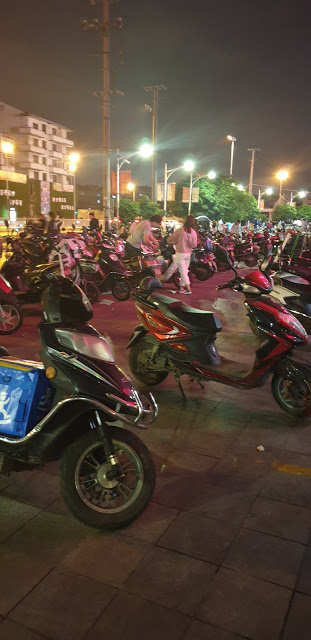
But, unlike where we live, the carpark is more of a scooter park!

It is also a small microcosm of Chinese life for the new more capitalistic oriented Chinese.

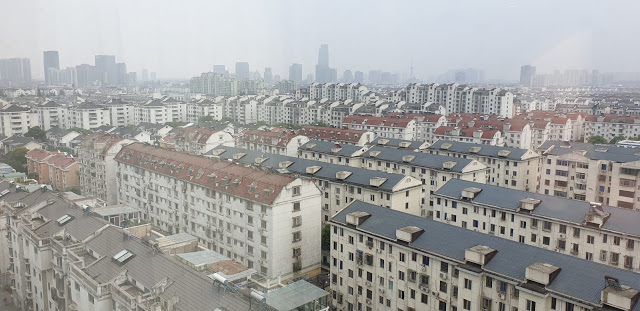
The next morning we get some idea of the scope of high-density living, though here, the buildings are not 30 stories tall, but still just as impressive.

These look like the medium density houses, but to the right of these are much larger buildings

The remarkable thing about this is those buildings stretch as far as the eye can see.

“Sunday in New York”, a romantic adventure that’s not a walk in the park!

“Sunday in New York” is ultimately a story about trust, and what happens when a marriage is stretched to its limits.

When Harry Steele attends a lunch with his manager, Barclay, to discuss a promotion that any junior executive would accept in a heartbeat, it is the fact his wife, Alison, who previously professed her reservations about Barclay, also agreed to attend, that casts a small element of doubt in his mind.

From that moment, his life, in the company, in deciding what to do, his marriage, his very life, spirals out of control.

There is no one big factor that can prove Harry’s worst fears, that his marriage is over, just a number of small, interconnecting events, when piled on top of each other, points to a cataclysmic end to everything he had believed in.

Trust is lost firstly in his best friend and mentor, Andy, who only hints of impending disaster, Sasha, a woman whom he saved, and who appears to have motives of her own, and then in his wife, Alison, as he discovered piece by piece damning evidence she is about to leave him for another man.

Can we trust what we see with our eyes or trust what we hear?

Haven’t we all jumped to conclusions at least once in our lives?

Can Alison, a woman whose self-belief and confidence is about to be put to the ultimate test, find a way of proving their relationship is as strong as it has ever been?

As they say in the classics, read on!

Purchase:

http://tinyurl.com/Amazon-SundayInNewYork

“The Document” – a thirty-day revision – Day 24

This book has been written for some time and the manuscript was sitting in a box with half a dozen others gathering dust and not quite as complete, so this month it is going to get the makeover, a first draft for the editor.

And so it begins…

Sanity, if nothing else, returns

Got the 50,000 words, 51,540 to be exact, but the story is not done yet.

Hasty revisions, adding more words, taking out some others, it’s a long and difficult day, with the yellow post-it note collection growing exponentially.

Where would we be without them, endless scraps of paper strewn over an already cluttered desk?

All it would take was one enthusiastic cleaning lady, and it would become an ‘oh-my-god’ moment.

The end, however, is becoming clearer, and I’m working towards it from three different angles.

‘What Sets Us Apart’ – A beta readers view

There’s something to be said for a story that starts like a James Bond movie, throwing you straight in the deep end, a perfect way of getting to know the main character, David, or is that Alistair?

A retired spy, well not so much a spy as a retired errand boy, David’s rather wry description of his talents, and a woman that most men would give their left arm for, not exactly the ideal couple, but there is a spark in a meeting that may or may not have been a setup.

But as the story progressed, the question I kept asking myself was why he’d bother.

And, page after unrelenting page, you find out.

Susan is exactly the sort of woman to pique his interest.  Then, inexplicably, she disappears.  That might have been the end to it, but Prendergast, that shadowy enigma, David’s ex-boss who loves playing games with real people, gives him an ultimatum, find her or come back to work.

Nothing like an offer that’s a double-edged sword!

A dragon for a mother, a sister he didn’t know about, Susan’s BFF who is not what she seems or a friend indeed, and Susan’s father who, up till David meets her, couldn’t be less interested, his nemesis proves to be the impossible dream, and he’s always just that one step behind.

When the rollercoaster finally came to a halt, and I could start breathing again, it was an ending that was completely unexpected.

I’ve been told there’s a sequel in the works.

Bring it on!

The book can be purchased here:  http://amzn.to/2Eryfth

In a word: Prize

What you win, first prize in a raffle, though I don’t think I’ve ever won first prize.  Second maybe.  But, aren’t all raffles rigged?  

But despite my unfortunate run of luck, a prize is generally give to someone who works hard, or wins a race

Or I could have been a prize fighter but lacked the size and the strength, and out of curiosity how many prize fighters didn’t win a prize?

And if I had been a pirate, I could have sailed the seven seas to find a prize, namely a ship to attack and take as my own.

And as a prime example, a Chelsea supporter walking into a bar full of Manchester United fans could be called a prize idiot.

This is not to be confused with the word prise

Don’t relatives prise the last dollar out of a dying man’s hand?

Or prise the truth out of a witness, or a perpetrator

Or prise a window open like thieves do when we forget to lock them properly?

“Echoes From The Past”, the past doesn’t necessarily stay there


What happens when your past finally catches up with you?

Christmas is just around the corner, a time to be with family. For Will Mason, an orphan since he was fourteen, it is a time for reflection on what his life could have been, and what it could be.

Until a chance encounter brings back to life the reasons for his twenty years of self-imposed exile from a life only normal people could have. From that moment Will’s life slowly starts to unravel and it’s obvious to him it’s time to move on.

This time, however, there is more at stake.

Will has broken his number one rule, don’t get involved.

With his nemesis, Eddie Jamieson, suddenly within reach, and a blossoming relationship with an office colleague, Maria, about to change everything, Will has to make a choice. Quietly leave, or finally, make a stand.

But as Will soon discovers, when other people are involved there is going to be terrible consequences no matter what choice he makes.

https://amzn.to/2CYKxu4

newechocover5rs

Writing about writing a book – Day 23

I’ve been thinking a lot about Bill’s service, and the characters he meets along the way, some of whom shape the man he became, others he remained friends with after he was discharged, and those that were killed.

Several have a direct bearing in the main story, for instance, Brainless, a rather ubiquitous nickname, given to him because of his actions, that is to say, he acts without thinking, sometimes when in great peril, a man who never quite recovered, but is, for all intents and purposes Bill’s friend and someone he feels responsible to look after, perhaps because of how many times he saved Bill from death, or worse.

There is also Manilow, but we’ll save him for later.

So, this is where ‘Brainless’ get’s his introduction:

It was the first time I’d been hit by a bullet, and it hurt.  It was a steep learning curve, realizing you have been hit, and then the brain going into overdrive to tell you first it going to hurt like hell, and then begin to assess the damage, running every scenario from ‘it’s a flesh wound’ to ‘Oh God, I’m going to die’.

At least, that was what had happened to me for my first time.

Seconds, or minutes, or hours later, a man who doubled as a Medic came scrabbling over to me and looked at the wound.  A silly thought, how did he know I’d been shot?  Had I screamed?  He made a quick assessment, told me I’d live, and dressed it as good and as quickly as he could.

There were other casualties.

I lasted until I was brought into a clearing some miles further on, after the enemy had been killed, or had retreated, and loaded onto a helicopter.  There I was told everything would be OK and then the lights went out.

My first visit to a mobile army hospital, after being hit, was a novelty.  It was nothing like a real hospital.  Nor was the staff.  It took a different sort of medical personnel to man a front-line hospital where you were just as likely to become a casualty yourself.

The doctor was quite jovial about the whole matter saying I would be back out again in no time, not exactly a prospect I was looking forward to.  It was almost a mend job without anesthetic and the memory of it remained with me for some time.  Facilities were not primitive, but they just appeared that way.

I was one of the less needy casualties that day.  After being stitched up, a nurse took me to a bed in a ward with a mixture of serious and not so seriously wounded.

The nurse, whose name was Wendy, had the same sense of humor I had.  She insisted we be on first name terms from the start.  How she kept her humor was a mystery, for most noticeable was her tired look as if she had been doing the same thing for too long.

The bed was comfortable, the temperature bearable, and the food edible.  Being, and remaining, injured had its good points.

I slept well the first night.  I presumed the injection she’d given me was to ensure I had a restful sleep.  It was long overdue and much needed.

The next morning the numbers had thinned.  Two men had died, several others returned to duty.  To my left was a sad and distant private, who, from time to time, would start moaning.  He’d been in the middle of a mortar attack and was both deaf and had serious psychological problems.

To my right, there was a large man who barely fit in the bed.  He was a perpetually unhappy person, with only minor injuries, a bullet wound to his upper leg.  Nothing serious, he said, and just wanted to leave as soon as possible.  Brainless, the nurse called him.  Always wanted to get back to the war and kill some more of the enemy.  An obsession, she said.

He was staring morosely at the ceiling when I woke.  It took a few minutes to regain full consciousness, a sign I’d been in a drugged sleep.

“What are you in for?” he asked.

“Leg wound.  Nothing serious.”  You?”

“Leg.  Bastards snuck up on me.  And the useless rearguard didn’t do his job properly.”

“Landmine?”

“Sniper.”

I’d seen both.  Tread in the wrong place, and you didn’t do it again.  Sniper’s fire came from almost anywhere, taking out soldiers and civilians indiscriminately.  You could never hear the bullet, just feel it.

“Mongrel,” I said with feeling.

“Yours?”

“Probably the same.  I didn’t see it coming.  I hate it when you can’t see the bastards.  There ought to be some law they send you a message first.  Give you a chance….”

“Chap other side killed himself.  Had enough.  It was written all over his face.  What kind of sooks are we bringing over here?”

“National service,” I said quietly.

“You?” he asked.

I could feel his contempt for ‘Nashos’ and to be glad I was not one.  “I believe I volunteered.”

He didn’t ask what I meant, and even if he had, I probably would have made up a lie.  I hardly thought if I said my father in law hated me that much he would send me here, would make any sense, particularly to this man beside me.

He snorted.  “More the fool you, then.”

We were both released on the same day.  His unit had suffered major casualties, and the story he gave me in the hospital was not quite true.  He’d gone down trying to save what men he could in an ambush.  Heroics came to mind, but his selfless actions were much more than that.  Without a unit, he joined ours.

Wendy remained in my mind for some time after that visit.  When I returned the next time, my injuries being more serious, I enquired as to her whereabouts, only to discover she was dead too, a victim of her own hand, simply because she could not cope with the death, mutilation, and waste.

There was no doubt it affected all of us in different ways.  Some didn’t like the idea of going back out into the jungle and found their own peace.  Others, like Wendy, needed something more, but all too often, no-one recognized what the solution was until it was too late.

Now that I have paved the way, I must get back to the main story and write the part where Brainless enters the picture.

© Charles Heath 2016-2020

Don’t do today what you can do tomorrow?

It’s a common mantra, where people honestly believe that they will live long enough to get everything done.

That is, until you go to a funeral for a person who died long before they should.

Funerals are by definition sad occasions. It is a time to reflect on the life of the deceased, a time when everyone who knew them comes together to celebrate their life, a lifetime spread over many, many years.

It is also a time when the whole family comes together, like births and weddings, where we discover the changes to those we haven’t seen in a long time, particularly when the family is spread out all over the country. And, sometimes, surprise new members, young and old.

I’ve certainly had a few of those.

It can also be a moment in time when you begin to reflect on your own mortality, especially when the deceased was in their 40s.

The fact is, death can strike you down at any time. While trying not to be morbid, with the threat of COVID hanging around, and the fact it does not discriminate age-wise, it’s not possible to discount the possibility that it might happen to you.

And, sitting in the back row, listening to the eulogy, you can’t help but think about how much or how little time you have left, and, quite possibly, what it is you have or haven’t done with your life.

Perhaps the question should be, are you going to put off till tomorrow what you can do today.

The sad fact is, we all do. We all believe we will have plenty of time to get things done. We live by a number of rather interesting mantras,

  • old enough to know better and young enough not to care
  • don’t do today what you can do tomorrow
  • there’s plenty of time to go on that overseas trip

How many people have died young, and done nothing of what they had planned to do later in life?

I know that I was one of those people, who thought if I worked hard, by the time I reached retirement everything would be paid off, the children would have moved on, and we would have enough money to live out our days in relative comfort, and we would have the time to see the world in leisure.

Then, something changed.

For our 30th wedding anniversary, we were going to go on that once-in-a-lifetime holiday, before all those goals had been reached. Perhaps we had an inkling that we might not be able to travel when older, that if we didn’t do it then, it would never happen.

It was perhaps fortuitous that we did.

Now past retirement, older but not necessarily wiser, travelling anywhere is difficult, and our financial situation is not what we had planned, and all of those dreams would have been shattered had we not moved everything forward by about 20 years.

And with the global pandemic starting about the same time we originally planned to start our worldly travels, had we stuck to the plan, it would never have eventuated.

Was it good management, foresight, or just good luck?

We’ll never know.

But something I do know, and is the best advice I can give anyone.

Don’t put off today what you can do tomorrow.

Why?

No one realises tomorrow never comes.

The cinema of my dreams – I always wanted to see the planets – Episode 6

Let’s pause a minute, in space, to get it some measurements right

Out there, in space, it’s not like being on the highway, going from one side of the country to the other.

That, effectively, is only a few thousand miles, or kilometres as we now measured distance, the influence of the European counties attached to the space alliance.

But late at night, and astrophysics, or astrology, or whatever the science of space is called, is not a subject to take up, particularly when you’re tired.

The other night I was tired, and confused, and hence got all my numbers muddled up. The thing is, when numbers go up to billions, with all them zeros, it could be confusing for everyone.

Or maybe it was just me.

But, the first constant is the speed of light. That’s approximately 1,079,251,200 km per hour, Pretty fast, eh.

But, as I’m told, nothing can go faster than the speed of light.

So, in this story, it’s a given.

Spaceship speeds, in this story, are measured as SSPD’s.

SSPD 1,000 is the speed of light.

This new spaceship will not go that fast. It is capable of SSPD 5, but even then, it’s not recommended. So, we are, from the beginning, are going to accept that it will go SSPD 4.

Trials got it to 4.5, but that was when the design engineers were aboard and could fix any problems.

So how fast are the SSPD increments?

SSPD 1 is 1,079,251 km per hour. SSPD 2 is double that. That’s the fastest cruising speed the current ships can travel.

This new ship goes twice as fast so at SSPD 4 it can cruise at 4,317,004 km per hour.

Now, where I got everything wrong, is the distance of the planets from earth, and the time it would take to get there.

Mars: about 56 million km when in line between the earth and the sun, but has a min of 54.5 million km

Venus: between 38 million and 261 million km

Mercury: averaging about 77 million km to a max of 222 million km

Jupiter: from a min of 588 million to a max of 968 million km

Saturn: from a min of 1.3 billion to 1.7 billion km

Uranus: from a min of 2.57 billion to 3.15 billion km

Neptune: from a min of 4.3 billion to 4.7 billion km

Since in the story it’s possible the ship might be stopping at Mars briefly, the time it could possibly take, given the position of mars at the time (about 60 million km), is about 14 hours.

As for the ultimate destination, Neptune, at 4.5 billion km approximately, it is going to take 1,042 hours, or 43.5 days.

Hopefully, I’m now over some of the confusion of distances between the planets, and will have some semblance of credible measurements and times.