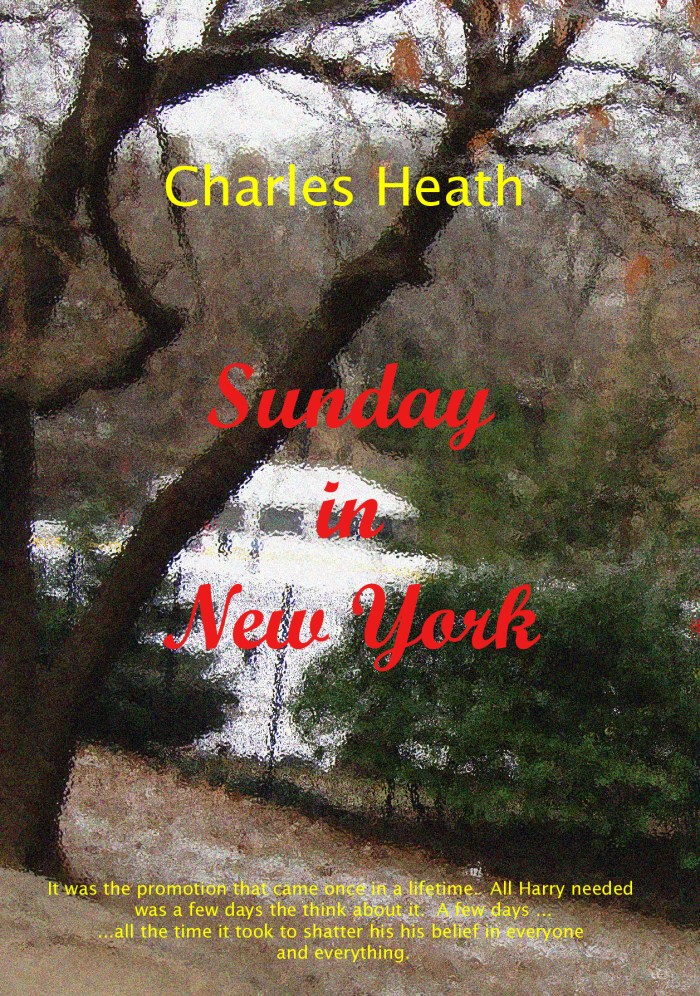
“Sunday in New York”, a romantic adventure that’s not a walk in the park!

“Sunday in New York” is ultimately a story about trust, and what happens when a marriage is stretched to its limits.

When Harry Steele attends a lunch with his manager, Barclay, to discuss a promotion that any junior executive would accept in a heartbeat, it is the fact his wife, Alison, who previously professed her reservations about Barclay, also agreed to attend, that casts a small element of doubt in his mind.

From that moment, his life, in the company, in deciding what to do, his marriage, his very life, spirals out of control.

There is no one big factor that can prove Harry’s worst fears, that his marriage is over, just a number of small, interconnecting events, when piled on top of each other, points to a cataclysmic end to everything he had believed in.

Trust is lost firstly in his best friend and mentor, Andy, who only hints of impending disaster, Sasha, a woman whom he saved, and who appears to have motives of her own, and then in his wife, Alison, as he discovered piece by piece damning evidence she is about to leave him for another man.

Can we trust what we see with our eyes or trust what we hear?

Haven’t we all jumped to conclusions at least once in our lives?

Can Alison, a woman whose self-belief and confidence is about to be put to the ultimate test, find a way of proving their relationship is as strong as it has ever been?

As they say in the classics, read on!

Purchase:

http://tinyurl.com/Amazon-SundayInNewYork

Mistaken Identity – The Editor’s Draft – Day 27

I have been working on the story, the editor is asking for a second draft after making suggested changes – and I’m now working on it

I want a high-octane ending, and I’ve been trying to visualise it in my mind.

I’m sure it’s a lot like how a director of a movie sees the end product and then tries to translate that onto the screen.

I can see it in my head, but it’s not translating onto paper.

I’d also like to write it like that so the reader can almost be sitting in the front-row seat as it all unfolds,

But in a matter of weeks, our once happy travel agent has gone from dispensing advice to others on how to have a good holiday, to a man caught in the middle of the storm.

People he’s only read about in papers and books had been appearing out of left field forcing him into making decisions he never thought he would have to.

He’s discovered his parents were not exactly the people he thought they were.

He’s discovered people can appear to be anything other than who they really are.

And he’s discovered he has the strength to overcome adversity.

Going back to the travel agency is going to be as boring as hell for him now.

Today’s effort amounts to 2,267 words, for a total, so far, of 64,343.

More tomorrow.

‘What Sets Us Apart’ – A beta readers view

There’s something to be said for a story that starts like a James Bond movie, throwing you straight in the deep end, a perfect way of getting to know the main character, David, or is that Alistair?

A retired spy, well not so much a spy as a retired errand boy, David’s rather wry description of his talents, and a woman that most men would give their left arm for, not exactly the ideal couple, but there is a spark in a meeting that may or may not have been a set up.

But as the story progressed, the question I kept asking myself was why he’d bother.

And, page after unrelenting page, you find out.

Susan is exactly the sort of woman the pique his interest.  Then, inexplicably, she disappears.  That might have been the end to it, but Prendergast, that shadowy enigma, David’s ex boss who loves playing games with real people, gives him an ultimatum, find her or come back to work.

Nothing like an offer that’s a double edged sword!

A dragon for a mother, a sister he didn’t know about, Susan’s BFF who is not what she seems or a friend indeed, and Susan’s father who, up till David meets her, couldn’t be less interested, his nemesis proves to be the impossible dream, and he’s always just that one step behind.

When the rollercoaster finally came to a halt, and I could start breathing again, it was an ending that was completely unexpected.

I’ve been told there’s a sequel in the works.

Bring it on!

The book can be purchased here:  http://amzn.to/2Eryfth

In a word: Vision

I had one myself once, whether it was a peek into my future, or whether it was just playing out a scene for one of my stories, it was rather intense.

That variation of the word vision is one that uses one’s imagination. I do it quite a lot, and I call it the cinema of my dreams.

But…

Vision, in the simplest sense of the word, is sight, what you see.

People can try to make it better, like movie studios, who have called it rather interesting titles such as VistaVision or Panavision, either of which sounds quite remarkable, and it may have been back in the day, but it’s probably quite ordinary these days.

A vision, in another sense, might be something like a dream as mentioned before, which might happen when we are asleep, but if awake, it might be because we are very bored with our job and we’re imagining what it would be like at Santorini or the Bahamas, or anywhere but where you are now.

It might also describe our particular slant on what else we would like to happen, whether at work or somewhere else, but it’s usually confined to our closest circle of friends. Bosses never invite nor want to hear plebs ideas of improving their lot.

Hence, I have a vision…

But no one will listen. Perhaps if I was Martin Luther King, things might be different.

Then, at the end of it all…

There are visions and then there are visions, like seeing something that no one else can see, whether driven by hallucinogenic drugs or magic mushrooms, or you just happened to be there to see what no one else could.

Dragons, lizard people, or the Virgin Mary.

And no, I have not seen any of the above.

Yet.

“Echoes From The Past”, the past doesn’t necessarily stay there


What happens when your past finally catches up with you?

Christmas is just around the corner, a time to be with family. For Will Mason, an orphan since he was fourteen, it is a time for reflection on what his life could have been, and what it could be.

Until a chance encounter brings back to life the reasons for his twenty years of self-imposed exile from a life only normal people could have. From that moment Will’s life slowly starts to unravel and it’s obvious to him it’s time to move on.

This time, however, there is more at stake.

Will has broken his number one rule, don’t get involved.

With his nemesis, Eddie Jamieson, suddenly within reach, and a blossoming relationship with an office colleague, Maria, about to change everything, Will has to make a choice. Quietly leave, or finally, make a stand.

But as Will soon discovers, when other people are involved there is going to be terrible consequences no matter what choice he makes.

https://amzn.to/2CYKxu4

newechocover5rs

Writing about writing a book – Day 5 continues – Those annoying people called characters

Whilst it is always an idea to sit down and write and keep going, not worrying too much about the narrative, there’s always the problem of ideas about characters, and relationships that come back and need to be addressed.

I have issues with Jennifer in that we will need to know something about her, and need a little backstory.

Jennifer is the second most important character in this novel and one that has more talents than what my main character, or anyone else for that matter, thinks she has.  Of course, that is deliberate on her part for a number of reasons that will be introduced at the appropriate time.

But, at the start, all we will have to work with, is the introduction provided by the narrator.

It may go something like this:


Jennifer Pennington Smythe was, as you might expect, very English, very reserved, and very private.  She was the definitive ‘don’t judge a book by its cover’, and I was guilty, at first, of suspecting she had once been a schoolmistress due to the severity of dress, demeanor, and expression.

HR had sent her to me when I’d requested an IT Specialist, though of what particular discipline it was never divulged, neither by HR nor by her.  She arrived one morning, told me she was to ‘help resolve our technical difficulties’, moved into an office that had been used as a storeroom, and worked hard to prove her worthiness in the role.

My first attempt at conversation was rebuffed, the second met with a very cold stare.  Everyone, including me, learned very quickly that any other topic of conversation than work would be ignored.  At the time it suited me, there was trouble in paradise and I didn’t want anything more on my plate to deal with.


So, what is this trouble?

There are three distinct stages of this relationship between the two most important characters, and it is the actions of one of the protagonists that brings them together.  This particular protagonist, of course, is the main character’s wife, a woman that is on the periphery for the period the novel covers, but a little background will be needed at some point before we reach this part of the narrative.

This now means that I will have to put together a back story for Bill and his ex-wife Ellen, not too much yet but enough to explain the next part of the evolving relationship between Bill and Jennifer.


I’m sure this topic is going to raise it’s head again and again…

Where am I?

This could be anywhere in the world

Palms swaying in the breeze

This could be taken from the beach of any tropical island retreat.

It could be taken at any mainland resort anywhere in the world, whilst lazing away the hours with a good book and a long, cool drink.

But it’s not.

It’s taken from my back yard in Brisbane where we’re in the grip of summer, and the wind is lowering the temperature from 39 degrees centigrade to a ‘feels like’ 32.

Still, in a sheltered corner, I’m having a nice cup of tea and reading a good book on what could be called a pretend holiday.

At least for the afternoon, anyway.

The cinema of my dreams – I always wanted to write a war story – Episode 34

For a story that was conceived during those long boring hours flying in a steel cocoon, striving to keep away the thoughts that the plane and everyone in it could just simply disappear as planes have in the past, it has come a long way.

Whilst I have always had a fascination with what happened during the second world war, not the battles or fighting, but in the more obscure events that took place, I decided to pen my own little sidebar to what was a long and bitter war.

And, so, it continues…


We gathered up what food there was to take with us.  There were no weapons left behind.  Leonardo had assumed correctly we would have used them if they’d been left there.

Carlo had changed slowly into an automaton, and I guess if I could read his mind, I’d know exactly what he was thinking.  Enrico had attached himself to Carlo, and I knew Carlo would look after him.

When I said that the burials would have to wait, Carlo agreed.

We had a short discussion on what we would be doing next, and in the first instance, we would be going back to the other soldiers and the church.  There, with both of our knowledge of the castle, its entrances, secret or otherwise, and the internal passageways which I knew Wallace and the others there were not too familiar with, we would formulate a plan to go in and pick them off one by one.

It seemed a good plan when we first talked about it, but on the way back to the church, and I had time to consider how it would work, it seemed we would only get an advantage once, and we would have to kill or capture as many as we could in the first raid.

Then it was going to be difficult.

Unless Carlo knew of more places we could enter the castle without being seen or heard.

I only knew of three.

And the first post we had to hit, and silence, the radio room.


My war had not been as start or as terrifying as most of those whom I’d known or worked with.  My part was more selective, finding and eliminating spies, informers, and enemy cells on home territory.  

Sometimes that would extend into enemy territory, particularly France where, as one who could speak French fluently, I found myself working with the resistance, using intelligence gathered by a network of spies we had, not only in France but in all parts of enemy territory.  That also meant, sometimes, accompanying weapons and other supplies into enemy territory.

It hadn’t included anything like what I’d just seen back at the underground cavern.

I’d been told, often, about the enemy executing whole villages, and large groups as retaliation for resistance operations that killed German soldiers, and particularly officers, but I’d not seen it first-hand.

Now I had.

I’d been told, along with the others who had been at the training camp way back at the start of the war, that we would inevitably see atrocities.  Those instructors, men who had survived the first war, were speaking from experience.  We were told it would make us angry.  It had.  I had this immediate thought of doing as much damage as I could to the perpetrators of that massacre.

But we had also been told that we had to harness that anger, and use it to drive our actions, bot in a reckless manner, but with a measured calm and with planning.  Blind rage, which had been predicted, would only get us killed.

I had left the cavern at the blind rage stage, but the walk to the church wore some of that off, and I began to piece together the seeds of a plan to get our revenge.  We were only a small group, but even so, we could work more efficiently than those at the castle. 

Leonardo was not going to tell Wallace that he hadn’t captured or killed me in his ambush, but it might make Wallace think that my ability to retaliate would be weakened.  Leonardo would know that Carlo and I were still alive.  He would not know about Blinky and his men.

It would be interesting to see if Wallace would commit any of his men to hunt us down, send Leonardo back out to finish the job, or just wait until Meyer turned up.  His contact in Gaole would know about the castle’s change of allegiance, but he would not know that Martina was not going to be there to greet them when they arrived in the village.

That was several days away.  We would have to be there, but it was going to be dangerous unless we found a way to neutralize the castle.  So far, in my head, we’d neutralized the radio and got as far as the dungeons before meeting enemy resistance.

The same had happened in the next six scenarios, after playing out the last we had arrived back at the church.


Chiara was resting as comfortably as the Sergeant could make her.

He had made a more thorough assessment of her injuries, and aside for the severe beating, she had sustained a few cracked ribs and several broken fingers.  The broken fingers were a surprise.  The sergeant had reset them as best he could.

Other than that, she would recover physically.  Mentally, he said, would be something else.  She was lucky, he said, her torturer was an amateur, and Italian.  Had it been the German Gestapo, she would be dead.

She was lucid and I told her we would make Leonardo pay for what he’d done.  I thought it best not to tell her about what had happened back at the cavern.  She had enough on her conscience without adding the senseless deaths of the villagers.

Then we had a meeting, where I asked Carlo to draw a plan of the castle and the places where we could breach their defenses and give us an element of surprise.

He had one that I hadn’t known about, one that might give us a fighting chance.

© Charles Heath 2020

Mistaken Identity – The Editor’s Draft – Day 27

I have been working on the story, the editor is asking for a second draft after making suggested changes – and I’m now working on it

I want a high-octane ending, and I’ve been trying to visualise it in my mind.

I’m sure it’s a lot like how a director of a movie sees the end product and then tries to translate that onto the screen.

I can see it in my head, but it’s not translating onto paper.

I’d also like to write it like that so the reader can almost be sitting in the front-row seat as it all unfolds,

But in a matter of weeks, our once happy travel agent has gone from dispensing advice to others on how to have a good holiday, to a man caught in the middle of the storm.

People he’s only read about in papers and books had been appearing out of left field forcing him into making decisions he never thought he would have to.

He’s discovered his parents were not exactly the people he thought they were.

He’s discovered people can appear to be anything other than who they really are.

And he’s discovered he has the strength to overcome adversity.

Going back to the travel agency is going to be as boring as hell for him now.

Today’s effort amounts to 2,267 words, for a total, so far, of 64,343.

More tomorrow.

Searching for locations: Rome, Italy

We visited Rome in August

It was hot.

It was verrrry hot.

We flew into Rome’s Leonardo da Vinci-Fiumicino airport after a rather bumpy flight from London.  Unlike most other airports the plane parked at a satellite terminal and after we disembarked we had to catch a train to the main terminal.

The most notable memory of this airport was my daughter’s discovery of a salami shop.

We had booked a transfer to take us to the hotel the Roma Corso Trieste Mercure in Via Gradisca from the airport.  It was a white air-conditioned van and so far we had avoided the heat.

One of the rooms had faulty air conditioning an absolute must as the rooms were very hot without it and necessitated a room change which was done quickly and efficiently.

The hotel was in the suburbs and without a car we were dependent on public transport.  According to the reception staff, there was a bus stop nearby, and a longer walk to the tram or light railway.  The bus seemed to be the best option as it would take us to the central terminal near the railway station, where all tour buses also operated from, and particularly the open-top buses that went to all the major tourist attractions.

That first day basically was given over to travelling, arriving by plane and settling into the hotel, thus we didn’t get to feel the force of the heat.  That came the next day.

After a walk around the hotel precinct to get our bearings and see what shops and restaurants were available, on returning to the hotel we were faced with limited choices of room service or to go out for dinner.

My daughter and l go for a long walk up Via Nomentana to find several shops and a restaurant.  We went into the restaurant and sat down.   We waited for 10 minutes and got no service nor did anyone come and ask us if we wanted to order food so instead we left somewhat disappointed and go next door to what seemed to be the Italian version of a delicatessen and ordered sandwiches and beer.   I bought a half dozen cans of Moretti beer two of which I drank on the way home.

It was still very hot even at eight at night and the sandwiches are delicious.  It just might be by that time we were starving and anything would have tasted great.

The next morning we are up and ready to chance the weather and some history.  Breakfast at the hotel is limited but very good.

We were going to use public transport and I’d studied up on the Internet.

Travelling on the bus required pre-purchase of tickets which could be bought in certain shops and locally when exploring the area near the hotel, l found a tobacconist.

Next, we needed to understand how to use the tickets. There was no one on the bus who could help so when l tried to scan the tickets and it failed, l gave up.  We had the same issue each day and in the end, the tickets never got used.

The trip to central Rome by bus took about 15 minutes.  In the morning it was reasonably cool and showed us a little of suburban Rome.  We also saw the trams but we would not be able to use them because our hotel not on a direct route.

That first full day we decided to go and see the Vatican.

Not understanding buses and which one we needed to get to the Vatican, we took a taxi.

Wow.  It was the metaphorical equivalent of driving over the edge of a cliff with a daredevil.  It was quite literally terrifying.

Or maybe we just didn’t know that this was probably the way people drove in Rome.

Shaken but delivered in one piece we found ourselves in the square opposite St Peters Basilica.

The square is impressive, with the statues atop a circular colonnaded walkway.  The church is incredible and took a few hours to take in and to top off the day we did a tour of the Vatican museum which took the rest of the afternoon.

Then it was back to the delicatessen for more sandwiches and beer, and an interesting discussion with several elderly Italian ladies, of which I did not understand one word.

On the second full day we decided to use one of the open-top bus tours and eventually decided on the hop-on hop-off tour simply because the bus was at the central transport terminal for trains and buses and it was getting hotter.

Our first stop was the Colosseum.  There were other monuments nearby, such as the Arch of Constantine, but as the heat factor increased we joined the queue to go into the Colosseum and gladly welcomed the shade once we got inside.

The queue was long and the wait equally so, but it was worth the wait.  It would be more interesting if they could restore part of it to its former glory so we could get a sense of the place as it once was.  But alas that may never happen, but even so, it is still magnificent as a ruin.

Outside in the heat, it was off to the ruins which were a longish walk from the Colosseum, taking Via Sacra, not far from the Arch of Constantine.  This day in the walkway there were a number of illegal vendors, selling knockoff goods such as handbags and watches, and who, at the first sight of the police, packed up their wares in a blanket and ran.

Included in these ruins were The Roman Forum, or just a few columns remaining, the Palatine Hill, Imperial Fori, including the Forum of Augustus, the Forum of Caesar, and more specifically the Forum of Trajan.  It was, unfortunately very hot and dusty in the ruins the day we visited.

We walked all the way to the Foro Romano and the Septimus Severo Arch at the other end of the ruins, past the Temple of Caesar.  I found it very difficult to picture what it was like when the buildings were intact, so I bought a guide to the ruins which showed the buildings as ruins and an overlay of how they would have looked.  The buildings, then, would be as amazing as the Colosseum, and it would have been interesting to have lived back then, though perhaps not as a Christian.

I lost count of the number of bottles of water we bought, but the word ‘frizzante’ was ringing in my ears by the end of the day.  Fortunately, the water did not cost a lot to buy.

At the end of the day, we caught the hop on hop off the bus at the Colosseum and decided not to get off and see any more monuments but observe them from the bus.  The only one I remember seeing was Circo Massimo.  Perhaps if we’d known it was going to be twice as hot on the bus, yes, there was no air-conditioning; we may have chosen another form of transport to get back to the hotel.

On the third and last day in Rome, we decided to go to the Trevi Fountain, see the pantheon and walk up the Spanish Steps.  We spent most of the morning in the cool of a café watching the tourists at the fountain.  By the time we reached the top of the Spanish Steps, we were finished.