In a word: Scene

This is an easy one.

It’s a part of a book or film which covers a single event, and predominantly with a set group of characters.

It could also mean it might relate to a particular genre that you like, as in,

I’m part of the jazz scene or the symphonic scene, though I think it had a more sinister context back in the late 60s early 70s.

A scene could also be a landscape (especially in art)

Then, of course, the last thing you want is a child to make a scene in front of others, in a display of temper, or bad manners

This is not to be confused with seen, as in, you should be seen and not heard, an oft used expression by a parent.

You could be seen, especially in places where you were not meant to be, or, conversely, make sure you are seen by the ‘right’ people in the ‘right’ places

Have you seen my dictionary, it’s quite large and heavy

I have seen his bad qualities

I have seen better days, though at the moment I can’t remember when

I have seen them all, sometimes seemingly impossible, but it is generated by exasperation, and generally more like I’ve seen everything now!


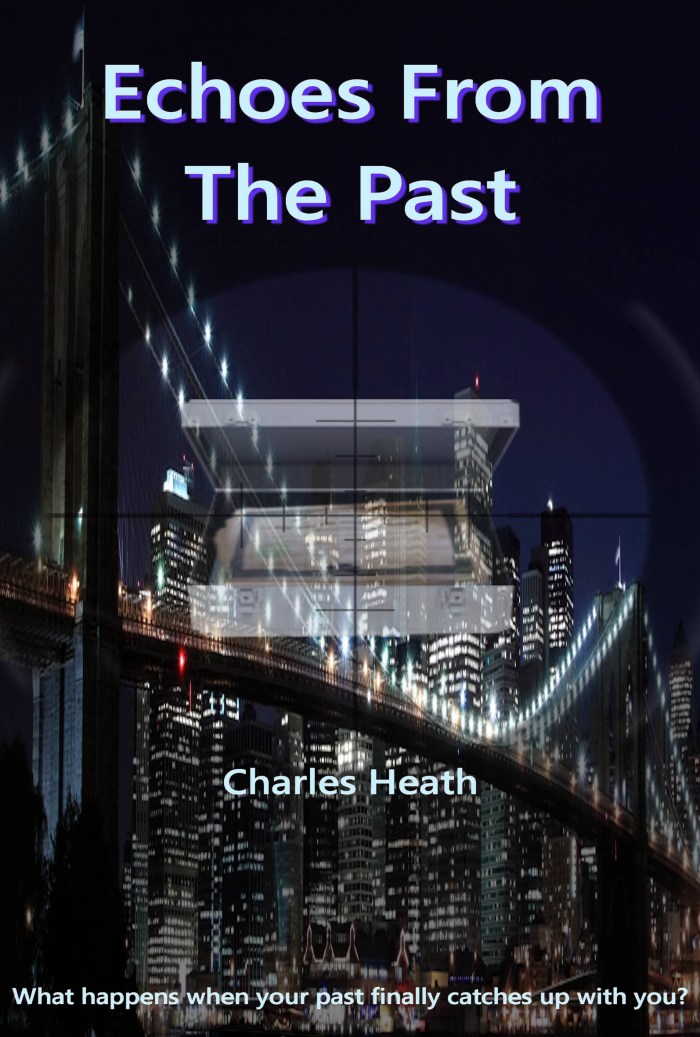
An excerpt from “Echoes from the Past”

Available on Amazon Kindle here:  https://amzn.to/2CYKxu4

With my attention elsewhere, I walked into a man who was hurrying in the opposite direction.  He was a big man with a scar running down the left side of his face from eye socket to mouth, and who was also wearing a black shirt with a red tie.

That was all I remembered as my heart almost stopped.

He apologized as he stepped to one side, the same way I stepped, as I also muttered an apology.

I kept my eyes down.  He was not the sort of man I wanted to recognize later in a lineup.  I stepped to the other side and so did he.  It was one of those situations.  Finally getting out of sync, he kept going in his direction, and I towards the bus, which was now pulling away from the curb.

Getting my breath back, I just stood riveted to the spot watching it join the traffic.  I looked back over my shoulder, but the man I’d run into had gone.  I shrugged and looked at my watch.  It would be a few minutes before the next bus arrived.

Wait, or walk?  I could also go by subway, but it was a long walk to the station.  What the hell, I needed the exercise.

At the first intersection, the ‘Walk’ sign had just flashed to ‘Don’t Walk’.  I thought I’d save a few minutes by not waiting for the next green light.  As I stepped onto the road, I heard the screeching of tires.

A yellow car stopped inches from me.

It was a high powered sports car, perhaps a Lamborghini.  I knew what they looked like because Marcus Bartleby owned one, as did every other junior executive in the city with a rich father.

Everyone stopped to look at me, then the car.  It was that sort of car.  I could see the driver through the windscreen shaking his fist, and I could see he was yelling too, but I couldn’t hear him.  I stepped back onto the sidewalk, and he drove on.  The moment had passed and everyone went back to their business.

My heart rate hadn’t come down from the last encounter.   Now it was approaching cardiac arrest, so I took a few minutes and several sets of lights to regain composure.

At the next intersection, I waited for the green light, and then a few seconds more, just to be sure.  I was no longer in a hurry.

At the next, I heard what sounded like a gunshot.  A few people looked around, worried expressions on their faces, but when it happened again, I saw it was an old car backfiring.  I also saw another yellow car, much the same as the one before, stopped on the side of the road.  I thought nothing of it, other than it was the second yellow car I’d seen.

At the next intersection, I realized I was subconsciously heading towards Harry’s new bar.   It was somewhere on 6th Avenue, so I continued walking in what I thought was the right direction.

I don’t know why I looked behind me at the next intersection, but I did.  There was another yellow car on the side of the road, not far from me.  It, too, looked the same as the original Lamborghini, and I was starting to think it was not a coincidence.

Moments after crossing the road, I heard the roar of a sports car engine and saw the yellow car accelerate past me.  As it passed by, I saw there were two people in it, and the blurry image of the passenger; a large man with a red tie.

Now my imagination was playing tricks.

It could not be the same man.  He was going in a different direction.

In the few minutes I’d been standing on the pavement, it had started to snow; early for this time of year, and marking the start of what could be a long cold winter.  I shuddered, and it was not necessarily because of the temperature.

I looked up and saw a neon light advertising a bar, coincidentally the one Harry had ‘found’ and, looking once in the direction of the departing yellow car, I decided to go in.  I would have a few drinks and then leave by the back door if it had one.

Just in case.

© Charles Heath 2015-2020

newechocover5rs

“Trouble in Store” – Short stories my way: Actions have consequences

It’s time for the policewoman to arrive.

There is such a thing as pure dumb luck.

If she did not walk through the door when she did then Jack would have walked away.

From the policewoman’s perspective:


She crossed the street from the corner instead of remaining on the same side of the street as she did every other night.  When she reached the other sidewalk, she was about 20 yards from the nearest window of the store.

As she crossed, she got a better view of the three people in the store and noticed the woman, or girl, was acting oddly as if she had something in her hand, and, from time to time looked down beside her.

A yard or two from the window she stopped, took a deep breath, and then moved slowly, getting a better view of the scene with each step.

Then she saw the gun in the girl’s hand, and the two men, the shopkeeper and a customer facing her, hands up.

It was a convenience store robbery in progress.

She reached for her radio, but it wasn’t there.  She was off duty.  Instead, she withdrew, and called the station on her mobile phone, and reported the robbery.  The officer at the end of the phone said a car would be there in five minutes.

In five minutes there could be dead bodies.

She had to do something, and reached into her bag and pulled out a gun.  Not her service weapon, but one she carried in case of personal danger.


Guns are dangerous weapons in the hands of professional and amateur alike.  You would expect a professional who has trained to use a gun to not have a problem but consider what might happen in exceptional circumstances.

People freeze under pressure.  Alternately, some shoot first and ask questions later.

We have an edgy and frightened girl with a loaded gun, one bullet or thirteen in a magazine, it doesn’t matter.  It only takes one bullet to kill someone.

Then there’s the trigger pressure, light or heavy, the recoil after the shot and whether it causes the bullet to go into or above the intended target, especially if the person has never used a gun.

The policewoman, with training, will need two hands to take the shot, but in getting into the shop she will need one to open the door, and then be briefly distracted before using that hand to steady the other.

It will take a lifetime, even if it is only a few seconds.

Actions have consequences:


The policewoman crouched below the window shelf line so the girl wouldn’t see her, and made it to the door before straightening.  She was in dark clothes so the chances were the girl would not see her against the dark street backdrop.

Her hand was on the door handle about to push it inwards when she could feel in being yanked hard from the other side, and the momentum and surprise of it caused her to lose balance and crash into the man who was trying to get out.

What the hell…

A second or two later both were on the floor in a tangled mess, her gun hand caught underneath her, and a glance in the direction of the girl with the gun told her the situation had gone from bad to worse.

The girl had swung the gun around and aimed it at her and squeezed the trigger twice.

The two bangs in the small room were almost deafening and definitely disorientating.

Behind her, the glass door disintegrated when the bullet hit it.

Neither she nor the man beside her had been hit.

Yet.

She felt a kick in the back and the tickling of glass then broke free as the man she’d run into rolled out of the way.

Quickly on her feet, she saw the girl had gone, and wasted precious seconds getting up off the floor, then out the door to find she had disappeared.

She could hear a siren in the distance.  They’d find her.


If the policewoman had not picked that precise moment to enter the shop, maybe the man would have got away.

Maybe.

If he’d been aware of the fact he was allowed to leave.

He was lucky not to be shot.

Yet there were two shots, and we know at least one of them broke the door’s glass panel.


Next – the epilog

© Charles Heath 2016-2020

The fourth attempt, other factors, and people

There are two other characters that will be used in this rewrite, the second an addition to give the main character a means of letting the reader get to know a bit about him.

His name is Milt, an African American that’s always been on the fringe.  Another who is a victim of his circumstances but not letting it get the better of him, the sort of man who makes the best of a bad situation.

He’s seen active service in the army, honourably discharged, but still affected though not as bad as some of those he served with.  He is in fact the ideal man for the job, with combat experience, so he’s not likely to get flustered in a shit storm.

And probably not the man you want on this site.  Being in desperate circumstances doesn’t mean you do desperate things.

He is one of a team of four and our main character drew the straw to partner him.  There are two others, based on the other side of the park, neither of whom are trustworthy, Smithy, the overall leader, to whom they all report at shift start and end, and Carruthers, an Englishman reputed to be ex SAS, but no one is inclined to believe him. 

The scars on his neck tell a story, but it was left to the other’s imagination, as he doesn’t talk about it.  Milt was of the opinion he was captured in Afghanistan and tortured, but that could be just be canteen scuttlebutt.

Whatever the circumstances, Graham kept away from him as much as possible, and was glad when he didn’t have to partner him for the shift.

The other character. Penelope has featured in the earlier versions of the story.  Over the changes her background has changed, but I’ve settled on a medical surgeon career, renown for doing tricky procedures with a high success rate, and in doing so gained a reputation, some not always good.

Wealth and ego don’t always make a good pair, and marrying wealth brings its own rewards and pitfalls, particularly when you discover the man you married isn’t exactly whom you thought he was.

It is of course a typical scenario, but I’m going to try and weave it differently.  There will be no more teasers until the story starts.

But she will be introduced earlier than in the previous iterations because she needs some backstory too, otherwise just arriving at Graham’s work and getting shot, while provoking a volatile situation that drags the reader in, out of left field is not exactly the best start.

So, let’s begin.

© Charles Heath 2022

The cinema of my dreams – I always wanted to write a war story – Episode 17

For a story that was conceived during those long boring hours flying in a steel cocoon, striving to keep away the thoughts that the plane and everyone in it could just simply disappear as planes have in the past, it has come a long way.

Whilst I have always had a fascination in what happened during the second world war, not the battles or fighting, but in the more obscure events that took place, I decided to pen my own little sidebar to what was a long and bitter war.

And, so, it continues…


Jack was the first to realise that Marina was coming back, hearing her outside long before I did.  He stood up and looked in the direction of where he expected to see her.

A minute later she appeared, looking and sounding out of breath, as if she had been in a hurry? 

Chased, or had some urgent news?

“Is everything OK?” I asked, waiting till she came in and shut the door behind her.

The building we were in used to be a factory or a repair shop.  The strange smell I’d picked up a few hours ago was that of machine oil.

“We need to have a chat with the two who picked you up.”

“Where are they now?”

“I’ve organised to meet them at another facility we have.  Not everyone comes here.  It’s why we are still here.  Francesco nor any of the resistance he took with him were aware of this location.

I considered myself lucky to be among the few.

“Is there a reason why I need to be there?”

“Yes.  But it’ll wait until we get there.  Let’s go.”

She had barely got in the door, nor caught her breath.  It was just enough time to collect a spare clip of ammunition for a gun she had on her, but I couldn’t see.

I followed her out into the darkness, not realising it was night, for the first time since I’d arrived, and once outside, realised that it was an underground bunker rather than a building on an allotment, so it couldn’t be easily seen from any direction.  It was surrounded by trees and bushes, looking as though they had not been tended properly for some time.

It was as much as I could see, close by because it was a moonless night.

We went up some stairs and came out in a clump of bushes, and walked several yards where there was a disguised walkway zig-zagging through the bushes.  It, too, would be hard to see from a distance.  When we came out the other side, I could just barely see a car parked under a tree, looking rather worse for wear, and I thought it had been abandoned there. 

When Marina told me to get in, I realised it was, like everything else, well disguised.

The surrounding area was that of forest and farms.  It was hard to imagine that this part of the world was in the grip of a world war, and not too far away, there was the castle, and further north, the Germans and what was left of the Italian military forces dug in for a last-ditch effort.  The tide was turning, but ever so slowly.

It was hard to imagine just how dangerous it was for those defectors to try and get through without being shot.

And, just for good measure, Marina said, there were quite a few soldiers, disguised as ordinary workers who had infiltrated the villages, and surrounding farms, and reporting back what they saw and heard.

We were, in going about in the vehicle, attracting unwanted attention, but it was why we were doing this at night, she said, perhaps gleaning from my expression the fact I was worried about getting caught.

“The people at the castle tend not to go out at night for fear of being picked off.  I’m surprised you didn’t learn this when you were there.”

“I suspect the suspended any activities from the moment I arrived.  One of the prisoners told me that all movements of people had stopped, and they were waiting to be shipped out.  Obviously, they thought I might discover what was going on.  They definitely stopped me from going below the main floor.”

“I was told you have some knowledge of the castle layout?”

“Some.  We have old plans back in London, but I suspect those would be out of date now and since the German occupation.  The only time I got to look downstairs was when I tried to escape and found an old below ground exit, then when they locked me in a cell, and then when I was set free.  It matched much of what I remember seeing on the plans.  But, I suspect there’s more because I didn’t get to see the holding cells with the other prisoners.”

“Perhaps Carlo can help you with that.”

“We spoke about it.  I think he’s going to pay them a visit and exact revenge.”

“I told him we have to wait for some reinforcements.”

“No word from London?”

“Not yet.”

We stopped and parked the car between a church and what was left of what might have been a rectory, set aside from some other buildings that looked like part of a village.  It was not that dark that I couldn’t see that several of the buildings had been bombed, minus roofs, and one had the front section reduced to rubble.  No attempt had been made to clean it up.

“German tanks,” Marina said.  “An early landing party of your army parachuted in about a kilometre behind the church.  The local commander mobilised his forces and chased them into those buildings, which, at the time, housed four families.  They were given the option to surrender.  They didn’t, so the commander gave the order to raze the buildings to the ground, with them in there.  Along with the four innocent families.  No one survived.”

“The church?”

“The commander thought it would be bad luck to destroy the house of God.  The soldiers should have hidden in there.  They shot the priest anyway.”

It seemed odd to me that any sort of group would parachute into this part of Italy for any reason, castle withstanding.  There was, as far as I knew, nothing of interest or importance here.  Perhaps I’d ask when I made it back to London.  If I made it back.

I followed her through the rubble and in through a side entrance to the church.  Inside it was dark, and Marina was using her torchlight sparingly in case someone was watching.  From what I could see, the inside of the church was untouched, but everything was covered in dust from disuse.

“No one thought to send another priest?” I asked.

“No.  When they heard what happened to the last one, they decided to wait until the war was over.  Besides, with everything that’s happened, the people around here believe God has abandoned them.”

Perhaps he had.  I know that I wasn’t all that religious to begin with, but a lot of people I knew had lost their faith in a God that allowed such tragedies to happen.

We passed through a door at the back of the church, behind the nave, and into what looked like the vestment room.  To one side was another door, and then steps down.  The church had a cellar.

At the bottom of the stairs, there was a large storage area lit by a portable lantern.

Carlo was standing to one side, his weapon ready to use.

Opposite him were a man and a woman, the woman I’d seen before, she was the one who shot me with the tranquilizer.  The man, I’d not seen him before.


© Charles Heath 2019

Mistaken Identity – The Editor’s Draft – Day 10

I have been working on the story, the editor is asking for a second draft after making suggested changes – and I’m now working on it

One third of the month is gone and this writing job is not getting any easier.

The notion that we can sit down and over a period of 30 days, we can write a 50,000 word novel would be, to some, a preposterous notion.

For me, it is not. I have done it for three years in a row, and even without having a plan.

This one has a plan, but that plan only sometimes stretches to a day or two ahead, depending on how I’m going.

Today, it had been hard going because I set time aside to just sit down and write it, but you all know how fickle that can be. Devote time, and the words don’t come, have no time and try scratching in between a lot of other jobs, and the words are flowing.

It is annoying to say the least.

Bit, for today, Jack has discovered he does, indeed, have a doppelganger, and that he is related, which explains the uncanny likeness. Of course, he has been followed to the island, and run to ground in a park where the two meet face to face. Oh, and the doppelganger has a name, Jacob.

It could have got ugly, but Maryanne is there, though Jack is still not sure why, and her presence averts what could have been an ugly showdown,

Instead, some words of advice. Jack must ask his mother for the answers.

A fine time for Jack to discover that his mother has been lying to him for his whole life.

But, of course, any attempt to get her on the phone is proving difficult.

And it might mean the end of his holiday.

Our Jack is not a happy man.

Today’s effort amounts to 2,873 words, for a total, so far, of 25,485.

Yes, word wise we have reached the half way mark, but story wise, it appears it make take a little longer.

More tomorrow.

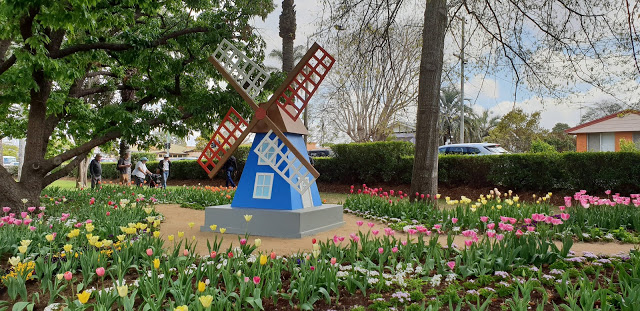
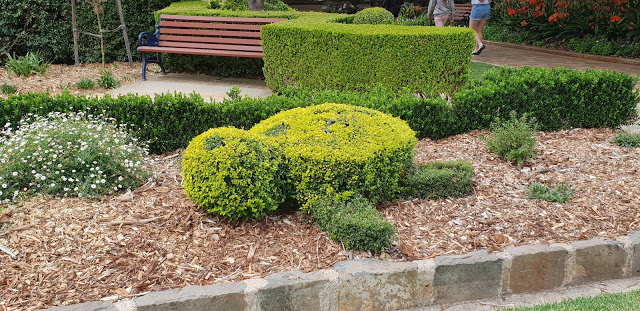
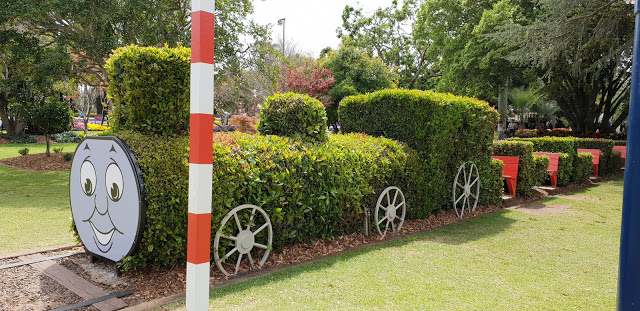
Searching for locations: Toowoomba Flower Festival, Toowoomba, Queensland, Australia

The Toowoomba Carnival of Flowers is held in September, and generally runs for ten days at the end of the month.

We visited the Laurel Bank Park, where there are beds of many colorful flowers,

open spaces,

statues,

an area set aside for not only tulips but a model windmill

and quite a number of hedge sculptures

There was also the opportunity to go on a morning or afternoon garden tour which visited a number of private gardens of residences in Toowoomba.

Sometimes it’s better to say that an expressed opinion is your own

It’s always a good thing to get that across especially if you work for an organization that could misinterpret what that opinion is, or generally have an opposing opinion.  Of course, by saying your opinions are your own, you’re covering yourself from becoming unemployed, but is this a futile act?

Perhaps its better to not say anything because everything you say and do eventually find its way to those you want most not to hear about it, perhaps one of the big negatives of the internet and social media.

And…

It seems odd to me that you can’t have an opinion of your own, even if it is contrary to that of the organization you work for, and especially if their opinion has changed over time.  An opposing opinion, not delivered in a derogatory manner, would have the expectation of sparking healthy debate, but it doesn’t always end up like that.

I’m sure there are others out there that will disagree, and use the overused word, loyalty’.   Perhaps their mantra will be ‘keep your opinions to yourself’.

This, too, often crops up in personal relationships, and adds weight to the statement, ‘you can pick your friends but not your relatives’.

I’m told I have an opinion on everything, a statement delivered in a manner that suggests sarcasm.  Whether it’s true or not, isn’t the essence of free speech, working within the parameters of not inciting hate, bigotry, racism, or sexism, a fundamental right of anyone in a democracy?

Seems not.

There’s always someone out there, higher up the food chain, with an opinion of their own, obviously the right one, and who will not hesitate to silence yours.  But, isn’t it strange that in order to silence you, they have to use leverage, like your job, to get theirs across.

Well, my opinions are in my writing, and whether or not you agree with them or not, I’m sure you will let me know.  In a robust but respectful manner.

Unlike some, my door is always open.

The cinema of my dreams – I never wanted to go to Africa – Episode 43

Our hero knows he’s in serious trouble.

The problem is, there are familiar faces and a question of who is a friend and who is foe made all the more difficult because of the enemy, if it was the enemy, simply because it didn’t look or sound or act like the enemy.

Now, it appears, his problems stem from another operation he participated in, and because of it, he has now been roped into what might be called a suicide mission.


The hut was a barracks, with bedding and ablutions for twenty men.  Since this was one of two, I assumed the other hut housed the twenty soldiers that the Colonel had alluded to.  There would be no more than one or two others including the Captain.

Hopefully, there were not more in Nagero.

The two hostages had been taken to the Captain’s office where I assumed there was probably a brig for them to be locked in.  Not quite what I was expecting, but no plan was ever perfect.

I went to the rear and sat down at a table that could accommodate about ten.

Davies and Shurl joined me.

I looked at Shurl.  “Good work, and glad they didn’t shoot you.”

“So am I.  Monroe had joined the others.  I had to make a lot of noise before they found me, so I don’t think this is a crack troop.”

“The Captain, or whatever he is, looks sharp,” Davies said.

“New command perhaps.  Can’t believe his luck, I’m guessing.  Did you get a look at the plane?”

“As much as I could without looking like I was looking at it.  It’s been well maintained, and I have no doubt we can get it off the ground.  It just depends if we need help to get the engines started.  It’s possible they don’t, though it’s not usual for this type of plane.  We shall see when the time comes.”

“Can you take off at night?”

“It’s a bit dangerous without lights.  I see they have a lighting system, so I suggest, if and when we break out of here you get someone to find the switch.”

“Noted.”

“Any idea when that’ll be?”

“I’m sure we have people working on that as we speak.”

The door at the entrance to the hut opened and the Captain stood next to his officer, with a gun pointed loosely in our direction, just in case we got the idea we could escape.

“Mr. James.  Time to tell me all about your escape plans.”

“I’m not so sure they could be called that, now.”

His tone hardened.  “Don’t keep me waiting.  I have people waiting for my report.”

I shrugged and got up.  “Just make sure everyone is ready to move when the time comes.  Tell Baines that I expect him to find the generator and get the lights working.”

The Captain’s impatient look told me not to keep him waiting any longer.

The Captain led the way, and his officer kept the gun pointed at me, just in case of what I’m not sure.  Inside his office, rather spacious, and with a door which likely led to some form of accommodation and the brig where the hostages were being held.  The door was closed so I couldn’t see, so it had to be an assumption.

The officer remained in the doorway, while the Captain sat behind a large desk, and gestured for me to sit the other side.  It didn’t look like a comfortable chair.

I thought I’d start the ball rolling.  “I’m assuming that there isn’t always an army guard on this airstrip?”

“No.  When we heard you were coming for the prisoners, a detachment was sent.  Fortuitous wouldn’t you say?”

“For who.”  Time to sow some seeds of discontent.

“What do you mean Mr. James?”

“Your mate back at the militia camp just pocketed two million US dollars’ worth of diamonds for those two men.  What was your cut?”

A shocked look, one that eased back into benign slowly.  No cut from that look, I’d say.

“We pride ourselves on being above bribery.  That was the old way of doing things.”

“Clearly the militia don’t agree.  Are you going to give them back to the commander so he can raffle them again?”

The Captain didn’t seem to understand the word ‘raffle’.

“Sell them back to us for another two million.  Maybe you should talk to your superiors and see what they think.  If you left us go, I can arrange for five million, for you and your friends to share.”

Disdain, or disappointment.

“What did I just say about bribery.”

“That it’s not the way things are done.  Maybe not in the capital, but this is the boondocks, and you’re the man in charge.  Five million can go a long way, but I suspect if you tell your superiors, you won’t get to see any of it.  Or perhaps you should take a few men over to the Militia commander’s camp and demand your share, or just take it.  After all, Captain, who is in charge of this sector, him or you?”

At least he was thinking about it.  Five million was a lot of money, but in US dollars, that could take him anywhere.

I remembered my old instructor saying, one, ‘every man has his price’.

I just had to find the Captains.

“Aside from trying to bribe me, Mr. James, what were you hoping to achieve here?”

“A rescue.  I know we tried once before and not succeeded, but you know how it is, if you at first don’t succeed, try, try, try again.”

“That it failed before should be a warning that we are not as weak as you might think we are.  The US Army is not necessarily the best in the world.”

“So I’m beginning to discover.  Did we train you?”

“No.  I spent some time in England, training with the British Army.”

So that was where he got his accent and ramrod stiff never a crease out of place posture.

“But,” he said, “this not about me, but you.  And your so-called film crew.  How did you expect top escape through this airstrip, flights are restricted, and you can’t possibly fly in a Hercules?  The runway is not long enough.

“No, we were hoping for something a bit smaller than that, but we’ll find out tomorrow what it is.  I’ll be standing on the patio looking as surprised as you are when it arrives.  Now, let me ask you a question.  Do you know who those men are that you have in detention?”

“Militia prisoners.”

“For doing what?”

“I don’t ask questions.  I obey orders.

“Then I’ll tell you.  They were trying to set up a trade agreement for some precious metal you have in abundance here.  Good for the country for income, and employment.  Might even help you get on better terms with the rest of the world.  Unless of course, you don’t want to.”

“I am a soldier, not a politician.  That’s their problem.  I was told to hold you until my superiors arrive.”

“Who told you?”

“The Colonel.  He’s based in Ada.”

So, we had a leak.  Surprising given the limited circulation of the plan.  It might be down to Jacobi, but somehow, I didn’t think it was him.  He had several opportunities to turn on us and he didn’t.

“So, you’re saying we basically drove into a trap?”

“Yes.  So much for the smart Americans who have all the technology and answers.

I could understand his contempt, especially when the attempt had failed so badly.  Pity then he didn’t understand what was about to happen to him.

© Charles Heath 2020

An excerpt from “The Things We Do For Love”; In love, Henry was all at sea!

In the distance he could hear the dinner bell ringing and roused himself.  Feeling the dampness of the pillow, and fearing the ravages of pent up emotion, he considered not going down but thought it best not to upset Mrs. Mac, especially after he said he would be dining.

In the event, he wished he had reneged, especially when he discovered he was not the only guest staying at the hotel.

Whilst he’d been reminiscing, another guest, a young lady, had arrived.  He’d heard her and Mrs. Mac coming up the stairs, and then shown to a room on the same floor, perhaps at the other end of the passage.

Henry caught his first glimpse of her when she appeared at the door to the dining room, waiting for Mrs. Mac to show her to a table.

She was about mid-twenties, slim, long brown hair, and the grace and elegance of a woman associated with countless fashion magazines.  She was, he thought, stunningly beautiful with not a hair out of place, and make-up flawlessly applied.  Her clothes were black, simple, elegant, and expensive, the sort an heiress or wife of a millionaire might condescend to wear to a lesser occasion than dinner.

Then there was her expression; cold, forbidding, almost frightening in its intensity.  And her eyes, piercingly blue and yet laced with pain.  Dracula’s daughter was his immediate description of her.

All in all, he considered, the only thing they had in common was, like him, she seemed totally out of place.

Mrs. Mac came out of the kitchen, wiping her hands on her apron.  She was, she informed him earlier, chef, waitress, hotelier, barmaid, and cleaner all rolled into one.  Coming up to the new arrival she said, “Ah, Miss Andrews, I’m glad you decided to have dinner.  Would you like to sit with Mr. Henshaw, or would you like to have a table of your own?”

Henry could feel her icy stare as she sized up his appeal as a dining companion, making the hair on the back on his neck stand up.  He purposely didn’t look back.  In his estimation, his appeal rating was minus six.  Out of a thousand!

“If Mr. Henshaw doesn’t mind….”  She looked at him, leaving the query in mid-air.

He didn’t mind and said so.  Perhaps he’d underestimated his rating.

“Good.”  Mrs. Mac promptly ushered her over.  Henry stood, made sure she was seated properly and sat.

“Thank you.  You are most kind.”  The way she said it suggested snobbish overtones.

“I try to be when I can.”  It was supposed to nullify her sarcastic tone but made him sound a little silly, and when she gave him another of her icy glares, he regretted it.

Mrs. Mac quickly intervened, asking, “Would you care for the soup?”

They did, and, after writing the order on her pad, she gave them each a look, imperceptibly shook her head, and returned to the kitchen.

Before Michelle spoke to him again, she had another quick look at him, trying to fathom who and what he might be.  There was something about him.

His eyes, they mirrored the same sadness she felt, and, yes, there was something else, that it looked like he had been crying?  There was a tinge of redness.

Perhaps, she thought, he was here for the same reason she was.

No.  That wasn’t possible.

Then she said, without thinking, “Do you have any particular reason for coming here?”  Seconds later she realized she’s spoken it out loud, had hadn’t meant to actually ask, it just came out.

It took him by surprise, obviously not the first question he was expecting her to ask of him.

“No, other than it is as far from civilization, and home, as I could get.”

At least we agree on that, she thought.

It was obvious he was running away from something as well.

Given the isolation of the village and lack of geographic hospitality, it was, from her point of view, ideal.  All she had to do was avoid him, and that wouldn’t be difficult.

After getting through this evening first.

“Yes,” she agreed.  “It is that.”

A few seconds passed, and she thought she could feel his eyes on her and wasn’t going to look up.

Until he asked, “What’s your reason?”

Slight abrupt in manner, perhaps as a result of her question, and the manner in which she asked it.

She looked up.  “Rest.  And have some time to myself.”

She hoped he would notice the emphasis she had placed on the word ‘herself’ and take due note.  No doubt, she thought,  she had completely different ideas of what constituted a holiday than he, not that she had actually said she was here for a holiday.

Mrs. Mac arrived at a fortuitous moment to save them from further conversation.

Over the entree, she wondered if she had made a mistake coming to the hotel.  Of course, there had been no possible way she could know than anyone else might have booked the same hotel, but realized it was foolish to think she might end up in it by herself.

Was that what she was expecting?

Not a mistake then, but an unfortunate set of circumstances, which could be overcome by being sensible.

Yet, there he was, and it made her curious, not that he was a man, by himself, in the middle of nowhere, hiding like she was, but for very different reasons.

On discreet observance whilst they ate, she gained the impression his air of light-heartedness was forced and he had no sense of humor.

This feeling was engendered by his looks, unruly dark hair, and permanent frown.  And then there was his abysmal taste in clothes on a tall, lanky frame.  They were quality but totally unsuited to the wearer.

Rebellion was written all over him.

The only other thought crossing her mind, and rather incongruously, was he could do with a decent feed.  In that respect, she knew now from the mountain of food in front of her, he had come to the right place.

“Mr. Henshaw?”

He looked up.  “Henshaw is too formal.  Henry sounds much better,” he said, with a slight hint of gruffness.

“Then my name is Michelle.”

Mrs. Mac came in to take their order for the only main course, gather up the entree dishes, then return to the kitchen.

“Staying long?” she asked.

“About three weeks.  Yourself?”

“About the same.”

The conversation dried up.

Neither looked at the other, rather at the walls, out the window, towards the kitchen, anywhere.  It was, she thought, almost unbearably awkward.

Mrs. Mac returned with a large tray with dishes on it, setting it down on the table next to theirs.

“Not as good as the usual cook,” she said, serving up the dinner expertly, “but it comes a good second, even if I do say so myself.  Care for some wine?”

Henry looked at Michelle.  “What do you think?”

“I’m used to my dining companions making the decision.”

You would, he thought.  He couldn’t help but notice the cutting edge of her tone.  Then, to Mrs. Mac, he named a particular White Burgundy he liked and she bustled off.

“I hope you like it,” he said, acknowledging her previous comment with a smile that had nothing to do with humor.

“Yes, so do I.”

Both made a start on the main course, a concoction of chicken and vegetables that were delicious, Henry thought, when compared to the bland food he received at home and sometimes aboard my ship.

It was five minutes before Mrs. Mac returned with the bottle and two glasses.  After opening it and pouring the drinks, she left them alone again.

Henry resumed the conversation.  “How did you arrive?  I came by train.”

“By car.”

“Did you drive yourself?”

And he thought, a few seconds later, that was a silly question, otherwise she would not be alone, and certainly not sitting at this table. With him.

“After a fashion.”

He could see that she was formulating a retort in her mind, then changed it, instead, smiling for the first time, and it served to lighten the atmosphere.

And in doing so, it showed him she had another more pleasant side despite the fact she was trying not to look happy.

“My father reckons I’m just another of ‘those’ women drivers,” she added.

“Whatever for?”

“The first and only time he came with me I had an accident.  I ran up the back of another car.  Of course, it didn’t matter to him the other driver was driving like a startled rabbit.”

“It doesn’t help,” he agreed.

“Do you drive?”

“Mostly people up the wall.”  His attempt at humor failed.  “Actually,” he added quickly, “I’ve got a very old Morris that manages to get me where I’m going.”

The apple pie and cream for dessert came and went and the rapport between them improved as the wine disappeared and the coffee came.  Both had found, after getting to know each other better, their first impressions were not necessarily correct.

“Enjoy the food?” Mrs. Mac asked, suddenly reappearing.

“Beautifully cooked and delicious to eat,” Michelle said, and Henry endorsed her remarks.

“Ah, it does my heart good to hear such genuine compliments,” she said, smiling.  She collected the last of the dishes and disappeared yet again.

“What do you do for a living,” Michelle asked in an off-hand manner.

He had a feeling she was not particularly interested and it was just making conversation.

“I’m a purser.”

“A what?”

“A purser.  I work on a ship doing the paperwork, that sort of thing.”

“I see.”

“And you?”

“I was a model.”

“Was?”

“Until I had an accident, a rather bad one.”

“Oh, I’m sorry.”

So that explained the odd feeling he had about her.

As the evening had worn on, he began to think there might be something wrong, seriously wrong with her because she didn’t look too well.  Even the carefully applied makeup, from close up, didn’t hide the very pale, and tired look, or the sunken, dark ringed eyes.

“I try not to think about it, but it doesn’t necessarily work.  I’ve come here for peace and quiet, away from doctors and parents.”

“Then you will not have to worry about me annoying you.  I’m one of those fall-asleep-reading-a-book types.”

Perhaps it would be like ships passing in the night and then smiled to himself about the analogy.

Dinner now over, they separated.

Henry went back to the lounge to read a few pages of his book before going to bed, and Michelle went up to her room to retire for the night.

But try as he might, he was unable to read, his mind dwelling on the unusual, yet the compellingly mysterious person he would be sharing the hotel with.

Overlaying that original blurred image of her standing in the doorway was another of her haunting expressions that had, he finally conceded, taken his breath away, and a look that had sent more than one tingle down his spine.

She may not have thought much of him, but she had certainly made an impression on him.

© Charles Heath 2015-2020

lovecoverfinal1