Skeletons in the closet, and doppelgangers

A story called “Mistaken Identity”

How many of us have skeletons in the closet that we know nothing about? The skeletons we know about generally stay there, but those we do not, well, they have a habit of coming out of left field when we least expect it.

In this case, when you see your photo on a TV screen with the accompanying text that says you are wanted by every law enforcement agency in Europe, you’re in a state of shock, only to be compounded by those same police, armed and menacing, kicking the door down.

I’d been thinking about this premise for a while after I discovered my mother had a boyfriend before she married my father, a boyfriend who was, by all accounts, the man who was the love of her life.

Then, in terms of coming up with an idea for a story, what if she had a child by him that we didn’t know about, which might mean I had a half brother or sister I knew nothing about. It’s not an uncommon occurrence from what I’ve been researching.

There are many ways of putting a spin on this story.

Then, in the back of my mind, I remembered a story an acquaintance at work was once telling us over morning tea, that a friend of a friend had a mother who had a twin sister and that each of the sisters had a son by the same father, without each knowing of the father’s actions, both growing up without the other having any knowledge of their half brother, only to meet by accident on the other side of the world.

It was an encounter that in the scheme of things might never have happened, and each would have remained oblivious of the other.

For one sister, the relationship was over before she discovered she was pregnant, and therefore had not told the man he was a father. It was no surprise the relationship foundered when she discovered he was also having a relationship with her sister, a discovery that caused her to cut all ties with both of them and never speak to either from that day.

It’s a story with more twists and turns than a country lane!

And a great idea for a story.

That story is called ‘Mistaken Identity’.

In a word: Top

Spinning like a …  yes, had a few of those dizzy spells, especially after too much to drink.  It’s where you say, ‘stop the world, I want to get off’.

And, ages ago, I think it was a musical production.

But…

Top, well there’s sides, a bottom, and a top.  Have you been to the top of the world, I think I’ve been to the bottom, and it’s not the poles I’m talking about.

But then the top of something is the highest point, such as a mountain.  For some odd reason, I’ve never had the inclination to climb to the top of a mountain, but I’m guessing the view from the top of Mt Everest would be interesting.

Are you at the top of your game?

We say this when a player, or athlete, is winning or playing at their best.  I just keep hoping this year will be when the Maple Leafs will be playing at the top of their game.

Especially when I personally attend at Scotiabank Arena in Toronto.

If you read thrillers then you’ll know the assassin is always about to top someone, that is to say, kill them.

Will you top up my drink?  It’s where someone asks you how many glasses of wine you’ve had, and the correct answer is one, it just never got empty!

Can you put the top back on the bottle?

I’m headed straight to the top of the company.  The roof maybe, certainly not as CEO.

Top gear, aside from being a motoring show on TV, it could also be third, fourth, of fifth gear, depending on the type of gearbox.

And, of course, there are about another hundred ways it could be used.

Confusing?  to say the least.

Have you another?  Let me know…

An excerpt from “Amnesia”, a work in progress

I remembered a bang.
I remembered the car slewing sideways.
I remember another bang, and then it was lights out.
When I opened my eyes again, I saw the sky.
Or I could be underwater.
Everything was blurred.
I tried to focus but I couldn’t. My eyes were full of water.
What happened?
Why was I lying down?
Where was I?
I cast my mind back, trying to remember.
It was a blank.
What, when, who, why and where, questions I should easily be able to answer. Questions any normal person could answer.
I tried to move. Bad, bad mistake.
I did not realise the scream I heard was my own. Just before my body shut down.

“My God! What happened?”
I could hear, not see. I was moving, lying down, looking up.
I was blind. Everything was black.
“Car accident, hit a tree, sent the passenger flying through the windscreen. Pity to poor bastard didn’t get the message that seat belts save lives.”
Was I that poor bastard?
“Report?” A new voice, male, authoritative.
“Multiple lacerations, broken collar bone, broken arm in three places, both legs broken below the knees, one badly. We are not sure of internal injuries, but ruptured spleen, cracked ribs and pierced right lung are fairly evident, x-rays will confirm that and anything else.”
“What isn’t broken?”
“His neck.”
“Then I would have to say we are looking at the luckiest man on the planet.”
I heard shuffling of pages.
“OR1 ready?”
“Yes. On standby since we were first advised.”
“Good. Let’s see if we can weave some magic.”

Magic.
It was the first word that popped into my head when I surfaced from the bottom of the lake. That first breath, after holding it for so long, was sublime, and, in reality, agonising.

Magic, because it seemed like I’d spent a long time under water.
Or somewhere.
I tried to speak, but couldn’t. The words were just in my head.
Was it night or was it day?
Was it hot, or was it cold?
Where was I?
Around me it felt cool.
It was very quiet. No noise except for the hissing of air through an air-conditioning vent. Or perhaps that was the sound of pure silence. And with it the revelation that silence was not silent. It was noisy.
I didn’t try to move.
Instinctively, somehow I knew not to.
A previous bad experience?
I heard what sounded like a door opening, and very quiet footsteps slowly come into the room. They stopped. I could hear breathing, slightly laboured, a sound I’d heard before.
My grandfather.
He had smoked all his life, until he was diagnosed with lung cancer. But for years before that he had emphysema. The person in the room was on their way, down the same path. I could smell the smoke.
I wanted to tell whoever it was the hazards of smoking.
I couldn’t.
I heard a metallic clanging sound from the end of the bed. A moment later the clicking of a pen, then writing.
“You are in a hospital.” A female voice suddenly said. “You’ve been in a very bad accident. You cannot talk, or move, all you can do, for the moment, is listen to me. I am a nurse. You have been here for 45 days, and just come out of a medically induced coma. There is nothing to be afraid of.”
She had a very soothing voice.
I felt her fingers stroke the back of my hand.
“Everything is fine.”
Define fine, I thought. I wanted to ask her what ‘fine’ meant.
“Just count backwards from 10.”
Why?
I didn’t reach seven.

Over the next ten days, that voice became my lifeline to sanity. Every morning I longed to hear it, if only for the few moments she was in the room, those few waking moments when I believed she, and someone else who never spoke, were doing tests. I knew it had to be someone else because I could smell the essence of lavender. My grandmother had worn a similar scent.
It rose above the disinfectant.
I also believed she was another doctor, not the one who had been there the day I arrived. Not the one who had used some ‘magic’ and kept me alive.
It was then, in those moments before she put me under again, that I thought, what if I was paralysed? It would explain a lot. A chill went through me.

The next morning she was back.
“My name is Winifred. We don’t know what your name is, not yet. In a few days, you will be better, and you will be able to ask us questions. You were in an accident, and you were very badly injured, but I can assure you there will be no lasting damage.”
More tests, and then, when I expected the lights to go out, they didn’t. Not for a few minutes more. Perhaps this was how I would be integrated back into the world. A little bit at a time.
The next morning, she came later than usual, and I’d been awake for a few minutes. “You have bandages over your eyes and face. You had bad lacerations to your face, and glass in your eyes. We will know more when the bandages come off in a few days. Your face will take longer to heal. It was necessary to do some plastic surgery.”
Lacerations, glass in my eyes, car accident, plastic surgery. By logical deduction, I knew I was the poor bastard thrown through the windscreen. It was a fleeting memory from the day I was admitted.
How could that happen?
That was the first of many startling revelations. The second was the fact I could not remember the crash. Equally shocking, in that same moment was the fact I could not remember before the crash either, and only vague memories after.
But the most shattering of all these revelations was the one where I realised I could not remember my name.
I tried to calm down, sensing a rising panic.
I was just disoriented, I told myself. After 45 days in an induced coma, it had messed with my mind, and it was only a temporary lapse. Yes, that’s what it was, a temporary lapse. I would remember tomorrow. Or the next day.
Sleep was a blessed relief.

The next day I didn’t wake feeling nauseous. Perhaps they’d lowered the pain medication. I’d heard that morphine could have that effect. Then, how could I know that, but not who I am?
I knew now Winifred the nurse was preparing me for something very bad. She was upbeat, and soothing, giving me a new piece of information each morning. This morning, “You do not need to be afraid. Everything is going to be fine. The doctor tells me you are going to recover with very little scarring. You will need some physiotherapy to recover from your physical injuries, but that’s in the future. We need to let you mend a little bit more before then.”
So, I was not going to be able to leap out of bed, and walk out of the hospital any time soon. I don’t suppose I’d ever leapt out of bed, except as a young boy. I suspect I’d sustained a few broken bones. I guess learning to walk again was the least of my problems.
But, there was something else. I picked it up in the timbre of her voice, a hesitation, or reluctance. It sent another chill through me.
This time I was left awake for an hour before she returned.
This time sleep was restless.
There were scenes playing in my mind, nothing I recognised, and nothing lasting longer than a glimpse. Me. Others, people I didn’t know. Or perhaps I knew them and couldn’t remember them.
Until they disappeared, slowly like the glowing dot in the centre of the computer screen, before finally fading to black.

The morning the bandages were to come off she came in bright and early and woken me. I had another restless night, the images becoming clearer, but nothing recognisable.
“This morning the doctor will be removing the bandages over your eyes. Don’t expect an immediate effect. Your sight may come back quickly or it may come back slowly, but we believe it will come back.”
I wanted to believe I was not expecting anything, but I was. It was probably human nature. I did not want to be blind as well as paralysed. I had to have at least one reason to live.
I dozed again until I felt a gentle hand on my shoulder. I could smell the lavender, the other doctor was back. And I knew the hand on my shoulder was Winifred’s. She told me not to be frightened.
I was amazed to realise in that moment, I wasn’t.
I heard the scissors cutting the bandages.
I felt the bandage being removed, and the pressure coming off my eyes. I could feel the pads covering both eyes.
Then a moment where nothing happened.
Then the pads being gently lift and removed.
Nothing.
I blinked my eyes, once, twice. Nothing.
“Just hold on a moment,” Winifred said. A few seconds later I could feel a cool towel wiping my face, and then gently wiping my eyes. Perhaps there was ointment, or something else in them.
Then a flash. Well, not a flash, but like when a light is turned on and off. A moment later, it was brighter, not the inky blackness of before, but a shade of grey.
She wiped my eyes again.
I blinked a few more times, and then the light returned, and it was like looking through water, at distorted and blurry objects in the distance.
I blinked again, and she wiped my eyes again.
Blurry objects took shape. A face looking down on me, an elderly lady with a kindly face, surely Winifred, who was smiling. And on the opposite side of the bed, the doctor, a Chinese woman of indescribable beauty.
I nodded.
“You can see?”
I nodded again.
“Clearly?”
I nodded.
“Very good. We will just draw the curtains now. We don’t want to overdo it. Tomorrow we will be taking off the bandages on your face. Then, it will be the next milestone. Talking.”
I couldn’t wait.

When morning came, I found myself afraid. Winifred had mentioned scarring, there were bandages on my face. I knew, but wasn’t quite sure how I knew, I wasn’t the handsomest of men before the accident, so this might be an improvement.
I was not sure why I didn’t think it would be the case.
They came at mid morning, the nurse, Winifred, and the doctor, the exquisite Chinese. Perhaps she was the distraction, taking my mind of the reality of what I was about to see.
Another doctor came into the room, before the bandages were removed, and he was introduced as the plastic surgeon that had ‘repaired’ the ravages of the accident. It had been no easy job, but, with a degree of egotism, he did say he was one of the best in the world.
I found it hard to believe, if he was, that he would be at a small country hospital.
“Now just remember, what you might see now is not how you will look in a few months time.”
Warning enough.
The Chinese doctor started removing the bandages. She did it slowly, and made sure it did not hurt. My skin was very tender, and I suspect still bruised, either from the accident or the surgery, I didn’t know.
Then it was done.
The plastic surgeon gave his work a thorough examination and seemed pleased with his work. “Coming along nicely,” he said to the other doctor. He issued some instructions on how to manage the skin, nodded to me, and I thanked him before he left.
I noticed Winifred had a mirror in her hand, and was somewhat reticent in using it. “As I said,” she said noticing me looking at the mirror, “what you see now will not be the final result. The doctor said it was going to heal with very little scarring. You have been very fortunate he was available. Are you ready?”
I nodded.
She showed me.
I tried not to be reviled at the red and purple mess that used to be my face. At a guess I would have to say he had to put it all back together again, but, not knowing what I looked like before, I had no benchmark. All I had was a snippet of memory that told me I was not the tall, dark, and handsome type.
And I still could not talk. There was a reason, he had worked on that area too. Just breathing hurt. I think I would save up anything I had to say for another day. I could not even smile. Or frown. Or grimace.
“We’ll leave you for a while. Everyone needs a little time to get used to the change. I suspect you are not sure if there has been an improvement on last year’s model. Well, time will tell.”
A new face?
I could not remember the old one.
My memory still hadn’t returned.

“Trouble in Store” – Short stories my way: Still working on the start

I have reworked the first part of the story with a few new elements about the characters and changed a few of the details of how the characters finish up in the shop before the policewoman makes her entrance.

This is part of the new first section that involves Jack:

Jack was staring down the barrel of a gun.

He had gone down to the corner shop to get a pack of cigarettes.

He had to hustle because he knew the shopkeeper, Alphonse, liked to close at 11:00 pm sharp.  His momentum propelled him through the door, causing the customer warning bell to ring loudly as the door bashed into it, and before the sound had died away, he knew he was in trouble.

It took a second, perhaps three, to sum up the situation. 

A young girl, about 16 or 17, scared, looking sideways at a man on the ground, then Alphonse, and then Jack.  He recognized the gun, a Luger, German, relic of WW2, perhaps her father’s souvenir, or more likely a stolen weapon, now pointing at him then Alphonse, then back to him.

Jack took another second or two to consider if he could disarm her.  No, the distance was too great.  He put his hands out where she could see them.  No sudden movements, try to remain calm, his heart rate up to the point of cardiac arrest.  No point making a bad situation worse.

Pointing with the gun, she said, “Move closer to the counter where I can see you better.”

Everything but her hand steady as a rock.  Only telltale sign of stress, the bead of perspiration on her brow.  It was 40 degrees Fahrenheit in the shop.

Jack shivered and then did as he was told. 

A few seconds more for him to decide she was in an unpredictable category.

“What’s wrong with your friend?”  Jack tried the friendly approach after he’d taken the three steps sideways necessary to reach the counter.

The shopkeeper, Alphonse, who, Jack noted seemed to have aged another ten years in the last few months, spoke instead; “I suspect he’s an addict, looking for a score.  At the end of his tether, my guess, and her to get some money.”

A simple hold up that had gone wrong.  Wrong time, wrong place, in more ways than one Jack thought, now realizing he had walked into a very dangerous situation.  She didn’t look like a user.  The boy on the ground, he did, and he looked like he was going through the beginnings of withdrawal.

Oddly, though, Jack had noticed a look pass between the shopkeeper and the girl.

 “All you had to go was give us the money, and we wouldn’t be here, now.”  She was glaring back at Alphonse.  “You can still make this right.”

A flicker of memory jumped out of the depths on Jack’s mind, something discussed at the dinner table with their neighbors, something about the shop as a pick-up point for drugs.

The boy on the floor, he was not here for the money.

Jack thought he’d try another approach.  “Look, I don’t want trouble, and you don’t want trouble.  I’ll go, forget this ever happened.  You might want to do the same.”

The girl looked like she was thinking.  The gun, though, still moved between him and the shopkeeper.

Another assessment of the girl; this was not her real home.  She was from a better class of people, a different part of town.  Caught up in a downward spiral because of her friend on the floor.

Caught in a situation she was not equipped to deal with.

That didn’t bode well for his, or anyone else in that shop right then, health.

© Charles Heath 2016-2020

Plots ripped from newspaper headlines – 2

Truth is stranger than fiction

So, today’s seeming straightforward news event that didn’t make the front page, nor the next three,  
is about the death of a man and a woman who had just begun dating, their bodies being found in an ordinary suburban house.

The police received a call regarding their welfare and upon visiting the house, found the man and woman lying side by side on the floor, deceased.

The police were not treating the deaths as suspicious.

So …

What if …

The first thing that leaps off the page is the fact the police are not treating the deaths as suspicious.

That’s exactly the moment that investigators should be looking at the situation a little more closely because, in our scenario, the scene has a staged look about it, and on the surface, it appears to be a simple case of a dual drug overdose.

Firstly, the friends of the two were not aware they were ‘doing drugs’ and if they were, lying on the floor at home was the last place it would happen.

No drugs were found in the house, and the sniffer dogs could find no trace of any except on the bodies.

Secondly, in the upstairs office, a laptop computer was missing, only the cable and mouse were still sitting on the table.  Curiously both their cell phones were missing, but nothing else.  Between them, they had about 500 pounds, which meant, if there was foul play, the perpetrator had very specific items to take.

Nothing else was disturbed.

Thirdly, a quick examination of the bodies showed the woman had bruising to her neck, a sign that someone had held her in a choke hold perhaps, but the coroner would have a closer look.

Fourthly, a simple check on the names comes back with an access denied flag on the male.

That, as far as Detective Chief Inspector Barnes was concerned, was enough to change the investigation from death by misadventure, to a suspicious, possible murder.

Mistaken Identity – The Editor’s Draft – Day 12

I have been working on the story, the editor is asking for a second draft after making suggested changes – and I’m now working on it

Today I’m dealing with the art of elusiveness, and trying to emulate what it would be like to hide the truth from someone. It would require a great deal of elusiveness and guile to carry it off as though whatever you’ve been lying about for so long doesn’t come back to bite you.

Of course, if I tried it in practice I’d fail miserably, because I don’t have a poke face, and worse, I can’t keep a secret.

So, best not to ask me if I can keep a secret because I will say yes very earnestly, and then give it up when the pressure is on.

I’d never make a good spy either.

But it does make me wonder about all those people out there that constantly tell lies about everything, their past, whether or not they’re having an affair, where they’ve been, and what happened to the money.

Some people are very good at it, especially those who change their names, or have a half dozen different passports.

But, here, in this story, Jack’s mother probably just wanted to believe her twin sister had perished a long time ago, and the longer it became since she last heard from her, the more it was likely she was gone.

Pity. She’s about to come back from the dead.

And, of course, she does know about the doppelganger Jacob, because he had already visited her.

But as to why Jacob has come out of the woodwork, well that has something to do with the past, and an old flame Jack’s mother had a long time ago.

He too has come out of the past for different reasons, none of them good for her health.

Today’s effort amounts to 2,983 words, for a total, so far, of 30,905.

More tomorrow.

The cinema of my dreams – I always wanted to write a war story – Episode 19

For a story that was conceived during those long boring hours flying in a steel cocoon, striving to keep away the thoughts that the plane and everyone in it could just simply disappear as planes have in the past, it has come a long way.

Whilst I have always had a fascination in what happened during the second world war, not the battles or fighting, but in the more obscure events that took place, I decided to pen my own little sidebar to what was a long and bitter war.

And, so, it continues…


Marina drove the truck slowly and carefully, without the benefit of headlights on a night that have become very dark when cloud cover moved in.  A good night to be out on foot, but not in a few tons of metal.

It seemed to take longer to go back to the old factory, if that was what it was, or it may have just been my imagination.  Certainly, it was rather tense in the cabin.

I wondered if what Chiara had said about not trusting me had made Marina have second thoughts of taking me back.  From where we were, I would have no idea where it was, and if she dropped me off, I could not find it again.

And that fear came true a few minutes later when she pulled off to the side of the road, near some trees, and stopped, turning off the engine.

The silence crept over us like a fog.

Such was the atmosphere I found myself whispering, “What’s wrong.”

“Lights.  Appearing briefly and disappearing.  Like someone is following us.”

She sat still for about five minutes, looking intently at the rear vision mirrors, and at times turning around to stare of the small window at the back of the cabin.

I did too, but I couldn’t see anything, nor had I, but I hadn’t thought to look in the rear vision mirrors because I thought we were safe.  How wrong I was, to assume that.  If there was one lesson I should learn from what I was doing, was that I should know what’s going on around me and that at no time could I ever believe I’m safe.  The moment I did and let my guard down, I would be dead.  I’d been told that in London, and in a relaxed moment, I’d forgotten it.  How many others had done the same and died?

A shake of her head, she got out of the truck, and quietly closed the door.  I did likewise and joined her at the rear.

“What’s happening?”

“I’m going to check back over the road, see if there’s anyone following us.  There have been too many instances of lights for it to be coincidental.”

“Since we left the church?”  In thinking that, it meant that either Chiara or Enrico may have inadvertently, or deliberately, told someone about the meeting.

I hope it’s just my imagination, but it was shortly after we left I saw the first light.”

“Could be a local farmer stumbling around at night.”

“It could, but no one is that silly to be caught out after dark.  There was a curfew, and most of us like to believe there still is.”

She looked back down the road, but all I could see was inky blackness.  The moon was still hidden by dark clouds above, and it looked like there was going to be rain.

“I’ll come with you.”

“You’d be better off staying here.  The last thing I need is a soldier stomping around in the dark.”

Thanks for the compliment, I thought.  “Then I’ll have to be quiet, and try not to stomp.”

Even in the darkness I could feel rather than see the scowl on her face.

“As you wish, but don’t get in my way, and don’t make me shoot you.”


Short and wiry, she was built for stealth and speed, unlike the bulky soldier I was.  Not that I was overfed and fat, but I was still a larger target than she was.  I could just see her outline in front of me, and she was moving very quietly.

I was trying very hard to emulate her.

Then I saw it.  A light going on briefly, then off, definitely in the direction we had just come from.

She had stopped and I nearly ran into her.

“You were right,” I said quietly.

“I was hoping I wouldn’t be.”

So had I.  The last thing we needed was trouble, trouble that would have to be eliminated.  She couldn’t have anyone else knowing about their hiding places, and meeting points.

A few minutes further along, we both heard a strange sound at the same time.

A wheel scraping against a fender?  There was no engine noise.  It became louder, then we saw what it was.  Someone riding a bicycle.  Close to the edge of the road so as to remain hidden from view because of the turns in the road, which would account for seeing the light at odd times.  At the front, there was a light that was taped to show only a thin slit of light.

I saw her look around, then take hold of a long branch that had recently fallen off one of the trees, pared it down, and then waited.  I could see what she was going to do.

When the bike came alongside, moving slowly because it was up a hill, and the rider was labouring hard, she poked the stick through the spokes of the front wheel, the rider just seeing her at the last moment, and not being able to avoid her.

The result was predictable, the rider went flying over the handlebars and crashed into the hard ground with a thud and a loud grunt.  

My role was to jump on the rider so he, or she, couldn’t escape.  Marina was right behind me and jammed a dirty rag in the persons mouth as I held them very tightly under me.

“Now what?”

This was not going to work for very long as the person under me was beginning to kick and thrash about.  In a few seconds, the gag would be spat out and the silence would be shattered.

I heard the gun before I saw it, a whooshing sound near my ear just before it hit the head of the captive, and suddenly there was no more movement or sound.

“A moment’s silence.”

We rolled the figure over, and looked at the face, just visible in the near darkness.  We had just been blessed with a shard of moonlight for a few seconds.

A man.

“You know him?” she asked.

Another look, just as the clouds shut off the light, and I thought so.

“One of the soldiers from the castle.  How would he know we were meeting at the church?”

“He might not.  Nor might he be following us, but just unlucky.”

“How so?”

“Chiara sometimes entertains men from the castle.  Part of our eyes and ears.  She was not part of the resistance when Fernando was in charge so they would just use her like any other enemy soldier would.”

“So this was a mistake.  If he doesn’t return, then they’ll get the wrong idea.”

“Unfortunately.  He has to be dealt with.”

“Killed?”

“No time to get squeamish on me.  He’s an enemy soldier.”

An enemy I preferred to be some distance away from before shooting to kill.  Up close and personal makes it so much harder.

“Come on.  Grab his shoulders.  There’s a gully over there, so we can make it look like he ran into a tree, tipped off the bike and hit his head on a rock.”

“Or a gun.”

“A few hits with a rock will fix that.  I’m sure there’s no one up there that can do autopsies on bodies.”

No, there wasn’t.  I just hoped I was not going to be the one that had to hit him.


Ten minutes later it was done.

We carried him to the gully, and at a suitable place laid the body as if it had landed off the bike and onto the rocks, where Marina picked up a large one and hit him several times with a lot of force the last making a sickening sound, and the blow that killed him.

I went back and collected the bicycle and staged it to meet the crash criteria, and then left.

For all intents and purposes, he had died falling off his bike after wandering off the road in the dark.

Both of us hoped it would not cause Chiara any trouble.

And, it was the first person I’d seen killed up close, and I doubted, in the coming days it would be the last.  It was not a sight I was going to forget in a hurry.

© Charles Heath 2019
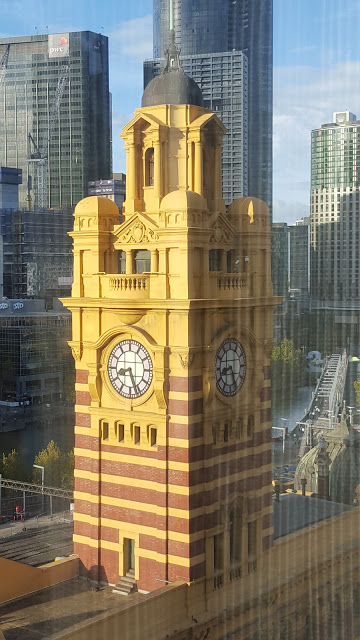
Searching for locations: Flinders Street Station, Melbourne, Australia

This is the famous clock tower of the Flinders Street Station (the main train station for suburban trains) in Melbourne.

We were staying in a hotel (The Doubletree) directly opposite to the station and our room overlooked the station and the clock tower.  I took photos of it during the day:

and this one, at night.  It came out better than I thought it would.

20160302_215639

While it seems like nothing is getting done…

This month is just starting to disappear, and once again, I don’t feel like I’m going to make any more progress than I did the last.

Winter has all but disappeared, and Spring is around the corner. Not as cold as Lake Louise in December, but it feels like it.

What were my expectations last month? 

I had set a list of projects for the month, more episodes for the three continuing stories, and a start to the next episodic story, ‘Motive, Means, and Opportunity’, though for this story I have brought together all the writing I’ve been doing in past weeks. But like most of these fringe stories, it has reached a point where more research is needed, and I have too much else to do.

Then there is the completion of ‘The things we do for love’. It’s finally finished and needs a read-through before going to the editor, but making time to just sit and read…?

The same applies to ‘Strangers We’ve Become’ and it is in the same time-consuming basket. It needs a final read-through, so it’s on the to-do list.

It would be easy to blame COVID-19, but that’s not the problem.  I’ve been home and had the time, but there have been a number of distractions and ideas for new stories that seem to divert my attention from what I should be doing.

It’s not writer’s block.  It’s not laziness.  It seems that I just don’t want to work on them, and that might be because there are problems with the narrative, and I’m just not ready to address them.

What has got my attention then?

I’m not sure how or why, but something triggered the idea of passing through a portal into another time, in the past.  I think I might have been looking for photographs to write another photo/story, and I came across a covered bridge, which led to looking for photographs of ghost towns.  What topped it off, there was an old western in black and white, High Noon, which provoked a whole lot of memories of many westerns I’d seen in the past.

What other reason do you need to write your own story?

Then, when visiting my grandchildren, we just happened to do some star gazing, using Google Sky Map, and picking out the planets.  Somehow I managed to take a photo and looking at it, took me back to the days of Star Trek, and the many series, which sort of gave me an idea for another story, which has been running off and on over the last month. It now has 53 episodes, and I need to write more, yep, on the to-do list.

Equally, I’m always on the lookout for photo opportunities that I can use to write short stories, and these continue apace, the latest being published this week, number 146.  These are being formed into anthologies, stories 1 to 50, and stories 51 to 100.  The first has been assembled into book form and is awaiting the editor’s first reading and report.  I’m still working on the second.

Meanwhile, another 50 have been written and awaiting publishing in volume 3.

Perhaps some of the time has been spent keeping up with Twitter, where over the last six months, and more recently, sales of my books on Amazon have been increasing.  Not to best-seller numbers, but people are reading my stories, and the reviews have been very good.

It has, of course, pushed me to work harder on marketing, and that had consumed some of my time, which unfortunately takes me away from writing.  It sometimes feels like a self-defeating exercise, but it is the same for all of us.

Oh, and something else that cropped up this month, my brother has been digging into our family history, and around the middle of the month, he found some interesting revelations about some family members, including a pseudo-Luddite, and then later on, when chasing down the places that we, as a family, lived, and this brought out some very interesting information about our father.

It also seems we may have had a distant relative on the ship that left after the Mayflower to Plymouth Rock, USA, at the very beginning. That will be remarkable if it is true.

I’m discovering for what I’d always assumed was an ordinary man, had done a lot of very interesting things in his life, and not only that, I’ve been fictionalizing the story.  I have potted pieces written over various stages, and, one day, they might come together as a sort of biography.  It is astonishing just how much you don’t know about your family, until much later on, at least for some of us.  Our relatives have always been a mystery to me, and it’s fascinating as each one is brought to life with new detail here and there.

Looking back on what I’ve just written, perhaps the passing of the month had been more productive than I first thought.  It just seems like nothing major has happened.

The cinema of my dreams – I never wanted to go to Africa – Episode 44

Our hero knows he’s in serious trouble.

The problem is, there are familiar faces and a question of who is a friend and who is foe made all the more difficult because of the enemy, if it was the enemy, simply because it didn’t look or sound or act like the enemy.

Now, it appears, his problems stem from another operation he participated in, and because of it, he has now been roped into what might be called a suicide mission.


I spent another hour trading stories of Army life, none of mine bearing any resemblance to the truth, before the party started.

I said to him, several times, that in my estimation, a part would start at a particular time. He seemed intrigued by how that could be possible when all my men were locked up and guarded.

The Captain, it seemed, was a man of limited intellect.

Or just plain overconfident that he had quelled the incursion and attempt to take the prisoners home.

I was under house arrest, just not in the house with the rest of the men. The Captain decided, being the ranking officer of our group, that I should be accorded facilities befitting my rank. It didn’t change my opinion of the Captain, but it did raise the respect level slightly.

As an officer and a gentleman, as he described himself, he was also a student of Army procedures and practices, not only of his own army but that of others. I admired his hobby out of working hours.

We were just discussing aspects of the first World War, and the part Africa played in it, when both of us suddenly heard gunshots. So did the guard and picked his gun and carefully went out the front door.

The Captain pulled his pistol from out of the top drawer and made sure the magazine had bullets in it. Just in case he needed to use it. All the men, suddenly increased to six, armed and dangerous, in that room had a gun, similar to the Captain. They were commanded by another soldier dressed in fatigues, perhaps a Colonel or higher.

I’d notice some Africa countries had a higher proportion of Generals, to say Lieutenants, and deduced from that, field promotions were a regular thing. That was not my experience here. So far.

I heard another gunshot, this time closer to the hut. Was it my people, mounting their attack? Or was it the Commander, back to retake what was his.

There would be no love lost between the Captain and the commander, and if was a betting man, in a fight, my money would be on the commander.

The sounds of gunfire continued for about ten minutes, then it became sporadic, then none at all. There were footsteps on the boards at the front of the hut, and then a cautious entry, gun barrel first, then, “if you have a gun pointed at the door, I suggest you put it down.” Monroe.

Having caught the Captain’s attention from the front, the Colonel came in the rear, and had his gun barrel pointing to the small of the Captain’s back. “Drop it now.”

The Captain did as he was told.

“You had more men on the perimeter?” he said with a sigh.

“Yes. I thought it prudent to have more than one sniper, a fact that the Militia commander hadn’t given a thought to.” I looked over at Monroe. “Have we secured the airfield?”

“Yes. 10 surviving soldiers, some of them in a bad way, are in the second barracks. They won’t be mounting a counterattack.”

I heard an engine; a large plane engine being started.

“That will be Davies playing with her new toy. Someone is on the runway lights; the rest are heading for the plane. Where are the hostages?” She glared at the Captain.

He shrugged.

Shurl burst in the door. “Out, back through that door,” I said. “Be careful there isn’t a guard waiting for you.”

Monroe looked at me. “Can I shoot the insubordinate bastard?”

A look of surprise, not terror, crossed the Captain’s face.

“Just take him back to the cells and lock him up.”

Shurl came out with the two hostages, just as the second plane engine fired. Monroe took the Captain back to the cells and returned a minute or so later. Shurl had taken the hostages to the plane. Baines would be waiting to switch on the lights at the last minute, and hopefully, the rest were on board.

They would be waiting for Monroe and me.

The both engines were running smoothly, and Davies was testing the rudder and flaps. Suddenly the runway lights came on, and Baines came running towards the plane. Monroe and I jumped aboard, then Baines followed, pulling the door shut behind him.

I heard the engine noise increase, and then we were moving.

I headed up to the cockpit and joined Davies. She was now in her element, her fact a picture of concentration. We were slowly moving to the end of the runway, and I could see her working her way through the preflight checklist.

I tried to speak to her, but she couldn’t hear. She had headphones on. There was a pair near the co-pilot’s seat. I sat down and put them on.

“Everything OK?”

“Nearly. Be quiet for a minute.”

We were at the end of the strip and she turned the plane. She would have checked the wind, not that I’d felt any, and adjusted the take-off direction accordingly.

Then, after what looked like a deep breath and slow exhale, she pushed the engine controls to maximum, and we started moving, slowly gathering speed. The runway surface wasn’t exactly flat, but it was enough not to impede forward motion. Not long after the rear of the plane rose, then in what seemed effortless, we were in the air.

Odd then, when we passed through 2,000 feet, I wondered who this plane belonged to.


© Charles Heath 2020