‘What Sets Us Apart’ – A beta readers view

There’s something to be said for a story that starts like a James Bond movie, throwing you straight in the deep end, a perfect way of getting to know the main character, David, or is that Alistair?

A retired spy, well not so much a spy as a retired errand boy, David’s rather wry description of his talents, and a woman that most men would give their left arm for, not exactly the ideal couple, but there is a spark in a meeting that may or may not have been a set up.

But as the story progressed, the question I kept asking myself was why he’d bother.

And, page after unrelenting page, you find out.

Susan is exactly the sort of woman the pique his interest.  Then, inexplicably, she disappears.  That might have been the end to it, but Prendergast, that shadowy enigma, David’s ex boss who loves playing games with real people, gives him an ultimatum, find her or come back to work.

Nothing like an offer that’s a double edged sword!

A dragon for a mother, a sister he didn’t know about, Susan’s BFF who is not what she seems or a friend indeed, and Susan’s father who, up till David meets her, couldn’t be less interested, his nemesis proves to be the impossible dream, and he’s always just that one step behind.

When the rollercoaster finally came to a halt, and I could start breathing again, it was an ending that was completely unexpected.

I’ve been told there’s a sequel in the works.

Bring it on!

The book can be purchased here:  http://amzn.to/2Eryfth

In a word: Vision

I had one myself once, whether it was a peek into my future, or whether it was just playing out a scene for one of my stories, it was rather intense.

That variation of the word vision is one that uses one’s imagination. I do it quite a lot, and I call it the cinema of my dreams.

But…

Vision, in the simplest sense of the word, is sight, what you see.

People can try to make it better, like movie studios, who have called it rather interesting titles such as VistaVision or Panavision, either of which sounds quite remarkable, and it may have been back in the day, but it’s probably quite ordinary these days.

A vision, in another sense, might be something like a dream as mentioned before, which might happen when we are asleep, but if awake, it might be because we are very bored with our job and we’re imagining what it would be like at Santorini or the Bahamas, or anywhere but where you are now.

It might also describe our particular slant on what else we would like to happen, whether at work or somewhere else, but it’s usually confined to our closest circle of friends. Bosses never invite nor want to hear plebs ideas of improving their lot.

Hence, I have a vision…

But no one will listen. Perhaps if I was Martin Luther King, things might be different.

Then, at the end of it all…

There are visions and then there are visions, like seeing something that no one else can see, whether driven by hallucinogenic drugs or magic mushrooms, or you just happened to be there to see what no one else could.

Dragons, lizard people, or the Virgin Mary.

And no, I have not seen any of the above.

Yet.

“Echoes From The Past”, the past doesn’t necessarily stay there


What happens when your past finally catches up with you?

Christmas is just around the corner, a time to be with family. For Will Mason, an orphan since he was fourteen, it is a time for reflection on what his life could have been, and what it could be.

Until a chance encounter brings back to life the reasons for his twenty years of self-imposed exile from a life only normal people could have. From that moment Will’s life slowly starts to unravel and it’s obvious to him it’s time to move on.

This time, however, there is more at stake.

Will has broken his number one rule, don’t get involved.

With his nemesis, Eddie Jamieson, suddenly within reach, and a blossoming relationship with an office colleague, Maria, about to change everything, Will has to make a choice. Quietly leave, or finally, make a stand.

But as Will soon discovers, when other people are involved there is going to be terrible consequences no matter what choice he makes.

https://amzn.to/2CYKxu4

newechocover5rs

Writing about writing a book – Day 5 continues – Those annoying people called characters

Whilst it is always an idea to sit down and write and keep going, not worrying too much about the narrative, there’s always the problem of ideas about characters, and relationships that come back and need to be addressed.

I have issues with Jennifer in that we will need to know something about her, and need a little backstory.

Jennifer is the second most important character in this novel and one that has more talents than what my main character, or anyone else for that matter, thinks she has.  Of course, that is deliberate on her part for a number of reasons that will be introduced at the appropriate time.

But, at the start, all we will have to work with, is the introduction provided by the narrator.

It may go something like this:


Jennifer Pennington Smythe was, as you might expect, very English, very reserved, and very private.  She was the definitive ‘don’t judge a book by its cover’, and I was guilty, at first, of suspecting she had once been a schoolmistress due to the severity of dress, demeanor, and expression.

HR had sent her to me when I’d requested an IT Specialist, though of what particular discipline it was never divulged, neither by HR nor by her.  She arrived one morning, told me she was to ‘help resolve our technical difficulties’, moved into an office that had been used as a storeroom, and worked hard to prove her worthiness in the role.

My first attempt at conversation was rebuffed, the second met with a very cold stare.  Everyone, including me, learned very quickly that any other topic of conversation than work would be ignored.  At the time it suited me, there was trouble in paradise and I didn’t want anything more on my plate to deal with.


So, what is this trouble?

There are three distinct stages of this relationship between the two most important characters, and it is the actions of one of the protagonists that brings them together.  This particular protagonist, of course, is the main character’s wife, a woman that is on the periphery for the period the novel covers, but a little background will be needed at some point before we reach this part of the narrative.

This now means that I will have to put together a back story for Bill and his ex-wife Ellen, not too much yet but enough to explain the next part of the evolving relationship between Bill and Jennifer.


I’m sure this topic is going to raise it’s head again and again…

I just want to be finished

Just when you think that the story is done, and you’re on the third re-read, just to make sure…

Damn!

I don’t like the way that chapter reads, and what’s worse, it’s about the tenth time I’ve looked at it.

It doesn’t matter the last three times you read it, it was just fine, or, the editor has read it and the chapter passed without any major comment.

I think the main problem I have is letting go.  For some odd reason, certain parts of a story sometimes seem to me as though they are not complete, or can be missing a vital clue or connection for the continuity of the story.

That, of course, happens when you rewrite a section that is earlier on in the story, and then have to make ongoing changes.

Yes, I hear the stern warnings, that I should have made a comprehensive outline at the beginning, but the trouble is, I can change the ending, as I’m writing it and then have to go back and add the hooks earlier on.  Not the best method, but isn’t that what an editor is for, to pick up the missed connections, and out of the blue events that happen for no reason?

I find that often after leaving a finished story for a month before the next reading, the whole picture must formulate itself in my head, so when I re-read, there was always a problem, one I didn’t want to think about until the re-read.

Even then it might survive a second pass.

I know the scene is in trouble when I get to it and alarm bells are going off.  I find anything else to do but look at it.

So, here I am, making major changes.

But, at least now I am satisfied with where it’s going.

Only 325 pages to go!

The cinema of my dreams – I always wanted to write a war story – Episode 36

For a story that was conceived during those long boring hours flying in a steel cocoon, striving to keep away the thoughts that the plane and everyone in it could just simply disappear as planes have in the past, it has come a long way.

Whilst I have always had a fascination with what happened during the second world war, not the battles or fighting, but in the more obscure events that took place, I decided to pen my own little sidebar to what was a long and bitter war.

And, so, it continues…

Jackerby came back and sat down.  It was clear he was annoyed his lunch was interrupted.

“Atherton’s not among those Leonardo brought back.”

Johannsen silently breathed a sigh of relief.  While he was still outside there was hope he would not get hurt.  If he had the sense to keep his head down.  Anyone else, Johannesen would not have cared.

“Who did Leonardo bring in?”

“Some woman called Martina, the one he says is in charge of the resistance.  He said he raided their last stronghold, killed everyone except the three people he knew were in the resistance.  They’re now in the dungeons.”

“We should be down there asking questions.”  A pointed glare from Wallace carried the message, what are you doing here?

“No use.  He nearly killed them, and it’ll take a while for them to recover.”

“To find out where Atherton is?”

“It seems that was the least of his concerns.  Apparently, she apparently humiliated him so he was more interested in payback.”

“It wouldn’t be hard to humiliate a fool like him,” Johannsen muttered.

Wallace glared at him.  “You should have more faith in our Italian friends, Richard.”

“My faith in him extends only to the fact he will drink the cellar dry.”

Wallace shrugged.  “Once he’s served his purpose…” and left it at that.  “Have you got onto London and asked them for further information on Mayer?”

“I think, by now, they would have tumbled to what’s going on here.  Especially after I saw Atherton come out of the radio room just before Jackerby arrived.  I asked the operator, and he gave me a coded message, but it’s not like any code I’ve seen.”

“And you’re telling me this now?”

“At least he didn’t smash it, which is what I would have done.  We haven’t heard any more from High Command other than to say the traitor was thought to be heading for Innsbruck and coming over the mountains near the Brenner Pass.  They’ve got people looking, but nothing as yet.”

“Now we’ve lost Carmichael, do we have a description of him?”

“Yes.”

“Good.  At least something is happening.”


After lunch, Johannsson went down to the dungeon to check on the prisoners.  Wallace had assigned their ‘welfare’ to him.  It was a difficult assignment seeing they arrived both exhausted, weak, and then subjected to an initial interrogation that determined whether or not they got medicines or food.

Most were left to starve.  Any women were sent to the soldier’s barracks, where they were out of his control.  None had ever come back, and he was ordered not to go check on them.

All told, there were 12 still in cells, with three due to be executed later that day.  All had worked in an armaments factory and had admitted to having information about the bombs that were being dropped over England.

Another six had yet to say what information they had, and had been subjected to severe torture, the handiwork of two of Jackerby’s men, and who Johannsen thought had been trained by the Gestapo.  In fact, he believed they were Gestapo, and that Jackerby, though he didn’t have the uniform, was a ranking SS officer.

Not a man to cross.  Leonardo would find that out soon enough.

The most recent three, the resistance fighters were put in separate cells next to each other.  The guards had been told to listen to any conversations they had, and report.  As yet, none of them had spoken.

Considering the condition they arrived in, that was no surprise.

He stood outside the cell holding the woman they called Martina.

The leader.

She hadn’t moved from the moment she had been dropped there.

A guard appeared beside him.

“Nothing yet?” Johansson asked him.

“I doubt they’ll speak again.  If that’s what Leonardo does to his so-called countrymen; I’d hate to see what he does to his enemies.”

“You let me know if she says anything.”

The soldier nodded, then went back to his station.

The other two were men, one old, one younger.  An odd group to be part of the resistance.  The woman he could understand and was the key. 

He now believed Atherton would come to rescue her.  Like any good British soldier, his empathy would be his downfall.

© Charles Heath 2020-2023

Mistaken Identity – The Editor’s Draft – Day 29

I have been working on the story, the editor is asking for a second draft after making suggested changes – and I’m now working on it

I know it’s premature, but I have begin thinking about the next adventure Jack is to embark on.

Six months down the track, the relationship with Rosalie founders, he is looking for something, anything, to lift him out of the sea of self pity.

Is it a case of ‘be careful what you wish for’.

It’s a hell of a title for the story, too.

Maryanne is going to come out of left field and drag him down the rabbit hole of adventure because her latest assignment, and the one that will eventually determine whether she stays or goes, requires a boyfriend as cover.

How is she going to convince Jack? Well, I’m glad you asked, that’s a very interesting story.

Back in the other story, the one that should be finished but isn’t….

Jack finds himself in the seedier part of London looking for McCallister and Jacob, and finds more than he bargained for.

Yes, that blockbuster cinematic ending I’ve been promising…

Today’s effort amounts to 2,587 words, for a total, so far, of 68,918.

More tomorrow.

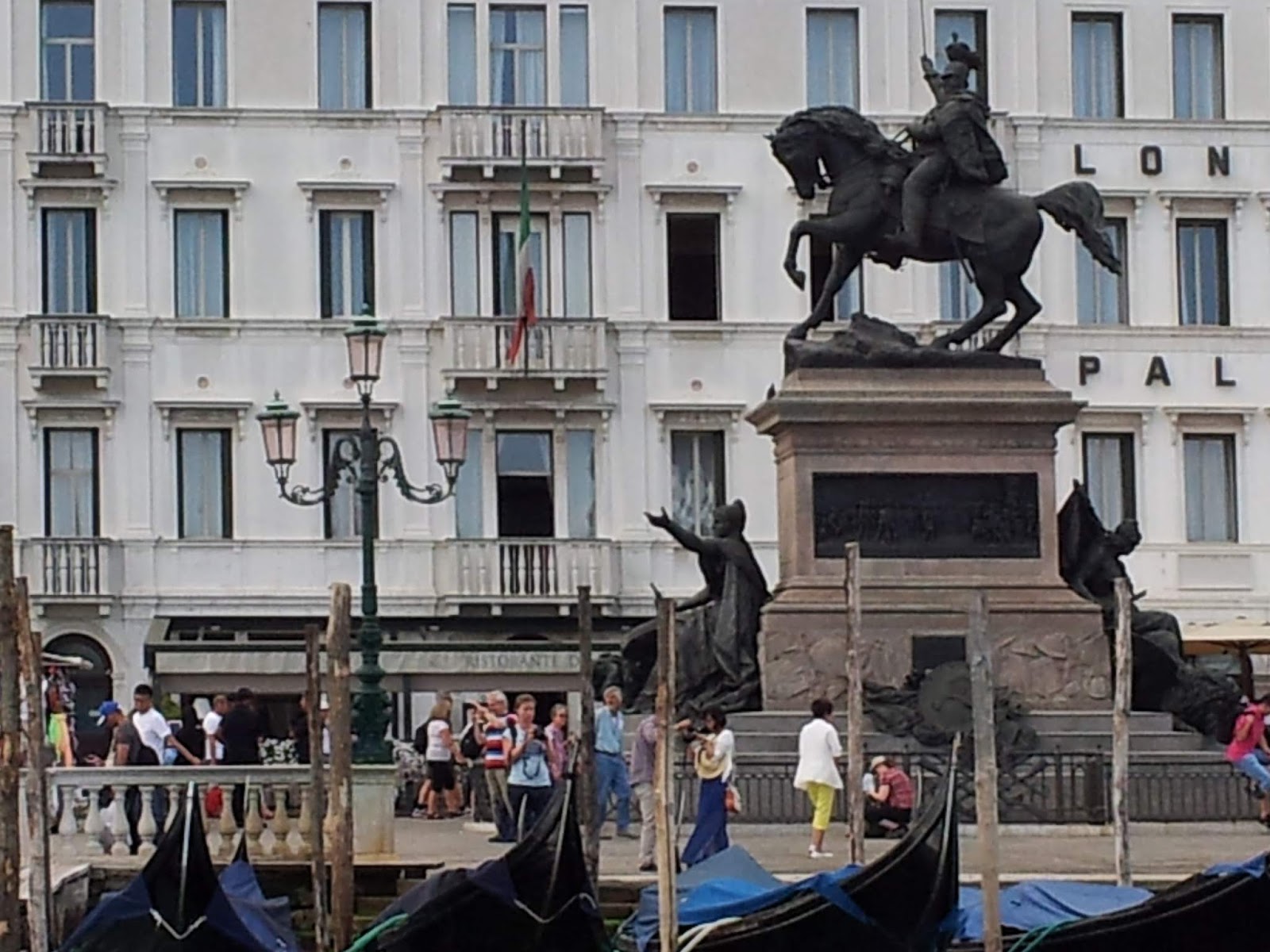
Searching for Locations: Venice, Italy

Venice is definitely a city to explore.  It has an incredible number of canals and walkways, and each time we would start our exploration at St Marks square when it’s not underwater

Everyone I have spoken to about exploring Venice has told me how easy it is to get lost.  It has not happened to me, but with the infinite number of ways you can go, I guess it is possible.

We started our exploration of Venice in St Marks square, where, on one side there was the Museo di Palazzo Ducale and, next door, the Basilica di San Marco.  Early morning and/or at high tide, water can be seen bubbling up from under the square, partially flooding it.  I have seen this happen several times.  Each morning as we walked from the hotel (the time we stayed in the Savoia and Jolanda) we passed the Bridge of Sighs.

Around the other three sides of the square are archways and shops.  We have bought both confectionary and souvenirs from some of these stores, albeit relatively expensive.  Prices are cheaper in stores that are away from the square and we found some of these when we walked from St Marks square to the Railway station, through many walkways, and crossing many bridges, and passing through a number of small piazzas.

That day, after the trek, we caught the waterbus back to San Marco, and then went on the tour of the Museo di Palazzo Du which included the dungeons and the Bridge of Sighs from the inside.  It took a few hours, longer than I’d anticipated because there was so much to see.

The next day, we caught the waterbus from San Marco to the Ponte di Rialto bridge.  Just upstream from the wharf there was a very large passenger ship, and I noticed there were a number of passengers from the ship on the waterbus, one of whom spoke to us about visiting Venice.  I didn’t realize we looked like professional tourists who knew where we were going.

After a pleasant conversation, and taking in the views up and down the Grand Canal, we disembarked and headed for the bridge, looking at the shops, mostly selling upmarket and expensive gifts, and eventually crossing to the other side where there was a lot of small market type stalls selling souvenirs as well as clothes, and most importantly, it being a hot day, cold Limonata.  This was my first taste of Limonata and I was hooked.

Continuing on from there was a wide street at the end and a number of restaurants where we had lunch.  We had a map of Venice and I was going to plot a course back to the hotel, taking what would be a large circular route that would come out at the Accademia Bridge, and further on to the Terminal Fusina Venezia where there was another church to explore, the Santa Maria del Rosario.

This is a photo of the Hilton Hotel from the other side of the canal.

It was useful knowledge for the second time we visited Venice because the waterbus from the Hilton hotel made its first stop, before San Marco, there.  We also discovered on that second visit a number of restaurants on the way from the terminal and church to the Accademia Bridge.

This is looking back towards San Marco from the Accademia Bridge:

And this, looking towards the docks:

Items to note:

Restaurants off the beaten track were much cheaper and the food a lot different to that in the middle of the tourist areas.

There are a lot of churches, big and small, tucked away in interesting spots where there are small piazza’s.  You can look in all of them, though some asked for a small fee.

Souvenirs, coffee, and confectionary are very expensive in St Marks square.

It’s good, it’s bad, and at times it can be very, very ugly

It was as if Microsoft Word was sent down from that place in the universe where a group of torturers sit around a table to find new ways of making our lives just that little bit more difficult.

I mean, most of the time it works really well and behaves itself.

But…

Then there are the times, usually when you are stressed about a deadline, or you are nearly at the end of what you believe to be the most brilliant writing you have ever put on paper.

Then…

Disaster strikes.

It could be the power goes off, even for just a few seconds, but it’s enough to kill the computer.  It could be that you have reached the end and closed Word down, thinking that it had autosaved, all the while ignoring that little pop up that says, ‘do you want to save your work’?

It’s been a long day, night, or session.  You’re tired and your mind is elsewhere, as it always is at the end.

You always assume that autosave is on.  It was the last time, it has been since the day you installed it however long ago that was.

So…

When the power comes back on, you start the computer, go into Word, and it brings back all the windows you had open when the power failed, and the one with the brilliant piece you just wrote, it’s just a blank sheet.

Or up to where it last autosaved, which is nowhere near the end.

Or it didn’t save at all.

You forget the software updated recently and that always brings changes.  Usually unwanted changes.

By which time you have that sinking feeling that all is lost, deadline missed, brilliant work lost, it’s the end of the world.

You promise yourself you’re going to get Scrivener, or something else, where this doesn’t happen.

Or if you’re like me, you put the cat on the keyboard and tell him to sort the mess out.

The cinema of my dreams – Was it just another surveillance job – Episode 16

As we all know, writing by the seat of your pants is almost the same as flying by the seat of your pants, a hazardous occupation.

As it happens, I like writing this way because like the reader, I don’t know what to expect next.

And equally, at times, you can write your self into a corner, much like painting, and then have to go back, make a few changes and//or repairs and then move forward.

It’s part of the writing process, only in this case, the changes occur before you’ve finished the novel if you finish.  Quite often a lot of writers get only so far, then the manuscript hits the bottom drawer, to be brought out on a distant rainy day.

Or your cat has mocked your writing ability one too many times.

Therefore, we’re winding back to Episode 16, and moving forward once again, from there.

O’Connor seemed to be more affluent than I because he was living in a flat located in an upmarket building.  Getting into the ground floor required a passkey, one I suspect might also be needed to get in the front door of his flat, but I’d worry about that later.

My first problem was that front door, and it was not until a tradesman exited that I took the opportunity to appear to arrive at the same time, pretending to find my card, and brushing past him as he was exiting.  He ignored me, his hands full, being in a hurry.

It took a day and a half of watching the building, waiting for an opportunity.  His flat was on the third floor and although there was an elevator, I took the stairs, hoping that I wouldn’t run into anyone.

Quickly and quietly, and thankfully without seeing another resident, I came out into the passageway, and it was about ten steps to his front door.  Number 37.  Not far away, in one direction, the end of the passage, and numbers 38, 39, and 40.  In the other, four more flats and the end of the corridor.  Windows at either end, perhaps an escape route.  I would not use the elevator if I had to leave in a hurry.

There were two elevators and one staircase.  Both elevators were stationary on the ground floor.

I knocked lightly on the door to number 37.

No answer.

I knocked a little harder on the door.  It was quite solid, and I had to wonder if the knocking sound penetrated the solid wood.

I checked the lock.  Simple to open.  We’d been given instruction by a master locksmith, and I’d brought my tools.

I waited a minute, checked to see if the elevators were still on the ground floor, then picked the lock and was inside within a minute.

Silence.

I felt along the wall for a light switch, usually by the door, and found it, and flicked it on.  The sudden light was almost blinding, but then my eyes adjusted.

Trashed, much the same as my flat.

But, with a difference.

A woman was stretched out on the floor, unmoving.  I could see, from where I was standing, she had been hit on the back of the head and could see the wound, and a trickle of blood through her hair.

Five steps to reach her, I reached down to check for a pulse.

Yes, she was alive.

I shook her gently.  She didn’t react.  I shook her a little more roughly and she stirred, then, as expected, lashed out.

I caught her hands, saying, “I just found you.  I’m not your enemy.”

Of course, considering I was a stranger in what could be her flat without permission, I was not surprised she continued to struggle until I tried being reassuring.  Then she stopped and asked, “Who are you?”

“A friend of O’Connor.  I worked with him.  Something happened to him at work and he said if that happened, I was to come here.  He didn’t say anything about you, though.”

“I live here, in the flat next door.  I heard a noise and came to investigate.  That’s all I remember.”

I helped her up into a sitting position, and, holding her head in her hands, looked around.  “Did you do this?”

“No.  Just got here.  But it’s the same at my place.  The people who did this are looking for something.  By the look of it, they didn’t find it here either.”

“I’ll get a damp cloth for your head.  It doesn’t look serious but there might be a slight concussion that might need attention.”

She felt the back of her head, and, when she touched the wound, gasped, “It hurts though.”

I stood and went over to the kitchenette.  O’Connor was not much of a cook, the benches looked new, and there was nothing out.  I looked in a draw near the sink and found a cloth, still with the price tag on it.  So were several utensils in the drawer.  I ran it under the water, then went back to her, now off the floor and sitting on one of the two chairs.  I handed her the wet cloth and she put it against the injured part of her head.

I made a mental note, it didn’t look like O’Connor had been here long, if at all.  Something was not right here, and if that was the case, I should take care when saying anything to this woman.

“Who are you again?” she asked.

“I worked with him.  My name is irrelevant.  It’s unlikely that he mentioned me to you, or anyone.  It’s the nature of our work.”

“Why should I believe you?  You could be my attacker.”

“If that were the case, why would I still be here trying to be helpful.”

A good question that elicited a curious expression.

“What do you do, what did Oliver do?”

Alarm bells were going off.  Oliver was not O’Connor’s first name.

“Nothing very interesting, I can assure you, and definitely nothing that would warrant this happening.  If it had only been me, I would have not thought any more of it, but since we worked together, and this has also happened to him, it seems we are mixed up in something bad.”

“Where is he, by the way?”

“I was hoping you could tell me.  If you live next door and know him well enough to be here, he might have told you.”

“No.  He never spoke about work.”

She was trying to stand so I helped her up and held on when it looked like she was about to collapse.  Last time I had a knock to the head, I had dizziness for a minute of two.  Her knock had been a lot harder.”

“Are you alright?”  She didn’t look it.

“I will be, I’m sure.”

I let her go, and she took several steps, then gave me a rather hard look.  “Why are you here again?”

“Trying to find my friend.”

“How did you get in here?”

Rather than make her disorientated, the knock must have sharpened her senses.  Time to test a theory. 

“I think we should call the police now, and report the break-in.”

I pulled out my phone.

“Look, I don’t want to get mixed up in this.  You go, and I report this when I get back home.  And, if you find him, tell him Josephine is looking for him.”

As I thought.  She was not able to explain to the authorities why she was in this flat, as I’m sure she believed I couldn’t either.

She started walking towards the door.  My staying any longer would raise her suspicions about me, and any search I was going to do would have to wait.  I opened the door, she walked out, and I followed shutting the door after me.

I left her standing outside the door and headed for the stairs.  A last glance back showed her still where I left her.  I went down to the first landing, then stopped.  It was part of the training, to treat everyone as suspicious.

Then I heard her voice, as she passed the top of the staircase, on her way back to her flat.  “He was here, looking for the files.  No, he’s gone.”  A minute’s silence, then “On my way.”

Another minute, I heard the elevator car arrive on the third floor.

I quickly ran down the stairs to the ground floor and waited at the door until she came out of the elevator, heading for the door.

Then as she passed through the front door, I came out into the foyer just in time to see a car stop out the front, and a familiar face out through the rear window.

Nobbin.

© Charles Heath 2019-2022