“Going out of my mind…” – a short story


Accidents can happen.

Sometimes they’re your fault, sometimes they’re not.

The accident I was in was not. Late at night driving home from work, a car came speeding out of a side street and T-boned my car.

It could have been worse, though the person who said it had a quite different definition of the word worse than I did.

To start with, I lost three months of my life in a coma, and even when I surfaced, it took another month to realize what had happened. Then came two months of working out my recovery plan.

If that wasn’t trial enough, what someone else might describe as the ‘last straw that broke the camel’s back’, my wife of 22 years decided to send me a text that morning, what was six months in hospital, to the day.

“I’m sorry, Joe, but enough is enough. I cannot visit you anymore, and for the sake of both our sanity, I think it’s time to draw a line in the sand. I know what happened isn’t your fault but given the prognosis, I don’t think I can cope with the situation. I need time to think about what will happen next and to do so, I’ll be going home to spend some time with family. Once again, I’m so sorry not to be doing this in person. I’ll let you know what I decide in due course. In the meantime, you have my best wishes for your recovery.”

In other words, goodbye. Her family lived in England, about 12,000 miles away in another hemisphere, and the likelihood of her returning was remote. We had meant to visit them, and had, in fact, booked the tickets shortly before the accident. I guess she couldn’t wait any longer.

My usual nurse came in for the first visit on this shift. She had become the familiar face on my journey, the one who made it worth waking up every morning.

“You look a little down in the dumps this morning. What’s up?”

She knew it couldn’t be for medical reasons because the doctor just yesterday had remarked how remarkable my recovery had been in the last week or so. Even I had been surprised given all the previous negative reports.

“Ever broken up by text?”

“What do you mean?”

“Frances has decided she no longer wants to be involved. I can’t say I blame her, she has put her whole life on hold because of this.”

“That’s surprising. She’s never shown any disappointment.”

“Six months have been a long time for everyone. We were supposed to be going home so she could see her family. Maybe that’s what it’s all about.”

I gave her the phone and she read the message.

Then she handed it back. “That’s goodbye, Tom. I’m sorry. And no, I’ve never had a breakup by text, but I guess there could always be a first time.”

She spent the next ten minutes going through the morning ritual, then said, “I’ve heard there’s a new doctor coming to visit you. Whatever has happened in the last few days had tongues wagging, and you might just become the next modern miracle. Fame and fortune await.”

“Just being able to walk again will be miracle enough.”

That had been the worst of it. The prognosis that it was likely I’d never be able to walk again, or work, and the changes to our lives that would cause. I knew Frances was bitterly disappointed that she might become the spouse who had to spend the rest of her life looking after, and though she had said it didn’t matter, that she would be there for me, deep down I knew a commitment like that took more internal fortitude than she had.

She ran her own business, managed three children into adulthood, and had a life other than what we had together. When I was fit and able, and nothing got in the way, it had worked. Stopping everything to cater to my problems had severely curtailed her life. Something had to give, and it had.

But, as I said, I didn’t blame her. She had tried, putting in a brave face day after day but once the daily visits slipped to every other day, to once a week, I knew then the ship was heading towards the rocks.

This morning it foundered.

I pondered the situation for an hour before I sent a reply. “I believe you have made the right decision. It’s time to call it, go home and take some time to consider what to do next is right. In normal circumstances, we would not be considering any of this, but these are not normal circumstances. But, just in case you are worried about the effect of all of this on me, don’t. I will get over it, whatever the result is, and what you need to do first and foremost is to concentrate on what is best for you. If that means drawing a line on this relationship, so be it. All I want for you is for you to be happy, and clearly, having to contend with this, and everything else on your plate, is not helping. I am glad we had what time we had together and will cherish the memories forever, and I will always love you, no matter what you decide.”

It was heartfelt, and I meant it. But life was not going to be the same without her.

I’d dozed off after sending the message, and only woke again when my usual doctor came into the room on his morning rounds, the usual entourage of doctors and interns in tow. I’d been a great case for sparking endless debate on the best route for my recovery among those fresh out of medical school. Some ideas were radical, others pie in the sky, but one that seemed implausible had got a hearing, and then the go-ahead, mainly because there was little else that apparently could be done.

That doctor, and now another I hadn’t seen before was standing in the front row, rather than at the back.

The doctor in charge went through the basics of the case, as he did every day, mainly because the entourage changed daily. Then, he deferred to the radical doctor as I decided to call her.

She went through the details of a discovery she had made, and the recommendation she’d made as a possible road to recovery, one which involved several radical operations which had been undertaken by the elderly man standing beside her. When I first met him, I thought he was an escaped patient from the psychiatric ward, not the pre-eminent back surgeon reputed to be the miracle worker himself.

It seemed, based on the latest x-rays that a miracle had occurred, but whether it was or not would be known for another week. Then, if all went well, I would be able to get out of bed, and, at the very least, be able to stand on my own. In the meantime, I had endless sessions of physio in the lead-up to the big event. Six months in bed had taken its toll on everything, and the week’s work was going to correct some of that.

It meant there was hope, and despite what I said and thought, hope was what I needed.

There had been ups and downs before this, fuelled by a morning when I woke up and found I could wriggle my toes. It was after the second operation, and I thought, given the number of pain killers, it had been my imagination.

When I mentioned it, there was some initial excitement, and, yes, it was true, I wasn’t going out of my mind, it was real. The downside was, I couldn’t move anything else, and other than an encouraging sign, as the days passed, and nothing more happened, the faces got longer.

Then, the physiotherapist moved in and started working on the areas that should be coming back to life. I felt little, maybe the pain killers again, until the next, and perhaps the last operation. I managed to lift my left leg a fraction of an inch.

But we’d been here before, and I wasn’t going to hold my breath.

Annabel, the daughter that lived on the other side of the country, finally arrived to visit me. I had thought, not being so far away she might have come earlier, but a few phone calls had sorted out her absence. Firstly, there was not much use visiting a coma patient, second, she was in a delicate stage of her professional career and a break might be the end of it, and thirdly, she accepted that I didn’t want to see her until I was much better.

She was not very happy about it, but it was a costly venture for her, in terms of time, being away from a young family, and just getting there.

Now, the time had come. She had a conference to attend, and I was happy to play second fiddle.

After the hugs and a few tears, she settled in the uncomfortable bedside chair.

“You don’t look very different than the last time I saw you,” she said.

“Hospitals have perfected the art of hiding the worst of it, but it’s true. The swelling had receded, the physios have revived the muscles, and I have a little movement again.”

“The injuries are not permanent?”

“Oh, they’re permanent but not as bad as first thought.”

“Pity my mother isn’t here.”

“She was, day after day, through the darkest period. I wouldn’t wish that on anyone. But your mother is an independent woman, and she has always been free to do what she wants, and I would not have had it any other way.”

“But deserting you in the middle of all this…”

“It’s been very debilitating on her. I can understand her reasons, and so should you. She will still be your mother no matter what happens to us.”

There had been a number of phone calls, from each of the children, decrying her actions after she had sent a text message to each of them telling them what she was doing. She had not told them she was leaving, in so many words, but leaving the door ajar, perhaps to allay their fears she was deserting them too. Annabel had been furious. The other two, not so much.

“And this latest development?”

I had also told her about the miracle worker, and the possibilities, without trying to get hopes up.

“On a scale of one to ten, it’s a three. We’ve been here before, so I’m going to save the excitement for when it happens, if it happens.”

“And if it doesn’t?”

It was a question I’d asked myself a number of times, one that I didn’t want an answer to. Hope was staving it off, each day a new day of discovery, and a day closer to the idea I might walk again. I had to believe it would happen, if not the next day, the next week, month, year, that it would eventually happen.

For now, all I had to do was stand on my own two feet.

It was ironic, in a way, that simple statement. ‘Stand on your own two feet’. Right then, it seemed so near, and yet, at the same time, so far away.

I didn’t answer that question, but did what I usually did with visitors, run a distraction and talk about everything else. This visit was no exception. I had a lot of catching up to do.

It’s odd how some call the day of momentous events D-Day because to me nothing would be more momentous than the invasion of France during the second world war.

Others were not quite of the same opinion. It was going to be a momentous day.

It started the same as any other.

The morning routine when the duty nurse came to do the checks. Then the physio, now a permanent fixture mid-morning, just after the tea lady arrived. Deliberate, I thought, to deprive me of my tea break, and some unbelievably delicious coconut cookies.

Then the routine changed, and the escort arrived to take me down to the room where the physio had set up an obstacle course. It looked like one, and I’d told him so when I first saw it, and he had said by the time he was finished with me, I’d be able to go from start to finish without breaking a sweat.

In my mind perhaps, but not with this broken body. I didn’t say that because I was meant to be positive.

An entourage arrived for the main event. I would have been happier to fail in front of the doctor, the miracle worker, and the physio, but it seemed everyone wanted a front-row seat. If it worked, the physio confided in me, there was fame and fortune being mentioned in Lancet, which was a prestigious medical journal.

Expectations were running high.

The physio had gone through the program at least a hundred times, and the previous day we had got to the point where I was sitting on the side of the bed. We’d tried this ordinary maneuver several times, previously without success under my own steam but this morning, for some reason it was different.

I was able to sit up, and then, with a struggle move my legs part of the way, and with a little help for the rest.

What was encouraging, was being able to swing my legs a short distance. It was those simple things that everyone could do without thinking, that had seemed impossible not a month before, that got people excited. I didn’t know how I felt other than I missed those simple things.

Then the moment had arrived. Hushed silence.

There was a structure in place. All I had to do was pull myself across, at the same time sliding off the bed and into a standing position. There was a safety harness attached so that if my grip slipped it would prevent me from falling.

It was probably not the time to tell them the pain in my lower back was getting worse.

So, like I’d been instructed, and going one step further than the day before, I reached out, grabbed the bars, and pulled myself up and over, at the same time, sliding off the side of the bed. I could feel the tug of the safety harness which told me I had left the safety of the bed, and was in mid motion.

I could feel my legs straightening, and then very softly landing on the floor, the safety harness letting my body drop down slowly.

The pain increased exponentially as the weight came down onto my legs, but my body had stopped moving. I could not feel the tightness of the harness, but a rather odd sensation in my legs.

All that time I had been concentrating so hard that I had heard nothing, not even the encouraging words from the physio.

Until I realized, from the noise around me, that it had worked. I was standing on my own two feet, albeit a little shakily.

And I heard the physio say, in his inimitable way, “Today you just landed on the moon. Tomorrow, it’s going to be one small step for mankind. Well done.”

© Charles Heath 2021

Let’s talk history

What happened yesterday is history, but that’s not necessarily how we view what is history and what isn’t.

Similarly what is and what isn’t history is usually decided on by academics, because history texts that are used in schools are not written by ‘the man in the street’ authors. They’re usually university types who specialise in a particular field, or specialise section of history.

Even then one doubts that what is written is not a consensus of a panel.

So, when we talk about re-writing history, that takes a very brave bunch of people who want to buck the norm.

Our history, that which was taught when I went to school,. about our own country, Australia, started in 1770. Some brave soul tried to say it began earlier than that, before Captain Cook and the British arrived, out up a flag pole, and declared it belonged to Britain, like in 1606 when the Dutch explorer Willem Janszoon landed on the Cape York peninsula, only it wasn’t called that then.

And he might have been as surprised as Captain Cook that there were people here to observe their arrival. Yes, people had been living in this country for tens of thousands of years before the Europeans arrived.

But that was not what we were taught. No, Captain Cook, 1770, the a fleet of ships in 1788, and off we run as a new country, and a dumping ground for Britain’s convicts. Our history starts there, and then meanders through time, dividing the country up into states, having famous explorers like Burke and Wills, and Blaxland, Wentworth, and Lawson, Hume and Hovell.

And we commemorate all these people and those who were in charge over the years, with names of states, cities, rivers, mountains, everything under the sun. You’ve only got to glance at the list of hundreds of these forefathers and explorers to see just how many places in this country were named after them.

No heed was taken of what they may have been called before because no one really understood the languages of the first people who lived here. And they never seem to rate as a matter of study for us children back then.

Now, as people have begun to realise our history goes way, way back, and that there should be a nod to those inhabitants, they are considering re-writing some of our history to incorporate these people. And change the names of places to their original. A famous instance of recent renaming is of Ayers Rock, now called Uluru.

Even then, Australian History didn’t rate very highly, and I have to say, as a child at school 50 odd years ago, I learned more about the British Empire/Commonwealth, and about the English kings and queens, than we did about our own Governor Generals, Prime Ministers and State Premiers.

Could I tell you the name of our first Prime Minister? No. I can say when Australia became Australia, yes. 1901. Can I tell you the first King of England? Yes, William the Conqueror in 1066. There were kings before that but they only ruled of parts of England.

But over the years since I have read the odd book of Australian History but for some reason it never quite seems as colourful or as interesting as that of England or Scotland, or even some of the European countries.

Now, since I’ve been reading about what’s happening in the United States I have begin to take an interest in American history, and it, too, seems to suffer the same problems we have with ours, a bunch of academics decided what it was, and what it would not include, and then there is this thing called the 1619 project.

Wow, that seems to have stirred up a hornet’s nest.

Can’t wait to see what happens next.

The cinema of my dreams – It all started in Venice – Episode 8

Cecilia and Juliet – trouble

How do you run into someone by accident, or randomly when it is neither an accident or random?

There was that problem of looking obvious, that it was staged, that, well you get the idea.

O was hoping staying at the same hotel on the same floor would solve the problem, but when I thought about it, living in Venice, why would I be staying in a hotel?

There was that unofficial reason I’d told Cecilia, that I was renovating, just in case of prying ears, but I was a bit slow in picking up on the new surveillance team Larry had out on Juliet, do he’d know what  I was up to, and if he informed Juliet, then it would ruin the surprise.

It all depended on whether or not the surveillance team was aware of who I was, which could be unlikely, given Giuseppe’s lack of recognition of my identity.  Larry’s mistrust of her might yet work to my advantage.

Then there was the name Juliet knew me by which was not the one Cecilia knew me, so I had to make sure that story was straight between us just in case she was with me when I ran into Juliet.

The trouble was, it was becoming a logistical nightmare.

So, it was rather a surprise when we finally did run into each other, in the restaurant the following morning after Cecilia arrived, and we were just sitting down.

I hadn’t seen Juliet, tucked away in a corner, not until she called out.  And I was with Cecilia, who was the consummate actor.

I heard my name and turned.  Cecilia looked over then sat.  I went over.

“What are you doing here, of all places?”

Was there a note of suspicion or surprise in her tone?

“I’m with an old friend, Cecilia, she’s in Venice for the film festival.  She’s an actor you know.  I didn’t until she called me.”

Juliet gave Cecilia the once over, then looked back at me.  I could see the unspoken question, ‘you still haven’t answered the question’.

“She needed a place to stay and my place is a renovator’s nightmare, so I decided to stay here with her for the duration.”

“Together?”

Not the first thing I expected from her.

“No, separate rooms.  She’s a bit above my pay grade.”

“Oh.”

“We’re off to the festival, she’s agreed to show me around, but if you’re free tonight perhaps we could meet up?  Dumb question, but what are you doing here?”

“I’m staying here.”

“Are you.  No surprise, of course, it’s a good hotel.  I guess we have the same taste in hotels.  Good to see you again, but I’d better go.”

I’d looked around a few times and Cecilia was making to sort of gestures an impatient movie star, ex-girlfriend type might make.

“You’d better go.  I’ll think about it.”

I could see her, ‘this is not a coincidence, look in her eyes and thought it oddly amusing.

Back at the table where Cecilia was waiting, she had been looking covertly in Juliet’s direction.  I sat down.

“She an old girlfriend, or something?”

“Or something.”

“You can tell.  I could feel the death stare.”

“That train left the station a long time ago.”

“Then someone forgot to tell her.  That whole encounter seemed very odd from where I’m sitting.”

“It was.  I asked her for dinner, but I’m not expecting a reply.  It caught me off guard.”

“Then a small suggestion, get your head back in the game.”

She was right.  Catching me by surprise put me on the back foot, and being so meant that the distraction could cause trouble.  I could remember back to the old days, and the training instructor’s words, ‘it only takes a fraction of a second, and you’re dead’.

He was right, it had happened once and I barely survived, coincidentally just before the first time I met Juliet.  That incident kept me vulnerable, a feeling I had hated at the time.

I glanced over at Cecilia, submersed in a text exchange on her cell phone, the conversation playing out in expressions, one of which was quite dark.

But, nevertheless, at least one of us was prepared.  I wondered if Rodby had spoken to her.  He knew of my association with Juliet, before Violetta, and the effect it had on me, especially after the mission that had almost left me broken.

And that, I thought, was another reason for my momentary loss of control; the effect she had on me when I was not prepared, not like the last encounter.  Taking me by surprise, she could still bring those old feelings to the surface, feelings I didn’t want to deal with.  I was still getting over the loss of Violetta which until this moment I had thought I was in a good place.

The text exchange ended.

“Trouble in paradise?” I asked.

“Men can be such idiots sometimes.”

“I know.  Who is he and do you want me to deal with him?”

“A pleasant thought, but no.  I can do that, but you might have to deal with Juliet by yourself.  Oh, she’s coming over.”

By the time I looked up, she was next to me.  “Tonight, here.  Bring your friend if you like.”  Juliet gave her a meaningful glare.

“Sorry, got to attend to man troubles.”

“Sorry to hear that.”  Back to me.

“Eight OK?”

“Fine.  See you then “

I watched her leave the restaurant, not sure what she hoped to gain other than once again to put me on the back foot.

“She has surveillance, the girl who looks like a librarian on holiday, by the door.”

I’d seen her before.  “There’ll be another.  Larry seriously doesn’t trust Juliet.”

“Of course.  French guy, pink shirt, so obvious you’d not think it was him.  Watch yourself.  I have to go for a while but don’t worry, I can find you later.  We need to talk about tonight.”

“Yes.  Later, then.”

© Charles Heath 2022

A score to settle – The Editor’s draft – Day 8

I have the story, the editor is asking for it, and I’m putting the final touches to it

Back to the revolution.

How easy is it to find out who’s driving the revolutionary forces?

It’s not as if the leader is going to stand up and make a proclamation, and in turn, bring down the country’s internal security forces.

Of course, the leader of those forces has a name, General Ramos, and is as ruthless and murderous as he tries to be urbane and charming, the very definition of a wolf on sheep’s clothing.

Equally, he and Delacrat often butt heads, but Ramos knows that having an honest man in charge of the police not only makes him very careful in what he does but says a lot about the image the military in running the country wants to project to the outside world.

So does Delacrat know there’s a plot afoot, and equally, what will be his reaction? Will he be sympathetic, or ruthless in hunting down the ringleaders?

Another facet of the revolution is going to be where Amanda, the keynote speaker our main character has been sent to protect, stands, because it’s likely she knows something about the plans for the revolution, and more importantly, those who are in charge of the rebel forces. Another factor in this dynamic is that Amanda and he have a history, so his job of remaining invisible in the background, a key element in doing his job, is going to be impossible.

That, for the moment, will be how this part of the story will unfold over the coming days.

Today’s word count: 2,385 words, for a running total of 18,476.

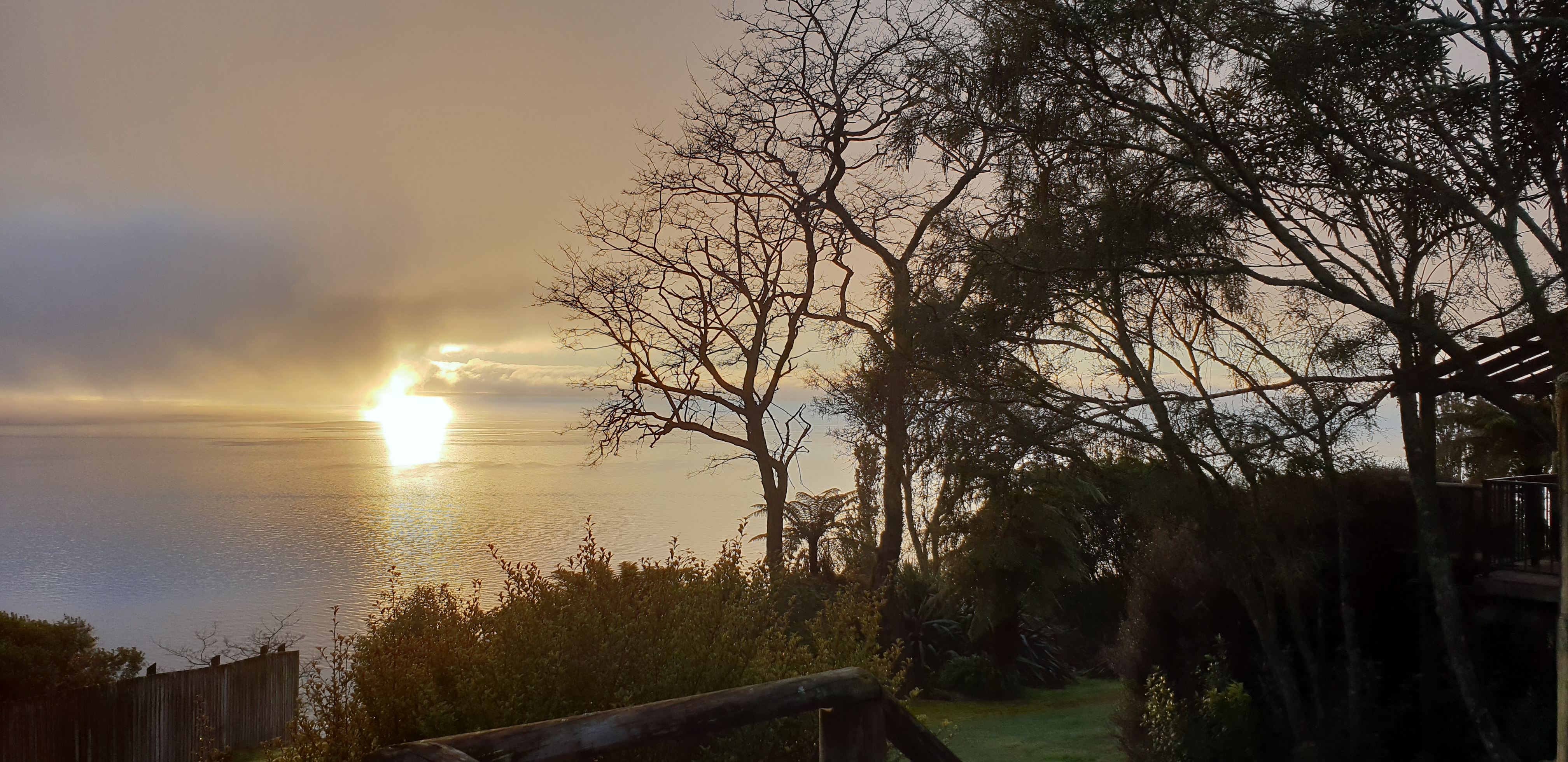
Searching for locations: Oreti Village – No two sunrises are the same – 1

Oreti village, Pukawa Bay, North Island, New Zealand

On the southern tip of Lake Taupo

Our first morning there, a Saturday.  Winter.  Cold.  And a beautiful sunrise.

20180812_073230

This was taken from the balcony, overlooking the lake.

The sun is just creeping up over the horizon

20180812_073241

It gradually gets lighter, and then the sun breaks free of the low cloud

It lights up the balcony

20180811_074651

And the trees just beyond, a cascade of colorful ferns.

20180811_074622

It looks like its going to be a fine day, our first for this trip, and we will be heading to the mountains to see snow, for the first time for two of our granddaughters.

A life so ordinary – the beginning

When I was trying to think of a title for this post, and probably a lot more in the same vein, I thought of using

The Life of an Ordinary man

or

The life of an ordinary person

and realized that political correctness wasn’t going to make the title any easier to create.

The other thing is that should we have the right to say our life is ordinary?

What is ordinary life?

Is it the life the Joe and Jane Average have?

Dear God, I think I’ll just give up and go home.

Then I started thinking about school and the first girl I liked. I was five, and with absolutely no understanding of what I was feeling, I think it was great we were just friends.

It was 1958.

That was a long, long time ago.

No need to worry about politics, where the next paycheck was coming from, can I afford the car payments, and why do my children hate me so much.

Five was a great age. You go to school, sit around having fun, have an afternoon sleep, you always got a bottle of milk mid-morning (pity there was no flavoring in it) and lunchtimes you sat outside near the oval and made daisy chains in summer, or ran through the puddles in winter.

Or play on the monkey bars.

I remember the school, Dandenong State School. A large gothic, or so I thought then, building, that looked really scary from the outside, and then, when you met the teachers, really scary inside.

It had a quadrangle and a bell.

We had an assembly every morning and sang God Save the Queen.

Halcyon days indeed.

We lived in a house in Bess Court.

It was odd how our places of residence were reduced to a street name.

From my first, Valetta street, I think the first house my parents moved into.

Later in a foray into the past via genealogy we discovered my father had qualified for a war service loan and built the house himself.

We stayed there for a few years, then moved to Warren Road, for a very short time. There was no rhyme or reason for this move but it was notable for one reason, my younger brother was born while we were there.

And one single other memory I have, is that I used to go picking jonquils in a field behind the house

Then we moved to Bess Court, where we stayed for a number of years, what literally become a house of horrors, a time that consisted of only bad memories.

While there, I started grade school.

Then it was a move to Henty Street, where I spent the rest of my life before getting married and moving out.

Oh, yes, there was an exception when we spent a year in another state, in the middle of nowhere, but that’s another story.

Each had significance, and a definitive set of memories, some good, some bad, some really bad, and some that were all of the above at the same time.

As for that ordinary, perhaps we’ll explore it tomorrow.

The cinema of my dreams – I never wanted to go to Africa – Episode 8

Was that a battle of wits?

I think I won the battle of wits, or whatever it was.

A few moments later he sat on the other side, pushing the chair back from the table, and me, as a deliberate act.

Distancing.

Besides adopting the speak when spoken to route, I was also adopting that age old modus operandi of not volunteering anything. If they knew anything they would have to tell me what they knew.

So, to begin with, another round of silence.

Then, after a few more minutes, s thin knowing smile, as if he knew everything I’d do before I did. Perhaps he was a psychology professor.

“What we you doing in a no fly zone?”

Well that answered at least two questions right there. We were where we were not supposed to be, and, as a stab in the dark, knowing how good the pilot was, we had deliberately strayed there.

On orders, or curiosity. No, orders.

Reason, suspected enemy or other activity in a designated area being used as cover. Had the Commander known about this and ordered a discreet incursion.

It felt more like a routine operation.

“I was not the pilot. You’d have to ask him, although that might be difficult now he’s dead.”

“The nature of you pre op briefing, then?”

“There wasn’t one, or if there was, I wasn’t included.”

“That would be a violation of regulations would it not?”

“You’d have to ask the military lawyers. I just make up the numbers, and do as I’m told.” I could add more but don’t volunteer information. Let them dig for it.

“Then why were you on board?”

He asked that question as if it was a surprise to him or someone else.

I think at that moment I realised there might be bigger fish that might get fried from this interview. There was an arrangement in place that if the pilot wanted to go up for extra hours, he had to take someone like me along, for situations like that which had happened.

This had been sanctioned by the Commander, but I don’t think it included heading out to hot spots. If this man was from our side, he might be on a witch hunt.

I looked at him in a new light.

This man was trouble of a different sort.

© Charles Heath 2019-2021

The first case of PI Walthenson – “A Case of Working With the Jones Brothers”

This case has everything, red herrings, jealous brothers, femme fatales, and at the heart of it all, greed.

See below for an excerpt from the book…

Coming soon!

PIWalthJones1

An excerpt from the book:

When Harry took the time to consider his position, a rather uncomfortable position at that, he concluded that he was somehow involved in another case that meant very little to him.

Not that it wasn’t important in some way he was yet to determine, it was just that his curiosity had got the better of him, and it had led to this: sitting in a chair, securely bound, waiting for someone one of his captors had called Doug.

It was not the name that worried him so much, it was the evil laugh that had come after the name was spoken.

Doug what? Doug the ‘destroyer’, Doug the ‘dangerous’, Doug the ‘deadly’; there was any number of sinister connotations, and perhaps that was the point of the laugh, to make it more frightening than it was.

But there was no doubt about one thing in his mind right then: he’d made a mistake. A very big. and costly, mistake. Just how big the cost, no doubt he would soon find out.

His mother, and his grandmother, the wisest person he had ever known, had once told him never to eavesdrop.

At the time he couldn’t help himself and instead of minding his own business, listening to a one-sided conversation which ended with a time and a place. The very nature of the person receiving the call was, at the very least, sinister, and, because of the cryptic conversation, there appeared to be, or at least to Harry, criminal activity involved.

For several days he had wrestled with the thought of whether he should go. Stay on the fringe, keep out of sight, observe and report to the police if it was a crime. Instead, he had willingly gone down the rabbit hole.

Now, sitting in an uncomfortable chair, several heat lamps hanging over his head, he was perspiring, and if perspiration could be used as a measure of fear, then Harry’s fear was at the highest level.

Another runnel of sweat rolled into his left eye, and, having his hands tied, literally, it made it impossible to clear it. The burning sensation momentarily took his mind off his predicament. He cursed and then shook his head trying to prevent a re-occurrence. It was to no avail.

Let the stinging sensation be a reminder of what was right and what was wrong.

It was obvious that it was the right place and the right time, but in considering his current perilous situation, it definitely was the wrong place to be, at the worst possible time.

It was meant to be his escape, an escape from the generations of lawyers, what were to Harry, dry, dusty men who had been in business since George Washington said to the first Walthenson to step foot on American soil, ‘Why don’t you become a lawyer?” when asked what he could do for the great man.

Or so it was handed down as lore, though Harry didn’t think Washington meant it literally, the Walthenson’s, then as now, were not shy of taking advice.

Except, of course, when it came to Harry.

He was, Harry’s father was prone to saying, the exception to every rule. Harry guessed his father was referring to the fact his son wanted to be a Private Detective rather than a dry, dusty lawyer. Just the clothes were enough to turn Harry off the profession.

So, with a little of the money Harry inherited from one of his aunts, he leased an office in Gramercy Park and had it renovated to look like the Sam Spade detective agency, you know the one, Spade and Archer, and The Maltese Falcon.

There’s a movie and a book by Dashiell Hammett if you’re interested.

So, there it was, painted on the opaque glass inset of the front door, ‘Harold Walthenson, Private Detective’.

There was enough money to hire an assistant, and it took a week before the right person came along, or, more to the point, didn’t just see his business plan as something sinister. Ellen, a tall cool woman in a long black dress, or so the words of a song in his head told him, fitted in perfectly.

She’d seen the movie, but she said with a grin, Harry was no Humphrey Bogart.

Of course not, he said, he didn’t smoke.

Three months on the job, and it had been a few calls, no ‘real’ cases, nothing but missing animals, and other miscellaneous items. What he really wanted was a missing person. Or perhaps a beguiling, sophisticated woman who was as deadly as she was charming, looking for an errant husband, perhaps one that she had already ‘dispatched’.

Or for a tall, dark and handsome foreigner who spoke in riddles and in heavily accented English, a spy, or perhaps an assassin, in town to take out the mayor. The man was such an imbecile Harry had considered doing it himself.

Now, in a back room of a disused warehouse, that wishful thinking might be just about to come to a very abrupt end, with none of the romanticized trappings of the business befalling him. No beguiling women, no sinister criminals, no stupid policemen.

Just a nasty little man whose only concern was how quickly or how slowly Harry’s end was going to be.

© Charles Heath 2019

Searching for locations: Kaikoura, New Zealand, and, of course, the whales

I’m sure a lot of people have considered the prospect of whale watching.  I’m not sure how the subject came up on one of our visits to New Zealand, but I suspect it was one of those tourist activity leaflets you find in the foyer of motels, hotels, and guesthouses.

Needless to say, it was only a short detour to go to Kaikoura and check out the prospect.

Yes, the ocean at the time seemed manageable.  My wife has a bad time with sea sickness, but she was prepared to make the trip, after some necessary preparations.  Seasickness tablets and special bands to wear on her wrist were recommended and used.

The boat was large and had two decks, and mostly enclosed.  There were a lot of people on board, and we sat inside for the beginning of the voyage.  The sea wasn’t rough, but there was about a meter and a half swell, easily managed by the boat while it was moving.

It took about a half hour or so to reach the spot where the boat stopped and a member of the crew used a listening device to see if there were any whales.

That led to the first wave of sickness.

We stopped for about ten minutes, and the boat moved up and down on the waves.  It was enough to start the queasy stomachs of a number of passengers.  Myself, it was a matter of going out on deck and taking in the sea air.  Fortunately, I don’t get seasick.

Another longish journey to the next prospective site settled a number of the queasy stomachs, but when we stopped again, the swell had increased, along with the boat’s motion.  Seasick bags were made available for the few that had succumbed.

By the time we reached the site where there was a whale, over half the passengers had been sick, and I was hoping they had enough seasick bags, and then enough bin space for them.

The whale, of course, put on a show for us, and those that could went out on deck to get their photos.

DSCN1026.JPG
DSCN1028.JPG
DSCN1029.JPG

By the end of the voyage, nearly everyone on board was sick, and I was helping to hand out seasick bags.

Despite the anti sickness preparations, my wife had also succumbed.  When we returned and she was asked if the device had worked, she said no.

But perhaps it had because within half an hour we were at a cafe eating lunch, fish and chips of course.

This activity has been crossed off the bucket list, and there’s no more whale watching in our traveling future.  Nor, it seems, will we be going of ocean liners.

Perhaps a cruise down the Rhine might be on the cards.  I don’t think that river, wide as it is in places, will ever have any sort of swell.

‘Sunday in New York’ – A beta reader’s view

I’m not a fan of romance novels but …

There was something about this one that resonated with me.

This is a novel about a world generally ruled by perception, and how people perceive what they see, what they are told, and what they want to believe.

I’ve been guilty of it myself as I’m sure we all have at one time or another.

For the main characters Harry and Alison there are other issues driving their relationship.

For Alison, it is a loss of self-worth through losing her job and from losing her mother and, in a sense, her sister.

For Harry, it is the fact he has a beautiful and desirable wife, and his belief she is the object of other men’s desires, and one in particular, his immediate superior.

Between observation, the less than honest motives of his friends, a lot of jumping to conclusions based on very little fact, and you have the basis of one very interesting story.

When it all comes to a head, Alison finds herself in a desperate situation, she realises only the truth will save their marriage.

But is it all the truth?

What would we do in similar circumstances?

Rarely does a book have me so enthralled that I could not put it down until I knew the result. They might be considered two people who should have known better, but as is often the case, they had to get past what they both thought was the truth.

And the moral of this story, if it could be said there is one, nothing is ever what it seems.

Available on Amazon here: amzn.to/2H7ALs8