A score to settle – The Editor’s draft – Day 12

I have the story, the editor is asking for it, and I’m putting the final touches to it

That sleepless night left me staring at a blank computer screen, drifting off into another world.

This is the problem of writing more than one story at a time. My other story, at the moment, is the treasure hunt, and it’s getting to the good part, actually finding where the treasure might be buried, and the thought of looking at unspeakable riches.

But, it hasn’t been plain saying, for the pirate, or the treasure hunters, and like all quests for treasure, it’s hard work and a lot of disappointment, working through the clues, the red herrings, and endless lies and deception.

If anything, money truely is the root of all evil.

Buy I digress…

Back in that nightmare of odd noises and misgivings about titles, I usually come up with a title, and if there’s a better one in the offing, it’d the one my editor comes up with.

She’s good, after the first reading, at picking a suitable title

In the meantime, we have a working title.

As for the noises in the night, I’m awake now and the noises have now identified themselves as normal, cats on the prowl. Possums jumping from trees to roofs, cars racing around the streets by drivers with nothing better to do, and the odd voice traveling on the wind.

Not everyone sleeps at night, not everyone behaves in a manner we expect.

Perhaps that’s a subject I can address in a story after I finish what’s on my plate now…

Something I will say about these early hours of the morning, it’s probably the best time to write, simply because there are no real interruptions, especially the phone and the myriad of scammers plying their new trade, stealing identities, and emptying bank accounts.

Tomorrow, I’m having the landline cut off, and wait and see how long it takes for those scammers to find my mobile number.

Today’s word count: 3,713 words, for the running total of 27,918.

“The Devil You Don’t” – A beta readers view

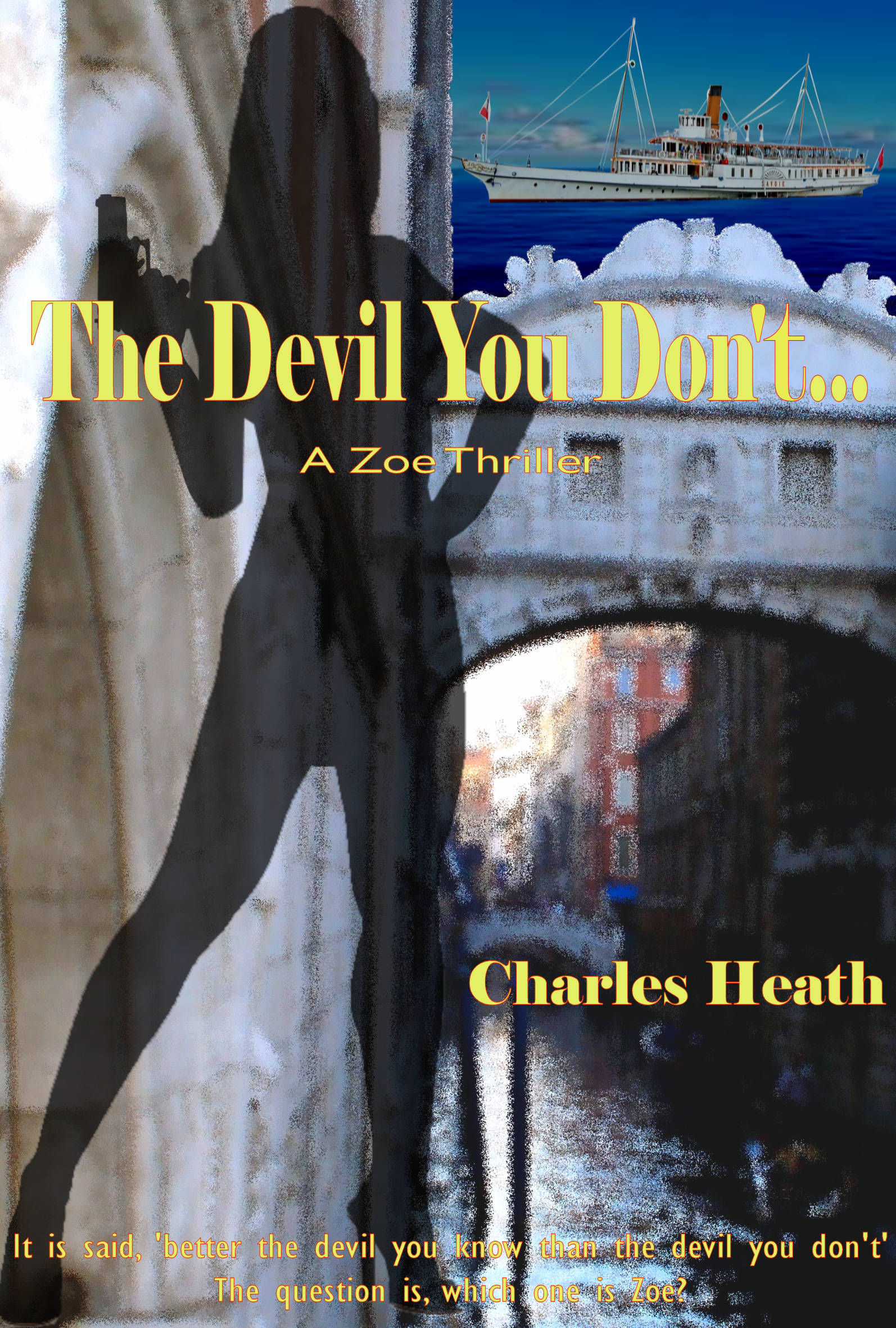
It could be said that of all the women one could meet, whether contrived or by sheer luck, what are the odds it would turn out to be the woman who was being paid a very large sum to kill you.

John Pennington is a man who may be lucky in business, but not so lucky in love. He has just broken up with Phillipa Sternhaven, the woman he thought was the one, but relatives and circumstances, and perhaps because she was a ‘princess’, may also have contributed to the end result.

So, what do you do when you are heartbroken?

That is a story that slowly unfolds, from the first meeting with his nemesis on Lake Geneva, all the way to a hotel room in Sorrento, where he learns the shattering truth.

What should have been a high turns out to be something else entirely, and from that point every thing goes to hell in a handbasket.

He suddenly realises his so-called friend Sebastian has not exactly told him the truth about a small job he asked him to do, the woman he is falling in love with is not quite who she says she is, and he is caught in the middle of a war between two men who consider people becoming collateral damage as part of their business.

The story paints the characters cleverly displaying all their flaws and weaknesses. The locations add to the story at times taking me back down memory lane, especially to Venice where in those back streets I confess it’s not all that hard to get lost.

All in all a thoroughly entertaining story with, for once, a satisfying end.

Available on Amazon here: https://amzn.to/2Xyh1ow

In a word: Can

Yes, another three letter word with a multitude of meanings, like

I can do this, it’s what we tell ourselves when faced with an impossible mission

You might want to carry a can, perhaps of drink, once made out of steel but now from aluminium.  It can also hold food, like baked beans

You might have a jerry can, which holds petrol, mighty handy if you are driving and run out.  It’s happened to me once

There’s the can-can, but that’s a dance

Can you do this, can I have a drink, you can park over there, it seems we can seek or be given permission

It is an informal name for either prison or a toilet, though it depends on where you are

And in the United States, a ‘tin can’ can also be used to describe a navy vessel

If you get canned from your job, it really means you got fired

In the can means the film has been completed

Of course, there is always a trash can which makes both a mess and a loud noise when they tip over, particularly at night

And, which also make a good set of wickets, painted on, when playing backyard cricket with your friends


“Echoes From The Past”, the past doesn’t necessarily stay there


What happens when your past finally catches up with you?

Christmas is just around the corner, a time to be with family. For Will Mason, an orphan since he was fourteen, it is a time for reflection on what his life could have been, and what it could be.

Until a chance encounter brings back to life the reasons for his twenty years of self-imposed exile from a life only normal people could have. From that moment Will’s life slowly starts to unravel and it’s obvious to him it’s time to move on.

This time, however, there is more at stake.

Will has broken his number one rule, don’t get involved.

With his nemesis, Eddie Jamieson, suddenly within reach, and a blossoming relationship with an office colleague, Maria, about to change everything, Will has to make a choice. Quietly leave, or finally, make a stand.

But as Will soon discovers, when other people are involved there is going to be terrible consequences no matter what choice he makes.

https://amzn.to/2CYKxu4

newechocover5rs

“More or less…” – A short story

It was meant to be time to reacquaint as brothers.

Louis and I had not seen each other for decades, and when he returned, about a week before, I got the impression there was more than just ‘missing his brother’ going on.

But that was Louis. He was never one to say what or how he felt about anything, preferring to be the strong silent type, and it had not fared well for him transitioning from teenager to adult.

As for me, when our parents split up, Louis went with our father, and I stayed with our mother, and, given the amount of acrimony there was attached to the split, it was no surprise to anyone that Louis and I had effectively become estranged.

In fact, when I had tried to find them, about two years after the split and our mother had died suddenly, all I found were loose ends. They had effectively vanished.

With that part of my life effectively over, I had married, had children and watched 30 years disappear before Louis suddenly popped up. He simply knocked on the front door one afternoon, Helen answered it, and within minutes they were the best of friends. I’d had that rapport, once, many years before, but life and circumstances had all but ruined that.

Or perhaps that was just me, worn down by that same life and circumstances we were all supposed to take on the chin.

His arrival was a welcome distraction, and when, after a week, he suggested that he and I go on a hike, the sort our father used to take us on when we were a family, I agreed. Helen was happy to be rid of me, and I guess a week without our arguing would suit everyone.

It was probably fortuitous timing. Helen and I had finally got to the point where divorce lawyers were about to be called in. The children had all moved on and had children and problems of their own, and we, as parents just didn’t gel anymore.

Besides, I said, just before I joined Louis in the truck, ready to embark for the wilderness, it would be time to clear my head.

And by day two, my head was clear, and Louis, taking the lead, led us along the ridgeline, a trek he said, that would take us about seven hours. We’d stopped the previous night in a base camp and then headed out the next morning. We were the only two, it being early in the season with snow still on the ground.

Above was the clear cloudless blue sky and in front of us, trees and mountains. There was snow on the ground but it was not solid and showed no signs of human footsteps, only animals. The air was fresh, and it was good to be away from the city and its pressures.

Approaching noon, I’d asked him if we were about halfway. I knew he was holding back, being the fitter of us.

“More or less.”

“More or less what, more closer or less close than we should be.”

I watched him do a 360-degree turn, scoping out our position. It was a maneuver I was familiar with from my time with the National Guard. I’d used my backcountry experience that I’d learned from my father, as a skill I thought they might be able to, and eventually did, use. I got the feeling Louis was looking for something.

“You get the impression we’re not alone?” I asked. I had that nagging feeling something was not right, not from about two miles back in the forest. It was like my sixth sense being switched on.

“Doesn’t seem so, though there have been a few animals lurking behind us, probably surprised anyone’s about this time of the year. It’s been a while, so I’m just getting a feel for the trail. This is, for now, our mountain.”

There was a time, from a time when we were kids, that I could tell when he was lying. He was better at covering it, but it was still there.

Where we’d stopped was a small clearing, a staging point that would be used by other trekkers, still overgrown because of lack of trekkers. Ahead there were the signs of a trail, and after six months, it would become clear again. In places, as we had made our way from the base camp, sections of the distinctive trail had all but disappeared, but Louis seemed to know where he was going, and it was not long before we had picked up the trail again. This spot was a lookout, giving a spectacular view of the valley below, and a fast running river through it.

I walked to the edge and looked up and down the valley, and at the trail that ran along the cliff for a short distance. I looked down, not the wisest of things to do, but it was long enough to catch sight of several charred pieces of wood. On top of the snow. The thing is, someone had been along this trail before us, and recently, something I thought wise to keep to myself.

Back at the log, I sat for a moment and drank some water, while Louis stood patiently, but impatiently, for me to join him.

“You look like you’ve got somewhere to be.” Probably not the wisest thing to say but it was out before I could stop it.

A flicker of annoyance crossed his face, then it was gone. “If we stop too long, joints will freeze up, especially when it gets colder.”

“Sorry.” I put the container back in the pack and joined him. “Let’s go. The cold and I don’t get along very well, and it’s been a long time since the last time I ventured into the great unknown.”

“Helen said you gave up trekking when you married her.”

“She wasn’t a trekker, Robbie. We all have to give up something, sooner or later.”

Another hour, feeling rather weary, we’d come to another small clearing and a place where I could sit down.

“You always were the weak link, Robbie. Admittedly you were younger, but you never seemed to grasp the concept of exercise and fitness.”

I looked up at him and could see my father, the exact stance, the exact words, the exact same sneer in his voice. It all came rushing back as if it was yesterday, the reasons why I chose to go with our mother, that another day with his bullying would be one too many. And he was a bully. And, in an instant, I could see the apple hadn’t fallen far from the tree.

“Out of shape after languishing in an office, perhaps,” I said, “but I was never the disappointment our father always considered me.”

“You didn’t join the army, follow in his footsteps, as he wanted us to do. I did. Proudly served, too.”

I could see it. Like father, like son. No surprise Robbie had followed in his father’s footsteps. And it was a clue as to what Robbie had been doing since I saw him last.

“So, tell me about it.”

“You wouldn’t understand.”

“No, I probably wouldn’t. Let’s push on.”

I’d also thought, along the way, he might ask questions, delve further into the problems that Helen and I were having, but I knew she had told him all he needed to know. I’d been held up at the office, and had rung to ask her to take him to dinner, get to know him, she might get to learn something of my life before I met her, details of which I hadn’t told her other than that my mother was dead, my father had left and taken Robbie with him. My past, I’d told her from the outset, was not something I would talk about.

I didn’t ask what they talked about, but I could see a change in both of them. Perhaps she had succumbed to Robbie’s charm, back in school all the girls did, but they all soon learned he was not a nice person, not once you got to know him. I didn’t warn her, and perhaps that was regrettable on my part, but it reflected the state in which our relationship had reached.

I’d also tried, once or twice, to find out if our father was still alive, but he deflected it, changing the subject. That meant he was still alive, somewhere, perhaps annoyed at Robbie for coming to see me. If I was a betting man, I’d bet our father would have denied permission for
Robbie to do so, even if he was a grown man and capable of making his own decisions.

Odd, but not surprising. Even now I could remember my father had secrets, and those secrets had fed into the breakup of our parents.

“So, you’ve been dodging it for days now, but you still haven’t told me if dad is alive or dead. He’d be about seventy-odd now.”

He stopped and turned to face me. “Would it matter if he was alive? I doubt you’d want to see him after what mother must have said about him.”

Interesting that he would think so. “She never had a bad word for him, and wouldn’t hear of one spoken, by me or anyone. And I have wondered what became of him, and you. At least now I know you spent time in the Army. If I was to guess what happened, that would be high on my list.”

“No surprise then you became an office wanker.”

Blunt, but, to him, it was a fact. I’d used that expression when telling Helen one time after a very bad day.

“We can’t all be heroes, Robbie.”

I put my hand up. Alarm bells were going off in my head. “You can come out now,” I yelled.

Robbie looked puzzled.

“I know you’re there. You’ve been behind us for about a half-mile now.”

A few seconds passed before the cracking of a twig, and then a person in a camouflage kit came towards us.

He’d aged, hair and beard grey in places but almost white now, but the face was familiar.

“What brings you to this part of the woods, Dad. Or is it just an unlucky coincidence?”

—–

© Charles Heath 2020-2021
Have you ever tried writing on a bus?

It’s amazing how quickly you discover the imperfections of road makers.

As odd as that sounds, a recent trip on a bus, actually earlier today, in fact, got me thinking about just how bad some of our roads really are.

As any writer will tell you, that half an hour or so on the trip to work or home, is just waiting for a few lines to be written, on your phone, or on your tablet.  I venture to suggest a laptop computer just might be a little difficult, and prone to stray eyes from the people sitting or standing near you.

And the tightness of the space available to you.  I know, I’ve tried.

But, if you’re not in the mood to research, I did a little of that too, by the way, the desire to write is tempered by the movement of the bus and your ability to type coherent words on a small keyboard in a very large, rocking, metal thing.

I have to say I have a large streak of jealousy for those people who can hammer out large texts to their friends while riding the bus, and in the most awkward of conditions, using both thumbs, and carrying 26 bags of groceries and dry cleaning, as well as having a full on political discussion with the person sitting/standing next to them.

Even when the bus hits a pothole, does a sudden lurch that sents the unsuspecting sprawling.

With my interactive word completer turned on, it is astonishing what words finish up in my small attempt at writing as my fingers fail to find the right letters, and creates what only could be described as the ramblings of a madman.

Perhaps I might have better luck tomorrow.


The cinema of my dreams – It all started in Venice – Episode 13

Cecilia changes the subject

Being an up-and-coming movie start was not all beer and skittles, as the saying goes.

Juliet gave her a look that I thought was her death stare, annoyed by her arrival at what might have been a critical point in the conversation.

Cecilia saw her and shook her head.  “Oops, I’m intruding.  Sorry.”  She stood

“You’re not,” I said, which earned me a harsh look too, “We’re just having coffee, but you might want something stronger.”

“No, I’d better go.”  She was looking directly at Juliet, putting the onus directly on her.

“Stay.  We’re just having coffee.”

Cecilia waved to a waitress and sat down again.  “Great, I wasn’t looking forward to going back to an empty room.”

For effect, she touched me on my arm, her seat being closer, and I could see what she was doing. 

We opted for more coffee, Cecilia ordered a bottle of champagne, and three glasses, an attempt to smooth the rocky waters.

Juliet was definitely annoyed.  Another death stare in Cecilia’s direction, then, “would I have seen anything you’ve starred in?”

“Me?  I’m not a star, not a big name, just bit parts in series like Midsommer Murders, and Silent Witness.  I get to play dead bodies and murder victims.  My last role was a little better, I got a half dozen lines.  But I’m just one of the hundreds of hopefuls out there.”

“Do you have a day job, then, if parts are so few and far apart?”

Interesting question, Juliet was thinking on her feet.

If she was trying to catch Cecilia out, but she was ahead of Juliet.  “I do.  I’d like to say that it’s being a high-class escort, but they make more money than I’d know what to do with, so I toil away as a supermarket checkout girl.  Gives me the most flexibility regarding time off, and I get to meet so many different people, who become part of my repertoire of characters.  What do you do?”

“Pathology.”

“A doctor.”

“A disgraced doctor that can’t practice medicine.  Perhaps that might be material enough for another of your characters.”

Cecilia had one glass of champagne the moment it came, and then refilled for a second.  She offered it to us, and I nodded, taking half a glass.  Juliet declined.

“Played a hospital patient, a bomb victim, swathed in bloody bandages, been a doctor in the background once, got to spill coffee over another doctor.”

“What is the best part you’ve had?”

 “A fallen nun.”

The best said about that the better, but not before my mind went to places it shouldn’t.  I changed the subject.  “What will you be doing after the festival is over?”

“Going home.  I have an audition for a part in a film about mercenaries, they want me to be a mercenary would you believe?”

Apparently Juliet didn’t think so.

“But I have a spare few days if you want to show me more of Italy.  I’d like to see a little of Tuscany, try some wine.”

Another touch and a smile.

“I thought you were going to Sorrento.”  Not unexpected from Juliet.

“It can wait.  I’ve been thinking of going home, and can take Cecilia to Tuscany, send her on her way, and go visit Larry’s mother at Sorrento “

“And if I take up your tour offer to come with you?”

Cecilia gave me a Juliet look.

“Then I’ll send you a text saying where and when I’ll meet you.”

Change bottle empty, Cecilia gave me one last look, one that would no doubt get a reaction from Juliet, and sauntered away.

Juliet watched her leave, and after she disappeared out of sight, said, “it seems to me she’s more than just a friend.”

“That’s just her, no doubt playing a role.  She asked me if you were a girlfriend, and I said, once maybe, but not now.  Seems she didn’t quite believe me.”

“I think we both know where that ship is headed.”

The rocks, perhaps.  “It’s too soon after Violetta to contemplate anything like that.  But, that doesn’t mean I can’t be friends for now, and see what the future brings.”

“Not much if what you say about this Larry character is true.”

“That said, you might also want to be careful.  Larry’s not averse to using or killing close contacts of only to send a message.  So, if feel unsafe, or he makes an overture, tell me and I’ll pass it on to my minders.”

“If he does, I’ll definitely let you know.”

“Good.  It’s getting later.  We should get back to the hotel.”

© Charles Heath 2022

A score to settle – The Editor’s draft – Day 13

I have the story, the editor is asking for it, and I’m putting the final touches to it

It’s 13 days in, and unlike many in the workforce, there is no chance of taking a break. Writing, for most of us, is not a nine-to-five job where at the end of the day you throw everything in the top drawer of your desk and go home.

Chances are, you’re already home, with papers, research, and a whole lot more scattered around you. You look at the clock and think any normal sensible person would be anywhere but where you are.

My say is nowhere bring done. After 8 hours of distractions, and trying to focus on what is important, for the umpteenth time, I’ve failed.

I haven’t written the required word count.

13 days in, I’m starting to feel the effects of working continuously on the job at hand. It’s not the physical part of the job, it’s the mental effect.

5 pm, and you can see that the day is not going to end well, or worse, that it’s never going to end. Perhaps having a proper plan which all but allows the story to write itself.

Even then, quite often things don’t go according to plan. Stories have a habit of going in directions that never seemed possible at the beginning.

Of course, that’s your fault because you gave the character life, and it chose to go its own way.

Damn characters.

So, I’m calling the characters into a meeting and telling them they need to rein in this free will I keep hearing about, and follow the path assigned to them.

I’ll let you know how it went tomorrow.

Today’s word count: 2,736 words, for a running total of 30,654.

Searching for locations: Just how hard can it be to see some snow?

You would think it is a relatively simple thing to get to the snow.

Of course, there are a few necessities like skis, boots, poles, and warm dry clothing, but that can all be bought or rented when you get there, or if you are an enthusiast, you already have the gear.

So, you get in the car, set the navigator, and off you go.  Till you get within 20 k of the ski field, it’s all plain sailing, everyone is excited, and mentally preparing.

Then it all starts to go sideways.

Those last few kilometers to the top are going to be arduous particularly if it’s been snowing and the roads are icy, but the weather is fine with blue skies and no recent snow falls.  Were expecting a slow drive and a parking spot.

The road is open.

But…

So late in the morning, a sign at the bottom of the mountain warns all the car parks at the ski field are full, but we venture on anyway.

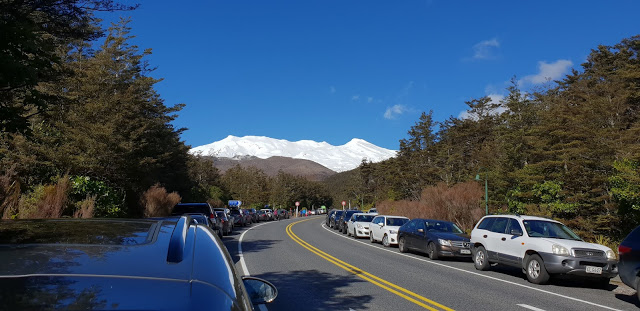
As you can see, the cars are parked so far away from the ski fields, the prospective skiers have to almost run a marathon before they get there!

And for some odd reason, we picked the very day everyone in New Zealand also wanted to go up to the ski fields so parking, even near the Chateau Tongariro was gone and there were endless cars looking for parking spots and traffic wardens had their hands full trying to keep traffic moving
So, for us and everyone else, everything stops at Chateau Tongariro, and from there the only vehicles allowed up are buses.

It’s about 10:30 and we are advised the only way we were getting to see snow was to take a bus

Now, there are two types of busses.  You can go up on a local bus, from Whakapapa Village that costs $20 a person which in the context of the cost of skiing not very much, but if you’re not, it’s quite expensive.

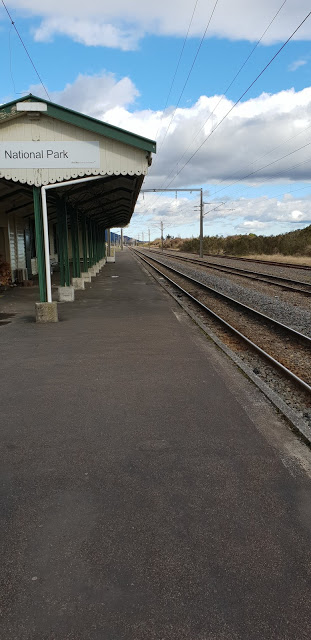
The second, one we were advised to use, operates from a place called National Park, about 9 km away, a snow shuttle that costs $6 each.  The trouble is by the time we were ready to go there, to catch a shuttle, there were no more shuttles.

We did not know what to expect when we got to ‘National Park’, but being a railway station makes sense.  It’s the only place with a very large carpark!

Oh, well, there’s always tomorrow.

Writers need to have many alter egos, don’t they?

I have often wondered just how much or how little of the author’s personality and experiences end up in a fictional character.

Have they climbed mountains,

Have they escaped from what is almost the inescapable,

Have they been shot, tortured, or worse,

Have they been dumped, or divorced,

Have they travelled to dangerous places, or got locked up in a foreign jail?

We research, read, and I guess experience some or all of the above on the way to getting the book written, but it’s perhaps an interesting fundamental question.

Who am I today?  Or, more to the point, who do I want to be today?

Or it can be a question, out of left field, in an interview; “Who are you?”

My initial reaction was to say, “I’m a writer.”  But that wasn’t the answer the interviewer is looking for.

Perhaps if she had asked, “Who are you when you’re writing your latest story?” it would make more sense.

Am I myself today?

Am I some fictional character an amalgam of a lot of other people?

Have I got someone definite in mind when I start writing the story?

The short answer might be, “I usually want to be someone other than what I am now.  It’s fiction.  I can be anyone or anything I want, provided, of course, I know the limitations of the character.”

“So,” she says, “what if you want to be a fireman?”

“I don’t want to be a fireman.”

“But if the story goes in the direction where you need a fireman…”

“What is this thing you have with firemen?”  I’m shaking my head.  How did we get off track?

“Just saying.”

“Then I’d have to research the role, but I’m not considering adding a fireman anytime soon.”

She sighs.  “Your loss.”

Moving on.

And there is that other very interesting question; “Who would you like to be if you could be someone else?”

A writer in that period between the wars, perhaps like an F Scott Fitzgerald or Ernest Hemingway, in Paris, or if it is a fictional character, Jay Gatsby.

He’s just the sort of person who is an enigma wrapped up in a mystery.