In a word: Dry

We all know what this means, without moisture, in other words not wet.

It could also mean dull factually, as in reading some non-fiction books, and quite often those prescribed as mandatory reading at school.

You could also have a dry sense of humour, where you have to be on your game to understand, or get, the humour.

It could also describe boredom by saying that it’s like watching paint dry.

For those who like a bit of a tipple, the last place you want to go is a dry bar, where no alcohol is served.

Perhaps this should be mandatory for weddings and funerals, places where feelings often run very high and do not need the stimulus of half a dozen double Scotches.

And speaking of alcohol and cider in particular, you can have it sweet, dry, or draft. Many people prefer dry, sometimes the drier the better, especially wine, and oddly martinis.

Aside from whether they are shaken or stirred.

But the most fascinating version of dry is dry cleaning. Just how can you ‘dry’ clean clothes?

Would that be what they call an oxymoron?

An excerpt from “What Sets Us Apart”, a mystery with a twist

See the excerpt from the story below, just a taste of what’s in store…

http://amzn.to/2Eryfth

whatsetscover

McCallister was old school, a man who would most likely fit in perfectly campaigning on the battlefields of Europe during the Second World War. He’d been like a fish out of water in the army, post-Falklands, and while he retired a hero, he still felt he’d more to give.

He’d applied and was accepted as head of a SWAT team, and, watching him now as he and his men disembarked from the truck in almost military precision, a look passed between Annette, the police liaison officer, and I that said she’d seen it all before. I know I had.

There was a one in four chance his team would be selected for this operation, and she had been hoping it would be one of the other three. While waiting for them to arrive she filled me in on the various teams. His was the least co-operative, and the more likely to make ad-hoc decisions rather than adhere to the plan, or any orders that may come from the officer in charge.

This, she said quite bluntly, was going to end badly.

I still had no idea why Prendergast instructed me to attend the scene of what looked to be a normal domestic operation, but as the nominated expert in the field in these types of situations, it was fairly clear he wasn’t taking any chances. It was always a matter of opinion between us, and generally I lost.

In this case, it was an anonymous report identifying what the authorities believed were explosives in one of the dockside sheds where explosives were not supposed to be.

The only reason why the report was given any credence was the man, while not identifying himself by name, said he’d been an explosive expert once and recognized the boxes. That could mean anything, but the Chief Constable was a cautious man.

With his men settled and preparing their weapons, McCallister came over to the command post, not much more than the SUV my liaison and I arrived in, with weapons, bulletproof vests, and rolls of tape to cordon off the area afterward. We both had coffee, steaming in the cold early morning air. Dawn was slowly approaching and although rain had been forecast it had yet to arrive.

A man by the name of Benson was in charge. He too had groaned when he saw McCallister.

“A fine morning for it.” McCallister was the only enthusiastic one here.

He didn’t say what ‘it’ was, but I thought it might eventually be mayhem.

“Let’s hope the rain stays away. It’s going to be difficult enough without it,” Benson said, rubbing his hands together. We had been waiting for the SWAT team to arrive, and another team to take up their position under the wharf, and who was in the final stages of securing their position.

While we were waiting we drew up the plan. I’d go in first to check on what we were dealing with, and what type of explosives. The SWAT team, in the meantime, were to ensure all the exits to the shed were covered. When I gave the signal, they were to enter and secure the building. We were not expecting anyone inside or out, and no movement had been detected in the last hour since our arrival and deployment.

“What’s the current situation?”

“I’ve got eyes on the building, and a team coming in from the waterside, underneath. Its slow progress, but they’re nearly there. Once they’re in place, we’re sending McKenzie in.”

He looked in my direction.

“With due respect sir, shouldn’t it be one of us?” McCallister glared at me with the contempt that only a decorated military officer could.

“No. I have orders from above, much higher than I care to argue with, so, McCallister, no gung-ho heroics for the moment. Just be ready to move on my command, and make sure you have three teams at the exit points, ready to secure the building.”

McCallister opened his mouth, no doubt to question those orders, but instead closed it again. “Yes sir,” he muttered and turned away heading back to his men.

“You’re not going to have much time before he storms the battlements,” Benson quietly said to me, a hint of exasperation in his tone. “I’m dreading the paperwork.”

It was exactly what my liaison officer said when she saw McCallister arriving.

The water team sent their ‘in position’ signal, and we were ready to go.

In the hour or so we’d been on site nothing had stirred, no arrivals, no departures, and no sign anyone was inside, but that didn’t mean we were alone. Nor did it mean I was going to walk in and see immediately what was going on. If it was a cache of explosives then it was possible the building was booby-trapped in any number of ways, there could be sentries or guards, and they had eyes on us, or it might be a false alarm.

I was hoping for the latter.

I put on the bulletproof vest, thinking it was a poor substitute for full battle armor against an exploding bomb, but we were still treating this as a ‘suspected’ case. I noticed my liaison officer was pulling on her bulletproof vest too.

“You don’t have to go. This is my party, not yours,” I said.

“The Chief Constable told me to stick to you like glue, sir.”

I looked at Benson. “Talk some sense into her please, this is not a kindergarten outing.”

He shrugged. Seeing McCallister had taken all the fight out of him. “Orders are orders. If that’s what the Chief Constable requested …”

Madness. I glared at her, and she gave me a wan smile. “Stay behind me then, and don’t do anything stupid.”

“Believe me, I won’t be.” She pulled out and checked her weapon, chambering the first round. It made a reassuring sound.

Suited up, weapons readied, a last sip of the coffee in a stomach that was already churning from nerves and tension, I looked at the target, one hundred yards distant and thought it was going to be the longest hundred yards I’d ever traversed. At least for this week.

A swirling mist rolled in and caused a slight change in plans.

Because the front of the buildings was constantly illuminated by large overhead arc lamps, my intention had been to approach the building from the rear where there was less light and more cover. Despite the lack of movement, if there were explosives in that building, there’d be ‘enemy’ surveillance somewhere, and, after making that assumption, I believed it was going to be easier and less noticeable to use the darkness as a cover.

It was a result of the consultation, and studying the plans of the warehouse, plans that showed three entrances, the main front hangar type doors, a side entrance for truck entry and exit and a small door in the rear, at the end of an internal passage leading to several offices. I also assumed it was the exit used when smokers needed a break. Our entry would be by the rear door or failing that, the side entrance where a door was built into the larger sliding doors. In both cases, the locks would not present a problem.

The change in the weather made the approach shorter, and given the density of the mist now turning into a fog, we were able to approach by the front, hugging the walls, and moving quickly while there was cover. I could feel the dampness of the mist and shivered more than once.

It was nerves more than the cold.

I could also feel rather than see the presence of Annette behind me, and once felt her breath on my neck when we stopped for a quick reconnaissance.

It was the same for McCallister’s men. I could feel them following us, quickly and quietly, and expected, if I turned around, to see him breathing down my neck too.

It added to the tension.

My plan was still to enter by the back door.

We slipped up the alley between the two sheds to the rear corner and stopped. I heard a noise coming from the rear of the building, and the light tap on the shoulder told me Annette had heard it too. I put my hand up to signal her to wait, and as a swirl of mist rolled in, I slipped around the corner heading towards where I’d last seen the glow of a cigarette.

The mist cleared, and we saw each other at the same time. He was a bearded man in battle fatigues, not the average dockside security guard.

He was quick, but my slight element of surprise was his undoing, and he was down and unconscious in less than a few seconds with barely a sound beyond the body hitting the ground. Zip ties secured his hands and legs, and tape his mouth. Annette joined me a minute after securing him.

A glance at the body then me, “I can see why they, whoever they are, sent you.”

She’d asked who I worked for, and I didn’t answer. It was best she didn’t know.

“Stay behind me,” I said, more urgency in my tone. If there was one, there’d be another.

Luck was with us so far. A man outside smoking meant no booby traps on the back door, and quite possibly there’d be none inside. But it indicated there were more men inside, and if so, it appeared they were very well trained. If that were the case, they would be formidable opponents.

The fear factor increased exponentially.

I slowly opened the door and looked in. A pale light shone from within the warehouse itself, one that was not bright enough to be detected from outside. None of the offices had lights on, so it was possible they were vacant. I realized then they had blacked out the windows. Why hadn’t someone checked this?

Once inside, the door closed behind us, progress was slow and careful. She remained directly behind me, gun ready to shoot anything that moved. I had a momentary thought for McCallister and his men, securing the perimeter.

At the end of the corridor, the extent of the warehouse stretched before us. The pale lighting made it seem like a vast empty cavern, except for a long trestle table along one side, and, behind it, stacks of wooden crates, some opened. It looked like a production line.

To get to the table from where we were was a ten-yard walk in the open. There was no cover. If we stuck to the walls, there was equally no cover and a longer walk.

We needed a distraction.

As if on cue, the two main entrances disintegrated into flying shrapnel accompanied by a deafening explosion that momentarily disoriented both Annette and I. Through the smoke and dust kicked up I saw three men appear from behind the wooden crates, each with what looked like machine guns, spraying bullets in the direction of the incoming SWAT members.

They never had a chance, cut down before they made ten steps into the building.

By the time I’d recovered, my head heavy, eyes watering and ears still ringing, I took several steps towards them, managing to take down two of the gunmen but not the third.

I heard a voice, Annette’s I think, yell out, “Oh, God, he’s got a trigger,” just before another explosion, though all I remember in that split second was a bright flash, the intense heat, something very heavy smashing into my chest knocking the wind out of me, and then the sensation of flying, just before I hit the wall.

I spent four weeks in an induced coma, three months being stitched back together and another six learning to do all those basic actions everyone took for granted. It was twelve months almost to the day when I was released from the hospital, physically, except for a few alterations required after being hit by shrapnel, looking the same as I always had.

But mentally? The document I’d signed on release said it all, ‘not fit for active duty; discharged’.

It was in the name of David Cheney. For all intents and purposes, Alistair McKenzie was killed in that warehouse, and for the first time ever, an agent left the Department, the first to retire alive.

I was not sure I liked the idea of making history.

© Charles Heath 2016-2020
“Because it’s not me” – a short story

If the was one fault I had, it was prevarication.

For a long time, I had always been afraid of making a mistake, after I had done exactly that.  They said our mistakes didn’t define us, but that one had.  I had lost the trust of everyone, from my parents to my friends.

It was only a small lie, or so I told myself, but it had far-reaching ramifications, and almost cost someone their life.  But whilst I believed it was not all that bad, and the police had agreed that anyone who had been put in the same position would have done the same, there were those who didn’t agree.

It was a moment in time I often relived in my mind, over and over, and eventually led to several outcomes.

First, I left home, the town where up till then I’d lived all of my life, walking away from family and those who used to be friends, knowing that what they said and what they felt were two entirely different things.  For all concerned, it was better that I left, cutting all ties, and making a fresh start, away from those whom I knew would never forget, even though they forgave me.

The second, and most dire, I changed my name, and my history, even how I looked.  Today, I was a very different person from that thirty years ago.

Third, I moved to another country and vowed never to return, always looking constantly over my shoulder, expecting someone from the past to find me.  I instinctively knew that I would never escape, that one day a stark reminder would come back and destroy everything.

I picked the one occupation that would keep me both occupied and invisible.

Journalist.

I had started at the bottom, literally writing death notices, and worked my way up to what is ubiquitously known as ‘foreign correspondent’, going to places where no one else would go, those hotbeds of unrest, and war zones, reporting from both sides.

Perhaps it could say I had a death wish, a statement my editor had once said when he came to see me in hospital back in London after I’d been caught up in a rocket attack and repatriated.  He had come to offer me a job back home, to tell me my tour was over.

I declined the opportunity, and he left, shaking his head.

But that was not the only visitor that came to the hospital that day.  The other visitor was an elderly man, immaculately dressed in a pinstripe suit and bowler hat.  It screamed public servant, and the moment I saw him wandering up the passage, a chill ran down my spine.

Although he looked like he was looking for someone else, I knew he would eventually finish up in my doorway.

Five minutes after I first saw him.

When he appeared at the door, I thought about ignoring him, but realized that wasn’t going to change anything.  Besides that, I guess I wanted to know why he would want to see me.

“James Wilson?”

“Would it make any difference if I said no?”  Well, it didn’t mean I couldn’t spar with him, just a little.  “Who are you.”

“Do you mind if I come in?”

I got the impression he would do it anyway, irrespective of what I said.  I said no, and as I suspected he came in anyway, closing the door behind him, then took a minute or two to make himself comfortable in the visitor’s chair, which was an impossible task.

Then, settled, he said, “I understand you have just been repatriated from Syria.”

“I was in the wrong place at the wrong time.”

It wasn’t common knowledge where I’d come from, so this person knew something about me, which was an immediate cause for concern.

“The bane of a reporter trying to cover a dangerous situation,” he said, with just the right amount of levity in his tone.  “I get it, by the way.  I once had that devil-may-care attitude you need to get the story.  I was chasing a Pulitzer, believe it or not, and used a few of those nine lives in the process.  Which one are you up to?”

I was going to say that awards didn’t matter but among those who made up the press pack in those God-forsaken places, there was an unwritten desire to be rewarded other than by pay.  For me, though, it was not a defining factor.

“Lost count.  But why would that interest you, or whoever it is you represent?  By the way, just who do you represent?”

Second attempt at finding out who this man was.  If he was dodging and weaving, it would suggest a clandestine organization.

“People who would like to use your unique talent in getting into trouble spots around the world.  We’re not asking you to come work for us exclusively, but rather piggyback on the job that you already do so well.”

An unnamed man from an unnamed organization.  What he was offering wasn’t unheard of, and I had been warned, more than once, that jobs, like he was suggesting, were more often than not offered to people like me.  With that came one line of advice, turn around and run like hell.

But, with nothing to amuse me in the hospital, I was curious.  “Doing what exactly?”

The fact his expression changed indicated my response had taken him by surprise.  Perhaps he was used to being told where to go.  Not yet.  I had this fanciful notion in the back of my mind that what he might offer might get me closer to the story.

“Keeping your eyes and ears open.  We’ll tell you what to look for, all you’ll be doing is looking for evidence.  There will be no need to go looking for trouble, if there’s evidence we ask you to report it, if not, no harm done.”

Not so hard.  If that was all it was.  The trouble was, if something sounds simple, which that did, but inevitably, it was going to be anything but.  I’d heard stories and the consequences.

“You’re presuming that my editor will send me back.  He just offered me a job at home.”

“I think both of us know you’re not interested in domesticity.  If he isn’t willing to adhere to your wishes, I’m sure we could find someone else who would be willing to take you on.  You have had several offers recently, have you not?”

So, without a doubt, he knew a lot about me, especially if he asked around.  I had had several offers, but I was happy where I was.  I liked the no questions about your past that my current employer had promised.

Yes, looking at the determination on this man’s face, I had no doubt they or he could do what he said.  No one comes to a meeting like this without holding all the cards.  Also, not that I wanted it to be so, It told me that my agreement was not necessarily going to be optional.

But I was happy to dither and find out.  “Since I’m not sure when the hospital is going to discharge me, and the fact I’m not exactly very mobile at the moment, can I consider the proposal.  Right now, as you can imagine, getting back to work is not exactly a priority.”

“Of course.”  He took a card out of his coat pocket and put it on the bedside table.  “By all means.  Call me on that number when you’ve decided.”

He stood.  “It will be a great opportunity.  Thank you for your time.”

Of course, the two impressions I was left with were, one, he had me mixed up with someone else, and two, that I would never see him again.

It was an impossible task, for me at least, because I did not have a poker face, and could barely carry a lie.  I would be the last person they’d want for the job.

And thinking that, I rolled over, put it out of my mind, and went back to sleep.


© Charles Heath 2021

Where do you write?

Here’s an interesting question, where do you find the most comfortable place to write?  Is it in an office, in a room overlooking the ocean, and basement where you can make it dark and creepy for atmosphere, is it at a train station, at work, which could end up presenting you with problems, or somewhere else.

Some people have an office, mine is a converted garage, and the walls are lined with books.  It isn’t the greatest place though.  There’s a smart alec cat always on my case.

There’s a couch in the living room where, late at night, I sometimes sit and ponder over about a thousand words of whatever the current story is in my head.  Cat withstanding.

It could be a cafe or restaurant, where it starts out as notes on the ambiance, the food, the people, then a little more, and gets me into trouble with my dining companions.

They should not have created writing programs for mobile phones.  Or for that matter, allow the phones to get smarter than their users.

But…

That’s a whole other story.

So having found that special or nonspecial spot in the house, or out there in the universe, how do you become creative?

Is it you’ve been carrying the ideas around in your head for a while and you just need somewhere neutral to get them on paper, or in that pesky smartphone?

Is it sitting by the window with a cup of coffee and a mice cream-filled cake, when something catches your eye, and instantly the words begin forming?

Are you with someone, a muse, a partner, a spouse, a friend, a secret friend, or just a stranger, and you start getting the wrong ideas?  Or the right ideas if it’s a different sort of book.

Sometimes I move seats and sit opposite the writer’s chair to take a good long hard look at the person, the so-called writer, conjuring up in my mind, if I was someone I’d just dragged in off the street, what would I ask?

They, no doubt would be cynical.

Why bother when there are a million others out there trying to do the same thing?

That’s the easy question.  Every story is different.  Why?  Because every writer has a different point of view, a different set of experiences, a different personality, different friends, this could go on forever…

Here’s a test, outline a story and give that outline to ten different writers.  You’d get ten different stories.

Where do you get the motivation?

Don’t know.  Some days I don’t want to get out of bed, others, I can’t go to sleep until the words have stopped.  Go figure.

What do you do for inspiration?

Inside, outside, upside down, everywhere and anywhere.

Just remember, always have a notebook and pencil on hand.  Why pencil, I never have any luck with pens.

A twitter biography

Every year I come back to revisit this, and each year it becomes a harder issue to deal with.  All that’s recently changed is the number of characters you can use

I’ve been trawling the endless collection of twitter descriptions provided by their users, noting that there is a restriction of 280 characters.

How do you sum yourself up in 280 characters?

I don’t think I can, so we tend to put down a few catchphrases, something that will draw followers.  I’m thinking the word ‘aspiring’ will be my catchword.

I’m aspiring to be a writer, or is that author?  Is there a difference, like for instance, one publishes ebooks on Amazon, one publishes hard copies in the traditional manner?

Is there a guide to what I can call myself?

Quite simply put, but in more than 140 characters, married happily, two wonderful children, three amazing grandchildren, and a wealth of experience acquired over the years.

Actually, that sounds rather boring, doesn’t it?

Perhaps it would be better if I was a retired policeman, a retired lawyer, a retired sheriff, a retired private investigator, a retired doctor, someone who had an occupation that was a rich mine of information from which to draw upon.

Retired computer programmers, supermarket shelf stackers, night cleaners, accounts clerks and general dogsbody s don’t quite cut the mustard.

I have also become fascinated with the expression ‘killer biography’.  Does it mean that I have to be a ‘killer’?

Better than the self-confession above.  Should we try to embellish our personal history in order to make it more appealing?

It’s much the same as writing about daily life.  No one wants to read about it, people want to be taken out of the humdrum of normalcy and be taken into a world where they can become the character in the book.

And there you have it, in a nutshell, why I write.


The cinema of my dreams – It all started in Venice – Episode 18

Observing the enemy

“She’s not talking,” the detective who had been trying to get answers to various questions, said, after coming out of the room, looking somewhat exasperated.

I’d been watching him spar with her, and her legal representative telling her that unless the police had concrete evidence, she need not answer any questions, except with a ‘No comment’.  Not once though did she ask to leave, which she could do at any time.

That was interesting.

“I’m not surprised.  Technically she’s done nothing wrong, yet.  Perhaps we need to ask some different questions.”

He sighed.  “Then, by all means, do so.  I’ve been told you know more about her connection to Larry Fortescue, a person we are very familiar with, but this is a connection we’re not fully across yet.  You are aware we found several crates in one of her warehouses with his name on them, one of which had several blocks of C4 in it.  She claims it’s not hers and has no idea who it got there, but not the fact she knows him in passing.”

Denying as one would expect that there was more to the relationship other the acquaintances, and appropriate for so-called rival crime bosses.

“You have to admit, though, it’s not the sort of stuff your average beauty products sales person would have lying around.”

Nominally, she called herself a beautician who runs a chain of so-called health clinics which made the perfect front for other more nefarious activities, allegedly.  No one had yet proved without a doubt anything else happened there.

“These days nothing would surprise me.  Some of the chemicals we also found could very easily be ingredients for bombs, but she had the permits, and it’s all accounted for.  This is the first time we’ve been able to pull her in.”

“A routine check, or a tip?”

“Actually, someone called the hotline to say that men who looked like terrorists in a white van were unloading crates in a suspicious manner.  I kid you not, that was what we were told.”

Men who looked like terrorists.

“Now that Larry is implicated, well be happy to share what we have.  He would be a far likelier owner of the explosive, and this is a rare mistake on his part to leave his name on the crate.  This is the first lead we have on how he keeps one step ahead of us, using others to hold his stuff and why we can never find it in his possession.  He’ll deny it’s his and that it’s one of his enemies setting him up.”

“We’ve been trying to find him.”

“He’s in Sorrento Italy visiting his mother, and no doubt combining business with pleasure.  It’s no coincidence she is there, he’s looking for me.”

“Then he’ll be out of luck then.  Thanks for the info, I’ll get our people onto tracking him down.  He also has a few questions to answer.”

I looked at the screen on which I had been viewing the interview, noted the smug expression, and the body language that said she thought she was untouchable.

In a sense, she had every right to believe that.  She hadn’t been on Rodby’s radar until she took up with Larry.  Larry was Rodby’s obsession, why I never found out, and knew better than to ask.  Both she and Larry were well known to the police, and both had managed to keep out of jail because they were careful, though Larry had been far more careless in his younger days.

And for a person who was firmly entrenched, but more or less invisible in the criminal landscape, joining with Larry was her biggest mistake.

Rodby had brought a file with him and I read it in the car on the way here and it was another very thorough deep dive into a woman who for all intents and purposes was nothing like who she portrayed in real life.

A woman with secrets she believed were still intact.

Secrets I could use to gain some leverage, not that I ever liked doing so because often it involved innocents caught up in a world, not of their choice.

But she chose to be a criminal, and there were always consequences, unintended or otherwise.

Enough thinking, it was time.

© Charles Heath 2022

A score to settle – The Editor’s draft – Day 17

I have the story, the editor is asking for it, and I’m putting the final touches to it

We’re now coming up to the start of the revolution and although the first parries by the rebels, so-called by the ruling junta because it sounds better than revolutionaries, or dissidents, will fail, it’s not because of bad management, but events they could not have foreseen.

That lethargy and periods of self-doubt have lifted like a fog, and the story is now taking shape.

Perhaps I had to get to the interesting part. Sometimes the setting of the scene and providing an introduction to the characters can be energy-draining because as the reader, it can take almost too long to get going.

Perhaps I should make a mental note of that so that in the second draft, I can remove the boring bits and get to the real story sooner.

I cannot wait for tomorrow and almost had to resist the temptation of not stopping for sleep, just in case the words stopped flowing. There are times, I have discovered, that in taking that break, the idea and word flow stops, and conjures up something like writer’s block.

Let’s hope tomorrow is the same as today.

Today’s word count: 2,742 words, for the running total of 43,196.

Searching for locations: Aratiatia Dam, Taupo, New Zealand

Aratiatia Dam water release, Taupo

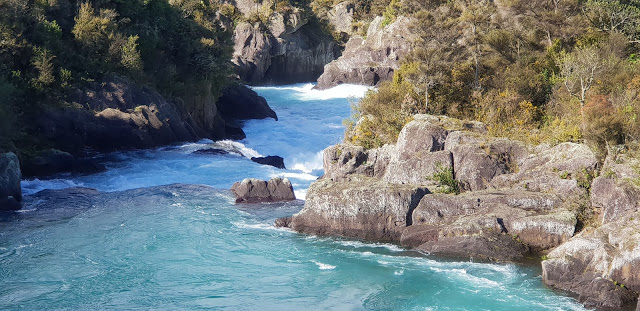
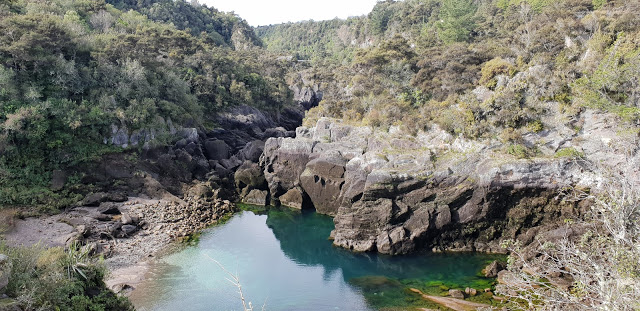
The Aratiatia Dam, rapids, and hydroelectric power station are located on the Waikato River, New Zealand’s longest river.  It is about 16km from Taupo, and 6km from Huka falls, and there is a walking track, for the fit, of course, between the two water attractions.

This happens three or four times every day, depending on the season, and lasts about 15 minutes.  Water is released at the rate of about 80,000 liters a second, so it is quite a lot of water being sent through the rapids.

There are a number of viewing points, the most popular being from the bridge, where I took these photos, and 5 minutes down the walking track to the ridgeline where you can get an overview of the river.

This is looking towards the rapids, as the catchment leading to the rapids starts to fill

The pool is almost full and the excess is starting its journey towards the rapids

Now full, the rapids are at capacity as up to 80,000 liters a second are heading down a 28-meter drop heading towards the hydroelectric power station.

And once full at the bottom, there is a jet boat ride available for a closer view of the water, and a few thrills to go with it.

I feel asleep in front of the computer screen

And when I woke up, I realised that I had just had a very bad dream. Or don’t they call bad dreams nightmares?

Can you diagnose yourself as having depression?

Of course, if you were to tell someone else, in one of these very serious tones, “I think I have depression” they will ask you what you’ve got to be depressed about.

It’s a good question. My first answer would be, “why did the doctor put me on antidepressants?” You know the stuff they give you, some derivative of serapax,

Then, if you tell anyone you’re on that stuff, they turn around and tell you just how bad it is and get off it right now.

That’s all very well, but you tell them you still have depression, and so the argument goes on.

But…

These days, they use low doses of antidepressants to manage pain, and in my case back pain. The first pill they gave me was Lyrica, which slowly took my memory away so that I couldn’t remember what anyone had said earlier in the day.

I thought I had early onset Alzheimer’s, or worse, dementia.

So I got off that, got the pain back, and moved to antidepressants. Now I’m seeing things.

That might help with the imagination for writing stories sometimes, but telling people you see the patterns on tiles moving is not a good start to any conversation.

Back to depression, though. It might be caused by being locked down and not being able to go anywhere, but that has never bothered me because I hate going out.

It might be a result of my childhood coming back to haunt me, and, believe me, you would not want the childhood I had, but it’s a maybe. A lot of old people find their past creeping up on them, and what happened 60 years ago seems more relevant than what happened 60 minutes ago.

You might think you’re badly done by, that everyone else is responsible for the mess you made of your life, if it is indeed a mess, but no, that isn’t true. My life is exactly what it’s meant to be, though how I got here remains the biggest of mysteries.

It’s why I’m writing the autobiography of a very ordinary nobody.

OK, that might be a hint, thinking I’m a nobody. After all, when I go out I always feel like I’m invisible.

A friend of mine tells me he always cries when there’s a sad part of a film on, and that’s his determination of depression.

I do too, but I don’t think it’s that.

After all, I did psychology and should understand the nuances of the human psyche, what makes us happy, what makes us sad, what makes us us.

So, rightly or wrongly I’ve stopped taking the antidepressants.

If suddenly my blog suddenly stops, you’ll know I’ve made the wrong decision.

The cinema of my dreams – I never wanted to go to Africa – Episode 18

Our hero knows he’s in serious trouble.

The problem is, there are familiar faces and a question of who is a friend and who is foe made all the more difficult because of the enemy, if it was the enemy, simply because it didn’t look or sound or act like the enemy.

Now, it appears, his problems stem from another operation he participated in.


The debriefing team were not quite what I expected, a man and a woman, one a Major, the other a Lieutenant, and it was apparent they had just met before coming into the room.

He was Major Lallo, Army intelligence, and the woman, Lieutenant Jill Monroe, a familiar name as I’m sure I’d heard it before.

Lallo was not a fighting soldier, he was a paperwork man.  I suspect he was more at home with an order book, and filing communications though that didn’t explain the rank, which he would have to have front line experience to attain.

Monroe looked to me to be the sort of woman soldier that had to prove she was better than any man and had the muscular form to go with it.  Not the sort of a woman to get into a fight over or against.

She stood at the end of the bed, and I suspect by her posture that she was there to make sure I didn’t run, which, by the way, was physically impossible.

Lallo sat in the chair beside the bed, tried to make himself comfortable.  He was going to ask the questions.  He had a small notebook he took out of his pocket with a list of questions.  The small pencil that slotted into the binding was there to write down the answers if any.  I was not sure I was up to answer any questions.

Settled, he started with, “You don’t have to answer, but I suggest you do.  I think by now you are starting to realise that, no matter how strong you think you might be, you’re not.  If you decided to be unforthcoming, then you can be assured that we will be interrogating you with a lot more, shall we say, enthusiasm than in the past.”

By the way he said it, I got the impression he would be the one.  His tone had changed suddenly, to a man who enjoyed others discomfort, and he was looking forward to breaking me if it came to that.

“And if I don’t have the answers to your questions, or should I say, not the answers you are expecting, what then?”

“One step at a time.  We’ll start with the easy questions first.”

I’m not quite sure what he classified as easy.  I didn’t think there were any.

“How long have you been at this base?”

Maybe I was wrong.  “Two months, three days.”

“How did your transfer to this specific base come about?”

“I don’t know.  I was at a training base in Ohio one day, then being presented with orders to get the next transport out the next.”

“Did you, or someone else you know, request your transfer to a new base?”

I didn’t think that was possible.  Someone of my rank went where they were told to go.

“No.  I’m a Sergeant, not a General.”

But was it possible Colonel Bamfield arranged for me to be transferred.  Given the fact he was here, now, it was not beyond the realms of possibility.  But if so, why?

“What was your function at your last base?”

What had this to do with my current situation or anything else for that matter?

“Instructor.”

“In what?”

“Infiltration, covert operations.”

“And I’m assuming then you been involved in these, shall we say, covert operations?”

No use denying it.  It was obvious he had seen my file, which all of a sudden had some very disturbing possibilities.  Just how much information though.

“Yes, but they’re classified and I can’t tell you anything and that.”

“Normally that would be the case, but…”  He left the sentence hanging there for a few seconds before adding, “There was a problem with your last operation, the reason, it appears, you were transferred to the training base in Ohio.  Is that correct?”

A mission that I had been told never to mention, speak of to anyone, no matter how high their rank in the military or government, or even think about again.

A mission I was told had been buried so deep it would never see the light of day.

Until now.


© Charles Heath 2019